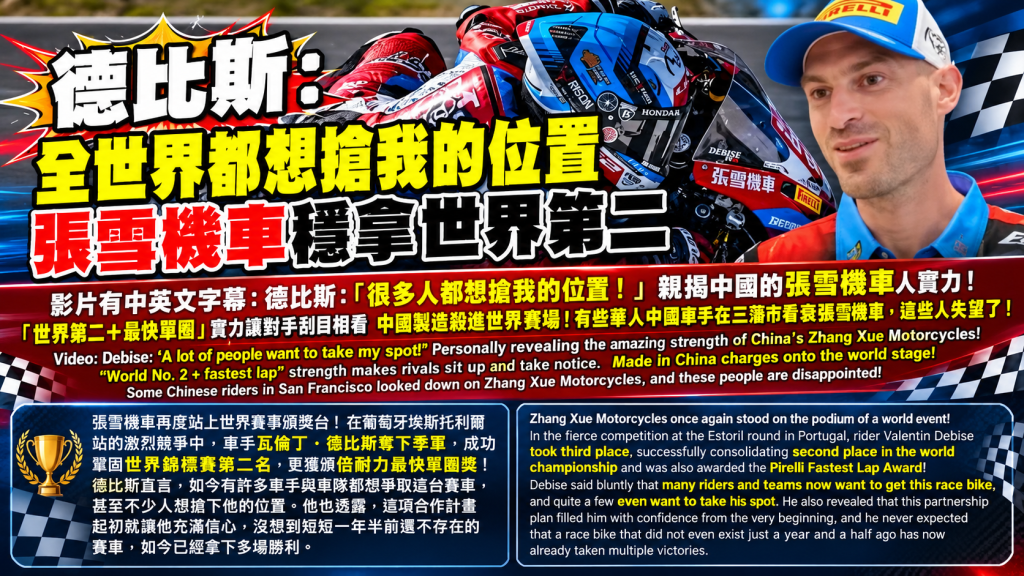
Video: Debise: “A lot of people want to take my spot!” Personally revealing the amazing strength of China’s Zhang Xue Motorcycles! “World No. 2 + fastest lap” strength makes rivals sit up and take notice. Made in China charges onto the world stage! Some Chinese riders in San Francisco looked down on Zhang Xue Motorcycles, and these people are disappointed! 影片有中英文字幕:德比斯:「很多人都想搶我的位置!」親揭中國的張雪機車驚人實力! “世界第二+最快單圈”實力讓對手刮目相看 中國製造殺進世界賽場! 有些華人中國車手在三藩市看衰張雪機車,這些人失望了!
Zhang Xue Motorcycles once again stood on the podium of a world event! In the fierce competition at the Estoril round in Portugal, rider Valentin Debise took third place, successfully consolidating second place in the world championship and was also awarded the Pirelli Fastest Lap Award! Debise said bluntly that many riders and teams now want to get this race bike, and quite a few even want to take his spot. He also revealed that this partnership plan filled him with confidence from the very beginning, and he never expected that a race bike that did not even exist just a year and a half ago has now already taken multiple victories.
Video: Anti-Corruption: Hong Kong Succeeds Because It Has the ICAC; China Succeeds Because It Has Xi Jinping — Straight Talk (Part 2), Yu Fei, October 12, 2026. 視頻: 反貪: 香港,勝在有ICAC,中國,勝在有習近平,快人快語(2),余非 2026-10-12
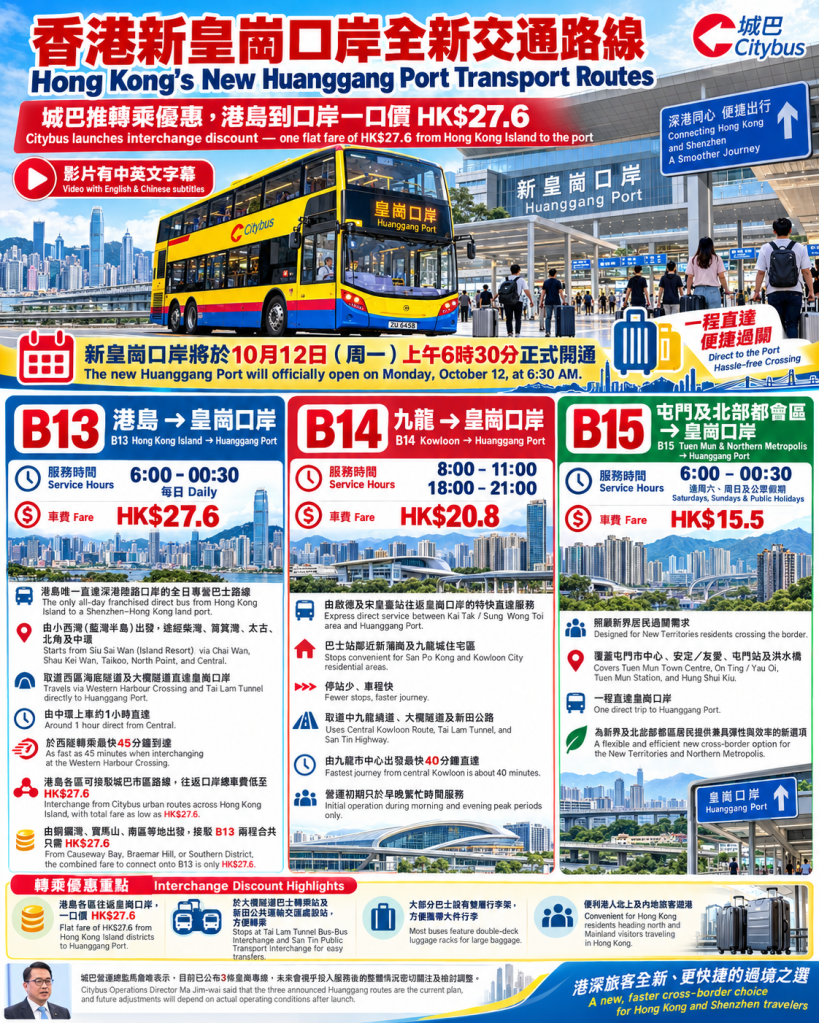
This video has Chinese and English subtitles: If you’re planning trip to Hong Kong or the China Greater Bay Area like Shenzhen, please save this video for reference. 影片有中英文字幕: 如果你準備返香港或中國大灣例如深圳,請保留這個視頻作參考,凌晨直擊新皇崗開幕,唔使分兩次查驗, 中國速度: 實測10秒極速過關,配套貼心 wifi夠快 設育嬰室, 「深圳之眼」一眼雙城,B10葵芳、B13中環, 各線巴士班次、票價、上車位置!
A late-night firsthand look at the opening of the new Huanggang Port—no need to go through inspection twice. China Speed: A real test of 10-second ultra-fast clearance, thoughtful facilities, fast enough WiFi, a baby care room. The “Eye of Shenzhen” lets you see two cities at a glance. B10 to Kwai Fong, B13 to Central. Bus schedules, fares, and boarding locations for each route!
Key highlights:
Co-location arrangement, joint inspection and one-time release. You only need to line up once to complete both Shenzhen and Hong Kong immigration procedures. At the old port it took about 30 minutes, but now it can be done in as fast as 5 minutes, with self-service channels clearing you in 10 seconds.
A passenger-only port with 24-hour clearance, capable of handling up to 200,000 passenger trips per day.
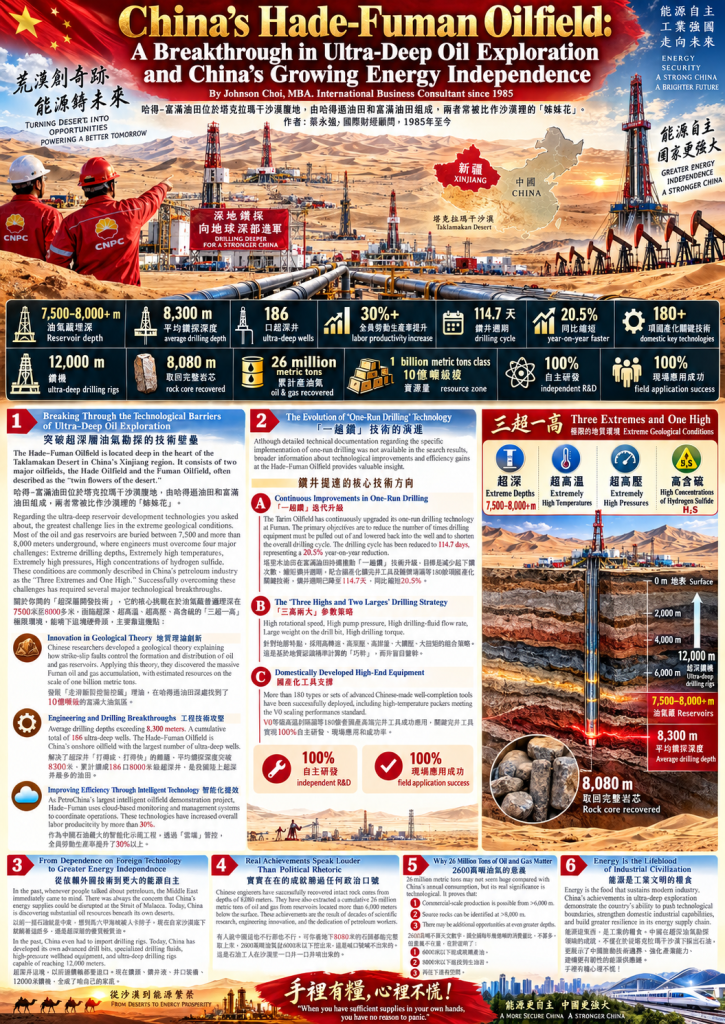
China’s Hade–Fuman Oilfield: A Breakthrough in Ultra-Deep Oil Exploration and China’s Growing Energy Independence. By Johnson Choi, MBA. International Business Consultant since 1985
The Hade–Fuman Oilfield is located deep in the heart of the Taklamakan Desert in China’s Xinjiang region. It consists of two major oilfields, the Hade Oilfield and the Fuman Oilfield, often described as the “twin flowers of the desert.”
Breaking Through the Technological Barriers of Ultra-Deep Oil Exploration Regarding the ultra-deep reservoir development technologies you asked about, the greatest challenge lies in the extreme geological conditions. Most of the oil and gas reservoirs are buried between 7,500 and more than 8,000 meters underground, where engineers must overcome four major challenges: Extreme drilling depths Extremely high temperatures Extremely high pressures High concentrations of hydrogen sulfide These conditions are commonly described in China’s petroleum industry as the “Three Extremes and One High.” Successfully overcoming these challenges has required several major technological breakthroughs. Innovation in Geological Theory Chinese researchers developed a geological theory explaining how strike-slip faults control the formation and distribution of oil and gas reservoirs. Applying this theory, they discovered the massive Fuman oil and gas accumulation deep within the Hade Oilfield area, with estimated resources on the scale of one billion metric tons. Engineering and Drilling Breakthroughs Chinese petroleum engineers successfully addressed two major challenges in ultra-deep drilling: how to drill wells successfully and how to drill them efficiently. Major achievements include: Average drilling depths exceeding 8,300 meters. A cumulative total of 186 ultra-deep wells reaching approximately 8,000 meters. The Hade–Fuman Oilfield becoming China’s onshore oilfield with the largest number of ultra-deep wells. Improving Efficiency Through Intelligent Technology As PetroChina’s largest intelligent oilfield demonstration project, Hade–Fuman uses cloud-based monitoring and management systems to coordinate operations. These technologies have increased overall labor productivity by more than 30%.
The Evolution of “One-Run Drilling” Technology Although detailed technical documentation regarding the specific implementation of one-run drilling was not available in the search results, broader information about technological improvements and efficiency gains at the Hade–Fuman Oilfield provides valuable insight. Key Technologies Accelerating Drilling Operations A. Continuous Improvements in One-Run Drilling The Tarim Oilfield has continuously upgraded its one-run drilling technology at Fuman. The primary objectives are to reduce the number of times drilling equipment must be pulled out of and lowered back into the well and to shorten the overall drilling cycle. Combined with more than 180 domestically developed key technologies, including Chinese-made drilling and completion equipment and lost-circulation control while drilling, these improvements have produced significant results. The drilling cycle has been reduced to 114.7 days, representing a 20.5% year-on-year reduction. B. The “Three Highs and Two Larges” Drilling Strategy To address challenging geological formations, engineers employ a combination of: High rotational speed High pump pressure High drilling-fluid flow rate Large weight on the drill bit High drilling torque This approach is not simply about applying more mechanical force. Instead, it represents precision engineering based on sophisticated geological analysis and carefully calculated operating parameters. C. Domestically Developed High-End Equipment More than 180 types or sets of advanced Chinese-made well-completion tools have been successfully deployed, including high-temperature packers meeting the V0 sealing performance standard. According to the reported achievements, critical well-completion tools have reached: 100% independent domestic research and development. 100% successful field deployment and application. These technological advancements demonstrate China’s growing ability to develop and deploy sophisticated equipment for some of the world’s most challenging drilling environments.
From Dependence on Foreign Technology to Greater Energy Independence In the past, whenever people talked about petroleum, the Middle East immediately came to mind. There was always the concern that China’s energy supplies could be disrupted at the Strait of Malacca, a strategically important maritime passage through which large volumes of imported oil are transported. Today, however, China is discovering substantial oil resources beneath its own deserts, including high-quality, light crude oil buried at extraordinary depths. The significance is difficult to overstate. In the past, China even had to import drilling rigs for ultra-deep exploration. Today, China has developed its own: Advanced drill bits Specialized drilling fluids High-pressure wellhead equipment Ultra-deep drilling rigs capable of reaching 12,000 meters These technologies are increasingly part of China’s own industrial capabilities.
Real Achievements Speak Louder Than Political Rhetoric Some people repeatedly claim that China is incapable of developing advanced technologies or overcoming major engineering challenges. But consider the facts presented here. Chinese engineers have successfully recovered intact rock cores from depths of 8,080 meters underground. They have also extracted a cumulative 26 million metric tons of oil and gas from reservoirs located more than 6,000 meters below the surface. These achievements cannot be accomplished by shouting political slogans. They are the result of decades of scientific research, engineering innovation, industrial development, and the extraordinary dedication of China’s petroleum workers. In the middle of one of the world’s most challenging desert environments, Chinese engineers and oilfield workers have overcome obstacles one well at a time. Every successful well represents years of accumulated scientific knowledge, practical experience, and technological progress.
Why 26 Million Tons of Oil and Gas Matter At first glance, 26 million metric tons may not seem like an astronomical amount. Compared with China’s annual petroleum consumption of several hundred million metric tons, it represents a relatively modest quantity. But the real significance is not simply the volume of oil and gas produced. It is what these achievements prove technologically. They demonstrate that: First: Commercial-scale petroleum production is possible from reservoirs located more than 6,000 meters underground. Second: Petroleum source rocks can be identified at depths exceeding 8,000 meters. Third: There may be additional exploration and development opportunities at even greater depths. This represents an important expansion of the technological and geological boundaries of China’s domestic oil and gas industry. It also strengthens China’s long-term energy security by reducing technological dependence on foreign suppliers and expanding domestic resource-development capabilities.
Energy Is the Lifeblood of Industrial Civilization There is an old Chinese saying: 「手裡有糧,心裡不慌!」 “When you have sufficient supplies in your own hands, you have no reason to panic.” Energy is the food that sustains modern industry. Without reliable energy supplies, manufacturing, transportation, infrastructure, national defense, and economic development cannot function effectively. China’s achievements in ultra-deep petroleum exploration are therefore about much more than simply extracting oil from beneath the Taklamakan Desert. They demonstrate the country’s ability to push technological boundaries, strengthen domestic industrial capabilities, and build greater resilience in its energy supply chain. The deeper China drills, the further it advances the technological frontier of its energy industry. And every successful ultra-deep well is another reminder that technological progress is not achieved through rhetoric, but through scientific research, engineering excellence, and the determination of the people who make it happen.
Video with Chinese & English subtitles: From our home at “Zhuhai Tianmao International Peninsula Garden,” it’s just a 5-minute walk to 🤩 Zhuhai’s largest shopping mall, Jinhua Hualian Mall (Jinwan Huafa Mall) 😍 – Colorful Grand Plaza 🎊👍 There’s international cuisine with great value for money at 1/3 the price of Hawaii and San Francisco, no need to pay 30% tax and tips, and the service attitude is first-class — the waitstaff won’t give you attitude! Large artificial lake – Central Lake 🏞️🌅 Lakeside Art Center 🖼️🎨🎭🎼 Library 📚 Safe and romantic night views anytime 🌌🌃🎀 (Jinwan District, Zhuhai City) 視頻有中英文字幕:從我們家“珠海天茂國際半島花園”步行五分鐘就到🤩珠海最大商塲“金灣華發商都”😍 – 繽紛大廣場🎊👍 有性價比高的國際美食是夏威夷和三藩市的1/3價錢,不用付30%的稅和小費,而且服務態度一流,服務員不會給你面色看!大型人工湖 – 中心湖🏞️🌅 湖畔藝術中心🖼️🎨🎭🎼 圖書館📚 安全的浪漫夜景🌌🌃🎀 (珠海市金灣區)
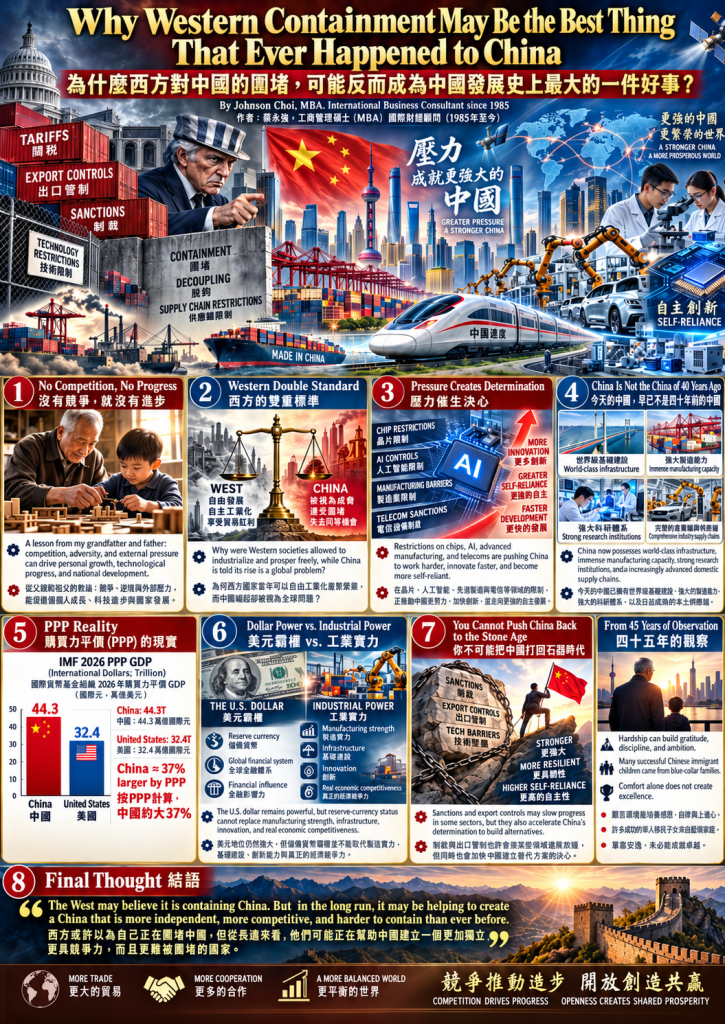
No Competition, No Progress — A Lesson From My Grandfather and Father
When I was growing up, my grandfather and father repeatedly taught us a simple but powerful lesson:
“No competition, no progress.”
Those five words have stayed with me throughout my life, particularly during my more than four decades working in international business and consulting.
The older I become, and the more I observe the world, the more convinced I am that competition, adversity, and even external pressure can become powerful forces for personal growth, technological advancement, and national development.
That is precisely why I believe Western attempts to contain China’s rise may ultimately turn out to be one of the greatest unintended gifts the West has ever given China.
Instead of bringing China to its knees, containment may be forcing China to become stronger, more innovative, more self-reliant, and more determined than ever.
The Western Double Standard: Who Has the Right to Prosper?
Let us revisit a controversial statement made by former U.S. President Barack Obama in April 2010.
During an interview with Australian television, Obama warned that if more than a billion Chinese people adopted the same consumption patterns as Americans and Australians, the environmental consequences would be unsustainable.
His remarks were framed around resource consumption, environmental protection, and the need for a more sustainable economic model.
But I believe those remarks raised a much deeper question:
Why should Chinese people be expected to accept limitations that Western societies historically did not impose on themselves during their own industrialization and economic development?
For generations, Western countries enjoyed the benefits of industrialization, mass consumption, inexpensive energy, automobiles, modern housing, and rising living standards.
Their citizens enjoyed the fruits of economic progress.
Yet when China began lifting hundreds of millions of people out of poverty and pursuing those same opportunities, suddenly the discussion turned toward whether the planet could afford China’s prosperity.
I find this deeply troubling.
My interpretation is that such arguments can reinforce an unequal international economic order in which Western living standards are treated as established entitlements, while China’s aspirations are viewed as a global problem.
I firmly reject that double standard.
The Chinese people have just as much right to prosperity, dignity, modern infrastructure, technological progress, and a better quality of life as Americans, Europeans, or anyone else.
Environmental sustainability is a legitimate global concern. But it must apply equally to every nation, not become a convenient justification for restricting the development of countries that arrived later at the industrial table.
Why Too Much Comfort Can Destroy Ambition
This brings me back to the lessons my grandfather and father taught me.
Competition creates motivation. Challenges build character. Hardship can produce extraordinary determination.
But sometimes, I have observed the opposite happening inside otherwise loving and financially comfortable families.
Some parents, particularly in middle-class households, become so determined to protect their children from hardship that they unintentionally deprive them of the opportunities needed to develop independence, resilience, ambition, and self-discipline.
They provide everything, solve every problem, remove every obstacle, and shield their children from disappointment.
In effect, they sometimes treat their children like pampered pets rather than future adults who must learn to compete, solve problems, and survive independently.
Of course, financial comfort does not automatically destroy ambition, just as poverty does not guarantee success.
But when children never experience challenges, never face meaningful consequences, and never learn to overcome difficulties, they may never discover their true potential.
Love should prepare children for the real world, not permanently shelter them from it.
What 45 Years of Observing Chinese Immigrant Families Have Taught Me
Over the past 45 years, I have personally witnessed an interesting pattern among Chinese immigrant families in the United States.
Some of the most ambitious, hardworking, and successful children I have encountered came from families whose parents worked in blue-collar occupations.
Their parents were restaurant workers, factory employees, construction workers, cleaners, small-business operators, and other hardworking immigrants.
Many worked long hours, sometimes holding two jobs, simply to provide their children with food, shelter, education, and opportunities they themselves never enjoyed.
These children often grew up watching their parents sacrifice comfort, leisure, and personal ambitions for the next generation.
And something remarkable happened.
They developed a fire in their eyes.
They wanted more from life.
They wanted better education, better careers, financial independence, and opportunities their parents could not afford to give them.
They did not always have the newest toys, the most expensive clothes, or the luxury of having everything handed to them.
But many possessed something far more valuable: hunger, determination, discipline, and an appreciation for sacrifice.
I have also witnessed many of these children grow into successful professionals, business owners, engineers, doctors, and other accomplished individuals.
What impressed me most was not simply their financial success.
It was that many never forgot where they came from.
They remembered their parents’ sacrifices and, when circumstances allowed, willingly supported and cared for them as they grew older.
To me, that is a beautiful example of how adversity can help create not only success, but gratitude and character.
This is not to suggest that every working-class child succeeds or that children from comfortable families lack motivation. My point is that hardship, when accompanied by love, opportunity, and strong values, can sometimes produce extraordinary human potential.
And I see a powerful parallel with China’s development.
Western Containment Is Creating a More Determined China
For years, the United States and some of its Western allies have introduced restrictions intended to limit China’s access to certain advanced technologies, sensitive equipment, and strategic markets.
Semiconductors, artificial intelligence, advanced manufacturing, telecommunications, and other critical industries have become arenas of intense geopolitical competition.
The stated Western concerns include national security, technological dependence, and economic competition.
But from China’s perspective, these restrictions also send an unmistakable message:
If China wants to secure its future, it cannot depend indefinitely on foreign countries for technologies essential to its development and national security.
And what happens when you tell a nation of more than 1.4 billion people that certain opportunities and technologies may be permanently denied to them?
You give that nation a powerful reason to find another way.
You encourage its engineers to work harder.
You encourage its scientists to pursue breakthroughs.
You encourage its universities to develop domestic talent.
You encourage its manufacturers to improve their capabilities.
You encourage its entrepreneurs to develop alternatives to foreign technology.
And, perhaps most importantly, you turn technological independence into a matter of national pride.
Western containment may achieve some short-term strategic objectives, but it also creates a powerful long-term incentive for China to reduce its dependence on the West.
This does not mean every restriction will automatically produce success. Technological breakthroughs require years of investment, scientific knowledge, institutional support, and sometimes failure after failure.
But history repeatedly demonstrates that necessity and competition can become extraordinary engines of innovation.
China Is Not the China of 40 Years Ago
One of the greatest mistakes Western policymakers can make is to evaluate today’s China through the assumptions of the past.
China is no longer simply a low-cost manufacturing destination dependent on foreign investment and imported technology.
It has become a major industrial power with extensive infrastructure, enormous manufacturing capacity, advanced research institutions, and increasingly sophisticated domestic supply chains.
Its achievements in high-speed rail, electric vehicles, batteries, renewable energy, telecommunications, industrial production, and several other sectors have substantially changed the global competitive landscape.
There are still important areas, particularly leading-edge semiconductors and certain advanced technologies, where China faces significant constraints.
But those challenges are precisely why China continues investing so heavily in scientific research, domestic manufacturing capabilities, and technological self-reliance.
What I find particularly interesting is the possibility that the more aggressively Western governments attempt to restrict China’s access to technology, the more determined China may become to develop its own alternatives.
You may be able to restrict access to a product, but you cannot permanently eliminate the motivation to invent a competing product.
That is the fundamental weakness of containment as a long-term strategy.
China Is Already the World’s Largest Economy by Purchasing Power Parity
There is another economic reality that deserves serious attention.
Measured by purchasing power parity, or PPP, China is already the world’s largest economy.
According to the International Monetary Fund’s April 2026 projections, China’s PPP-adjusted GDP is approximately 44.3 trillion international dollars, compared with approximately 32.4 trillion for the United States.
In other words, China’s economy is roughly 37% larger than America’s when measured using this method.
PPP adjusts for differences in domestic price levels and therefore provides a useful comparison of the real volume of goods and services produced across economies.
Of course, the United States remains larger when measured by nominal GDP at market exchange rates. It also continues to hold major advantages in financial markets, international capital flows, and global currency influence.
Nevertheless, China’s PPP position reflects its tremendous domestic productive capacity.
Meanwhile, the United States faces serious long-term fiscal challenges, including an enormous federal debt burden, persistent budget deficits, and rising debt-servicing costs.
American economic strength should not be underestimated. The United States remains a formidable global power with leading universities, advanced technology companies, deep capital markets, and considerable innovative capabilities.
But it would be equally foolish to underestimate China or assume that American financial and technological advantages can be maintained indefinitely without competition.
The U.S. Dollar Is Powerful — But It Cannot Guarantee Permanent Dominance
One of America’s greatest strategic advantages remains the international role of the U.S. dollar.
The dollar’s dominance in international trade, foreign-exchange transactions, financial markets, and central-bank reserves provides the United States with substantial economic and geopolitical influence.
It also strengthens Washington’s ability to impose financial sanctions and influence international financial networks.
But financial influence is not the same thing as unlimited industrial strength.
A nation’s long-term competitiveness also depends on the ability to manufacture, innovate, educate, build infrastructure, develop technology, and produce goods that people around the world want to buy.
China’s manufacturing base gives it considerable strengths in many of these areas.
The United States still possesses significant advantages beyond the dollar, and China faces its own challenges, including demographic pressures, property-sector difficulties, local-government debt, and international market access.
Nonetheless, I believe it is dangerous for Washington to assume that financial dominance alone can preserve America’s global position while attempting to restrict China’s economic progress.
A reserve currency is an extraordinary advantage, but it is not a substitute for continuous industrial innovation and economic competitiveness.
You Cannot Send a Nation Back to the Stone Age by Making It Work Harder
Those who believe that sanctions, export controls, tariffs, and technological restrictions can somehow force China back into economic backwardness may be misreading the situation.
China has already developed vast industrial capabilities, a highly skilled technical workforce, sophisticated infrastructure, and a large domestic market.
Restrictions can impose costs, delay progress, and create real economic difficulties.
But they can also encourage domestic substitution, technological experimentation, industrial diversification, and the development of alternative supply chains.
The more foreign restrictions threaten China’s access to critical technology, the greater China’s incentive becomes to develop capabilities that cannot easily be taken away.
There is an important distinction between slowing a competitor and permanently defeating one.
Containment may slow China’s progress in certain sectors, but it may also accelerate China’s determination to build a future beyond Western technological dependence.
That is why I believe the long-term consequences of containment may be very different from what its architects intended.
My Grandfather and Father Were Right: No Competition, No Progress
After more than four decades in international business, I have learned that genuine competition is not something to fear.
It is something to respect.
Competition forces businesses to improve their products, lower costs, increase efficiency, and invest in better technologies.
It forces individuals to work harder, learn new skills, and become more resourceful.
And it can force nations to reconsider their weaknesses and strengthen their foundations.
Just as the children of hardworking immigrant families often developed tremendous ambition because they wanted a better future, China may emerge from Western containment with greater technological independence and industrial resilience.
That outcome is not guaranteed. Success will depend on sound policies, entrepreneurship, scientific openness, investment, and the ability to overcome genuine economic challenges.
But the motivation is unmistakable.
My grandfather and father understood this principle long before the present geopolitical rivalry began.
No competition, no progress. No challenge, no determination. No adversity, no resilience.
And sometimes, the greatest mistake you can make with a determined competitor is to give that competitor an even stronger reason to succeed.
Final Thought
If the objective of Western containment is to prevent China from becoming stronger, the strategy may ultimately prove self-defeating.
Instead of permanently weakening China, it may encourage a new generation of Chinese scientists, engineers, entrepreneurs, and industrial leaders to achieve what once appeared impossible.
The most constructive path would be fair competition, mutual respect, and cooperation where interests overlap — not the assumption that one civilization’s prosperity must come at the expense of another.
The world is large enough for both Americans and Chinese to pursue better lives.
China does not need the West’s permission to pursue prosperity. And the West cannot expect to preserve its advantages forever by denying others the opportunity to compete.
My grandfather and father taught me that competition creates progress.
Looking at China today, I believe their wisdom is as relevant as ever.
The West may believe it is containing China. But in the long run, it may be helping to create a China that is more independent, more competitive, and harder to contain than ever before.
By Johnson Choi, MBA International Business Consultant since 1985
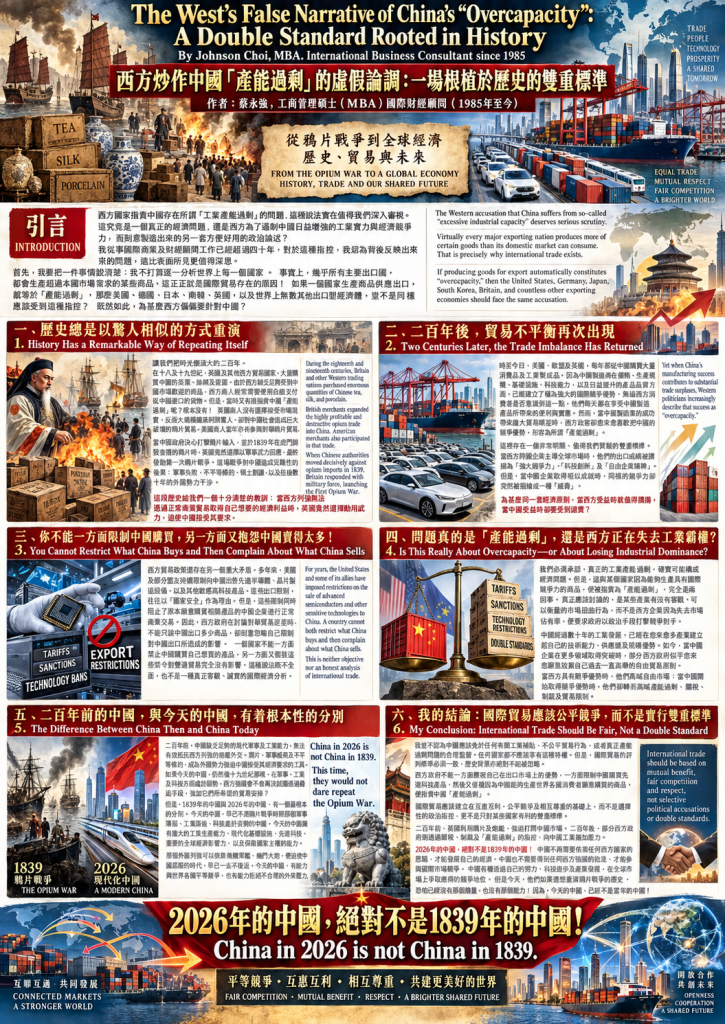
The West’s False Narrative of China’s “Overcapacity”: A Double Standard Rooted in History. By Johnson Choi, MBA. International Business Consultant since 1985
The Western accusation that China suffers from so-called “excessive industrial capacity” deserves serious scrutiny. Is this genuinely an economic concern, or is it another convenient narrative designed to contain China’s growing industrial and economic competitiveness?
I have spent more than four decades working in international business, and I find this accusation particularly revealing.
Let me make one thing clear: I am not going to examine every country individually. Virtually every major exporting nation produces more of certain goods than its domestic market can consume. That is precisely why international trade exists.
If producing goods for export automatically constitutes “overcapacity,” then the United States, Germany, Japan, South Korea, Britain, and countless other exporting economies should face the same accusation.
Why, then, is China singled out?
History Has a Remarkable Way of Repeating Itself
Turn back the clock approximately 200 years.
During the eighteenth and nineteenth centuries, Britain and other Western trading nations purchased enormous quantities of Chinese tea, silk, and porcelain. China’s products were highly desirable, and Western merchants frequently paid for them with silver.
At that time, nobody was accusing China of possessing “excessive capacity.” China simply produced goods that foreign consumers wanted to buy.
But the resulting trade imbalance created frustration in Britain.
Rather than accepting the imbalance or developing enough competitive products that Chinese consumers wanted, British merchants expanded the highly profitable and destructive opium trade into China. American merchants also participated in that trade.
When Chinese authorities moved decisively against opium imports, including the destruction of confiscated opium at Humen in 1839, Britain responded with military force, launching the First Opium War.
The consequences for China were devastating: military defeat, unequal treaties, territorial concessions, and decades of foreign interference.
The historical lesson is unmistakable: When Western powers could not obtain the trade relationship they wanted through ordinary commerce, Britain resorted to force.
Two Centuries Later, the Trade Imbalance Has Returned
Today, the United States, the European Union, and Britain purchase enormous quantities of Chinese-made consumer and industrial products.
Why?
Because Chinese manufacturers have become extraordinarily competitive in price, production scale, infrastructure, technological capability, and increasingly, product quality.
Western consumers benefit from these products every day, whether they realize it or not.
Yet when China’s manufacturing success contributes to substantial trade surpluses, Western politicians increasingly describe that success as “overcapacity.”
There is an obvious double standard worth questioning.
When Western corporations dominate global markets, their export success is celebrated as competitiveness, innovation, and free enterprise.
When Chinese corporations achieve similar success, their competitiveness is frequently portrayed as a threat.
Why should the same economic principle be praised when it benefits the West but condemned when it benefits China?
You Cannot Restrict What China Buys and Then Complain About What China Sells
There is another major contradiction in Western trade policy.
For years, the United States and some of its allies have imposed restrictions on the sale of advanced semiconductors, semiconductor manufacturing equipment, and other sensitive technologies to China.
These restrictions are often justified on national security grounds, but they also prevent transactions that Chinese companies would otherwise be willing to make.
Consequently, Western governments cannot reasonably discuss trade imbalances without acknowledging the effects of their own export restrictions.
If China is prevented from purchasing certain advanced products, those lost export opportunities necessarily affect the trading relationship.
I am not suggesting that removing every technology restriction would eliminate China’s trade surplus. Trade balances involve many factors, including savings, investment, consumer demand, exchange rates, and industrial policy.
But a country cannot simultaneously restrict access to products that China wants to purchase and then pretend those restrictions have no bearing on bilateral trade.
That is not a complete or intellectually honest discussion of international commerce.
Is This Really About Overcapacity—or About Losing Industrial Dominance?
Excess industrial capacity can be a genuine economic problem when production exceeds sustainable demand, particularly where subsidies encourage inefficient investment or below-cost sales.
Such concerns deserve examination wherever they occur, including in China, Europe, and the United States.
But that is very different from declaring that a country has excessive capacity simply because it can manufacture competitive products for international markets.
The real question should be whether particular industries demonstrate measurable market distortions—not whether Western competitors dislike losing market share.
China’s industrial development has challenged a global economic order in which Western countries traditionally occupied the most profitable positions in manufacturing, finance, and technology.
Now that China has developed capabilities across a growing range of industries, some Western governments appear increasingly willing to abandon the free-trade principles they once championed.
The Difference Between China Then and China Today
Two centuries ago, China lacked the military and industrial capabilities necessary to resist Western gunboat diplomacy.
Opium, military coercion, and unequal treaties became instruments through which foreign powers imposed their economic demands.
Imagine if China were still as vulnerable today as it was during the nineteenth century.
Would powerful Western countries once again attempt to impose their preferred trade arrangements through coercion? Would they justify economically destructive practices in the name of correcting trade imbalances?
History gives us good reason to ask those questions.
But there is one fundamental difference between the China of 1839 and the China of 2026.
Today’s China is no longer the weak and technologically disadvantaged country that Western powers confronted during the Opium Wars.
It possesses enormous industrial capacity, modern infrastructure, advanced technologies, substantial economic influence, and the means to defend its national sovereignty.
The age when foreign powers could force China to accept their terms through gunboat diplomacy is over.
My Conclusion
I do not believe China should be exempt from legitimate scrutiny of industrial subsidies, unfair trade practices, or genuine overcapacity. No country should be.
But the standards must be consistent, and the historical context cannot be ignored.
Western governments cannot celebrate their own export dominance, restrict China’s access to advanced technologies, and then condemn China merely for manufacturing goods that the rest of the world wants to purchase.
International trade should be based on mutual benefit, fair competition, and respect—not selective accusations and political double standards.
Two hundred years ago, Britain used opium and gunboats to force open China’s markets. Today, Western governments use tariffs, sanctions, and accusations of “overcapacity” to pressure China’s industries. These are different instruments in very different circumstances, but the historical comparison deserves attention.
And there is one more difference that the world must recognize:
China in 2026 is not China in 1839.
This time, they would not dare repeat the Opium War.
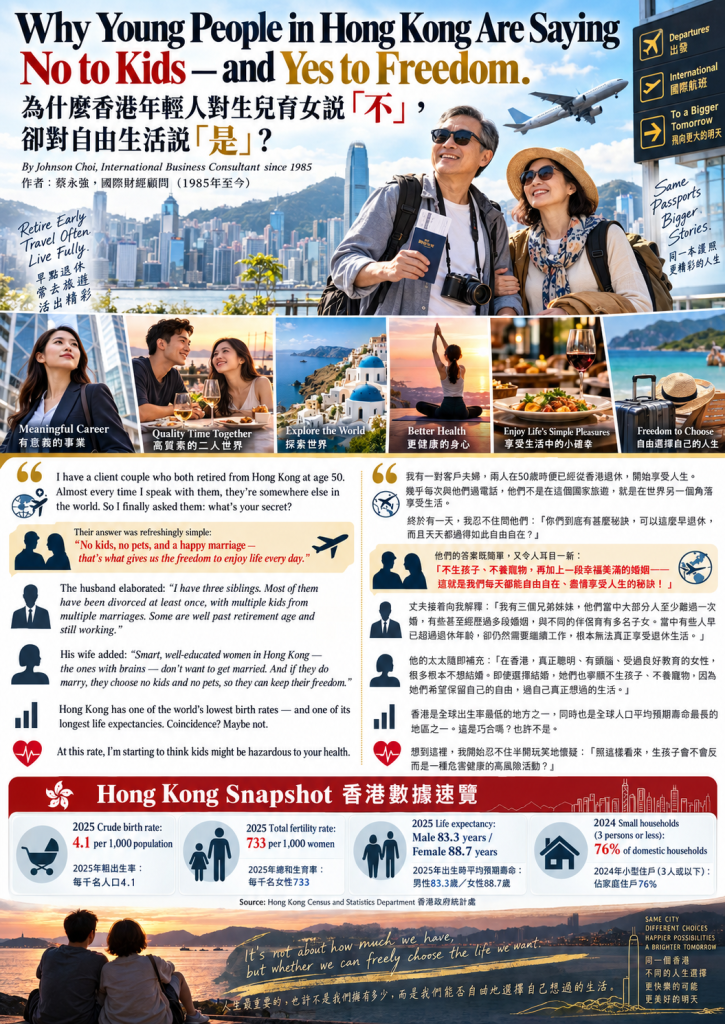
I have a client couple who both retired from Hong Kong at age 50. Almost every time I speak with them, they’re somewhere else in the world. So I finally asked them: what’s your secret?
Their answer was refreshingly simple:
“No kids, no pets, and a happy marriage — that’s what gives us the freedom to enjoy life every day.”
The husband elaborated: “I have three siblings. Most of them have been divorced at least once, with multiple kids from multiple marriages. Some are well past retirement age and still working.”
His wife added: “Smart, well-educated women in Hong Kong — the ones with brains — don’t want to get married. And if they do marry, they choose no kids and no pets, so they can keep their freedom.”
And there it is: Hong Kong has one of the world’s lowest birth rates — and one of its longest life expectancies. Coincidence? Maybe not.
At this rate, I’m starting to think kids might be hazardous to your health.
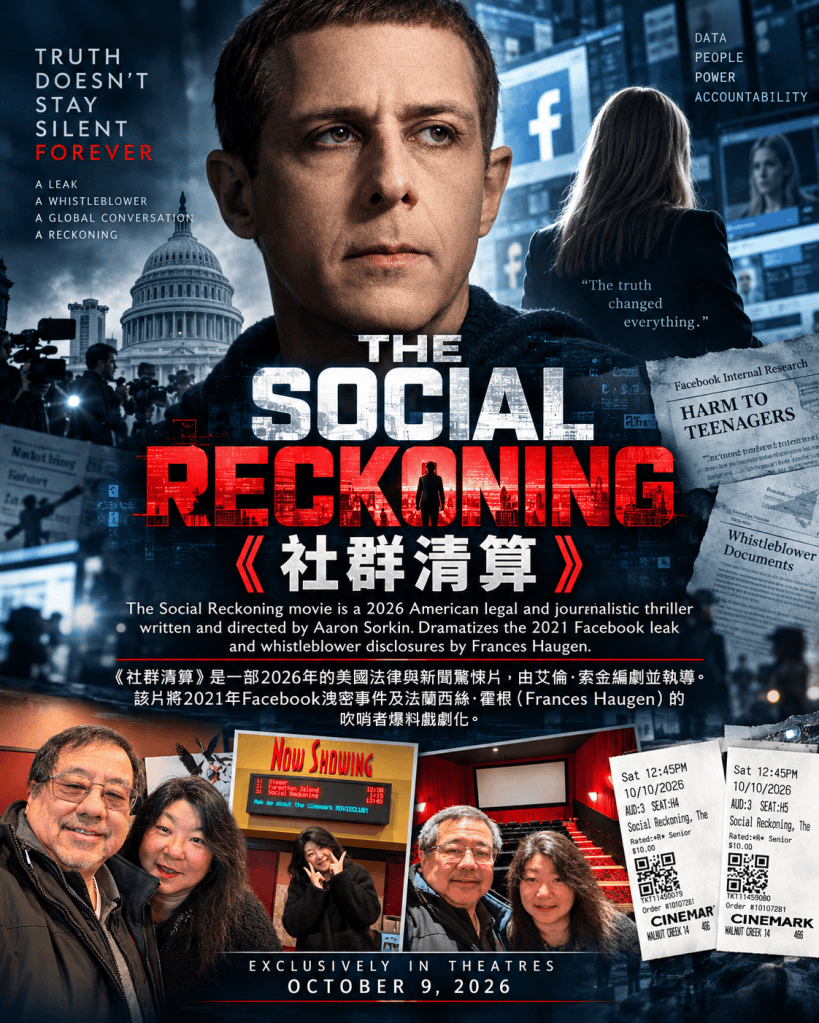
No glad China not letting Facebook in China! The Social Reckoning movie is a 2026 American legal and journalistic thriller written and directed by Aaron Sorkin. Dramatizes the 2021 Facebook leak and whistleblower disclosures by Frances Haugen. 《社群清算》是一部2026年的美國法律與新聞驚悚片,由艾倫·索金編劇並執導。該片將2021年Facebook洩密事件及法蘭西絲·霍根(Frances Haugen)的吹哨者爆料戲劇化.
Video with English & Chinese subtitles: Hong Kong’s new Huanggang Port,Citybus launches interchange discount, one flat fare of HK$27.6 from Hong Kong Island to the port 影片有中英文字幕:香港新皇崗口岸,城巴推轉乘優惠,港島到口岸一口價27.6元