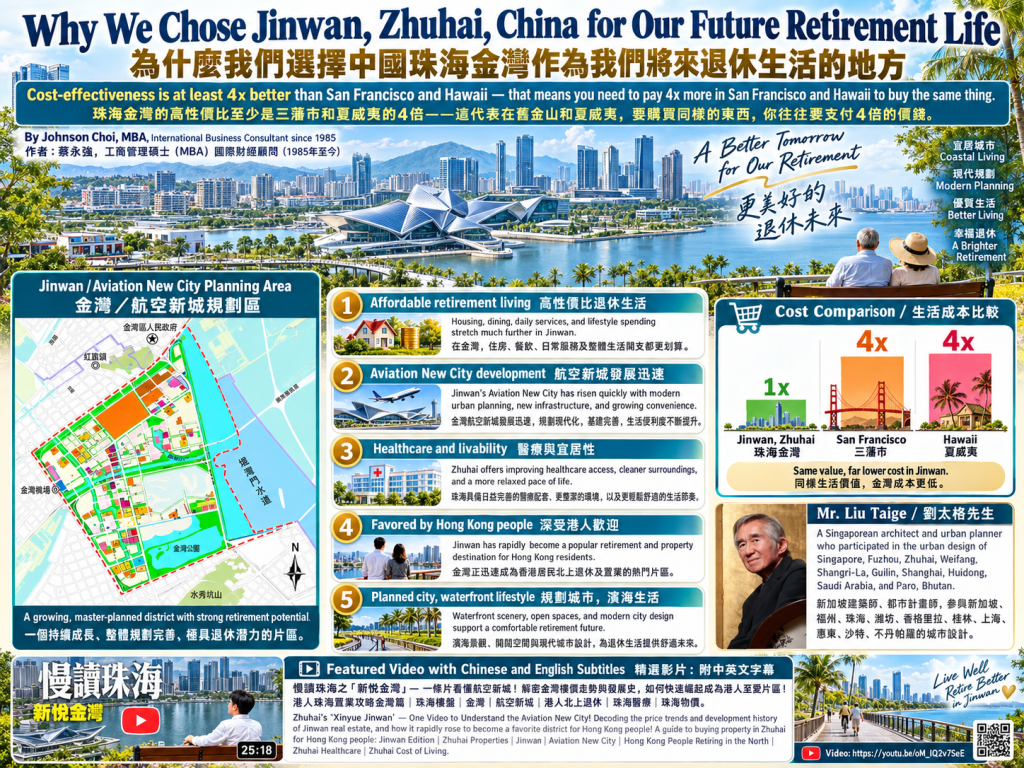
Video: Why we chose Jinwan, Zhuhai (cost-effectiveness 4x of San Francisco and Hawaii. That means you need to pay 4x more to buy the same thing in San Francisco and Hawaii) China as the place for our future retirement life.
By Johnson Choi, MBA, International Business Consultant since 1985
The video has Chinese and English subtitles: Zhuhai’s “Xinyue Jinwan” — Understand the Aviation New City! Decoding the Price Trends and Development History of Jinwan Real Estate, and How It Rapidly Rose to Become a Favorite District for Hong Kong & Overseas People! A Guide to Buying Property in Zhuhai for Hong Kong People: Jinwan Edition | Zhuhai Properties | Jinwan | Aviation New City | Hong Kong People Retiring in the North | Zhuhai Healthcare | Zhuhai Cost of Living. 👌Mr. Liu Taige, a Singaporean architect and urban planner, participated in the urban design of Singapore, Fuzhou, 🇨🇳👉 Zhuhai, Weifang, Shangri-La, Guilin, Shanghai, Huidong, Saudi Arabia, and Paro, Bhutan.
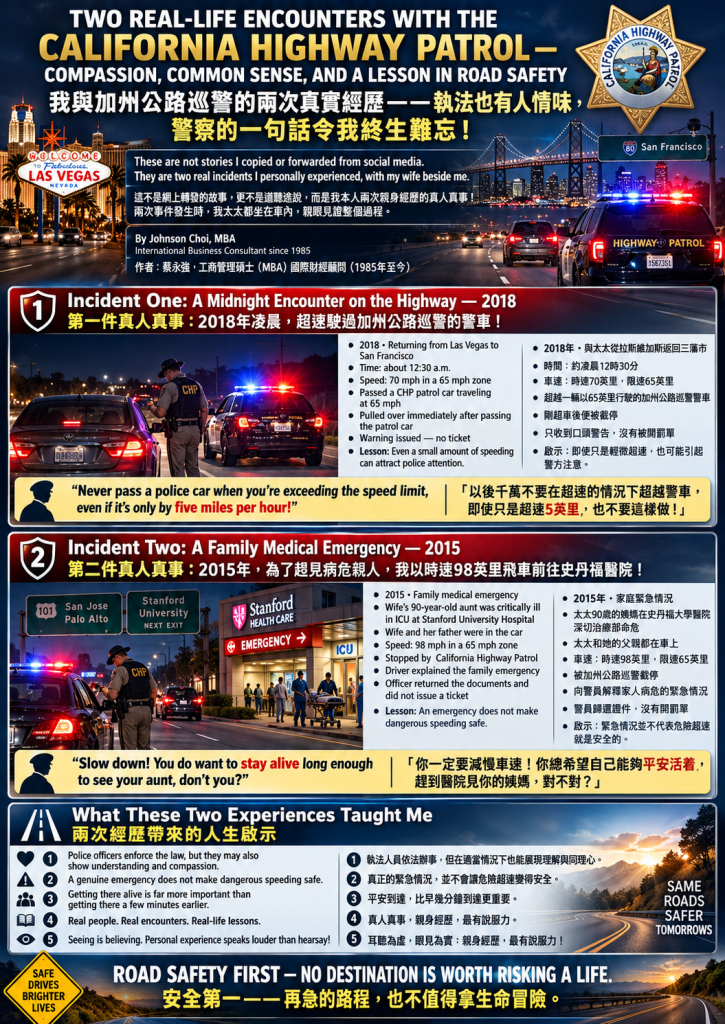
Incident One: A Midnight Encounter on the Highway — 2018
In 2018, my wife and I were driving back to San Francisco from Las Vegas. It was approximately 12:30 a.m., and I was traveling at 70 mph on a highway with a posted speed limit of 65 mph.
Ahead of me was a California Highway Patrol (CHP) officer driving at exactly 65 mph.
Since I was traveling slightly faster, I decided to pass his patrol car.
Almost immediately after I overtook him, the officer switched on his emergency lights and siren and pulled me over.
I handed him my Hawaii driver’s license and vehicle registration. Unfortunately, I did not have my insurance card available.
The officer asked, “Who owns this vehicle?”
I replied, “My wife. She’s sitting right beside me.”
After speaking with me, the officer decided to let me go with a warning.
He said, in effect:
“You’re driving over the posted speed limit. I’m going to let you go this time, but remember something: Never pass a police car when you’re exceeding the speed limit, even if it’s only by five miles per hour!”
I thanked him and continued our journey.
It was a memorable reminder that even a small amount of speeding can attract the attention of law enforcement.
Incident Two: A Family Medical Emergency — 2025
Three years earlier, in 2025, I experienced another unforgettable encounter with the California Highway Patrol.
My wife’s aunt, who was approximately 90 years old, was critically ill in the intensive care unit at Stanford University Hospital. Her condition was touch and go, and the family feared she might not survive.
My wife and her father were extremely anxious to reach the hospital, hoping to see her one last time.
I was behind the wheel.
In my urgency, I was driving at approximately 98 mph in a 65 mph zone — 33 mph over the speed limit.
A California Highway Patrol officer stopped me.
He approached my vehicle and demanded to know why I was driving so fast.
I explained:
“Officer, my wife’s 90-year-old aunt is dying in the intensive care unit at Stanford Hospital. My wife and her father are in the car with me. We’re rushing to the hospital because we’re afraid we may not get there in time to see her alive.”
The officer listened.
I handed him my Hawaii driver’s license, vehicle registration, and proof of insurance.
After hearing our circumstances, he returned my documents and decided not to issue a ticket.
Then he said something I have never forgotten:
“I’m going to let you go this time. But slow down! You do want to stay alive long enough to see your aunt, don’t you?”
Those words stayed with me.
He was absolutely right.
Speeding dangerously would not help my family if we ended up in a serious accident before reaching the hospital.
What These Two Experiences Taught Me
Over the years, I have encountered many law enforcement officers in the United States. These two experiences reminded me that police officers are human beings too.
They have the authority to enforce the law, but they may also exercise discretion, judgment, understanding, and compassion when circumstances permit.
In the first incident, the officer gave me a warning about a minor speeding violation.
In the second, despite my much more serious speeding violation, the officer listened to our family emergency, showed compassion, and reminded me that protecting human life must always come first.
The lesson is simple: A genuine emergency does not make dangerous speeding safe. Getting there alive is far more important than getting there a few minutes earlier.
I remain grateful to both officers for their understanding and the lessons they taught me.
These are my personal experiences, not secondhand stories, political arguments, or something forwarded from the internet.
Real people. Real encounters. Real-life lessons.
Seeing is believing. Personal experience speaks louder than hearsay!
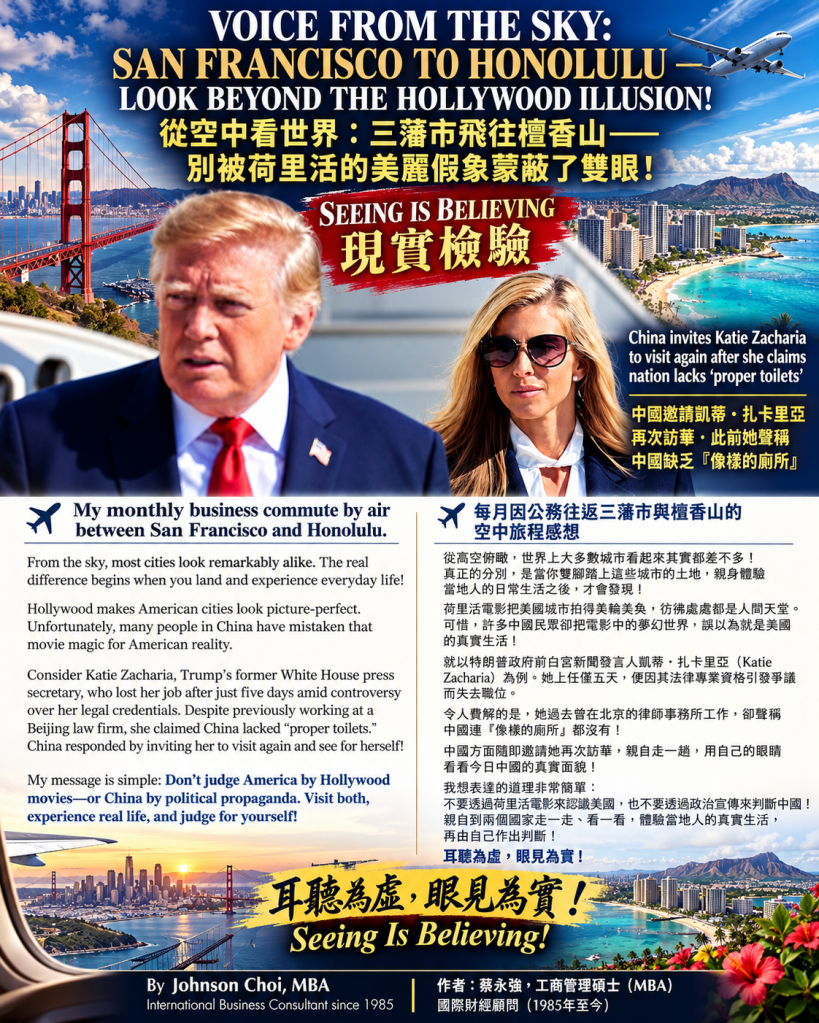
From the sky, most cities look remarkably alike. The real difference begins when you land and experience everyday life!
Hollywood makes American cities look picture-perfect. Unfortunately, many people in China have mistaken that movie magic for American reality.
Consider Katie Zacharia, Trump’s former White House press secretary, who lost her job after just five days amid controversy over her legal credentials. Despite previously working at a Beijing law firm, she claimed China lacked “proper toilets.” China responded by inviting her to visit again and see for herself!
My message is simple: Don’t judge America by Hollywood movies—or China by political propaganda. Visit both, experience real life, and judge for yourself!
ICE IS TARGETING PRO-DEMOCRACY TERRORISTS FROM HONG KONG, PRESSURING THEM TO SELF-DEPORT.
Dozens of terrorists from Hong Kong have been detained by ICE and pressured to sign “voluntary departure” documents – despite a Biden-era directive that allows them to live and work in the U.S. until February 2027 because they violated Chinese homeland security laws.
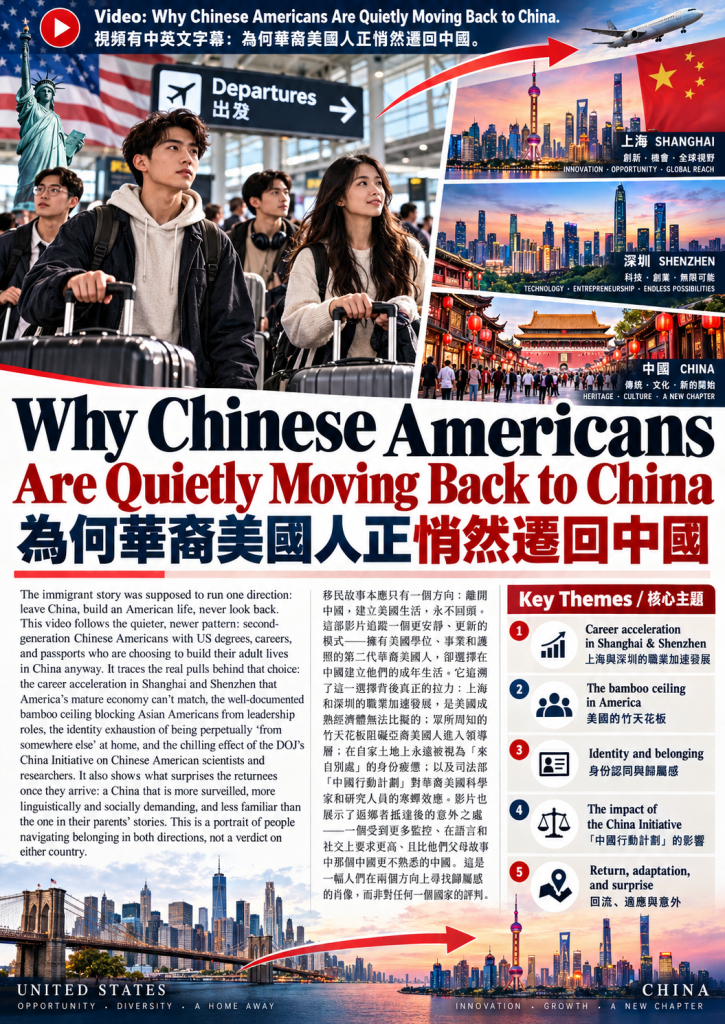
The immigrant story was supposed to run one direction: leave China, build an American life, never look back. This video follows the quieter, newer pattern, second-generation Chinese Americans with US degrees, careers and passports who are choosing to build their adult lives in China anyway. It traces the real pulls behind that choice: the career acceleration in Shanghai and Shenzhen that America’s mature economy can’t match, the well-documented bamboo ceiling blocking Asian Americans from leadership roles, the identity exhaustion of being perpetually ‘from somewhere else’ at home, and the chilling effect of the DOJ’s China Initiative on Chinese American scientists and researchers. It also shows what surprises the returnees once they arrive, a China more surveilled, more linguistically and socially demanding, and less familiar than the one in their parents’ stories. This is a portrait of people navigating belonging in both directions, not a verdict on either country.
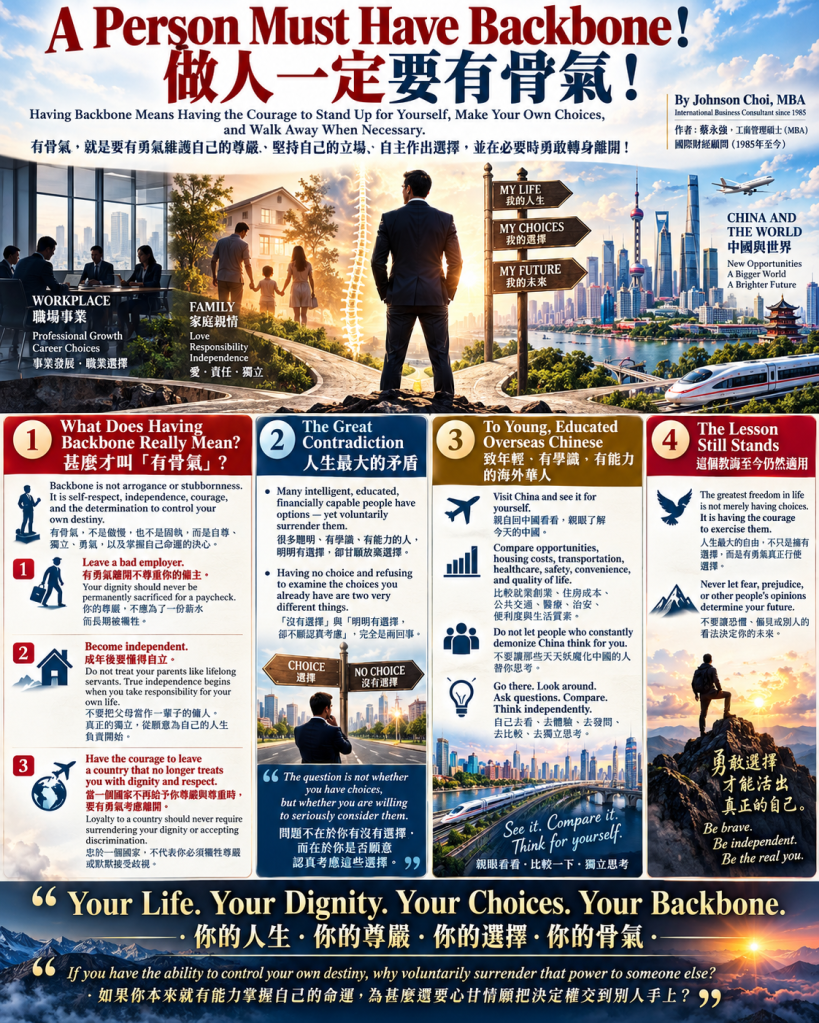
My Grandfather and Father Taught Me: “A Person Must Have Backbone!” Having Backbone Means Having the Courage to Stand Up for Yourself, Make Your Own Choices, and Walk Away When Necessary.
By Johnson Choi, MBA International Business Consultant since 1985
Growing up, my grandfather and father repeatedly taught me one important lesson:
“A person must have backbone!”
That simple principle has guided me throughout my life.
But as I have grown older and observed people across different countries and cultures, I have often wondered:
Is having backbone equally valued in Western culture? And more importantly, how many people actually have the courage to demonstrate it?
Of course, having backbone is not always easy. A person’s ability to stand independently depends on many factors, including education, financial security, family responsibilities, personal circumstances, and available opportunities.
Those who are intelligent, well-educated, financially independent, and professionally capable generally have more choices than others.
What surprises me most is how many people who actually have those choices voluntarily surrender them.
What Does Having Backbone Really Mean?
To me, backbone is not about being arrogant, confrontational, or stubborn.
It is about having self-respect, independence, courage, and the determination to control your own destiny.
Backbone means having the courage to leave a bad employer.
If your employer repeatedly mistreats, humiliates, or exploits you, and you have the qualifications and financial ability to find better opportunities, why continue accepting such treatment?
Your dignity should never be permanently sacrificed for a paycheck.
Backbone means becoming independent instead of treating your parents like lifelong servants.
After graduating from college, young adults who have the ability to support themselves should learn to stand on their own feet.
Parents spend decades raising and supporting their children. They deserve the opportunity to enjoy their later years rather than being treated as unpaid housekeepers, cooks, and personal assistants by adult children who refuse to grow up.
True independence begins when you take responsibility for your own life.
Backbone means having the courage to leave a country that no longer treats you with dignity and respect.
This is particularly relevant to overseas Chinese living in Western countries.
If the country you have called home for decades increasingly treats people of Chinese ancestry as suspicious, questions their loyalty, or makes them feel like outsiders simply because they are not white, shouldn’t you at least consider your alternatives?
Nobody should be expected to tolerate discrimination indefinitely simply to prove their loyalty.
Loyalty to a country should never require surrendering your dignity or accepting discrimination.
The Great Contradiction: Having Options but Refusing to Exercise Them
What amazes me is that many people appear to possess everything necessary to stand independently.
They are intelligent. They are educated. They have professional qualifications, financial resources, international experience, and opportunities elsewhere.
Yet when confronted with unfair treatment, discrimination, or an environment that no longer serves their interests, they continue complaining without taking meaningful action.
They have the ability to change their circumstances, but choose to remain exactly where they are.
Why?
Is it ignorance? Fear of change? Social pressure? Attachment to familiar surroundings? Financial or family obligations?
Or have some people become so accustomed to their circumstances that they no longer recognize the choices available to them?
I understand that not everyone can simply pack a suitcase and leave. Real-life responsibilities can make even the most reasonable decisions complicated.
But there is a fundamental difference between having no choice and refusing to examine the choices you already have.
To Young, Educated Overseas Chinese: Discover China for Yourself!
If you are young, intelligent, educated, and professionally capable, perhaps it is time to broaden your horizons.
Why not visit China, your ancestral homeland, and see with your own eyes what the country has become?
Explore its modern cities, transportation networks, technological developments, business opportunities, and everyday lifestyle.
Speak directly with local residents, entrepreneurs, professionals, and young people.
Compare employment opportunities, housing costs, public transportation, healthcare, personal safety, and overall quality of life with what you currently experience abroad.
You may discover advantages you never imagined. You may also find shortcomings and challenges.
Either way, form your conclusions from firsthand experience rather than inherited prejudices or political propaganda.
Do not allow people who constantly demonize China to make your decisions for you.
And do not blindly accept positive stories either.
Go there. Look around. Ask questions. Compare. Think independently.
You have a brain. You have an education. You have choices. Use them!
My Grandfather and Father’s Lesson Still Stands
Having backbone does not necessarily mean leaving your employer, your family home, or your adopted country.
Sometimes it means staying and standing up for what is right.
But it always means having the courage to think independently, defend your dignity, and make decisions based on your own interests and principles rather than fear or social pressure.
After more than forty years in international business, I have become increasingly convinced of one thing:
The greatest freedom in life is not merely having choices. It is having the courage to exercise them.
My grandfather and father were right:
“A person must have backbone!”
And I would add one more lesson:
“If you have the ability to control your own destiny, why voluntarily surrender that power to someone else?”
Never let fear, prejudice, or other people’s opinions determine your future.
Your life. Your dignity. Your choices. Your backbone.
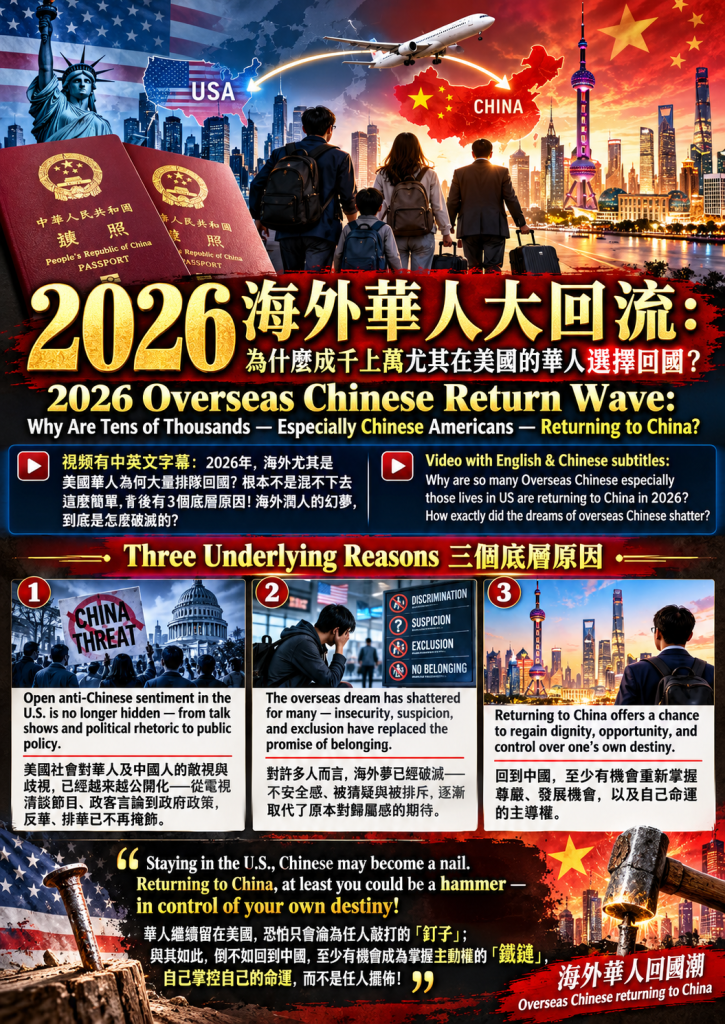
Video with English & Chinese subtitles: Why are so many Overseas Chinese especially those lives in US are returning to China in 2026? How exactly did the dreams of overseas Chinese shatter?
Anti-Chinese in US in talk show, by politicians and policies is open and not even want to hide it anymore. Staying in US Chinese becoming a nail, returning to China at least you could be a hammer in control of your own destiny!
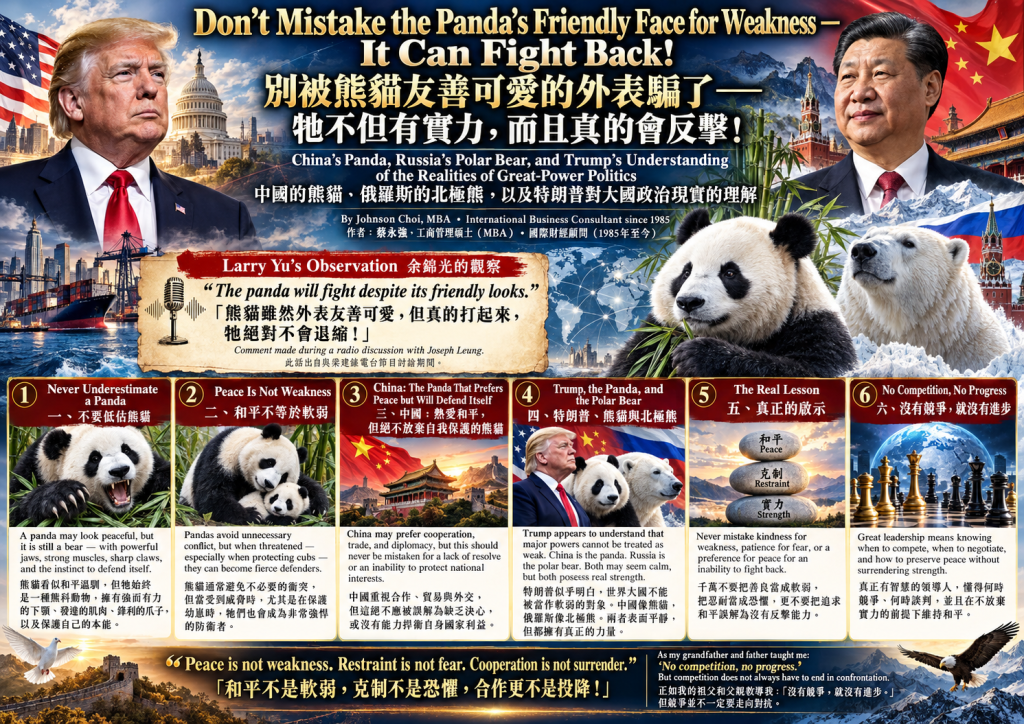
Don’t Mistake the Panda’s Friendly Face for Weakness — It Can Fight Back! China’s Panda, Russia’s Polar Bear, and Trump’s Understanding of the Realities of Great-Power Politics
By Johnson Choi, MBA International Business Consultant since 1985
Recently, my good friend Larry Yu made a fascinating observation during a radio discussion with Joseph Leung.
Larry said: “The panda will fight despite its friendly looks.”
That simple statement caught my attention.
The more I thought about it, the more I realized that Larry had made a powerful observation—not only about the giant panda, but also about international politics and the way major powers respond when they feel threatened.
So I decided to do some research.
And guess what? Larry was right about the panda!
Never Underestimate a Panda Because It Looks Cute. Most people associate giant pandas with peace, friendliness, bamboo, and adorable black-and-white faces.
They look harmless. They move slowly. They spend much of their day eating bamboo.
But appearances can be deceiving.
A giant panda is still a bear, equipped with powerful jaws, strong muscles, sharp claws, and the natural instincts to defend itself.
Pandas generally avoid unnecessary confrontation, but that does not mean they are incapable of aggression. In particular, a mother panda protecting her cub can be a formidable opponent.
She may bite, swipe, vocalize, or aggressively defend her offspring when she perceives a serious threat.
In other words: A panda prefers peace, but peace should never be mistaken for helplessness.
The Panda Doesn’t Have to Bluff
What interested me most was the panda’s defensive behavior.
A giant panda does not need to look ferocious to possess the strength to fight.
It can appear peaceful one moment and respond aggressively when threatened.
That is an important lesson in both wildlife behavior and human relationships:
Never confuse a peaceful temperament with an inability to defend one’s interests.
The Smithsonian’s National Zoo confirms that giant pandas are naturally solitary bears and that aggression can occur under certain circumstances. Mothers also devote considerable effort to protecting and raising their vulnerable cubs.
China, the Panda That Prefers Peace but Will Defend Itself
This brings me back to Larry Yu’s observation.
For decades, China has been internationally represented by the giant panda—an animal associated with goodwill, friendship, and peaceful diplomacy.
But I believe the panda also provides another important lesson.
China may prefer economic cooperation, trade, investment, and diplomatic engagement, but that preference should not be interpreted as an unwillingness to protect its national interests.
Just as a panda does not spend its day looking for a fight, a powerful country does not necessarily seek confrontation.
However, when it believes its security, sovereignty, or vital interests are threatened, its response may be very different.
The mistake is assuming that because someone prefers peace, they are afraid to fight.
Trump, China’s Panda, and Russia’s Polar Bear
This is where I find President Donald Trump’s approach to China and Russia particularly interesting.
Whether you like Trump or dislike him, I believe he understands something that many politicians underestimate:
You cannot negotiate successfully with major powers by assuming they are weak or that they will always retreat under pressure.
China is the panda.
Russia is the polar bear.
Both animals may appear relatively calm under normal circumstances, but both possess tremendous defensive capabilities.
Of course, international politics is far more complicated than animal behavior. Nevertheless, I believe the comparison offers an interesting perspective on diplomacy.
Trump’s willingness to maintain direct dialogue with Chinese and Russian leaders suggests a recognition that diplomacy and negotiation can sometimes achieve more than endless threats and confrontation.
His approach remains controversial, particularly regarding Russia and Ukraine, and diplomatic engagement does not guarantee peace. Still, his recent dealings with Moscow show that he is prepared to negotiate even amid serious geopolitical disagreements.
I have followed international business and politics for more than four decades, and one lesson has remained consistent throughout my career:
Respecting the strength of others is not weakness. It is intelligence.
In business, you don’t insult a powerful competitor and then expect a favorable deal.
In international relations, the stakes are even higher.
Sometimes, the smartest decision is not to challenge someone to a fight but to recognize their capabilities and find common ground.
Like Trump or Not, at Least Give Him Credit for Understanding Power
I know many people strongly disagree with Trump.
That is their right.
I don’t agree with everything he says or does either.
But when it comes to dealing with China and Russia, I believe that recognizing the realities of great-power competition is a sign of political intelligence.
Trump appears willing to deal directly with the panda and the polar bear rather than simply dismissing them.
Whether this strategy succeeds will ultimately depend on the results.
For me, the larger lesson is simple:
A wise leader knows when to compete, when to negotiate, and when confrontation would be unnecessarily costly.
And that brings me back to Larry Yu.
His seemingly simple comment during Joseph Leung’s radio program carried a much deeper message than I initially realized.
“The panda will fight despite its friendly looks.”
Larry, you made an excellent point!
After doing my research, I would add one more observation:
Never mistake kindness for weakness, patience for fear, or a preference for peace for an inability to fight back.
The panda may look friendly.
The polar bear may appear calm.
But neither should be underestimated.
And in the complicated world of international politics, perhaps the smartest leaders are those who understand that reality before learning it the hard way.
As my grandfather and father taught me: “No competition, no progress.” But competition does not always have to end in confrontation. Sometimes, the greatest achievement is knowing how to compete while preserving peace.
The USS Abraham Lincoln actually ran out of food in just four months—and sailors had to rely on special rations for the next six, he added.
Shocking details of the US’s tortuous war on Iran were revealed by an unnamed Navy chief from the USS Abraham Lincoln, interviewed by California mortgage broker Jason Hall, a personal friend.
Hall’s write-up quickly got more than a million views on X, the social media platform.
SAILORS BOO HEGSETH Secretary for War Pete Hegseth was greeted with boos by sailors when he boarded the USS Abraham Lincoln, the senior sailor revealed.
“Hegseth went on the ship the day before they got back & was soundly booed. Said he’s never seen that.”
As for the news reports about how bad conditions were in terms of food and other supplies, “it was worse”, the Navy chief told him.
“Said he & other officers met with the Admiral of the Navy. They asked what was going on & he said he had no idea. Zero clear direction of from DoD, terrible organization, no idea of objective, no plan at all & no support. Just a total cluster & Mickey Mouse operation,” said Hall, who uses the online name Jhallito.
NO EXIT STRATEGY Most depressingly, the Navy chief said there was no exit strategy of any kind. “He doesn’t see any way we get out of there anytime soon. No clear path to victory,” Hall added.
The USS Abraham Lincoln was one of 85 ships in the waters near Iran—and all were from the US, as they were not getting support from any other country.
Trump’s frequent claims that Iran had no remaining air force or navy were clearly inaccurate as the US ship was under continuous pressure from the Iranians.
“He said they were under attack constantly. On defense 24 hours. Not allowed to retaliate. Complete disarray in orders from sending planes to attack one minute to blockade & babysitting ships the next. They just sailed circles for months with no clear objective,” Hall said.
SIMILAR STORIES Other friends and family of US military staff joined in the discussion.
“My buddy was in that huge air base in Jordan that got bombed constantly for over 6 months,” said Bill NHI from South Carolina.
“Very similar stories from his end. Constant threat of being blown up – hundreds of red alerts, sleepless nights, s**t food, zero plan, way worse than what was reported here.”
Hall said that the sailors’ efforts to follow orders in this awful situation was impressive.
“This gives me so much more respect for our military men & women. Tossed into a completely unknown position, that virtually none agreed with or wanted to do, while being extended all the time without notice & they just did the work for 11 months. I’ve never been prouder,” he added.
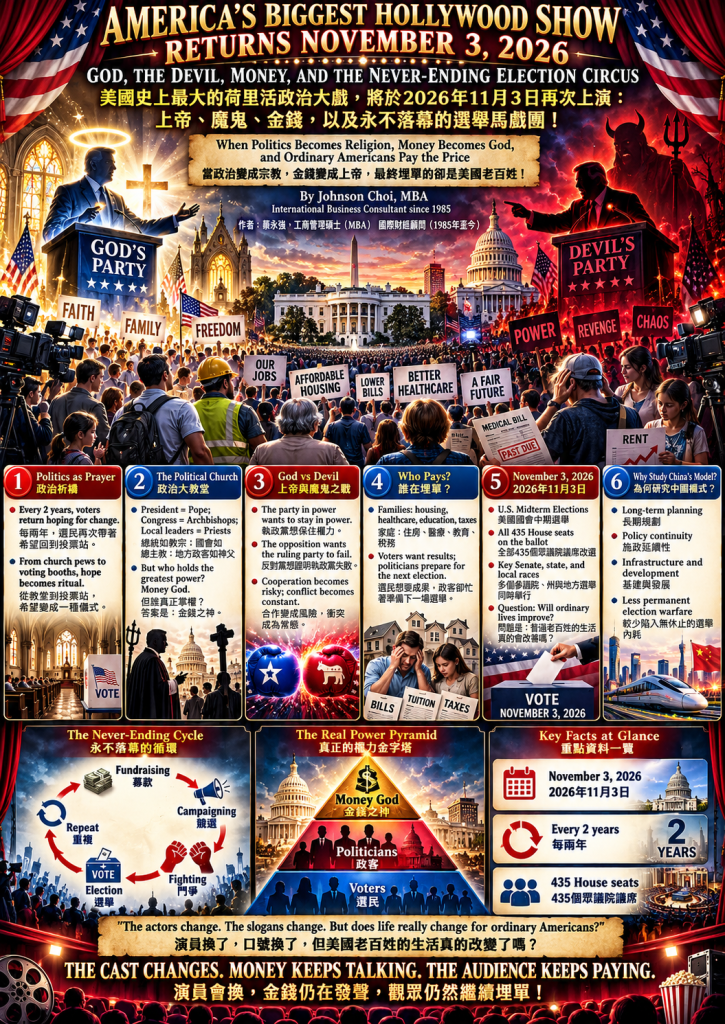
Every two years, America stages what I consider the greatest political Hollywood production on Earth.
The next spectacular performance is scheduled for November 3, 2026 — the U.S. midterm elections.
There will be heroes and villains, dramatic speeches, emotional promises, political scandals, expensive advertising, and endless accusations.
Billions of dollars will be spent convincing Americans that this time, everything will be different.
The actors may change. The political costumes may change. The slogans certainly will change.
But will the lives of ordinary Americans really change for the better?
That is the question I believe every voter should ask.
American Democracy and Christianity: A Fascinating Comparison
Many Western democracies have deep historical connections to Christianity.
As a baptized Catholic and a Christian myself, I have spent much of my life observing the relationship between faith, human behavior, and political institutions.
Prayer is an important part of Christian life.
In good times, we pray with gratitude. In difficult times, we pray for guidance, strength, and divine assistance.
We believe our prayers will be heard, even when the answers are not what we expect.
American elections sometimes remind me of a similar ritual.
Every two years, Americans participate in a national political ceremony.
Instead of entering a church, they enter a voting booth.
Instead of offering prayers, they cast ballots.
They hope that somehow, somewhere, an intelligent, capable, honest, and compassionate leader will emerge to improve their lives.
And when the promised miracles fail to materialize?
They return two years later and perform the ritual all over again.
The election becomes a political prayer, and the ballot becomes an expression of hope.
There is nothing wrong with hope.
But hope without meaningful institutional change can become an endless cycle of disappointment.
The Political Church: Presidents, Archbishops, Priests — and the Money God
For the sake of political satire, imagine American democracy as a giant church.
The President occupies the position of the Pope.
Senators and members of Congress resemble archbishops and bishops.
Governors, mayors, and local politicians play the roles of parish priests.
Each delivers sermons.
Each promises salvation.
Each claims to understand the suffering of ordinary people.
And each asks the congregation for continued faith and support.
But here is my question:
Who exercises the greatest influence over this political church?
In my satirical version of American politics, the answer is the Money God.
Campaign financiers, wealthy donors, corporate lobbying organizations, and powerful special interests enjoy extraordinary opportunities to influence the political process.
Of course, not every politician is controlled by money, and not every donation purchases a political favor.
Nevertheless, money undeniably plays an enormous role in determining who can compete effectively, whose messages dominate television screens, and which interests gain access to elected officials.
The ordinary voter may possess one ballot.
A wealthy donor may possess the resources to finance an entire political advertising campaign.
Both have a voice.
But do both voices carry equal practical influence?
That is the uncomfortable question at the heart of American political financing.
When money becomes the supreme political power, changing the politicians may not change the system.
The congregation gets a new preacher.
The sermon changes.
But the people financing the cathedral remain influential.
God Versus the Devil: America’s Never-Ending Political War
Now comes the most entertaining part of the Hollywood production.
In Christianity, we recognize the struggle between good and evil.
In American politics, the two major political parties frequently portray their rivalry in similarly dramatic terms.
For purposes of this satire, let us call the party occupying the White House God’s Party and the opposition the Devil’s Party.
These labels are theatrical metaphors, not religious judgments about either party.
The party in power naturally portrays itself as the defender of America.
The opposition frequently describes itself as the force that must rescue America from disastrous leadership.
But notice something interesting.
The opposition has an enormous political incentive to demonstrate that the governing party has failed.
After all, if the government becomes successful, popular, and widely respected, how does the opposition convince voters that a change of leadership is urgently necessary?
This creates a dangerous temptation.
Instead of asking, “How can we work together to improve the lives of Americans?”
Both sides can become obsessed with asking:
“How can we make the other side lose?”
The governing party wants to retain power.
The opposition wants to capture power.
Compromise becomes politically risky.
Cooperation can be portrayed as betrayal.
And achievements that should benefit the entire country become weapons in the next election.
Not all politicians behave this way, and bipartisan achievements remain possible. But the incentives toward permanent confrontation are difficult to ignore.
The Greatest Losers Are the American People
While the two political armies fight for control of Washington, ordinary Americans must deal with the consequences.
They still have mortgages to pay.
They still worry about healthcare expenses.
They still struggle with housing affordability, education costs, retirement security, taxes, and the rising cost of everyday necessities.
Families want safe neighborhoods.
Parents want good schools.
Workers want stable employment.
Retirees want dignity, security, and peace of mind.
But instead of concentrating on these everyday concerns, Washington repeatedly becomes consumed by investigations, political accusations, fundraising battles, partisan obstruction, and preparations for the next election.
Every two years, another political showdown arrives.
Every four years, the presidential drama becomes even more spectacular.
One party celebrates victory.
The other promises revenge at the ballot box.
And the cycle begins again.
The politicians argue about who deserves power. Ordinary Americans simply want government to work.
This is why I call American elections the greatest recurring Hollywood political production.
The entertainment is extraordinary.
The advertising budget is astronomical.
The political emotions are intense.
But the admission price is ultimately paid by the American people.
November 3, 2026: Will the Winner Really Change the System?
On November 3, Americans will once again go to the polls.
The country will watch the results with enormous anticipation.
Television commentators will analyze every congressional district.
Political parties will celebrate their victories and explain away their defeats.
Financial donors and lobbying organizations will reassess their strategies.
And Americans will be told that the nation’s future has reached another historic turning point.
But I would ask a different question.
Regardless of which party wins, will America’s underlying political incentives fundamentally change?
Will the influence of wealthy donors suddenly disappear?
Will congressional gridlock become a thing of the past?
Will politicians stop spending enormous amounts of time raising money for their next campaigns?
Will partisan competition finally give way to a sustained commitment to improving ordinary people’s lives?
I have my doubts.
The deeper problem, in my opinion, is that both political parties operate within a system where fundraising, electoral advantage, institutional power, and special-interest influence can become more important than long-term national planning.
This does not mean every politician is corrupt or that every political decision results from a secret bargain.
It means that the structural incentives deserve far more scrutiny than the personalities appearing on television.
The actors may be replaced. The stage remains. And the powerful interests behind the production do not necessarily disappear when the curtain falls.
Why I Find China’s System Worth Studying
Now let us consider a completely different political model.
China describes its political and economic system as socialism with Chinese characteristics.
Rather than organizing national governance around regular multiparty contests for control of the central government, China emphasizes long-term planning, policy continuity, economic development, infrastructure investment, and implementation through its existing political institutions.
China’s political system has genuine limitations, including restrictions on political opposition, public expression, and the ability of citizens to replace national leaders through competitive elections.
Those differences should not be ignored.
Nevertheless, I believe an important question is often missing from Western political discussions:
Should we judge a government primarily by how its leaders are chosen, or also by what its institutions actually deliver to the people?
Consider the areas that matter most in everyday life:
Transportation systems and infrastructure.
Housing affordability and living costs.
Access to healthcare and public services.
Economic opportunities and technological development.
Public safety, convenience, and quality of life.
Long-term national development instead of permanent election campaigning.
These are practical measurements of governance.
China has substantial challenges of its own, including economic pressures, demographic changes, and questions of political accountability.
However, its ability to maintain certain long-term development priorities without holding American-style national election campaigns is a meaningful institutional difference.
For someone like me, who has spent more than four decades working in international business and observing different societies, it is a difference worth examining.
I would much rather spend my time enjoying life, visiting friends, experiencing new technology, and watching communities develop than following another endless cycle of political mudslinging.
And I suspect many people, regardless of nationality, would agree with that sentiment.
Democracy Should Be Judged by Results, Not Political Theater
Let me make one point clear.
I am not questioning the sincerity of Christian prayer.
Faith is a deeply personal matter, and my own Catholic upbringing remains part of who I am.
Nor am I suggesting that voting is meaningless.
The right to vote is an important political right, one that enables citizens to influence leadership and hold governments accountable.
My criticism is directed at a political culture that increasingly resembles entertainment rather than responsible governance.
A country cannot build its future on political drama alone.
Democracy should not become a never-ending competition over who can raise the most money, produce the most effective attack advertisements, or destroy the reputation of an opponent.
The purpose of government should be to improve people’s lives.
That ought to be the ultimate measurement of political success, whether the system calls itself democratic, socialist, or something else.
After all, ordinary people everywhere want remarkably similar things:
A decent home.
Good health.
Financial security.
Safe communities.
Opportunities for their children.
And the freedom to enjoy their lives without constantly worrying about political conflict.
My Final Thoughts: Same Hollywood, Different Actors
On November 3, 2026, America will stage another magnificent political performance.
There will be winners and losers.
There will be celebration and disappointment.
There will be promises of a new beginning.
But when the television cameras disappear and the campaign posters come down, Americans will still have to wake up the next morning, go to work, pay their bills, and take care of their families.
As a Christian, I respect the importance of prayer.
As someone who has worked in international business since 1985, I also believe in performance, results, and accountability.
Prayer alone does not build a bridge.
Campaign slogans do not create affordable housing.
Political attacks do not improve healthcare.
And changing the actors does not automatically change the system.
My preference is for a society where governments spend more time delivering measurable improvements and less time fighting endless political wars.
That is why I believe the Chinese model deserves serious attention alongside the Western democratic model, with the strengths and weaknesses of both examined fairly.
Americans should be free to choose their leaders.
But they should also demand that those leaders spend less time preparing for the next election and more time preparing for the next generation.
America’s greatest problem is not that elections happen every two years. It is that governing too often becomes secondary to campaigning for the next one.
And that, ladies and gentlemen, is why I call it:
THE GREATEST HOLLYWOOD SHOW ON EARTH — WHERE THE CAST CHANGES, THE MONEY KEEPS TALKING, AND THE AUDIENCE KEEPS PAYING.
By Johnson Choi, MBA International Business Consultant since 1985