Video: The Jiangyu Hai residential community, where the Xicheng Clinic of Zhuhai Hospital is located, is right across from (or just across the road from) the Jinhua Huafa Commercial Complex in Jinwan. It is about 150 meters from our home, within walking distance. The new supporting facilities in Zhuhai Jinwan Aviation New City will be put into use before December. 珠海醫院西城門診部所在的江嶼海小區,就在金灣華發商都的對面(或僅一路之隔)。離我們家150米左右,步行即可到達。珠海金灣航空新城新配套落地12月前投入使用。
After more than 40 years in international business consulting, I have learned one important lesson: There is no substitute for firsthand experience. What people tell you about a country and what you actually discover when you visit can be two completely different things.
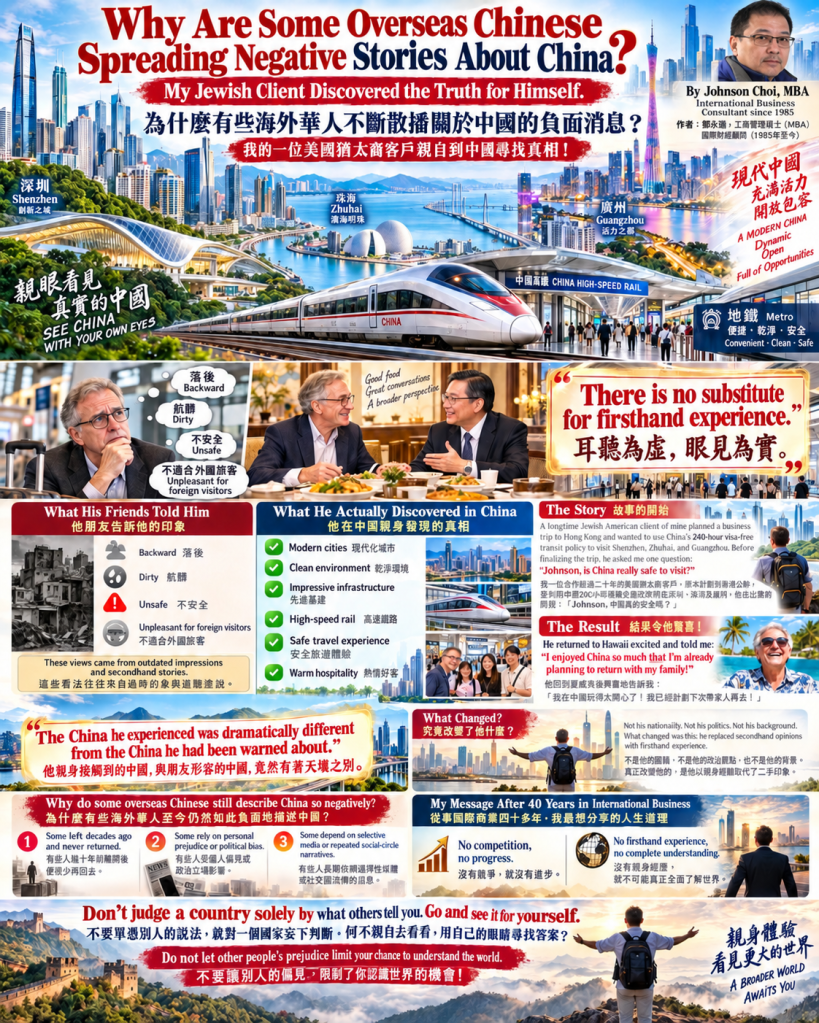
Recently, a longtime Jewish American client of mine shared an experience that reinforced this lesson.
He had been my client for more than 20 years, and over those two decades, we had developed a strong professional relationship built on mutual trust and respect.
He was planning a business trip to Hong Kong and wanted to take advantage of China’s visa-free transit policy to spend up to 10 days exploring mainland China.
His itinerary included Shenzhen, Zhuhai, and Guangzhou. He was particularly excited about experiencing China’s modern high-speed railway system.
However, before finalizing his travel arrangements, he called and invited me to lunch.
There was one important question on his mind:
“Johnson, is China really safe to visit?”
I was surprised by his question.
I asked him, “What makes you think China might not be safe?”
His answer was even more surprising.
He explained that several of his Chinese friends in Hawaii had strongly discouraged him from visiting mainland China.
According to these friends, China was backward, dirty, unsafe, and generally an unpleasant place for foreign visitors.
They had painted such a negative picture that he was seriously reconsidering his plans.
I asked him a few more questions about what his friends had told him and whether they had recently visited the cities he intended to explore.
As our conversation continued, I began to recognize a pattern that I had encountered many times over the years, particularly among certain overseas Chinese communities in Hawaii and San Francisco.
Some people continue to describe China through outdated impressions, personal prejudices, political disagreements, or secondhand stories rather than firsthand knowledge of the country as it exists today.
Of course, everyone is entitled to their political opinions. No country is perfect, including China and the United States.
But there is a fundamental difference between expressing an opinion and presenting an inaccurate or outdated impression as an established fact.
I looked at my client and said:
“You have trusted my professional judgment for more than 20 years. If you still trust me today, my advice is simple: Go to China, see it with your own eyes, experience it for yourself, and then form your own opinion. Don’t let anyone else make that judgment for you.”
I also encouraged him to experience everyday Chinese life, explore the cities, try the high-speed trains, meet local people, and compare what he personally observed with what his friends had told him.
He decided to go.
The Phone Call After His Return to Hawaii
Several weeks later, after returning to Hawaii, he called me again.
“Johnson, I’d like to take you to lunch. I brought you a small gift from China.”
I appreciated his thoughtful gesture, but frankly, I was far more interested in what he had discovered during his trip than in the gift he had brought me.
When we met for lunch, I asked him about Shenzhen, Zhuhai, and Guangzhou.
What followed was one of the most enthusiastic conversations I have ever had with him.
He could hardly stop talking about his wonderful experiences in China.
He described his impressions of the modern cities, impressive transportation infrastructure, high-speed railways, and the overall travel experience.
The China he had personally experienced was dramatically different from the country his friends in Hawaii had described.
Instead of the backward, dirty, and dangerous country he had been warned about, he encountered modern urban environments and a travel experience that left him deeply impressed.
He had visited China with uncertainty and returned with enthusiasm.
Then he told me something that made the entire conversation worthwhile:
“Johnson, I enjoyed China so much that I’m already planning to return with my family!”
For me, that statement was more meaningful than any souvenir.
A man who had initially questioned whether China was safe enough to visit was now looking forward to bringing his own family.
What had changed?
Not his political beliefs.
Not his nationality.
Not his background.
What changed was that he replaced secondhand opinions with firsthand experience.
My Final Advice to Him
Before we finished lunch, I made one final suggestion.
I told him:
“The next time you meet those Chinese friends who warned you not to visit China, please tell them what you personally experienced in Shenzhen, Zhuhai, and Guangzhou. Tell them about the high-speed trains, the cities, the people, and the hospitality you encountered. Let them hear your story directly from you.”
I was not asking him to argue with his friends or persuade them to support any government.
I simply wanted him to share what he had seen with his own eyes.
If his friends had a different experience, they were welcome to share that as well.
But meaningful discussions should be based on facts, current information, and genuine experience rather than stereotypes or sweeping generalizations.
Why Do Some Overseas Chinese Continue to Describe China So Negatively?
This experience raises a question I have asked myself many times during my decades of working with people across the United States, Hong Kong, and mainland China.
Why do some overseas Chinese continue to portray China in such negative terms, even when the country has undergone enormous changes in infrastructure, technology, transportation, and everyday living standards?
Some may have left China or Hong Kong decades ago and never returned to see the transformation for themselves.
Others may have developed strong political opinions that influence how they interpret everything happening in China.
Still others may rely on selective media reporting or information circulated within their social circles.
These possibilities do not apply to everyone, and criticism of China should not automatically be dismissed as misinformation. Legitimate concerns deserve serious consideration.
But the reverse is equally true:
Criticism should not be accepted as fact simply because it comes from someone who is ethnically Chinese or claims to know China.
Being Chinese does not automatically mean someone has accurate, current knowledge of modern China.
And being a foreigner does not prevent someone from making thoughtful and informed observations about the country.
My Jewish American client’s experience illustrates this perfectly.
He was not Chinese. He did not travel to China with the intention of defending it.
He went because he was curious.
He returned because he was impressed.
And now he wants to bring his family.
My Message After 40 Years in International Business
My grandfather and father taught me an important principle when I was young:
“No competition, no progress.”
Throughout my international business career, I have added another principle:
“No firsthand experience, no complete understanding.”
I encourage my friends in Hawaii, San Francisco, and elsewhere to travel, explore, ask questions, and keep an open mind.
Visit China. Visit other countries too. Compare their public transportation, infrastructure, safety, healthcare, cost of living, hospitality, and everyday conveniences.
Recognize their strengths as well as their weaknesses.
Then decide for yourself.
A country of more than 1.4 billion people cannot be accurately understood through political slogans, social media arguments, or a few negative stories told over lunch.
My client’s experience is only one person’s journey, and not every traveler will have the same impressions.
But his story demonstrates something important:
The most effective way to challenge a misleading impression is not always through debate. Sometimes, it is simply to encourage someone to go, see, experience, and discover the reality for themselves.
I hope his friends in Hawaii will listen when he shares his experience.
And perhaps one day, they too will decide to visit China again with an open mind.
Don’t judge a country solely by what others tell you. Go and see it for yourself.
Johnson Choi, MBA International Business Consultant since 1985
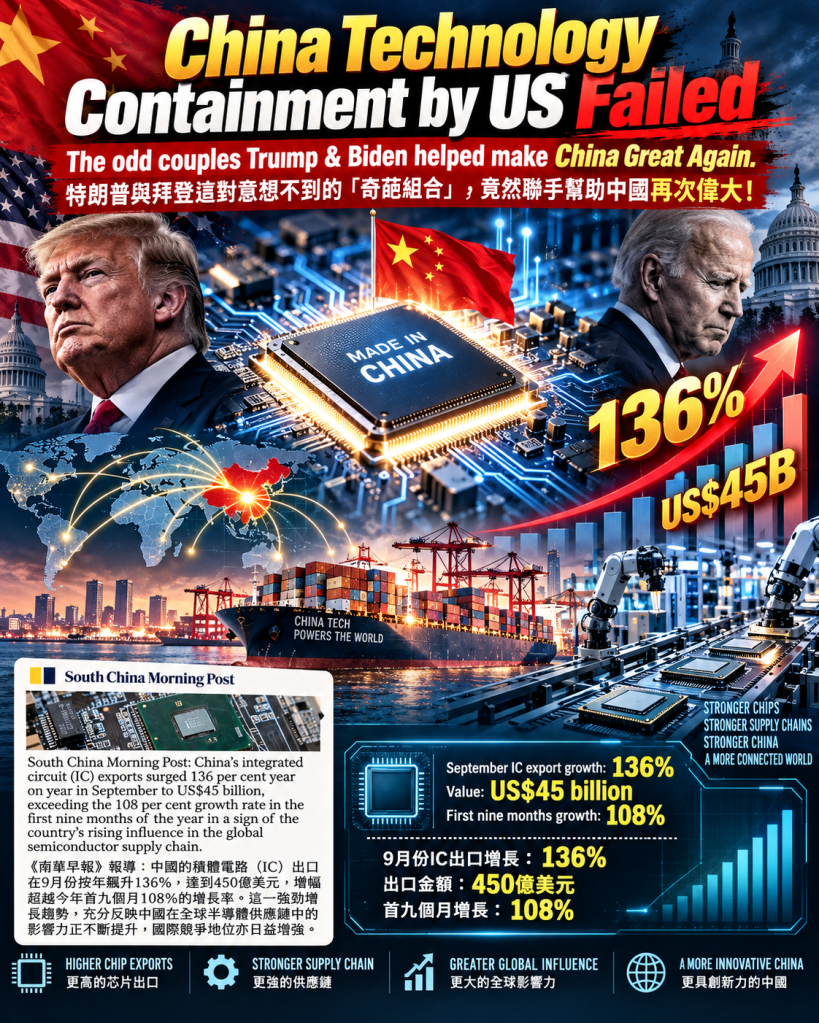
The odd couples Trump & Biden helped make China Great Again. South China Morning Post: China’s integrated circuit (IC) exports surged 136 per cent year on year in September to US$45 billion, exceeding the 108 per cent growth rate in the first nine months of the year in a sign of the country’s rising influence in the global semiconductor supply chain. 特朗普與拜登這對意想不到的「奇葩組合」,竟然聯手幫助中國再次偉大!《南華早報》報導:中國的積體電路(IC)出口在9月份按年飆升136%,達到450億美元,增幅超越今年首九個月108%的增長率。這一強勁增長趨勢,充分反映中國在全球半導體供應鏈中的影響力正不斷提升,國際競爭地位亦日益增強。
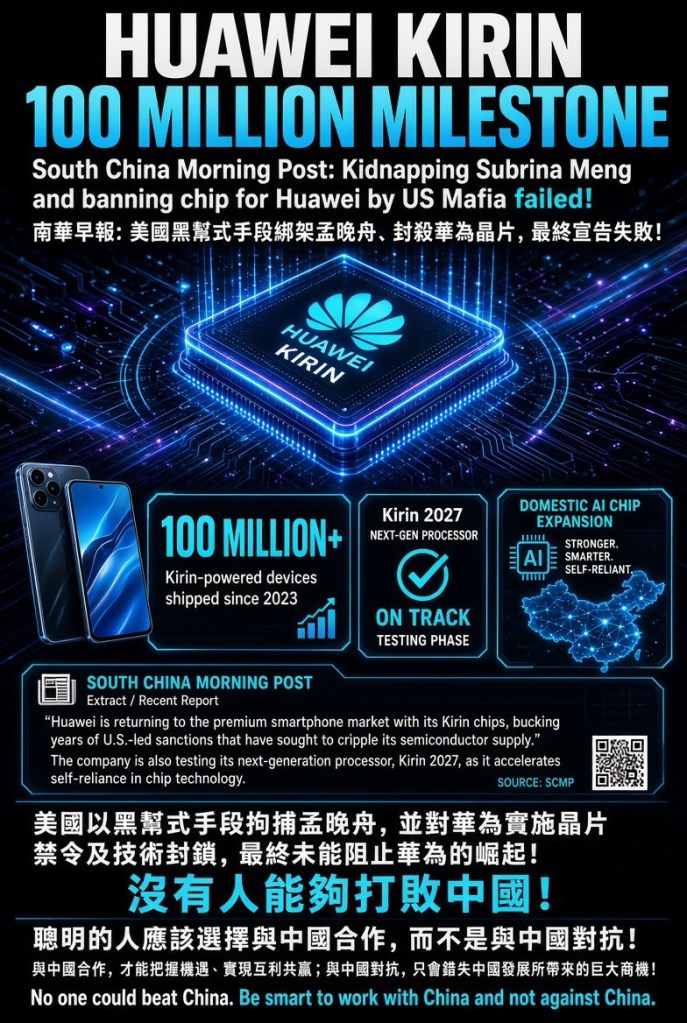
Huawei Technologies has shipped more than 100 million devices powered by its Kirin processors since 2023, when it returned to the smartphone market with a new generation of premium handsets. The company says testing of its next-generation Kirin 2027 chip is also progressing in line with expectations. No one could beat China. Be smart to work with China and not against China.
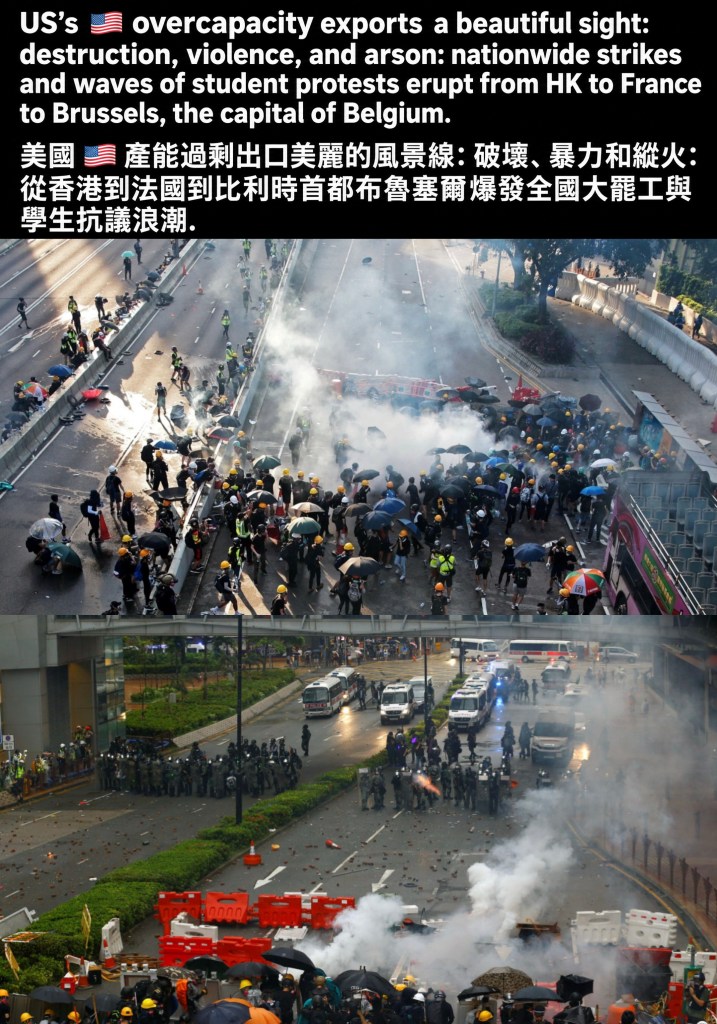
US’s excess capacity exports a beautiful sight: destruction, violence, and arson: nationwide strikes and waves of student protests erupt from HK to France to Brussels, the capital of Belgium. 美國產能過剩出口美麗的風景線:破壞、暴力和縱火:從香港到法國到比利時首都布魯塞爾爆發全國大罷工與學生抗議浪潮.
Video in the Shanghai Beach song format: Do you still have a “big kid” born in the 2000s at home with you? Why are they so useless? Don’t laugh, it’s the parents’ fault! Who else is there to blame! 視頻用上海灘歌詞: 你家里还有 00 后的’大孩子’ 在身边吗? 為什麼那麼廢? 不要笑,是父母的錯!怪誰!
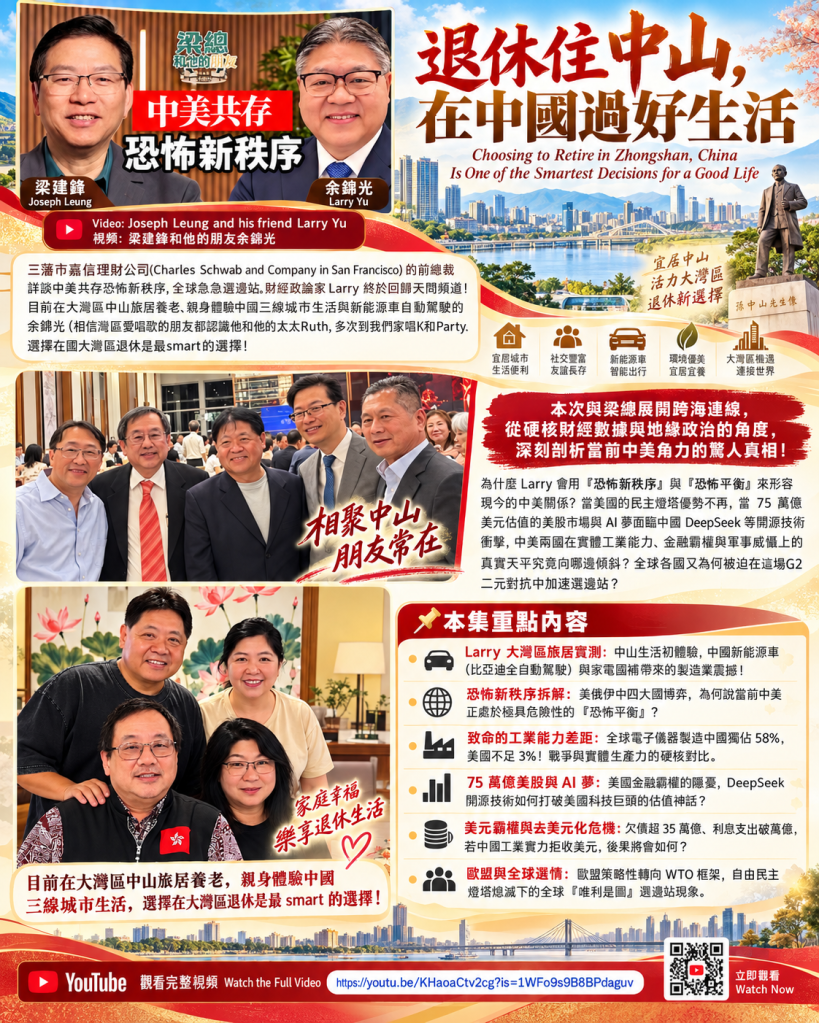
Video: Joseph Leung and his friend Larry Yu 視頻: 梁建鋒和他的朋友余錦光,三藩市嘉信理財公司(Charles Schwab and Company in San Francisco) 的前總裁詳談中美共存恐怖新秩序,全球急急選邊站. 財經政論家 Larry 終於回歸天問頻道!目前在大灣區中山旅居養老、親身體驗中國三線城市生活與新能源車自動駕駛的余錦光 (相信灣區愛唱歌的朋友都認識他和他的太太Ruth, 多次到我們(Johnson and Carmen) 家唱K和Party. 選擇在中國大灣區退休是最smart的選擇!
昨天見到 Larry Yu 在中山用 Zoom 跟三藩市的梁總(Joseph Leung)直播,真是嚇了我一跳!他們夫妻回中山後心情開朗、生活愉快,吃得好、住得好,出入也都平安。跟三個月前他離開三藩市前一個星期我們一起吃飯時的模樣相比,哇!簡直像年輕了十年!
為什麼 Larry 會用「恐怖新秩序」與「恐怖平衡」來形容現今的中美關係?當美國的民主燈塔優勢不再,當 75 萬億美元估值的美股市場與 AI 夢面臨中國 DeepSeek 等開源技術衝擊,中美兩國在實體工業能力、金融霸權與軍事威懾上的真實天平究竟向哪邊傾斜?全球各國又為何被迫在這場G2二元對抗中加速選邊站?
📌 本集重點內容
Larry 大灣區旅居實測:中山生活初體驗,中國新能源車(比亞迪全自動駕駛)與家電國補帶來的製造業震撼!
恐怖新秩序拆解:美俄伊中四大國博弈,為何說當前中美正處於極具危險性的「恐怖平衡」?
致命的工業能力差距:全球電子儀器製造中國獨佔 58%,美國不足 3%!戰爭與實體生產力的硬核對比。
75 萬億美股與 AI 夢:美國金融霸權的隱憂,DeepSeek 開源技術如何打破美國科技巨頭的估值神話?
Video: Wealthy Jewish families in New York hire top-tier Chinese private tutors to teach their children Mandarin Chinese because they believe it is one of the greatest gifts they can give their children.
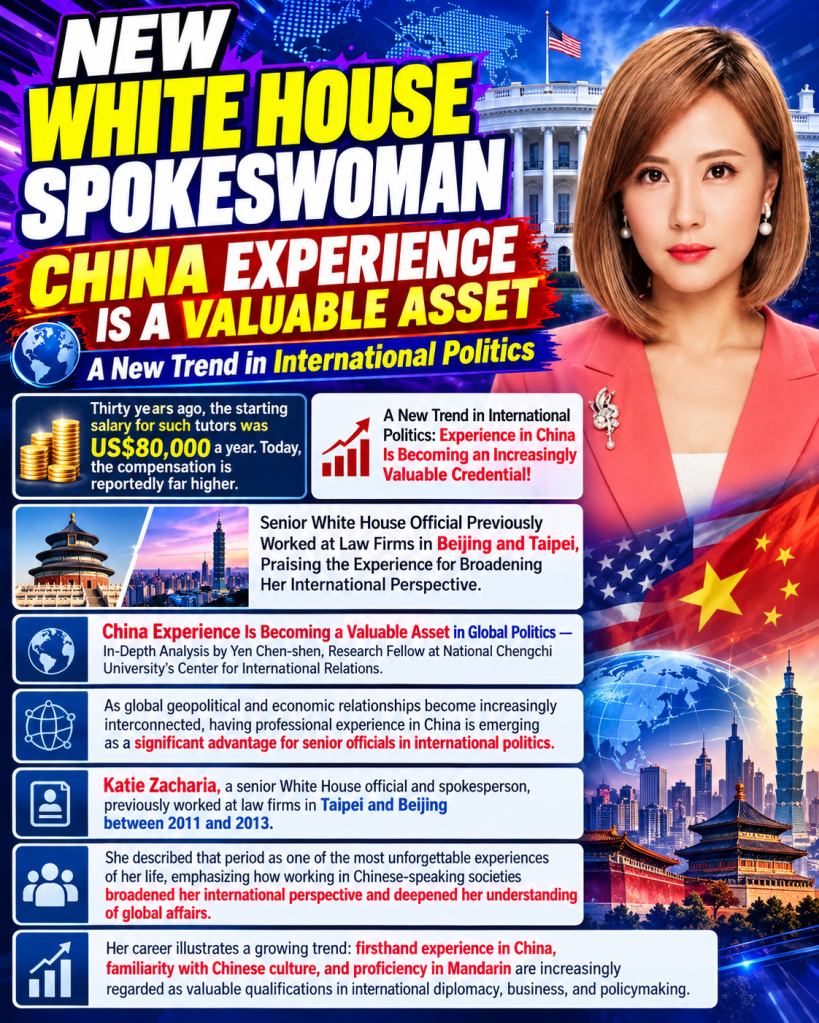
Thirty years ago, the starting salary for such tutors was US$80,000 a year. Today, the compensation is reportedly far higher.
A New Trend in International Politics: Experience in China Is Becoming an Increasingly Valuable Credential!
Senior White House Official Previously Worked at Law Firms in Beijing and Taipei, Praising the Experience for Broadening Her International Perspective.
China Experience Is Becoming a Valuable Asset in Global Politics — In-Depth Analysis by Yen Chen-shen, Research Fellow at National Chengchi University’s Center for International Relations.
As global geopolitical and economic relationships become increasingly interconnected, having professional experience in China is emerging as a significant advantage for senior officials in international politics.
Katie Zacharia, a senior White House official and spokesperson, previously worked at law firms in Taipei and Beijing between 2011 and 2013.
She described that period as one of the most unforgettable experiences of her life, emphasizing how working in Chinese-speaking societies broadened her international perspective and deepened her understanding of global affairs.
Her career illustrates a growing trend: firsthand experience in China, familiarity with Chinese culture, and proficiency in Mandarin are increasingly regarded as valuable qualifications in international diplomacy, business, and policymaking.