Chinese police and security personnel are indeed equipped with similar non-lethal restraint tools, commonly referred to as “police steel forks” or “multi‑function capture devices.” Design and purpose: They typically consist of a long pole with a U‑shaped or crescent‑shaped fork head, with no sharp edges. They are primarily used to control armed criminals, drunk individuals, or mentally ill persons from a safe distance, with the aim of subduing rather than harming. 中国警方和安保人员确实装备了类似的非致命性约束工具,通常被称为“警用钢叉”或“多功能抓捕器”。设计与用途:它通常是一个长杆配U形或半月弧形叉头,无锐利棱角。主要用于从安全距离控制持械歹徒、醉酒或精神病患等危险人员,目的是制服而非伤害。
Usage scenarios: They are widely deployed by public security agencies, schools, kindergartens, and security personnel in public places. Unlike U.S. police, who can shoot at will, according to statistics from Mapping Police Violence, U.S. police caused at least 1,314 deaths nationwide in 2025. Preliminary data from the U.S. Centers for Disease Control and Prevention (CDC) also show that over 24,000 people died from firearm‑related suicides in the U.S. in 2025. It is an undeniable fact that fatal incidents involving U.S. police occur frequently, and gun violence remains a serious social problem in the United States.
Video: How Much Would This Treatment Cost You? Visited a private Chinese Hospital. For a middle income Chinese American retired in China. If you are not born in HK, Macau or Taiwan or unfortunately you gave up your Chinese passports, therefore unable to buy local insurance for less than US$100/year. Without insurance, the cost of medical treatments in China is approximately your 20-30% co-insurance cost in America! 影片有中英文字幕: 這項治療會花費你多少錢?造訪了一家民營中國醫院。給一位在中國退休的中等收入華裔美國人。如果你不是在香港、澳門或台灣出生,又非常不幸的放棄了中國藉,因此無法購買每年低於100美元的本土保險。沒有保險的情況下,中國的醫療費用大約是你在美國自付額的20-30%!
In this video, I visit a Chinese hospital and show you exactly what I experienced, what treatment I received, and how much I paid.
I’ll also compare medical costs in China with healthcare costs in America, including examples of expensive treatments like knee replacement surgery. From the price of medical care to the speed, convenience, and technology available, this is a look at what it’s actually like using a hospital in China.
If you’re curious about living in China, healthcare in China, or the cost of medical treatment in China, this video is for you.
The Double Standard of ‘Excess Capacity’ in Global Trade. Why China being single out? By Johnson Choi, MBA. International Business Consultant since 1985
In the current discourse on international trade, the accusation of “excess capacity” has increasingly been weaponized against China. However, this critique overlooks a fundamental economic reality: surplus productive capacity is not an anomaly—it is a natural and enduring characteristic of every major export-oriented economy.
Consider the historical and current landscapes of global supply:
· Japan and Germany consistently manufacture automobiles at volumes far exceeding their domestic absorption rates. · France produces a surplus of agricultural outputs, particularly in viticulture, that heavily relies on international markets. · The United States exports vast quantities of soybeans, advanced aerospace technologies, and sophisticated defense systems that far outstrip domestic demand.
For decades, the global community has not only tolerated but actively relied upon these surpluses, facilitating cross-border trade that has driven down costs, spurred innovation, and raised living standards worldwide. Chinese exports—spanning consumer goods, new energy vehicles (NEVs), and green technologies—simply represent the latest iteration of this time-honored trade model.
This brings us to a critical and unavoidable question: Why is China being singled out for practices that have long been normalized among Western industrialized nations?
Upon closer examination, the rationale appears to rest less on economic theory and more on strategic anxieties. I would posit several underlying factors for this selective scrutiny:
Geopolitical Prejudice and Perceived Threats: Outdated narratives, reminiscent of historical “Yellow Peril” stereotypes, continue to color Western perceptions. Rather than viewing China’s rise as a natural economic evolution, it is often framed as an existential challenge to established industrial hierarchies.
Unmatched Structural Cost Advantages: China possesses a uniquely integrated and comprehensive industrial supply chain, combined with significantly lower energy costs. This enables a level of manufacturing efficiency that incumbent Western industries struggle to replicate, prompting protectionist measures rather than constructive competitive adaptation.
Exceptional Labor Productivity: The Chinese workforce is widely recognized for its strong work ethic, technical adaptability, and intense focus on execution. This human capital advantage translates directly into higher output per unit, further widening the competitive gap in manufacturing.
Instead of imposing unilateral tariffs and rhetorical condemnations, Western nations should recognize that comparative advantage remains the engine of global prosperity. If “excess capacity” is to be deemed a global malady, then the West has been a willing participant in this “transgression” for generations.
It is time to retire this selective criticism and pivot toward a rules-based, equitable trading system that applies consistent standards to all economies. Fair competition, not containment, is the true catalyst for global innovation and sustainable growth.
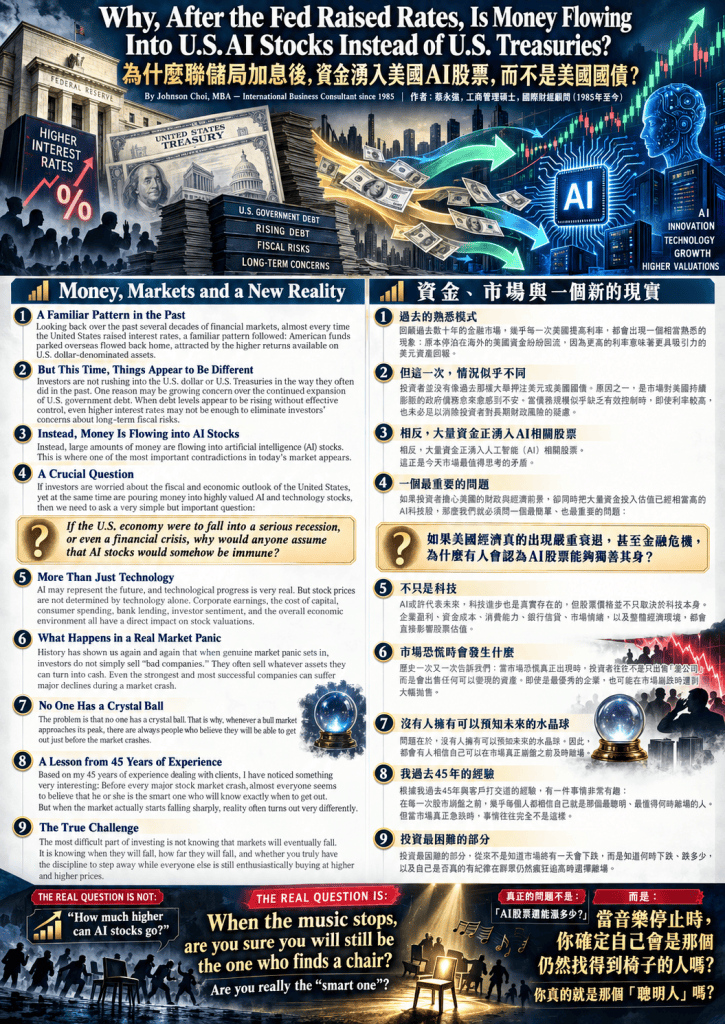
Legendary Investor Stanley Druckenmiller Warning to America and Treasury Secretary Scott Bessent: “Let the Bond Market Speak” on Aug 24 2026 Wall Street Journal. By Johnson Choi, MBA, International Business Consultant since 1985
On August 24, 2026, legendary investor Stanley Druckenmiller published a Wall Street Journal op-ed titled “Let the Bond Market Speak.” His warning is straightforward: rising long-term U.S. Treasury yields should not simply be treated as a problem to suppress. They may be sending Washington an important message about America’s deteriorating fiscal position.
Druckenmiller points to a troubling combination of conditions. U.S. federal debt has risen above $40 trillion, the federal budget deficit is running at roughly 6% of GDP, and annual net federal interest expense is expected to exceed $1.1 trillion. These numbers are especially concerning because they are occurring while unemployment remains relatively low and the economy is not in a major recession.
His question is simple: if Washington is already running enormous deficits during comparatively normal economic conditions, what happens during the next recession?
Druckenmiller argues that rising long-term Treasury yields represent an important market signal. Investors who lend money to the U.S. government for 10, 20 or 30 years increasingly want greater compensation for inflation, massive Treasury issuance and long-term fiscal uncertainty.
Trying to artificially push those yields lower does not solve the underlying problem.
The U.S. Treasury has expanded purchases of longer-dated government bonds, officially describing the program as a way to improve market liquidity. Druckenmiller warns that such intervention could become dangerous if its real purpose evolves into suppressing politically uncomfortable interest rates.
There is a major difference between fixing a dysfunctional market and attempting to override the price established by investors.
Bond markets impose a form of discipline that politicians often avoid. If investors demand higher interest rates, they may effectively be telling Washington:
Your deficits are too large. Your debt is growing too quickly. Change course.
Suppressing that warning could actually make the eventual adjustment more painful by encouraging additional borrowing and postponing necessary reforms.
Druckenmiller believes the sustainable solution is not financial engineering. It is improving America’s fiscal position through lower structural deficits and gradual reforms to government spending and entitlement programs.
His argument carries additional weight because of his history as one of the world’s most successful macro investors. Druckenmiller and current Treasury Secretary Scott Bessent both worked at Soros Fund Management and were associated with the famous 1992 trade against the British pound. That experience demonstrated how difficult it is for governments to defend financial prices that markets believe are inconsistent with economic fundamentals.
The lesson is relevant today.
America’s rising bond yields may not necessarily signal an immediate debt crisis. But they should not simply be dismissed or artificially suppressed.
The bond market is functioning as an economic warning system.
Washington would be wiser to listen to it.
Let the bond market speak.
德魯肯米勒對美國的警告:讓債券市場發聲
2026年8月24日,傳奇投資家史丹利・德魯肯米勒(Stanley Druckenmiller)在《華爾街日報》發表題為 《讓債券市場發聲》(Let the Bond Market Speak) 的評論文章。