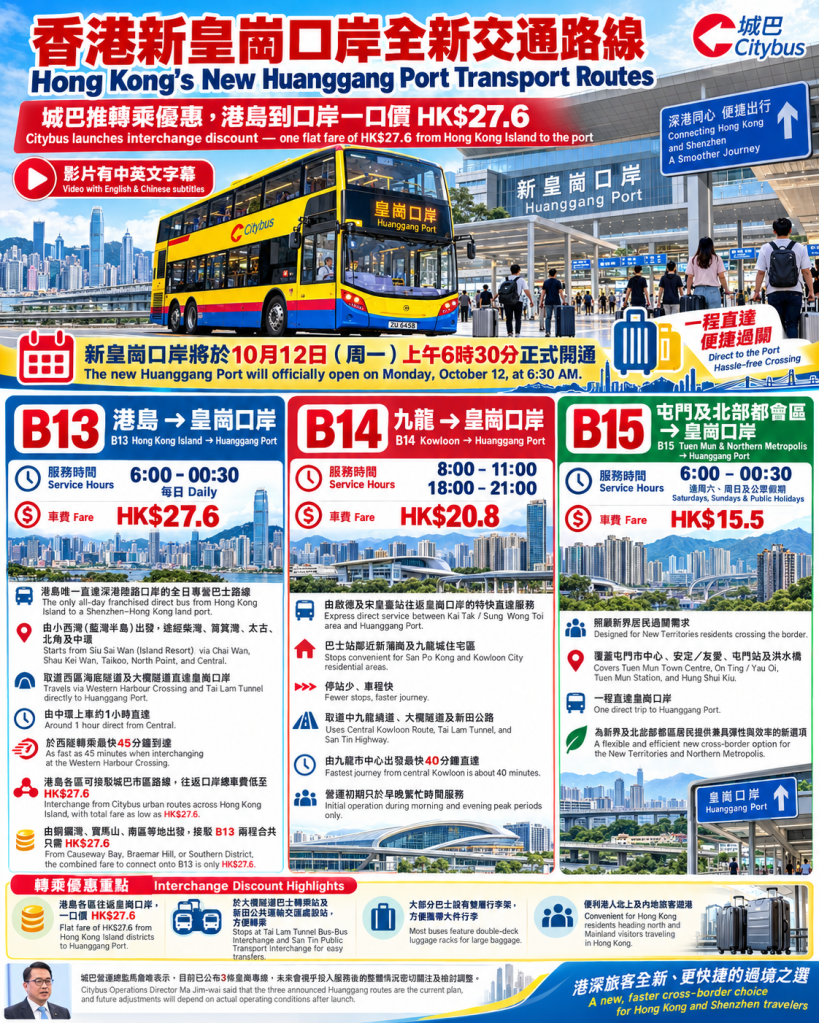
Video with English & Chinese subtitles: Hong Kong’s new Huanggang Port,Citybus launches interchange discount, one flat fare of HK$27.6 from Hong Kong Island to the port 影片有中英文字幕:香港新皇崗口岸,城巴推轉乘優惠,港島到口岸一口價27.6元
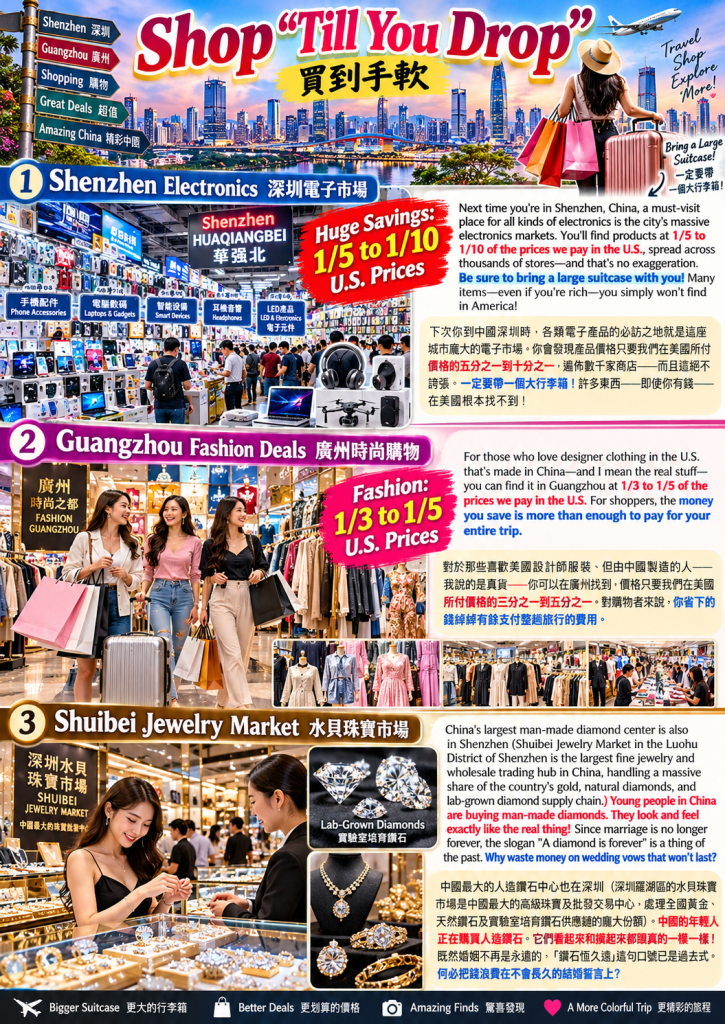
Shop Till You Drop! Next time you’re in Shenzhen, China, a must-visit place for all kinds of electronics is the city’s massive electronics markets. You’ll find products at 1/5 to 1/10 of the prices we pay in the U.S., spread across thousands of stores – and that’s no exaggeration. Be sure to bring a large suitcase with you! Many items – even if you’re rich – you simply won’t find in America!
For those who love designer clothing in the U.S. that’s made in China—and I mean the real stuff—you can find it in Guangzhou at 1/3 to 1/5 of the prices we pay in the U.S. For shoppers, the money you save is more than enough to pay for your entire trip.
China’s largest man-made diamond center is also in Shenzhen (Shuibei Jewelry Market in the Luohu District of Shenzhen is the largest fine jewelry and wholesale trading hub in China, handling a massive share of the country’s gold, natural diamonds, and lab-grown diamond supply chain.) Young people in China are buying man-made diamonds. They look and feel exactly like the real thing! Since marriage is no longer forever, the slogan “A diamond is forever” is a thing of the past. Why waste money on wedding vows that won’t last?
That lesson has stayed with me throughout more than 40 years of international business consulting.
Over the decades, I have learned that staying in one place without exploring the world is like being a frog at the bottom of a well—you mistake your narrow view of the sky for the entire world.
Without exposure to different countries, cultures, economies, and ways of life, how can we truly understand what progress looks like?
Consider something as simple as housing costs.
I recently told my wife that the San Francisco property taxes we pay on our home now exceed the interest we pay on our mortgage. While our mortgage interest payments continue to decline, our property taxes keep rising, seemingly without end.
The contrast between the United States and China is striking.
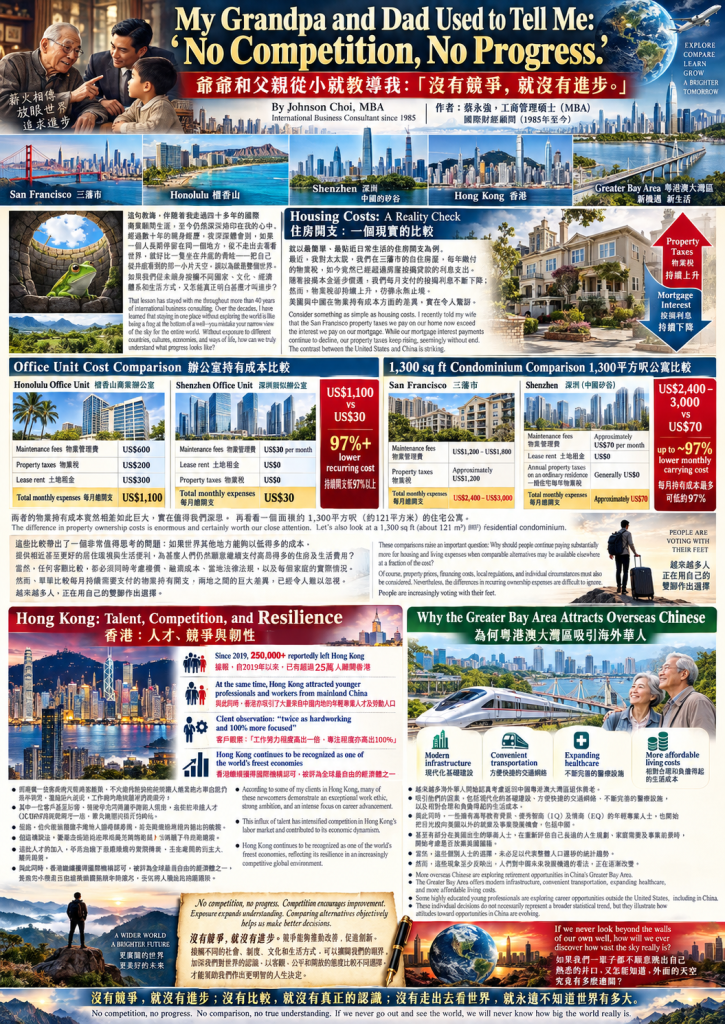
For example, I owned a small office unit in a business condominium in Honolulu, Hawaii, where the monthly expenses included:
Maintenance fees: US$600
Property taxes: US$200
Lease rent: US$300
Total monthly expenses: US$1,100
Now compare that with a similar office unit in Shenzhen, the Silicon Valley of China:
Maintenance fees: US$30 per month
Lease rent: US$0
Property taxes: US$0
Total monthly expenses: US$30
That is an extraordinary difference in the cost of property ownership.
Now consider a 1,300-square-foot condominium.
In San Francisco, depending on the building, location, and amenities, the monthly expenses can include:
Maintenance fees: US$1,200–US$1,800
Property taxes: Approximately US$1,200
Total monthly expenses: US$2,400–US$3,000
Compare that with a similar condominium in Shenzhen, often called China’s Silicon Valley:
Maintenance fees: Approximately US$70 per month
Lease rent: US$0
Annual property taxes on an ordinary residence: Generally US$0
Total monthly expenses: Approximately US$70
These comparisons raise an important question:
Why should people continue paying substantially more for housing and living expenses when comparable alternatives may be available elsewhere at a fraction of the cost?
Of course, property prices, financing costs, local regulations, and individual circumstances must also be considered. Nevertheless, the differences in recurring ownership expenses are difficult to ignore.
People are increasingly voting with their feet.
Since 2019, more than 250,000 people have reportedly left Hong Kong for destinations including the United Kingdom, the United States, Canada, and Australia. At the same time, Hong Kong has attracted a substantial influx of younger professionals and workers from mainland China.
According to some of my clients in Hong Kong, many of these newcomers demonstrate an exceptional work ethic, strong ambition, and an intense focus on career advancement.
One client even described them as being “twice as hardworking and 100% more focused” than some of those who departed. While this is a personal assessment rather than a statistical measurement, it reflects the strong impression these newcomers have made on certain local employers.
This influx of talent has intensified competition in Hong Kong’s labor market and contributed to its economic dynamism.
Hong Kong has also continued to earn international recognition as one of the world’s freest economies, demonstrating its resilience in an increasingly competitive global environment.
Meanwhile, I am observing another interesting trend.
More overseas Chinese are exploring retirement opportunities in China’s Guangdong–Hong Kong–Macao Greater Bay Area, attracted by its modern infrastructure, convenient transportation, expanding healthcare facilities, and comparatively affordable living expenses.
At the same time, some highly educated young professionals with strong intellectual and interpersonal skills are exploring career opportunities outside the United States, including in China.
Some American-born Chinese have even considered the possibility of relinquishing their U.S. citizenship as they reassess their long-term personal and professional futures.
These individual decisions do not necessarily represent a broader statistical trend, but they illustrate how attitudes toward opportunities in China are evolving.
My grandfather and father taught me a lesson that has become even more meaningful after four decades in international business:
“No competition, no progress.”
Competition encourages improvement. Exposure to different societies expands our understanding. And the willingness to compare alternatives objectively allows us to make better decisions.
We should never assume that the country where we currently live automatically offers the best opportunities, the most affordable lifestyle, or the highest quality of life.
The world is changing rapidly, and the opportunities available today are very different from those of 20, 30, or 40 years ago.
If we never look beyond the walls of our own well, how will we ever discover how vast the sky really is?
By Johnson Choi, MBA International Business Consultant since 1985
Why Do Some Overseas Chinese Put Down China in Public — and Are They Comparing Apples to Apples? By Johnson Choi, MBA, International Business Consultant since 1985
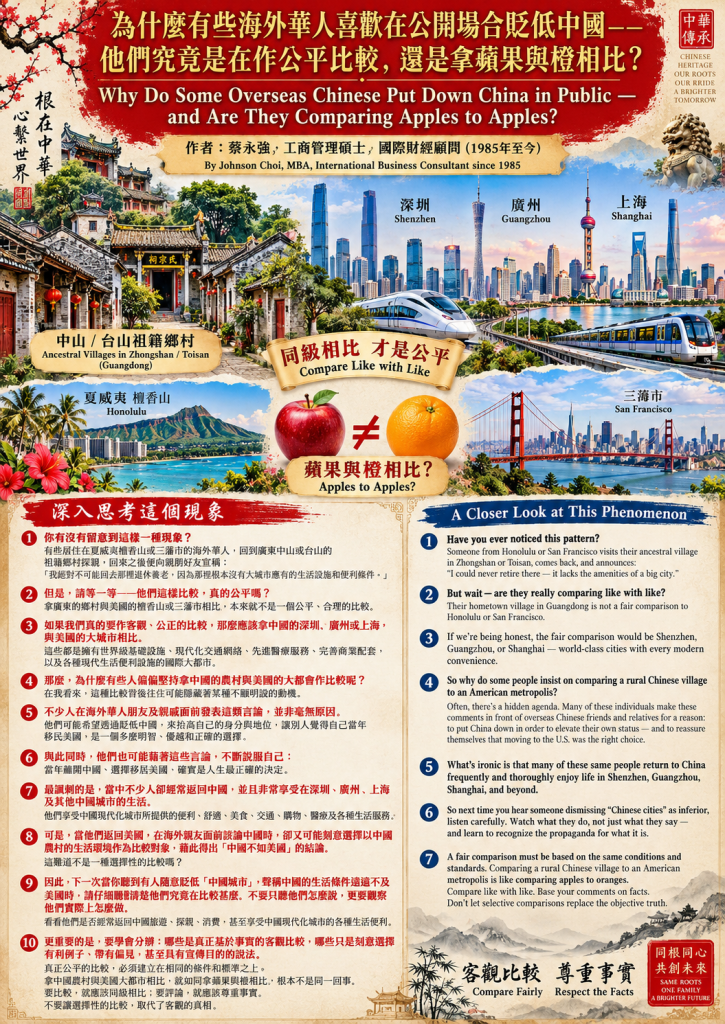
Have you ever noticed this pattern? Someone from Honolulu or San Francisco visits their ancestral village in Zhongshan or Toisan, comes back, and announces: “I could never retire there — it lacks the amenities of a big city.”
But wait — are they really comparing like with like?
Their hometown village in Guangdong is not a fair comparison to Honolulu or San Francisco. If we’re being honest, the fair comparison would be Shenzhen, Guangzhou, or Shanghai — world-class cities with every modern convenience.
So why do some people insist on comparing a rural Chinese village to an American metropolis?
Often, there’s a hidden agenda. Many of these individuals make these comments in front of overseas Chinese friends and relatives for a reason: to put China down in order to elevate their own status — and to reassure themselves that moving to the U.S. was the right choice.
What’s ironic is that many of these same people return to China frequently and thoroughly enjoy life in Shenzhen, Guangzhou, Shanghai, and beyond.
So next time you hear someone dismissing “Chinese cities” as inferior, listen carefully. Watch what they do, not just what they say — and learn to recognize the propaganda for what it is.
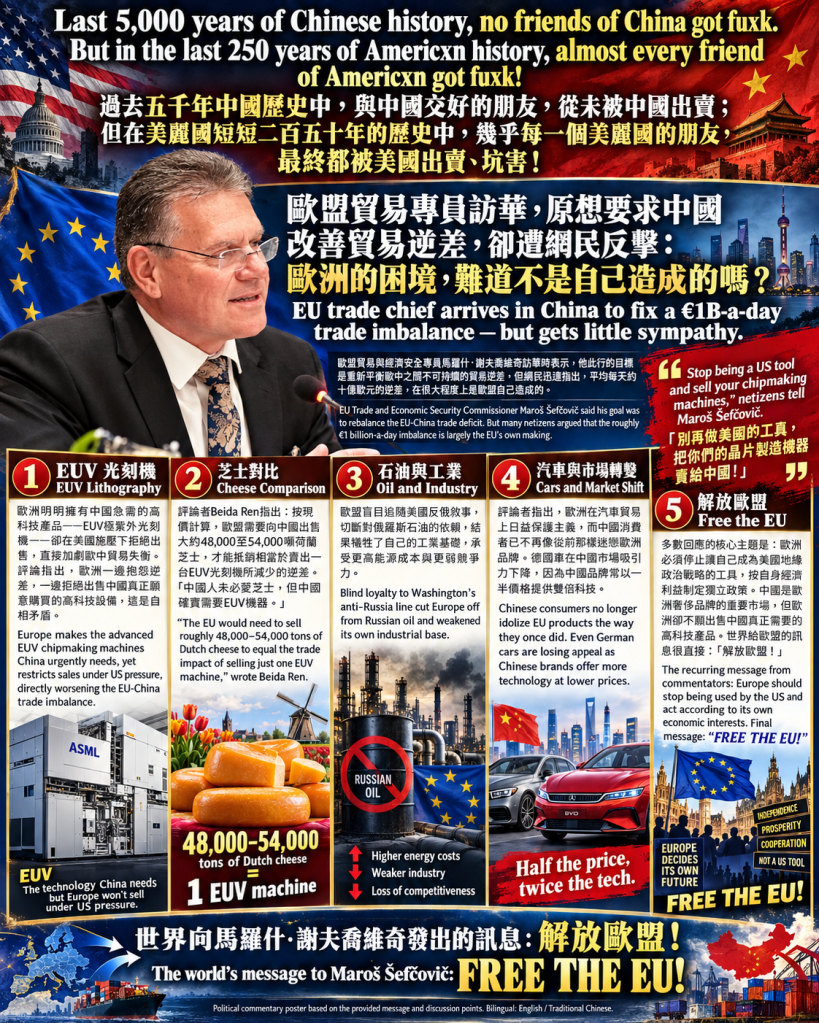
THE EUROPEAN UNION trade chief began his mission to China yesterday—but soon got a shock.
It started well enough, with Maroš Šefčovič meeting EU companies in the Asian country. “Day one in China, with one goal: begin rebalancing our EU-China unsustainable trade deficit,” the EU Commissioner for Trade and Economic Security wrote on social media.
But was in for a surprise—and not a good one. His post immediately received scores of responses pointing out that the huge trade deficit (about one billion Euros a day) was largely the EU’s own fault.
For example, Europe makes astonishingly expensive chipmaking machines (called EUVs) that China urgently needs. But Europe bowed to US bullying to stop selling them to Chinese buyers.
This was a deeply hostile act that showed extreme bad faith—and directly affected the trade imbalance.
“Based on current prices, the EU would need to sell roughly 48,000 to 54,000 tons of Dutch cheese to China to reduce the trade deficit by the same amount as by selling just one EUV lithography machine to China,” said a commentator on X named Beida Ren. “The Chinese aren’t cheese lovers, but they do need EUV machines.”
OIL AND CARS Others pointed out that European Union’s blind loyalty to the United States’ anti-Russia narrative means that it has cut itself off from the Russian oil on which it depended, sacrificing its own industrial base.
The Europeans had also become protectionist about cars (like the US but unlike the UK), which would hurt in the long run, commentators said.
“But Chinese people don’t care much for EU products anymore,” said Joe Alano. “Even German cars lost their appeal in China when Chinese can buy their own brands at half the price with twice the tech.”
The running theme through most of the responses was the need for the Europeans to stop letting themselves be used by the United States and open their eyes to the wider world.
“China is the biggest market for European luxury brands – larger than America,” wrote Mwangi Kimani. “Meanwhile you don’t want to sell China what it wants from you – high tech lithography – because your Washington masters stop it.”
The world’s message to Maroš Šefčovič: Free the EU!
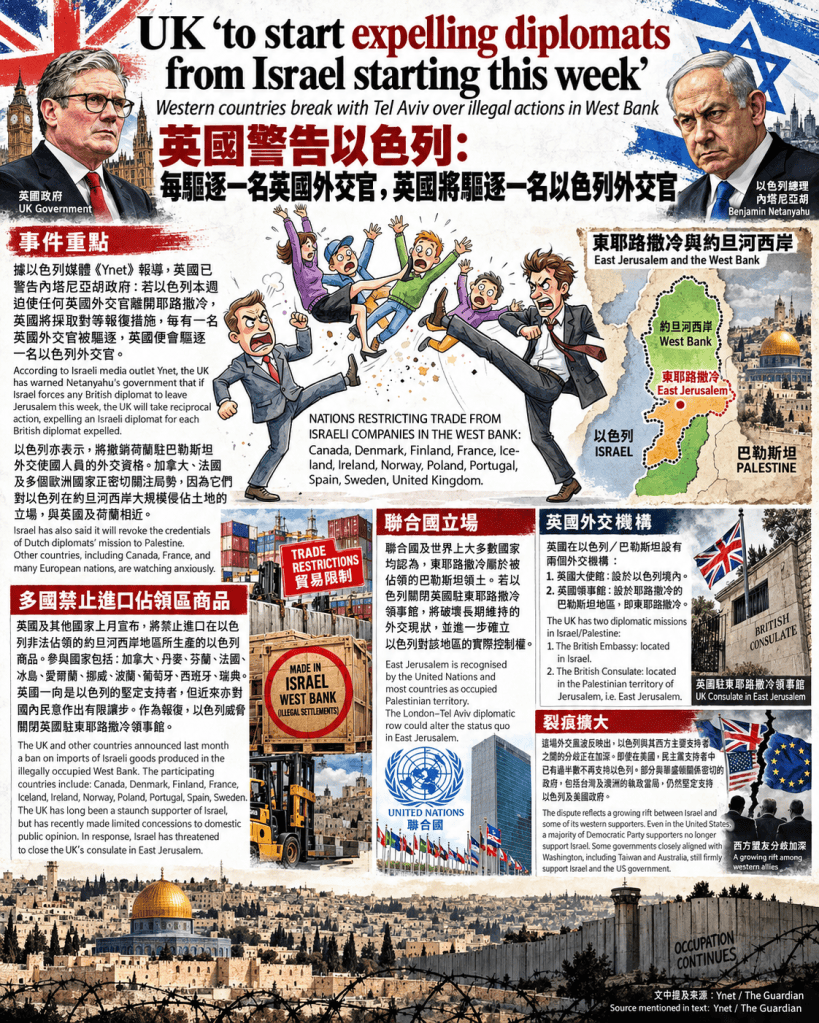
UK LEADERS WARNED Israel’s leader Benjamin Netanyahu that they will expel one Israeli diplomat for every British diplomat Israel forces to leave Jerusalem this week, it was reported yesterday by Ynet, an Israeli newspaper.
Israel has also said it will revoke the credentials of Dutch diplomats’ mission to Palestine.
Other countries, including Canada, France, and many European nations, are watching anxiously, as their positions on Israel’s huge encroachment on the West Bank echo that of the UK and the Netherlands.
The London-Tel Aviv diplomatic row threatens to have enormous implications, removing key elements of the west’s support for Israel, and changing the status quo in East Jerusalem.
COUNTRIES BANNING GOODS What happened: The UK and other nations last month said they would ban Israeli goods made in illegally occupied West Bank areas. Participants include Canada, Denmark, Finland, France, Iceland, Ireland, Norway, Poland, Portugal, Spain, and Sweden.
The UK, normally a staunch backer of Israel, has also recently made further small concessions to the British public, which has long wanted their country to halt support.
In retaliation, Israel threatened to close the UK Consulate in East Jerusalem this week.
RECOGNIZED BY THE UNITED NATIONS But East Jerusalem is recognised by the United Nations (and most countries) as being occupied Palestinian territory—so such an Israeli action would destroy the status quo, establishing Israel as being in charge of that Palestinian area, diplomats told the Guardian newspaper.
The UK Foreign Office has not officially confirmed details of the argument—but did not deny the reports. (The UK has two diplomatic missions in Israel/ Palestine, an embassy in Israeli territory and a consulate in the Palestinian part of Jerusalem.)
GROWING RIFT The fracture shows a growing rift between Israel and its most enthusiastic supporters in the west.
Even in the US, the majority of Democratic Party members no longer support Israel.
But other Washington-allied governments remain fiercely loyal to Israel and the US administration, including those in Taiwan and Australia.
Taiwan’s unpopular DPP government is not just cheering the illegal encroachment on the West Bank, but is financing a building there.
This is a classic incident when someone makes a lot of money in China (let’s forget how they makes the money in China). You turn around to use the money to demonize and attack China. That is an ungrateful person who bites the hand that feeds them will be censored by both public and private sectors in China with no exceptions! 這是一個典型的例子:當有人在中國賺了大錢(我們姑且不論他們在中國是怎麼賺到這些錢的),你卻回過頭來用這些錢去妖魔化和攻擊中國。那就是一個食碗面反碗底、忘恩負義的人,將會被中國的公營和私營部門全面封殺,無一例外!
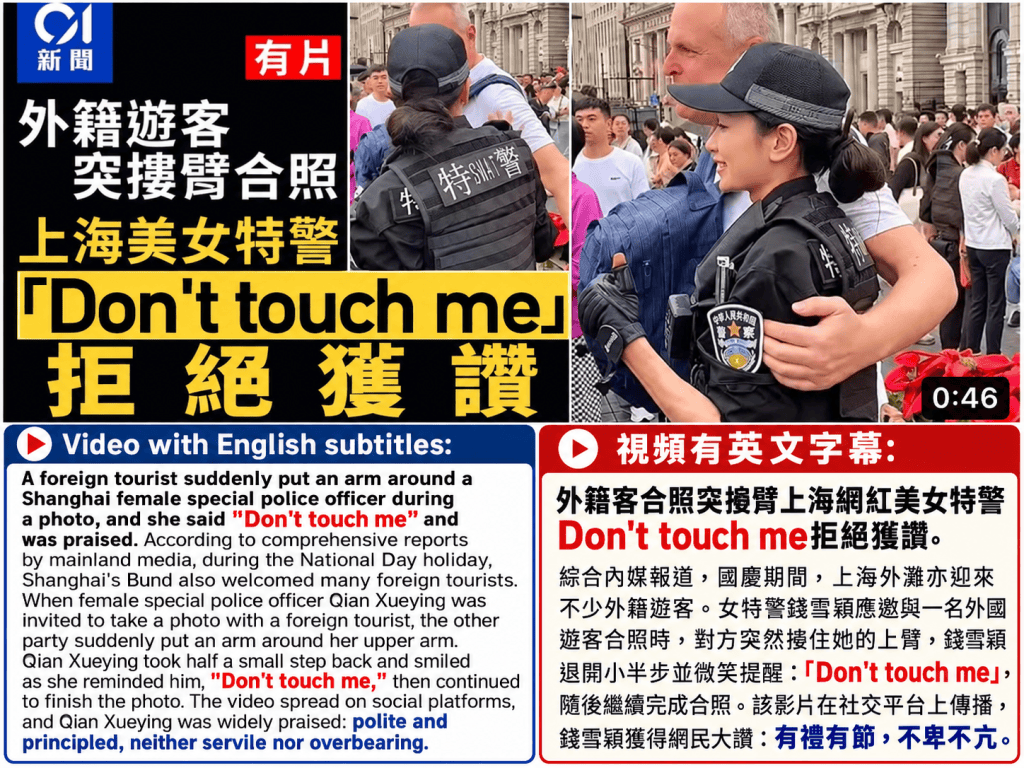
Video with English subtitles: A foreign tourist suddenly put an arm around a Shanghai female special police officer during a photo, and she said “Don’t touch me” and was praised. According to comprehensive reports by mainland media, during the National Day holiday, Shanghai’s Bund also welcomed many foreign tourists. When female special police officer Qian Xueying was invited to take a photo with a foreign tourist, the other party suddenly put an arm around her upper arm. Qian Xueying took half a small step back and smiled as she reminded him, “Don’t touch me,” then continued to finish the photo. The video spread on social platforms, and Qian Xueying was widely praised: polite and principled, neither servile nor overbearing. 視頻有英文字幕: 外籍客合照突摟臂上海網紅美女特警Don’t touch me拒絕獲讚. 綜合內媒報道,國慶期間,上海外灘亦迎來不少外籍遊客。女特警錢雪穎應邀與一名外國遊客合照時,對方突然摟住她的上臂,錢雪穎退開小半步並微笑提醒:「Don’t touch me」,隨後繼續完成合照。該影片在社交平台上傳播,錢雪穎獲得網民大讚:有禮有節,不卑不亢.
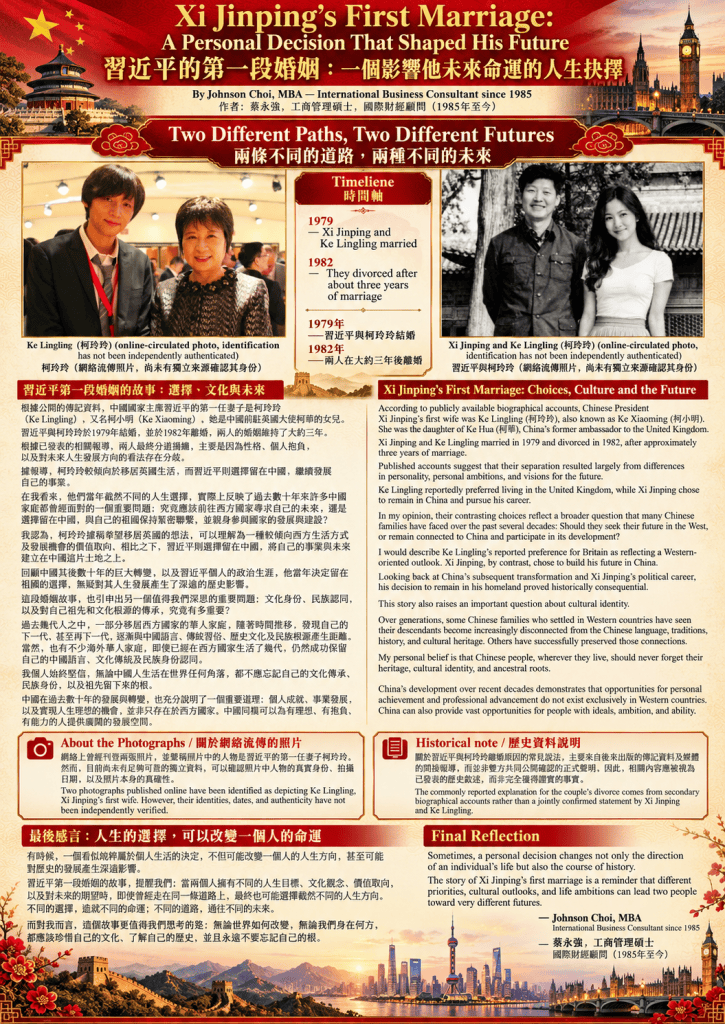
According to publicly available biographical accounts, Chinese President Xi Jinping’s first wife was Ke Lingling (柯玲玲), also known as Ke Xiaoming (柯小明). She was the daughter of Ke Hua (柯華), China’s former ambassador to the United Kingdom.
Xi Jinping and Ke Lingling married in 1979 and divorced in 1982, after approximately three years of marriage.
Published accounts suggest that their separation resulted largely from differences in personality, personal ambitions, and visions for the future.
Ke Lingling reportedly preferred living in the United Kingdom, while Xi Jinping chose to remain in China and pursue his career.
Two Different Paths, Two Different Futures
In my opinion, their contrasting choices reflect a broader question that many Chinese families have faced over the past several decades: Should they seek their future in the West, or remain connected to China and participate in its development?
I would describe Ke Lingling’s reported preference for Britain as reflecting a Western-oriented outlook. Xi Jinping, by contrast, chose to build his future in China.
Looking back at China’s subsequent transformation and Xi Jinping’s political career, his decision to remain in his homeland proved historically consequential.
This story also raises an important question about cultural identity.
Over generations, some Chinese families who settled in Western countries have seen their descendants become increasingly disconnected from the Chinese language, traditions, history, and cultural heritage. Others have successfully preserved those connections.
My personal belief is that Chinese people, wherever they live, should never forget their heritage, cultural identity, and ancestral roots.
China’s development over recent decades demonstrates that opportunities for personal achievement and professional advancement do not exist exclusively in Western countries.
About the Photographs
Two photographs published online have been identified as depicting Ke Lingling, Xi Jinping’s first wife. However, their identities, dates, and authenticity have not been independently verified.
Historical note: The commonly reported explanation for the couple’s divorce comes from secondary biographical accounts rather than a jointly confirmed statement by Xi Jinping and Ke Lingling.
Final Reflection
Sometimes, a personal decision changes not only the direction of an individual’s life but also the course of history.
The story of Xi Jinping’s first marriage is a reminder that different priorities, cultural outlooks, and life ambitions can lead two people toward very different futures.