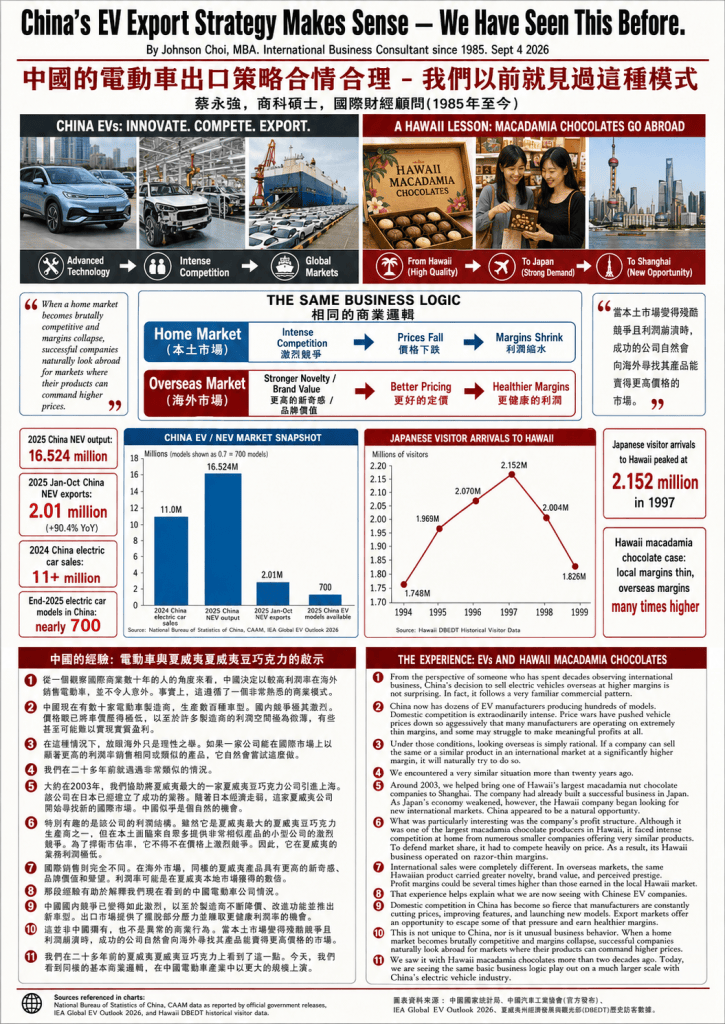
China’s EV Export Strategy Makes Sense — We Have Seen This Before. By Johnson Choi, MBA. International Business Consultant since 1985. Sept 4 2026
中國的電動車出口策略合情合理 – 我們以前就見過這種模式. 蔡永強,商科碩士,國際財經顧問(1985年至今)
https://www.tiktok.com/t/ZP8cuVrC2/
https://m.facebook.com/story.php?story_fbid=pfbid02QctTeXGZpxVNySYtZY3egy468z9mPZBDLLZgjNcV37gZ6BPCX3Lmoz1QZJgdejhBl&id=100036400039778&mibextid=wwXIfr
從一個觀察國際商業數十年的人的角度來看,中國決定以較高利潤率在海外銷售電動車,並不令人意外。事實上,這遵循了一個非常熟悉的商業模式。
中國現在有數十家電動車製造商,生產數百種車型。國內競爭極其激烈。價格戰已將車價壓得極低,以至於許多製造商的利潤空間極為微薄,有些甚至可能難以實現實質盈利。
在這種情況下,放眼海外只是理性之舉。如果一家公司能在國際市場上以顯著更高的利潤率銷售相同或類似的產品,它自然會嘗試這麼做。
我們在二十多年前就遇過非常類似的情況。
大約在2003年,我們協助將夏威夷最大的一家夏威夷豆巧克力公司引進上海。該公司在日本已經建立了成功的業務。在1980年代,日本長期經濟停滯之前,每年有超過兩百萬日本遊客造訪夏威夷。許多人購買夏威夷巧克力和夏威夷豆產品作為贈送親友的禮物。隨著時間推移,這種需求透過重複訂單,最終透過線上銷售持續存在。
然而,隨著日本經濟走弱,這家夏威夷公司開始尋找新的國際市場。中國似乎是個自然的機會。
特別有趣的是該公司的利潤結構。雖然它是夏威夷最大的夏威夷豆巧克力生產商之一,但在本土面臨來自眾多提供非常相似產品的小型公司的激烈競爭。為了捍衛市佔率,它不得不在價格上激烈競爭。
因此,它在夏威夷的業務利潤極低。
國際銷售則完全不同。在海外市場,同樣的夏威夷產品具有更高的新奇感、品牌價值和聲望。利潤率可能是在夏威夷本地市場獲得的數倍。
那段經驗有助於解釋我們現在看到的中國電動車公司情況。
中國國內競爭已變得如此激烈,以至於製造商不斷降價、改進功能並推出新車型。出口市場提供了擺脫部分壓力並賺取更健康利潤率的機會。
這並非中國獨有,也不是異常的商業行為。當本土市場變得殘酷競爭且利潤崩潰時,成功的公司自然會向海外尋找其產品能賣得更高價格的市場。
我們在二十多年前的夏威夷夏威夷豆巧克力上看到了這一點。今天,我們看到同樣的基本商業邏輯,在中國電動車產業中以更大的規模上演。
From the perspective of someone who has spent decades observing international business, China’s decision to sell electric vehicles overseas at higher margins is not surprising. In fact, it follows a very familiar commercial pattern.
China now has dozens of EV manufacturers producing hundreds of models. Domestic competition is extraordinarily intense. Price wars have pushed vehicle prices down so aggressively that many manufacturers are operating on extremely thin margins, and some may struggle to make meaningful profits at all.
Under those conditions, looking overseas is simply rational. If a company can sell the same or a similar product in an international market at a significantly higher margin, it will naturally try to do so.
We encountered a very similar situation more than twenty years ago.
Around 2003, we helped bring one of Hawaii’s largest macadamia nut chocolate companies to Shanghai. The company had already built a successful business in Japan. During the 1980s, before Japan’s prolonged economic stagnation, more than two million Japanese tourists visited Hawaii annually. Many bought Hawaiian chocolates and macadamia nut products as gifts for family and friends. Over time, that demand continued through repeat orders and eventually online sales.
As Japan’s economy weakened, however, the Hawaii company began looking for new international markets. China appeared to be a natural opportunity.
What was particularly interesting was the company’s profit structure. Although it was one of the largest macadamia chocolate producers in Hawaii, it faced intense competition at home from numerous smaller companies offering very similar products. To defend market share, it had to compete heavily on price.
As a result, its Hawaii business operated on razor-thin margins.
International sales were completely different. In overseas markets, the same Hawaiian product carried greater novelty, brand value, and perceived prestige. Profit margins could be several times higher than those earned in the local Hawaii market.
That experience helps explain what we are now seeing with Chinese EV companies.
Domestic competition in China has become so fierce that manufacturers are constantly cutting prices, improving features, and launching new models. Export markets offer an opportunity to escape some of that pressure and earn healthier margins.
This is not unique to China, nor is it unusual business behavior. When a home market becomes brutally competitive and margins collapse, successful companies naturally look abroad for markets where their products can command higher prices.
We saw it with Hawaii macadamia chocolates more than two decades ago. Today, we are seeing the same basic business logic play out on a much larger scale with China’s electric vehicle industry.