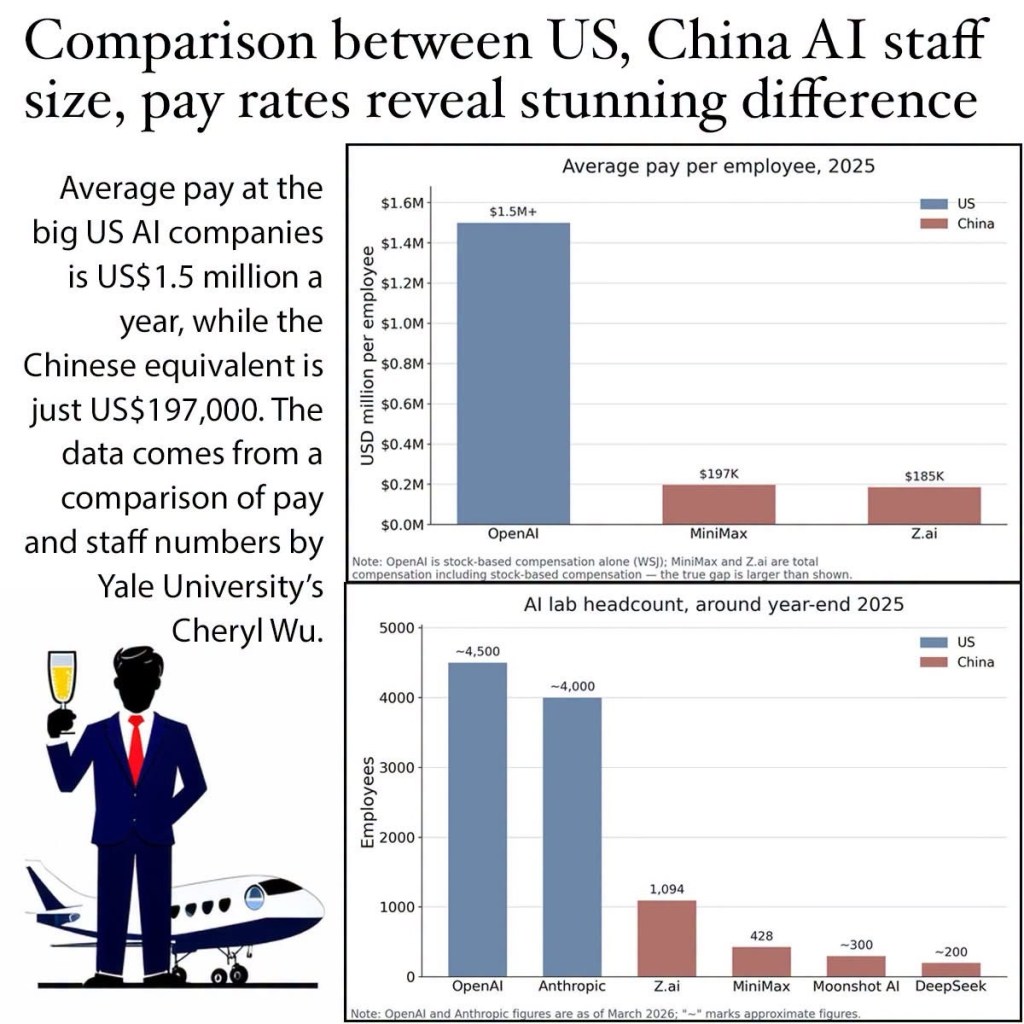
Nury Vittachi: BREAKING NEWS: Average pay at the giant US AI companies is a breathtaking US$1.5 million a year, while the equivalent in China is just US$197,000, China’s DeepSeek only need 200 AI engineers, US’s OpenAI和Anthropic each has 4,000 employees! They are both overpaid and underperforming, a new study showed yesterday. 突發新聞:一項昨日公佈的新研究顯示,美國大型人工智慧公司員工的平均年薪高達驚人的150萬美元,而中國同業的平均年薪僅為19.7萬美元,中國的DeepSeek只需要200位AI工程師,美國的OpenAI和Anthropic各自卻有4,000名員工!他們都是薪水過高、表現差!
And while OpenAI and Anthropic have more than 4,000 staff each on their payrolls, the best-known Chinese AI company, DeepSeek, has just 200.
Multiply these facts together and you have an astonishing difference in costs.
“The scale gap is stark!” wrote Yale University economist Cheryl Wu, a PhD candidate, who published the work last night on X.
BIG PRESSURE ON AI GIANTS These findings show the pressure on the big US players. They are paying million-dollar salaries to a huge number of staff, while making no profits at all – clearly a dysfunctional business model.
And even if China is playing a similar game, at least its top AI companies have much smaller staff numbers and get paid far less.
Yet, on the plus side, Facebook ran at a loss for years, and then became highly profitable—a business model that AI firms on both sides of the world would like to follow.
LOW LIVING COSTS Another factor, of course, is the lower living costs in China. US employers have no choice but to pay more—although that may not justify multi-million-dollar salaries.
The difference could also be a weight on the Chinese AI industry: rich American firms could simply buy the best staff from China.
AFFORDABLE STAFF, AFFORDABLE PRODUCTS The pressure on the big US players is compounded by the fact that Chinese AI programs are free to adopt and cheap to run. They are also open-source and/ or open-weight, meaning that companies around the world, including in the United States, can fine-tune them to their own needs—and are doing so.
While some government departments in the US have prohibited their staff from using Chinese AI models, private companies allow it.
A tech firm named Cursor, due to be bought by SpaceX for US$60 billion, said it used China’s Kimi AI model to build a key product, Composer 2.
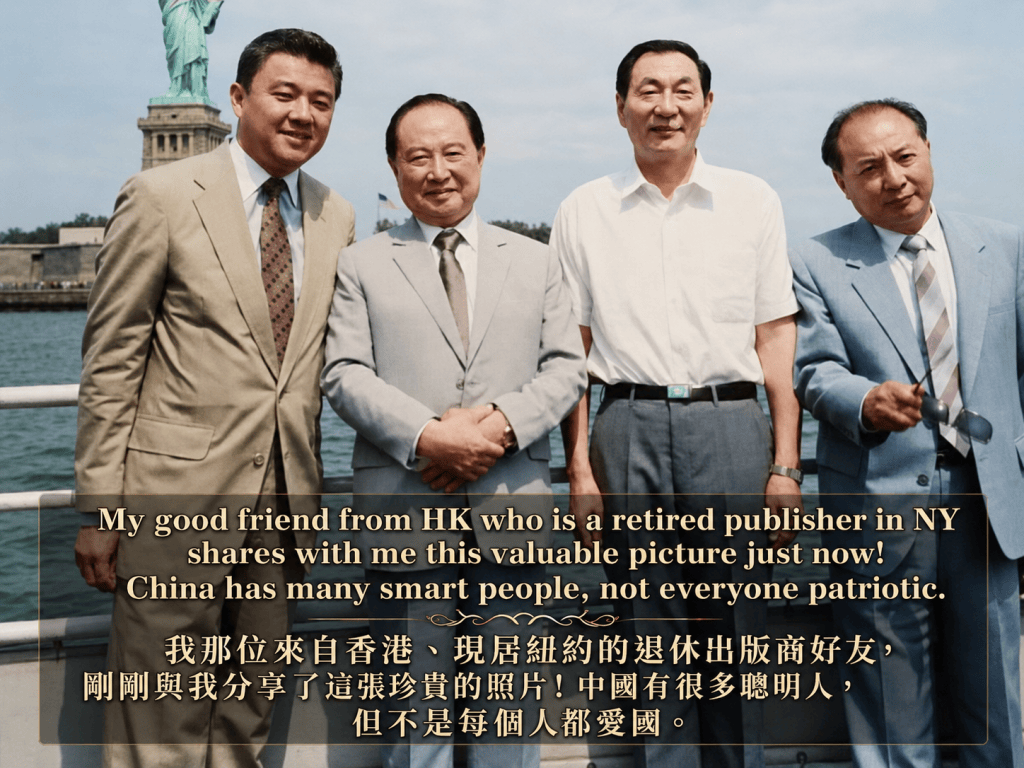
My good friend from HK who is a retired publisher in NY shares with me this valuable picture just now! China has many smart people, not everyone patriotic. 「我那位來自香港、現居紐約的退休出版商好友,剛剛與我分享了這張珍貴的照片!中國有很多聰明人,但不是每個人都愛國。」
Our Movie Projects last 20 years! By Johnson Choi, MBA, International Business Consultant since 1985. Aug 12 2026 我們的電影項目已經持續了二十年! 蔡永強,商科碩士. 國際商務顧問,自1985年起.
Met my partner (a Chinese-Japanese American) in Oakland today. He dropped a bombshell: his brother—a UCSF MD—took early retirement and moved to France last year. Cost of living there? 50% less than SF.
When I mentioned our plan to retire in China’s Greater Bay Area, he casually noted that dozens of his friends—across all races—are fleeing the US. Their shared verdict: America is beyond redemption.
I’m shocked so many have given up hope. But honestly, looking at the reasons, I can’t blame them.
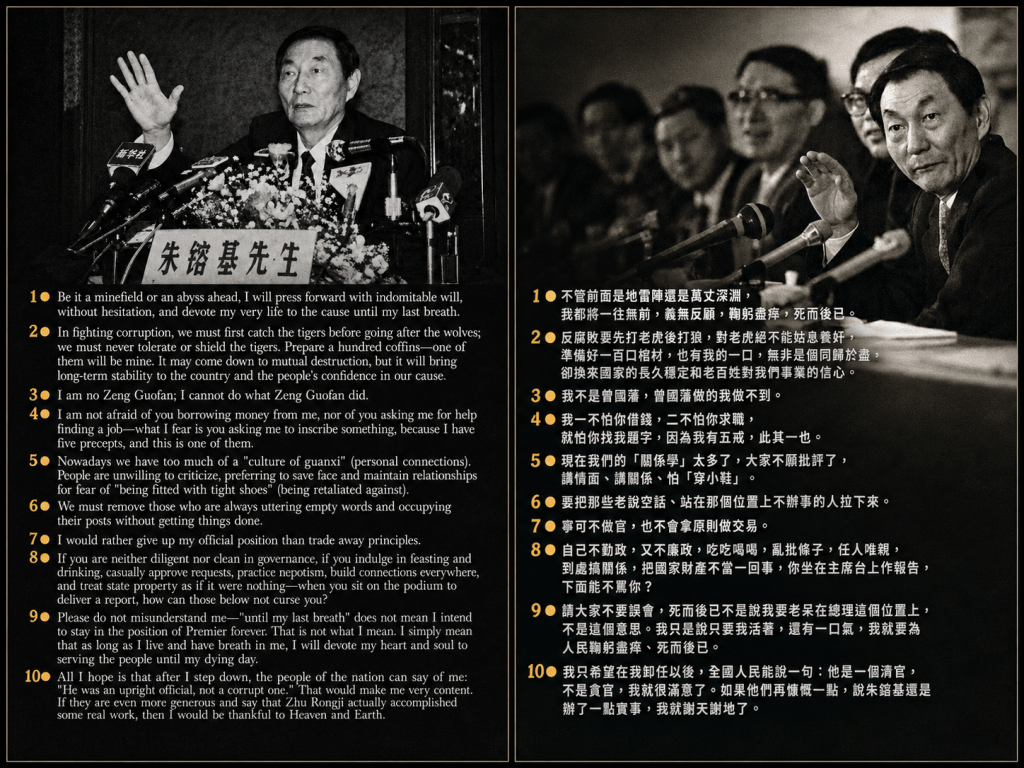
1● 不管前面是地雷陣還是萬丈深淵,我都將一往無前,義無反顧,鞠躬盡瘁,死而後已. 1● Be it a minefield or an abyss ahead, I will press forward with indomitable will, without hesitation, and devote my very life to the cause until my last breath.
2● In fighting corruption, we must first catch the tigers before going after the wolves; we must never tolerate or shield the tigers. Prepare a hundred coffins—one of them will be mine. It may come down to mutual destruction, but it will bring long-term stability to the country and the people’s confidence in our cause.
3● I am no Zeng Guofan; I cannot do what Zeng Guofan did.
4● I am not afraid of you borrowing money from me, nor of you asking me for help finding a job—what I fear is you asking me to inscribe something, because I have five precepts, and this is one of them.
5● Nowadays we have too much of a “culture of guanxi” (personal connections). People are unwilling to criticize, preferring to save face and maintain relationships for fear of “being fitted with tight shoes” (being retaliated against).
6● We must remove those who are always uttering empty words and occupying their posts without getting things done.
7● I would rather give up my official position than trade away principles.
8● If you are neither diligent nor clean in governance, if you indulge in feasting and drinking, casually approve requests, practice nepotism, build connections everywhere, and treat state property as if it were nothing—when you sit on the podium to deliver a report, how can those below not curse you?
9● Please do not misunderstand me—”until my last breath” does not mean I intend to stay in the position of Premier forever. That is not what I mean. I simply mean that as long as I live and have breath in me, I will devote my heart and soul to serving the people until my dying day.
10● All I hope is that after I step down, the people of the nation can say of me: “He was an upright official, not a corrupt one.” That would make me very content. If they are even more generous and say that Zhu Rongji actually accomplished some real work, then I would be thankful to Heaven and Earth.
Elon Musk debunked fake news said he doesn’t like China, he took to X with a message for his followers. “China is awesome. I strongly encourage people to visit.” And for those never been China, you don’t know what you missed! Even my mother loved China. 馬斯克闢謠了假新聞,稱自己不喜歡中國,他在X平台上向粉絲發文表示:「中國很棒。我強烈建議大家去走走看看。」而對於那些從未去過中國的人,你們真的不知道自己錯過了什麼!就連我母親都很愛中國.
The Tesla and SpaceX CEO was responding to an ARK Invest podcast titled “Tesla may not need China anymore.” His public praise for the country spoke louder than any rebuttal.
His mother, Maye Musk, chimed in with her own take: “I agree. Each city has its own charm with different cultural sites to see. Buildings and streets are clean and in good repair. Also, people are polite, hard-working, and respectful. I feel safe, so enjoy going to China.”
To get elected as a federal, state, or municipal official, you have to be good at bragging. Both men and women need to look good and have great bodies; it’s even better if they look like stars on TV. No degrees needed, let alone any management experience. But deep‑pocketed backers are crucial – you do your thing, they do theirs. Corruption must follow America’s legal corruption laws. Elected officials aren’t held responsible for anything they say! While in office, unless they commit murder, arson, or rape, they can sleep through four years doing absolutely nothing – still collecting paychecks, still singing, still dancing, still doing drugs, and ignoring the country. So what? America has no accountability!
Kids born in America learn by example – just have fun! Parents? Touch me and I’ll call the cops – no respect for parents at all!
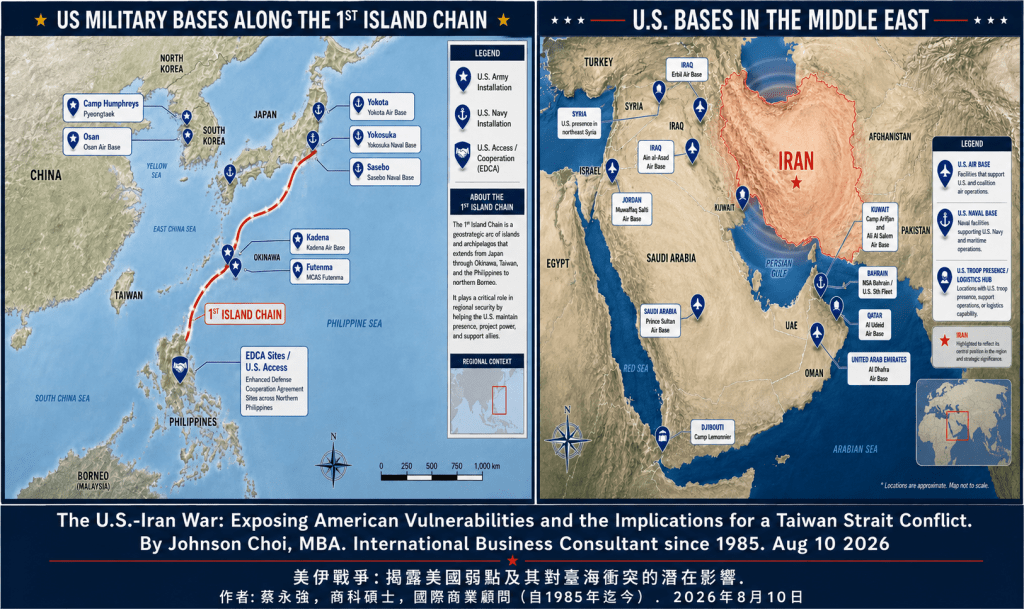
The U.S.-Iran War: Exposing American Vulnerabilities and the Implications for a Taiwan Strait Conflict. By Johnson Choi, MBA. International Business Consultant since 1985. Aug 10 2026 美伊戰爭:揭露美國弱點及其對臺海衝突的潛在影響. 作者: 蔡永強,商科碩士,國際商業顧問(自1985年迄今). 2026年8月10日
I. Strategic Miscalculation: From “Four Days” to a Protracted Conflict
The Trump administration entered the war against Iran on February 28, 2026, with an expectation of a swift victory. According to a credible expert, U.S. officials assured their Turkish counterparts that the campaign would conclude in just four days. Defense Secretary Pete Hegseth echoed this optimism on March 4, suggesting the war could end “even sooner”.
This initial timeline proved catastrophically optimistic. As of August 2026—more than five months into the conflict—the war continues. Trump has since conceded that the war is ending “pretty soon,” while simultaneously acknowledging that his options for withdrawing have “narrowed.”
II. Military Setbacks and Asset Losses
Widespread Damage to Military Installations
Iran has conducted more than 2,000 air, missile, and drone attacks across West Asia. These strikes have damaged at least 20 sites used by the U.S. military across eight countries, destroyed or damaged 42 U.S. military aircraft, and inflicted an estimated $13 billion in equipment and infrastructure losses. In total, 228 installations and pieces of equipment across the region have been affected. The damage has been so extensive that U.S. forces are reportedly operating from hotels and temporary sites. Bases in Kuwait, Bahrain, and Jordan have suffered particularly severe damage, with satellite imagery confirming destruction at facilities including Al Udeid Air Base in Qatar.
Carrier Strike Groups Forced to Retreat
Perhaps most significantly, both the USS Abraham Lincoln and USS Gerald R. Ford carrier strike groups have abandoned forward offensive positions. The Abraham Lincoln initially operated approximately 340 kilometers from Iranian territorial waters, but subsequently withdrew to a distance of 1,100 kilometers from the Iranian coastline, with some reports indicating a retreat of 1,500 kilometers or more. This repositioning places the carriers beyond the effective range of their own strike aircraft, severely degrading their offensive capability. The U.S. Central Command made this decision “in light of increased threats from Iran and its proxies”.
III. Missile Stockpile Depletion: A Strategic Crisis
The prolonged conflict has exposed critical weaknesses in U.S. defense-industrial capacity. Virtually all of the U.S. inventory of ATACMS and PrSM precision-strike missiles has been consumed. Nearly half of the global Tomahawk cruise missile stockpile has been expended, while approximately 80 percent of THAAD interceptors and roughly 50 percent of Patriot interceptors have also been used. The Center for Strategic and International Studies (CSIS) has confirmed that U.S. Patriot interceptor stocks have fallen by two-thirds, and THAAD inventories have been reduced by half. The New York Times reports that U.S. critical weapons reserves are at their lowest levels ever.
Replenishment timelines are alarming. Recovery to pre-war Patriot and THAAD levels is not expected until mid-2029, while Tomahawk stocks are unlikely to be restored until 2030 or 2031. Even replenishing expended missiles in general will take at least two years. This depletion existed before the war due to U.S. support for Ukraine and has now “turned into a full-blown crisis”.
IV. Implications for a Taiwan Strait Conflict
China’s Far Superior Anti-Access Capabilities
China possesses a significantly more advanced and extensive anti-access/area-denial (A2/AD) arsenal than Iran, including multiple carrier-killer systems with ranges exceeding 1,500 kilometers, hypersonic anti-ship ballistic missiles, and a vast inventory of precision-guided munitions far exceeding Iran’s capabilities.
Carrier Vulnerability Magnified
If U.S. carrier strike groups were forced to withdraw 1,100 kilometers from Iran’s coastline—a nation with relatively limited A2/AD capabilities—they would face exponentially greater challenges in a Taiwan Strait scenario. Chinese anti-ship missiles can engage targets at distances of 1,500–4,000 kilometers, meaning U.S. carriers would be compelled to operate far beyond the first island chain, rendering carrier-based aircraft largely ineffective due to fuel constraints.
Regional Bases Under Greater Threat
U.S. military installations across Japan, South Korea, Guam, and other first-island-chain locations would face Iranian-scale attacks multiplied in intensity, given China’s far larger missile inventory, greater precision, and shorter engagement distances.
Deterrence Credibility Undermined
The Wall Street Journal has explicitly noted that “Russia and China are closely monitoring this depletion and may seize the opportunity to take strategic action in contested areas such as Taiwan or Eastern Europe.” The U.S. ability to respond to future crises involving China has been “severely weakened”.
V. Conclusion
The U.S.-Iran war has inadvertently exposed fundamental vulnerabilities in American power projection: the inability to sustain long-range precision strikes, the vulnerability of carrier strike groups to asymmetric missile threats, the fragility of overseas basing infrastructure, and a defense-industrial base incapable of rapid replenishment.
A Taiwan Strait conflict would present challenges several orders of magnitude greater. China possesses superior missile technology, greater range, larger inventories, and shorter lines of communication. The same weaknesses exposed in the Middle East—carrier retreat, base vulnerability, and missile depletion—would be magnified dramatically in the Western Pacific, where China’s A2/AD capabilities are purpose-built to exploit these exact vulnerabilities.
The Iran war has thus served as an unintentional strategic demonstration: the era of unopposed U.S. power projection into contested near-peer environments has ended.




 Johnson Choi Biz