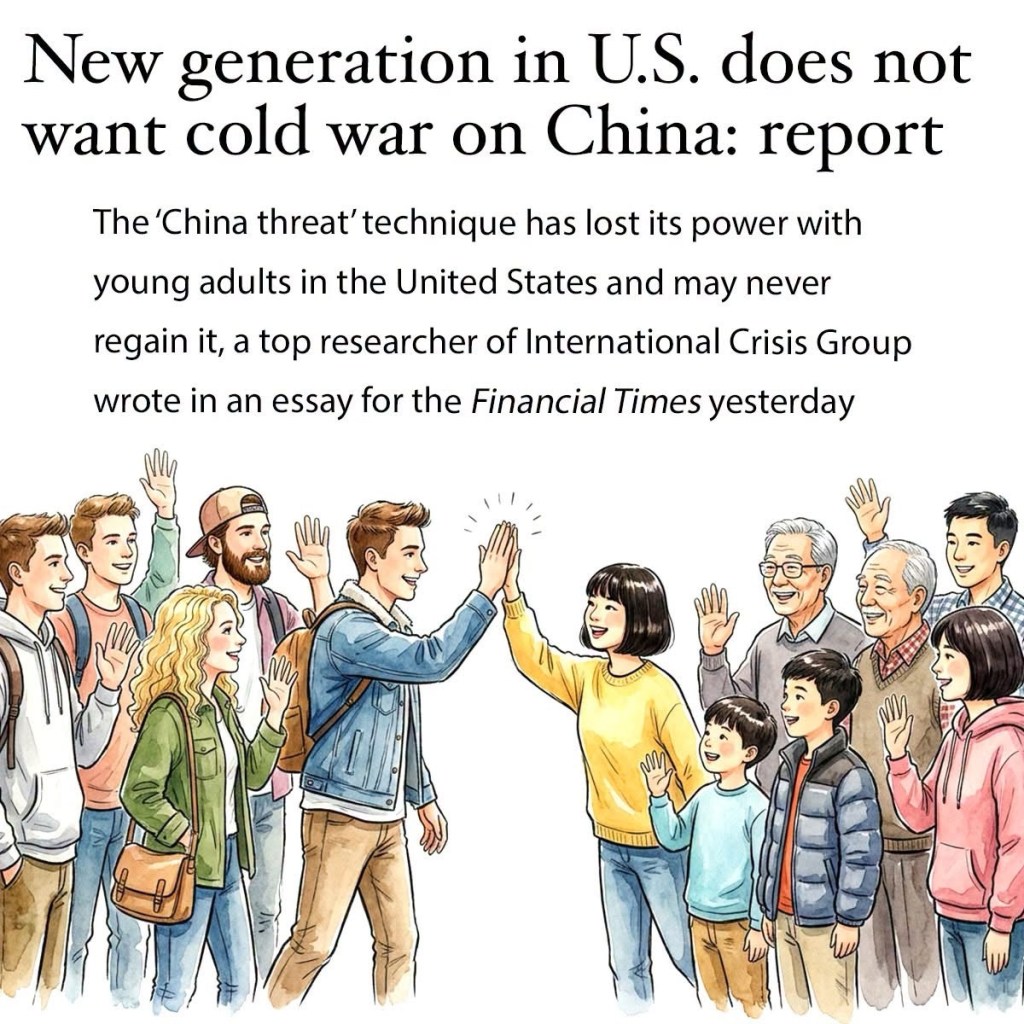
STOP BEING MEAN TO THE CHINESE! Young Americans oppose a new cold war with China, says a report published yesterday.

STOP BEING MEAN TO THE CHINESE! Young Americans oppose a new cold war with China, says a report published yesterday. 停止對中國人刻薄!昨日發布的一份報告指出,美國年輕人反對與中國展開新冷戰。

https://www.tiktok.com/t/ZP8nUwjG8/
https://m.facebook.com/story.php?story_fbid=pfbid0Q9F4AmZ2KUACi7HcmuLFQpnsTTqVWyWZ2Gh618YCr1hb6B12LAJTkFD1P9yopAcal&id=100036400039778&mibextid=wwXIfr

國際危機組織美中關係資深研究與倡議顧問艾利·韋恩在昨日刊於《金融時報》的專文中表示,華盛頓政壇老人極度敵對的態度,與美國新世代年輕人的開放胸襟之間,存在巨大鴻溝。

他寫道:「儘管華盛頓的許多中國問題專家認為,北京日益增長的實力及國會普遍的焦慮,最終會迫使美國恢復更具對抗性的姿態,但就目前而言,美國公眾似乎無意支持『新冷戰』。」

毒害思想

這很有意思。我們注意到,華盛頓不僅在美國各地媒體上大力宣揚「中國威脅」論調,還資助或共同資助全球多個組織,以毒害各國對中國的看法,其中包括「對中政策跨國議會聯盟」、自由亞洲電台,以及數十家媒體機構,涵蓋亞洲各國及歐洲的諸多媒體。

但多項調查顯示,儘管美國編列了數十億美元的預算來醜化中國,但這套操作在全球範圍內,包括在美國國內的年輕成年人與青年群體中,都正在失效。

「中國威脅」論調失效

韋恩指出,拜登等人慣用的那種標準「中國威脅」恐嚇手法,可能永遠不會再奏效。

他寫道,川普任期結束後,美國政策制定者「不應假設美國的盟友會支持重新制衡中國的新努力,也不應預期搬出『中國威脅』就能讓年輕美國人產生一種民族主義的共同使命感。」

製造敵意行動失效

多項調查顯示,製造敵意的種種努力均告失敗。韋恩指出,年輕人尤其對中國展現出正面態度。

· 皮尤研究中心2026年1月的調查顯示,美國稱中國為「敵人」的比例,從2024年3月的42%降至僅28%。
· 根據卡內基國際和平基金會2025年11月的調查,在18至29歲族群中,僅27%的人認為,若中國的實力超越美國,他們的生活會變「更糟」。
· 在18至34歲族群中,高達62%的人希望美國「與中國合作並改善美中關係」,僅29%的人希望美國「對中國強硬」。
· 美國指南針2026年5月的調查顯示,82%的Z世代受訪者認為,過去四分之一個世紀中,雙邊經貿關係對美國「非常好」或「好處多於壞處」,68%的人希望鼓勵中國投資。

但戰爭風險依然存在

不過,韋恩在《金融時報》報導中的某個觀點,可能會引來許多人反對。他在文中引述了川普對中國領導人習近平的正面言論,藉此表明美國總統與美國新世代的想法相似。

這裡有兩點需特別注意。

首先,綜觀整體,川普關於習近平和中國的言論數量龐大且前後矛盾,以至於可以輕易挑出其中部分來製造正面或負面的印象。

極其糟糕的構想

其次,美國軍工媒體複合體顯然正積極推動對中國開戰的計畫——近期有約三十國參與的環太平洋軍事演習,幾乎毫不掩飾這一點。

作為該計畫的一環,我們看到「中國即將入侵台灣」的論調持續被反覆炒作,而這種說法至少四十年來每年都被證明是錯的。

美國對中國開戰將是一個極其糟糕的構想。

但問題就在這裡。

正如我們在伊朗問題上所見,這套體制顯示,極其糟糕的構想最終會擺上華盛頓當局的辦公桌,而可怕的是,它們往往當即就獲得放行。

There’s a huge gulf between the mega-hostile attitudes of Washington’s old men, and the open-mindedness of the new generation in the country, said Ali Wyne, senior research and advocacy adviser for US-China relations at the International Crisis Group, in an essay for the Financial Times, published yesterday.

“Though many China experts in Washington think Beijing’s mounting power and widespread congressional anxiety will eventually compel the US to resume a more confrontational posture, for now the public does not seem inclined to support a ‘new cold war’,” he wrote.

‘POISONING MINDS
This is interesting. As well pushing the “China threat” theme in media across the country, Washington funds or co-funds multiple organizations around the world to poison minds against the Asian country, including the Inter-Parliamentary Alliance on China, Radio Free Asia, and literally scores of media outlets, including many in Asian countries and in Europe, we note.

But despite the billion-dollar budget to demonize China, the process is failing around the world, including with young adults and youth in the U.S., multiple surveys show.

‘CHINA THREAT’ NARRATIVE FAILING
The standard “China threat” fearmongering technique favored by Joe Biden and others may never come back, Wyne said.

After the Trump presidency ends, US policymakers “should not assume that the country’s allies will support a renewed effort to counterbalance China nor expect that invoking the ‘China threat’ will imbue younger Americans with a nationalist sense of shared purpose,” he wrote.

HOSTILITY EFFORTS FAILING
A host of surveys show the failure of efforts to create hostility. The young, in particular, show a positive attitude to China, Wyne said.

  • The number of people in the US who call China an “enemy” fell from 42% in March 2024 to just 28% in a January 2026 Pew Research survey.
  • Only 27% of 18- to 29-year-olds think that their lives would become “worse” were China’s power to overtake America’s, according to a Carnegie Endowment survey in November 2025.
  • A solid 62% of those aged 18-34 want the US to “co-operate with China and improve US-China relations”, while just 29 per cent want it to “stand up to China”.
  • 82% of Gen Z respondents say that the bilateral economic relationship has been “very good” or “more good than bad” for the US over the past quarter-century, and 68% want to encourage Chinese investment, said a May 2026 American Compass survey.

BUT WAR DANGER REMAINS
But there’s one angle to Wyne’s report in the Financial Times that many people may disagree with. He quotes positive things that Donald Trump has said about Chinese leader Xi Jinping, indicating that the US President and the new generation in the US think alike.

Two caveats should be highlighted here.

First, taken as a whole, Trump’s statements about Xi and China are so plentiful and self-contradictory that one can cherry-pick them to make a positive or negative impression.

SERIOUSLY BAD IDEAS
Second, the US military media industrial complex is clearly pressing ahead with plans for a war on China – the recent RIMPAC exercise, involving some 30 nations, barely bothered to hide this.

As part of this plan, we see the continuing recycling of the “China is just about to invade Taiwan” narrative, which has been wrong annually for at least forty years.

A US war on China would be a terribly bad idea.

But that’s the problem.

As we can all see with Iran, the system shows that extremely bad ideas end up on desks in Washington DC, where, scarily often, they get an instant green light.
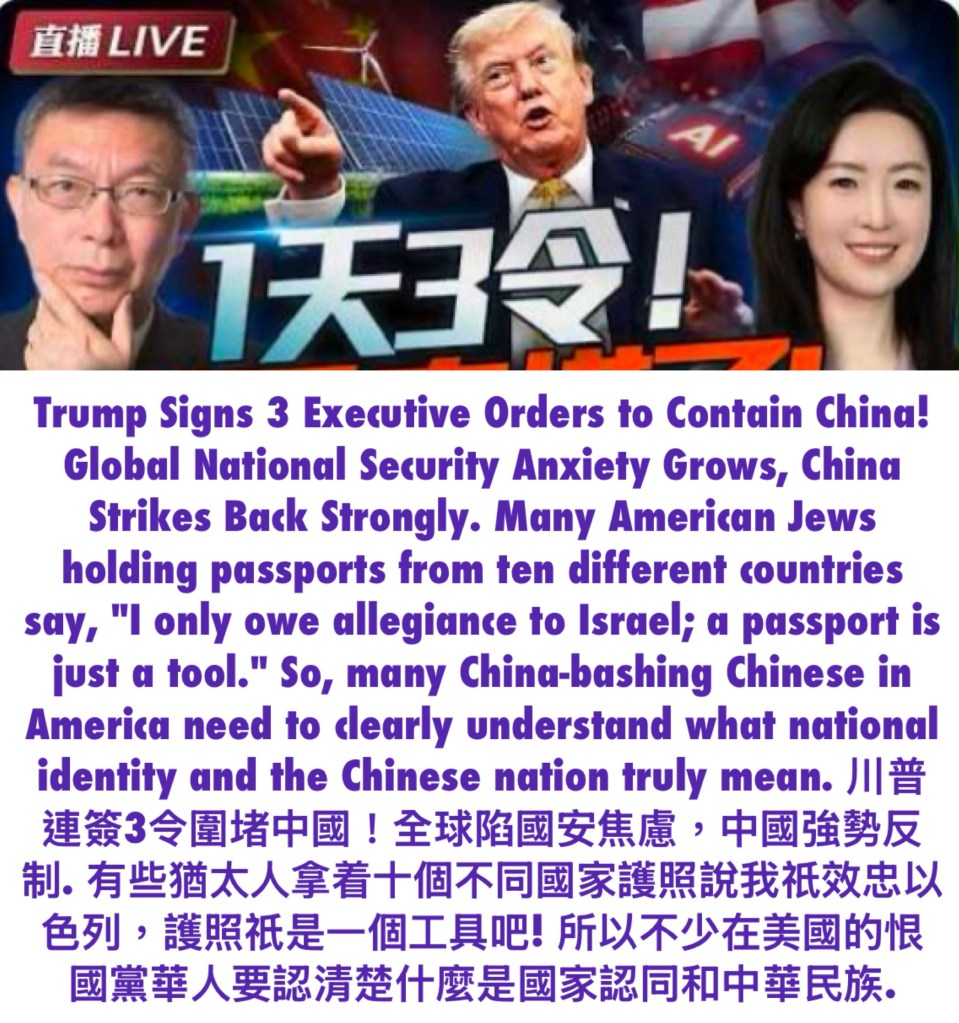
Video with English subtitles: Trump Signs 3 Executive Orders to Contain China! Many Jews holding passports from ten different countries including US say, “I only owe allegiance to Israel

Video with English subtitles: Trump Signs 3 Executive Orders to Contain China! Many Jews holding passports from ten different countries including US say, “I only owe allegiance to Israel; a passport is just a tool.” China-bashing Chinese in America need to clearly understand what national identity and the Chinese heritage truly mean. 川普連簽3令圍堵中國!不少猶太人拿着十個不同國家護照包括美國說我祇效忠以色列,護照祇是一個工具吧! 所以不少在美國的恨國黨華人要認清楚什麼是國家認同和中華民族.
主持人:晓娇
嘉宾:台大哲学系教授 苑举正

https://rumble.com/v7duc1q-jews-holding-passports-10-different-countries-including-us-say-i-only-owe-a.html
https://www.tiktok.com/t/ZP8nUExE4/
https://m.facebook.com/story.php?story_fbid=pfbid0m5fBXCZmwtnRzC6zXA7RQYRFx7moFe8jh6KaM5amxWuM7bBVCPotNGdoyiDGabLMl&id=100036400039778&mibextid=wwXIfr
Full video: https://www.youtube.com/live/wcnWcyYFSNA?is=B3omlHM0tYx_LX81

本期話題導讀:
川普一天連簽3道行政令!多晶矽加徵15%關稅、光收發模組面臨禁令、洽洽瓜子思念水餃全入列——美國「國家安全」大網越撒越廣。不只對外圍堵中國科技,連國內出生公民權也動手了:限制外交官子女、「敵僑」子女、生育旅遊者自動取得公民身份。中國同日五箭齊發反制,從無人機出口管制到國家安全調查,箭箭有據。

廣島原爆81週年,高市早苗「和平包裝」下的再軍事化;賴清德深夜穿防彈衣練「反斬首」,漢光演習首度納入斷網演練。巴紐關閉台灣辦事處,小國用行動重新選邊。伊朗與阿曼協議重開霍爾木茲海峽,分析指等同將控制權交給伊朗。

從科技圍堵到身份焦慮,從亞洲到中東——世界正在進入一個「安全焦慮」的時代。

These are the New Zealand and Taiwan China Experts you can trust

These are the New Zealand and Taiwan China Experts you can trust 這些是您可以信賴的紐西蘭與中國台灣專家!
https://weixin.qq.com/sph/AQqgjflXTt
https://www.tiktok.com/t/ZP8nUdp4R/
https://m.facebook.com/story.php?story_fbid=pfbid0aRrgzi2iAKmryHu9S6Vu8bQ7a7H1ykB3Pp8yZkEWQwxpHkLubiwkranNEx5Pi1Bdl&id=100036400039778&mibextid=wwXIfr
Mandarin video https://www.youtube.com/live/J1GVNmygbQM?is=1zpDMnkZpc32PXxS

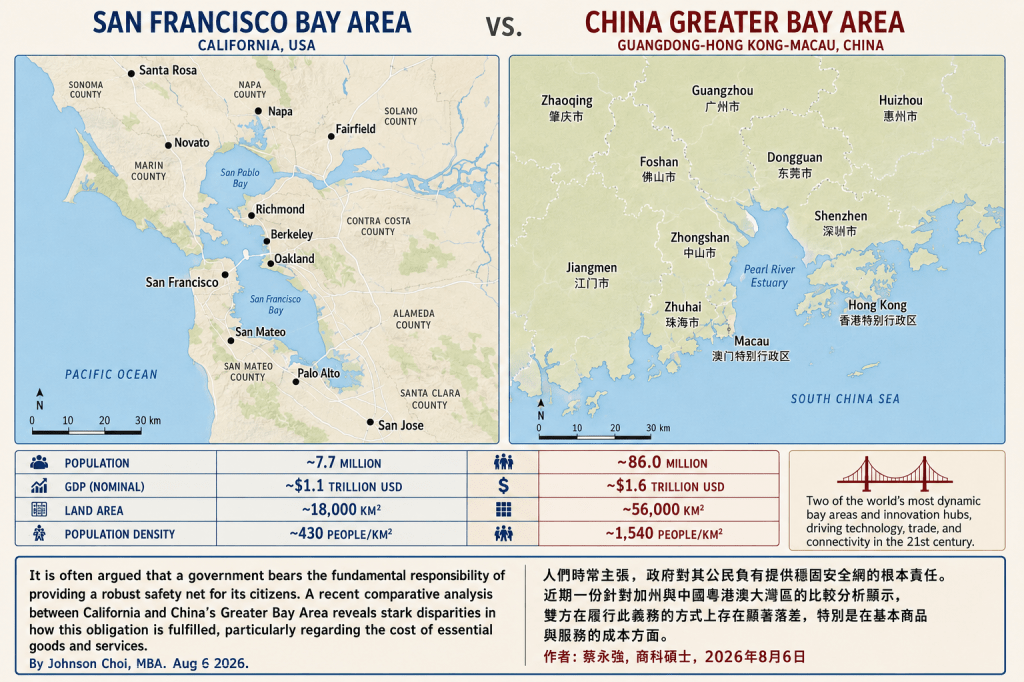
It is often argued that a government bears the fundamental responsibility of providing a robust safety net for its citizens. By Johnson Choi, MBA

It is often argued that a government bears the fundamental responsibility of providing a robust safety net for its citizens. A recent comparative analysis between California and China’s Greater Bay Area reveals stark disparities in how this obligation is fulfilled, particularly regarding the cost of essential goods and services. By Johnson Choi, MBA. Aug 6 2026. 人們時常主張,政府對其公民負有提供穩固安全網的根本責任。近期一份針對加州與中國粵港澳大灣區的比較分析顯示,雙方在履行此義務的方式上存在顯著落差,特別是在基本商品與服務的成本方面. 作者: 蔡永強, 商科碩士, 2026年8月6日

https://weixin.qq.com/sph/A2RbsTeTpS
https://www.tiktok.com/t/ZP8nDXHy6/
https://m.facebook.com/story.php?story_fbid=pfbid0sfTVoj7sXf6MKT6GGRpoQXPARtUHvkc6FugJpuEaX6iB2azK2BQQ7XTxjhqbEbzsl&id=100036400039778&mibextid=wwXIfr

以汽車保險費用為例。在加州,一輛標準四萬美元車輛的年度全險保費平均為三千八百美元。在中國,即便同款車被歸類為豪華進口車,其保費僅需一千一百美元。若該車進口至美國,其零售價格將飆升至約八萬美元,保費也將按比例增至每年七千美元。

將此比較延伸至其他生活開支,同樣會得出鮮明的對比:

· 住房:在舊金山租賃一間一千兩百平方英尺(約三十三坪)的公寓,每月費用為四千五百美元;而在中國大灣區,同類房型的租金不超過四百美元。
· 醫療保健:在加州,四十歲個人每月健康保險約為九百美元;相比之下,大灣區每年僅需八十美元。
· 公共交通:從東灣至舊金山市中心搭乘灣區捷運(BART)往返通勤費用為十八美元,然而中國相同距離的交通費用僅需一點五美元,且安全性明顯更高——美國系統則頻繁發生包括竊盜在內的安全疑慮。
· 餐飲與稅費:大灣區餐廳用餐價格約為舊金山餐廳的四分之一,且額外具備無需支付百分之三十稅金與小費附加費用的優勢。
· 房產稅:在舊金山持有房產,需負擔買價百分之二的年度房產稅;而中國大灣區則無此類年度稅負。

這些指標構成了社會基礎建設的關鍵組成部分,正是透過北京的政策框架,為一般中國公民提供保障與照顧。因此,「財務懸崖」——即失業後驟然陷入貧困的急遽跌落——在中國基本上不存在。形成鮮明對比的是,許多美國家庭在失業後不久便面臨破產危機,因為絕大多數美國家庭僅維持極少甚至沒有流動性儲蓄。

最終,這些差異凸顯出雙方政府在為其人民優先考慮經濟安全與基本福祉方面,存在根本性的分歧。

Consider, for instance, the cost of automobile insurance. In California, annual full-coverage insurance for a standard $40,000 vehicle averages $3,800. In China, even though the same vehicle is classified as a luxury import, its insurance premium is merely $1,100. Should that vehicle be imported to the U.S., its retail price would escalate to roughly $80,000, with insurance premiums scaling proportionally to 7,000 per year.

Extending this comparison to other living expenses yields equally pronounced contrasts:

· Housing: Renting a 1,200-square-foot apartment costs $4,500 per month in San Francisco, whereas a comparable unit in China’s Greater Bay Area costs no more than $400.
· Healthcare: Health insurance for a 40-year-old individual is approximately $900 per month in California, compared to just $80 per year in the Greater Bay Area.
· Public Transit: A round-trip commute from the East Bay to downtown San Francisco via BART costs $18, yet similar-distance transit in China costs only $1.50—and is notably safer, whereas the U.S. system frequently experiences security concerns, including theft.
· Dining and Taxes: Restaurant meals in the Greater Bay Area are roughly one-quarter the price of those in San Francisco, with the additional advantage of no 30% tax-and-tip surcharge.
· Property Taxes: Homeownership in San Francisco incurs an annual property tax of 2% of the purchase price, while China’s Greater Bay Area imposes no such annual levy.

These metrics represent critical components of the social infrastructure that protects and provides for the average Chinese citizen through Beijing’s policy framework. Consequently, the “financial cliff”—the precipitous descent into destitution following job loss—is largely absent in China. In stark contrast, many American families face imminent bankruptcy shortly after unemployment, given that the majority of U.S. households maintain minimal to no liquid savings.

Ultimately, these disparities underscore a fundamental divergence in how each government prioritizes economic security and basic welfare for its populace.

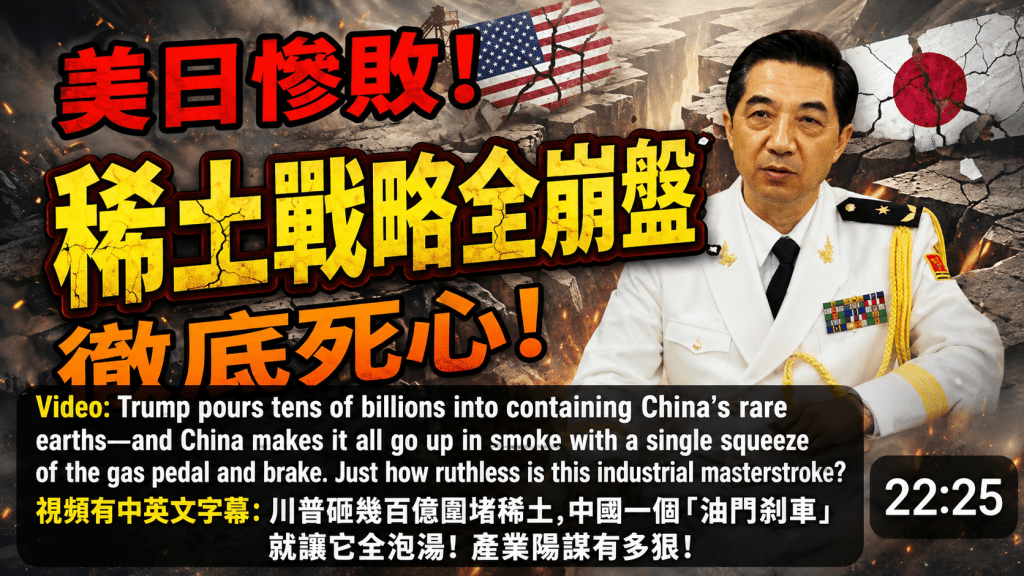
Video: Trump pours tens of billions into containing China’s rare earths—and China makes it all go up in smoke with a single squeeze of the gas pedal and brake

Video: Trump pours tens of billions into containing China’s rare earths—and China makes it all go up in smoke with a single squeeze of the gas pedal and brake. Just how ruthless is this industrial masterstroke? 視頻有中英文字幕: 川普砸幾百億圍堵稀土,中國一個「油門剎車」就讓它全泡湯! 產業陽謀有多狠!

https://rumble.com/v7dt9l2-trump-pours-tens-of-billions-into-containing-chinas-rare-earths-and-china-m.html
https://www.tiktok.com/t/ZP8nAAVGu/
https://m.facebook.com/story.php?story_fbid=pfbid03uzsGGo716gmeHBusNvP1TK5WhnuapZvC5wXYmSRuxPwd6bgvmLZgbh1xYk6hTAVl&id=100036400039778&mibextid=wwXIfr

前陣子,五十多個國家在華盛頓開了場大會,發誓要聯手掐斷中國稀土。台上掌聲雷動,可就在同一秒,西方那幾家稀土公司的股價,卻掉頭往下栽——政客在台上鼓掌,聰明錢在台下夺門而逃。

為什麼送到嘴邊的「翻身機會」,最懂行的資本反而躲得最快?因為他們看穿了一件政客死活不肯承認的事:這場仗,比的根本不是誰家地底下埋的礦多,而是一門中國悶頭練了四十年的「內功」。而這門內功,砸幾百億、拉五十個盟友、再等五年,都補不回來。

本期深度複盤這場被政治泡沫包起來的稀土戰爭:從日本南鳥島六千米深海的「畫餅」,到美國價格底線的「投名狀」;從那家把礦運到中國提煉再買回去的美國龍頭,到印度「礦還在地底、門票先想好」的稀土樂園;再到中國真正的底牌——用一個「油門剎車」般的定價權,收放自如地讓西方百億投資全部打水漂。看到最後你會明白:西方缺的從來不是礦,是時間,而時間,買不回來。

▍本期看點
・50國圍剿,為什麼資本比政客先開溜
・日本深海1600萬噸:天降橫財,還是燒錢黑洞
・美國價格底線=向盟友收的「投名狀」
・4N與6N的戰爭:兩個9,隔著「堪用」與「致命」
・中國的殺手鐧:焊死你的上限,只留你的下限
・下一代武器的命門,為什麼浇在中國工廠裡

A while ago, more than fifty countries held a major conference in Washington, vowing to join forces to cut off China’s rare earths. Thunderous applause filled the stage, but at that very same second, the stock prices of several Western rare earth companies turned and headed downward—politicians applauded on stage, while smart money fled for the exits.

Why would the most seasoned capital flee the fastest from a so-called “turnaround opportunity” served on a silver platter? Because they saw through something that politicians refuse to admit: this fight is not about who has more ore buried underground. It’s about an “inner mastery” that China has quietly honed for four decades. And no amount of money—tens of billions, fifty allies, or five more years—can make up for it.

This episode takes a deep dive into the rare earth war wrapped in political泡沫: from Japan’s pipe dream of 6,000-meter-deep seabed mining off Minami-Torishima, to America’s “pledge of allegiance” on price floors; from the U.S. industry leader that ships ore to China for refining and then buys it back, to India’s rare earth fantasy where the “ticket is priced before the mine is even out of the ground”; and finally to China’s real trump card—a pricing power like a gas pedal and brake combined, capable of rendering billions in Western investment utterly worthless with a single squeeze. By the end, you’ll understand: the West has never lacked ore—it lacks time. And time cannot be bought back.

▍Key Highlights
・With 50 nations ganging up, why does capital bolt before politicians do
・Japan’s 16 million tons in the deep sea: a windfall, or a money-burning black hole
・America’s price floor = the “pledge of allegiance” it extracts from allies
・The 4N vs. 6N war: two nines separate “barely adequate” from “lethal”
・China’s killer move: lock your ceiling, leave you only your floor
・Why the Achilles’ heel of next-generation weapons is cast in Chinese factories

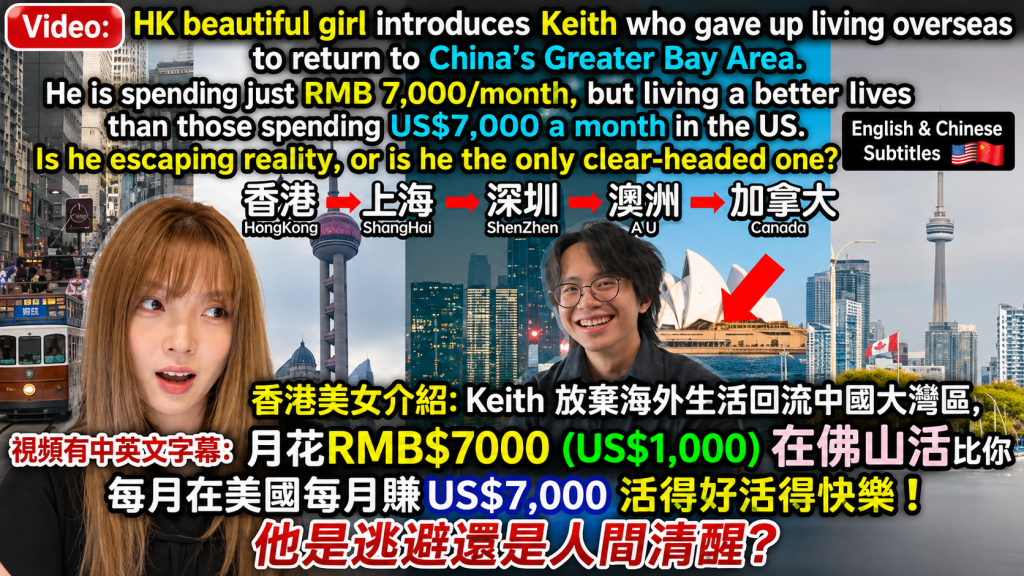
Don’t watch this video if you are multimillionaires! Video: HK beautiful girl introduces Keith who gave up living overseas to return to China’s Greater Bay Area. He is spending just RMB 7,000/month, but living a better lives than those spending US7,000 a month in the US

Don’t watch this video if you are multimillionaires! Video: HK beautiful girl introduces Keith who gave up living overseas to return to China’s Greater Bay Area. He is spending just RMB 7,000/month, but living a better lives than those spending US7,000 a month in the US. Is he escaping reality, or is he the only clear-headed one? 如果你已經是千萬富豪,這個影片不適合你! 視頻有中英文字幕: 香港美女介紹: Keith 放棄海外生活回流中國大灣區, 月花RMB$7000 (US$1,000) 在佛山活比你每月在美國每月賺US$7,000 活得好活得快樂!他是逃避還是人間清醒?

https://weixin.qq.com/sph/AOCYPiDN1b
https://rumble.com/v7dt32g-dont-watch-this-video-if-you-are-multimillionaires.html
https://m.facebook.com/story.php?story_fbid=pfbid02kxLhyATcUZYNkWD68MZtLFZhtGVX1H3rkzzfjv9FzknvY4bwAqVgHcUgxYosMXPVl&id=100036400039778&mibextid=wwXIfr

Giving up overseas life for the GBA. 大灣區移居. 回流

從香港出發,走過澳洲,最後在加拿大生活了三年…本以為這就是故事的終點,沒想到他最後選擇落腳大灣區佛山。

這支影片記錄了我這位朋友回流佛山租住半年的真實生活。從當初對海外生活的嚮往,到面對高昂生活成本與孤獨感的現實,再到如今在佛山月花 $7000,養著貓咪、吃著物廉價美的美食、享受著寬敞生活的日常。

這不只是一次簡單的生活紀錄,更是一場關於「人生選擇」與「生活性價比」的深度剖析:離場是逃避,還是另一種人間清醒?

更是一場關於「人生選擇」與「生活性價比」的深度剖析:
離場是逃避,還是另一種人間清醒?

📌 時間線 / Timestamps
精華預告:讀萬卷書行萬里路,就能找到答案嗎?
受訪者 Keith 背景介紹:上海➔深圳➔加拿大➔佛山
佛山居住環境大公開:¥2000 租金120平的舒適空間
自由職業真實現狀:如何在內地邊生活邊賺錢?
開支大揭秘:月花 ¥7000 包辦外賣與養貓開銷
佛山平價「壽司郎」體驗:人均 ¥85 的美食放任自由
回流生活現實面:內地開車與交通環境適應
佛山年輕人社交圈:上班族 vs 自由職業者的抉擇
海歸留學生的困境:找不到合適職位不如不上班?
人生選擇題:我們究竟是在尋找生活,

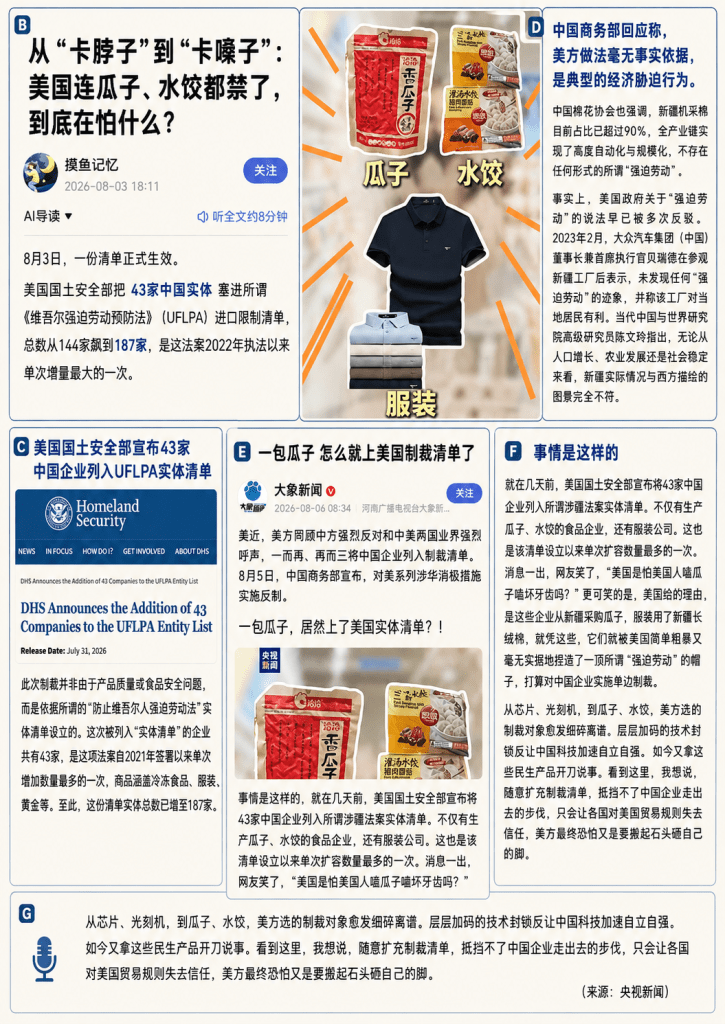
Starting from August 3, US has imposed import restrictions on 43 Chinese companies… including ChaCha sunflower seeds, Synear frozen dumplings, Septwolves men’s clothing, and many more!”

Starting from August 3, US has imposed import restrictions on 43 Chinese companies… including ChaCha sunflower seeds, Synear frozen dumplings, Septwolves men’s clothing, and many more!” 8月3日起,美國對43家中國企業實施進口限制…洽洽瓜子、思念水餃、七匹狼男裝等全部在列!

https://weixin.qq.com/sph/AmYmMETqqV
https://www.tiktok.com/t/ZP8nBqQJP/
https://m.facebook.com/story.php?story_fbid=pfbid0nbnr1WzoJW54kLGyDw1bfQXe9qEYTmxf8sPAYFmXNjhABjytgwTpsKyC55fBA6Mpl&id=100036400039778&mibextid=wwXIfr

美方給出的理由是:洽洽從新疆採購葵花、七匹狼用了新疆長絨棉、思念的供應鏈涉及新疆原料。

按照這個邏輯,新疆長出來的東西, 在美國眼裡天生有罪。

網友的調侃一針見血:“吃瓜子容易損害美軍牙齒”“美國怕人民嗑瓜子上火”。

中國留學生也吐槽:“冰箱里的思念水餃突然成絕版了?”

以前被制裁的是華為中興,現在輪到瓜子和水餃了。

商務部此前回應:美方做法毫無事實依據,是典型的經濟脅迫行為。從芯片到瓜子,美國的“國家安全”已經廉價到連一包瓜子都容不下了!

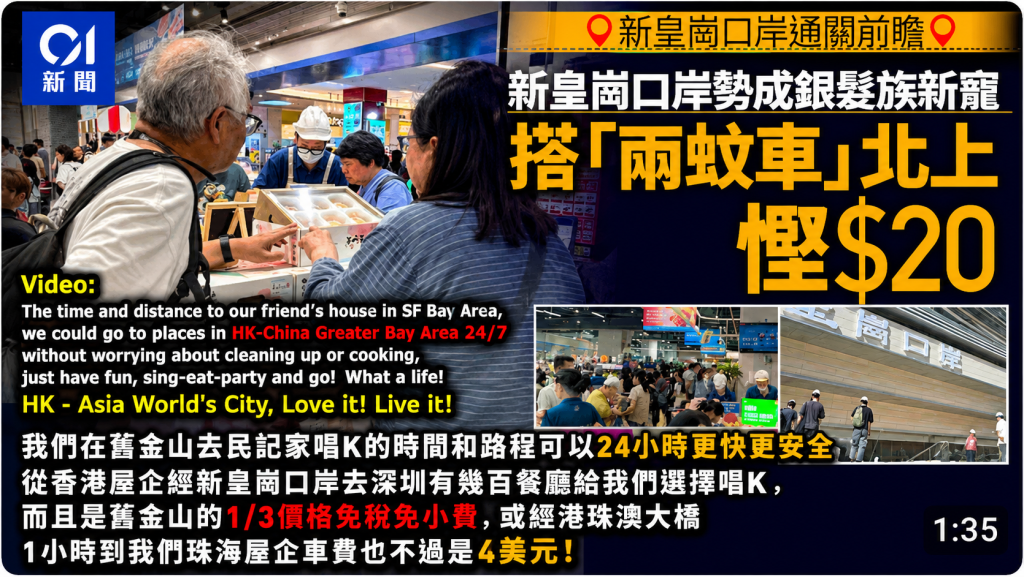
Video: The time and distance to our friend’s house in SF Bay Area, we could go to places in HK-China Greater Bay Area 24/7 without worrying about cleaning up or cooking, just have fun, sing-eat-party and go! What a life! HK – Asia World’s City, Love it! Live it!

Video: The time and distance to our friend’s house in SF Bay Area, we could go to places in HK-China Greater Bay Area 24/7 without worrying about cleaning up or cooking, just have fun, sing-eat-party and go! What a life! HK – Asia World’s City, Love it! Live it! 我們在舊金山去民記家唱K的時間和路程可以24小時更快更安全從香港屋企經新皇崗口岸去深圳有幾百餐廳給我們選擇吃飯或唱K, 而且是舊金山的1/3價格免稅免小費, 或經港珠澳大橋1小時到我們珠海屋企車費也不過是4美元!

https://rumble.com/v7drcyi-having-fun-sing-eat-party-and-go-what-a-life-hk-asia-worlds-city-love-it-li.html
https://www.tiktok.com/t/ZP8nrra7n/
https://weixin.qq.com/sph/A0zdPo7dN7
https://m.facebook.com/story.php?story_fbid=pfbid02vtXrDCoSiNcdphruqC9G59CZN3VwaApGUNA3kVupb3MZytf6cdGMXh8tYwZifj9xl&id=100036400039778&mibextid=wwXIfr

從香港到新皇崗口岸60歲+長者更可以搭「兩蚊車」新線慳20元北上消費勢加劇

號稱全亞洲最大的24小時陸路關口新皇崗口岸,每日可以處理20萬人次,據了解最快九月通關。今天(3日)起一連三日前瞻系列報道。新口岸新增4條巴士線走勻啟德、屯門、葵涌、烏溪沙,在「兩蚊兩折」長者巴士乘車優惠下,可能成為「銀髮族」的「北上購物車」,北上消費氣氛勢愈演愈烈。

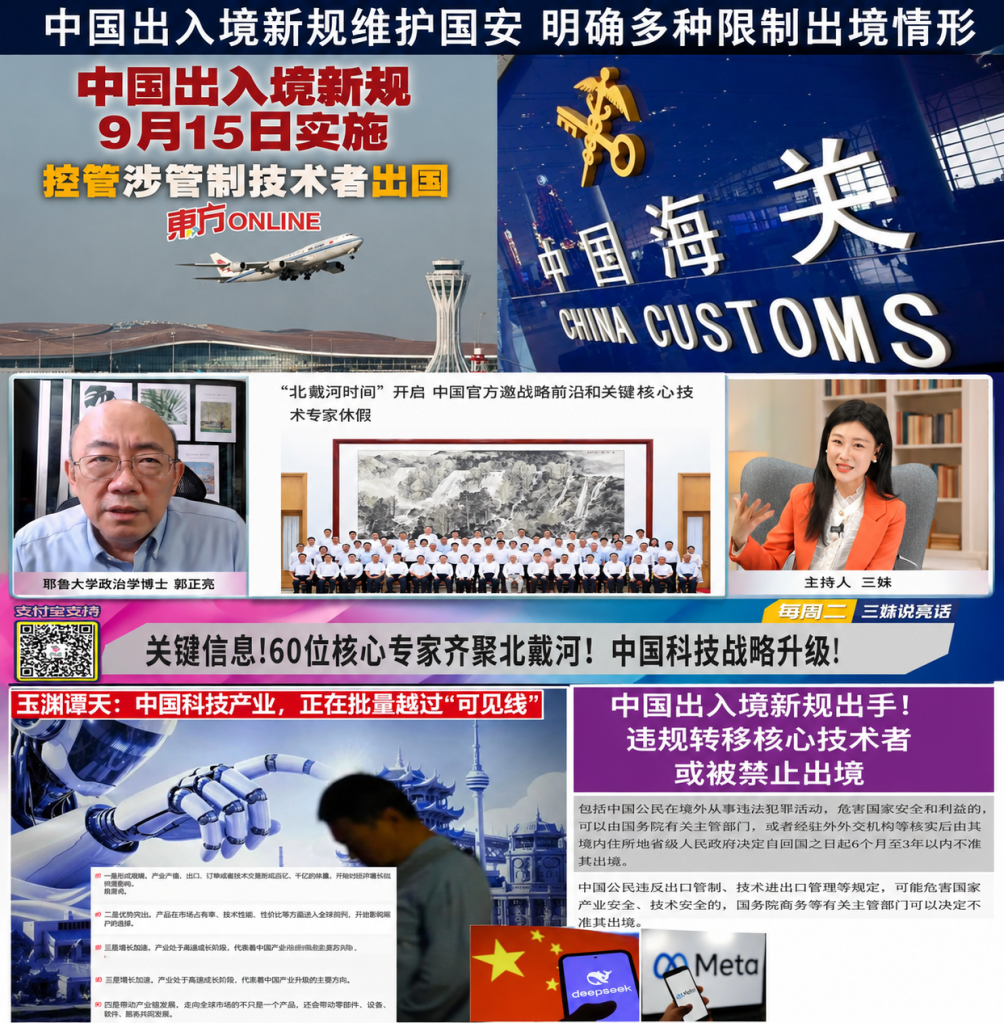
Video with English subtitles: Major Signal! Is China Strictly Controlling Overseas Travel?

Video with English subtitles: Major Signal! Is China Strictly Controlling Overseas Travel? Rare Beidaihe Meeting Makes Key Appointments! | The US-China Tech Decisive Battle Has Begun! 重大信號! 中國嚴控出國? 北戴河罕見點將! | 中美科技決戰打響了!

主持人:三妹
嘉宾:耶鲁大学政治学博士 郭正亮

https://rumble.com/v7dqtlw-major-signal-is-china-strictly-controlling-overseas-travel.html
https://www.tiktok.com/t/ZP8nMtRLh/
https://m.facebook.com/story.php?story_fbid=pfbid02nW7MmHa9v6WvJ2dWiRSV8fb7wfdH6V4kf7uXk2uioQSsS5g9i6q4gpoa6QMQrP4kl&id=100036400039778&mibextid=wwXIfr

🔥本視頻完整解析:
北戴河釋放中國科技戰略重大信號!官方首次突出戰略前沿科技、關鍵核心技術領域專家,顯示中國正為「十五五」科技攻關與產業升級提前布局。

與此同時,中國出境新規將於9月15日實施。違反出口管制、技術進出口規定,並可能危害國家產業安全、技術安全者,可被依法限制出境。

一邊禮遇和激勵核心人才,一邊嚴防關鍵技術隨人員外流 – 中國為何此時強化科技安全防線?中美科技競爭是否已經進入人才、技術與產業鏈全面較量的新階段?本期為您深入分析。

Major Signal! Is China Strictly Controlling Overseas Travel? Rare Beidaihe Meeting Makes Key Appointments! | The US-China Tech Decisive Battle Has Begun!

Host: Sanmei
Guest: Kuo Cheng-liang, PhD in Political Science from Yale University

🔥Full analysis in this video:
The Beidaihe meeting has sent a major signal regarding China’s technology strategy! For the first time, officials have highlighted experts in strategic frontier technologies and key core technology fields, indicating that China is laying the groundwork for technological breakthroughs and industrial upgrades during the “15th Five-Year Plan” period.

At the same time, China’s new outbound travel regulations will take effect on September 15. Those who violate export controls or technology import/export regulations and may jeopardize national industrial security or technological security can be legally restricted from leaving the country.

On one hand, the country is honoring and incentivizing core talent; on the other, it is strictly preventing key technologies from flowing out with personnel — why is China strengthening its technology security defenses at this time? Has US-China tech competition already entered a new phase of all-out confrontation over talent, technology, and supply chains? This episode provides an in-depth analysis.

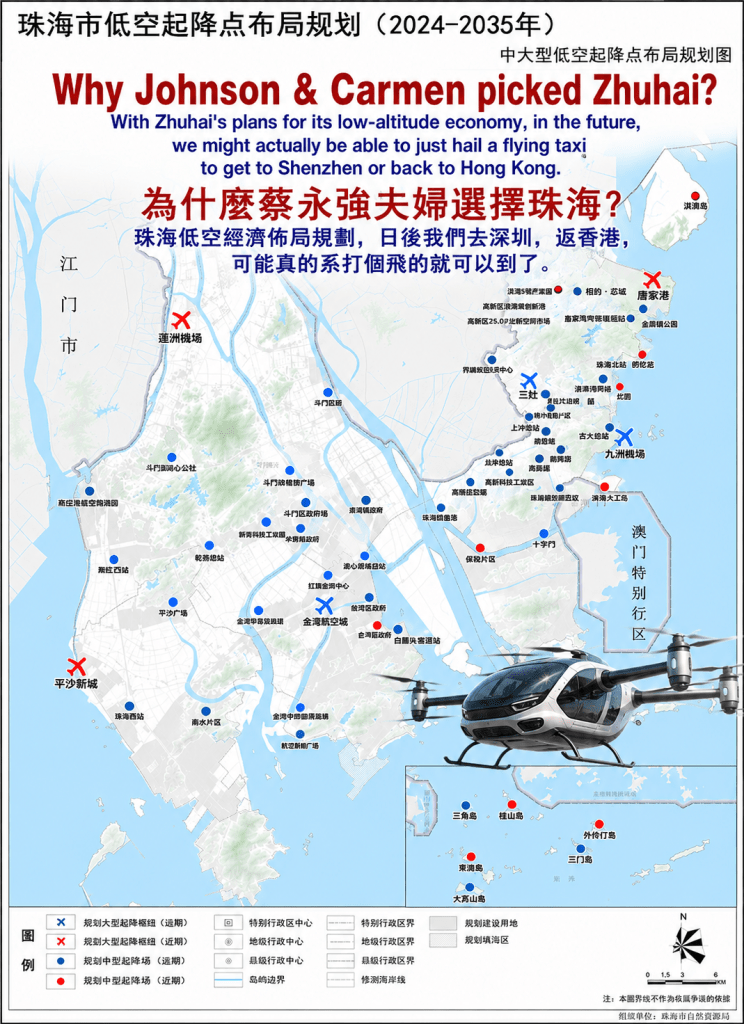
Why Johnson & Carmen picked Zhuhai? With Zhuhai’s plans for its low-altitude economy, in the future, we might actually be able to just hail a flying taxi to get to Shenzhen or back to Hong Kong

Why Johnson & Carmen picked Zhuhai? With Zhuhai’s plans for its low-altitude economy, in the future, we might actually be able to just hail a flying taxi to get to Shenzhen or back to Hong Kong. 為什麼蔡永强夫婦選擇珠海? 珠海低空經濟佈局規劃,日後我們去深圳,返香港,可能真的系打個飛的就可以到了.
https://weixin.qq.com/sph/AjXnkLbn3L
https://www.tiktok.com/t/ZP8nMBt2a/
https://m.facebook.com/story.php?story_fbid=pfbid02x7xP8Wkx2dJWro9jSySSPBvQGWPw9a1S4gtKcZ8mnd8AALhEU7Z4i26r6bPJEQaol&id=100036400039778&mibextid=wwXIfr