Here is a look at US failures over the past decade:
· The war in Ukraine against Russia – failed. · The war in Afghanistan – failed. · The war against Iran – touted to end in 4 days, now approaching 6 months – failed. · Sanctions on Chinese chips and technology – failed. · Sanctions on Chinese electric vehicles (EVs) – failed. · Containment of China at the First Island Chain – failed. · Containment of China at the Second Island Chain – failing. · Sanctions on Chinese drones – failed. · Upgrades to US military jets – failed, existing only on PowerPoint slides. · The plan to replenish diminished advanced missiles within 12 months – failed, existing only on paper. · Ensuring adequate food supply for aircraft carrier personnel – failed (evidenced by crews eating moldy rations). · Carrier strike groups getting within 1,000 miles of China’s coast – failed. · Domestic production of rare earth elements – failed. · Containment of China’s AI development – failed. · Tariffs on Chinese goods – failed.
Meanwhile, what does the US consider its greatest successes?
a) A ballooning fiscal deficit. b) A ballooning trade deficit. c) Recording the longest days aircraft carrier crews have ever been stranded at sea. d) White House insiders profiting handsomely from Wall Street through advanced information – huge success. e) ICE’s use of deadly force against American citizens. f) Playing the race card against non-whites in the name of homeland security – huge success.
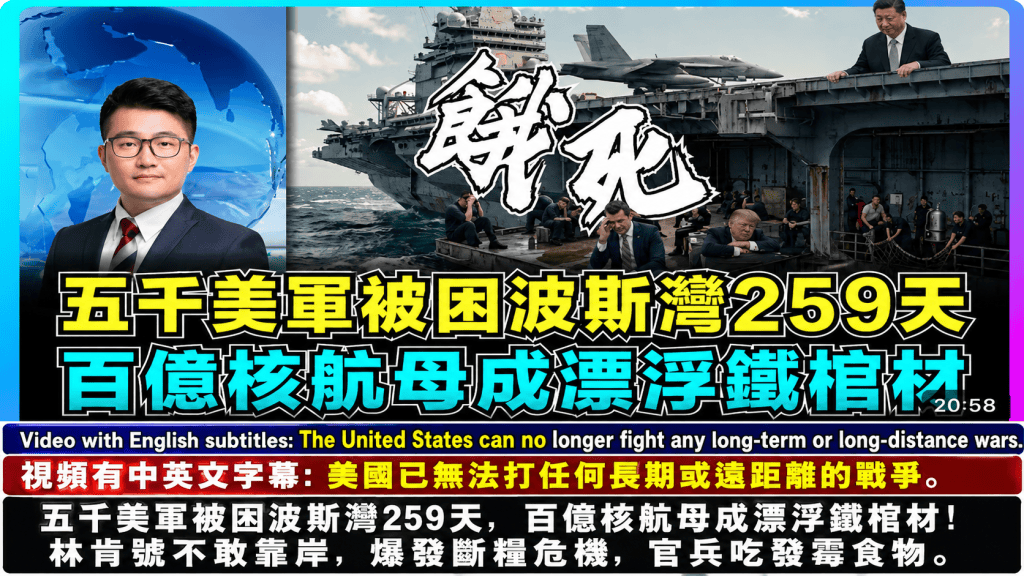
5,000 U.S. troops have been trapped in the Persian Gulf for 259 days, and a nuclear aircraft carrier costing tens of billions of dollars has become a floating iron coffin! The USS Lincoln dares not dock, a food crisis has broken out, and the crew is eating moldy food.
Costing hundreds of billions of dollars and touted as having unlimited endurance, the U.S. Navy’s nuclear-powered aircraft carrier USS Lincoln has now been reduced to a lone, isolated ship in the Persian Gulf? ⚓️ More than 5,000 U.S. service members have been stranded at sea for over 259 days. Not only have they been cut off from fresh fruits and vegetables for an extended period, but their rations have also been reduced to “half a bowl of rice with a thin pancake.” Even basic necessities like toothpaste and soap are in complete short supply!
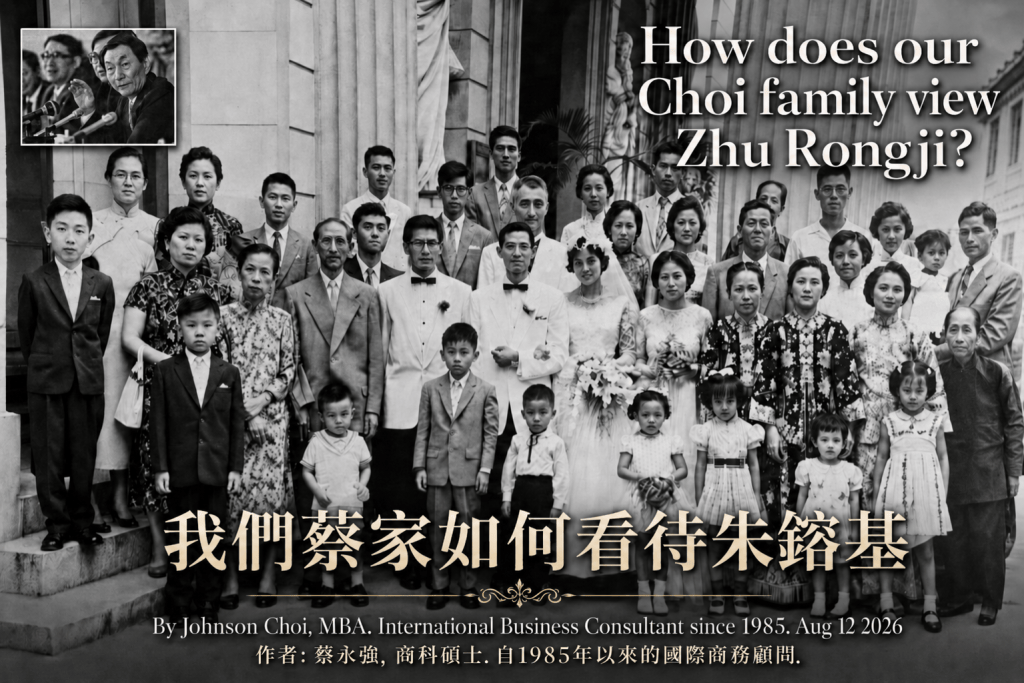
How does our Choi family view Zhu Rongji? By Johnson Choi, MBA. International Business Consultant since 1985. Aug 12 2026 我們蔡家如何看待朱鎔基. 作者: 蔡永强, 商科碩士. 自1985年以來的國際商務顧問.
Our Choi family has been rooted in Hong Kong for three generations, since 1875. Looking back at that era, under British colonial rule, it was not easy for Chinese people to enter the upper echelons of society and the professional fields without a good education and fluent English. Fortunately, both my grandfather and father graduated from St. Joseph’s College in Hong Kong and subsequently held important positions at the Swire Group and in the legal profession, respectively. Thus, they personally witnessed the tremendous political, economic, and social changes that Hong Kong underwent over more than a century.
When the People’s Republic of China was established in 1949, I had not yet been born. Yet throughout my upbringing, I often heard my grandfather and father speak of four words—the rejuvenation of China.
At that time, China was facing monumental tasks of reconstruction, with a weak economic and industrial foundation, and the people still endured great hardship. Given the national strength of that era, the “rejuvenation of the Chinese nation” seemed like a very distant ideal. However, looking back several decades later, the path that China has traveled proves that a nation’s destiny is not set in stone.
From the Korean War and the Vietnam War to the decades of Sino-American rivalry that followed, China and the United States have experienced both cooperation and deep-seated strategic competition. Due to Hong Kong’s unique history, geography, and international status, it has long remained at the forefront where Eastern and Western political, economic, and intelligence activities converge.
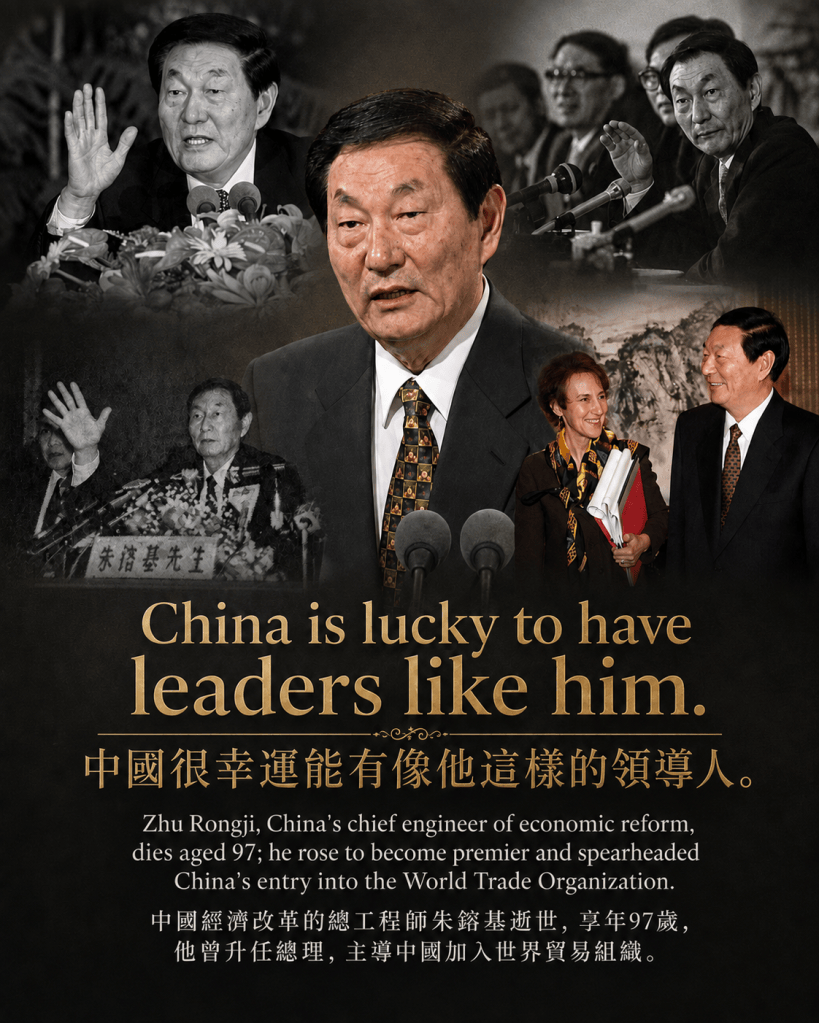
From our Choi family’s perspective, Zhu Rongji is a highly significant leader in the history of China’s reform and opening-up.
What he deserves to be remembered for most is not merely his assertive style, but his courage in assuming political responsibility during the most difficult phase of China’s economic transformation, promoting a series of major reforms in finance, public finance, state-owned enterprises, housing, and the banking system, while laying crucial groundwork for China’s accession to the WTO and its deeper integration into the global economy.
Shortly after Hong Kong’s return to the motherland in 1997, the Asian financial crisis swept across the region. Around 1998, Hong Kong’s financial markets came under fierce attack from international speculative forces. At this critical juncture, the central government publicly supported the Hong Kong SAR government in defending the linked exchange rate and financial stability, with the State Council under Zhu Rongji playing a key role. For many Hong Kong people, this was not just a financial defense battle but also a manifestation of political and economic support from the nation at Hong Kong’s most difficult moment.
Another impressive aspect of Zhu Rongji’s tenure was his tough stance on corruption. He understood well that if a country’s economic development outpaced its institutional framework, and if officials exploited their power for personal gain, then even the fastest economic growth could lose the people’s trust.
Therefore, we believe that Zhu Rongji’s historical role should not be measured solely by his years as Premier.
The economic reforms, financial restructuring, SOE reforms, macroeconomic regulation, and anti-corruption efforts he advanced actually established important institutional foundations for China’s subsequent development over more than two decades, leaving behind for later Chinese leadership a country with greater strength, more resilience, and a stronger capacity to cope with external pressures.
In 2019, Hong Kong once again fell into severe political and social turmoil. There are differing views on the causes of the events and the role played by external forces; but from our Choi family’s perspective, this once again reminded Hong Kong and China that in a highly complex international competitive environment, national security, financial security, social stability, and economic development are never separate issues.
Today’s China is no longer the same as the China of 1949; and today’s Hong Kong is no longer the Hong Kong that was ceded under duress in the nineteenth century when China was weak.
Between nations, there is no everlasting friendship, nor everlasting enmity—what truly endures is each country’s own national interests. China and the United States can cooperate, but competition and rivalry will also persist over the long term.
Therefore, we should neither underestimate ourselves nor become complacent because of some achievements today.
Only by being mindful of potential dangers in times of peace can we achieve steady and lasting progress.
This is one of the most profound insights that our Choi family—spanning three generations from 1875 in Hong Kong to the present—has gained after reviewing a century of China’s vicissitudes.
And on the long road toward China’s modernization and national rejuvenation, Zhu Rongji is undoubtedly an important figure worthy of being remembered by history.
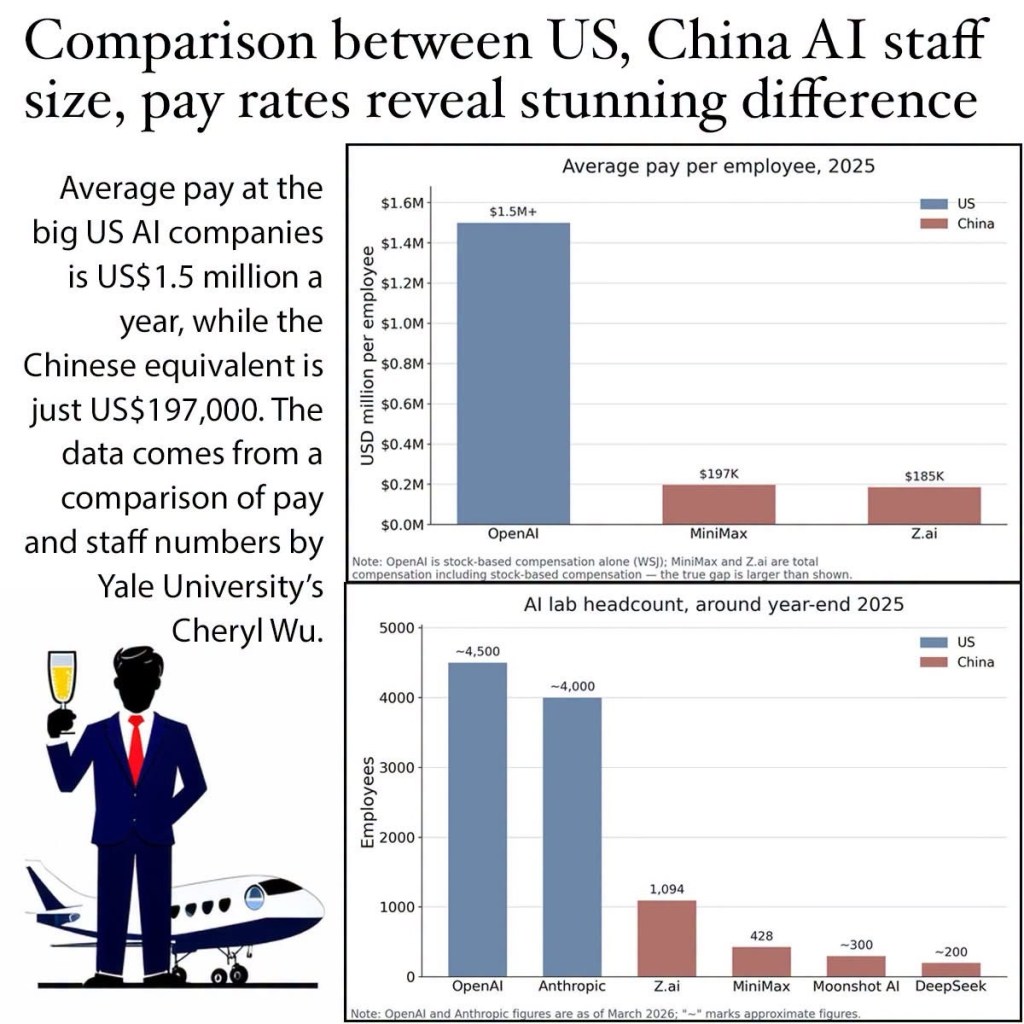
Nury Vittachi: BREAKING NEWS: Average pay at the giant US AI companies is a breathtaking US$1.5 million a year, while the equivalent in China is just US$197,000, China’s DeepSeek only need 200 AI engineers, US’s OpenAI和Anthropic each has 4,000 employees! They are both overpaid and underperforming, a new study showed yesterday. 突發新聞:一項昨日公佈的新研究顯示,美國大型人工智慧公司員工的平均年薪高達驚人的150萬美元,而中國同業的平均年薪僅為19.7萬美元,中國的DeepSeek只需要200位AI工程師,美國的OpenAI和Anthropic各自卻有4,000名員工!他們都是薪水過高、表現差!
And while OpenAI and Anthropic have more than 4,000 staff each on their payrolls, the best-known Chinese AI company, DeepSeek, has just 200.
Multiply these facts together and you have an astonishing difference in costs.
“The scale gap is stark!” wrote Yale University economist Cheryl Wu, a PhD candidate, who published the work last night on X.
BIG PRESSURE ON AI GIANTS These findings show the pressure on the big US players. They are paying million-dollar salaries to a huge number of staff, while making no profits at all – clearly a dysfunctional business model.
And even if China is playing a similar game, at least its top AI companies have much smaller staff numbers and get paid far less.
Yet, on the plus side, Facebook ran at a loss for years, and then became highly profitable—a business model that AI firms on both sides of the world would like to follow.
LOW LIVING COSTS Another factor, of course, is the lower living costs in China. US employers have no choice but to pay more—although that may not justify multi-million-dollar salaries.
The difference could also be a weight on the Chinese AI industry: rich American firms could simply buy the best staff from China.
AFFORDABLE STAFF, AFFORDABLE PRODUCTS The pressure on the big US players is compounded by the fact that Chinese AI programs are free to adopt and cheap to run. They are also open-source and/ or open-weight, meaning that companies around the world, including in the United States, can fine-tune them to their own needs—and are doing so.
While some government departments in the US have prohibited their staff from using Chinese AI models, private companies allow it.
A tech firm named Cursor, due to be bought by SpaceX for US$60 billion, said it used China’s Kimi AI model to build a key product, Composer 2.
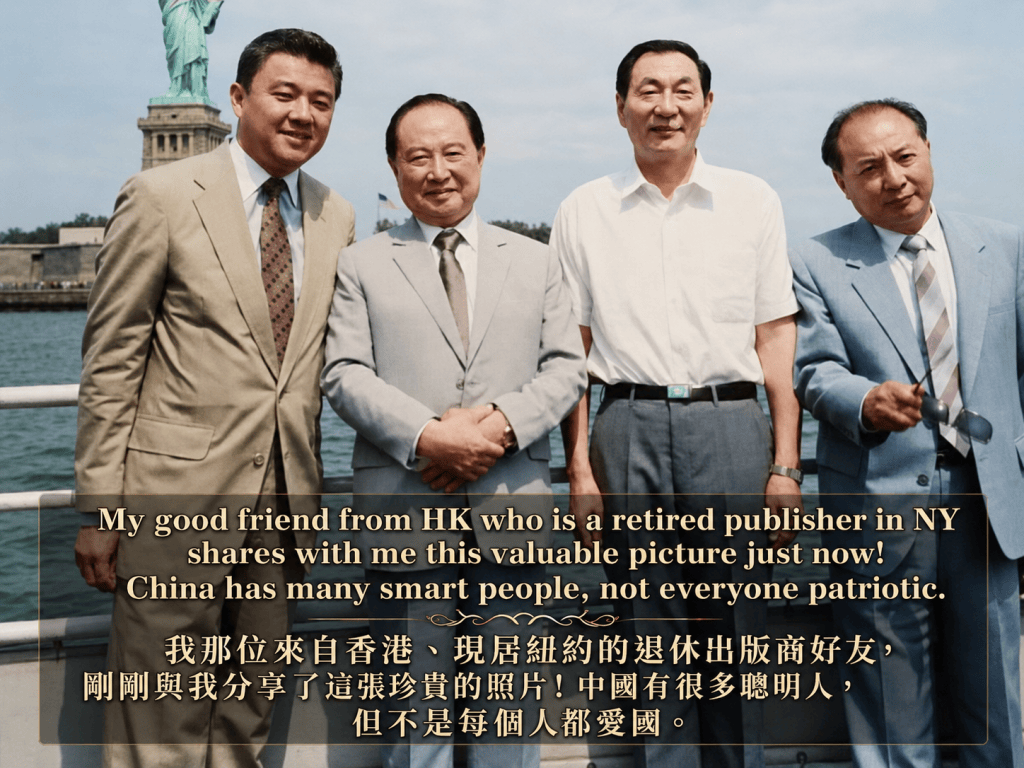
My good friend from HK who is a retired publisher in NY shares with me this valuable picture just now! China has many smart people, not everyone patriotic. 「我那位來自香港、現居紐約的退休出版商好友,剛剛與我分享了這張珍貴的照片!中國有很多聰明人,但不是每個人都愛國。」
Our Movie Projects last 20 years! By Johnson Choi, MBA, International Business Consultant since 1985. Aug 12 2026 我們的電影項目已經持續了二十年! 蔡永強,商科碩士. 國際商務顧問,自1985年起.
Met my partner (a Chinese-Japanese American) in Oakland today. He dropped a bombshell: his brother—a UCSF MD—took early retirement and moved to France last year. Cost of living there? 50% less than SF.
When I mentioned our plan to retire in China’s Greater Bay Area, he casually noted that dozens of his friends—across all races—are fleeing the US. Their shared verdict: America is beyond redemption.
I’m shocked so many have given up hope. But honestly, looking at the reasons, I can’t blame them.
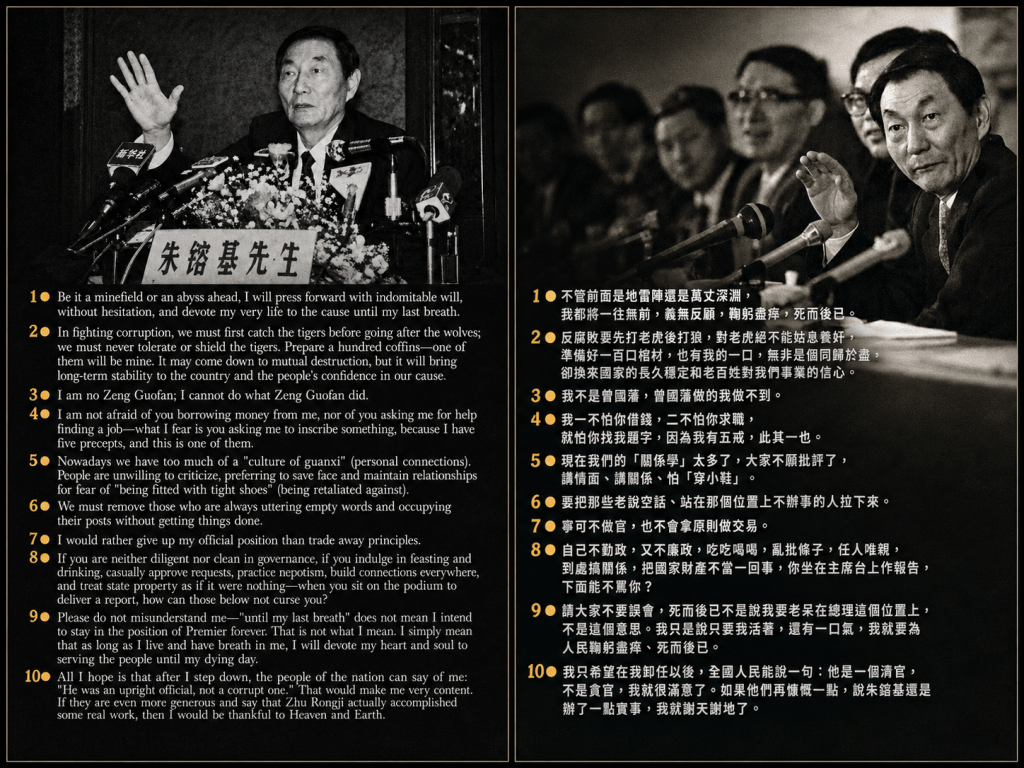
1● 不管前面是地雷陣還是萬丈深淵,我都將一往無前,義無反顧,鞠躬盡瘁,死而後已. 1● Be it a minefield or an abyss ahead, I will press forward with indomitable will, without hesitation, and devote my very life to the cause until my last breath.
2● In fighting corruption, we must first catch the tigers before going after the wolves; we must never tolerate or shield the tigers. Prepare a hundred coffins—one of them will be mine. It may come down to mutual destruction, but it will bring long-term stability to the country and the people’s confidence in our cause.
3● I am no Zeng Guofan; I cannot do what Zeng Guofan did.
4● I am not afraid of you borrowing money from me, nor of you asking me for help finding a job—what I fear is you asking me to inscribe something, because I have five precepts, and this is one of them.
5● Nowadays we have too much of a “culture of guanxi” (personal connections). People are unwilling to criticize, preferring to save face and maintain relationships for fear of “being fitted with tight shoes” (being retaliated against).
6● We must remove those who are always uttering empty words and occupying their posts without getting things done.
7● I would rather give up my official position than trade away principles.
8● If you are neither diligent nor clean in governance, if you indulge in feasting and drinking, casually approve requests, practice nepotism, build connections everywhere, and treat state property as if it were nothing—when you sit on the podium to deliver a report, how can those below not curse you?
9● Please do not misunderstand me—”until my last breath” does not mean I intend to stay in the position of Premier forever. That is not what I mean. I simply mean that as long as I live and have breath in me, I will devote my heart and soul to serving the people until my dying day.
10● All I hope is that after I step down, the people of the nation can say of me: “He was an upright official, not a corrupt one.” That would make me very content. If they are even more generous and say that Zhu Rongji actually accomplished some real work, then I would be thankful to Heaven and Earth.
Elon Musk debunked fake news said he doesn’t like China, he took to X with a message for his followers. “China is awesome. I strongly encourage people to visit.” And for those never been China, you don’t know what you missed! Even my mother loved China. 馬斯克闢謠了假新聞,稱自己不喜歡中國,他在X平台上向粉絲發文表示:「中國很棒。我強烈建議大家去走走看看。」而對於那些從未去過中國的人,你們真的不知道自己錯過了什麼!就連我母親都很愛中國.
The Tesla and SpaceX CEO was responding to an ARK Invest podcast titled “Tesla may not need China anymore.” His public praise for the country spoke louder than any rebuttal.
His mother, Maye Musk, chimed in with her own take: “I agree. Each city has its own charm with different cultural sites to see. Buildings and streets are clean and in good repair. Also, people are polite, hard-working, and respectful. I feel safe, so enjoy going to China.”



 Johnson Choi Biz