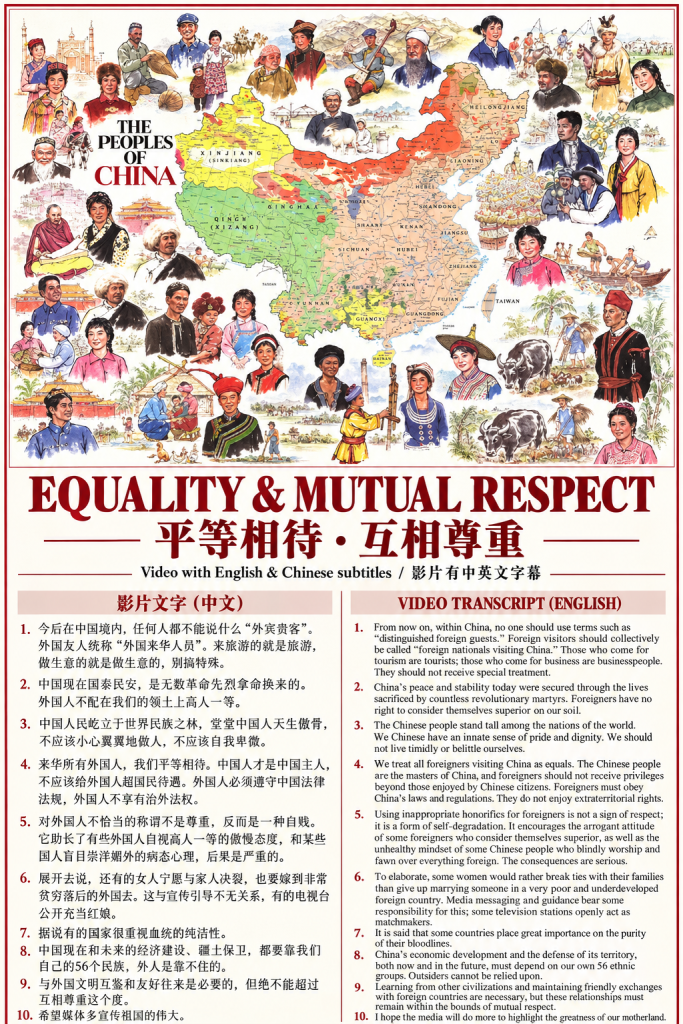
Video with English & Chinese subtitles: From now on, within China, no one should use terms such as “distinguished foreign guests.” Foreign visitors should collectively be called “foreign nationals visiting China.” Those who come for tourism are tourists; those who come for business are businesspeople. They should not receive special treatment.
China’s peace and stability today were secured through the lives sacrificed by countless revolutionary martyrs. Foreigners have no right to consider themselves superior on our soil.
The Chinese people stand tall among the nations of the world. We Chinese have an innate sense of pride and dignity. We should not live timidly or belittle ourselves.
We treat all foreigners visiting China as equals. The Chinese people are the masters of China, and foreigners should not receive privileges beyond those enjoyed by Chinese citizens. Foreigners must obey China’s laws and regulations. They do not enjoy extraterritorial rights.
Using inappropriate honorifics for foreigners is not a sign of respect; it is a form of self-degradation. It encourages the arrogant attitude of some foreigners who consider themselves superior, as well as the unhealthy mindset of some Chinese people who blindly worship and fawn over everything foreign. The consequences are serious.
To elaborate, some women would rather break ties with their families than give up marrying someone in a very poor and underdeveloped foreign country. Media messaging and guidance bear some responsibility for this; some television stations openly act as matchmakers.
It is said that some countries place great importance on the purity of their bloodlines.
China’s economic development and the defense of its territory, both now and in the future, must depend on our own 56 ethnic groups. Outsiders cannot be relied upon.
Learning from other civilizations and maintaining friendly exchanges with foreign countries are necessary, but these relationships must remain within the bounds of mutual respect.
I hope the media will do more to highlight the greatness of our motherland.
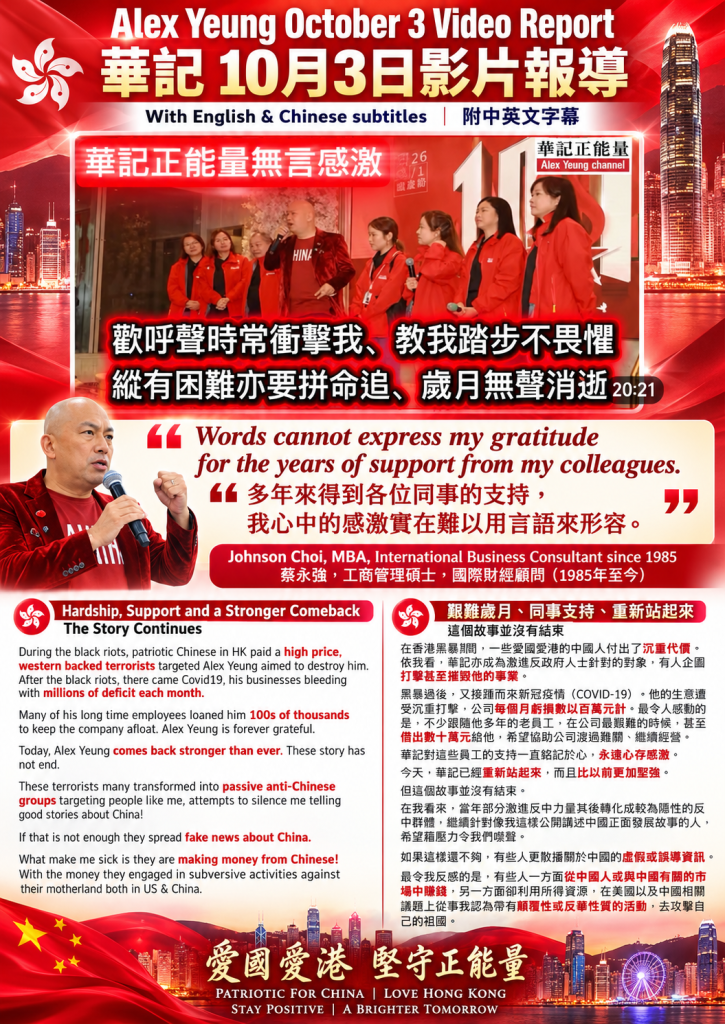
Alex Yeung October 3 Video Report with English & Chinese subtitles: “Words cannot express my gratitude for the years of support from my colleagues.”
Johnson Choi, MBA, International Business Consultant since 1985: “During the black riots, patriotic Chinese in HK paid a high price, western backed terrorists targeted Alex Yeung aimed to destroy him.”
“After the black riots, there came Covid19, his businesses bleeding with millions of deficit each month. Many of his long time employees loaned him 100s of thousands to keep the company afloat. Alex Yeung is forever grateful. Today, Alex Yeung comes back stronger than ever. These story has not end. These terrorists many transformed into passive anti-Chinese groups targeting people like me, attempts to silence me telling good stories about China! If that is not enough they spread fake news about China. What make me sick is they are making money from Chinese! With the money they engaged in subversive activities against their motherland both in US & China”
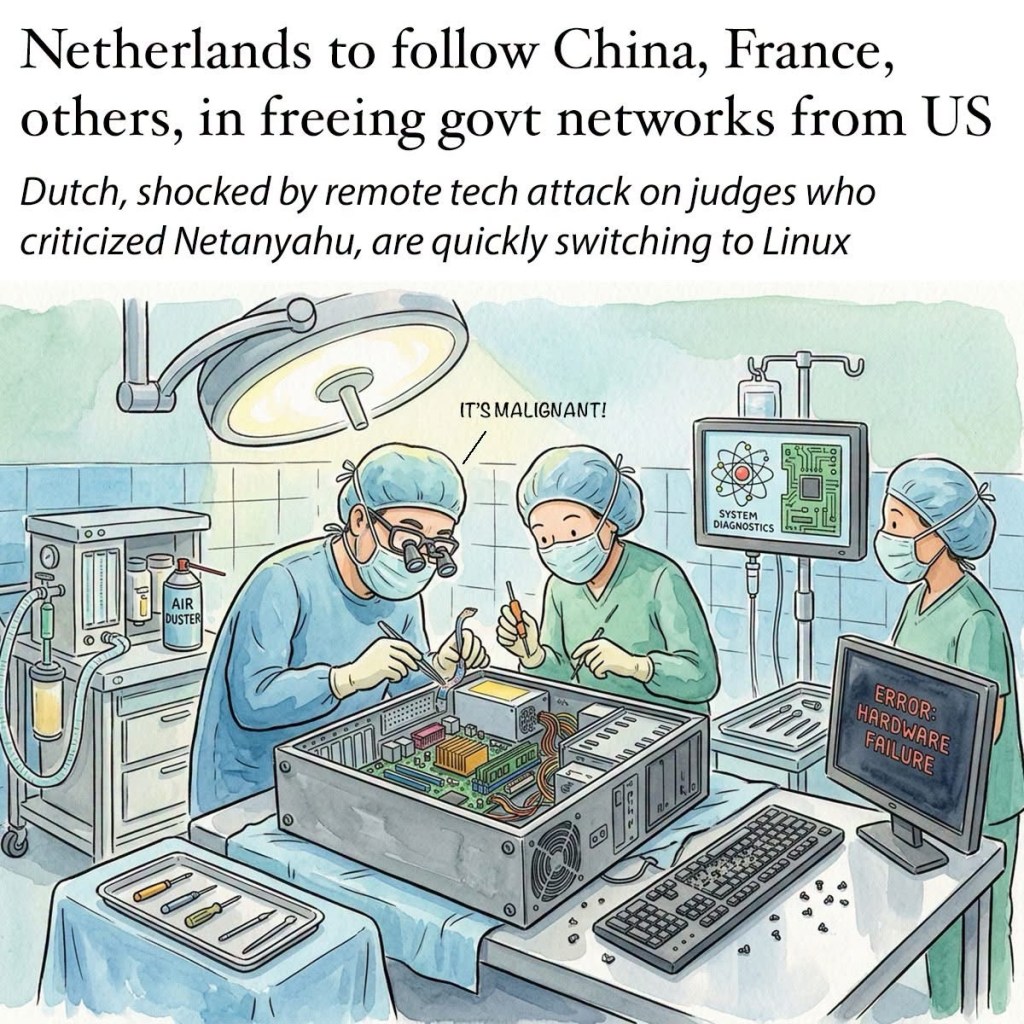
The Dutch government was shocked into action after the US remotely disabled the computers of judges in the Hague who criticized Israel leader Benjamin Netanyahu.
The sudden loss of ICC staff’s Outlook email accounts caused significant problems.
The US reserves the right to unilaterally sanction anyone, anywhere in the world–all your Google accounts could disappear in an instant. Bye-bye, gmail.
“The Dutch government is creating its own digital work environment based on the Dutch Linux distribution NixOS,” said Jasper Bakker of news website Tweakers.
The spreading realization: smart countries protect their digital sovereignty.
HARDWARE, TOO China is trying to ditch both software and hardware. Beijing in 2019 ordered government offices to switch away from foreign PCs, and fortunately has a great many locally produced computers to fill the gap.
China’s Ministry of State Security this summer told some state-linked organizations to quickly remove a customized version of Windows 10 from their machines, Bloomberg reported in August. Other organizations are set to “clean” their systems of the program by February of 2027.
Russia, France, Germany, Switzerland, Denmark, Italy and Austria are also replacing Microsoft programs with alternatives in various government areas, particularly in military sectors.
In Hong Kong, a number of government departments have already replaced Microsoft Office products with alternatives.
THE PROBLEM IS THE PUBLIC But security specialists worldwide note that large-scale switching will be a challenge.
While multiple countries are clearing their governmental systems of dominant US programs, virtually all computers owned by members of the public are filled with it—and few consumers will take the trouble to switch away from Microsoft Office, let alone from the Windows operating system.
Even in China, Microsoft is dominant at consumer level. The Windows program accounted for 87.64% of desktop web traffic in China as recently as July 2026, StatCounter reported.
Fortunately, alternative operating systems like Huawei’s HarmonyOS work well, and are growing in popularity.
Russia has enforced a total ban on Western software for government and military, mandating the use of domestic Astra Linux.
ALTERNATIVES As for Europe, the best hope is the rise of easy-install alternatives. These do exist.
France, like the Netherlands, is opting for changing the operating systems, transitioning 2.5 million civil servants to Linux. They have also been told to ditch MS Teams and use Visio, a local alternative.
Individual German states are also opting for Linux, and are using Open Document Format and LibreOffice in place of MS Office.
WEAPONIZATION IS THE ISSUE The problem is not US software, which works perfectly well. The issue is the way the programs are weaponized.
When the US weaponized GPS against a Chinese ship they (wrongly) suspected of carrying weapons of mass destruction, the world realized they needed an alternative, and now has one: Beidou.
When the US weaponized SWIFT against Russia, the world realized they needed an alternative, and became aware of one: CIPS.
And when the US weaponized Microsoft Outlook against judges in the Netherlands, the Dutch government finally sprang into action. Sometimes you need a shock to get you moving.
HERE’S WHAT THE WORLD WAS TOLD YESTERDAY: Suspected Iran-linked terrorists were caught with vans filled with explosives near a US airbase in the UK. US president Donald Trump said his intelligence people had been watching the men for a “long time” because they “were looking to do big damage”.
This morning, what do we learn? The story above is all WRONG.
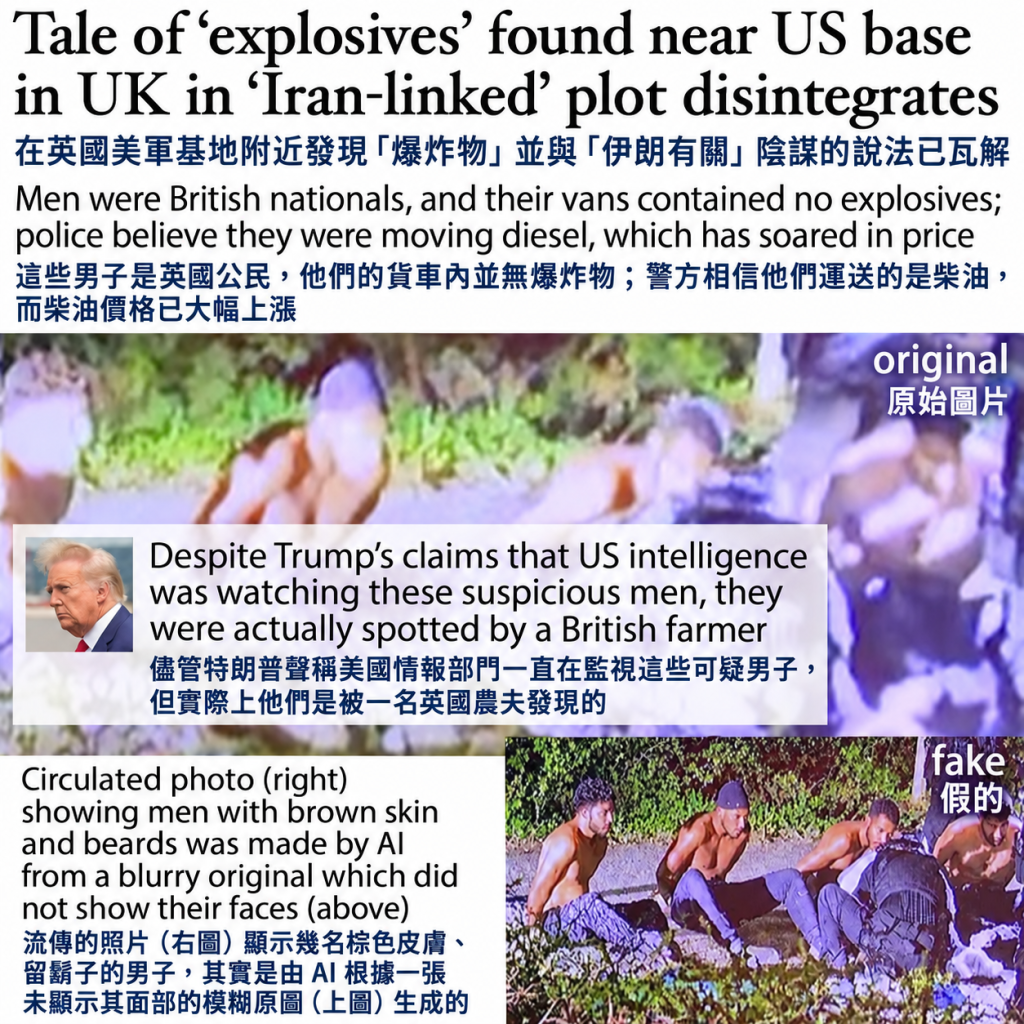
It has now been revealed that “no explosive material had been found” in the vehicles, police said.
The vans contained diesel, the value of which has soared because of unnecessary conflicts, such as the US-Israel attack on Iran.
The vehicles were branded “Fuel 2You”, suggesting they were openly transporting fuel.
Also, “All five men were British Nationals”.
Further, no tip-off came from US intelligence but from a local farmer in her 50s who called the police after seeing men with white vans.
Photos turned out to have been creatively spun out of one blurred original by an OpenAI program.
Most notably, all the men were released on bail, indicating that they were not considered dangerous.
WHAT A DIFFERENCE What a difference a day makes. It’s worth recalling what yesterday’s headlines actually said. “Counter-terror police investigate Iran link over suspected bomb plot at RAF base used by US,” the Guardian said. “Five men arrested on terrorism charges after explosives found near RAF Fairford in Gloucestershire”.
The photos with added AI-generated faces were shared on social media by several groups, including the British Army Veterans Group, and spread quickly, viewed at least 1.6 million times.
It’s certainly valid to report that men apparently acting suspiciously were found in part of rural Britain near an airbase, RAF Fairford in Gloucestershire. That’s no excuse to report that they had vans of explosives to blow up an airbase and point the finger at Iran.
THE REAL STORY As people with a little healthy skepticism know, the actual truth (as opposed to what the headlines say) can usually be found buried deep inside the text.
And so it is with this story.
The very last paragraph of the latest report on this tale in the Guardian says that the UK’s Iranian embassy said the reports of this being an Iranian operation were false, and pointed to the real illegality in the conflict:
“The circulation of such fabricated speculations, particularly in the aftermath of the criminal acts of aggression committed by the United States and the Israeli regime against the Iranian people, will serve no purpose other than to fuel Iranophobia propaganda in the UK.”
The irony, of course, is that diesel thefts have soared worldwide as the doubling of prices have led to literally millions of people being unable to run their factories and vehicles.
A global fuel crisis was triggered by the US-Israel attack on Iran on February 28—which the UN has agreed is an ongoing war crime.
And can we name one of the bases the US is using for its operations?
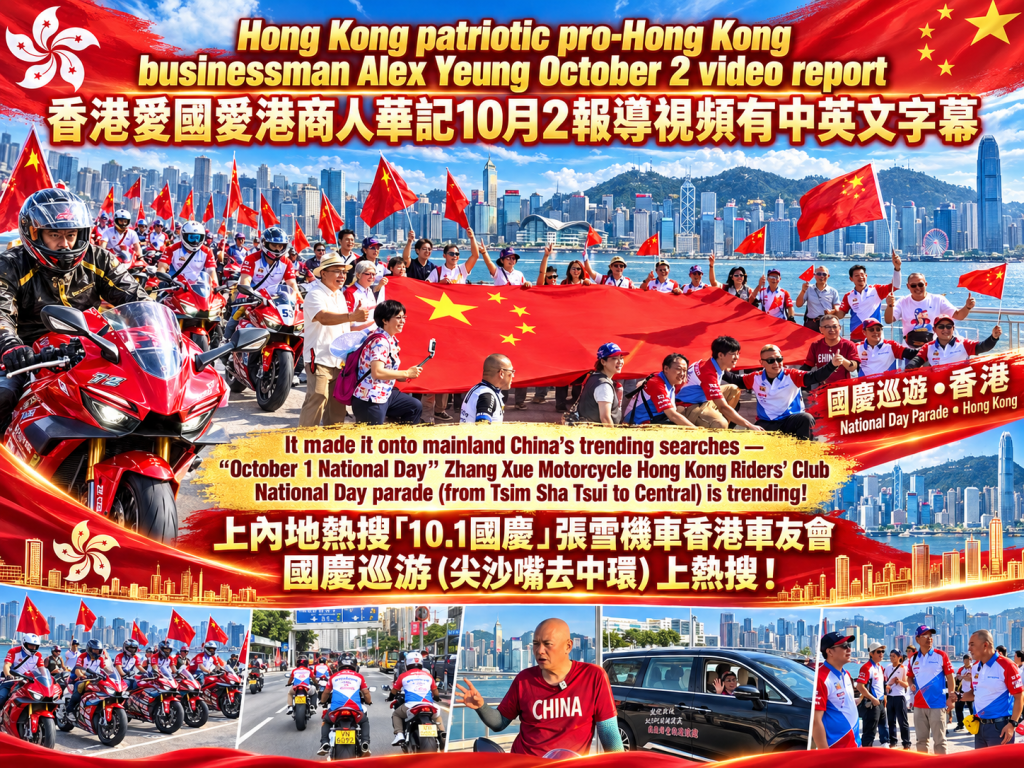
Hong Kong patriotic pro-Hong Kong businessman Alex Yeung October 2 video report: It made it onto mainland China’s trending searches — “October 1 National Day” Zhang Xue Motorcycle Hong Kong Riders’ Club National Day parade (from Tsim Sha Tsui to Central) is trending! 香港愛國愛港商人華記10月2報導視頻有中英文字幕: 上內地熱搜「10.1國慶」張雪機車香港車友會國慶巡游(尖沙嘴去中環)上熱搜!
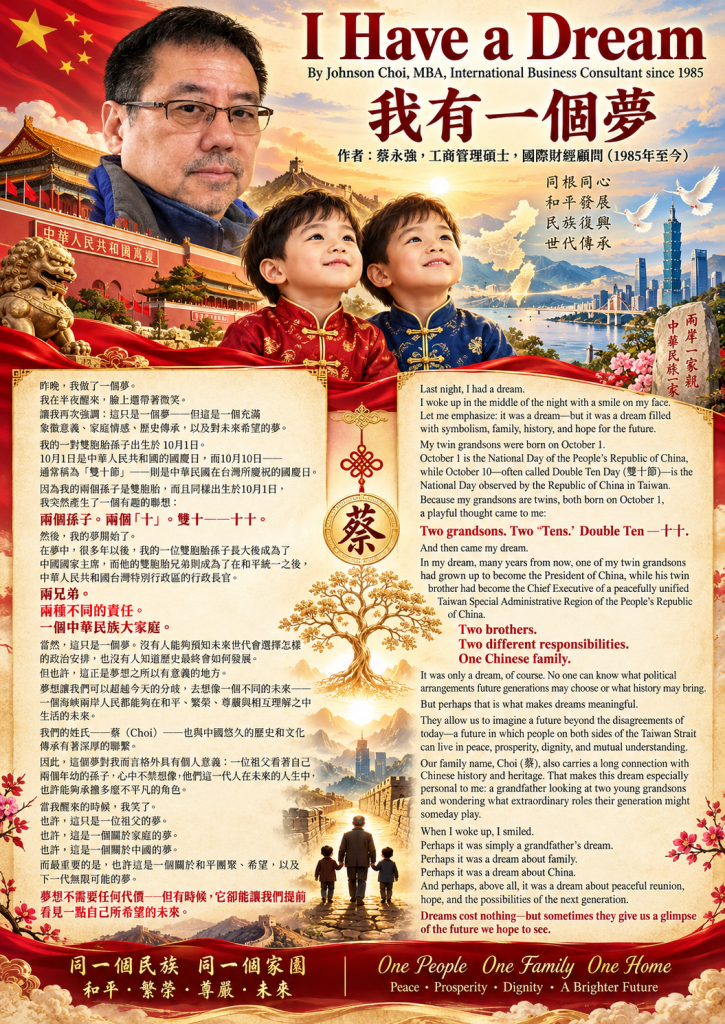
I woke up in the middle of the night with a smile on my face.
Let me emphasize: it was a dream—but it was a dream filled with symbolism, family, history, and hope for the future.
My twin grandsons were born on October 1.
October 1 is the National Day of the People’s Republic of China, while October 10—often called Double Ten Day (雙十節)—is the National Day observed by the Republic of China in Taiwan.
Because my grandsons are twins, both born on October 1, a playful thought came to me:
Two grandsons. Two “Tens.” Double Ten — 十十.
And then came my dream.
In my dream, many years from now, one of my twin grandsons had grown up to become the President of China, while his twin brother had become the Chief Executive of a peacefully unified Taiwan Special Administrative Region of the People’s Republic of China.
Two brothers. Two different responsibilities. One Chinese family.
It was only a dream, of course. No one can know what political arrangements future generations may choose or what history may bring.
But perhaps that is what makes dreams meaningful.
They allow us to imagine a future beyond the disagreements of today—a future in which people on both sides of the Taiwan Strait can live in peace, prosperity, dignity, and mutual understanding.
Our family name, Choi (蔡), also carries a long connection with Chinese history and heritage. That makes this dream especially personal to me: a grandfather looking at two young grandsons and wondering what extraordinary roles their generation might someday play.
When I woke up, I smiled.
Perhaps it was simply a grandfather’s dream.
Perhaps it was a dream about family.
Perhaps it was a dream about China.
And perhaps, above all, it was a dream about peaceful reunion, hope, and the possibilities of the next generation.
Dreams cost nothing—but sometimes they give us a glimpse of the future we hope to see.
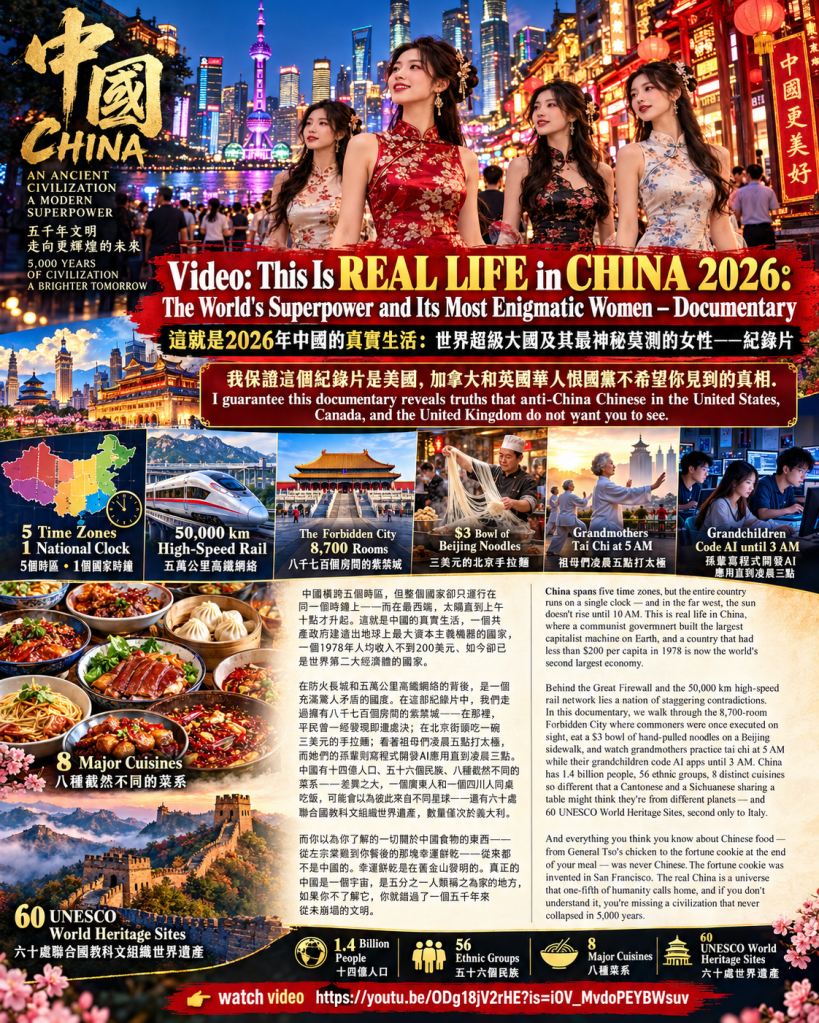
Video: This Is REAL LIFE in CHINA 2026: The World’s Superpower and Its Most Enigmatic Women – Documentary. 這就是2026年中國的真實生活:世界超級大國及其最神秘莫測的女性——紀錄片. 我保證這個紀錄片是美國,加拿大和英國華人恨國黨不希望你見到的真相.
China spans five time zones, but the entire country runs on a single clock — and in the far west, the sun doesn’t rise until 10 AM. This is real life in China, where a communist government built the largest capitalist machine on Earth, and a country that had less than $200 per capita in 1978 is now the world’s second largest economy.
Behind the Great Firewall and the 50,000 km high-speed rail network lies a nation of staggering contradictions. In this documentary, we walk through the 8,700-room Forbidden City where commoners were once executed on sight, eat a $3 bowl of hand-pulled noodles on a Beijing sidewalk, and watch grandmothers practice tai chi at 5 AM while their grandchildren code AI apps until 3 AM. China has 1.4 billion people, 56 ethnic groups, 8 distinct cuisines so different that a Cantonese and a Sichuanese sharing a table might think they’re from different planets — and 60 UNESCO World Heritage Sites, second only to Italy.
And everything you think you know about Chinese food — from General Tso’s chicken to the fortune cookie at the end of your meal — was never Chinese. The fortune cookie was invented in San Francisco. The real China is a universe that one-fifth of humanity calls home, and if you don’t understand it, you’re missing a civilization that never collapsed in 5,000 years.
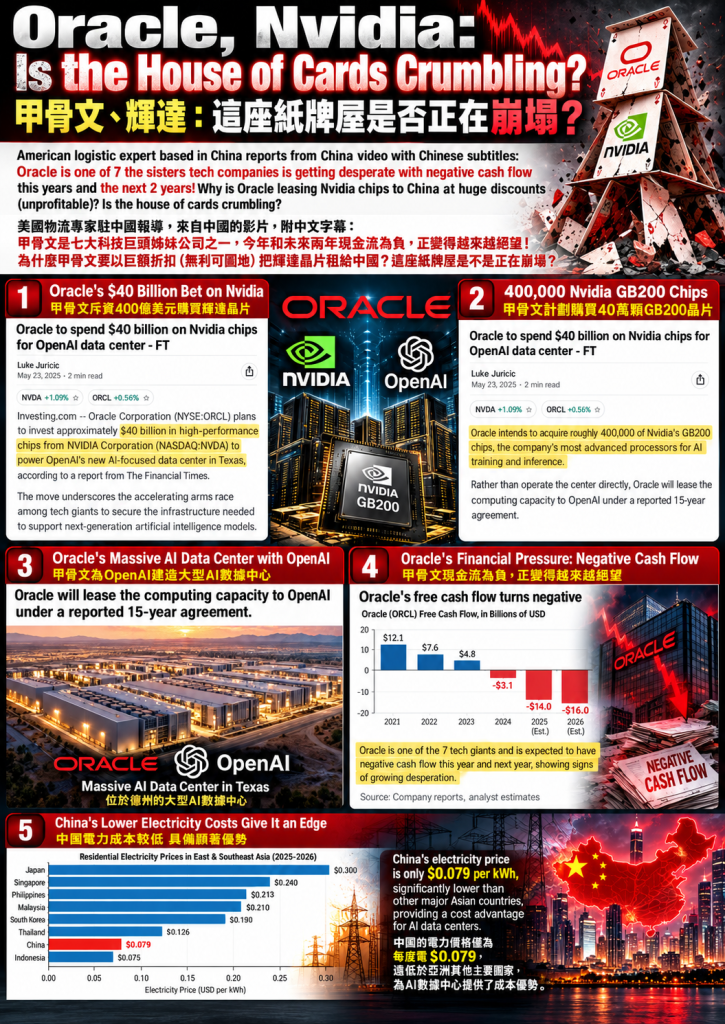
American logistic expert based in China reports from China video with Chinese subtitles: Oracle is one of 7 the sisters tech companies is getting desperate with negative cash flow this years and the next 2 years! Why is Oracle leasing Nvidia chips to China at huge discounts (unprofitable)? Is the house of cards crumbling? 美國物流專家駐中國報導,來自中國的影片,附中文字幕:甲骨文是七大科技巨頭姊妹公司之一,今年和未來兩年現金流為負,正變得越來越絕望!為什麼甲骨文要以巨額折扣(無利可圖地)把輝達晶片租給中國?這座紙牌屋是不是正在崩塌?
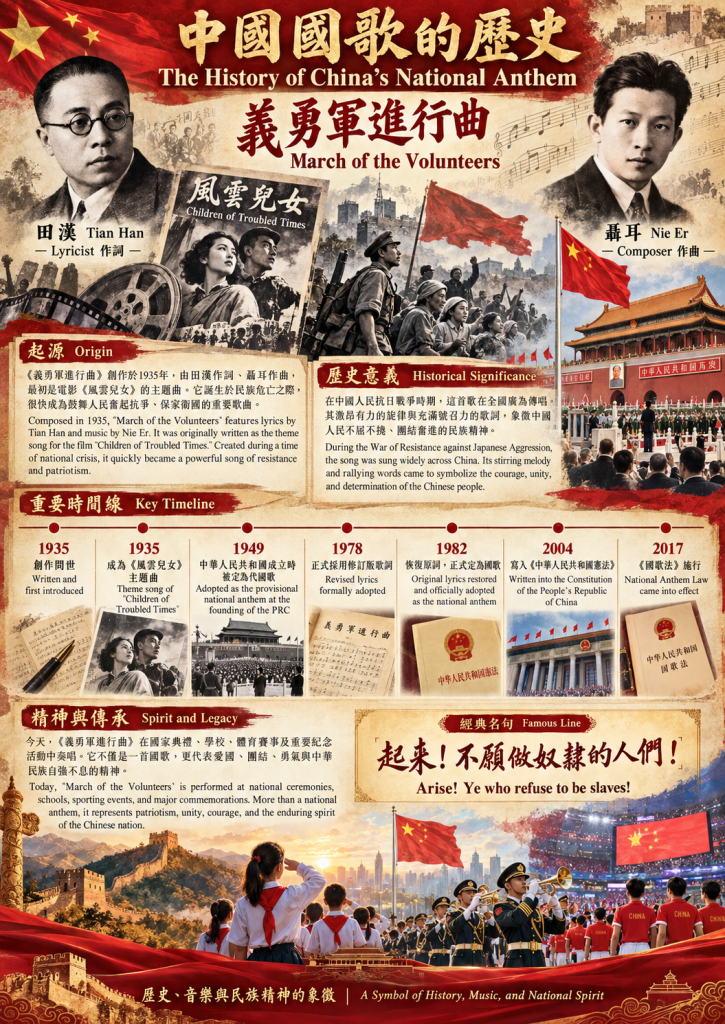
Video with English & Chinese subtitles: Why do the national anthems of many other countries sing about freedom, glory, and beautiful landscapes, while China’s national anthem sounds so forceful and full of the spirit of struggle? Why Our Anthem Roars 視頻有中英文字幕: 《為什麼我們的國歌如此激昂?》從曾經山河破碎,到今天所說的繁榮與發展——這就是我們的國歌。
Recently, I saw a comment online. Someone asked: now that we live in a peaceful era, and many national anthems celebrate freedom and glory, why does China’s anthem begin with:
“Arise! Ye who refuse to be slaves!”
and then declare:
“With our flesh and blood, let us build our new Great Wall!”
Why, the person asked, should people today continue singing words born from war and hardship?
Anyone who seriously studies this period of history will understand that this song was not simply written to promote hatred.
Behind it are the blood, sacrifice, and courage of countless Chinese people during one of the most dangerous periods in the country’s history.
Many people may not know exactly who the Volunteers were.
The Volunteer Armies were not simply well-equipped regular military units. They included people who became some of the most important—and often forgotten—figures of modern Chinese history.
On September 18, 1931, Japan’s Kwantung Army blew up a section of the South Manchuria Railway and used the incident as a pretext for military action. This became known as the September 18 Incident.
Under the circumstances at the time, units of the Northeastern Army received orders not to resist. Large numbers of regular troops withdrew, and within a short period, extensive areas of Northeast China fell.
Millions of ordinary people suddenly found themselves facing occupation and the loss of their homes.
Some officers and soldiers refused to give up their weapons and went into the mountains to continue resisting.
But many of those who joined the resistance were ordinary people.
They were farmers, hunters, and villagers—people who previously had never fought in a war.
One day they might have been cultivating their fields. The next, they put down their hoes and picked up rifles, hunting guns, and whatever weapons they could find.
They had little food, limited supplies, no sophisticated logistical system, and often no formal military designation.
Ordinary people gave them a simple name:
the Volunteer Armies.
Winters in Northeast China could fall to thirty or forty degrees below freezing.
The Japanese forces possessed aircraft, tanks, heavy weapons, and standardized military equipment. Many Volunteer fighters had only old rifles or crude weapons. Sometimes two or three men had to share a single gun.
Every bullet that was fired meant one fewer bullet remained.
Reports of their resistance passed through blockades and eventually reached the lyricist Tian Han.
The stories described soldiers dying in battle, some reportedly strapping explosives to themselves and charging enemy tanks.
Others died in the freezing snow with their hands still tightly gripping their weapons.
So when we sing today:
“With our flesh and blood, let us build our new Great Wall,”
some people may think it is merely artistic hyperbole.
But to people living through that period, it was not simply exaggeration.
It reflected a brutal reality.
It represented history written in life and blood on the frozen land of Northeast China.
Later, Nie Er composed the music.
As described in the video, he immersed himself in the work, composing intensely until the melody emerged that would move generations:
“Arise! Ye who refuse to be slaves!”
Every note sounds almost like a clenched fist striking a table.
But the message was not presented as a call to invade another country.
It was portrayed as the cry of a people who, at the darkest and most dangerous moment, felt that there was nowhere left to retreat.
Some people therefore ask: China today is peaceful and developed, so why continue singing such a national anthem?
The answer offered by the video is that the anthem is not intended to preserve hatred for future generations.
Rather, it reminds people that the land beneath their feet was once defended at enormous human cost.
If the anthem arose from that historical experience, the video argues, then that history should not simply be glossed over.
Today, some people may not even open their mouths during the brief period when the national flag is raised and the anthem is sung.
Yet behind those few dozen seconds of music lie years of war, a shattered country, and the lives of countless unnamed people who died.
If later generations become unwilling even to sing the anthem, the speaker asks, how will they understand what earlier generations experienced?
Remembering history does not necessarily mean preserving hatred.
It can mean remembering those who sacrificed their lives, remembering what ordinary people endured, and recognizing that peace and development did not come easily.
Today, when the Five-Starred Red Flag is raised and “March of the Volunteers” is played, the video presents the anthem as more than a memory of suffering.
It also symbolizes a people emerging from hardship and continuing to move forward.
From a period of national devastation to the prosperity and development celebrated today—
this is the story the video associates with China’s national anthem.
Alex Yeung’s late-night livestream video on Oct 1: The Oct 1st National Day banquet concluded successfully! Everyone left in high spirits, filled with joy and happy memories. Once again, thank you all for coming! About 1,000 guests attended the National Day dinner. Among them, a few may possibly have been connected to scam groups, or may came from the “Yellow Camp” supporter. 影片有中英文字幕: 華記10月1日深夜直播:10.1國慶晚宴圓滿落幕!各位網友都帶著滿滿的喜悅、開心滿載而歸。再次感謝大家蒞臨!1,000位貴賓參加國慶飯局,當中,有幾位可能來自詐騙集團也可能是黃C港獨.