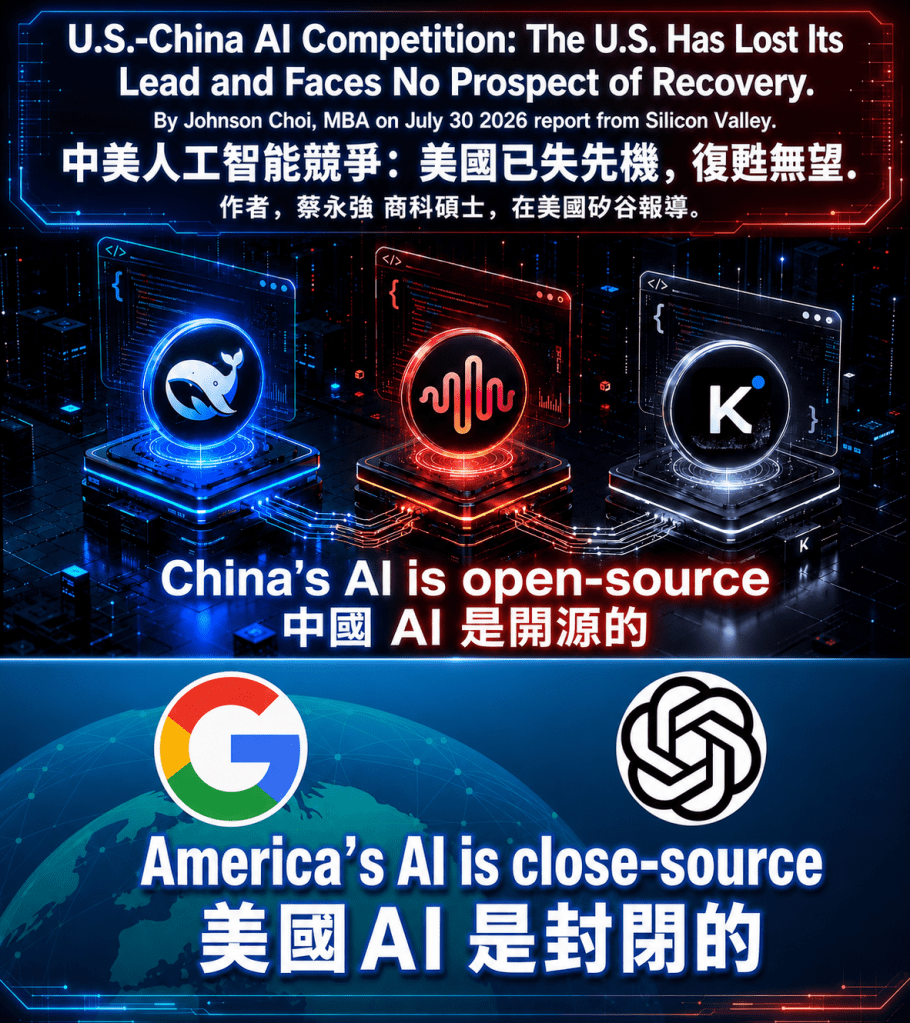
U.S.-China AI Competition: The U.S. Has Lost Its Lead and Faces No Prospect of Recovery. By Johnson Choi, MBA on July 30 2026 report from Silicon Valley.

U.S.-China AI Competition: The U.S. Has Lost Its Lead and Faces No Prospect of Recovery. By Johnson Choi, MBA on July 30 2026 report from Silicon Valley. 中美人工智能競爭:美國已失先機,復甦無望. 作者,蔡永強 商科碩士,在美國矽谷報導.

https://weixin.qq.com/sph/Ar9iSuxaPF
https://www.tiktok.com/t/ZP8tvYAQj/
https://m.facebook.com/story.php?story_fbid=pfbid0Tby3QvMnGLiAh7Uwtp56FWS69nRAkWcLASCzJyYqjwxZZ6iGp1TdoVZmRxsdmDqal&id=100036400039778&mibextid=wwXIfr

Wall Street, tech giants, and the White House have recently been touting America’s chip advantages. However, advanced semiconductors are only one component of AI infrastructure; the real bottlenecks lie in the energy and water resources needed to support massive data centers. Just as a top-tier racing car requires sufficient fuel to compete over long distances, the sustained operation of AI computing power depends on stable and affordable electricity and cooling water.

In reality, many regions in the U.S. are already grappling with structural challenges such as insufficient grid capacity and water scarcity. Even where supply can be secured, industrial electricity and water costs are four to five times higher than in China, directly undermining the operational economics of data centers and making long‑term, large‑scale deployment unsustainable.

By contrast, China’s AI development path emphasizes an open‑source ecosystem, allowing companies to freely download, modify, and deploy models—significantly lowering the barriers to entry. In the U.S., mainstream AI solutions tend to adopt closed‑source business models, which not only command high licensing fees but also cost 50 to 100 times more than comparable Chinese open‑source offerings.

This price gap is particularly crippling for startups. With limited resources, U.S. startups find it difficult to afford expensive closed‑source AI services, so turning to Chinese open‑source models has become a widespread trend. Industry observations suggest that roughly 70% of U.S. startups now use Chinese open‑source AI technologies in their products or processes. Should such options be restricted, most of these companies would face skyrocketing operational costs, loss of competitiveness, and even forced closures or relocation abroad.

In summary, America’s lag in the AI race stems not merely from technology or chips, but more fundamentally from deep‑seated disadvantages in infrastructure costs and business models. Under the twin pressures of the open‑source wave and resource constraints, the U.S. is unlikely to regain a dominant position—time is no longer on its side.

美國華爾街、科技巨擘與白宮近來頻頻宣揚其晶片優勢,然而,先進晶片僅是AI基礎設施的一環,真正的瓶頸在於支大規模數據中心的能源與水資源供給。猶如頂級賽車需仰賴充足燃油,方能馳騁長途賽道;AI算力的持續運轉,同樣離不開穩定且低廉的電力與冷卻用水。

現實情況是,美國多個地區已面臨電網承載力不足及水資源短缺的結構性難題。即便勉強尋得供應,其工業用電與用水成本亦高達中國的4至5倍,這直接侵蝕了數據中心的營運經濟性,使長期大規模部署難以為繼。

反觀中國,AI發展路徑側重開源生態,企業可自由下載、修改並部署模型,大幅降低技術進入門檻。美國主流AI方案則多採閉源商業模式,不僅授權費用昂貴,且相較中國同級開源方案,收費差距可達50至100倍。

此一價格鴻溝對新創企業尤為致命。資源有限的美國新創公司,難以負擔高額的閉源AI服務費,因而轉向中國開源模型已成為普遍趨勢。據業界觀察,目前約有七成美國新創公司在其產品或流程中採用中國開源AI技術。若此類選擇受限,多數企業恐將面臨營運成本飆升、競爭力喪失,甚至被迫倒閉或遷離美國的困境。

綜上所述,美國在AI競賽中的落後並非僅源於技術或晶片,更根源於基礎設施成本與商業模式的根本劣勢。在開源浪潮與資源約束雙重作用下,美國欲重回主導地位,恐已時不我予。
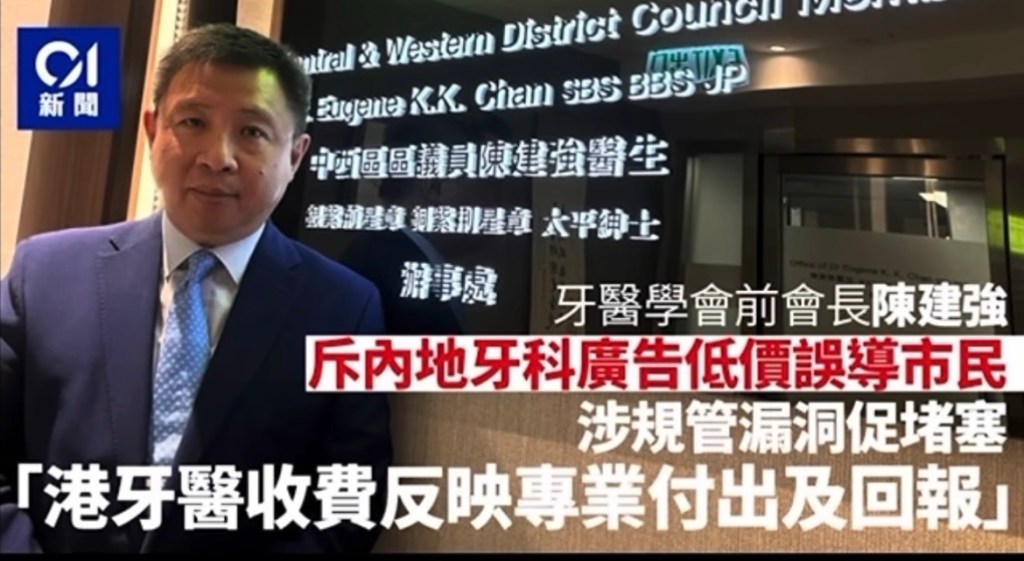
Exclusive interview with Dr. Chan Kin-keung, former President of the Hong Kong Dental Association

Video: Exclusive interview with Dr. Chan Kin-keung, former President of the Hong Kong Dental Association, exposing the rampant proliferation of overseas dental advertisements, revealing regulatory loopholes and urging improvements, while also pointing out that low-price promotions create unfair competition and misleadingly low pricing. 華記7月28報導:專訪香港牙醫學會前會長「陳建強醫生」揭露境外牙科廣告氾濫揭規管漏洞‎促改善,低價促銷形成不公兼低價誤導!
https://rumble.com/v7dfybe-dr.-chan-kin-keung-former-president-of-the-hong-kong-dental-association.html
https://www.tiktok.com/t/ZP8tt7v53/
https://weixin.qq.com/sph/ATVsW7ahSF
https://m.facebook.com/story.php?story_fbid=pfbid06aR8mFxKUyoiE7WfChb8jo7H7dK48hApUxMeD4XPTKdv3e4qDnq54ZwX8Vf3k3b3l&id=100036400039778&mibextid=wwXIfr

Video: If You Can’t Beat China Open-Source AI, Ban Them? Trump Moves to Block Chinese Open-Source AI Models exposes Trump’s ignorance on AI and Technology!

Video: If You Can’t Beat China Open-Source AI, Ban Them? Trump Moves to Block Chinese Open-Source AI Models exposes Trump’s ignorance on AI and Technology! 視頻有中英文字幕: 如果你打不贏中國開源AI 模型,就禁止他們?川普出手阻擋中國開源AI模型反映他的無知!

https://rumble.com/v7dfnbk-if-you-cant-beat-china-open-source-ai-ban-them.html
https://weixin.qq.com/sph/ADKoaIw54C
https://www.tiktok.com/t/ZP8tGcaQH/
Complete video: https://youtu.be/_Arxfm43ltc?is=SAzQ7TtbTICeqXOz
https://m.facebook.com/story.php?story_fbid=pfbid02fijRRPu9DDYNKr1EwQ6mTXj4CLoRsWWUVcvkHMcCdf4e8NgB8UyhUELUuP2StCC6l&id=100036400039778&mibextid=wwXIfr

最新一項皮尤研究中心民調顯示,超過三成美國受訪者認為中國已經超越美國,引領全球人工智慧發展。近日,中國公司「月之暗面」推出全新AI模型,繼DeepSeek之後再度撼動美國市場。與此同時,美媒報導美國政府正考慮禁止中國AI模型。近兩百家美國新創公司聽聞風聲,聯名致信川普政府反對禁令,警告白宮此舉不但無法阻止中國模型的全球擴散,反而會讓部分美國企業破產。為什麼美國政府想禁止中國AI?川普會聽取這些企業的反對意見嗎?

cent Pew Research Center poll shows that over 30% of American respondents believe China has surpassed the US to lead global artificial intelligence development. Recently, the Chinese company Dark Side of the Moon launched a new AI model, once again shaking the US market after DeepSeek. Meanwhile, US media reported that the US government is considering banning Chinese AI models. Nearly 200 US startups, hearing rumors, jointly wrote to the Trump administration opposing the ban, warning the White House that such a move would not stop the global spread of Chinese models but would instead bankrupt some American companies. Why does the US government want to ban Chinese AI? Will Trump listen to the opposition from these companies?

Johnson Choi Music Video: With you along the way, from childhood to adulthood to retirement

Johnson Choi Music Video: With you along the way, from childhood to adulthood to retirement, as long as health remains, happiness is here. Growing old slowly with you, all of you, returning to our roots – looking forward living an even more wonderful life in the Greater Bay Area of China! 蔡永強音樂視頻:從童年到成年到退休,一路有你,有你們,健康在,幸福就在,陪你慢慢變老,回歸根本 – 滿心期待不久將來在中國大灣區的退休生活 -活得更精彩!
https://www.tiktok.com/t/ZP8tsG5xe/
https://weixin.qq.com/sph/AjRTn3cW1N
https://rumble.com/v7deyci-johnson-choi-music-video-with-you-along-the-way-from-childhood-to-adulthood.html
https://m.facebook.com/story.php?story_fbid=pfbid0Z336VurH6JULu7vjqXsY5N3Xg4Y3eELnLqmp5f2F2UtbE8YgL1pv3rQFEWjnzj9dl&id=100036400039778&mibextid=wwXIfr

https://youtu.be/rSCJgr76kx0?is=7GtZT_xTxyUgGlX5

NYT: Stay away from airports if you have expired US Visa, undocumented workers or illegal aliens! ICE Arrests Surge at Airports

NYT: Stay away from airports if you have expired US Visa, undocumented workers or illegal aliens! ICE Arrests Surge at Airports, Opening New Front in Deportation Drive. Plainclothes agents are detaining travelers with expired visas, including spouses of U.S. citizens, as the Trump seeks to increase arrests to create a State of Terrors! 「紐約時報:若你持有過期美國簽證、是無證勞工或非法移民,請遠離機場!」移民及海關執法局在機場的逮捕行動激增,為驅逐行動開闢新戰線。便衣探員正在拘留持有過期簽證的旅客,其中包括美國公民的配偶,而川普正尋求增加逮捕人數以製造恐怖狀態滿足白人族羣!
https://www.tiktok.com/t/ZP8tpVTNm/
https://weixin.qq.com/sph/A9tfeVuckx
https://m.facebook.com/story.php?story_fbid=pfbid035akYGa1tbonvBbtf6DopmzwfqzJ6D6wuW6Z4CCxwGBTrhxPXiWNQvmo5ovPqPzSTl&id=100036400039778&mibextid=wwXIfr

Dear Rosarians, It has been almost 15 years since our beloved Fr Xavier passed away in Macao China

Dear Rosarians, It has been almost 15 years since our beloved Fr Xavier passed away in Macao China. To commemorate this dedicated educator who contributed most of his life to make our school a school that was filled with love and joy, the Dominican Mission has decided to have a special Mass in the school chapel on 19th October. 各位校友: 不經不覺,我們敬愛的創校神父之一 – 謝天仁神父,已經去世了差不多十五年了,為紀念這位為玫瑰崗學校盡心盡力貢獻多年的神父逝世十五周年,道明會決定於今年10月19日(謝天仁神父去世的日子)於母校3樓的聖堂舉行追思彌撒.
https://www.tiktok.com/t/ZP8tgsswc/
https://m.facebook.com/story.php?story_fbid=pfbid0YFH56zci77skGCujMTt3sVfjGFughdbTNZKEfQpr2YiEJcBZBodj6t252dBSEgG4l&id=100036400039778&mibextid=wwXIfr

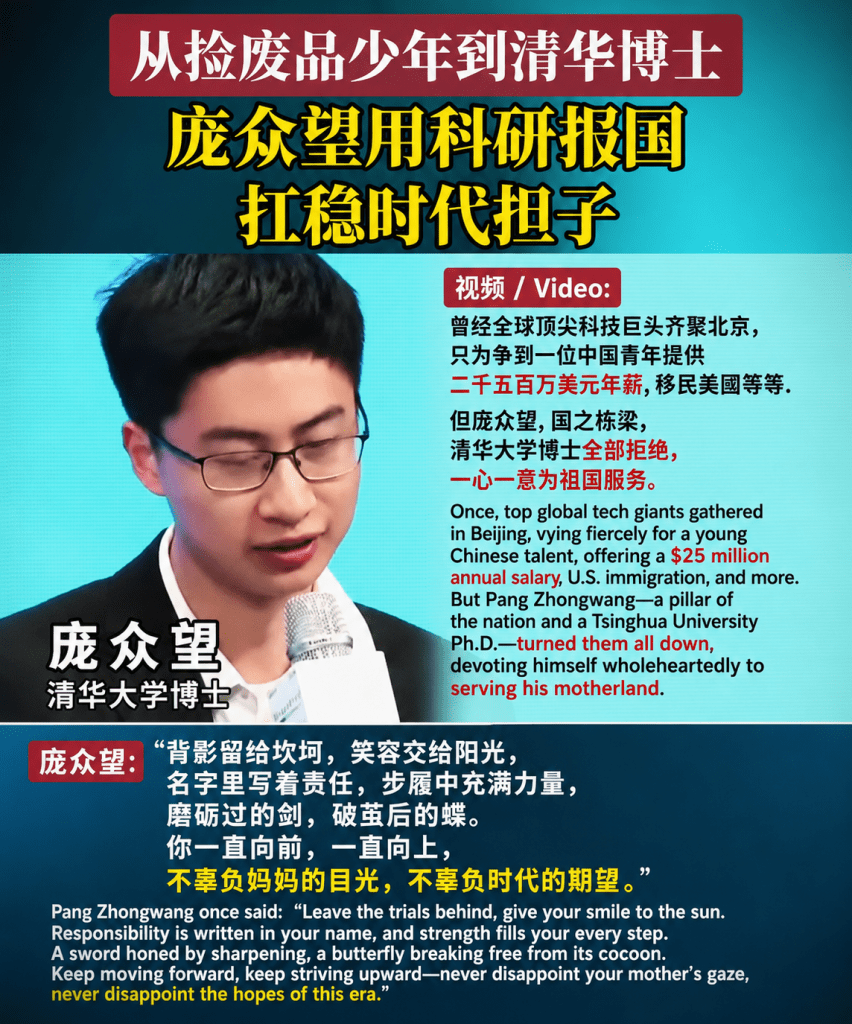
Video: Once, top global tech giants gathered in Beijing, vying fiercely for a young Chinese talent, offering a $25 million annual salary, U.S. immigration, and more.

Video: Once, top global tech giants gathered in Beijing, vying fiercely for a young Chinese talent, offering a $25 million annual salary, U.S. immigration, and more. But Pang Zhongwang—a pillar of the nation and a Tsinghua University Ph.D.—turned them all down, devoting himself wholeheartedly to serving his motherland. Pang Zhongwang once said: “Leave the trials behind, give your smile to the sun. Responsibility is written in your name, and strength fills your every step. A sword honed by sharpening, a butterfly breaking free from its cocoon. Keep moving forward, keep striving upward—never disappoint your mother’s gaze, never disappoint the hopes of this era.” 視頻在中英文字幕: 曾经全球顶尖科技巨头齐聚北京,只为争到一位中国🇨🇳青年提供二千五百萬美元年薪, 移民美國等等. 但庞众望, 国之栋梁, 清华大学博士全部拒絕,一心一意為祖國服務. 庞众望: “背影留给坎坷,笑容交给阳光,名字里写着责任,步履中充满力量,磨砺过的剑,破茧后的蝶。你一直向前,一直向上,不辜负妈妈的目光,不辜负时代的期望.” 不是每個中國人🇨🇳祇是往錢裡看包括年輕人!

https://weixin.qq.com/sph/ARAgwbVbeJ
https://rumble.com/v7ddukw-top-global-tech-giants-gathered-in-beijing-vying-fiercely-for-a-young-chine.html
https://www.tiktok.com/t/ZP8tgmTpy/
https://m.facebook.com/story.php?story_fbid=pfbid02a5kpS8whzdX2uFAT71NPkYn5qLatzb4Xdh2RU5Rf9RKe5KGPKemx7P3NLQzggtMel&id=100036400039778&mibextid=wwXIfr

他曾担心“有负众望” 进入大学后逐渐找到方向
庞众望出生于一个贫困家庭,父亲是一位精神分裂症患者,母亲下肢残疾行动不便。面对家庭的重担,庞众望一边勤于学业,一边照料家庭。
人生的前18年里,庞众望曾因先天性心脏病命悬一线,曾为母亲住院挨家挨户借钱,也曾为还债捡废品赚钱,但他一直以积极乐观的心态拥抱生活,并一直抱有“知识改变命运”的愿望。
2017年,庞众望高分考进清华大学,就读精密仪器系,开启了人生新的阶段。进入大学后,他曾在意他人目光,怕“有负众望”。但他后来在科研中找到方向,即便经历多次失败,也凭着家庭赋予的韧性坚持了下来。
入校后一年半的时间里,庞众望不断尝试新的领域。他曾担任班级团支书、生活委员、宣传委员,心理的落差也在一次次尝试中化解。很多爱心人士曾表示要资助庞众望,但都被他婉言谢绝。在学校全面的补助措施下,他的学习和生活并无后顾之忧。
“妈妈每天都在笑,我为什么要去难受?”
在庞众望入读清华大学的这些年,母亲庞志芹对他的影响一如既往。“从小我妈妈就把我教育得挺乐观的,她常说人要往前看,我妈妈每天都在笑,我为什么要去难受?”庞众望回忆。
庞众望的母亲庞志芹一出生便与病痛相伴,先天性脊柱裂导致她下肢发育不全,双腿被截肢,父母出于安全考虑没让她上学。生下孩子后,不识字的庞志芹给孩子起名:庞众望。
“这孩子是我最大的希望,我自己一辈子没读过书,可羡慕读书的了,就想让他能读,尽量读好书。”庞志芹说。
考入清华大学,是庞众望给妈妈和家人的第一个惊喜。3年后,母亲又收到了儿子的好消息,庞众望获得了直博的资格,选择继续在清华大学攻读博士研究生。只是那时,庞志芹已经走到了生命的尽头。
2020年,庞志芹因病住院,在家人的陪伴下,走完了自己48年的人生。
“我们这一代人的使命就是科研报国”
母亲过世后,庞众望多次梦见小时候推着母亲去赶集的画面。他说自己很少在母亲面前流露语言上的情感,更愿意用行动来表达。“我觉得她给我起了这样的名字,我能够做的就是在未来不辜负她给我起的名字。”
2021年,庞众望本科毕业后,继续留在清华大学精密仪器系攻读博士学位。
在生活和求学的路上,社会各界的关心和帮助,一直是庞众望的底气所在,政府的低保持续为这个家庭兜底,从高中母校到清华大学,学校发放的助学金和自己获得的奖学金,也让他不必为生活费用分心。
8年前,母亲送给庞众望的期许,如今已成为他清晰而坚定的理想,科研报国。“我们这一代人的时代使命就是科研报国。科技只有掌握在自己手里的才叫科技。”
“始终记得妈妈的期望 为国家多做贡献、帮助更多的人”
庞众望没有想到,自己的故事能鼓舞很多人。在《感动中国2024年度人物颁奖盛典》现场,庞众望分享了一个小故事,“去年我遇到了一个小姑娘,她说自己选择了一个非常不喜欢的专业,是我的故事帮她走出了那段低谷,最后从事了自己喜欢的工作。”
如今,庞众望的妈妈离开已有5年,他始终记得妈妈临走之前跟自己说的话,“为国家多做点贡献,帮助更多的人。”庞众望说,“未来,我会继续去努力,不辜负妈妈对我的期待。”

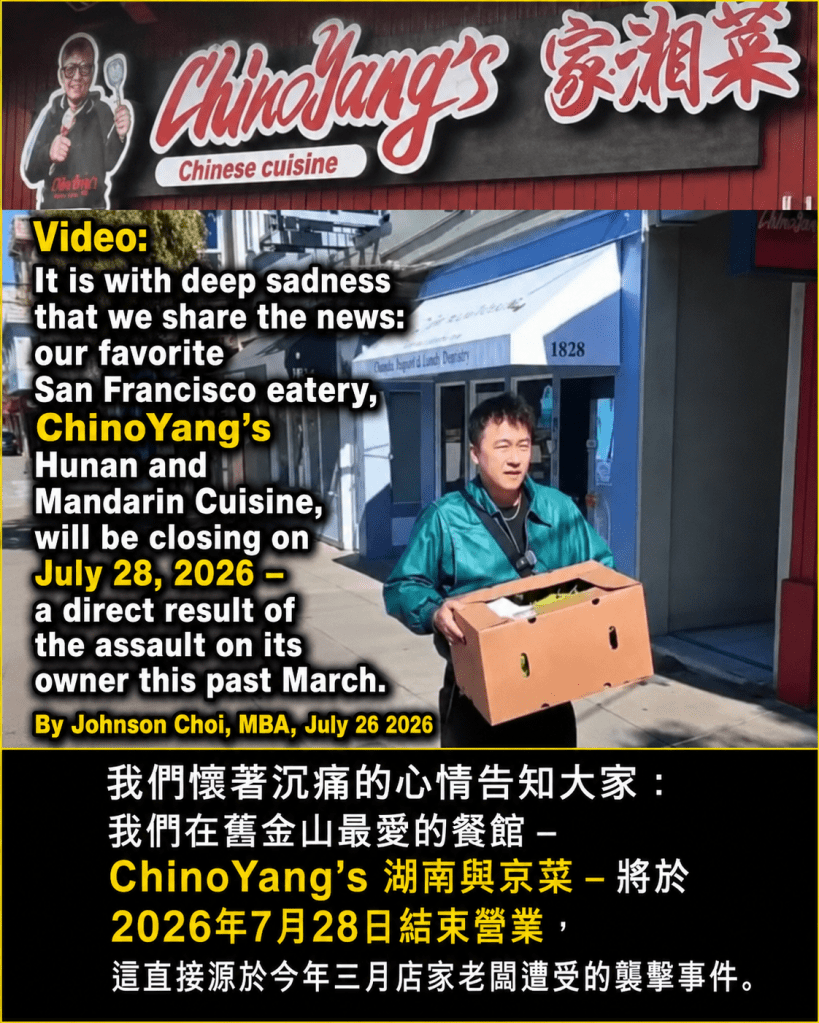
Video: It is with deep sadness that we share the news: our favorite San Francisco eatery, ChinoYang’s Hunan and Mandarin Cuisine, will be closing on July 28, 2026 – a direct result of the assault on its owner this past March.

Video: It is with deep sadness that we share the news: our favorite San Francisco eatery, ChinoYang’s Hunan and Mandarin Cuisine, will be closing on July 28, 2026 – a direct result of the assault on its owner this past March. By Johnson Choi, MBA, July 26 2026 我們懷著沉痛的心情告知大家:我們在舊金山最愛的餐館 – ChinoYang’s 湖南與京菜 – 將於2026年7月28日結束營業,這直接源於今年三月店家老闆遭受的襲擊事件。

https://rumble.com/v7dd222-our-favorite-san-francisco-eatery-chinoyangs-hunan-and-mandarin-cuisine-clo.html
https://www.tiktok.com/t/ZP8tqcNea/
https://weixin.qq.com/sph/AlDjK6RxHV
https://m.facebook.com/story.php?story_fbid=pfbid0bbfsdGmLvUDg1pzYrqA84P6SAsa77zie3uaN6WTcN6uAz7UeEtKMbV6Kik3dXdFxl&id=100036400039778&mibextid=wwXIfr

這令人心碎的損失,赤裸裸地反映了針對華裔美國人的反亞裔仇恨與暴力犯罪日益升溫,而這種煽動性言論更被美國總統、國會代表團,以及州與市級政府官員危險地推波助瀾 – 他們將美國所有的弊病都歸咎於華裔美國人與中國。這項威脅完全無法預測,攻擊者可能在任何時間、任何地點現身。

正是這種不確定性,促使數以千計的美國人如今選擇移居中國大灣區養老。畢竟,正如一句中國老話所說:「人在天堂,錢在銀行,又有何用?」

This heartbreaking loss is a stark reflection of the rising anti-Asian hate and violent crimes targeting Chinese Americans, rhetoric that has been dangerously fueled by U.S. Presidents, Congressional delegations, and state and city officials who scapegoat Chinese Americans and China for all of America’s ills. The threat is utterly unpredictable—attackers can appear anywhere, at any time.

That very uncertainty is precisely why thousands of Americans are now choosing to retire in China’s Greater Bay Area. After all, as the old Chinese saying wisely puts it: “Your money in the bank is useless when you are in heaven.”

We are celebrating our 28th wedding anniversary in August

We are celebrating our 28th wedding anniversary in August. 我們將在八月慶祝我們的二十八週年結婚紀念日. Johnson & Carmen Choi 蔡永強夫婦
https://weixin.qq.com/sph/AXVuQcfcEy
https://www.tiktok.com/t/ZP8tqj8Kw/
https://m.facebook.com/story.php?story_fbid=pfbid02c5X4Cxxp4pzw718RaVrpFZEMGYRbRaN3m1Ya8PCwNpeaNmU6NGtgvkVU168wQeY7l&id=100036400039778&mibextid=wwXIfr

Analysis of Disparities in Choice for Chinese Amid High-Cost Challenges in Hong Kong and San Francisco. By Johnson Choi, MBA on 7-27-26

Analysis of Disparities in Choice for Chinese Amid High-Cost Challenges in Hong Kong and San Francisco. By Johnson Choi, MBA on 7-27-26 香港与旧金山高成本困境下的华人群体选择空间差异分析. 欲知詳情請和蔡永強聯絡. 筆者: 蔡永強,商科碩士.

https://www.tiktok.com/t/ZP8t4ovTh/
https://weixin.qq.com/sph/ArtGjX4C11
https://m.facebook.com/story.php?story_fbid=pfbid0y3aFmfCM47hwfj8fzFv7t6oFS1VZV47paxKbvNSfNm3ENtxvxVyLptJLQfzsxXMdl&id=100036400039778&mibextid=wwXIfr

香港与美国旧金山均面临显著的城市生活成本压力,具体表现为物价、租金及房价持续高企,同时服务行业普遍存在附加费用偏高与服务质量参差的问题(例如旧金山餐饮消费常附加30%的税费及服务费)。然而,两地华人群体在应对此类困境时,其可选项与灵活性存在本质差异。

地理区位与跨境通勤效率的悬殊对比: 以粤港澳大湾区“一小时生活圈”为参照,香港居民可依托高效跨境基建实现快速通勤。例如,自香港各区域至深圳等大湾区口岸,24小时巴士服务频密,单程票价仅约0.3美元,且通关时间最短仅需五分钟。反观旧金山湾区,日常跨城通勤耗时显著,午间外出用餐的往返车程普遍长达三小时,此类时间成本严重制约了居民的生活半径与消费选择。

跨境消费与退休迁移的理性经济选择: 当前,大量美加退休人士基于成本收益考量,主动选择移居大湾区以提升可支配收入与实际生活品质。据调研,美国及加拿大综合物价水平约为中国的4至7倍,而在香港可便捷获取的商品与服务,其品类丰富度、价格竞争力及新鲜度均优于北美市场。多位移居者反馈,香港市场能够提供北美难以购得的特定商品,且价格更为合理、供应链更新鲜。

结构性差异的制度与地理根源: 上述现象并非偶然,而是源于两地不同的地理区位、跨境政策及区域经济整合程度。香港依托“一国两制”框架与内地深度互联,享有低成本、高时效的跨境生活资源;而旧金山作为美国西海岸门户,其周边区域协同效应有限,跨境消费选择受制于边境政策与物理距离,致使普通居民(非高净值群体)缺乏替代性方案。

综上,两地虽表面面临相似的通胀与服务市场挑战,但香港华人群体的实际应对策略与生活缓冲空间,显著优于其美国对应群体,此差异归根于区域经济整合度及跨境基础设施的可达性。

Analysis of Disparities in Choice for Chinese Amid High-Cost Challenges in Hong Kong and San Francisco

Hong Kong and San Francisco, USA, both face significant urban cost-of-living pressures, manifested in persistently high prices for goods, rents, and real estate, alongside widespread issues of excessive surcharges and uneven service quality in the hospitality sector (e.g., dining in San Francisco often incurs an additional 30% in taxes and service fees). However, when addressing these challenges, the options and flexibility available to Chinese communities in the two locations differ fundamentally.

Geographic Location and Cross-Border Commuting Efficiency: A Striking Contrast

Taking the Guangdong–Hong Kong–Macao Greater Bay Area’s “one-hour living circle” as a benchmark, Hong Kong residents benefit from efficient cross-border infrastructure enabling rapid commuting. For instance, from various districts in Hong Kong to checkpoints into the Greater Bay Area (such as Shenzhen), 24-hour bus services are frequent, with a one-way fare of approximately USD 0.30 and customs clearance taking as little as five minutes. In contrast, in the San Francisco Bay Area, daily intercity commuting is notably time‑consuming; a round trip for a midday meal outside the office typically takes three hours, severely constraining residents’ living radius and consumption choices.

Rational Economic Choices in Cross-Border Consumption and Retirement Migration
Currently, a significant number of retirees from the US and Canada are actively choosing to relocate to the Greater Bay Area, driven by cost‑benefit considerations to enhance disposable income and overall quality of life. Surveys indicate that the general price level in the US and Canada is roughly four to seven times that of China, while goods and services readily available in Hong Kong offer greater variety, more competitive pricing, and superior freshness compared to the North American market. Multiple expatriate residents report that Hong Kong’s market provides specific products difficult to obtain in North America, at more reasonable prices and with fresher supply chains.

Institutional and Geographic Roots of Structural Differences
These phenomena are not accidental but stem from divergent geographic locations, cross‑border policies, and degrees of regional economic integration. Leveraging the “One Country, Two Systems” framework, Hong Kong maintains deep connectivity with the mainland, enjoying low‑cost, time‑efficient cross‑border living resources. San Francisco, as a gateway on the US West Coast, experiences limited regional synergies, and cross‑border consumption options are constrained by border policies and physical distance, leaving ordinary residents (excluding high‑net‑worth individuals) with few viable alternatives.

Conclusion
In summary, while both cities superficially grapple with similar inflationary pressures and service‑market challenges, the actual coping strategies and living buffers available to the Chinese community in Hong Kong are markedly superior to those of their counterparts in the US. This disparity ultimately stems from differences in regional economic integration and the accessibility of cross‑border infrastructure.