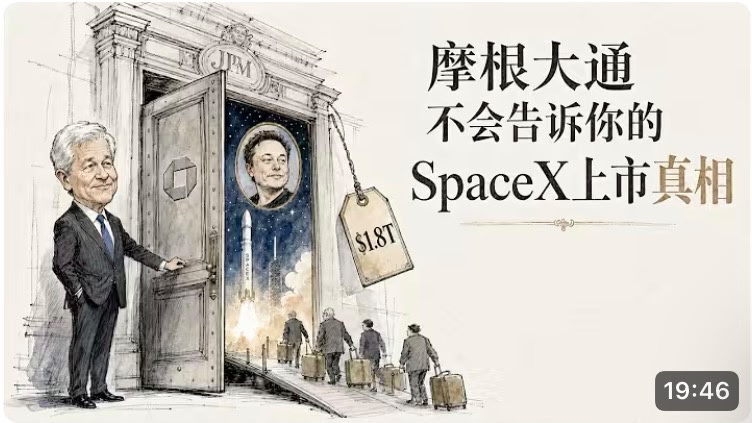
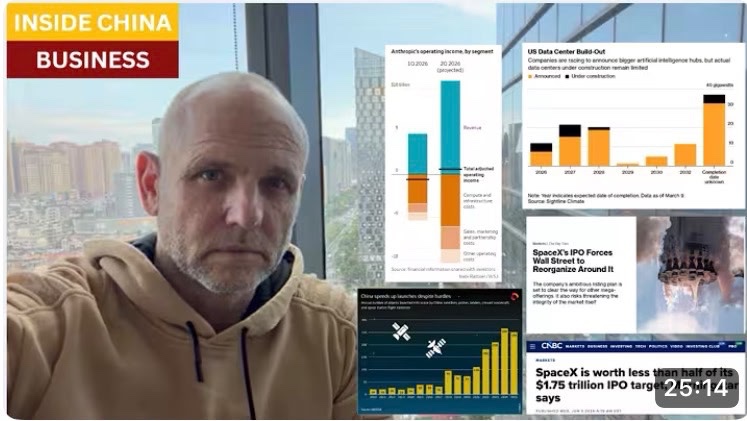
American logistic expert report from China video: Screwed again: small investors to bail out billionaires from SpaceX, OpenAI, and Anthropic 再度被坑:散戶將為SpaceX、OpenAI和Anthropic的億萬富豪們接盤
SpaceX will soon go public, in an offering that will value the company at over a trillion dollars.
Anthropic and OpenAI are Artificial Intelligence companies, who also plan megacap IPO’s for later in the year.
Recent changes to indexing rules will compel massive share buys into these companies by retirement and pension plans, and by passive ETF’s and mutual funds.
In the past, new companies were required to wait until insiders sold most of the shares after the lockup periods before being added to investment indices. Companies also needed to show a strong history of growth and sound financial practices.
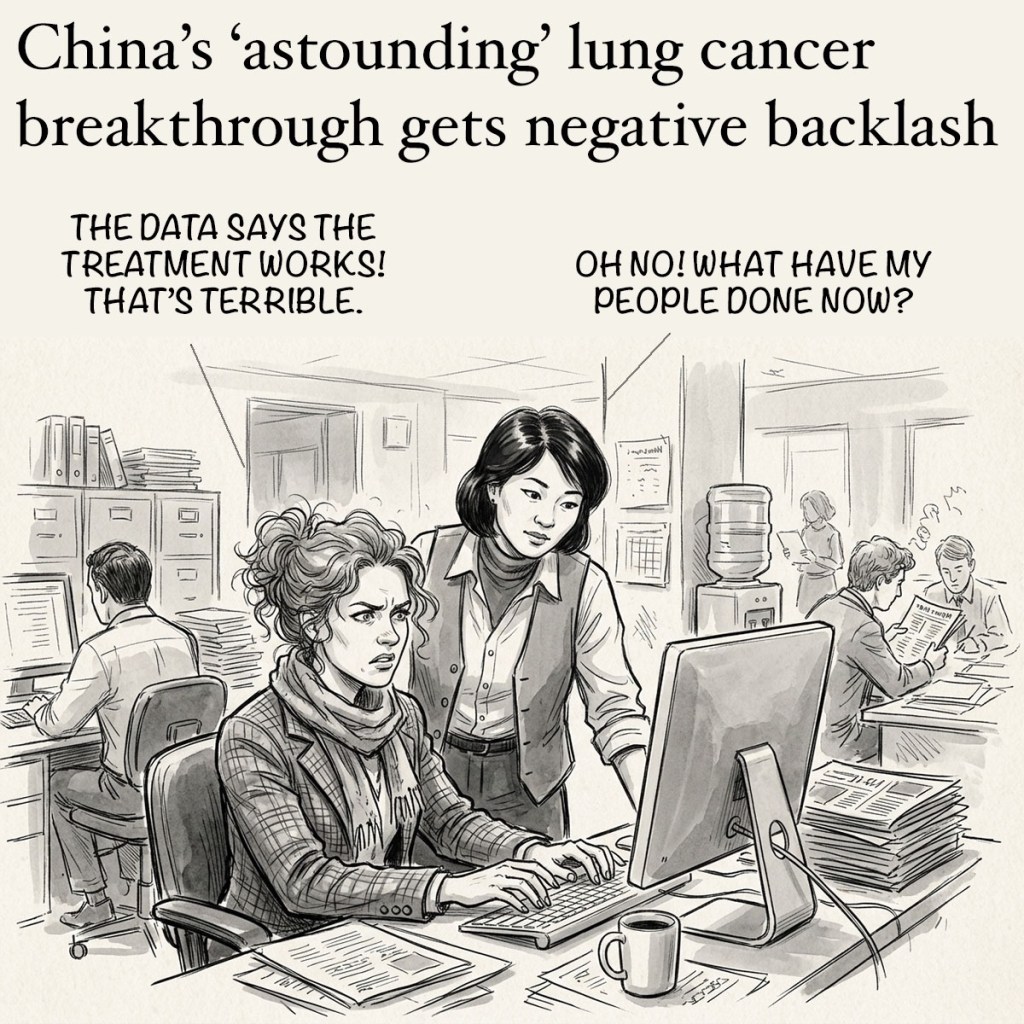
CHINESE SCIENTISTS created a new medicine that is being hailed as a breakthrough in the fight against lung cancer, it was revealed this week.
“And the results here, I think, are quite astounding,” said Dr Monty Pal of the American Society of Clinical Oncology (ASCO) in a YouTube video review. “What we see here is an improvement in median overall survival.”
Yet the development of the new drug, called ivonescimab in English, is being portrayed as worrying news by politicians and media in the US. Why?
The US elite’s congenital megalomania means it has to be number one in every field. This need triggers extreme paranoia—and means that Chinese lifesaving advances are bad news.
.
NATIONAL SECURITY THREAT
“It’s a war right now with China,” said United States Department of Health and Human Services Chris Klomp at the recent Conservative Political Action Conference.
“We face a national security threat right now…it’s not one of missiles and tanks. It’s of laboratories and life-saving medications.”
Oh no! Not life-saving medications!
Will the dastardly Chinese stop at nothing?
But it gets worse. If American patients become reliant on the Chinese for drugs, there is a risk of “creating a new Strait of Hormuz”, said former FDA chief Dr. Peter Marks, quoted in the New York Times.
That’s a telling remark. Not only is the paranoia up front and center, but look at the example he chose. The US created an entirely needless problem in Iran, with thousands dead and millions suffering from fuel shortages.
Western political plays have real world consequences for both sides–and innocent parties, too.
CHINA SCIENTISTS GET TOP SPOT
The medical issue escalated last week at the annual ASCO global gathering of oncologists (cancer doctors).
The five biggest breakthroughs are given top-of-the-bill presentation slots—and politicians and journalists were shocked when one of them went to Chinese medical scientists who conducted their trials in China.
THE ISSUES
Let’s look at the issues, one by one:
Are there serious concerns that the new drug, ivonescimab, doesn’t work or only works on Chinese people?
No. The drug was created by a Chinese firm called Akeso Biopharma, and it is already used successfully in China. There has since been a global study in the United States, Canada and Europe, too, to ensure diversified data.
Are there worries that China may deny sending this and other drugs to Americans?
No. Chinese companies keep the rights for their own country and then license the drugs in the US to American firms. Ivonescimab in the US is a product of Summit Therapeutics of Miami.
Is there concern that the data is false?
No. The Lancet, a medical academic journal, has already printed a study saying that people who got the new drug had a 34 percent lower death rate.
Is the problem that the Chinese copied the drug from the US?
No. That’s not how science works. Science advances through data-driven breakthroughs, irrespective of where they take place.
So what is the problem?
It’s the usual one: the US needs to dominate everything, whoever gets hurt. In the case of medicines from China, the victims of needless hostility will include US citizens, if drugs are delayed or banned.
BUILDING WALLS President Donald Trump has already signed legislation that prevents US government bodies signing contracts with Chinese biotech firms, however beneficial their products and services may be.
And separately, politicians in Congress are trying to get rules passed that prevent the recognition of data from clinical trials in Mainland China or Hong Kong.
Some US journalists also appear less interested in the scientific breakthroughs than the politics of who is making them. The New York Times report last week on the topic began with these lines:
“For decades, an annual gathering of oncologists has featured drug trials that were run mainly at American and European hospitals.
“But at this year’s meeting, which is being held in Chicago this weekend, the signs are everywhere of China’s ascendance as a powerhouse in drug development — and of the threat that many believe it poses to American biotechnology.”
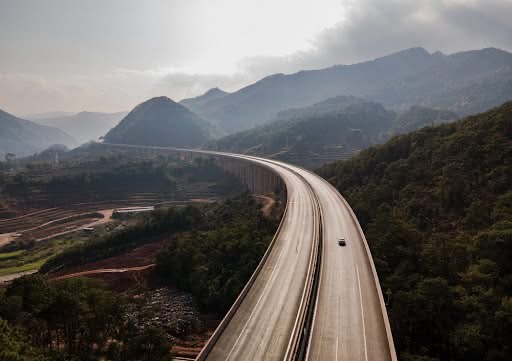
Ronny Tong Ka Wah; the Roads – Some time ago, my wife and I visited Yunnan and found that the highways here are world-class in terms of design, construction and maintenance. 湯家驊: 路 – 前陣子和太太到雲南旅遊,發覺無論在設計、建造和保養方面,這裏的高速公路均達世界水平。
Ronny Tong Ka Wah; the Roads – Some time ago, my wife and I visited Yunnan and found that the highways here are world-class in terms of design, construction and maintenance.
One day I realized that there were not many cars on the road, I asked the guide why This road is particularly low on cars? The guide said, “Oh, this road was built less than a year ago. A little curious, then asked what city can this road connect to? He laughed and said that there was no city, just a few remote villages; he further explained that farmers in the mountains used to walk all day to the market every week with their own fruits and vegetables, and today the highway came outside their door, and every week young men would drive light trucks to buy crops from them; more income, life was stable, and the village was rich. We are very moved to hear that many infrastructure projects in the country are not for the pursuit of economic returns, but only for the improvement of people’s lives; this is China today.
From another perspective, public data shows that the country has added 300,000 miles of highway and 40,000 miles of highway over the past 10 years; compared to only 240,000 miles of highway built in the United States during the same period. In terms of railroads, the country built 40 thousand miles of railway and 20,000 miles of high-speed rail in the same period; the United States not only did not add railroads, but also In this decade, the country spent 4.8% of its GDP or 60% of its national debt on infrastructure, while the US spent only 0.51% of its GDP or 4.25% of its national debt on infrastructure. You would say, ah, but America is a developed country; the problem is that developed countries don’t need to build infrastructure? Of course not! The fact is, the difference between the US and China in this respect is just governing values.
Our generation raised in the colonial era has a tendency to be elite in our youth; but with more knowledge and maturity, we begin to realize that no system is less important than the right values and how to improve the quality of life of the people. We have our own way to go, why should we care how others go their way?
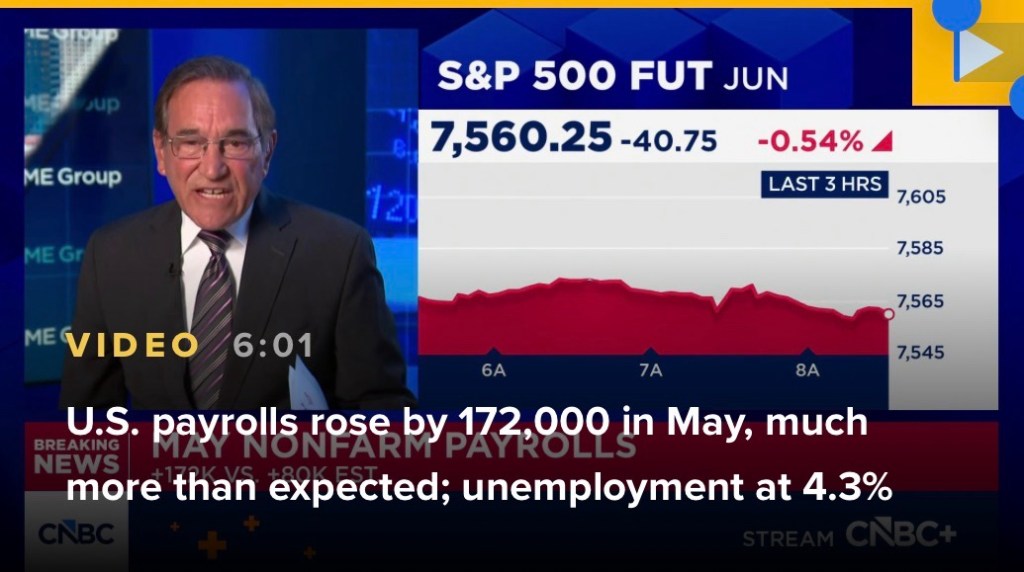
I don’t know how real is this job report: “U.S. payrolls rose by 172,000 in May”. I know at least 2 companies in SF fired/layoff over 30 engineers with average annual salary of US$200,000 我不知道這份就業報告有多真實:「美國五月份就業人數增加了17.2萬人」。我知道舊金山至少有兩家公司解僱/裁掉了超過30名工程師,他們的平均年薪為20萬美元.
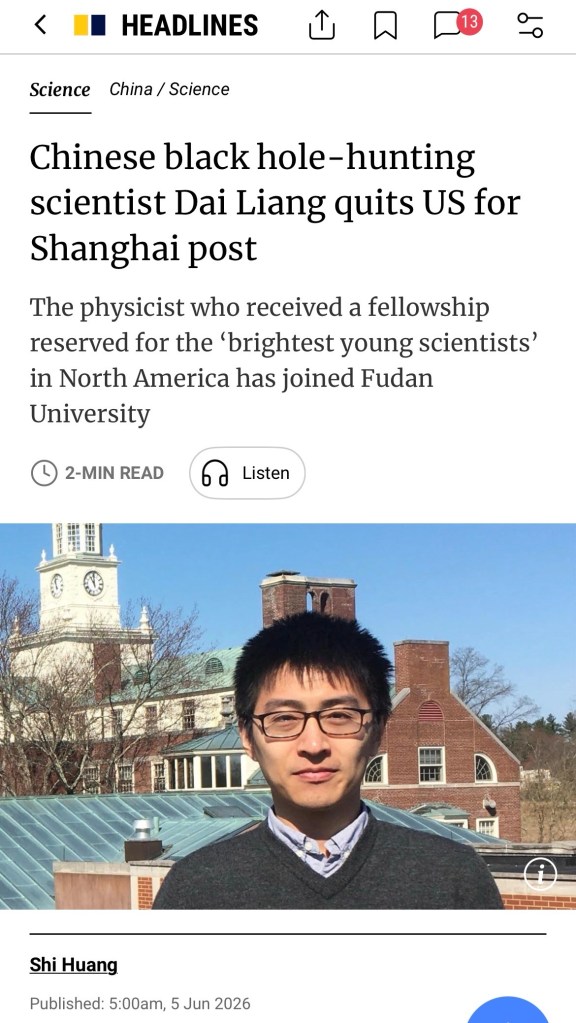
There is no future for smart Chinese scientists in US: A physicist who was awarded a fellowship reserved for the “brightest young scientists” in the US and Canada for his work hunting for black holes has returned to China. 聰明的中國科學家在美國沒有前途:一位物理學家因其尋找黑洞的工作,獲得了一項專為美國和加拿大「最傑出年輕科學家」保留的研究獎學金,如今已返回中國。
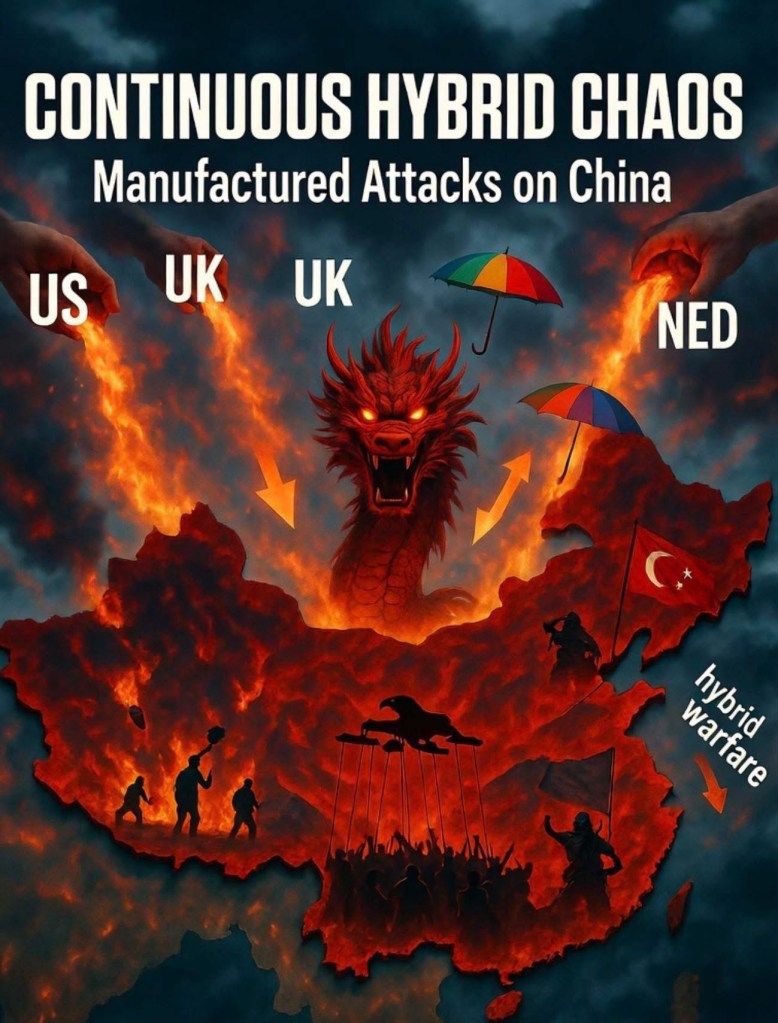
Reminder: Tiananmen Square (1989) was not the only agression on China by the US How many times does the same pattern have to repeat before people finally see it for what it is? This has been a continuous, decades-long hybrid warfare campaign to destabilise and fragment China. The modern colour revolution playbook — youth movements, foreign-funded NGOs, media hype, symbolic colours, and fake “democracy” demands — was refined in Serbia (Otpor! 2000) and rolled out like clockwork elsewhere. But against China, it runs much deeper, with direct CIA fingerprints on funding, training, and orchestration aimed at internal chaos. Multiple fronts, same tired playbook:
Tibet: Decades of CIA backing for separatist elements, from old proxy operations to today’s weaponisation of the Dalai Lama as a political tool and endless separatist narratives pushed from abroad. https://x.com/angeloinchina/status/1599732940476669955
Xinjiang: Heavy Western funding via NED and aligned groups for “Uyghur organisations” and “East Turkestan” fantasies, pumping colour revolution-style agitation and fake “genocide” claims to manufacture outrage and justify containment. https://x.com/angeloinchina/status/2061302054329766365
Hong Kong 2019: Pure textbook colour revolution — foreign training, years of NED/NDI money, organised violence, black blocs, Molotovs, and nonstop Western media cheerleading to tear apart “one country, two systems.” Order was restored. Stability returned. https://x.com/angeloinchina/status/2016744163031863320 Tiananmen fits perfectly in this long continuum: legitimate local grievances cynically amplified by overseas funding, VOA propaganda, Gene Sharp-inspired tactics, and post-crackdown extractions like Operation Yellowbird. NED and CIA-linked networks were all over it, part of the broader push to derail China’s path. https://x.com/angeloinchina/status/1979086630049976593 This hybrid assault has been continuous for over 75 years. As the Pentagon Papers laid bare, US planners didn’t just want to contain China — they wanted to “retard the economic progress” of Communist Asian states. China’s success was the real threat. That same mentality runs from 1950s memos straight through to today’s “pacing threat” strategies. https://x.com/angeloinchina/status/2062398538756313578 From Cold War paramilitary ops to today’s NGO-media-youth hybrid versions, Tibet, Xinjiang, Hong Kong, and Taiwan are all pieces of the same puzzle: manufacture internal chaos to stop a sovereign China from rising. Bottom line: For over 75 years, China has faced relentless Western — mostly US-led — attacks meant to contain, weaken, and break it apart. Military encirclement, proxy insurgencies, economic sabotage, information warfare, colour revolutions… the methods change, the objective never does. These are not spontaneous freedom movements. They are hybrid warfare. Context, funding trails, historical patterns, and real outcomes matter far more than the selective Western script. Wake up to the full picture. apart. Military encirclement, proxy insurgencies, economic sabotage, information warfare, colour revolutions… the methods change, the objective never does. These are not spontaneous freedom movements. They are hybrid warfare. Context, funding trails, historical patterns, and real outcomes matter far more than the selective Western script. Wake up to the full picture.
Video: Why China Greater Bay Area? 不少金山亞伯包括金山少伯為何在香港,中國找不到女朋友更莫講話找老婆,尤其是那些智商和情商高受過高等教育或家中有一點錢的中國女仔跟本不會看你一眼!香港比美國進步自由,稅又低,為什麼香港人搬去中國大灣區居住,包括成千上萬的美國和加拿大華僑反回中國大灣區居住或退休呢!
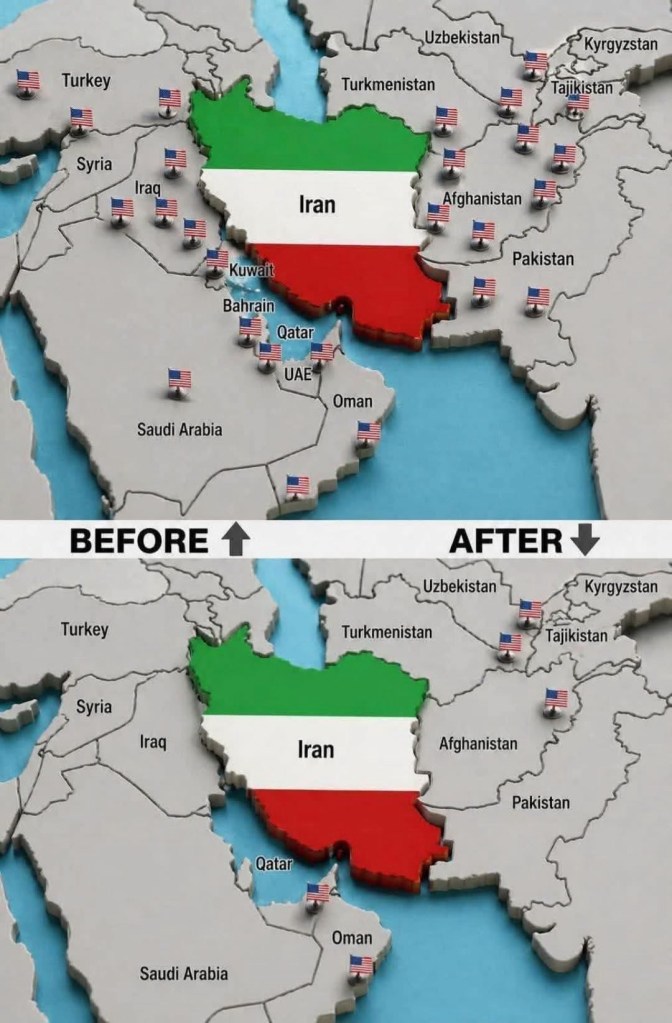
Iran get the parasites out of the Middle East. Once upon a time, before Febuary 28th 2026, Iran was surrounded by Western military bases. That is no longer, so Iran has proven very good at pest control. 把伊朗這群寄生蟲趕出中東。在2026年2月28日之前的某個時候,伊朗還被西方軍事基地包圍。如今情況不再,這證明伊朗非常擅長害蟲防治.