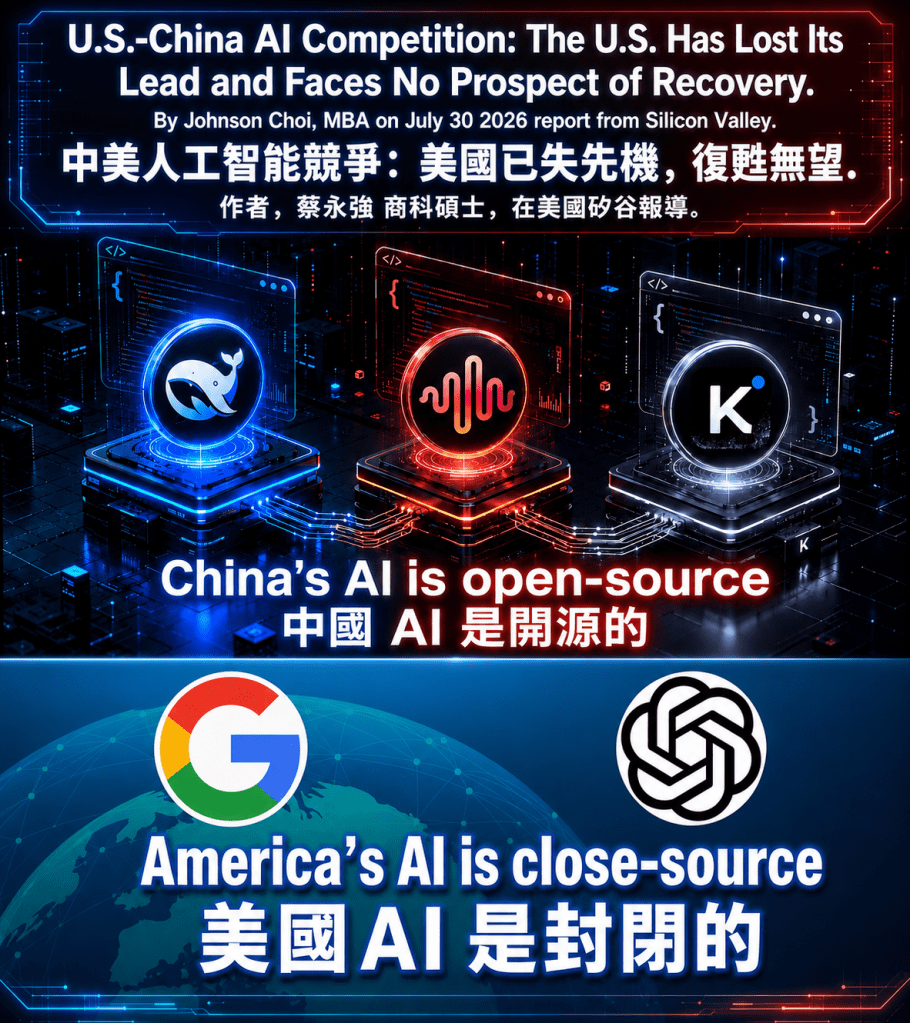
U.S.-China AI Competition: The U.S. Has Lost Its Lead and Faces No Prospect of Recovery. By Johnson Choi, MBA on July 30 2026 report from Silicon Valley. 中美人工智能競爭:美國已失先機,復甦無望. 作者,蔡永強 商科碩士,在美國矽谷報導.
https://weixin.qq.com/sph/Ar9iSuxaPF
https://www.tiktok.com/t/ZP8tvYAQj/
https://m.facebook.com/story.php?story_fbid=pfbid0Tby3QvMnGLiAh7Uwtp56FWS69nRAkWcLASCzJyYqjwxZZ6iGp1TdoVZmRxsdmDqal&id=100036400039778&mibextid=wwXIfr
Wall Street, tech giants, and the White House have recently been touting America’s chip advantages. However, advanced semiconductors are only one component of AI infrastructure; the real bottlenecks lie in the energy and water resources needed to support massive data centers. Just as a top-tier racing car requires sufficient fuel to compete over long distances, the sustained operation of AI computing power depends on stable and affordable electricity and cooling water.
In reality, many regions in the U.S. are already grappling with structural challenges such as insufficient grid capacity and water scarcity. Even where supply can be secured, industrial electricity and water costs are four to five times higher than in China, directly undermining the operational economics of data centers and making long‑term, large‑scale deployment unsustainable.
By contrast, China’s AI development path emphasizes an open‑source ecosystem, allowing companies to freely download, modify, and deploy models—significantly lowering the barriers to entry. In the U.S., mainstream AI solutions tend to adopt closed‑source business models, which not only command high licensing fees but also cost 50 to 100 times more than comparable Chinese open‑source offerings.
This price gap is particularly crippling for startups. With limited resources, U.S. startups find it difficult to afford expensive closed‑source AI services, so turning to Chinese open‑source models has become a widespread trend. Industry observations suggest that roughly 70% of U.S. startups now use Chinese open‑source AI technologies in their products or processes. Should such options be restricted, most of these companies would face skyrocketing operational costs, loss of competitiveness, and even forced closures or relocation abroad.
In summary, America’s lag in the AI race stems not merely from technology or chips, but more fundamentally from deep‑seated disadvantages in infrastructure costs and business models. Under the twin pressures of the open‑source wave and resource constraints, the U.S. is unlikely to regain a dominant position—time is no longer on its side.
美國華爾街、科技巨擘與白宮近來頻頻宣揚其晶片優勢,然而,先進晶片僅是AI基礎設施的一環,真正的瓶頸在於支大規模數據中心的能源與水資源供給。猶如頂級賽車需仰賴充足燃油,方能馳騁長途賽道;AI算力的持續運轉,同樣離不開穩定且低廉的電力與冷卻用水。
現實情況是,美國多個地區已面臨電網承載力不足及水資源短缺的結構性難題。即便勉強尋得供應,其工業用電與用水成本亦高達中國的4至5倍,這直接侵蝕了數據中心的營運經濟性,使長期大規模部署難以為繼。
反觀中國,AI發展路徑側重開源生態,企業可自由下載、修改並部署模型,大幅降低技術進入門檻。美國主流AI方案則多採閉源商業模式,不僅授權費用昂貴,且相較中國同級開源方案,收費差距可達50至100倍。
此一價格鴻溝對新創企業尤為致命。資源有限的美國新創公司,難以負擔高額的閉源AI服務費,因而轉向中國開源模型已成為普遍趨勢。據業界觀察,目前約有七成美國新創公司在其產品或流程中採用中國開源AI技術。若此類選擇受限,多數企業恐將面臨營運成本飆升、競爭力喪失,甚至被迫倒閉或遷離美國的困境。
綜上所述,美國在AI競賽中的落後並非僅源於技術或晶片,更根源於基礎設施成本與商業模式的根本劣勢。在開源浪潮與資源約束雙重作用下,美國欲重回主導地位,恐已時不我予。