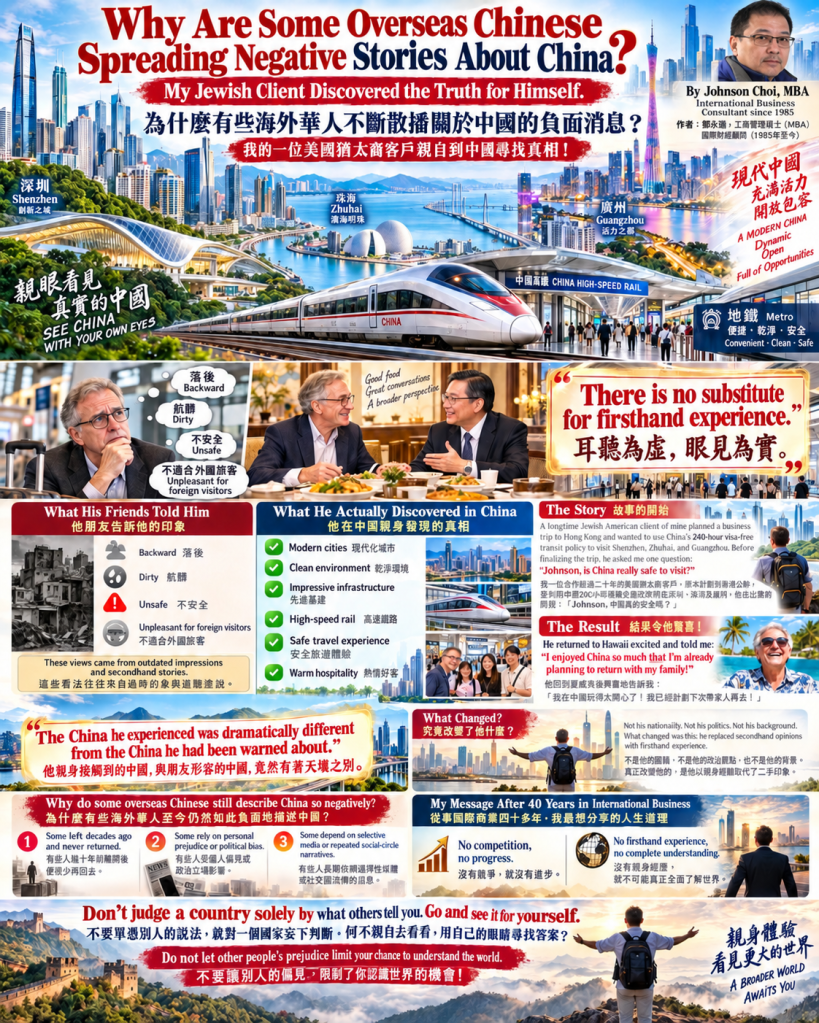
Why Are Some Overseas Chinese Spreading Negative Stories About China? My Jewish Client Discovered the Truth for Himself.
By Johnson Choi, MBA
International Business Consultant since 1985
為什麼有些海外華人不斷散播關於中國的負面消息?我的一位美國猶太裔客戶親自到中國尋找真相!
作者:蔡永強,工商管理碩士(MBA)國際財經顧問(1985年至今)
從事國際商業及財經顧問工作超過四十年,我深深體會到一個非常重要的人生道理:
「耳聽為虛,眼見為實。別人口中的一個國家,與你親身踏足當地後所看到、感受到的真實情況,可能完全是兩回事。」
最近,我一位相識多年的美國猶太裔客戶,向我分享了一段親身經歷,再次印證了這個道理。
這位客戶與我合作已經超過二十年。過去二十多年來,我們建立了深厚的專業關係,彼此之間一直保持着互相信任與尊重。
不久前,他計劃前往香港公幹,並希望利用中國的240小時(10天)過境免簽政策,順道到中國內地觀光考察。
他的行程包括深圳、珠海及廣州三個城市,而他最感興趣的其中一項體驗,就是親身乘坐中國現代化的高速鐵路。
然而,在正式確定行程之前,他突然打電話邀請我共進午餐,希望聽聽我的意見。
原來,他心中有一個非常重要的疑問:
「Johnson,中國真的安全嗎?我應不應該去?」
聽到這個問題,我感到有點意外。
於是,我反問他:
「為甚麼你會認為中國可能不安全?」
他的回答,更令我感到驚訝。
他告訴我,幾位居住在夏威夷的華人朋友,曾經強烈勸阻他不要前往中國內地。
按照這些朋友的說法,中國是一個落後、骯髒、不安全,而且對外國旅客而言十分不方便、不適合旅遊的地方。
他們把中國描述得如此負面,以致我的客戶開始認真考慮取消原定的中國行程。
我進一步詢問他,那些朋友究竟說了甚麼,以及他們最近有沒有親身到訪深圳、珠海或廣州。
隨着我們的交談逐漸深入,我開始明白,這其實是我多年來在夏威夷及三藩市部分海外華人社群中,經常遇到的一種現象。
有些人對中國的看法,仍然停留在幾十年前的舊印象,或者受到個人偏見、政治立場及道聽塗說的消息影響,而不是根據今天中國的實際發展情況作出判斷。
當然,每個人都有權擁有自己的政治觀點。世界上沒有任何國家是十全十美的,中國如此,美國亦一樣。
但是,表達個人意見,與把過時或不準確的印象當成事實向別人傳播,兩者之間存在根本性的差別。
我望着這位認識超過二十年的客戶,對他說:
「過去二十多年來,你一直信任我的專業判斷。如果今天你仍然像過去二十多年一樣信任我,那麼我的建議非常簡單:你應該親自到中國走一趟,用自己的眼睛去看,用自己的身體去感受,然後作出自己的判斷。不要讓別人替你決定應該怎樣看待中國。」
我還鼓勵他深入體驗中國人的日常生活,走訪不同城市,乘坐高鐵,接觸當地居民,並把自己親眼所見、親身所感,與夏威夷朋友告訴他的事情作出比較。
最後,他決定按照原定計劃前往中國。
一、返回夏威夷後的一通電話
幾個星期後,他結束中國之行,回到夏威夷。
不久,他再次打電話給我。
他說:
「Johnson,我想請你吃午飯。我從中國帶了一份小禮物回來送給你。」
我當然十分感謝他的心意。
但坦白說,比起他從中國帶回來的小禮物,我更加關心的是:
他在深圳、珠海及廣州究竟看到了甚麼?經歷了甚麼?他對中國的印象有沒有改變?
我們再次見面共進午餐時,我立即問他這次中國之行的感受。
接下來的談話,可以說是我認識他二十多年以來,聽過他最興奮、最滔滔不絕的一次分享。
他幾乎停不下來,不斷向我講述在中國的美好經歷。
從現代化的城市建設,到令人印象深刻的交通基礎設施;從高速鐵路,到整體旅遊體驗,他都讚不絕口。
他親身接觸到的中國,與那些夏威夷華人朋友向他描述的中國,竟然有着天壤之別。
他原本以為自己將會看到一個落後、骯髒、危險的國家。
然而,他實際上看到的,卻是現代化的城市環境、令人印象深刻的公共交通系統,以及令他十分滿意的旅遊體驗。
出發前,他對中國充滿疑慮;回來後,他卻對中國充滿讚賞與期待。
接着,他告訴我一句令我感到非常欣慰的話:
「Johnson,我這次在中國玩得實在太開心了!我已經開始計劃下一次帶家人一起去中國!」
對我而言,這句話比任何紀念品都更加珍貴。
試想想:
一個原本連中國是否安全都感到懷疑的人,現在竟然主動計劃帶同自己的家人,再次前往中國旅遊。
究竟是甚麼改變了他?
不是他的政治信仰。
不是他的國籍。
也不是他的個人成長背景。
真正改變他的,是他終於放下別人的二手消息,透過自己的親身經歷,重新認識中國。
二、午餐結束前,我給他的最後一個建議
在我們結束午餐之前,我向他提出了一個小小的建議。
我對他說:
「下次當你再次見到那些曾經勸你不要去中國的華人朋友時,請你親口告訴他們,你在深圳、珠海和廣州的真實經歷。」
「告訴他們你乘坐的中國高鐵,告訴他們你親眼看到的現代化城市,告訴他們你接觸過的中國人民,以及你所感受到的熱情款待。」
「讓他們直接從你口中,聽到一個親身到過中國的美國人所看到的中國。」
我並不是要求他與朋友爭論,更不是要他說服任何人支持某個政府。
我只是希望他把自己親眼所見、親身所感的事情,誠實地分享出來。
如果他的朋友曾經有過不同的經歷,他們當然也可以分享自己的看法。
但真正有意義的討論,應該建立在事實、最新資訊及真實經歷之上,而不是依靠刻板印象、以偏概全,或者未經查證的消息。
三、為甚麼有些海外華人至今仍然如此負面地描述中國?
這次經歷,令我再次想起一個困擾我多年的問題。
在過去四十多年來,我經常往來美國、香港及中國內地,接觸過來自不同文化、政治及社會背景的人士。
我不禁想問:
「中國在基礎建設、科技、交通運輸及人民日常生活水平等方面,已經經歷了如此巨大的轉變,為甚麼仍然有部分海外華人,繼續以極其負面的方式描述中國?」
其中一個可能原因,是有些人早在幾十年前便離開中國或香港,之後很少,甚至從未再次回去看看。
因此,他們對中國的認識,可能仍然停留在當年離開時的印象。
另一個原因,是部分人士對中國持有強烈的政治立場,因而影響了他們對中國各方面發展的理解和判斷。
還有一些人,可能長期依賴某些特定媒體的選擇性報導,或者只接收自己社交圈子內反覆流傳的消息。
久而久之,他們對中國的印象便可能與今天的實際情況出現落差。
當然,以上原因並不適用於所有海外華人。
我們不能把所有對中國的批評都一概視為假消息。任何有事實根據的批評與合理關注,都值得認真聆聽和討論。
但反過來說,道理亦同樣成立。
我們絕對不應該因為某個人擁有華人血統,或者自稱非常了解中國,便不經思考地把他的說法當成事實。
一個人即使是華人,也不代表他必然了解今天中國的真實情況。
同樣,一個人即使不是華人,也完全可以透過親身考察,對中國作出客觀、深入而有見地的觀察。
我的這位美國猶太裔客戶,就是一個很好的例子。
他不是華人。
他前往中國,也不是為了替中國辯護。
他出發,是因為好奇。
他回來,是因為留下了深刻而美好的印象。
而現在,他更希望帶同家人,再次親身體驗中國。
這就是親身經歷的力量。
四、從事國際商業四十多年,我最想分享的人生道理
我從小便經常聽到祖父和父親教導我們一句話:
「沒有競爭,就沒有進步。」
這句教誨一直伴隨着我成長,亦成為我從事國際商業及財經顧問工作四十多年來的重要人生信念。
隨着見識不斷增加,我又領悟到另一個同樣重要的道理:
「沒有親身經歷,就不可能真正全面了解世界。」
因此,我經常鼓勵居住在夏威夷、三藩市,以及世界各地的朋友:
多出去走走。
多看看不同國家。
多接觸不同文化。
多提出問題。
永遠保持開放的思想。
有機會便親自到中國看看,也應該到其他國家走走。
比較不同地方的公共交通、基礎建設、社會治安、醫療服務、生活成本、待客態度,以及日常生活的各種便利設施。
既要看到別人的優點,也要了解他們的不足。
然後,根據自己親身觀察到的事實,作出獨立判斷。
一個擁有超過十四億人口、幅員廣闊的國家,不可能單靠幾句政治口號、社交媒體上的爭論,或者飯桌上聽來的幾個負面故事,就能夠真正了解。
我的客戶這次中國之行,畢竟只是一個人的親身經歷。
我亦明白,不是每一位旅客到中國後,都必然會有完全相同的感受。
但他的故事,至少清楚說明了一個非常重要的道理:
「要改變一個人對某個國家的錯誤或片面印象,最有效的方法,有時候並不是與他爭論,而是鼓勵他親自去看看、走走、體驗一下,讓他自己發現事實。」
我衷心希望,當這位客戶下次與那些夏威夷華人朋友見面時,他們願意認真聽聽他的親身經歷。
或許有一天,這些朋友也會放下過去的成見,以更加開放的心態,再次踏足中國,親眼看看這個國家今天的面貌。
到了那個時候,他們可能會發現:
自己多年來一直相信的中國印象,與今天親眼看到的中國,原來可以有如此巨大的差別。
最後,我想用一句話作為這篇文章的總結:
「不要單憑別人的說法,就對一個國家妄下判斷。世界這麼大,何不親自去看看,用自己的眼睛尋找答案?」
耳聽為虛,眼見為實。
不要讓別人的偏見,限制了你認識世界的機會!
作者:蔡永強,工商管理碩士(MBA)國際財經顧問(1985年至今)
After more than 40 years in international business consulting, I have learned one important lesson: There is no substitute for firsthand experience. What people tell you about a country and what you actually discover when you visit can be two completely different things.
Recently, a longtime Jewish American client of mine shared an experience that reinforced this lesson.
He had been my client for more than 20 years, and over those two decades, we had developed a strong professional relationship built on mutual trust and respect.
He was planning a business trip to Hong Kong and wanted to take advantage of China’s visa-free transit policy to spend up to 10 days exploring mainland China.
His itinerary included Shenzhen, Zhuhai, and Guangzhou. He was particularly excited about experiencing China’s modern high-speed railway system.
However, before finalizing his travel arrangements, he called and invited me to lunch.
There was one important question on his mind:
“Johnson, is China really safe to visit?”
I was surprised by his question.
I asked him, “What makes you think China might not be safe?”
His answer was even more surprising.
He explained that several of his Chinese friends in Hawaii had strongly discouraged him from visiting mainland China.
According to these friends, China was backward, dirty, unsafe, and generally an unpleasant place for foreign visitors.
They had painted such a negative picture that he was seriously reconsidering his plans.
I asked him a few more questions about what his friends had told him and whether they had recently visited the cities he intended to explore.
As our conversation continued, I began to recognize a pattern that I had encountered many times over the years, particularly among certain overseas Chinese communities in Hawaii and San Francisco.
Some people continue to describe China through outdated impressions, personal prejudices, political disagreements, or secondhand stories rather than firsthand knowledge of the country as it exists today.
Of course, everyone is entitled to their political opinions. No country is perfect, including China and the United States.
But there is a fundamental difference between expressing an opinion and presenting an inaccurate or outdated impression as an established fact.
I looked at my client and said:
“You have trusted my professional judgment for more than 20 years. If you still trust me today, my advice is simple: Go to China, see it with your own eyes, experience it for yourself, and then form your own opinion. Don’t let anyone else make that judgment for you.”
I also encouraged him to experience everyday Chinese life, explore the cities, try the high-speed trains, meet local people, and compare what he personally observed with what his friends had told him.
He decided to go.
The Phone Call After His Return to Hawaii
Several weeks later, after returning to Hawaii, he called me again.
“Johnson, I’d like to take you to lunch. I brought you a small gift from China.”
I appreciated his thoughtful gesture, but frankly, I was far more interested in what he had discovered during his trip than in the gift he had brought me.
When we met for lunch, I asked him about Shenzhen, Zhuhai, and Guangzhou.
What followed was one of the most enthusiastic conversations I have ever had with him.
He could hardly stop talking about his wonderful experiences in China.
He described his impressions of the modern cities, impressive transportation infrastructure, high-speed railways, and the overall travel experience.
The China he had personally experienced was dramatically different from the country his friends in Hawaii had described.
Instead of the backward, dirty, and dangerous country he had been warned about, he encountered modern urban environments and a travel experience that left him deeply impressed.
He had visited China with uncertainty and returned with enthusiasm.
Then he told me something that made the entire conversation worthwhile:
“Johnson, I enjoyed China so much that I’m already planning to return with my family!”
For me, that statement was more meaningful than any souvenir.
A man who had initially questioned whether China was safe enough to visit was now looking forward to bringing his own family.
What had changed?
Not his political beliefs.
Not his nationality.
Not his background.
What changed was that he replaced secondhand opinions with firsthand experience.
My Final Advice to Him
Before we finished lunch, I made one final suggestion.
I told him:
“The next time you meet those Chinese friends who warned you not to visit China, please tell them what you personally experienced in Shenzhen, Zhuhai, and Guangzhou. Tell them about the high-speed trains, the cities, the people, and the hospitality you encountered. Let them hear your story directly from you.”
I was not asking him to argue with his friends or persuade them to support any government.
I simply wanted him to share what he had seen with his own eyes.
If his friends had a different experience, they were welcome to share that as well.
But meaningful discussions should be based on facts, current information, and genuine experience rather than stereotypes or sweeping generalizations.
Why Do Some Overseas Chinese Continue to Describe China So Negatively?
This experience raises a question I have asked myself many times during my decades of working with people across the United States, Hong Kong, and mainland China.
Why do some overseas Chinese continue to portray China in such negative terms, even when the country has undergone enormous changes in infrastructure, technology, transportation, and everyday living standards?
Some may have left China or Hong Kong decades ago and never returned to see the transformation for themselves.
Others may have developed strong political opinions that influence how they interpret everything happening in China.
Still others may rely on selective media reporting or information circulated within their social circles.
These possibilities do not apply to everyone, and criticism of China should not automatically be dismissed as misinformation. Legitimate concerns deserve serious consideration.
But the reverse is equally true:
Criticism should not be accepted as fact simply because it comes from someone who is ethnically Chinese or claims to know China.
Being Chinese does not automatically mean someone has accurate, current knowledge of modern China.
And being a foreigner does not prevent someone from making thoughtful and informed observations about the country.
My Jewish American client’s experience illustrates this perfectly.
He was not Chinese. He did not travel to China with the intention of defending it.
He went because he was curious.
He returned because he was impressed.
And now he wants to bring his family.
My Message After 40 Years in International Business
My grandfather and father taught me an important principle when I was young:
“No competition, no progress.”
Throughout my international business career, I have added another principle:
“No firsthand experience, no complete understanding.”
I encourage my friends in Hawaii, San Francisco, and elsewhere to travel, explore, ask questions, and keep an open mind.
Visit China. Visit other countries too. Compare their public transportation, infrastructure, safety, healthcare, cost of living, hospitality, and everyday conveniences.
Recognize their strengths as well as their weaknesses.
Then decide for yourself.
A country of more than 1.4 billion people cannot be accurately understood through political slogans, social media arguments, or a few negative stories told over lunch.
My client’s experience is only one person’s journey, and not every traveler will have the same impressions.
But his story demonstrates something important:
The most effective way to challenge a misleading impression is not always through debate. Sometimes, it is simply to encourage someone to go, see, experience, and discover the reality for themselves.
I hope his friends in Hawaii will listen when he shares his experience.
And perhaps one day, they too will decide to visit China again with an open mind.
Don’t judge a country solely by what others tell you. Go and see it for yourself.
Johnson Choi, MBA
International Business Consultant since 1985