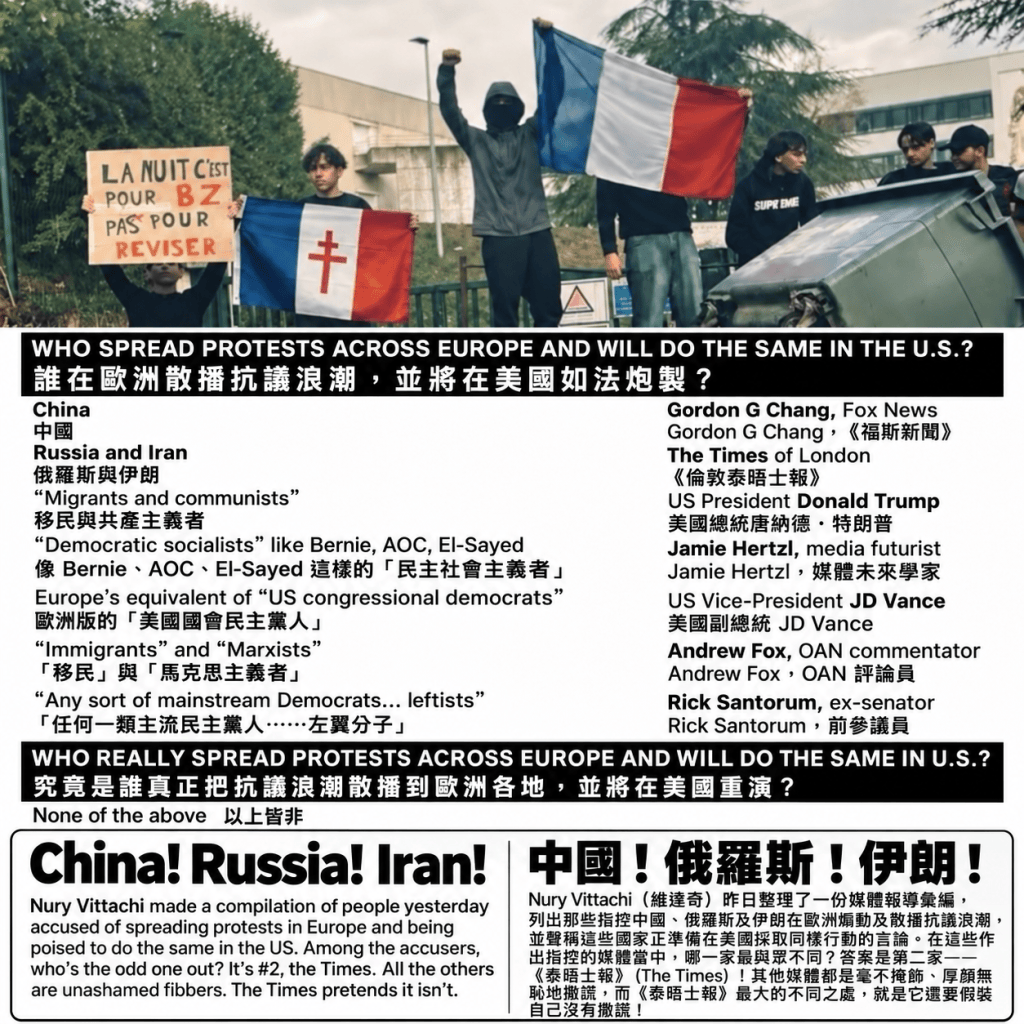
China! Russia! Iran! Nury Vittachi made a compilation of people yesterday accused of spreading protests in Europe and being poised to do the same in the US. Among the accusers, who’s the odd one out? It’s #2, the Times. All the others are unashamed fibbers. The Times pretends it isn’t. 中國!俄羅斯!伊朗!Nury Vittachi(維達奇)昨日整理了一份媒體報導彙編,列出那些指控中國、俄羅斯及伊朗在歐洲煽動及散播抗議浪潮,並聲稱這些國家正準備在美國採取同樣行動的言論。在這些作出指控的媒體當中,哪一家最與眾不同?答案是第二家——《泰晤士報》(The Times)!其他媒體都是毫不掩飾、厚顏無恥地撒謊,而《泰晤士報》最大的不同之處,就是它還要假裝自己沒有撒謊!
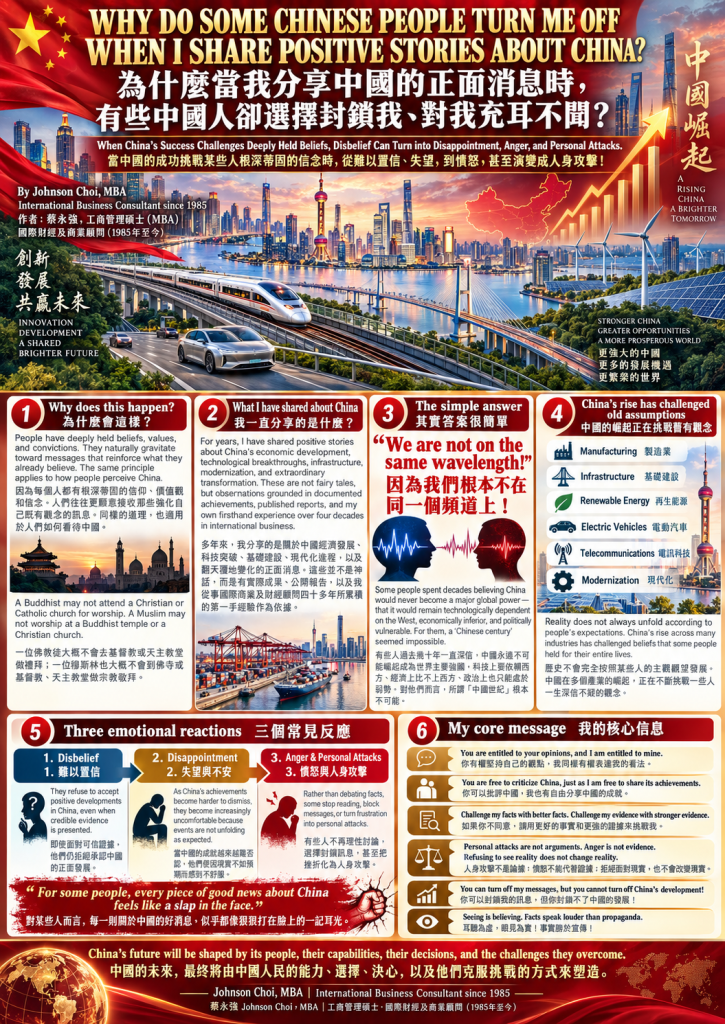
WHY DO SOME CHINESE PEOPLE TURN ME OFF WHEN I SHARE POSITIVE STORIES ABOUT CHINA?
When China’s Success Challenges Deeply Held Beliefs, Disbelief Can Turn into Disappointment, Anger, and Personal Attacks.
By Johnson Choi, MBA International Business Consultant since 1985
A Buddhist would probably not attend a Christian or Catholic church for religious worship. Likewise, a Muslim would probably not worship at a Buddhist temple or a Christian church.
Why? Because people have deeply held beliefs, values, and convictions. They naturally gravitate toward messages that reinforce what they already believe.
The same principle applies to how people perceive China.
SEEING IS BELIEVING. FACTS SPEAK LOUDER THAN PROPAGANDA.
⸻
蔡永強 Johnson Choi, MBA 工商管理碩士. 國際財經及商業顧問(1985年至今) International Business Consultant since 1985
Over the years, I have shared countless positive stories about China’s economic development, technological breakthroughs, infrastructure, modernization, and extraordinary transformation.
These are not fairy tales. Many are based on documented achievements, published reports, and my own firsthand experiences accumulated over more than four decades as an international business consultant.
Yet I have noticed something fascinating.
The more positive news I share about China, the more uncomfortable some Chinese people become!
Why?
The answer is actually quite simple:
We are not on the same wavelength!
Some people have spent decades believing that China would never rise to become a major global power. They were convinced that China would always remain technologically dependent on the West, economically inferior, and politically vulnerable.
For them, the possibility of a Chinese century was unimaginable.
But history does not always unfold according to people’s expectations.
China’s rise in manufacturing, infrastructure, renewable energy, electric vehicles, telecommunications, and many other industries has challenged assumptions that some people held for their entire lives.
And when reality challenges deeply held beliefs, not everyone responds with an open mind.
I have observed three increasingly emotional reactions:
First comes disbelief. They refuse to accept positive developments in China, even when credible evidence is presented.
Then comes disappointment. As China’s achievements become harder to dismiss, they become increasingly uncomfortable because events are not unfolding as they had expected.
Finally comes anger. Rather than debating facts or offering constructive criticism, some simply stop reading my messages, block my posts, or turn their frustration into personal attacks.
For certain individuals, every piece of good news about China seems to feel like a slap in the face!
I find this reaction particularly revealing.
Why should China’s economic progress, scientific discoveries, technological innovation, or improvements in people’s living standards upset anyone?
You do not have to agree with China’s political system to acknowledge its achievements.
Likewise, recognizing China’s accomplishments does not mean ignoring its challenges or claiming that everything in China is perfect.
Acknowledging facts should never require ideological loyalty.
Unfortunately, some individuals appear more interested in defending their long-established narratives than examining what is actually happening.
I am not surprised.
Anyone who has studied Chinese history knows that our nation has experienced centuries of internal divisions, rivalries, shifting loyalties, foreign interference, espionage, and betrayal.
History reminds us that there have always been individuals willing to place personal interests, political loyalties, or outside agendas above the interests of their own country.
However, disagreement alone does not make someone a traitor or a spy. Such serious accusations require evidence.
What concerns me most is when differences of opinion turn into deliberate misinformation, personal hostility, and attempts to silence opposing viewpoints.
My message remains simple:
You are entitled to your opinions, and I am entitled to mine.
You are free to criticize China, just as I am free to share its achievements.
But if you disagree with me, challenge my facts with better facts. Challenge my evidence with stronger evidence.
Personal attacks are not arguments. Anger is not evidence. And refusing to see reality does not change reality.
After more than 40 years in international business, I have learned one important lesson:
The world does not stop changing simply because some people refuse to change their minds.
China’s future will not be determined by those who praise it or those who condemn it. It will be shaped by its people, their capabilities, their decisions, and the challenges they overcome.
You can turn off my messages, but you cannot turn off China’s development!
And whether the 21st century ultimately becomes the Chinese century is a question that history—not political prejudice—will answer.
My lifelong principle remains unchanged:
SEEING IS BELIEVING. FACTS SPEAK LOUDER THAN PROPAGANDA.
耳聽為虛,眼見為實!
Johnson Choi, MBA International Business Consultant since 1985
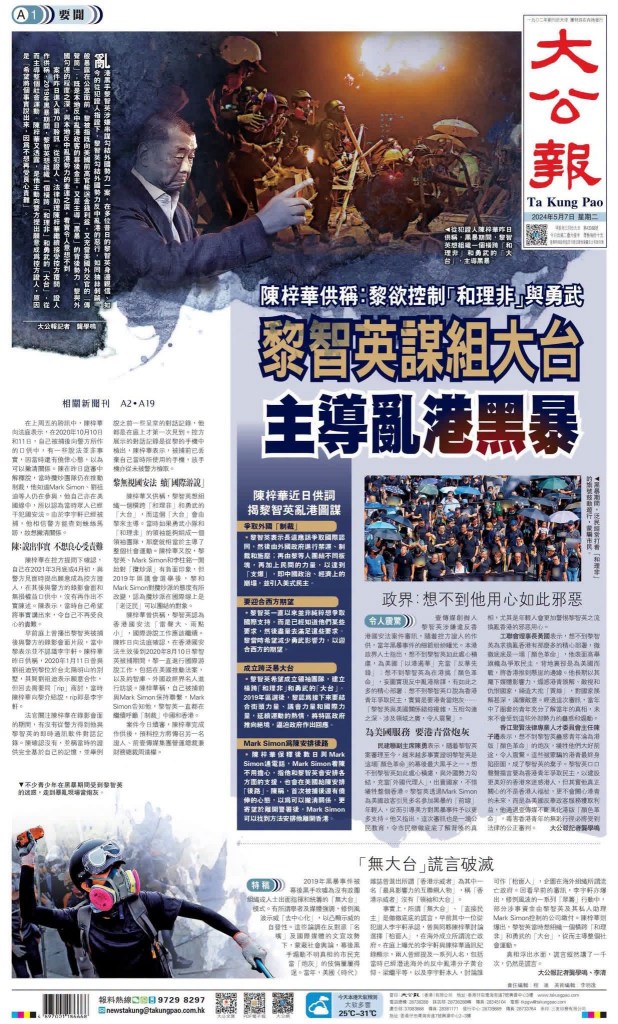
Ng Chau-pei, Member of the 8th Legislative Council and Representative of the Hong Kong Federation of Trade Unions (FTU): “Resurrecting the Past in Margaret Thatcher’s Name: Jimmy Lai Has Been Found Guilty of Endangering National Security — How Can Anyone Justify Whitewashing His Crimes?” 第八屆立法會議員 吳秋北 工聯會: 以戴卓爾之名借屍還魂, 黎智英危害國家安全罪成豈容美化
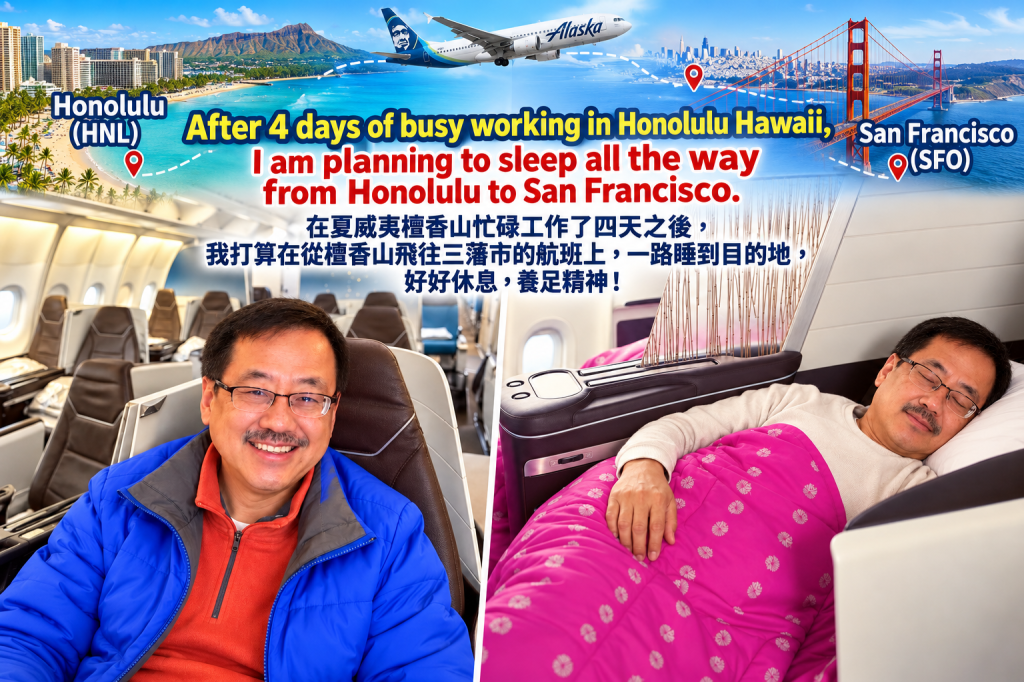
After 4 days of busy working in Honolulu Hawaii, I am planning to sleep all the way from Honolulu to San Francisco. 在夏威夷檀香山忙碌工作了四天之後,我打算在從檀香山飛往三藩市的航班上,一路睡到目的地,好好休息,養足精神!
Some people already tried to cross HK/China borders both ways, it takes less than 45 seconds using the e-Channel App! 已有部分人士親身實測,無論從香港進入中國內地,還是從中國內地返回香港,只需使用「e-Channel(電子通道)」應用程式,最快不到45秒便可完成通關手續!
Don’t want to queue twice when crossing the border? Huanggang “Joint Inspection” open for Registration! Queue once, show your document once, and complete immigration clearance for both Hong Kong and Shenzhen? It takes only 5 minutes for Eligible Applicants. 不想過關時排兩次隊?皇崗口岸「合作查驗,一次放行」現已開放登記!只需排一次隊、出示一次證件,就能一次過完成香港與深圳兩地的出入境查驗手續!符合資格的申請人,最快只需5分鐘即可完成通關! 告別重複排隊,體驗深港兩地便捷高效的通關新模式!
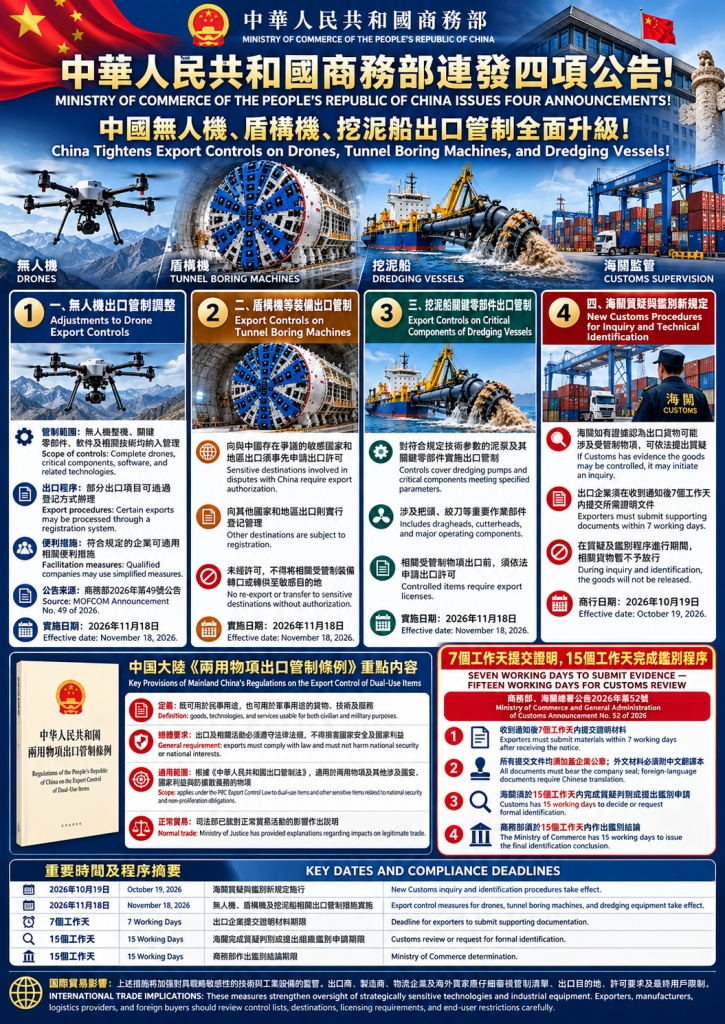
Scope of controls: Complete drones, critical components, software, and related technologies are included in export control management.
Export procedures: Certain exports may be processed through a registration system.
Facilitation measures: Companies that meet regulatory requirements may qualify for simplified procedures.
Source: Ministry of Commerce Announcement No. 49 of 2026.
Effective date: November 18, 2026.
Export Controls on Tunnel Boring Machines and Related Equipment
Exports of tunnel boring machines (TBMs) and related equipment to sensitive countries and regions involved in disputes with China require prior export authorization.
Exports to other countries and regions are subject to a registration system.
Without authorization, controlled equipment may not be re-exported or transferred to designated sensitive destinations.
Effective date: November 18, 2026.
Export Controls on Critical Components of Dredging Vessels
Export controls apply to dredging pumps and critical components that meet specified technical parameters.
Controlled items include essential operating components such as dragheads, cutterheads, and related equipment.
Exporters must obtain the required licenses before shipping controlled items overseas.
Effective date: November 18, 2026.
New Customs Procedures for Export Control Inquiries and Technical Identification
If Customs authorities have evidence suggesting that exported goods may fall under export control regulations, they may initiate a formal inquiry.
Exporters must submit the required supporting documents within seven working days of receiving the notification.
During the inquiry and technical identification process, the goods concerned will not be released for export.
Effective date: October 19, 2026.
⸻
Key Provisions of Mainland China’s Regulations on the Export Control of Dual-Use Items
Definition of Dual-Use Items
Dual-use items refer to goods, technologies, and services that can be used for both civilian and military purposes.
These items may involve national security, military applications, strategic technologies, and efforts to prevent the proliferation of weapons of mass destruction.
General Regulatory Requirements
Exports of dual-use items and related activities must comply with applicable Chinese laws and regulations.
Such activities must not undermine China’s national security or national interests.
Scope of Application
Under the Export Control Law of the People’s Republic of China, the regulations apply to dual-use items and other controlled goods, technologies, and services related to:
Protecting China’s national security and national interests.
Fulfilling international non-proliferation obligations.
Regulating the export of sensitive technologies and strategic equipment.
Will These Measures Affect Normal International Trade?
Mainland China’s Ministry of Justice has provided explanations concerning the regulations and their potential implications for legitimate international trade activities.
⸻
SEVEN WORKING DAYS TO SUBMIT EVIDENCE — FIFTEEN WORKING DAYS FOR CUSTOMS REVIEW
Ministry of Commerce and General Administration of Customs Announcement No. 52 of 2026
Announcement on Further Optimizing Inquiry and Identification Procedures for Dual-Use Export Controls
Issuing authority: Bureau of Industrial Security and Import and Export Control, Ministry of Commerce
Document number: Ministry of Commerce and General Administration of Customs Announcement No. 52 of 2026
Date of issuance: October 19, 2026
Exporters Must Submit Supporting Documents Within Seven Working Days
Exporters must provide the required documents within seven working days after receiving a Customs Notice of Inquiry Regarding Dual-Use Export Controls.
All submitted documents must bear the company’s official seal.
If any documents are written in a foreign language, Chinese translations must also be provided.
Customs Must Complete Its Preliminary Review Within Fifteen Working Days
Within 15 working days of receiving all required documents from the exporter, Customs authorities must either:
Complete their preliminary assessment and determine whether the goods fall under export control requirements; or
Submit a request to the Ministry of Commerce for formal technical identification.
Ministry of Commerce Must Issue Its Determination Within Fifteen Working Days
Upon receiving a complete set of identification materials, the Ministry of Commerce must issue its technical identification conclusion within 15 working days.
Important Compliance Requirements for Exporters
While Customs inquiries and technical identification procedures remain pending, the goods concerned will not be cleared for export.
Companies must ensure that export declarations and supporting documents are accurate, complete, and compliant with applicable export control laws and administrative requirements.
⸻
KEY DATES AND COMPLIANCE DEADLINES
October 19, 2026
New Customs inquiry and technical identification procedures take effect.
November 18, 2026
The announced export control measures covering drones, tunnel boring machines, and dredging equipment are scheduled to take effect.
7 Working Days
Deadline for exporters to submit supporting documentation following a Customs inquiry notice.
15 Working Days — Customs Review
Time allowed for Customs to complete its preliminary assessment or request formal technical identification.
15 Working Days — Ministry of Commerce Determination
Time allowed for the Ministry of Commerce to issue its identification conclusion after receiving complete documentation.
⸻
INTERNATIONAL TRADE IMPLICATIONS
The announced measures would strengthen China’s regulatory oversight of strategically sensitive technologies and industrial equipment, including unmanned aerial systems, tunnel boring machinery, and specialized dredging components.
For international trading companies, manufacturers, logistics providers, and foreign buyers, the measures could introduce additional licensing requirements, documentation obligations, and compliance reviews.
Businesses engaged in cross-border trade involving these technologies should carefully review the applicable control lists, export destinations, licensing requirements, and end-user restrictions before proceeding with shipments.
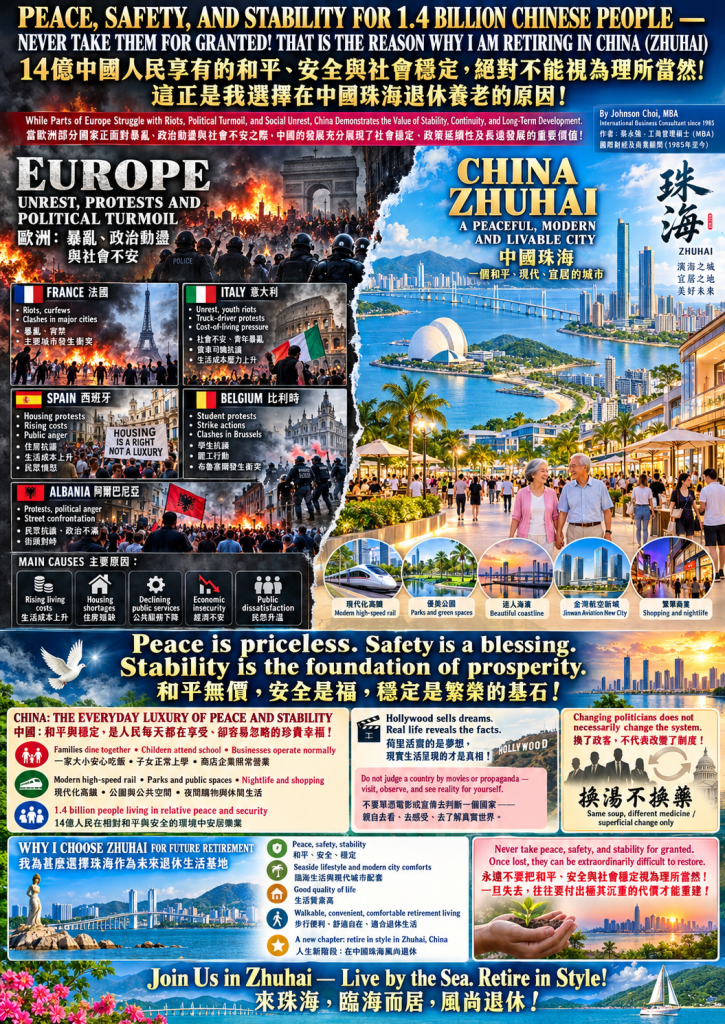
PEACE, SAFETY, AND STABILITY FOR 1.4 BILLION CHINESE PEOPLE — NEVER TAKE THEM FOR GRANTED! THAT IS THE REASON WHY I AM RETIRING IN CHINA (ZHUHAI)
While Parts of Europe Struggle with Riots, Political Turmoil, and Social Unrest, China Demonstrates the Value of Stability, Continuity, and Long-Term Development.
By Johnson Choi, MBA International Business Consultant since 1985
Join Us in Zhuhai — Live by the Sea. Retire in Style!
作者:蔡永強,工商管理碩士(MBA)國際財經及商業顧問(1985年至今)
Peace is priceless. Safety is a blessing. Stability is the foundation of prosperity. Yet these are three things that people often fail to appreciate until they are gone.
For approximately 1.4 billion Chinese people, the ability to live, work, travel, raise families, operate businesses, and enjoy everyday life in relative peace and security is something that should never be taken for granted.
Turn on the television, open a newspaper, or browse international news platforms today. What do you see?
Riots, demonstrations, political confrontation, and social unrest in countries such as France, Italy, Spain, Belgium, and Albania.
People are protesting over rising living costs, housing shortages, declining public services, economic insecurity, and dissatisfaction with their governments. Some demonstrations have escalated into violent confrontations, property destruction, and clashes with police.
These developments should remind us of an important reality: Peace and stability are not automatic. They must be maintained, protected, and appreciated.
CHINA: THE EVERYDAY LUXURY OF PEACE AND STABILITY
Meanwhile, across much of China, ordinary people continue going about their daily lives.
Families enjoy dinner together. Children attend school. Businesses operate. Restaurants and shopping malls welcome customers. Millions travel on modern high-speed trains, and people enjoy public spaces, parks, and evening activities.
What appears ordinary to people living in China may be considered an extraordinary privilege by those experiencing prolonged unrest elsewhere.
Of course, China faces its own economic and social challenges. No country or political system is perfect.
Nevertheless, I believe China’s achievements in public safety, infrastructure development, and long-term national planning deserve greater international recognition.
When 1.4 billion people can pursue their everyday lives in a broadly stable environment, that stability is a tremendous national asset.
HOLLYWOOD’S AMERICA AND EUROPE ARE NOT ALWAYS THE REAL AMERICA AND EUROPE
Over my decades of international business experience, I have met many people whose first impressions of America and Europe were shaped by Hollywood movies, television programs, and glamorous travel advertisements.
Before visiting these countries, they imagined beautiful streets, luxurious homes, prosperous communities, and the exciting lifestyles portrayed on the screen.
But after arriving, some discovered a different reality.
Homelessness, aging infrastructure, expensive healthcare, high living costs, crime in certain neighborhoods, and visible social inequality came as unpleasant surprises.
Hollywood sells dreams. Real life reveals the facts.
This does not mean America and Europe have no strengths. They certainly do. But neither should their challenges be ignored while China’s progress is routinely dismissed.
My advice has always been simple:
Do not judge a country by Hollywood movies, political propaganda, or social media. Visit it, walk its streets, speak with ordinary people, and discover reality for yourself.
SOCIALISM WITH CHINESE CHARACTERISTICS: JUDGE A SYSTEM BY ITS RESULTS
For decades, many Western commentators have argued that China must adopt Western-style multiparty democracy to achieve modernization and prosperity.
Yet China has followed its own development path, known as Socialism with Chinese Characteristics.
In my assessment, this system has demonstrated important strengths in maintaining political continuity, implementing long-term infrastructure projects, coordinating national development, and supporting economic transformation.
China’s modernization did not happen overnight. It required decades of planning, investment, hard work, and institutional continuity.
The central question should not simply be whether a country follows a Western political model.
It should also be:
Can its political and economic system deliver safety, stability, better infrastructure, economic opportunity, and improving living standards for its people?
These are among the practical measurements by which I judge governance.
AMERICAN ELECTIONS: CHANGING POLITICIANS DOES NOT NECESSARILY CHANGE THE SYSTEM
I have lived in America for more than half a century. I have witnessed many American elections, participated in the political process, and exercised my right to vote.
I have seen Republicans win. I have seen Democrats win.
Presidents change. Congressional majorities change. Political slogans change.
Yet many fundamental problems remain.
America continues to struggle with enormous political divisions, the influence of money in politics, rising public debt, healthcare affordability, and widening economic inequality.
After watching American politics for decades, I have become increasingly skeptical that simply replacing one political party with another can resolve these structural problems.
There is a Chinese expression:
「換湯不換藥」
Different packaging, same underlying formula.
In other words, the faces may change, but the underlying system often remains remarkably similar.
On November 3, 2026, Americans will again go to the polls for the midterm elections.
I respect the right to vote, and I recognize that elections can influence public policy and government accountability.
However, based on my personal experience, I have little expectation that this election alone will deliver the fundamental transformation promised by the slogan Make America Great Again.
Changing politicians is not the same as fixing a political system. Winning an election is not the same as solving a nation’s problems.
WELCOME TO AMERICA — THE 21ST-CENTURY ROMAN EMPIRE?
History teaches us that great powers do not necessarily decline because of a single enemy or a single catastrophic event.
Sometimes their greatest threats develop from within.
Political polarization, excessive military commitments, fiscal pressures, social inequality, institutional dysfunction, and the erosion of public trust can gradually weaken even the most powerful nations.
The Roman Empire offers one historical analogy worth contemplating.
America today possesses extraordinary strengths in technology, universities, finance, entrepreneurship, and military power. But these strengths do not make it immune to internal decline.
An empire can remain powerful abroad while becoming increasingly divided and troubled at home.
That is why I sometimes describe contemporary America as the 21st-century Roman Empire.
It is not a prediction of inevitable collapse. It is a warning that no nation, regardless of its wealth or power, should assume its greatness will last forever.
MY FINAL MESSAGE: NEVER TAKE PEACE FOR GRANTED
For those living in China, I offer this reminder:
Do not assume that peaceful streets, safe communities, functioning public transportation, and the freedom to enjoy ordinary family life are guaranteed everywhere in the world.
Appreciate what you have while recognizing that further improvements are always necessary.
For my fellow Americans, I offer another thought:
A great nation should be measured not only by its military power, stock markets, Hollywood influence, or campaign promises, but also by the safety, dignity, opportunity, and everyday well-being of its people.
Peace is more valuable than political slogans.
Stability is more important than endless political theater.
And genuine prosperity must ultimately be measured by the quality of ordinary people’s lives.
After more than four decades in international business and more than half a century experiencing American society firsthand, one lesson stands above all:
Never take peace, safety, and stability for granted. Once lost, they can be extraordinarily difficult to restore.
By Johnson Choi, MBA International Business Consultant since 1985
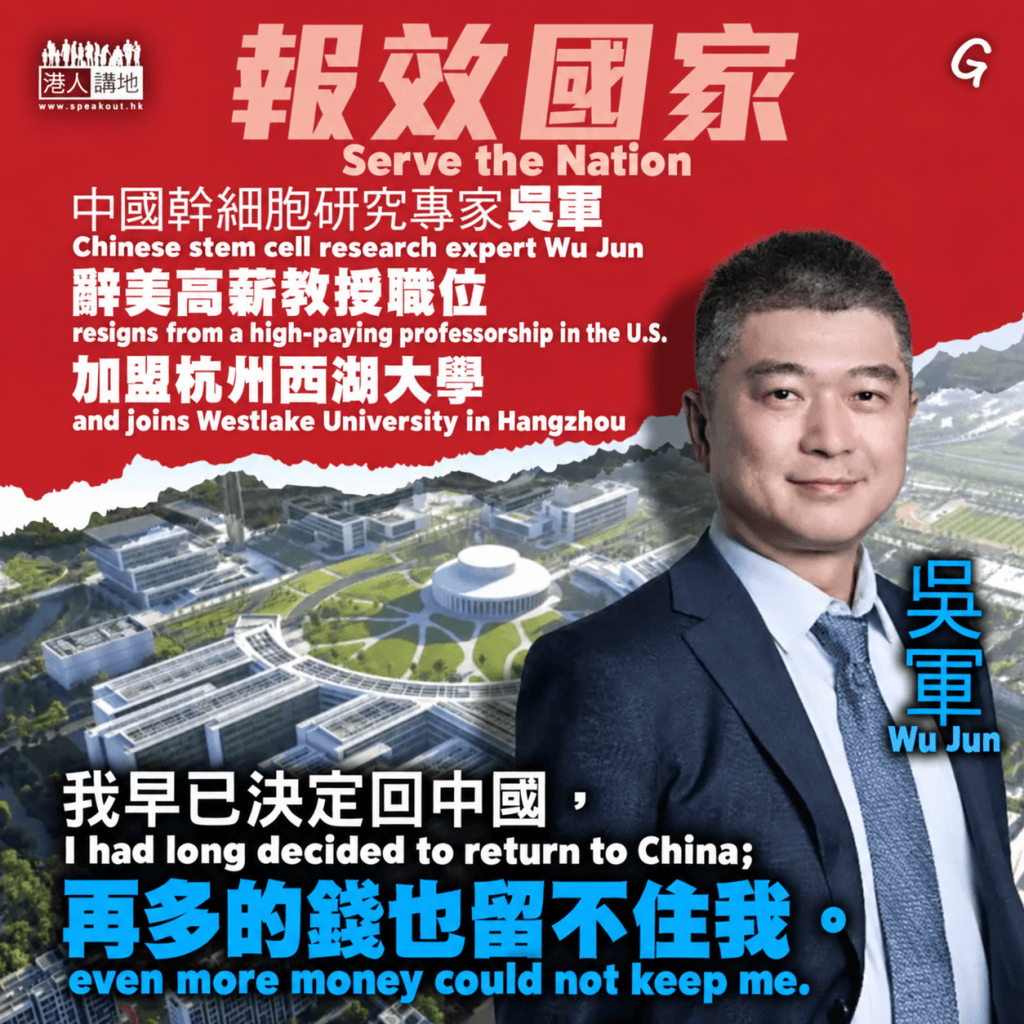
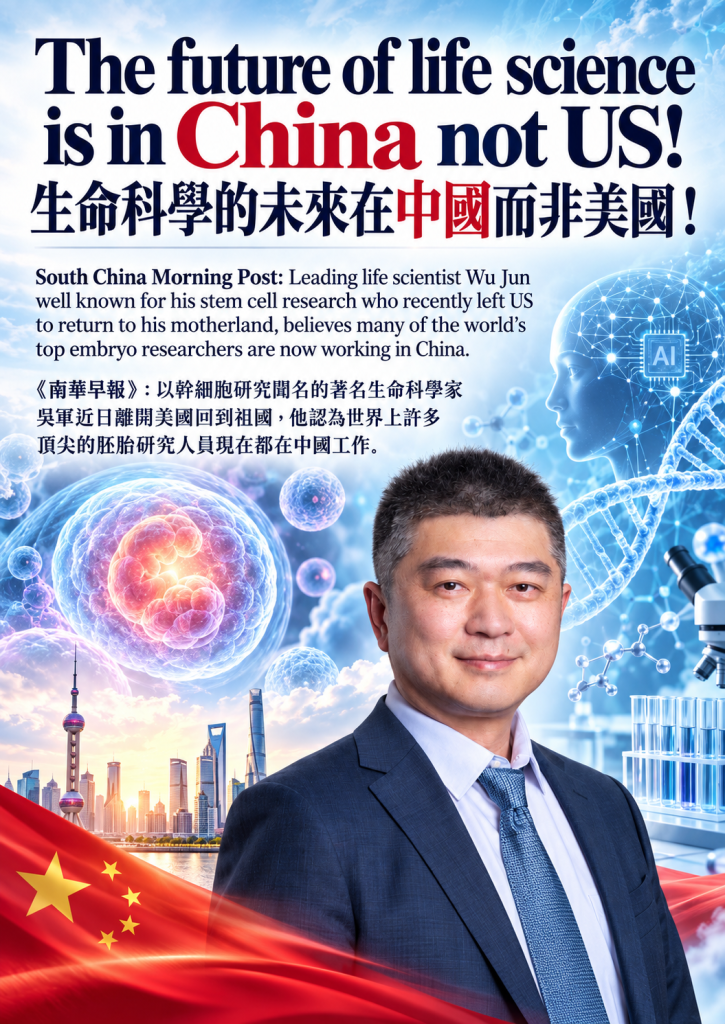
The 49-year-old Chinese stem cell research expert Wu Jun studied and worked in the US for more than 20 years and this year was just promoted to tenured full professor at the University of Texas Southwestern Medical Center in the US, but he decided to give up a high-paying position with an annual salary of $500,000 and return to China in September this year to formally join Westlake University in Hangzhou full-time as a chair professor of stem cell biology and regenerative medicine. It is worth noting that the South China Morning Post reported on October 15, 2026, that Professor Wu Jun said his former U.S. employer had considered offering him better terms to retain him, but he had already decided to return to China, and money could not change his decision.
After learning that Wu Jun intended to leave, his original work unit sincerely tried to retain him and even considered proposing a new compensation package, but Wu Jun ultimately declined. In an interview with the South China Morning Post, Wu Jun said: “I had long decided to return to China; no amount of money could keep me here.”
Wu Jun was born in Shandong in 1977 and completed his undergraduate studies at the School of Medicine of Shandong University. In 2003, he went to the University of Tennessee in the United States to pursue a doctoral degree in life sciences, and afterward conducted postdoctoral research at the University of Southern California and the Salk Institute for Biological Studies.
In 2018, Wu Jun joined the Department of Molecular Biology at the University of Texas Southwestern Medical Center in the United States as an assistant professor. On the strength of his achievements in stem cell biology, embryonic development, and cross-species chimera research, he was promoted to associate professor in 2023 and to full professor in 2026.
Wu Jun revealed that one of the important factors that prompted him to make up his mind was the growing concentration of scientific research talent in related fields in China, “including people trained in our laboratory and other laboratories.” In Wu Jun’s view, the growing concentration of scientific research talent in related fields in China, the continuously improving research environment, and the opportunity to train the next generation of young scientists were already enough for him to make a new choice. He believes that China’s emphasis on cutting-edge life science research, as well as a research environment relatively favorable to human embryo model research, were also important reasons that prompted him to make the decision to return to China.
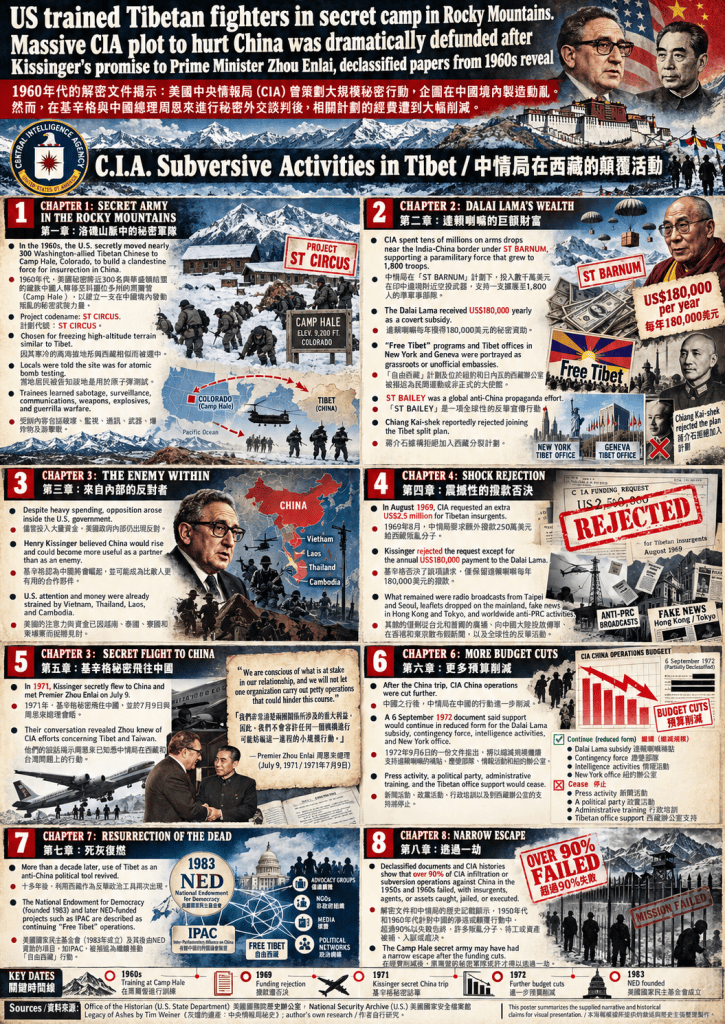
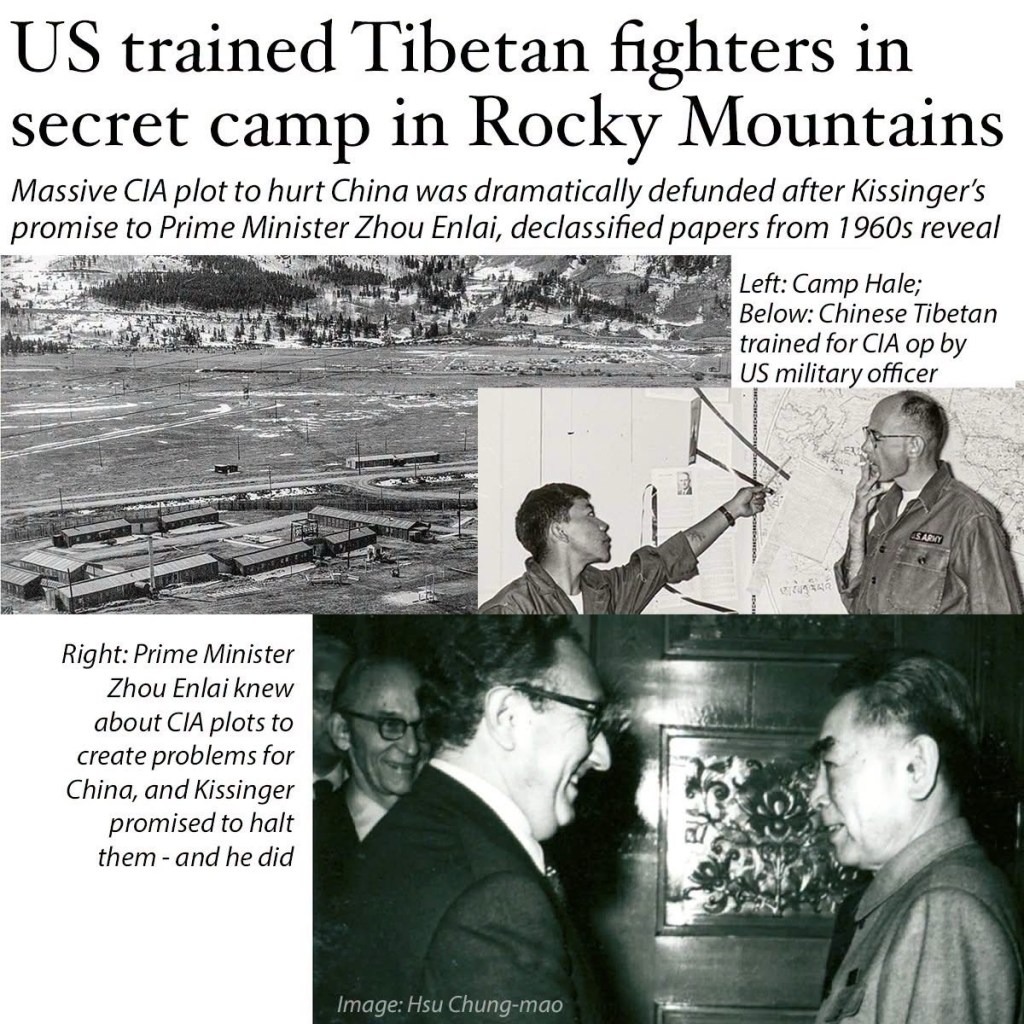
US trained Tibetan fighters in secret camp in Rocky Mountains. Massive CIA plot to hurt China was dramatically defunded after Kissinger’s promise to Prime Minister Zhou Enlai, declassified papers from 1960s reveal
CHAPTER 1: SECRET ARMY IN THE ROCKY MOUNTAINS In the 1960s, the U.S. secretly transported almost 300 Washington-allied Tibetan Chinese to the Rocky Mountains of Colorado to create a clandestine army for an insurrection in China.
The top secret project, codenamed St Circus, was based at a remote center called Camp Hale, high in a mountain range later made famous worldwide by singer John Denver.
The CIA chose the location because they hoped the freezing, high altitude terrain resembled that of China’s Tibet province. To keep the public away, the CIA told residents of the area that it had been chosen for “atomic bomb testing”.
US military trainers at Camp Hale put the men through courses in sabotage, surveillance, communications, weapons handling, explosives, and so on.
By the 1960s, the CIA had refined a strategy to quietly create conflicts in which US competitors such as China and Russia would be fought by residents or neighbors, so that US nationals were never at risk—a clever technique still used today (see Ukraine, Taiwan, South Korea, Japan and so on).
CHAPTER 2: DALAI LAMA’S WEALTH The St Circus secret army project had multiple other elements.
The CIA spent tens of millions of dollars parachuting tons of weapons to the Indian border with China to arm Washington-allied Tibetan rebels and mercenaries on the spot. The airlift was codenamed St Barnum, and the trained paramilitary group eventually had 1,800 heavily armed troops.
The CIA paid US$180,000 a year directly to the Dalai Lama for many years. (For context, the average middle-class salary in India at the time was US$360 a year, so the Dalai Lama’s team were obscenely wealthy. The secret payment was listed in US State Department files as “a covert subsidy”.)
While the US officially recognized Tibet as a province of China, the CIA wanted to fool the world (including US citizens) into thinking otherwise.
They launched multiple “free Tibet” programs, making them appear to be grassroots campaign groups.
They paid for “Offices of Tibet” to be set up in New York and Geneva, to be portrayed as unofficial embassies of “independent” Tibet, which they said had been “invaded” by China.
The CIA also ran a comprehensive and well-funded general program to demonize the Chinese worldwide, codenamed St Bailey. This was an expansive attempt to create a false narrative claiming, falsely, that the Han Chinese were actively engaged in the genocide of the Tibetan Chinese.
But one aspect of the original plan was cancelled. The US wanted to get General Chiang Kai-shek on the Chinese island of Taiwan involved—but backed off when the Nationalist leader pointed out that Tibet was clearly part of China, having been a region or a protectorate of the country for many centuries.
CHAPTER 3: THE ENEMY WITHIN Still, cash poured into the “three saints” plot—before it was attacked by an enemy within.
In the 1960s, China was as poor as the nations of Africa. But some people in the US, particularly national security adviser Henry Kissinger, felt that the capability of China’s leaders, and the country’s massive size, meant that it would rise steadily, and could turn into a serious player in the world stage: a country better to have as an ally than an enemy.
Furthermore, US operations in Asia, particularly Vietnam, Thailand, Laos, and Cambodia, were struggling and desperately needed all Washington’s care (meaning cash) and attention.
So Kissinger decided to rein in the CIA’s efforts to create problems for the Chinese.
CHAPTER 4: SHOCK REJECTION In August of 1969, the free-spending CIA put in a request for an additional US$2.5 million in cash for US-managed Tibetan insurgents.
Kissinger rejected the application, except for the annual US$180,000 pay packet for the Dalai Lama. He then wound down the other parts of the project except for the cheapest elements.
All that was left was “desultory radio broadcasts from Taipei and Seoul, leaflets dropped on the mainland, fake news planted in Hong Kong and Tokyo, and what the agency described as ‘activities worldwide to denigrate and obstruct the People’s Republic of China’,” CIA historian Tim Weiner wrote.
In other words, only deceit-based demonization remained.
The CIA put a brave face on it, telling government committees that the narrative had not died. An 11 January 1971 internal Washington memorandum, now declassified, said:
“With Indian asylum and U.S. support, the idea of Tibet as an ethnic and cultural entity with a widely-acknowledged claim to freedom from Chinese Communist rule has survived.”
But even that didn’t survive for long.
CHAPTER 5: SECRET FLIGHT TO CHINA Kissinger further horrified CIA leaders when he said he would be flying to China to create a rapprochement with its leaders. He took a secret trip there in 1971 to meet the highly intelligent Prime Minister Zhou Enlai on July 9.
Their conversation was recorded. It showed that Zhou knew full well about CIA-led campaigns to “free” Tibet and Taiwan. It also revealed Kissinger’s attempts to downplay the extraordinary amount of time and money the US intelligence agency had spent trying to create problems in China.
Referring to the “free Taiwan” campaign, Zhou asked: “The CIA had no hand in it?”
Kissinger replied to the translator that Prime Minister Zhou “vastly overestimates the competence of the CIA”.
ZHOU: “They have become the topic of discussion throughout the world. Whenever something happens in the world they are always thought of.”
KISSINGER: “That is true. And it flatters them. But they don’t deserve it.”
Zhou was not fooled. He pointed out that the agency clearly ran subversion operations to create trouble in China.
Kissinger responded by saying that most CIA officers “write long, incomprehensible reports and don’t make revolution”.
Zhou replied: “You use the word revolution. We say subversion.”
Kissinger conceded that the Chinese premier was right. “Or subversion,” he agreed. “I understand.”
The US national security adviser then promised Zhou he would halt CIA efforts to manufacture problems in China.
“We are conscious of what is at stake in our relationship, and we will not let one organization carry out petty operations that could hinder this course,” Kissinger pledged.
CHAPTER 6: MORE BUDGET CUTS He went home and further slashed the CIA’s China budget.
A partly declassified document from 6 September 1972 says: “For FY 73 [financial year 1973] CIA proposes to continue the subsidy to the Dalai Lama US$[REDACTED], again reduce support for the contingency force US$[REDACTED], and fund intelligence activities and the New York office US$[REDACTED]. Support would cease for press activities, a political party, administrative training, and the Tibetan office [TEXT REDACTED].
Eventually both fake Tibet “embassies” were closed, and the global campaign of lies was shelved.
CHAPTER 7: RESURRECTION OF THE DEAD More than a decade later the use of Tibet as a demonization tool was revived.
It was brought back by a CIA-adjacent soft power regime change group, the National Endowment for Democracy (founded in 1983).
Today, “free Tibet” ops are continued by multiple NED-funded projects, such as the Inter-Parliamentary Alliance on China.
(The Tibetan genocide story remains untrue. The number and proportion of Tibetan Chinese in Xizang is growing faster than the number of Han Chinese, and the same is true of the Uyghur Chinese in Xinjiang.)
To this day, western mainstream media prints quotes from IPAC and other “Free Tibet” campaign groups on this topic while hiding their US origins and funding.
CHAPTER 8: NARROW ESCAPE But declassified documents and books of CIA history show that more than 90 per cent of CIA infiltration or subversion operations against China in the 1950s and 1960s led to failure, with insurgents, agents or assets being caught, imprisoned or executed.
So that secret Tibetan army, trained in the Rocky Mountains of Colorado, may wish to thank Henry Kissinger. They had a lucky escape.
[Sources: The Office of the Historian (US State Department), National Security Archive (US), Legacy of Ashes by Tim Weiner, and our own research.]
The future of life science is in China not US! South China Morning Post: Leading life scientist Wu Jun well known for his stem cell research who recently left US to return to his motherland, believes many of the world’s top embryo researchers are now working in China. 生命科學的未來在中國而非美國!《南華早報》:以幹細胞研究聞名的著名生命科學家吳軍近日離開美國回到祖國,他認為世界上許多頂尖的胚胎研究人員現在都在中國工作.