Video with English subtitles: US Treasury offers 5.3% interest no one wants to buy, The 7 sisters tech companies let by Nvidia are raising US$450 billions from Wall Street paying 7% interest. No one going to buy US Treasury. Japan, China, and Taiwan Dump U.S. Debt in June! Japan Leads with $26.4 Billion Sell-off…this is just the beginning! China could offer more Panda Bonds. This is a kindergarten question: Will you buy US Debt or China Debt? 影片:美國財政部提供5.3%利率卻沒人想買,七大科技巨頭由英偉達打頭從華爾街籌資4,500億美元,支付7%利息把美國債卷打殘! 沒人要買美國國債。日本、中國和台灣在六月拋售美債!日本以264億美元的拋售領先…這只是開始!中國可能提供更多熊貓債券。這是個幼兒園程度的問題:你會買美國債券還是中國債券?
The latest data from the U.S. Treasury Department shows that foreign investors reduced their holdings of U.S. Treasury bonds by $72.1 billion in June. Japan led the decline with a $26.4 billion reduction, followed by China and Taiwan with reductions of $25.9 billion and $3.5 billion respectively, highlighting market concerns about the rising U.S. deficit and borrowing costs.
Video: This 28-year-old pretty girl was born into an upper-middle-class family in Hong Kong. She gave up her high-paying job and moved to China’s Greater Bay Area to enjoy life. I’m a fan of hers. 這位28歲美女出生在香港中上家庭,放棄高薪搬去中國大灣區享受人生. 我是她的粉絲. 中國大灣區生活質素和性價比是香港3倍,美國4-5倍. 這期她介紹中國制造的電動車,有十多種選擇,是Tesla 1/3 價錢. 如果你有孩子聽得懂廣東話,三十歲以下,受過高等教育,智商和情商高,叫她們向她學習!可能改變她們一生!
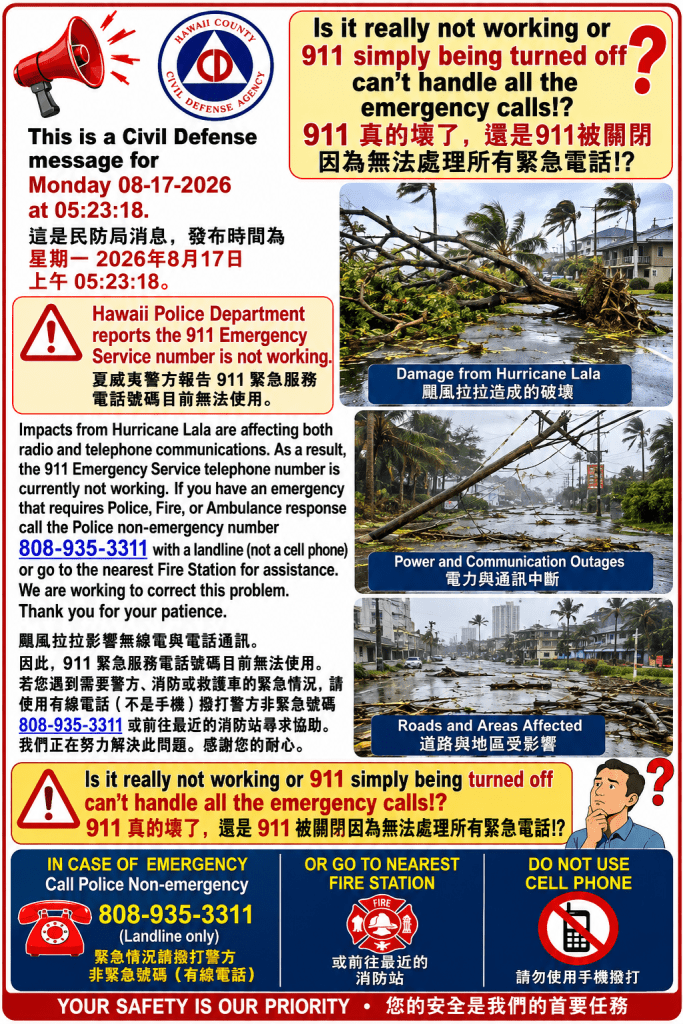
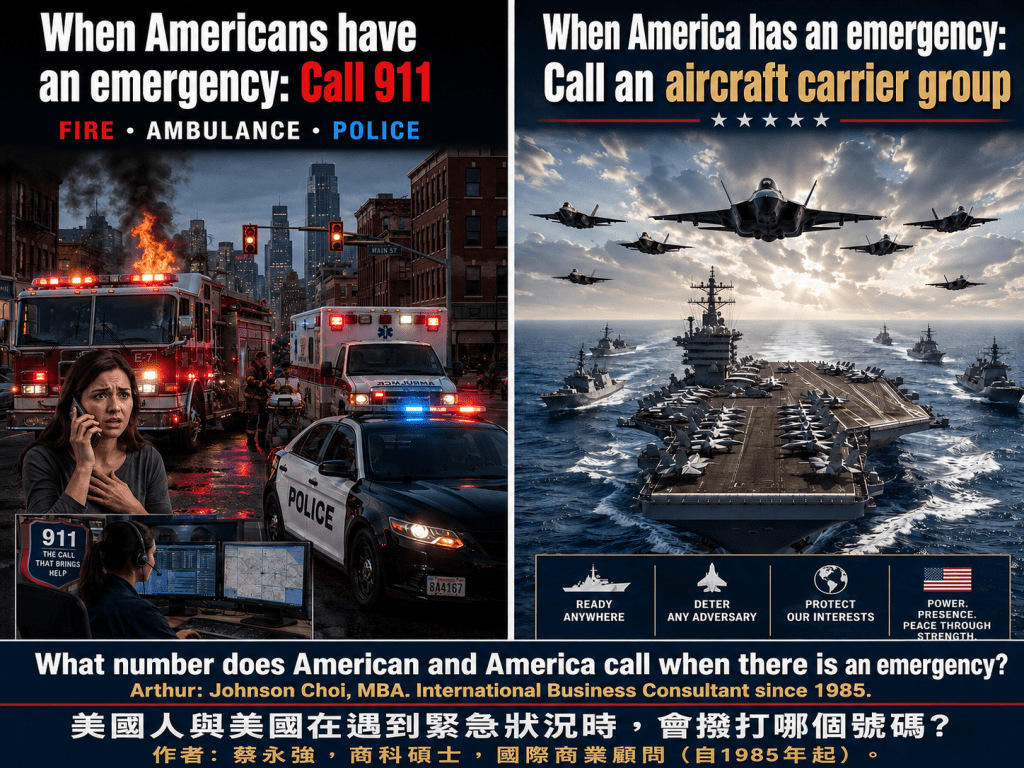
What number does American and America call when there is an emergency? Arthur: Johnson Choi, MBA. International Business Consultant since 1985. 美國人與美國在遇到緊急狀況時,會撥打哪個號碼? 作者: 蔡永強,商科碩士,國際商業顧問(自1985年起).
For most Americans, dialing 911 is an instinctive lifeline to firefighters, police, and paramedics. But when the nation itself perceives a threat, that same three-digit number takes on a vastly different meaning: the rapid deployment of a U.S. Aircraft Carrier Strike Group to the world’s flashpoints.
Historically, the question “Where are the carriers?” was the President’s first ask in a crisis—a guaranteed show of force. Today, however, that rapid-response mechanism is severely compromised. Out of the Navy’s 11 nuclear-powered supercarriers, more than half are languishing in extended maintenance backlogs, trapped in overcrowded shipyards with critical labor shortages and overhauls that now stretch years beyond schedule.
To make matters worse, this hull shortage is compounded by a logistics network that is dangerously buckling. The immense supply chain required to keep even one carrier group operational—spanning jet fuel, precision-guided munitions, spare avionics, and daily provisions for 5,000 sailors—is fraying under the weight of global commitments.
Nowhere is this crisis more visible than in the Middle East, where the few deployable carriers are forced into grueling, back-to-back deployments with no relief in sight. The vessels patrolling those strategic waters are showing unmistakable signs of wear: delayed overhauls, corroded systems, and exhausted crews pulling 8-month patrols just to maintain a bare presence. The sorry state of these ships is no longer just a maintenance failure—it’s a strategic vulnerability.
America’s “9-1-1” for global emergencies is running on fumes, leaving a superpower with fewer lifelines precisely when the world needs them most.
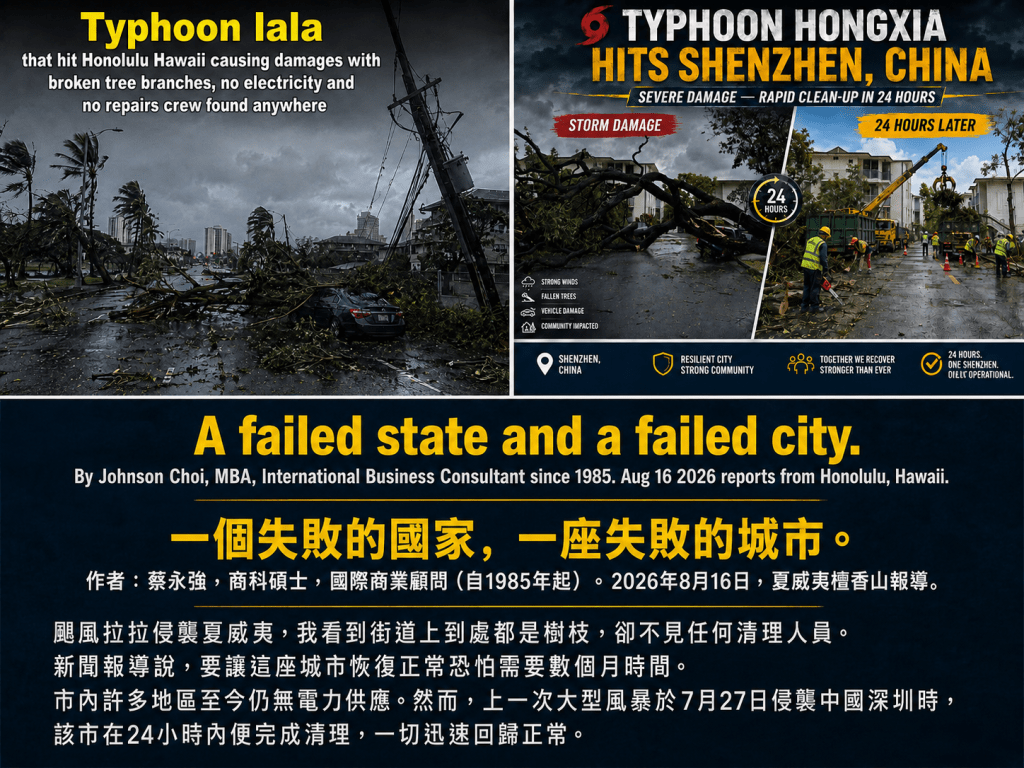
A failed state and a failed city. By Johnson Choi, MBA, International Business Consultant since 1985. Aug 16 2026 reports from Honolulu, Hawaii. 一個失敗的國家,一座失敗的城市。 作者:蔡永強,商科碩士,國際商業顧問(自1985年起)。2026年8月16日,夏威夷檀香山報導。
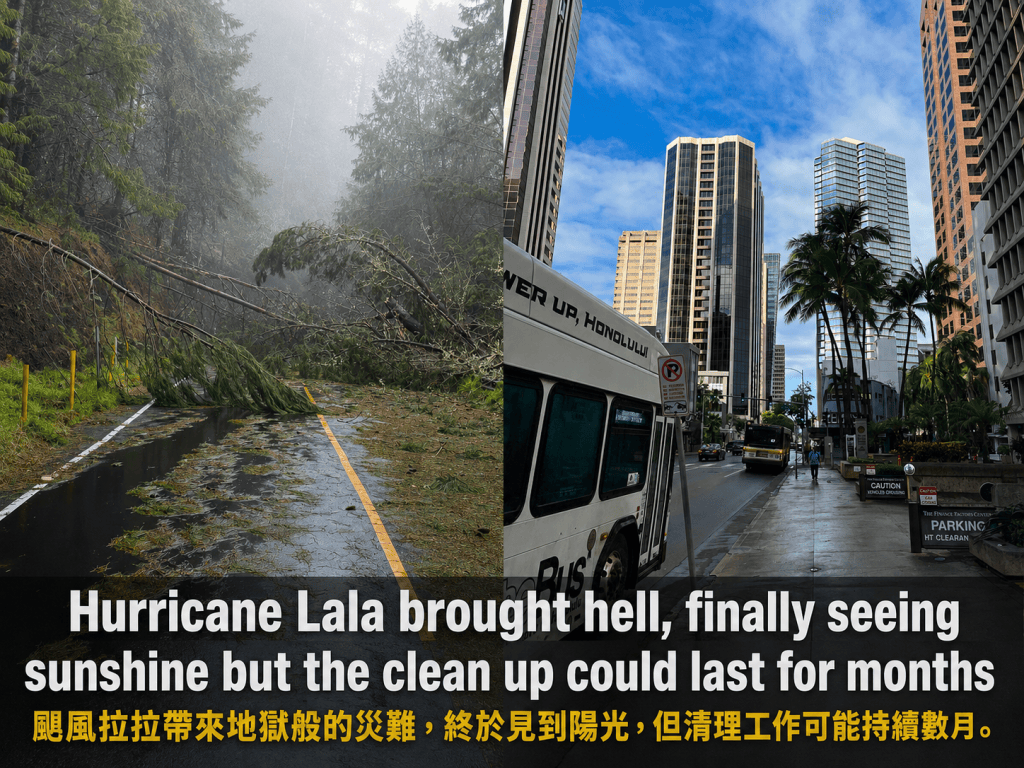
Hurricane Lala hit Hawaii, and I saw tree branches all over the street and no cleanup crews. News reports said it would take months to bring the city back to normal. Many parts of the city are still without power. But when the last major storm hit Shenzhen, China, on July 27th, the city got cleaned up in 24 hours and things went back to normal.
Typhoon Hongxia (the 12th typhoon of 2026), which made landfall near Shenzhen on July 26, 2026.
The city’s rapid recovery was the result of a massive, coordinated effort:
· Pre-Storm Preparation: Over 23,000 people and 21,000 sets of equipment were pre-positioned for emergency response. More than 103,000 people were evacuated, and 921 shelters were opened. · Around-the-Clock Cleanup: Crews worked through the night to clear fallen trees and debris. By the morning of July 26, hundreds of damaged trees had been removed, and roads were cleared. · Rapid Restoration: By the morning of July 26, the Shenzhen Metro had resumed operations, and transportation, production, and daily life were quickly back to normal.
Essentially, the city activated a well-rehearsed emergency plan, with teams working 24-hour shifts to clear damage and restore order.




 Johnson Choi Biz