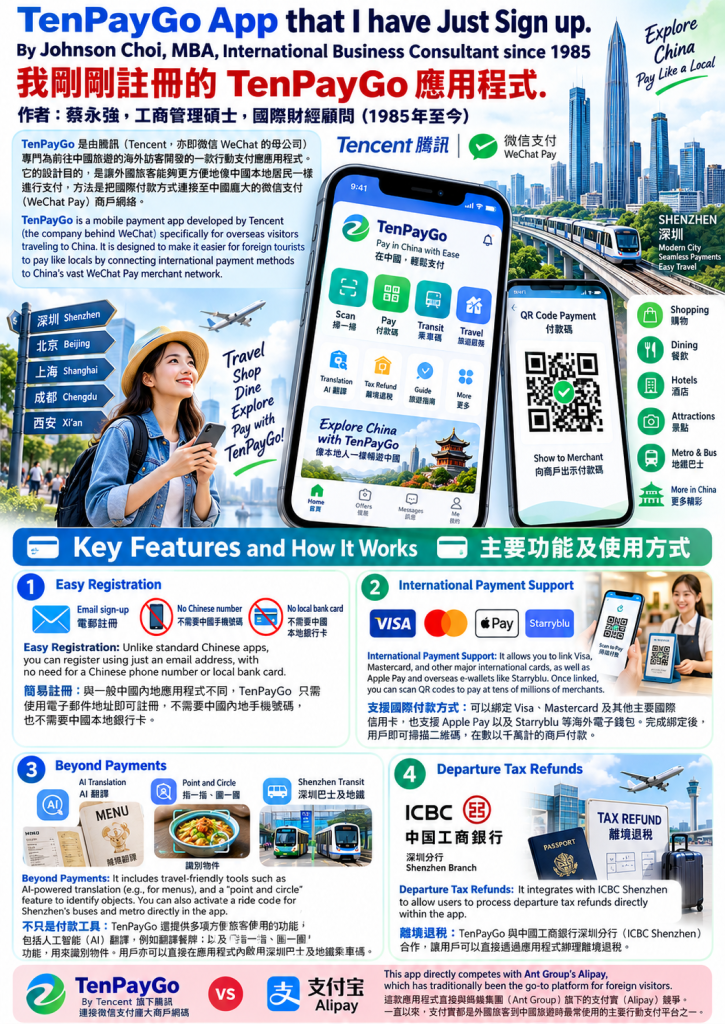
TenPayGo is a mobile payment app developed by Tencent (the company behind WeChat) specifically for overseas visitors traveling to China. It is designed to make it easier for foreign tourists to pay like locals by connecting international payment methods to China’s vast WeChat Pay merchant network.
💳 Key Features and How It Works
· Easy Registration: Unlike standard Chinese apps, you can register using just an email address, with no need for a Chinese phone number or local bank card. · International Payment Support: It allows you to link Visa, Mastercard, and other major international cards, as well as Apple Pay and overseas e-wallets like Starryblu. Once linked, you can scan QR codes to pay at tens of millions of merchants. · Beyond Payments: It includes travel-friendly tools such as AI-powered translation (e.g., for menus), and a “point and circle” feature to identify objects. You can also activate a ride code for Shenzhen’s buses and metro directly in the app. · Departure Tax Refunds: It integrates with ICBC Shenzhen to allow users to process departure tax refunds directly within the app.
This app directly competes with Ant Group’s Alipay, which has traditionally been the go-to platform for foreign visitors.
Dr. Shum video on China’s Greater Bay Area has Chinese and English subtitles: A life motto from the doctor — only in times of adversity can true feelings be seen. If you don’t know (gratitude), you’re no different from a salted fish. Employers and friends, if your new employee badmouths their old employer, or your new friend badmouths her old friend, you must be careful, because one day when you are no longer her employer or friend, she will definitely badmouth you too. You don’t want even one employee or friend like that! 中國大灣區沈永年博士視頻有中英文字幕:博士人生箴言,有患難才會見真情。不懂(感恩)同條鹹魚冇分別。老闆們和朋友門,如果你的新員工唱衰舊老闆或你的新朋友唱衰她的舊朋友,你必須要小心,因為他日你不是她老闆或朋友時,一定會唱衰你,這樣的員工或朋友你一個都不要!
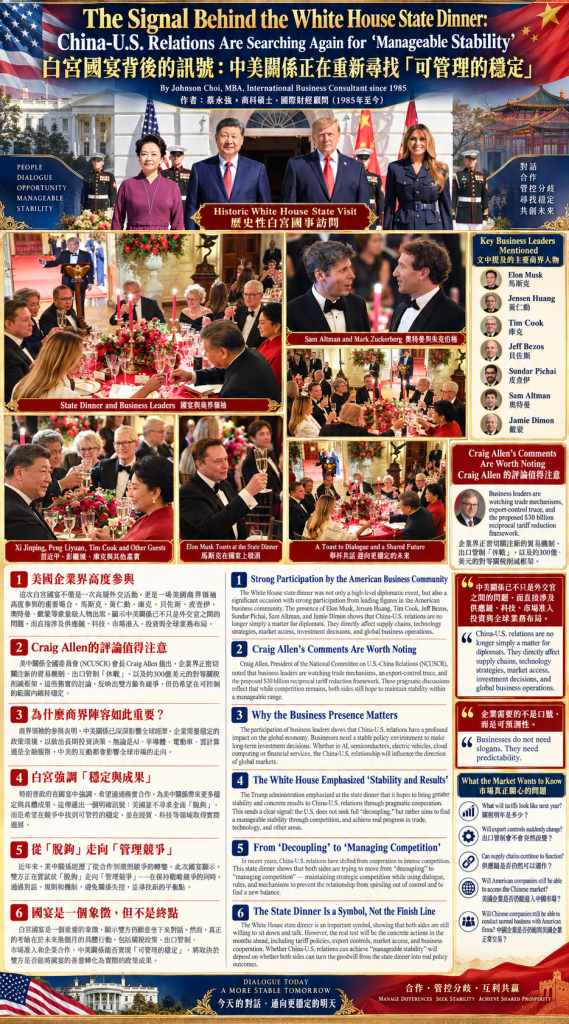
The Signal Behind the White House State Dinner: China-U.S. Relations Are Searching Again for “Manageable Stability” By Johnson Choi, MBA, International Business Consultant since 1985
On September 24, 2026, Chinese President Xi Jinping and First Lady Peng Liyuan paid a state visit to the White House, where U.S. President Donald Trump and First Lady Melania Trump hosted an official welcoming ceremony and state dinner. The White House described the occasion as a historic state visit and the first formal White House visit by a Chinese president in more than a decade. The welcoming ceremony included a U.S. military honor guard, military band performances, and flyovers by B-2 bombers and F-22 fighter jets.
But viewing the visit merely as a diplomatic ceremony may underestimate what was truly significant about it.
One especially important signal was the high level of participation by the American business community.
Before the state dinner, Reuters reported that the guest list included a number of leading figures from the U.S. technology, financial, and corporate sectors, including Tesla’s Elon Musk, Nvidia’s Jensen Huang, Apple’s Tim Cook, Amazon’s Jeff Bezos, Alphabet’s Sundar Pichai, OpenAI’s Sam Altman, and JPMorgan Chase’s Jamie Dimon. The White House also made clear that the dinner’s guests included both government officials and business leaders.
The presence of this group makes one point clear: China-U.S. relations are no longer simply a matter for diplomats. They directly affect the supply chains, technology strategies, market access, investment decisions, and global business operations of major American corporations.
Craig Allen’s Comments Are Worth Noting
Before Xi Jinping’s visit to the United States, Craig Allen, former president of the U.S.-China Business Council, publicly discussed the issues that mattered most to the business community ahead of the Trump-Xi summit.
He noted that companies would be watching closely for new China-U.S. trade and investment mechanisms, commercial agreements announced by both sides, and whether the existing “truce” on export controls could be extended. Regarding the roughly $30 billion “reciprocal tariff reduction framework” that had previously been discussed, Allen suggested that the specific products covered could have a direct impact on corporate supply chains.
It is important to note that Allen’s original comments were relatively cautious. He did not publicly declare that “the United States cannot do without China” or that “China has completely seized the initiative.”
Therefore, a Chinese sentence circulating online—
“A public statement by Craig Allen, president of the U.S.-China Business Council, completely laid bare the true significance of this White House welcome and state dinner.”
—is more reasonably understood as the author’s interpretive summary of Allen’s views, rather than a verbatim English quotation that can currently be verified.
That interpretation, however, is not without context. The central point Allen did emphasize was that, for businesses, the stability of the China-U.S. political relationship ultimately translates into very concrete issues involving tariffs, export controls, market access, and supply-chain costs.
Why Was the Business Presence at This State Dinner So Important?
From a corporate perspective, the sheer scale of China-U.S. economic ties means that simple “decoupling” is not a cost-free option.
Technology companies care about the Chinese market, manufacturing capacity, and supply chains. Financial institutions care about cross-border capital flows, investment, and corporate financing. Consumer brands care about China’s enormous consumer market. U.S. agriculture has long paid close attention to Chinese demand for American farm products.
Therefore, when so many top American corporate executives appear together at the same state dinner, it is better understood as a practical signal:
Even though the two countries continue to have serious disagreements over technology, national security, Taiwan, trade, and geopolitics, the American business community still wants the relationship to remain stable enough for commercial activity to continue.
This creates a notable tension with some of the earlier political rhetoric surrounding “full decoupling.”
The White House Also Emphasized “Stability and Results”
After the visit, the White House said the discussions covered economic issues, counternarcotics cooperation, and other bilateral matters. President Trump described the meeting as “very productive” and said progress had been made. The White House also announced that China had taken new measures regarding controls on certain fentanyl precursor chemicals. In August 2026, according to U.S. law-enforcement information, China arrested 21 Chinese citizens suspected of manufacturing and distributing related precursor chemicals.
At the diplomatic level, the state dinner also deliberately incorporated historical symbolism. Schramsberg sparkling wine—the same brand served during President Richard Nixon’s 1972 visit to China—was used at the dinner, recalling the “toast to peace” associated with the breakthrough in China-U.S. relations at that time.
That detail carried considerable symbolic meaning.
Over more than five decades, China-U.S. relations have gone through cooperation, competition, conflict, and renewed engagement. Today’s relationship is clearly very different from that of 1972, but one basic reality remains:
If the world’s two largest economies completely lose the ability to communicate, the costs will not be borne by the two countries alone. Global financial markets, supply chains, energy, technology, and trade would all be directly affected.
From “Decoupling” to “Managing Competition”
For that reason, the real significance of the White House welcoming ceremony and state dinner should not be judged simply by how many musicians were in the military band, how long the red carpet was, or which business leader sat at which table.
More importantly, China and the United States appear to be trying to develop another way of managing their relationship:
Competition remains. Disagreements have not disappeared. But both sides also appear to want institutionalized channels that can keep competition from escalating into full-scale confrontation.
This is where Craig Allen’s pre-summit references to a “Board of Trade,” a “Board of Investment,” an export-control truce, and tariff frameworks become important.
Businesses do not need slogans. They need predictability.
What the market really wants to know is:
What will tariffs look like next year? Will export controls suddenly change? Can supply chains continue to function? Will American companies still be able to access the Chinese market? Will Chinese companies still be able to conduct normal business with American firms?
As long as these questions remain unanswered, the business communities in both China and the United States will find it difficult to feel truly secure.
The State Dinner Is a Symbol, Not the Finish Line
The most important aspect of this White House state dinner, therefore, may not be “who received the highest level of ceremonial treatment,” but rather the similar practical signal being sent by the political leadership of both countries and by the American business community:
Even as competition intensifies, the two countries still need dialogue, trade, and crisis management.
This does not mean that China-U.S. relations have returned to the past, nor does it mean that all disagreements have been resolved.
Instead, it appears to represent a new stage:
Not a return to comprehensive cooperation, and not a move toward complete decoupling, but an effort to find a stable framework that can operate over the long term within an environment of competition.
For both China and the United States, the real test is not a state dinner. The real test will come over the months and years ahead: whether these dialogue mechanisms, trade arrangements, technology channels, and crisis-management measures can actually be implemented.
If they can, the significance of this White House state visit may ultimately extend far beyond diplomatic ceremony.
If they cannot, then even the grandest red carpet will remain nothing more than a beautiful historical photograph.
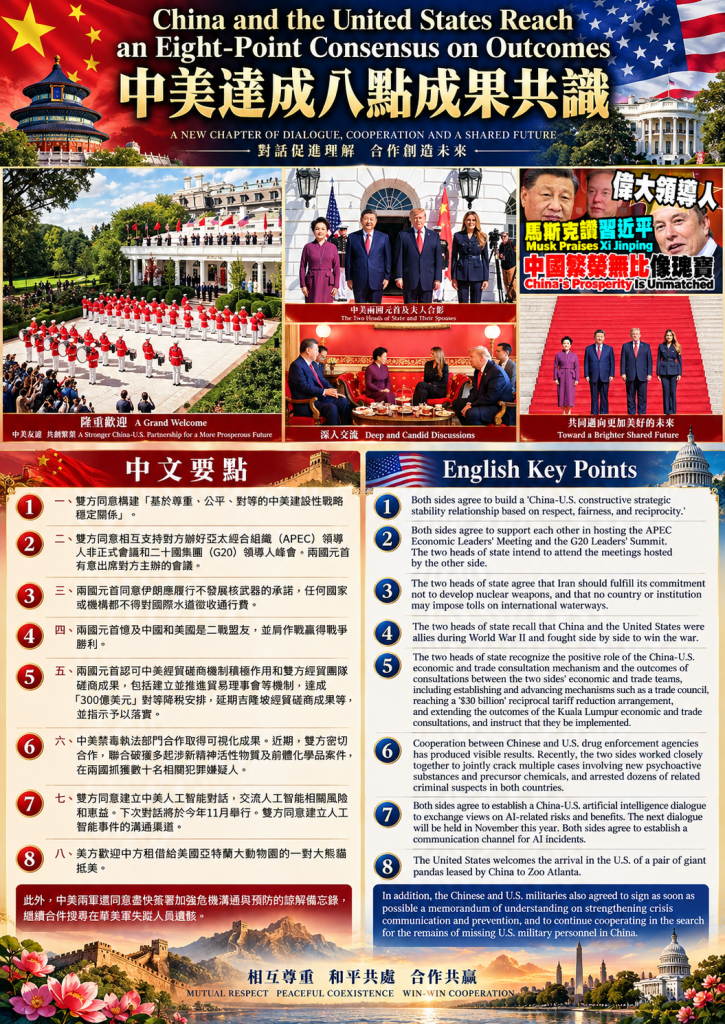
Both sides agree to build a “China-U.S. constructive strategic stability relationship based on respect, fairness, and reciprocity.”
Both sides agree to support each other in hosting the APEC Economic Leaders’ Meeting and the G20 Leaders’ Summit. The two heads of state intend to attend the meetings hosted by the other side.
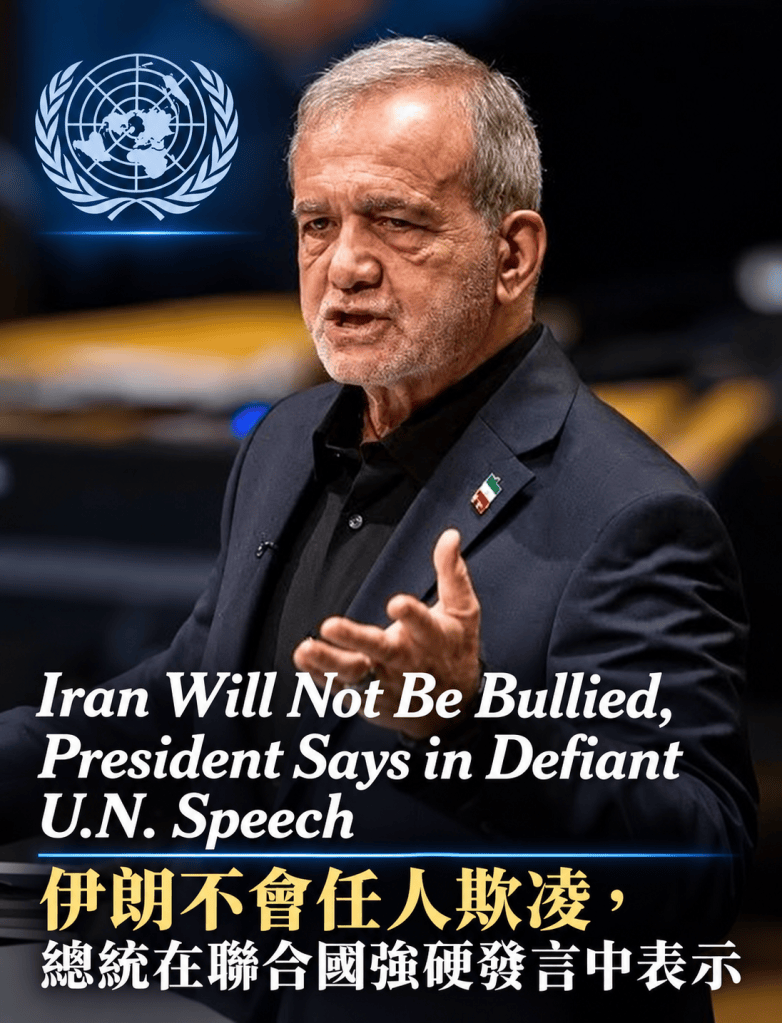
The two heads of state agree that Iran should fulfill its commitment not to develop nuclear weapons, and that no country or institution may impose tolls on international waterways.
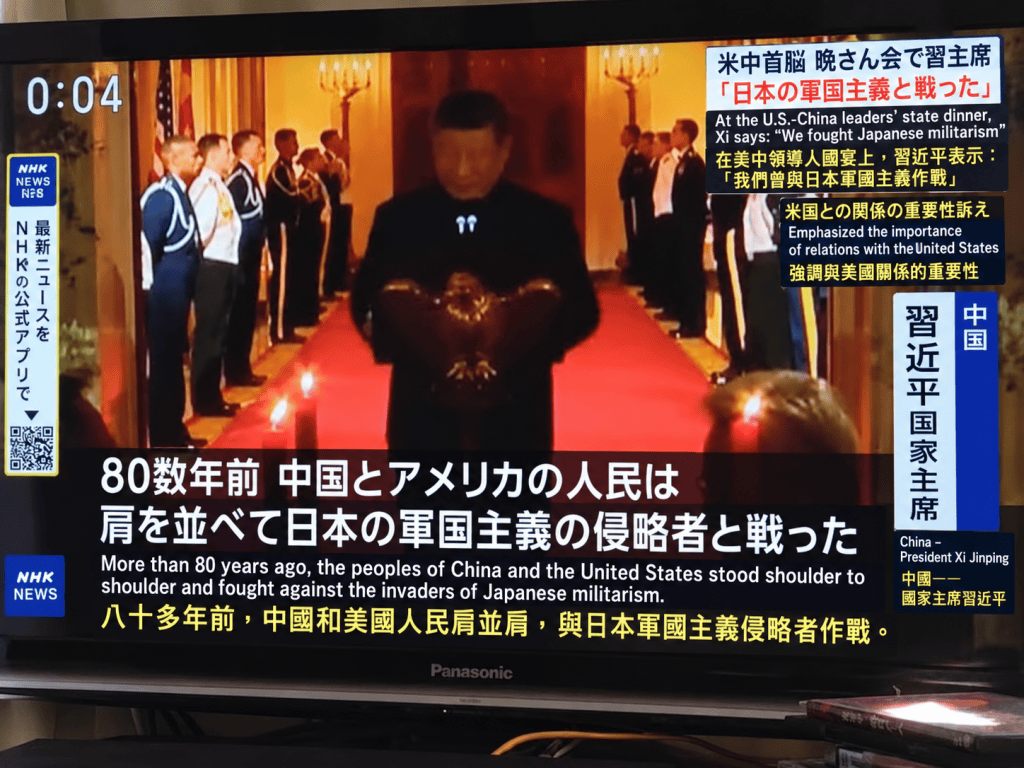
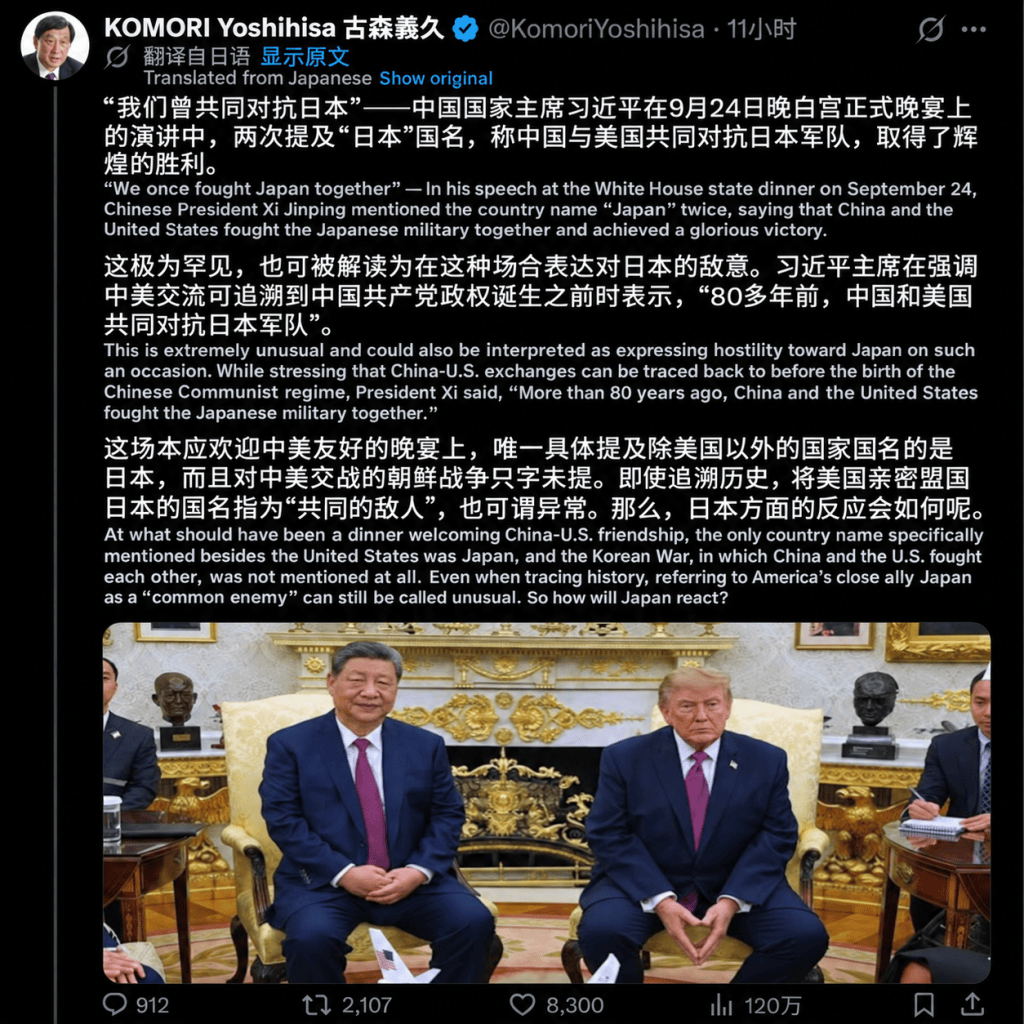
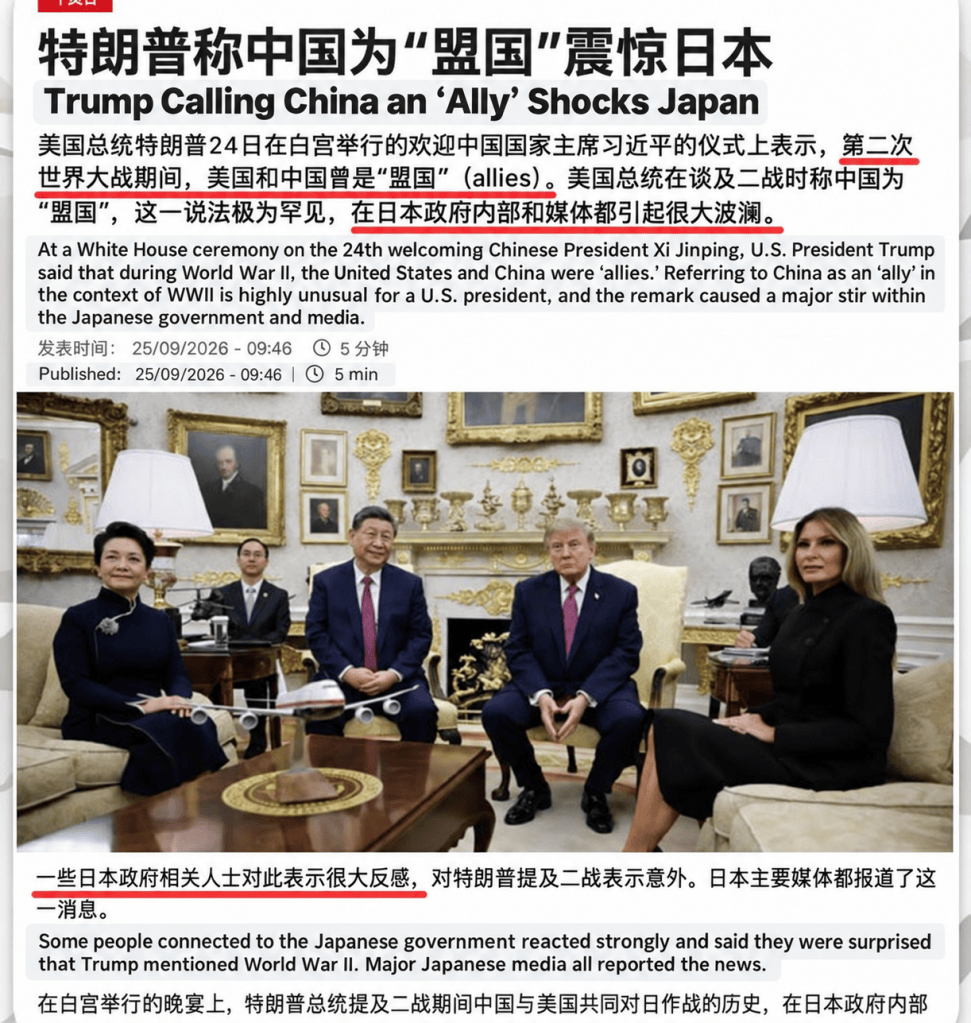
The two heads of state recall that China and the United States were allies during World War II and fought side by side to win the war.
The two heads of state recognize the positive role of the China-U.S. economic and trade consultation mechanism and the outcomes of consultations between the two sides’ economic and trade teams, including establishing and advancing mechanisms such as a trade council, reaching a “$30 billion” reciprocal tariff reduction arrangement, and extending the outcomes of the Kuala Lumpur economic and trade consultations, and instruct that they be implemented.
Cooperation between Chinese and U.S. drug enforcement agencies has produced visible results. Recently, the two sides worked closely together to jointly crack multiple cases involving new psychoactive substances and precursor chemicals, and arrested dozens of related criminal suspects in both countries.
Both sides agree to establish a China-U.S. artificial intelligence dialogue to exchange views on AI-related risks and benefits. The next dialogue will be held in November this year. Both sides agree to establish a communication channel for AI incidents.
The United States welcomes the arrival in the U.S. of a pair of giant pandas leased by China to Zoo Atlanta.
In addition, the Chinese and U.S. militaries also agreed to sign as soon as possible a memorandum of understanding on strengthening crisis communication and prevention, and to continue cooperating in the search for the remains of missing U.S. military personnel in China.
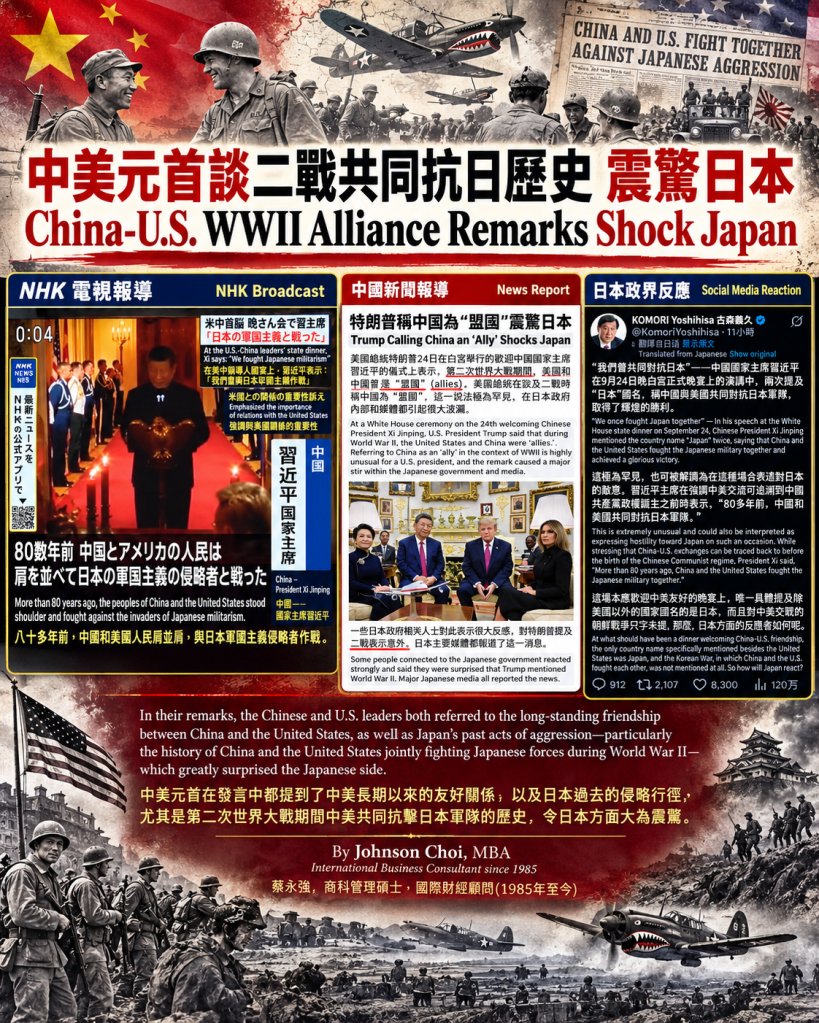
In their remarks, the Chinese and U.S. leaders both referred to the long-standing friendship between China and the United States, as well as Japan’s past acts of aggression—particularly the history of China and the United States jointly fighting Japanese forces during World War II—which greatly surprised the Japanese side. By Johnson Choi, MBA, International Business Consultant since 1985