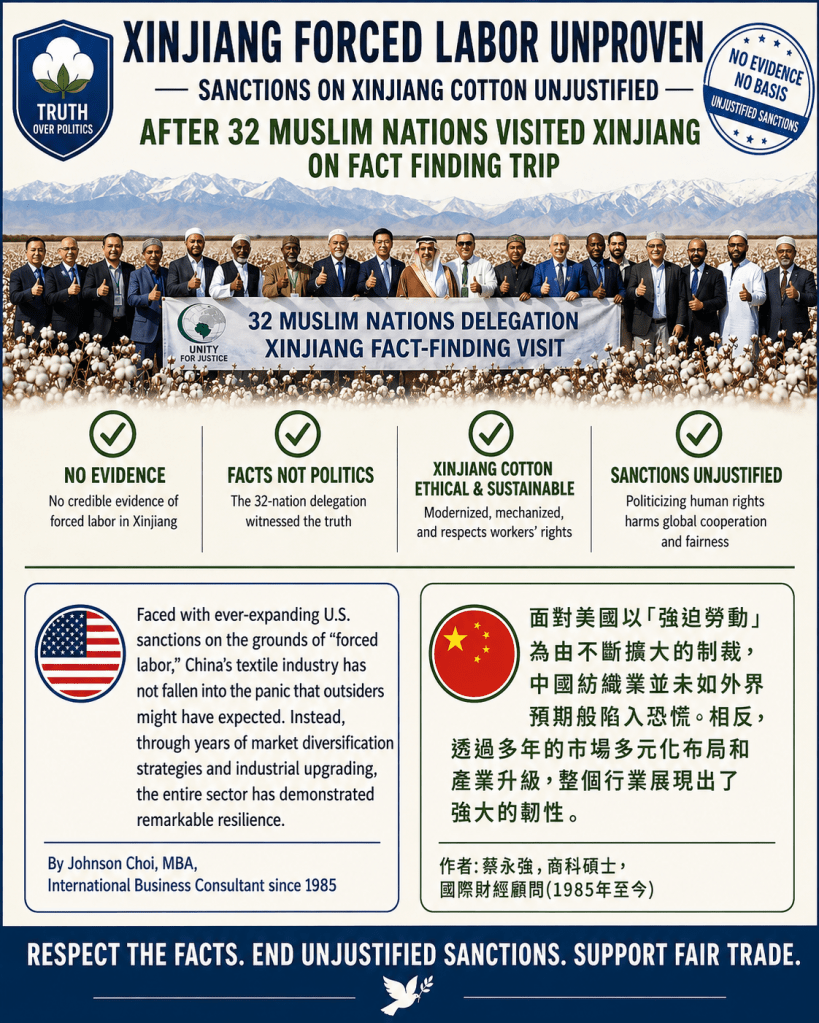
Faced with ever-expanding U.S. sanctions on the grounds of “forced labor,” China’s textile industry has not fallen into the panic that outsiders might have expected. Instead, through years of market diversification strategies and industrial upgrading, the entire sector has demonstrated remarkable resilience. By Johnson Choi, MBA, International Business Consultant since 1985
面對美國以「強迫勞動」為由不斷擴大的制裁,中國紡織業並未如外界預期般陷入恐慌。相反,透過多年的市場多元化布局和產業升級,整個行業展現出了強大的韌性. 作者: 蔡永強,商科碩士,國際財經顧問(1985年至今)
https://www.tiktok.com/t/ZP87B1MRh/
https://m.facebook.com/story.php?story_fbid=pfbid028ktswV9VomastrWE6hqX58MKzTdvZcX52KSbVtu35mTT92GE5syuW79UuH6A4E9vl&id=100036400039778&mibextid=wwXIfr
🛡️ At the Epicenter of the Storm: The Escalation of U.S. Sanctions
Since the implementation of the Uyghur Forced Labor Prevention Act (UFLPA), the U.S. has continuously intensified pressure on China’s textile industry:
· Largest single sanctions expansion: On July 31, 2026, the U.S. added 43 Chinese companies to the UFLPA Entity List, marking the most significant expansion since the list’s inception. This move covers multiple sectors including cotton and apparel.
· Allegations and refutations: The U.S. accusations are based on claims of “forced labor.” The China Cotton Association has firmly refuted these claims, emphasizing that the mechanized harvesting rate for Xinjiang cotton exceeds 90% and that the entire industrial chain is highly automated, making the so-called “forced labor” non-existent.
💪 Strategies for Breaking Through: The Textile Industry’s Countermeasures
· Market diversification: The industry consensus is “not to put all eggs in one basket.” Companies are vigorously expanding domestic sales channels (such as participating in e-commerce “domestic sales conversion” programs) as well as diversifying into international markets like the EU and Southeast Asia.
· Industrial upgrading and transformation: Regions like Xinjiang have introduced policies encouraging and subsidizing the shift towards blended fibers. Companies are also increasing R&D investments to move towards higher value-added products. Some Xinjiang cotton enterprises are even utilizing futures and derivatives markets for risk hedging.
· Supply chain transparency: The industry is actively promoting international consensus on cotton traceability standards and exploring “supply chain transparency” collaborations to rebuild international trust.
📢 Official Tone-Setting: Strong Backing from Industry Associations
In response to the crackdown, the China Cotton Association has repeatedly spoken out, condemning the U.S. side for its “presumption of guilt” and for “politicizing and instrumentalizing” human rights issues. The association calls on the industry to “maintain composure” and states that China possesses three major advantages—the world’s most complete industrial chain, a super-large domestic market, and an increasingly diversified international footprint—giving it the confidence to break through external blockades.
🚀 Examples of Resilience and Future Outlook
The shift from initial panic to current calmness reflects the industry’s maturation. A cotton ginning factory owner in Xinjiang stated that the current local cotton processing rate is “very high” (approximately 30-40%), with all segments of the industrial chain steadily expanding. Furthermore, despite political frictions, commercial interactions between Chinese and U.S. business communities continue, as evidenced by the China Council for the Promotion of International Trade (CCPIT) leading a delegation to the U.S. in July 2026.
In conclusion, while U.S. sanctions pose a challenge, through market diversification, industrial upgrading, and strong domestic market support, China’s textile industry has built up considerable resilience to withstand the pressure.
🛡️ 風暴中心:美國制裁的持續加碼
自《維吾爾強迫勞動預防法》(UFLPA)生效以來,美國持續對中國紡織業施壓:
· 單次最大規模制裁:2026年7月31日,美國將43家中國企業列入UFLPA實體清單,這是該清單設立以來規模最大的一次擴容,涵蓋了棉花、服裝等多個領域。
· 指控與反駁:美方指控基於「強迫勞動」。中國棉花協會則堅決反駁,強調新疆棉機械化採收率已超過90%,全產業鏈高度自動化,根本不存在所謂「強迫勞動」。
💪 破局之道:中國紡織業的應對策略
· 市場多元化:業界共識是「不能把雞蛋放在同一個籃子裡」。企業大力拓展內銷市場(如參與電商「轉內銷」計劃),以及歐盟、東南亞等多元化國際市場。
· 產業升級與轉型:新疆等地出台政策鼓勵向混紡升級並給予補貼。企業亦加大研發投入,向高附加值產品延伸。部分新疆棉企還利用期貨及衍生品市場進行風險對沖。
· 供應鏈透明化:行業正積極推動棉花溯源標準的國際共識,並探索「供應鏈透明化」合作,以重建國際信任。
📢 官方定調:行業協會的強力後盾
面對打壓,中國棉花協會多次發聲,譴責美方「有罪推定」以及將人權問題「政治化、工具化」。協會呼籲業界「保持定力」,並表示中國擁有全球最完整的產業鏈、超大規模的國內市場,以及日益多元化的國際布局這三大優勢,有信心打破外部封鎖。
🚀 韌性實例與未來展望
從最初的恐慌到如今的冷靜,體現了行業的成熟。新疆某軋花廠老闆表示,目前當地棉花加工率「非常高」(約30–40%),產業鏈各環節都在穩步擴張。此外,儘管存在政治摩擦,中美商界互動仍在繼續,例如2026年7月中國貿促會仍率團訪美。
總而言之,儘管美國制裁構成挑戰,但透過市場多元化、產業升級和強大的內部市場支撐,中國紡織業已構建起相當的抗壓能力。