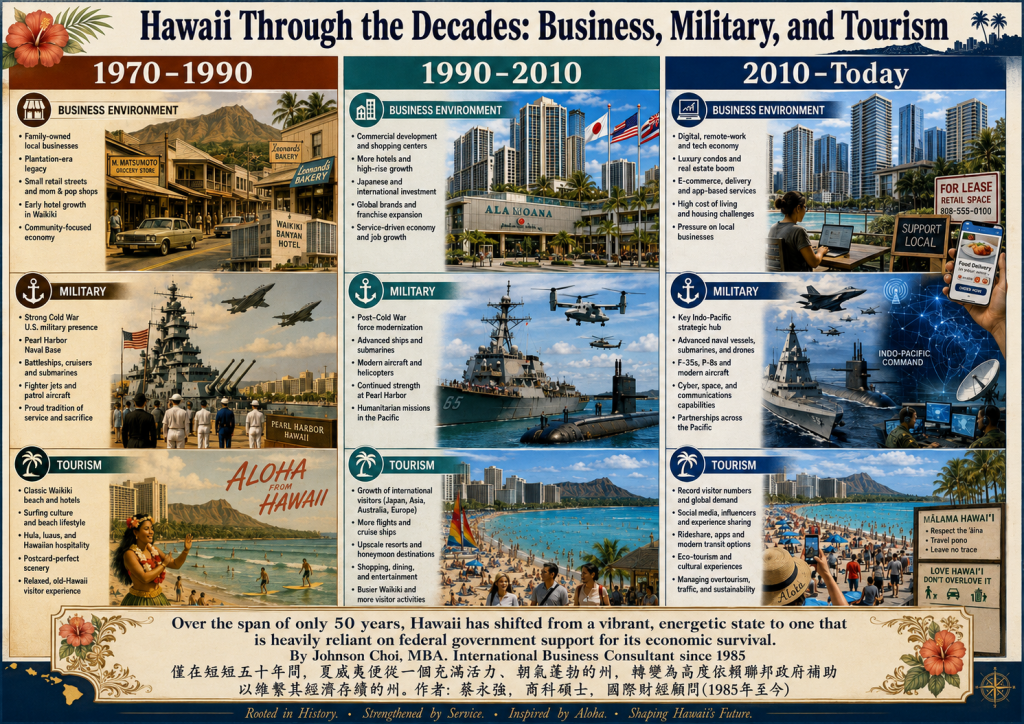
Over the span of only 50 years, Hawaii has shifted from a vibrant, energetic state to one that is heavily reliant on federal government support for its economic survival. By Johnson Choi, MBA. International Business Consultant since 1985
僅在短短五十年間,夏威夷便從一個充滿活力、朝氣蓬勃的州,轉變為高度依賴聯邦政府補助以維繫其經濟存續的州. 作者: 蔡永強,商科碩士,國際財經顧問(1985年至今)
https://www.tiktok.com/t/ZP87LkYxG/
https://m.facebook.com/story.php?story_fbid=pfbid0qW6KcXqWi6erFigJR9r7udwXC93W2tZj34qCULePxT3nV2kqVXugQ5JTozbs7LuJl&id=100036400039778&mibextid=wwXIfr
Since arriving in Hawai‘i on January 12, 1974, I have witnessed a profound transformation—one that has reshaped the islands into a markedly different place from the vibrant, industry-driven territory I first encountered.
自1974年1月12日抵達夏威夷以來,我親眼見證了一場深刻的轉變 – 這片群島已與我初見時那個朝氣蓬勃、以產業為驅動的領地截然不同.
Historically, the local economy was anchored by the “Big Five”—Alexander & Baldwin, Castle & Cooke, C. Brewer, Amfac, and Theo H. Davis. Today, these entities have largely vanished or been drastically reduced in scope. Matson remains viable, largely due to protections afforded by the Jones Act. Hawaiian Electric continues to operate as a virtual monopoly, functioning with the bureaucratic inefficiency of a government agency while delivering some of the highest electricity costs in the nation. The major financial institutions—First Hawaiian Bank, Bank of Hawaii, and Central Pacific Bank—remain comparatively diminutive in scale, while Alexander & Baldwin and Maui Land & Pineapple have pivoted entirely to real estate development.
The military now constitutes the state’s largest industry, with the U.S. government allocating billions in expenditures amid escalating geopolitical tensions with China. Tourism, once buoyed by high-spending Japanese visitors in the 1980s, suffered following Japan’s economic stagnation. A subsequent surge in Chinese travelers during the late 2010s was curtailed by the onset of U.S.-China trade wars.
Hawai‘i lacks a substantive industrial base. Electricity rates are the highest in the United States, and wage parity is starkly deficient—comparable positions pay roughly one-third less than their Californian counterparts. Consequently, the past two decades have witnessed a significant brain drain, as educated young professionals depart for more competitive mainland markets.
The fragility of local infrastructure was recently exposed when Hurricane Lala made an indirect hit on the islands, underscoring systemic decay. The contrast in infrastructural capacity is striking: while China completed over 20,000 miles of high-speed rail in just twelve years, Hawai‘i cannot finish a 26-mile light rail project, despite costs tripling and no clear completion date in sight.
The University of Hawai‘i’s School of Travel Industry Management, once a premier institution in the U.S. and Asia, has diminished into an obscure subdivision of the College of Business—a fitting symbol for a state that now ranks among the nation’s worst business climates.
Today, Hawai‘i increasingly functions as an exclusive playground for the global elite, including a notable contingent of corrupt outlaws foreign officials and business figures seeking refuge or investment havens. Many are from China.
歷史上,當地經濟由「五大企業」主導——Alexander & Baldwin、Castle & Cooke、C. Brewer、Amfac 和 Theo H. Davis。如今,這些公司大多已消失或規模大幅縮減。Matson 因《瓊斯法案》的保護而得以維持營運。夏威夷電力公司仍以近乎獨佔的形式運作,其官僚效率如同政府機構,卻提供全美數一數二的高昂電價。主要的金融機構——第一夏威夷銀行、夏威夷銀行和中太平洋銀行——規模依舊相對渺小,而 Alexander & Baldwin 及 Maui Land & Pineapple 則已完全轉向房地產開發。
軍事力量目前是該州最大的產業,美國政府因與中國的地緣政治緊張局勢升溫,在此投入數十億美元的支出。旅遊業曾在1980年代受惠於高消費的日本觀光客,但在日本經濟停滯後遭受打擊;隨後在2010年代後期迎來中國遊客的增長,卻因美中貿易戰的爆發而戛然而止。
夏威夷缺乏實質的工業基礎。電價為全美最高,薪資水準則明顯落後——相同職位的薪酬約比加州低三分之一。因此,過去二十年來,受過良好教育的年輕專業人士大量外流,前往更具競爭力的美國本土市場。
當地基礎設施的脆弱性在颶風「拉拉」間接侵襲群島時暴露無遺,凸顯了系統性的老化。基建能力的對比尤為驚人:中國在短短十二年間完成超過兩萬英里的高鐵網絡,而夏威夷卻連一條26英里的輕軌都無法完工,成本已超支三倍,且完工日期遙遙無期。
夏威夷大學的旅遊產業管理學院,曾是美國及亞洲頂尖的旅館管理學府,如今已淪為商學院下一個不起眼的附屬單位——這對於一個商業環境在全美排名墊底的州來說,可謂最佳的寫照。
如今,夏威夷日益成為全球菁英的專屬遊樂場,吸引了眾多尋求避風港或投資基地的外國官員與商界人士,其中許多人來自中國。