Video: Cherish the Hard-Won and Hard-Earned Stable Life in China! 視頻有中英文字幕: 珍惜得來不易的中國安穩生活。我在美國生活逾五十載,自1985年起出任國際財經顧問,並代表美國政府擔任商務部夏威夷出口顧問委員會主席達八年之久。2008年,我於美國白宮獲喬治·布殊總統親手頒授全美小企業家冠軍大獎。自2003年至今,我一直擔任中國香港夏威夷商會主席。
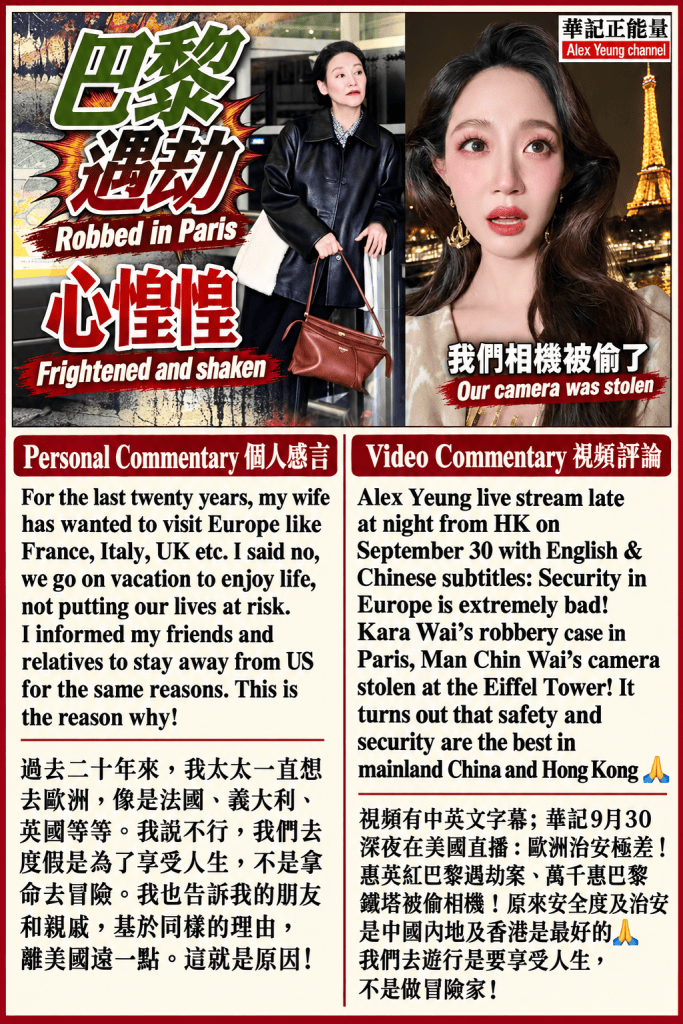
For the last twenty years, my wife has wanted to visit Europe like France, Italy, UK etc. I said no, we go on vacation to enjoy life, not putting our lives at risk. I informed my friends and relatives to stay away from US for the same reasons. This is the reason why! 過去二十年來,我太太一直想去歐洲,像是法國、義大利、英國等等。我說不行,我們去度假是為了享受人生,不是拿命去冒險。我也告訴我的朋友和親戚,基於同樣的理由,離美國遠一點。這就是原因!
Alex Yeung live stream late at night from HK on September 30 with English & Chinese subtitles: Security in Europe is extremely bad! Kara Wai’s robbery case in Paris, Man Chin Wai’s camera stolen at the Eiffel Tower! It turns out that safety and security are the best in mainland China and Hong Kong 🙏
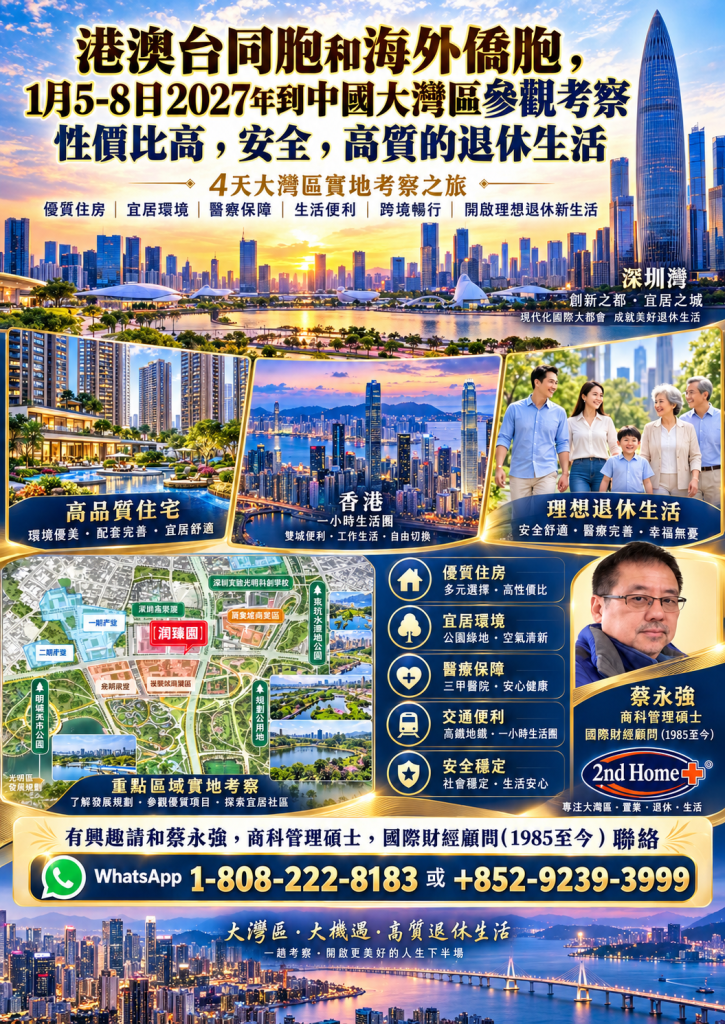
Hong Kong, Macau and Taiwan compatriots, as well as overseas Chinese, are invited to visit China’s Greater Bay Area from January 5–8, 2027 to explore high-value, safe, and high-quality retirement living options. For those interested, please contact: Johnson Choi, MBA International Business Consultant (1985–Present) WhatsApp: 1-808-222-8183 or +852-9239-3999 港澳台同胞和海外僑胞,1月5-8日2027年到中國大灣區參觀考察性價比高,安全,高質的退休生活. 有興趣請和蔡永強,商科管理碩士,國際財經顧問(1985至今)聯絡WhatsApp 1-808-222-8183 或+852-9239-3999
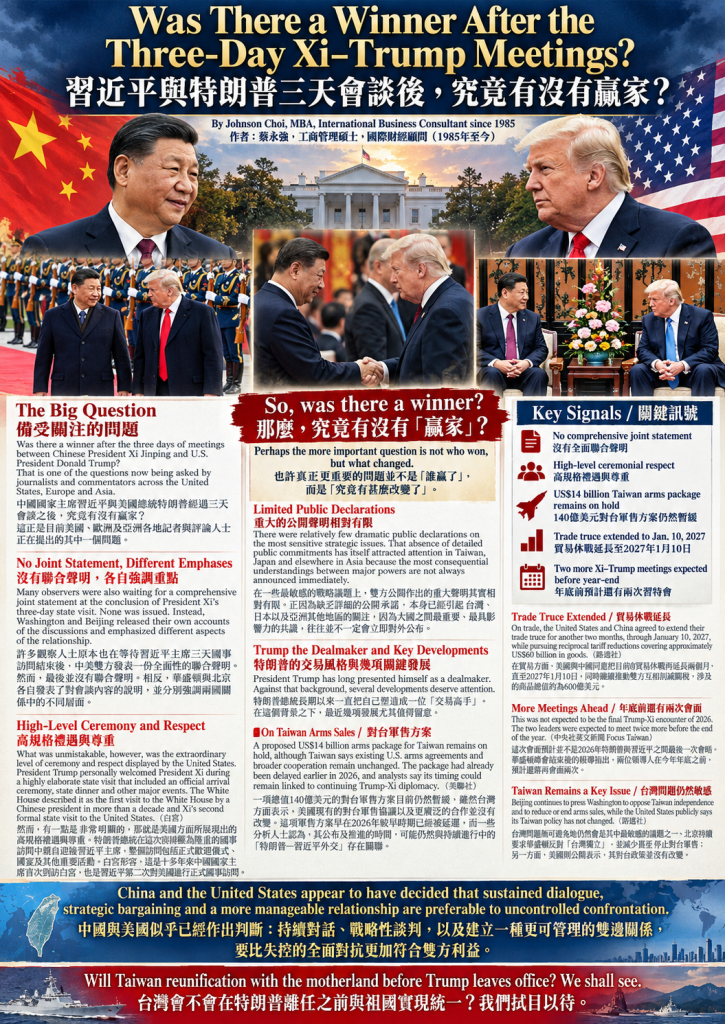
“Was there a winner after the three days of meetings between Chinese President Xi Jinping and U.S. President Donald Trump?”
That is one of the questions now being asked by journalists and commentators across the United States, Europe and Asia.
Many observers were also waiting for a comprehensive joint statement at the conclusion of President Xi’s three-day state visit. None was issued. Instead, Washington and Beijing released their own accounts of the discussions and emphasized different aspects of the relationship.
What was unmistakable, however, was the extraordinary level of ceremony and respect displayed by the United States. President Trump personally welcomed President Xi during a highly elaborate state visit that included an official arrival ceremony, state dinner and other major events. The White House described it as the first visit to the White House by a Chinese president in more than a decade and Xi’s second formal state visit to the United States. (The White House)
So, was there a “winner”?
Perhaps the more important question is not who won, but what changed.
There were relatively few dramatic public declarations on the most sensitive strategic issues. That absence of detailed public commitments has itself attracted attention in Taiwan, Japan and elsewhere in Asia because the most consequential understandings between major powers are not always announced immediately.
President Trump has long presented himself as a dealmaker. Against that background, several developments deserve attention.
A proposed US$14 billion arms package for Taiwan remains on hold, although Taiwan says existing U.S. arms agreements and broader cooperation remain unchanged. The package had already been delayed earlier in 2026, and analysts say its timing could remain linked to continuing Trump-Xi diplomacy. (AP News)
On trade, the United States and China agreed to extend their trade truce for another two months, through January 10, 2027, while pursuing reciprocal tariff reductions covering approximately US$60 billion in goods. (Reuters)
These developments do not by themselves establish that Washington has made a complete “180-degree turn” toward Beijing. But they do indicate that the Trump administration is giving greater emphasis to negotiation, bargaining and continued high-level engagement with China.
Equally significant, this was not expected to be the final Trump-Xi encounter of 2026. Reporting following the Washington summit indicated that the two leaders were expected to meet twice more before the end of the year. (Focus Taiwan – CNA English News)
That means the Washington meetings should probably be viewed not as the conclusion of a negotiation, but as one stage in a continuing process.
Taiwan will inevitably remain one of the most sensitive issues. Beijing continues to press Washington to oppose Taiwan independence and to reduce or end arms sales, while the United States publicly says its Taiwan policy has not changed. (Reuters)
Whether these continuing negotiations eventually produce a major change in cross-Strait relations—or even some form of peaceful reunification arrangement—is impossible to know today. Any such outcome would depend not only on decisions in Washington and Beijing but also on developments and decisions involving Taiwan itself.
For now, the most important signal from these three days may be this:
China and the United States appear to have decided that sustained dialogue, strategic bargaining and a more manageable relationship are preferable to uncontrolled confrontation.
There are still two more expected Xi-Trump meetings before the end of the year.
The story is therefore far from finished.
Will Taiwan reunification with the motherland before Trump leaves office? We shall see.
Video with English subtitles: Recently, a video from Chengdu of a driver and a passenger has been deeply moving! When the driver picked up a blind passenger, the conversation in the car brought people to tears. 影片有英文字幕: 近日成都一段影片司機與乘客令人感動!司機接到盲人乘客,車來的對話內容令人淚流滿面.
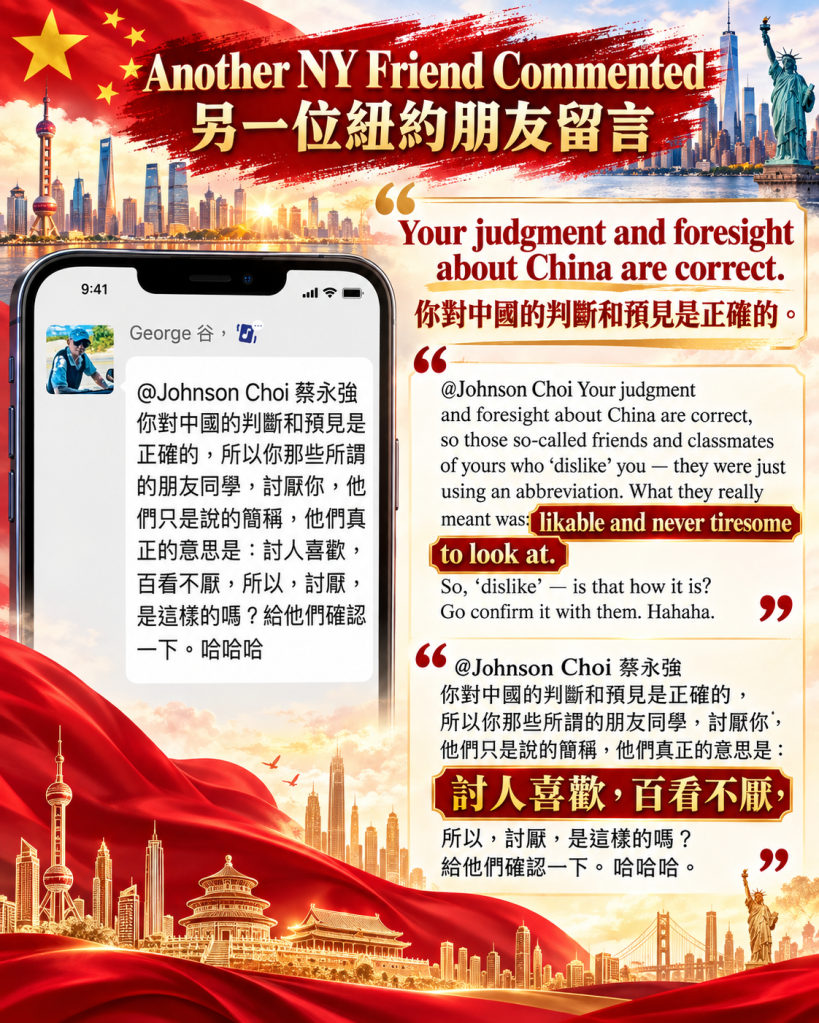
Another NY friend commented: @Johnson Choi Your judgment and foresight about China are correct, so those so-called friends and classmates of yours who “dislike” you — they were just using an abbreviation. What they really meant was: likable and never tiresome to look at. So, “dislike” — is that how it is? Go confirm it with them. Hahaha. 另一位紐約朋友留言: @Johnson Choi 蔡永強 你對中國的判斷和預見是正確的,所以你那些所謂的朋友同學,討厭你,他們只是說的簡稱,他們真正的意思是:討人喜歡,百看不厭,所以,討厭,是這樣的嗎?給他們確認一下。哈哈哈
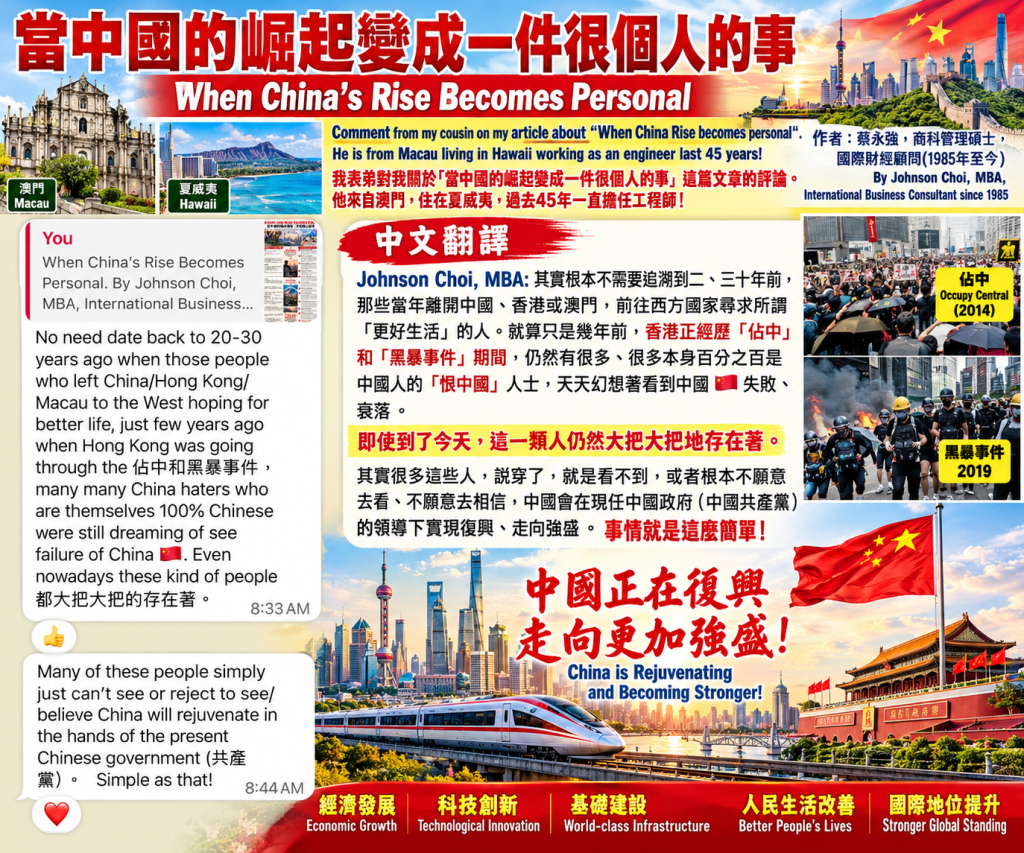
Comment from my cousin on my (Johnson Choi) article about “When China Rise becomes personal “. He is from Macau living in Hawaii working as an engineer last 45 years! 我表弟對我(蔡永強)關於「當中國的崛起變成一件很個人的事」這篇文章的評論。他來自澳門,住在夏威夷,過去45年一直擔任工程師!
Johnson: No need date back to 20-30 years ago when those people who left China/Hong Kong/Macau to the West hoping for better life Johnson:其實根本不需要追溯到二、三十年前,那些當年離開中國、香港或澳門,前往西方國家尋求所謂「更好生活」的人。就算只是幾年前,香港正經歷「佔中」和「黑暴事件」期間,仍然有很多、很多本身百分之百是中國人的「恨中國」人士,天天幻想著看到中國 🇨🇳 失敗、衰落。
…just few years ago when Hong Kong was going through the 佔中和黑暴事件,many many China haters who are themselves 100% Chinese were still dreaming of see failure of China 🇨🇳. Even nowadays these kind of people 都大把大把的存在著。
Many of these people simply just can’t see or reject to see/believe China will rejuvenate in the hands of the present Chinese government (共產黨)。 Simple as that!
Alex Yeung reported from HK on September 29 video: Special thanks to Denza D9 (much superior in pricing, technology and luxury compared to any Tesla cars) for supporting: Zhang Xue Motorcycle 10.1 riding experience in HK to celebrate China National Day 香港華記報導於9月29日視頻有英文字幕:特別感謝騰勢D9(在價格、科技和豪華程度上,遠遠優於任何特斯拉汽車)支持:張雪摩托車10.1在香港的騎行體驗,以慶祝中國國慶.
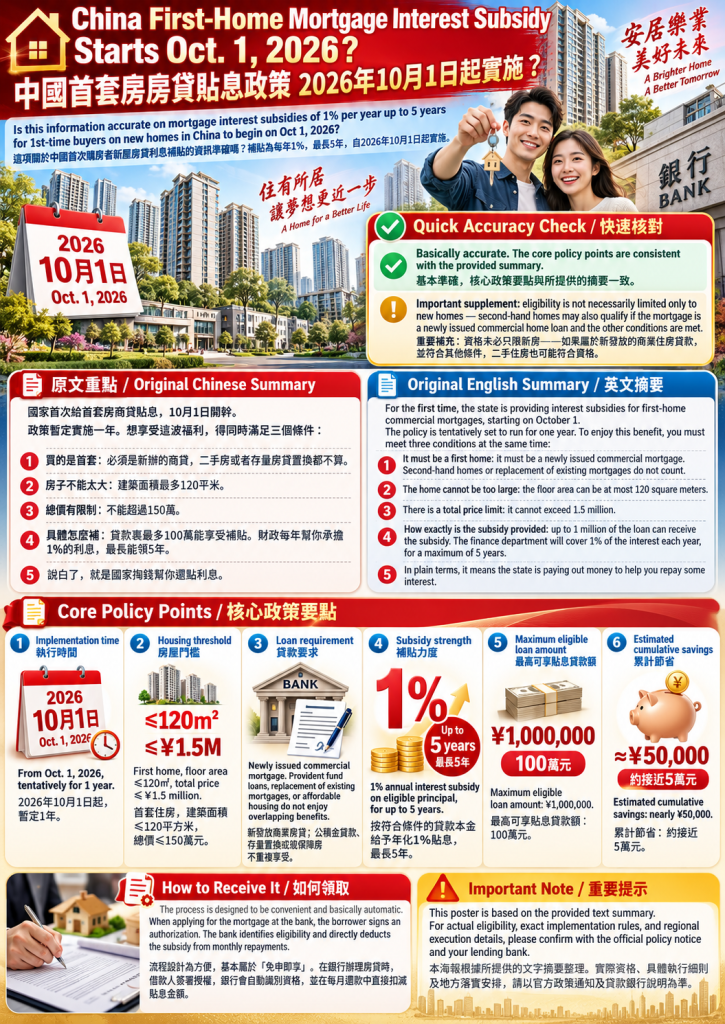
Is this information accurate on mortgage interest subsidies of 1% per year up to 5 years for 1st time buyers on new homes in China to begin on Oct 1 2026 這項關於中國首次購房者新屋房貸利息補貼的資訊準確嗎?補貼為每年1%,最長5年,自2026年10月1日起實施。
For the first time, the state is providing interest subsidies for first-home commercial mortgages, starting on October 1. The policy is tentatively set to run for one year. To enjoy this benefit, you must meet three conditions at the same time: It must be a first home: it must be a newly issued commercial mortgage. Second-hand homes or replacement of existing mortgages do not count. The home cannot be too large: the floor area can be at most 120 square meters. There is a total price limit: it cannot exceed 1.5 million. How exactly is the subsidy provided: up to 1 million of the loan can receive the subsidy. The finance department will cover 1% of the interest each year, for a maximum of 5 years. In plain terms, it means the state is paying out money to help you repay some interest.
The information you sent is basically accurate, and the core policy points are consistent with the official release. This is the first time the central government has provided interest subsidies for first-home commercial housing loans, aiming to reduce the home-buying costs of families with rigid housing demand.
However, there is one point that needs to be added: second-hand homes actually also count. Although it must be a “newly issued commercial mortgage,” it is not limited to new homes. Buying a second-hand home can also qualify.
📋 Core policy points
· Implementation time: from October 1, 2026, tentatively for 1 year. · Housing threshold: floor area ≤120 square meters, total price ≤1.5 million yuan, and it must be a first home. · Loan requirement: newly issued commercial loans. Provident fund loans, replacement of existing loans, or affordable housing do not receive overlapping benefits. · Subsidy strength: interest subsidy of 1% annualized on the loan principal, for a maximum of 5 years. The maximum loan amount eligible for the interest subsidy is 1 million, which means the cumulative savings can be nearly 50,000 yuan.
💡 How to receive it?
The process is very convenient and is basically “enjoy without application.” When you handle the loan at the bank, you sign an authorization, and the bank will automatically identify your eligibility and directly deduct the interest subsidy amount from your monthly repayment. You do not need to run the procedures yourself.