US ties Europe to its chariot 美國將歐洲與其戰車聯繫起來 by Liu Rui Jul 21 2022

US ties Europe to its chariot 美國將歐洲與其戰車聯繫起來 by Liu Rui Jul 21 2022

America’s double standards on its “war on terror” 美國對“反恐戰爭”的雙重標準 by Global Times Jul 21 2022

Video: The United States is anti-rational and anti-science! There is a problem with American-style democracy! US is going in the wrong direction 台灣中天新聞 – 美國反理性反科學衰弱中! 蔡正元: 美式民主出問題了!美國走在錯誤方向上 美國病得很利害 但自己好像不知道病在哪裏
https://rumble.com/v1d5xp9-there-is-a-problem-with-american-style-democracy-us-is-going-in-the-wrong-d.html
https://www.facebook.com/100036400039778/posts/754741835749144/?d=n

Video: US double standards on freedom democracy & human rights shameful, US decline inevitable, world could choose China over US, Saudi intentionally embarrassed Biden – no need give him face 賴岳謙, 帥化民專業分析! 美國所謂民主民主自由的雙重標準, 美國開始走下坡, 中國漸崛起原因, 世界不用選擇美國, 中東六國故意不給到訪的拜登任何面子要他掉面
https://rumble.com/v1d5e7v-us-decline-inevitable-world-could-choose-china-over-us-saudi-intentionally-.html
https://www.facebook.com/100036400039778/posts/754668935756434/?d=n

Transcript of Chinese Ambassador to US Qin Gang’s Fireside Chat At the Aspen Security Forum 中國駐美大使秦剛爐邊談話抄錄 在阿斯彭安全論壇上
Video link https://youtu.be/6eIYXbkISpU
On July 20, Ambassador Qin Gang had a fireside chat with Edward Luce, US National Editor of the Financial Times, at the Aspen Security Forum. The transcript is as follows:
Edward Luce: It’s a great pleasure, Ambassador, to be with you here today. Given your considerable diplomatic experience, I hope you forgive me if I start off with a relatively hard question, which is, are the US and China entering into a new Cold War?
Ambassador Qin Gang: First of all, thank you, Ed, for having me. It’s a good pleasure to be here to share my views with you and our audience on China and China-US relations, which our audience is very interested in. I know it’s after-lunch time. People can easily fall asleep after lunch. I will try my best to make you awake. (laughter)
To answer your question, the Cold War is a tragedy in the world history. When people speak of the Cold War, they think about estrangement, division, confrontation and conflict. Your question itself indicates that people are worrying that history would repeat itself. Why people are worrying that the Cold War is coming back? Because some people have Cold-War mentality. Some people are mistakenly taking China as the former Soviet Union, as a major threat. But I want to say that, as a matter of fact, China is not the former Soviet Union. The Communist Party of China (CPC) is not the Soviet communist party. The CPC stays true to its founding mission, that is, to serve the people wholeheartedly, to put people at the center. It has successfully lifted 800 million Chinese people out of poverty over the past 40 years, accounting for 70% of the global poverty reduction. China has developed into the second largest economy and the largest trading partner of more than 120 countries and regions. China is providing a massive amount of public goods for the world. Internationally, China is a peace-loving country and stays committed to the path of peaceful development. China is the only country to include peaceful development in its Constitution. China has never engaged in foreign expansion or invasion. China never exports its ideology. On the contrary, China is working hard with other countries to build a community with a shared future for mankind.
By saying so and given all these facts, do you believe that China is the former Soviet Union, the CPC is the communist party of the former Soviet Union? Do you think that China is a threat? Taking China as a threat is just like picking up a wrong fight.
There will be no winner, but only losers, in a new Cold War. Fighting a new Cold War will build a new Berlin Wall, which will divide us and create hostility and division. It will bring unbearable consequences to the world. No country wants a new Cold War. China doesn’t want it. Neither does the US. President Biden has claimed many times that the US does not seek to have a new Cold War with China. The key is to honor words with actions. We do hope that the US side will make reassurance about its strategic intention on China, get rid of those Cold War elements in its policies, no “democracy versus authoritarianism” narrative, no geopolitical confrontation, no decoupling, no supply cut, and no arms race. Only by doing so, can we prevent China-US relations from sliding into a new Cold War, which we all hate to see. Thank you.
Edward Luce: Thank you. And we’ll get into the definitions of the Cold War and also the Biden administration’s policy towards China in a moment. But let me just ask about China’s own diplomatic stance — biding its time and hiding its light under a bushel. It seems the biding-time-hiding-light phase is over, and China is a less patient power today, what are you impatient for? What are you seeking?
Ambassador Qin Gang: Well, you are talking about China’s foreign policies and behavior. Let me give the example of myself as an ambassador. As Ambassador, my responsibility and my job is to follow through on the important mutual understanding between President Xi and President Biden to make sure that China-US relations are stable, manageable and constructive. The Ambassador should be a representative carrying the best of his country. My colleagues and I would like to be a bridge and a bond between China and the United States. We are working very hard to reach out to people of different sectors, of different places to tell people what is really happening in China, what is the real development intention of China and what is happening between China and the United States. We want to build trust, respect, and to reduce misunderstanding and miscalculation. We want to listen to different people, different voices, so that we can have a balanced, comprehensive view about the situation. As a diplomat, his job is to protect his country’s interests. We have differences, but our differences do not justify misinformation, disinformation, lies and malicious attacks. Facing those words and deeds interfering in China’s domestic affairs, damaging China’s interests, as diplomats, we have to stand up to say no, we have to protect our interests. This is the job of every diplomat. I believe that diplomats of other countries would only do the same, but that doesn’t mean that China has changed its foreign policy, or China has changed its posture.
China has 5000 years of civilization. China’s development and rejuvenation are underpinned by a very clear historical logic and strong internal driving force. China’s rejuvenation is irreversible. In dealing with the outside world, we have enough patience, confidence, wisdom and capability, although we know that our road ahead is not a smooth one. But the question is, do some countries in the world have patience with China’s development?
Edward Luce: Okay, just picking up on your point about non-interference in the internal affairs of another country. I assume you were referring to criticisms over Xinjiang and Hong Kong, for example, amongst other things, but it is fair to point out that China is a signatory to the UN Charter and to the Universal Declaration on Human Rights, which implicitly restrain sovereignty of a government to do what it likes internally. There is a limit in terms of international law. Isn’t it therefore legitimate to criticize what’s happening in Hong Kong and what’s happening in Xinjiang?
Ambassador Qin Gang: Xinjiang and Hong Kong related issues, fundamentally, are not about democracy, human rights, ethnicity or religion. It is about anti-terrorism, anti-secession, it is about protecting people’s lives, safeguarding China’s national sovereignty, security and development interests. Xinjiang can never be allowed to be another “Islamic State”. What is happening in Hong Kong? Hong Kong has to be decolonized and governed by people loving China and loving Hong Kong. After Hong Kong returned to the arms of the motherland, the “One Country Two Systems” has worked well. You asked me why China is facing criticism from other Western countries. It will take a long time for me to explain the ins and outs about Xinjiang and Hong Kong. In the interest of time, let me share this with you. When I arrived in Denver on Sunday, I saw President Lincoln’s famous line on a billboard at the airport, “A house divided cannot stand”. President Lincoln’s famous words explain everything — what some Western countries are saying and doing in Xinjiang and Hong Kong, and what China is doing there. We are both trying to prove that President Lincoln was correct, but from opposite angles, out of different purposes. One thing I can reassure you is that the house of China will stand united, firm and strong.
Edward Luce: I’m gonna get into the Taiwan issue and tensions in a moment, but it seems logical sequentially to ask you about Russia’s invasion of Ukraine, because that is a direct breach of China’s principle of non-interference in other countries’ affairs and the inviolability of sovereignty and international boundaries. On February 4, President Xi Jinping and President Vladimir Putin signed this treaty, the statement of friendship between China and Russia “with no limits”. Does that imply that this principle of inviolability of sovereignty matters less than this limitless partnership that you now have with Putin’s Russia?
Ambassador Qin Gang: The issue of Ukraine has historical and practical complexities. It is a long story. China observes this issue based on the merits of the matter itself, and China makes its decision independently. We advocate that national sovereignty and territorial integrity of all countries must be respected. The purposes and principles of the United Nations Charter must be upheld. The legitimate security concerns of all countries must be taken seriously. And all efforts conducive to the peaceful settlement must be supported. China’s stance is fair and objective. China doesn’t stand alone. This is a similar or same position as many other developing countries, including India, South Africa, Brazil and Indonesia.
Now, the conflict is still going on. The impact is spilling over, leading to multiple crisis, including political and security crisis, energy shortage, food crisis, economic downturn, outflow of refugees. What China is calling for is immediate ceasefire and resumption of peace talks. All parties involved should be engaged, including between Russia and the United States and its NATO allies. Sit down, calm down to find a way out of dilemma, based on the principles of accommodating each other’s legitimate concerns. Only by doing so, can we achieve peace, can we restore security in Europe, which should be stable, comprehensive, balanced, effective and sustainable.
I am puzzled that over the past more than 100 days since the crisis, people keep challenging China’s principled position on sovereignty and territorial integrity, without looking into the root causes of the conflict. Actually, there’s a double standard when talking about sovereignty. On Ukraine, people emphasize the principle of sovereignty. But on China, they are doing damage to China’s sovereignty and territorial integrity, particularly on Taiwan, Xinjiang and Hong Kong. Chinese companies are wrongly punished by sanctions and there’s a lot of disinformation and lies around.
And there’s misunderstanding of China-Russia relations. You mentioned the Joint Statement of February 4. Let me tell you this. China-Russia relationship is not an alliance. It’s not for confrontation. It’s not targeting any third party. I suggest that you read the Joint Statement carefully from beginning to end, without taking any words out of context. The document summarizes common views and grounds of China and Russia on democracy, security, development and world order. It shows the two countries’ common opposition to Cold War mentality, to geopolitical confrontation. And it shows the two countries’ common support for promoting democracy in international relations, for upholding the purposes and principles of the Charter of the United Nations, and for practicing true multilateralism. In this sense, China’s cooperation with any other countries has no limits and forbidden areas. If the United States or any other countries want to join us to this end, welcome on board.
Edward Luce: Thank you for mentioning Taiwan, because that was my next question. Clearly, there’s been a ratcheting up of tensions in the last year or two. There’s been more high-level US visits to Taipei. There’s been more Chinese military exercises and overflights, etc. And the perception, particularly since February 24, is that the next great geopolitical flashpoint is Taiwan. President Biden himself on three occasions said the US would come to the aid of Taiwan in the event of China invading. He was then clarified by his staff, I guess amended. They said there was no change to the Biden administration’s official strategic ambiguity over Taiwan. Do you accept that clarification?
Ambassador Qin Gang: The question of Taiwan is the most sensitive, important core issue in China-US relations. China loves peace. People on both sides of the Taiwan Strait are compatriots. The last thing we wish to do is fight with our compatriots. We will try our best in our great sincerity to achieve the peaceful reunification, because we believe that it best serves the interests of people on both sides.
We have seen tensions in recent years in the situation across the Taiwan Strait. The root cause is that the one-China principle has been undermined. It’s under threat, as you mentioned, the Tsai Ing-wen authorities in Taiwan is advancing its political agenda for “Taiwan Independence” in an incremental way. It borrows the US support, and the United States is hollowing out and blurring up the one-China policy. It is substantially uplifting the official links with Taiwan by sending more officials to the island. It is sending sophisticated weapons to Taiwan, and even claims that the US will defend Taiwan militarily. The one-China principle, which is underpinned by the international documents and the three Sino-US Joint Communiques, is under threat. The one-China principle is the political foundation for China-US relations, and is the bedrock for the peace and stability across the Taiwan Strait as well.
So what do we need to do? President Biden has said many times that the United States is still committed to the one-China policy, the United States does not support “Taiwan independence”, and the United States does not want to have a conflict with China on Taiwan. So, no conflict and no war, this is the biggest consensus between China and the United States. But we urge the United States to honor his commitments with actions and to fully implement the one-China policy and the stipulations of Sino-US Joint Communiques. The reason we don’t give up on non-peaceful means for reunification is not targeting Taiwan people. It is to constrain “Taiwan independence” separatist forces, to prevent foreign interference, to protect the prospects for peaceful reunification. So only by adhering strictly to the one-China policy, only by joining hands to constrain and oppose “Taiwan Independence”, can we have peaceful reunification, can we have long-lasting peace and stability across the Taiwan Strait. Let’s work together to give peace a chance and let peace prevail.
Edward Luce: If I could just very briefly follow up with the Hong Kong example. One of the reasons people are worried about Hong Kong is it was seen as the test case for Taiwan that you could have “One Country Two Systems”, with Hong Kong having a separate political system but within a one-China sovereignty, and that now seems to have ended. It’s become “One System” which implies the carrots to Taiwan — here’s how you can live within China — has been removed and all that remains is a stick. Do you understand why that may be how people interpret?
Ambassador Qin Gang: Let me clarify what “One Country Two Systems” means. “One Country Two Systems” was firstly designed for Taiwan but it was first put into practice in Hong Kong. The relations between “One Country” and “Two Systems” are crystal clear. That is, “One Country” is the precondition for “Two Systems”. If there’s no “One Country”, where are the “Two Systems”?
What has happened in Hong Kong over the past 3 years is that some people did not want “One Country”, and did not want Hong Kong to be part of China. They over-emphasized the differences, and overstressed the “Two Systems”. They want the “One Country” to be denied and even changed by the “Two Systems”. How can you tolerate people in Hong Kong advocating “let’s return to the colonial rule of the British empire”, “let Hong Kong be a state of the US”, “let Hong Kong be an outpost to change China”? These wrongdoings endanger the prospect of “One Country Two Systems”. What the central government is doing is to set the record straight, correct those wrongdoings and put Hong Kong back to order, back to laws, so that “One Country Two Systems” can work well and Hong Kong can maintain lasting stability and prosperity. Hong Kong returned to China just 25 years ago. It’s too early to say “One Country Two Systems” has failed. We have confidence to make “One Country Two Systems” successful. And it’s a good example for the reunification of China.
Edward Luce: I have 2 to 3 minutes left to ask you about the economic dimension. And we are in a situation where China is are applying to join the CPTPP which was created by the United States, co-created, but of which the US is not a member. A). do you think you’re gonna be accepted into the CPTPP, and 😎. can you explain why America, notwithstanding some recent, modest initiatives in the region, do you understand why the United States is not taking major economic initiatives in the region?
Ambassador Qin Gang: China has applied to join CPTPP and we are in talks with members of CPTPP. This shows China’s determination to deepen reform, further open up and actively participate in the regional economic integration. I don’t have a crystal ball. I have no timetable, but I do know that China’s accession will have multiple benefits to all parties concerned. For China, of course, CPTPP is a very high-standard international trade agreement. Joining CPTPP will make China more prosperous and more developed at a higher standard, with higher quality. For CPTPP members, China’s accession can make the country more contributing to the areas like market access, tariff reduction, competition, digital rules, so that members of CPTPP can have more benefits, more dividends of China’s development. For the world. If China joins CPTPP, CPTPP will grow remarkably in terms of population, in terms of the GDP combined, and in terms of trade in total. It will insert stronger impetus into regional and global economy.
About why America is so sensitive to international trade agreements or international trade negotiations, frankly speaking, I need to know the answer as well. But I do know that United States is creating a different framework economically. It is called Indo-Pacific Economic Framework. But this Framework is closed to certain countries. It rejects, refuses to talk about common concerns in the region, such as tariff reduction, market access, and development cooperation. It’s not open, transparent, or inclusive. It’s ideological driven. And I’m worried. I’m afraid that it will create division, decoupling, and supply cut in the region, which is not in the interest of this region for development and for common prosperity.
Edward Luce: A very, very quick final. Do you see any difference between dealing with the Trump and Biden administrations, and is my suspicion that actually you prefer dealing with Trump? Is it the correct one?
Ambassador Qin Gang: Well, China-US relations haven’t been out of the difficulties caused by the previous administration. And it’s facing mounting challenges today. But we have noted that the Biden administration has very serious commitments about China-US relations. Their words are positive. We hope that words can be translated into deeds. The key issue is, can the US accept the development of China, a country that is very different from the United States historically, politically and culturally. We have differences. But don’t forget, we have huge common interests and shared responsibilities, not only for the people of two countries, but also for the peace, security and prosperity of the world. So which comes first, differences or commonalities? The world is entering a new period of instability and transformation. We have more challenges requiring the cooperation between China and United States. We are at a critical juncture. Shall we work on a dead alley of zero-sum game or on a bright pass of win-win corporation? I think all of you, like me, can make a right choice. Cold War or geopolitical confrontation should not happen. Thank you.
Edward Luce: That’s a positive note to end on, Ambassador Qin. Thank you very much.
Ambassador Qin Gang: Thank you!

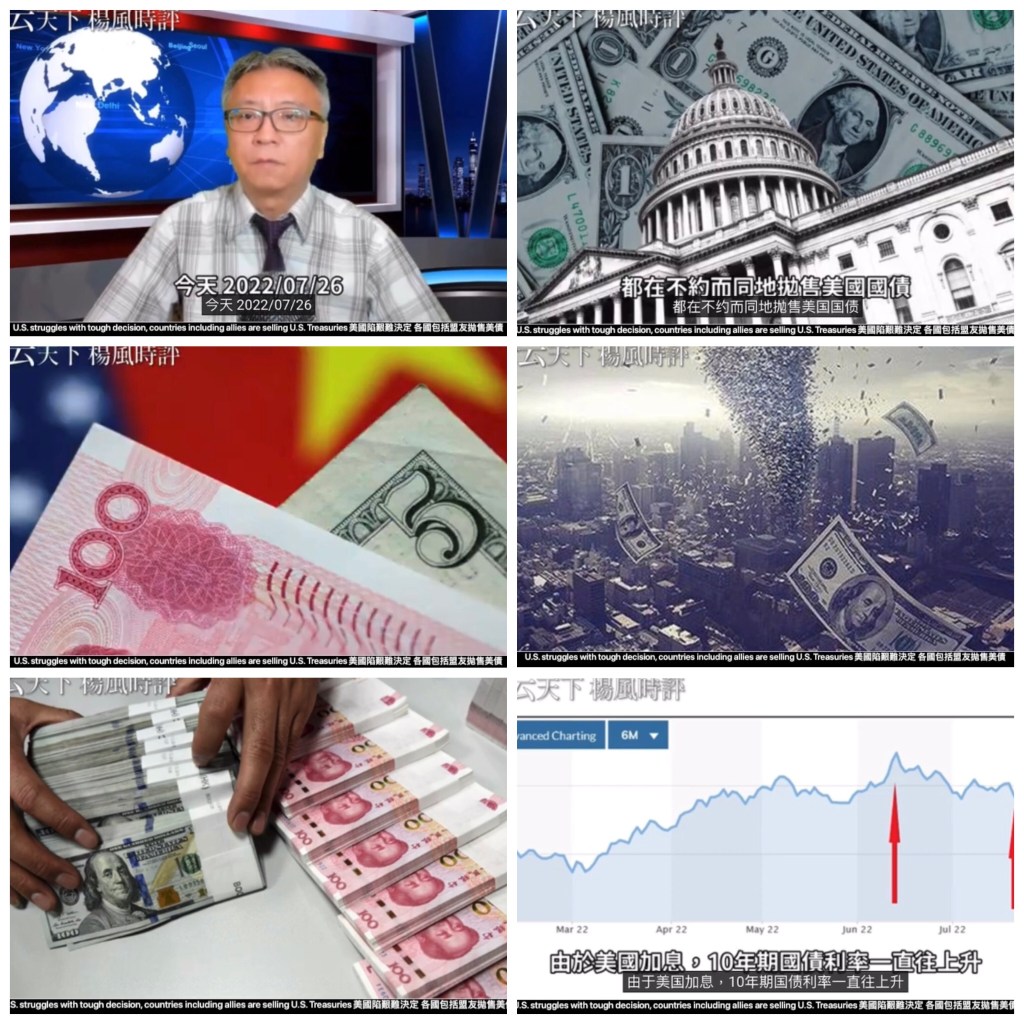
Video: Turkey start de-dollarization, China dumps U.S. treasury bonds, CIA warns Biden, Putin, and Iran crisis 土耳其去美元 中國狂拋美債 CIA警告拜登普欽拉伊朗危機
https://rumble.com/v1d4iff-turkey-start-de-dollarization-china-dumps-u.s.-treasury-bonds.html
https://www.facebook.com/100036400039778/posts/754558405767487/?d=n

Shinzo Abe Failed to Rearm Japan. Let’s Keep It That Way. 安倍晉三未能重新武裝日本。 讓我們保持這種狀態 By Koichi Nakano. Mr. Nakano is an expert on Japanese right-wing politics at Sophia University in Tokyo. 7-20-22
Japan had barely begun processing the shock of the former Japanese prime minister Shinzo Abe’s assassination by a gunman on July 8 before attention turned to whether his quest to remilitarize Japan, including the revision of its pacifist Constitution, would survive him.
Japan’s longest-serving prime minister, Mr. Abe was a towering presence at home and an influential statesman abroad. He advocated a more globally engaged Japan, was a driving force in the Quad alliance between the United States, Australia, India and Japan and is credited by some with initiating the very idea of the wider Indo-Pacific region.
He also envisioned a more militarily robust Japan, centered on his unfulfilled dream of revising its postwar Constitution, which prohibits his country from maintaining an offensive armed forces capability. His supporters have vowed to make these dreams — driven largely by fear of a more powerful China — a reality.
Yet it’s time for Japan to bid farewell not only to Mr. Abe but also to his nationalist rearmament agenda. Japan’s political and economic resources should be focused not on revising the Constitution and increasing defense spending but on maintaining peace through diplomacy and shoring up an economy left shaky by years of Mr. Abe’s trickle-down policies.
Critically, at a time when the United States is focused on confronting China, a humbler, more pacifist Japan could have an important role to play by re-engaging with Beijing to help decrease tensions between China and the United States.
Mr. Abe was shot while campaigning on behalf of his Liberal Democratic Party for parliamentary elections that were to be held just two days later. He leaves behind a personal legacy far more controversial and checkered than is warranted by the simplistic, fawning tributes that followed his demise.
Detractors at home considered Mr. Abe an arrogant bully who silenced critics. Constitutional, parliamentary and media checks and balances were undermined during his tenure, and he notoriously made false statements to Parliament 118 times over a political scandal.
He unnecessarily offended neighbors like South Korea and China— where anger still seethes over Japan’s brutal wartime aggression — with his historical revisionism. His December 2013 visit to the Yasukuni Shrine in Tokyo, which honors Japanese war dead, including war criminals from the World War II era, even invited a rare rebuke from the United States. He also backed school textbooks that gloss over Japan’s World War II barbarity, including the forcing of thousands of women around Asia to serve as sex slaves for Japanese troops.
But few aspects of Mr. Abe’s career threatened to alter Japan’s national character and role in the region as much as his crusade against Article 9, which renounces war as a means of solving international disputes and limits Japan’s military to a self-defense role. Mr. Abe unnerved millions of Japanese who see no reason to depart from a commitment to peace that kept Japan out of any direct involvement in war since 1945, allowing it to focus on becoming an economic power.
Mr. Abe failed to change the article despite two stints in power, from 2006 to ’07 and from 2012 to ’20. He settled instead for a reinterpretation that allows Japan to help close allies militarily under certain conditions but has been criticized as unconstitutional.
Japan looks no closer to revising Article 9 today, especially with the L.D.P.’s right wing now deprived of its uncontested standard-bearer. A commitment to peace runs deep in a country that was taken to war by a military government, causing huge suffering in Asia and ending in Japan’s total defeat and the distinction of being the only country attacked with nuclear weapons.
An opinion survey in late June by the broadcaster NHK found that only 5 percent of respondents named revising the Constitution as their top electoral priority, while 43 percent identified the economy. Public opinion on revising Article 9 is split, with 50 percent in favor and 48 percent against, according to a poll in May, and 70 percent said momentum for a revision was not increasing.
The long-dominant L.D.P. and its allies secured the two-thirds majority in Parliament’s upper house required to initiate a national referendum on amending the Constitution. But that was widely expected even before Mr. Abe’s murder, and the ruling coalition’s gains stemmed in part from divisions within the opposition rather than a pro-Abe groundswell. Even Mr. Abe never seriously pushed for a referendum because of the political risks, despite enjoying a two-thirds majority for some of his years in power.
Attention now turns to Prime Minister Fumio Kishida, but it’s a measure of just how smothering Mr. Abe’s presence was — he forbade open dissent among party leaders — that the Japanese don’t really know what to expect from Mr. Kishida, who represents L.D.P. moderates who have opposed constitutional revision. After the election, Mr. Kishida promised greater defense spending and pledged renewed attention on Article 9 but gave no hint that this was more than a courteous nod to the departed Mr. Abe.
But there is no doubt that Mr. Kishida’s hand is strengthened. Mr. Abe left no clear right-wing successor, and his death throws the faction into disarray, allowing Mr. Kishida an opportunity to assert more control over the national agenda.
This should include building support for a departure from Abenomics, policies launched during Mr. Abe’s second spell in power that were intended to shake off two decades of economic stagnation through fiscal and monetary stimulus, ramped-up government spending and deregulatory reforms. Corporate profits rose, but public debt accumulated, bold structural reforms were never seriously pursued, and wages remained stagnant. Then the pandemic hit. The yen is weakening, and inflation is on the rise — and so are coronavirus infections.
Mr. Kishida has called for prioritizing wage increases and narrowing the rich-poor gap. This will require more social security funding, which will inevitably clash with the doubling of defense spending in the next five years that Mr. Abe sought. With the economy a greater concern to the public than security issues, Mr. Kishida can ill afford to waste precious political capital on revising Article 9.
On dealing with China, Mr. Kishida revealed little of his own diplomatic vision when he served as a foreign minister of Mr. Abe’s, but his faction has traditionally engaged with China, and he may now be better positioned to pursue a policy more focused on dialogue with Beijing.
Mr. Abe’s tragic demise offers his successors a chance to emerge from his shadow and turn the page on his policies.
Stripping away the safeguards of Article 9 and remilitarizing Japan would only further inflame tensions with China and risk an arms race with potentially devastating consequences for Japan and the region. On the contrary, a reaffirmed commitment to peace would allow domestic resources to be focused on the economy and open the door for better relations with Japan’s neighbors founded on peace through diplomacy.
It’s time to beat Mr. Abe’s swords into plowshares.

Asia Times: Sputnik moment isn’t what it used to be. The first one in 1957 spurred the US on to technological greatness; now, China’s progress spurs stagnation and indolence 亞洲時報: 人造衛星的時刻已經不是過去的樣子了. 1957 年的第一次推動美國走向技術偉大; 現在, 中國的進步引發了停滯和怠惰 by George Koo 7-21-22
An artist’s impression of Sputnik 1 in orbit, created in 2007 to mark the 50th anniversary of the launch of Sputnik. Image: Gregory R Todd via Wikipedia
When China successfully tested a hypersonic weapon system in October 2021, General Mark A Milley, chairman of the US Joint Chiefs of Staff, said this was very close to a “Sputnik moment.”
The first Sputnik moment took place on October 4, 1957, when the Soviet Union surprised Washington by sending aloft the world’s first man-made satellite, called Sputnik 1.
All of a sudden, the heretofore assumed technological superiority that Americans thought they had over the Soviets vanished overnight. Public panic fueled by fear and loathing became a national crisis.
For the rest of that October, The New York Times talked about the Soviet satellite, on average, in 11 articles every day.
The US under president Dwight Eisenhower responded promptly to the Sputnik moment. He ordered the formation of the Defense Advanced Research Projects Agency (DARPA) in February 1958 to develop emerging technologies for the military.
In July, he signed the National Aeronautics and Space Act to create NASA.
Response to Sputnik challenge
Congress quickly followed by passing the National Defense Education Act to pour billions of dollars into the American education system and raise the quality and quantity of university graduates in science, mathematics and engineering.
By the time the USSR sent Yuri Gagarin into orbit on April 12, 1961, the US was ready for the space race and set putting man on the moon as the goal. The culmination was the worldwide televised moon landing of astronauts Neil Armstrong and Buzz Aldrin from Apollo 11 in July 1969.
DARPA and the National Aeronautics and Space Administration generated many noteworthy technological breakthroughs, and many of those were spun off into civilian uses. Some directly or indirectly became home-run investments that nurtured an emerging venture-capital industry.
The budget appropriations for the National Science Foundation created by Congress in 1950 were boosted every year to encourage scientific research in academia and research institutes.
The 1970s were undoubtedly the golden decade for America. Then-president Richard Nixon went to China in 1972, which later led to normalization of relations between the two countries. The endless war ended in Vietnam. America led in virtually every field of science and technology. The fruit orchards south of San Francisco became the now famous Silicon Valley.
The US claimed ownership of most of the top universities in the world. International students all over the world aspire to do postgraduate studies in America. A flood of the best and brightest from China began in the 1990s.
US won the rivalry over Soviet Union
America had risen to the challenge of the Sputnik moment, and it was easy to be a proud American.
The American people celebrated the collapse of the Soviet Union in 1991 and looked forward to a forthcoming “peace dividend” with enthusiasm and anticipation. Tragically, the dividend never materialized.
Instead, the draft of the Wolfowitz Doctrine in 1992 became the guiding framework for future White House administrations. Paul Wolfowitz, undersecretary of defense at the time, was the principal author of the doctrine.
As summarized by the documentary program Frontline, the essential points of the doctrine were:
The No 1 objective of the US post-Cold War strategy is to prevent the emergence of a rival superpower.
Another major objective is to safeguard US interests and promote American values.
If necessary, the United States must be prepared to take unilateral action.
The legacy of this doctrine has been America’s unilateral action in Iraq, Libya and many other less publicized overthrows or interference of regimes not to US liking. The price was the loss of millions of innocent lives.
“Safeguard our interests and promote American values” are invariably part of Secretary of State Antony Blinken’s remarks supporting his justification for the threat of and actual unilateral action.
China became the next designated adversary
The doctrine needed a rival to warrant actions to “prevent emergence.” The US branded China as its next threat. To justify the American position, it declared a unilateral trade war and accused China of massive intellectual-property theft. And the US increased its military surveillance off the coast of China and justified increasing its naval presence in the South China Sea as based on “freedom of navigation.”
A litany of US provocations succeeded in getting China to respond. One result was the hypersonic weapon system. But this was hardly a Sputnik moment. General Milley’s comment was meant to motivate increase budget allocation for weapon development.
However, Washington and the mainstream media seem oblivious that the deliberate provocations have created a formidable opponent. Since the US declared China as an adversary, it has surpassed the US in many technical fields.
One response was to deny China access to advanced semiconductor manufacturing technology in order to kneecap its semiconductor industry and cripple its manufacturing that depends on advanced chips.
But as David Goldman observed in a recent Asia Times article, “The Biden administration’s belated attempt to suppress China’s semiconductor industry appears to have backfired. China has found workaround technologies that bypass the aging American IP that Washington has embargoed.”
By concentrating its national energy and attention on stifling China’s advance, the US has neglected to invest in solutions and remedies that would have raised the well-being of America.
We Americans could have raised the living standard of the poor. We could have made universal health care affordable for everyone. We could have repaired our old bridges and highways. We could have strengthened our law and order and made it fair to all regardless of race. We could have invested in our education and in scientific research to ensure our future.
We could have done all that and more. Instead, we experienced more than 30 years of stagnation and indolence because of the US determination to rule the world.
George Koo retired from a global advisory services firm where he advised clients on their China strategies and business operations. Educated at MIT, Stevens Institute and Santa Clara University, he is the founder and former managing director of International Strategic Alliances. He is currently a board member of Freschfield’s, a novel green building platform. Follow him on Twitter @george_koo.

Risks on coming to America: daily gun violence, racism against Asians especially Chinese, hate crimes & demonize Chinese Americans encourage by US politicians in the name of “fake” freedom democracy and human rights.

Video: To reduce EU inflation must rely on China, but US won’t be happy 解決通膨靠東方? 歐盟再度找上中國, 但美國非常不高興
https://rumble.com/v1d1set-to-reduce-eu-inflation-must-rely-on-china-but-us-wont-be-happy.html
https://www.facebook.com/100036400039778/posts/754200472469947/?d=n