Video: Once, top global tech giants gathered in Beijing, vying fiercely for a young Chinese talent, offering a $25 million annual salary, U.S. immigration, and more. But Pang Zhongwang—a pillar of the nation and a Tsinghua University Ph.D.—turned them all down, devoting himself wholeheartedly to serving his motherland. Pang Zhongwang once said: “Leave the trials behind, give your smile to the sun. Responsibility is written in your name, and strength fills your every step. A sword honed by sharpening, a butterfly breaking free from its cocoon. Keep moving forward, keep striving upward—never disappoint your mother’s gaze, never disappoint the hopes of this era.” 視頻在中英文字幕: 曾经全球顶尖科技巨头齐聚北京,只为争到一位中国🇨🇳青年提供二千五百萬美元年薪, 移民美國等等. 但庞众望, 国之栋梁, 清华大学博士全部拒絕,一心一意為祖國服務. 庞众望: “背影留给坎坷,笑容交给阳光,名字里写着责任,步履中充满力量,磨砺过的剑,破茧后的蝶。你一直向前,一直向上,不辜负妈妈的目光,不辜负时代的期望.” 不是每個中國人🇨🇳祇是往錢裡看包括年輕人!
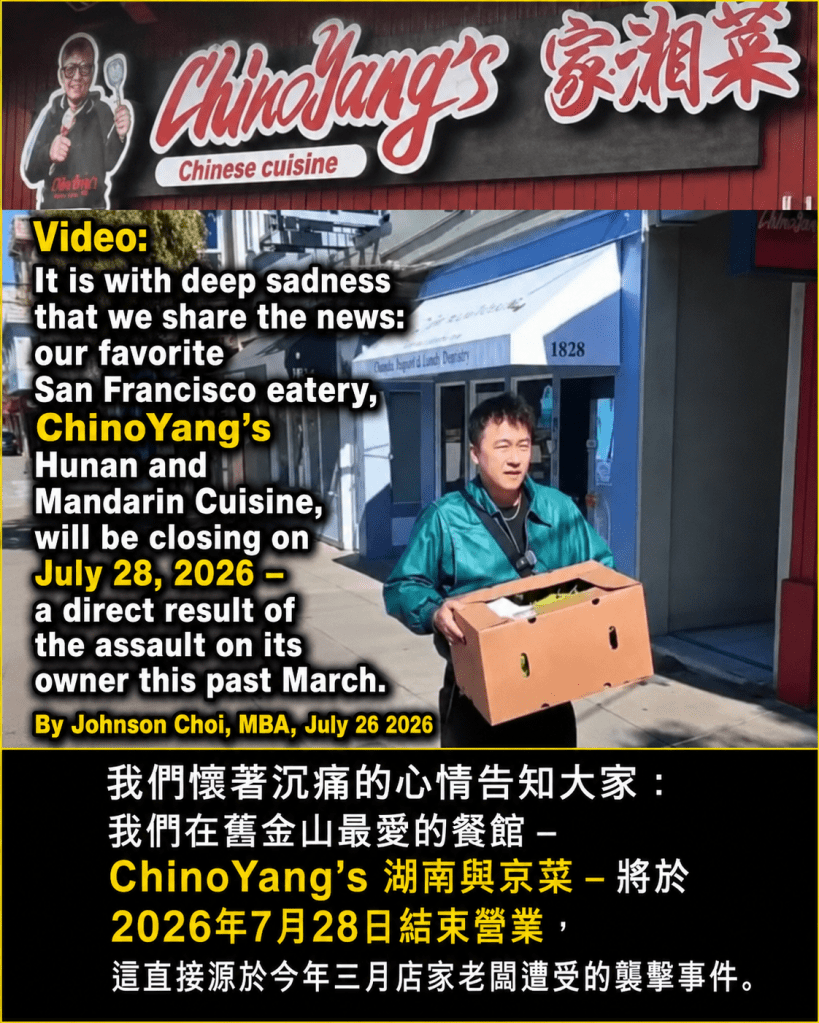
Video: It is with deep sadness that we share the news: our favorite San Francisco eatery, ChinoYang’s Hunan and Mandarin Cuisine, will be closing on July 28, 2026 – a direct result of the assault on its owner this past March. By Johnson Choi, MBA, July 26 2026 我們懷著沉痛的心情告知大家:我們在舊金山最愛的餐館 – ChinoYang’s 湖南與京菜 – 將於2026年7月28日結束營業,這直接源於今年三月店家老闆遭受的襲擊事件。
This heartbreaking loss is a stark reflection of the rising anti-Asian hate and violent crimes targeting Chinese Americans, rhetoric that has been dangerously fueled by U.S. Presidents, Congressional delegations, and state and city officials who scapegoat Chinese Americans and China for all of America’s ills. The threat is utterly unpredictable—attackers can appear anywhere, at any time.
That very uncertainty is precisely why thousands of Americans are now choosing to retire in China’s Greater Bay Area. After all, as the old Chinese saying wisely puts it: “Your money in the bank is useless when you are in heaven.”
Analysis of Disparities in Choice for Chinese Amid High-Cost Challenges in Hong Kong and San Francisco. By Johnson Choi, MBA on 7-27-26 香港与旧金山高成本困境下的华人群体选择空间差异分析. 欲知詳情請和蔡永強聯絡. 筆者: 蔡永強,商科碩士.
Analysis of Disparities in Choice for Chinese Amid High-Cost Challenges in Hong Kong and San Francisco
Hong Kong and San Francisco, USA, both face significant urban cost-of-living pressures, manifested in persistently high prices for goods, rents, and real estate, alongside widespread issues of excessive surcharges and uneven service quality in the hospitality sector (e.g., dining in San Francisco often incurs an additional 30% in taxes and service fees). However, when addressing these challenges, the options and flexibility available to Chinese communities in the two locations differ fundamentally.
Geographic Location and Cross-Border Commuting Efficiency: A Striking Contrast
Taking the Guangdong–Hong Kong–Macao Greater Bay Area’s “one-hour living circle” as a benchmark, Hong Kong residents benefit from efficient cross-border infrastructure enabling rapid commuting. For instance, from various districts in Hong Kong to checkpoints into the Greater Bay Area (such as Shenzhen), 24-hour bus services are frequent, with a one-way fare of approximately USD 0.30 and customs clearance taking as little as five minutes. In contrast, in the San Francisco Bay Area, daily intercity commuting is notably time‑consuming; a round trip for a midday meal outside the office typically takes three hours, severely constraining residents’ living radius and consumption choices.
Rational Economic Choices in Cross-Border Consumption and Retirement Migration Currently, a significant number of retirees from the US and Canada are actively choosing to relocate to the Greater Bay Area, driven by cost‑benefit considerations to enhance disposable income and overall quality of life. Surveys indicate that the general price level in the US and Canada is roughly four to seven times that of China, while goods and services readily available in Hong Kong offer greater variety, more competitive pricing, and superior freshness compared to the North American market. Multiple expatriate residents report that Hong Kong’s market provides specific products difficult to obtain in North America, at more reasonable prices and with fresher supply chains.
Institutional and Geographic Roots of Structural Differences These phenomena are not accidental but stem from divergent geographic locations, cross‑border policies, and degrees of regional economic integration. Leveraging the “One Country, Two Systems” framework, Hong Kong maintains deep connectivity with the mainland, enjoying low‑cost, time‑efficient cross‑border living resources. San Francisco, as a gateway on the US West Coast, experiences limited regional synergies, and cross‑border consumption options are constrained by border policies and physical distance, leaving ordinary residents (excluding high‑net‑worth individuals) with few viable alternatives.
Conclusion In summary, while both cities superficially grapple with similar inflationary pressures and service‑market challenges, the actual coping strategies and living buffers available to the Chinese community in Hong Kong are markedly superior to those of their counterparts in the US. This disparity ultimately stems from differences in regional economic integration and the accessibility of cross‑border infrastructure.
Someone once asked this question: Would you give up an entire forest for a single tree? By Johnson Choi, MBA 曾經有人問過這樣一個問題:你是否會為了一棵樹,而放棄整片森林? 作者: 蔡永強, 商科碩士. 7-26-2026
If we could turn back time thirty years, if you had already grasped the global trends of that era, you would have seen — that towering tree (the United States) stood over a hundred feet tall, while the trees in the surrounding forest (Asia, Africa, the Middle East) were no more than six feet high, with withered branches and rotting yellow leaves. More critically, the roots of that great tree had long since silently extended beneath every smaller tree, draining away all the water and nutrients. Every tree in the entire forest could barely sustain a struggling existence.
Back then, it believed the world belonged to it alone, and that it could do whatever it pleased. Yet who could have foreseen that in the distant reaches of the forest, a pine tree named “China” was quietly toiling, deeply rooted, enduring hardship, and surviving tenaciously through wind and rain. Unfortunately, that hundred‑foot giant was careless, busy setting fires of war all around, and never noticed that distant pine rising silently from the ground.
By the time it suddenly awoke to the truth, that small pine — merely six feet tall thirty years ago — had already surpassed eighty feet, standing tall and firm, with sturdy branches capable of providing richer nourishment and stronger support to the surrounding trees, and better able to withstand external storms and shocks. The former hegemon tried repeatedly to destroy it, using every means at its disposal and pulling out all the stops. But time was no longer on its side; each move it made came at the bitter cost of wounding the enemy eight thousand while losing ten thousand of its own.
Seeing that the situation was beyond redemption, the hundred‑foot giant finally decided to sound the retreat and withdraw to its own domain. And the powers behind it were merely that 10% so‑called elite class. Since they could no longer harvest the distant pine, they turned their spears around and began harvesting their own people — the other 90% of Americans.
Thus, we often hear the “China‑hating contingent” in the United States loudly proclaiming China’s decline, asking: If China is so great, why do its wealthy still come to America? The answer is actually quite simple — because they have enough financial means to squeeze into the top 10% of the white elite in the U.S., joining forces to harvest that 90% of Americans, which also includes 90% of Chinese Americans.







 Johnson Choi Biz