Independent legal analyst shreds ASPI’s Uyghur ‘forced labour’ claims 獨立法律分析師(揭穿)粉碎了 ASPI 的維吾爾族“強迫勞動”主張 虛假宣傳 – 2.1.22 citizensparty.org
Page last updated on 01 February 2022
https://citizensparty.org.au/independent-legal-analyst-shreds-aspis-uyghur-forced-labour-claims
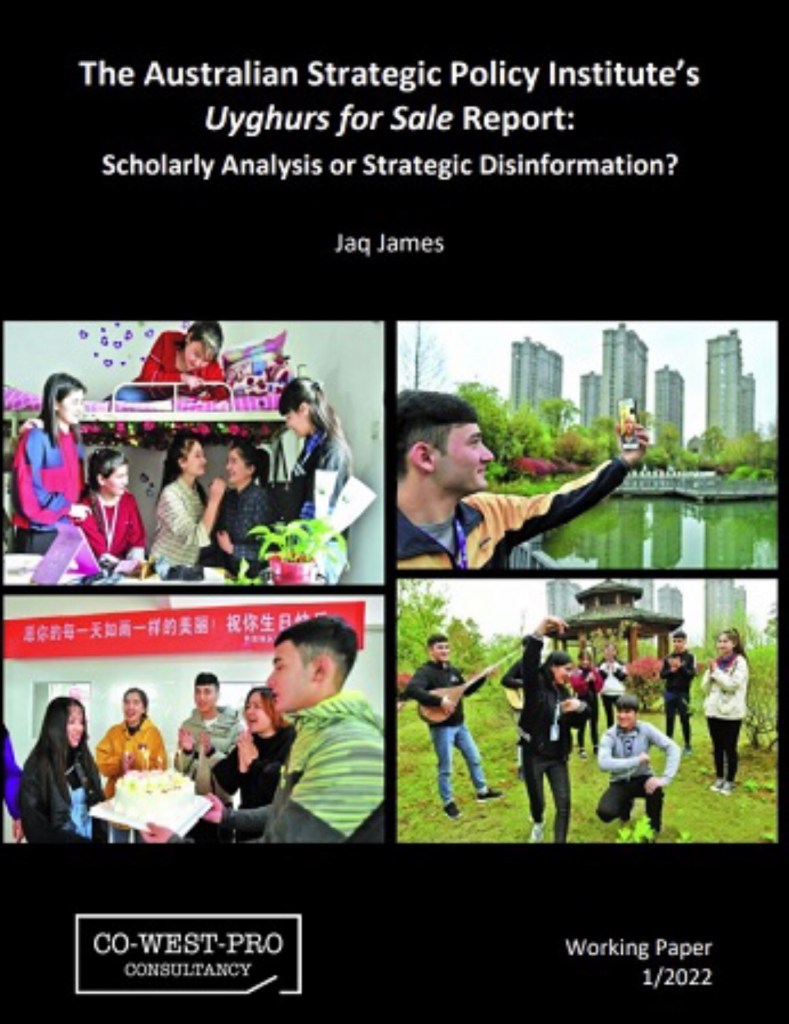
Ever since its publication in February 2020, the Australian Strategic Policy Institute’s (ASPI) report Uyghurs for Sale: ‘Re-education’, forced labour and surveillance beyond Xinjiang has been hugely influential in propagating the notion that the Chinese government has enslaved large numbers of Uyghurs, an ethnic minority from China’s northwestern Xinjiang autonomous region, to be used as forced labour in factories around the country. Several independent media, including the Australian Alert Service, 1 soon exposed the fraudulent research methodology behind the report, and debunked various of its allegations; but media, politicians and “humanitarian” NGOs around the world continue to take ASPI’s word as gospel. Now, independent Canberra-based lawyer and analyst Jaqueline “Jaq” James has done the job the mainstream punditry should have done two years ago. In a paper published this month titled The Australian Strategic Policy Institute’s Uyghurs for Sale Report: Scholarly Analysis or Strategic Disinformation?, she shows clearly that the answer is the latter.
Jaq James’s legal analysis of ASPI’s forced labour report shows that there is no evidence for any of ASPI’s claims.
Jaq James is eminently qualified to deliver such an analysis. First, she holds a Bachelor of Laws (with Honours), and is soon to complete a Master of Laws specialising in international law at the Australian National University (ANU) in Canberra; additionally, she holds Masters in both Public Policy and Education. She also speaks Mandarin and has a good understanding of China’s culture and systems of governance, having worked and studied there for several years, including a stint as a university lecturer teaching English as a Second Language to People’s Liberation Army cadets. It was this “link” to the PLA that saw her smeared as a Chinese government agent by the Australian newspaper last October,2 in what Ms James suggested at the time was a pre-emptive bid by Canberra’s defence and intelligence establishment to discredit her ahead of the release of her paper.
They were right to be worried. James’s detailed, meticulous but still very readable legal analysis demonstrates unequivocally that not only does none of ASPI’s evidence of human rights violations stand up to scrutiny, but that most of its accusations are without legal merit in the first place, since the alleged conduct cited does not in fact breach any human rights law. Moreover, by leading an international campaign that has seen transnational companies dismiss and/or cease hiring Uyghur workers, ASPI and by extension the Australian government are themselves guilty of violating Uyghurs’ human rights, specifically the right to work and obtain education.
Warmongering for fun and profit
ASPI is a defence and strategic policy think tank founded by the Australian government in 2001. It operates as a quasi-independent government-owned company, and is funded mainly via an annual grant from the Defence Department; however, it also receives large sums from the US State Department, as well as the UK and other Anglo-American-aligned governments. ASPI “also controversially takes funding from the armaments industry, as well as having some members of its governing council simultaneously sitting on the boards of armament-manufacturing companies”, James notes, while its “receipt of funding from foreign governments and foreign political parties to engage in political and governmental influence work” has earned ASPI a spot on the Attorney-General’s Department’s Foreign Influence Transparency Scheme Public Register. Most of that influence is exerted in efforts to demonise China, including in areas well outside its bailiwick. Its Uyghurs for Sale report, written by five members of ASPI’s International Cyber Policy Centre (ICPC) is a striking case in point.
James writes, “ASPI alleged that the Chinese Government is likely implementing a systematic forced labour program via its pre-employment training and job placement schemes aimed at facilitating Uyghurs to move into factory work across China.” It listed 82 international companies it said were “likely” complicit in using forced Uyghur labour, and estimated that more than 80,000 Uyghurs “could be” subjected to forced labour. ASPI’s aggressive marketing of the report and its lead author, Chinese-born ICPC researcher Vicky Xiuzhong Xu, succeeded in having “countless mainstream media outlets and human rights organisations [go] on to platform Ms Xu’s forced labour allegations, including the Working Group on Business and Human Rights for the United Nations … and the Institute of Business and Human Rights”, James reports. “Despite these entities holding a watchdog status, not a single one that repeated Ms Xu’s findings critically engaged with her cited sources and her interpretations of those sources.”
Indeed, it appears that no-one had critically analysed the report from a legal perspective, until Ms James took on the task herself. Doing so, she said, was “very challenging, for two reasons. First, even though the ASPI report centred around the claim of forced labour, there was little substantial engagement with international laws. When laws were referenced by ASPI, they were either not fully contextualised or not clearly and consistently connected to all of the allegations. …
“Second, where ASPI made specific allegations, many of its cited references were misrepresented, were of unreliable quality, or were decontextualised. Sometimes the references would also state the opposite of what ASPI claimed.”
Smoke and mirrors
From the get-go, the ASPI report’s allegations are based on a misrepresentation of international law. “ASPI’s accusation of forced labour centred around one document—the ILO Indicators of Forced Labour 2012”, she writes. (“ILO” is the International Labour Organisation, the UN agency responsible for setting labour standards in participating UN member states.) That document, she explains, is a manual for frontline practitioners which “contains eleven indicators that ‘represent the most common signs or “clues” that point to the possible existence of a forced labour case (emphasis added). In other words, the ILO indicators do not necessarily, of themselves, lead to a person being forced into labour; rather, they are simply red flags that warrant further investigation. This important distinction was not explained by ASPI to its readers.” The actual definition of “forced labour” under international law, as spelled out in the ILO Forced Labour Convention 1930 (No 29), is “all work or service which is exacted from any person under the menace of any penalty and for which the said person has not offered himself voluntarily”. Voluntary, by the ILO’s definition, means that consent to work was freely given by the worker and can be revoked at any time. “Thus, ‘forced labour’ has a narrow definition that is clearly demarcated from other substandard working conditions”, James notes. Despite being “central to any accusation of forced labour”, this definition “was tucked away in an endnote … instead of featuring in the body of the report.” By referencing the ILO indicators alone, as though they comprised some sort of legal checklist, “ASPI effectively widened the term ‘forced labour’ to mean any unfavourable working condition or labour rights violation. … Consequently, the very foundations of ASPI’s argumentations were compromised from the outset because the central legal element of consent was not a consistent feature in its analysis.”
Yet even by just the ILO indicators, most of ASPI’s accusations are without merit. Uyghur workers at a Taekwang Shoes factory (a Nike supplier) in Qingdao attending night school to study Mandarin and receive vocational training is deemed “excessive overtime”, with no mention of whether or not the workers had consented to attend—or that the ILO does not deem compulsory education “work or service” anyway. Factory compounds with barbed-wire fences and “watchtowers”, where workers’ comings and goings are monitored by surveillance cameras and police, are touted as proof of restriction of movement (ILO indicator three) and intimidation and threats (indicator six). Omitted is what Ms James describes as the “well-known fact … [that] many large factories in China have barbed fencing, viewing boxes and security monitoring for the purposes of keeping non-employees out, not keeping employees in. … Likewise, many large companies and education institutions in China have internal or nearby satellite police stations for security purposes.” In one especially ridiculous case, ASPI appears upset about a Uyghur woman who said she had “learned to improve her Mandarin and workplace discipline and to take daily showers” while working for an electronics manufacturer. “It is unclear what ILO indicator ASPI believed this case study fell within”, James remarks drily.
Of the 18 specific concerns raised in the ASPI report, only seven involved anything that if proven would legally constitute forced labour. None stacked up. One, an allegation that Uyghur workers had been brought involuntarily across the country from Xinjiang to work for Taekwang Shoes, was based on anonymous hearsay reported in the Washington Post, alongside a quote attributed to an unnamed Uyghur woman who complained “in broken Mandarin” that “We can’t go back [to Xinjiang] on our own”. As James notes, however, “one short statement from one anonymous woman is not sufficient to make the accusation that all Uyghur workers were involuntarily sent to Taekwang Shoes”, the more so given she might just as well have meant that workers “did not have the capacity to return on their own (e.g. their limited Mandarin proficiency could make it difficult to use long-distance transport without a bilingual assistant).” Furthermore, previous audits by Taekwang Shoes’ international customers had reportedly found that Uyghur workers were free to end their contracts at any time, and had done so. “It is also noted”, James reports, “that The Washington Post article was published one to two days after the ASPI report was originally released. This means there was some type of co-operation arrangement (perhaps collusion) … as opposed to The Washington Post article being an independently cited source. What seems to support the more serious accusation of collusion is that ASPI changed its publication date from ‘February 2020’ to ‘1 March 2020’ on the inside cover of its later versions of its report without any known explanation for the discrepancy.”
In another example, ASPI alleged forced labour at a clothing factory solely on the basis that Uyghurs employed there were graduates of a vocational school in Xinjiang “which ASPI claimed has been a re-education camp since 2017. ASPI said it reached its conclusion through analysis of official documents and satellite imagery that showed fenced-off areas that ‘resemble other political indoctrination camps’” (of which it failed to provide examples for comparison). The satellite image in question, however, was from 2018, when several areas of the school were temporarily fenced off, apparently for reconstruction or renovation. Images from the following year show all the fencing removed, while a simple online search brings up a wealth of photographs taken in 2017-19 (of which Ms James supplies numerous examples) revealing it to be nothing more than an ordinary trades school.
Clean up your act
“Forced labour is a symbol of evil that conjures up outrage in us all”, Ms James states in her paper’s conclusion. “What should also be an outrage is when political power-brokers appropriate a symbol of evil for a game of geopolitical one-upmanship: to further demonise a country that Australians are already conditioned to distrust and dislike. ASPI lobbed eighteen specific accusations relating to forced labour at China, and, as this paper shows, not one of them survives close scrutiny. It is submitted that this is because the ASPI report was not a work of scholarly analysis, but rather a piece of strategic disinformation to exact harm.” And the main harm has come to the thousands of Uyghurs who have lost their jobs as Western companies sever ties with Chinese suppliers, forcing the closure of some factories and the discriminatory termination of Uyghurs in others (for which in at least one case ASPI has publicly taken credit), as they rush to avoid a backlash from their propagandised consumer bases and/or sanctions from the US government.
“All stakeholders, especially the Australian Government, must right the grave wrong perpetrated against the Uyghurs because of the ASPI report”, Ms James insists. As ASPI is a Commonwealth company whose Executive Director is appointed by and reports to the Minister for Defence, the government is arguably legally and certainly morally responsible for the consequences of its actions. Ms James suggests that to begin making amends, the government should obtain legal advice from the Australian Government Solicitor “to see if the affected Uyghurs could successfully sue ASPI for the tort of interference with a contract or the tort of conspiracy under Australian common law.” And if the AGS believes they have a strong case, the government “should offer financial assistance to the Uyghurs so they can launch a test class action against ASPI in an Australian court … [and] should also support the Uyghurs in lodging legal actions against the ASPI report authors, personally.” She also recommends several legal and regulatory reforms that would force ASPI to respect proper academic and legal standards in its reports; and that Parliament should investigate ASPI’s modus operandi, including whether Executive Director Peter Jennings and ICPC Director Fergus Hanson instructed Xu et al. to bypass legal and academic rigour.
By Richard Bardon, Australian Alert Service, 12 January 2022
Footnotes
- “ASPI: forced labour hypocrites and academic fraudsters”, AAS, 14 Oct. 2020. See also Marcus Reubenstein, “ASPI’s forced labour links”, APAC News, 12 Oct. 2020; and Ajit Singh, “‘Forced labour’ stories on China brought to you by US gov, NATO, arms industry to drive Cold War PR blitz”, The Grayzone, 26 Mar. 2020.
- “Unpicking The Australian’s unhinged McCarthyism”, AAS, 13 Oct. 2021.



 Johnson Choi Biz