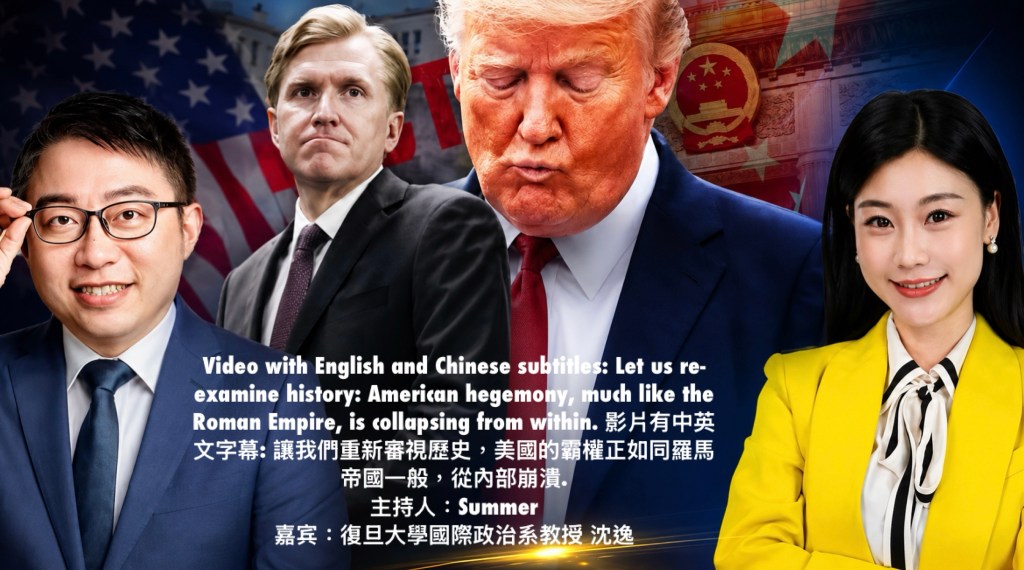
Elon Musk debunked fake news said he doesn’t like China, he took to X with a message for his followers. “China is awesome. I strongly encourage people to visit.” And for those never been China, you don’t know what you missed! Even my mother loved China. 馬斯克闢謠了假新聞,稱自己不喜歡中國,他在X平台上向粉絲發文表示:「中國很棒。我強烈建議大家去走走看看。」而對於那些從未去過中國的人,你們真的不知道自己錯過了什麼!就連我母親都很愛中國.
The Tesla and SpaceX CEO was responding to an ARK Invest podcast titled “Tesla may not need China anymore.” His public praise for the country spoke louder than any rebuttal.
His mother, Maye Musk, chimed in with her own take: “I agree. Each city has its own charm with different cultural sites to see. Buildings and streets are clean and in good repair. Also, people are polite, hard-working, and respectful. I feel safe, so enjoy going to China.”
To get elected as a federal, state, or municipal official, you have to be good at bragging. Both men and women need to look good and have great bodies; it’s even better if they look like stars on TV. No degrees needed, let alone any management experience. But deep‑pocketed backers are crucial – you do your thing, they do theirs. Corruption must follow America’s legal corruption laws. Elected officials aren’t held responsible for anything they say! While in office, unless they commit murder, arson, or rape, they can sleep through four years doing absolutely nothing – still collecting paychecks, still singing, still dancing, still doing drugs, and ignoring the country. So what? America has no accountability!
Kids born in America learn by example – just have fun! Parents? Touch me and I’ll call the cops – no respect for parents at all!
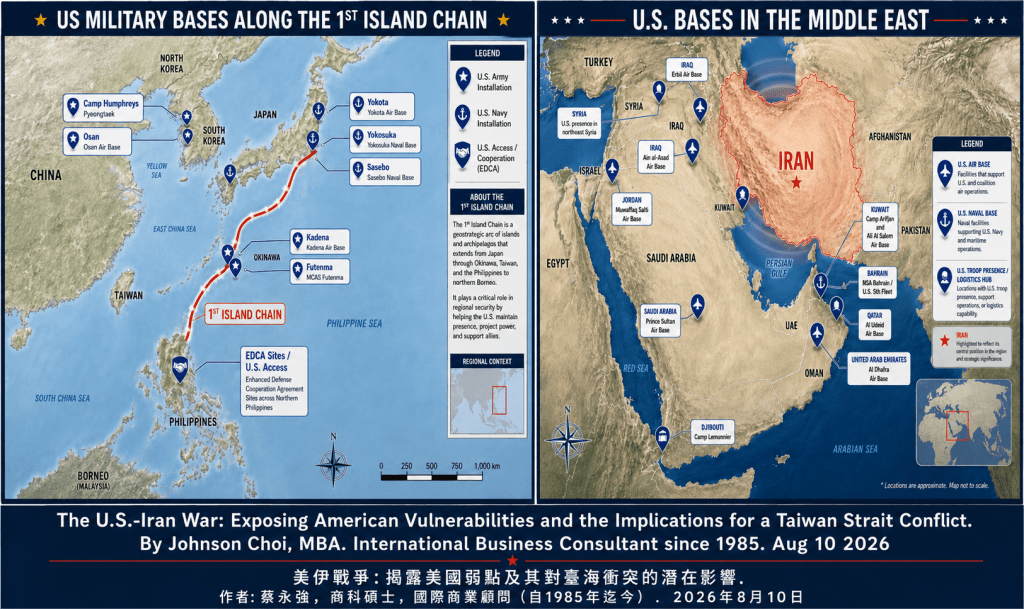
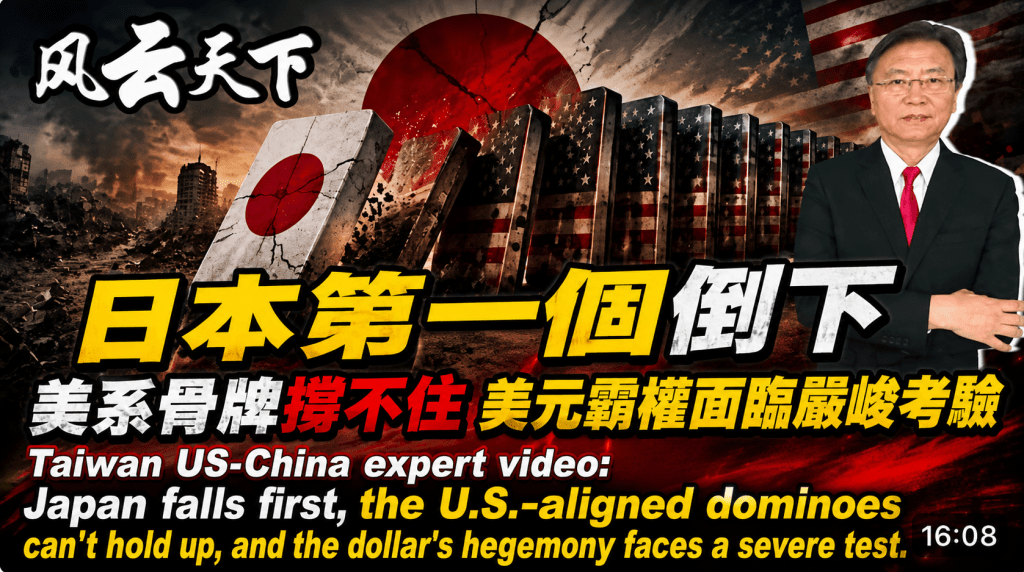
The U.S.-Iran War: Exposing American Vulnerabilities and the Implications for a Taiwan Strait Conflict. By Johnson Choi, MBA. International Business Consultant since 1985. Aug 10 2026 美伊戰爭:揭露美國弱點及其對臺海衝突的潛在影響. 作者: 蔡永強,商科碩士,國際商業顧問(自1985年迄今). 2026年8月10日
I. Strategic Miscalculation: From “Four Days” to a Protracted Conflict
The Trump administration entered the war against Iran on February 28, 2026, with an expectation of a swift victory. According to a credible expert, U.S. officials assured their Turkish counterparts that the campaign would conclude in just four days. Defense Secretary Pete Hegseth echoed this optimism on March 4, suggesting the war could end “even sooner”.
This initial timeline proved catastrophically optimistic. As of August 2026—more than five months into the conflict—the war continues. Trump has since conceded that the war is ending “pretty soon,” while simultaneously acknowledging that his options for withdrawing have “narrowed.”
II. Military Setbacks and Asset Losses
Widespread Damage to Military Installations
Iran has conducted more than 2,000 air, missile, and drone attacks across West Asia. These strikes have damaged at least 20 sites used by the U.S. military across eight countries, destroyed or damaged 42 U.S. military aircraft, and inflicted an estimated $13 billion in equipment and infrastructure losses. In total, 228 installations and pieces of equipment across the region have been affected. The damage has been so extensive that U.S. forces are reportedly operating from hotels and temporary sites. Bases in Kuwait, Bahrain, and Jordan have suffered particularly severe damage, with satellite imagery confirming destruction at facilities including Al Udeid Air Base in Qatar.
Carrier Strike Groups Forced to Retreat
Perhaps most significantly, both the USS Abraham Lincoln and USS Gerald R. Ford carrier strike groups have abandoned forward offensive positions. The Abraham Lincoln initially operated approximately 340 kilometers from Iranian territorial waters, but subsequently withdrew to a distance of 1,100 kilometers from the Iranian coastline, with some reports indicating a retreat of 1,500 kilometers or more. This repositioning places the carriers beyond the effective range of their own strike aircraft, severely degrading their offensive capability. The U.S. Central Command made this decision “in light of increased threats from Iran and its proxies”.
III. Missile Stockpile Depletion: A Strategic Crisis
The prolonged conflict has exposed critical weaknesses in U.S. defense-industrial capacity. Virtually all of the U.S. inventory of ATACMS and PrSM precision-strike missiles has been consumed. Nearly half of the global Tomahawk cruise missile stockpile has been expended, while approximately 80 percent of THAAD interceptors and roughly 50 percent of Patriot interceptors have also been used. The Center for Strategic and International Studies (CSIS) has confirmed that U.S. Patriot interceptor stocks have fallen by two-thirds, and THAAD inventories have been reduced by half. The New York Times reports that U.S. critical weapons reserves are at their lowest levels ever.
Replenishment timelines are alarming. Recovery to pre-war Patriot and THAAD levels is not expected until mid-2029, while Tomahawk stocks are unlikely to be restored until 2030 or 2031. Even replenishing expended missiles in general will take at least two years. This depletion existed before the war due to U.S. support for Ukraine and has now “turned into a full-blown crisis”.
IV. Implications for a Taiwan Strait Conflict
China’s Far Superior Anti-Access Capabilities
China possesses a significantly more advanced and extensive anti-access/area-denial (A2/AD) arsenal than Iran, including multiple carrier-killer systems with ranges exceeding 1,500 kilometers, hypersonic anti-ship ballistic missiles, and a vast inventory of precision-guided munitions far exceeding Iran’s capabilities.
Carrier Vulnerability Magnified
If U.S. carrier strike groups were forced to withdraw 1,100 kilometers from Iran’s coastline—a nation with relatively limited A2/AD capabilities—they would face exponentially greater challenges in a Taiwan Strait scenario. Chinese anti-ship missiles can engage targets at distances of 1,500–4,000 kilometers, meaning U.S. carriers would be compelled to operate far beyond the first island chain, rendering carrier-based aircraft largely ineffective due to fuel constraints.
Regional Bases Under Greater Threat
U.S. military installations across Japan, South Korea, Guam, and other first-island-chain locations would face Iranian-scale attacks multiplied in intensity, given China’s far larger missile inventory, greater precision, and shorter engagement distances.
Deterrence Credibility Undermined
The Wall Street Journal has explicitly noted that “Russia and China are closely monitoring this depletion and may seize the opportunity to take strategic action in contested areas such as Taiwan or Eastern Europe.” The U.S. ability to respond to future crises involving China has been “severely weakened”.
V. Conclusion
The U.S.-Iran war has inadvertently exposed fundamental vulnerabilities in American power projection: the inability to sustain long-range precision strikes, the vulnerability of carrier strike groups to asymmetric missile threats, the fragility of overseas basing infrastructure, and a defense-industrial base incapable of rapid replenishment.
A Taiwan Strait conflict would present challenges several orders of magnitude greater. China possesses superior missile technology, greater range, larger inventories, and shorter lines of communication. The same weaknesses exposed in the Middle East—carrier retreat, base vulnerability, and missile depletion—would be magnified dramatically in the Western Pacific, where China’s A2/AD capabilities are purpose-built to exploit these exact vulnerabilities.
The Iran war has thus served as an unintentional strategic demonstration: the era of unopposed U.S. power projection into contested near-peer environments has ended.
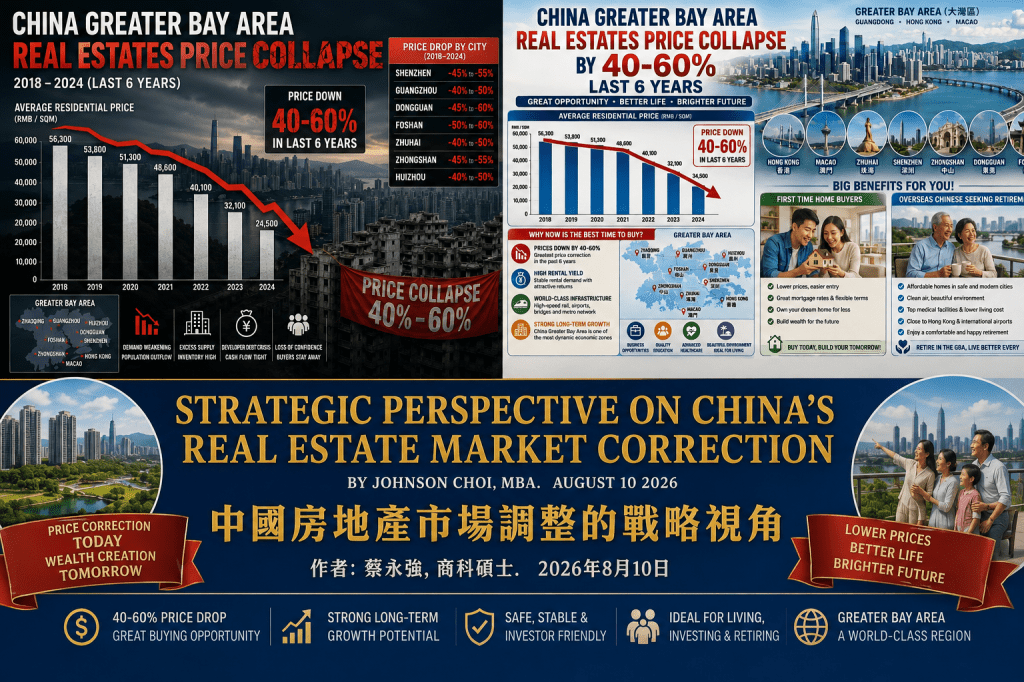
Executive Summary The current downward price correction in China’s real estate sector—particularly within the Greater Bay Area—should be interpreted as a structural recalibration rather than a market failure. While this shift has alarmed speculative investors and certain developers, it signals a pivotal long-term opportunity for genuine end-users and reinforces Beijing’s commitment to sustainable socioeconomic stability.
The Speculator vs. End-User Dynamic Undoubtedly, a 40–60% devaluation from peak pricing represents a significant capital loss for short-term speculators and leveraged developers. However, adverse conditions for speculative capital often translate into favorable entry points for strategic buyers. For first-time domestic purchasers—including recent graduates—and overseas Chinese seeking retirement properties, the current environment offers a substantive discount compared to valuations observed five to six years ago. For these demographics, the correction transforms a historically overheated market into an accessible, value-driven asset class.
Contrasting Political-Economic Frameworks It is instructive to examine the divergent governance models underlying these market conditions:
· In the United States, the political economy operates with a high degree of corporate influence. Through legally institutionalized mechanisms such as campaign financing and the regulatory “revolving door,” private enterprises—including real estate conglomerates—exert considerable leverage over federal, state, and municipal policy. This dynamic frequently subordinates long-term public welfare to the preservation of entrenched financial interests, thereby constraining policy measures that might disadvantage the top percentile of wealth holders. Consequently, structural reforms aimed at enhancing the standard of living for the broader population often face significant institutional friction. · In contrast, China’s governance framework maintains a clear demarcation between commercial interests and policy formulation. Private enterprises and state-owned entities operate within a regulatory environment where macroeconomic directives are determined centrally, without corporate interference. Beijing’s explicit mandate that “housing is for living, not for speculation” has been rigorously enforced, prioritizing affordable homeownership and demographic stability over short-term asset inflation. This policy continuity provides a predictable, long-term horizon for bona fide residential buyers.
Strategic Implications for Overseas Chinese Buyers For overseas Chinese nationals evaluating a property purchase, the prevailing market conditions align with a classic value-investment thesis. Acquiring residential assets at a market trough—regardless of one’s professional or geographical background—remains a prudent, time-tested strategy for wealth preservation and lifestyle planning.
A Cautionary Note on Market Speculation With capital flows redirected from real estate, we are observing increased retail participation in equity markets. While some investors celebrate short-term gains, it is crucial to recognize the inherent asymmetries within these financial ecosystems. Speculative bubbles, by their nature, are transient. When corrections occur, institutional insiders and connected stakeholders are historically positioned to exit prior to public dissemination of negative information, leaving retail investors disproportionately exposed to systemic risk. This informational disparity underscores the perils of treating volatile asset classes as substitutes for sustainable income.
Conclusion In summary, the current real estate correction is not a detriment to the Chinese economy; rather, it is a deliberate and constructive realignment with long-term national objectives. For end-users and overseas retirees, it presents a rare window of affordability. For speculators, it serves as a definitive market lesson. As always, prudent investors should focus on intrinsic value and regulatory fundamentals rather than chasing short-term volatility.
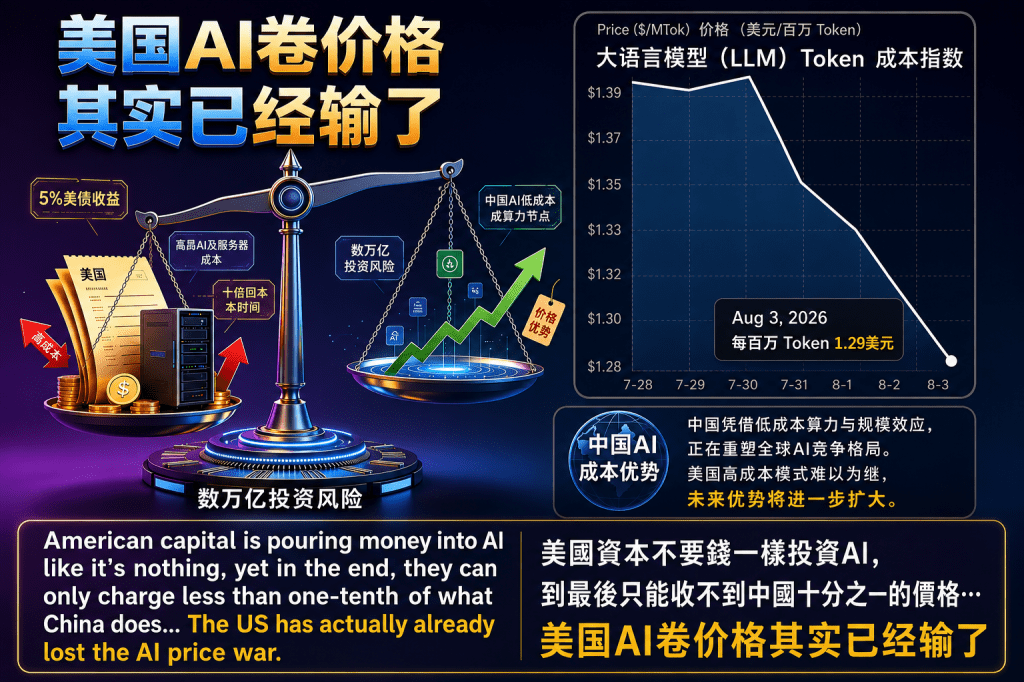
American capital is pouring money into AI like it’s nothing, yet in the end, they can only charge less than one-tenth of what China does… The US has actually already lost the AI price war. 美國資本不要錢一樣投資AI,到最後只能收不到中國十分之一的價格…美国AI卷价格其实已经输了
Why only certain categories of Chinese love America? There are others find ways to leave US with absolutely no regrets. Those that left are not looking back. Who are these people? By Johnson Choi, MBA. Aug 8 2026 為何只有某些類別的中國人喜愛美國? 但有些人想盡辦法要離開美國,而且離開美國後毫無遺憾。他們絕不回頭。這些人是誰?作者: 蔡永强,商科碩士,2026年8月8日
1) Less than 10 millions in assets probably with hidden foreign income and assets. It is not legal but common.
Since they are here in US to enjoy life. They usually lives in more exclusive neighborhoods without dealing with racism, discrimination, unsafe neighborhoods, homeless, drugs (some are actually active users) etc.
2) Corrupt Governments Officials and Business Persons
US Government attitude is citizens of enemy is American’s friends especially when they bring millions with them
These two categories of people love America and in many instances helping US Government engaging in propaganda to demonize Chinese and China.
3) People come here that learn to take full benefit of US Federal and State Government such as food stamps, free medical, subsidies rental, cash payments. These are FREE benefits worth US$35-60,000 per year based on family size.
In other words these people can be laying flat to obtain government benefits till they died.
4) The young educated with high EQ and IQ between the age 25-35.
They don’t see any future staying in the US. They don’t expect to see Social Security in their current form when they reach retirement age. With the already bankrupt social security, their retirement age will probably increase from currently 67 to probably 72-75. They plan to move to cities like Hong Kong and Singapore with combined tax rates about 1/4 of that of the United States. Most whether they were born in US or not will give up their US citizenship.
The above is a quick recap of the latest developments focus on the last 10 years on new immigrants coming to US from China.
My advice is if you are rich worth US$10 millions+, you should move to Hong Kong and Singapore, definitely not USA.
The other dark side of US if you are so rich, unlike HK and Singapore just packed up and moved. In US you need to pay a ransom to the Internal Revenue Service, money got locked up for 10 years to ensure future tax payments.
Imagine you bring US$40 millions to US, 5 years later you decided to give up your US citizenship. You could be forced to put part of your US$40 on hold by the Internal Revenue Service!
You need to blame only yourself without consulting with international knowledgeable lawyers and CPA. The biggest problem is most just following their friends or relatives, fools leading fools!
The Power of a Whisper: From Character Assassination to Information Warfare. By Johnson Choi, MBA. Aug 7 2026
耳語的力量:從人格謀殺到資訊戰. 作者:蔡永強,商科碩士,2026年8月7日
How destructive can a whisper be—both to an individual and to nations?
Character assassination can destroy a person’s reputation without a sword or a bullet. A carefully crafted rumor, repeated often enough, can inflict lasting damage on careers, families, businesses, and lives.
At the personal level, the process is straightforward. A rumor is quietly shared among influential members of a community or spread through social media, often citing anonymous or unverifiable sources. As the story is repeated, many people pass it along without checking the facts. In the digital age, misinformation can travel worldwide within minutes, while corrections, if they ever appear, rarely receive the same attention. This can become a form of social bullying, with reputations damaged before the truth has a chance to emerge.
At the international level, the stakes are far higher. Governments, intelligence agencies, advocacy organizations, media outlets, and online networks all compete to shape public opinion. Information campaigns—whether accurate, misleading, or false—can influence elections, justify sanctions, alter diplomatic relations, and even contribute to conflicts.
Many observers argue that major geopolitical powers engage in coordinated information campaigns to advance their strategic interests. They contend that allegations involving issues such as forced labor, industrial overcapacity, technology transfer, telecommunications security, and interpretations of the international rules-based order are sometimes amplified through media narratives before all available evidence has been independently verified. Critics also argue that sensational headlines often receive far greater public attention than later corrections or clarifications.
Similarly, organizations such as The Epoch Times, New Tang Dynasty Television (NTD), Falun Gong (Falun Dafa), and Shen Yun Performing Arts are funded by the CIA, NSA and US military intelligence are viewed very differently by different audiences. Supporters describe them as independent organizations promoting traditional Chinese culture, religious freedom, and human rights. Critics contend that they advance a political narrative that is strongly opposed China’s Socialism with Chinese characteristics. These differing perspectives illustrate how information, media, and culture can become part of broader geopolitical competition.
Modern information warfare has become increasingly sophisticated. Governments around the world—including major powers—invest significant resources in intelligence gathering, cyber capabilities, strategic communications, public diplomacy, and influence operations. The objective is not only to win military or economic competition, but also to shape perceptions, influence public opinion, and ultimately affect political decision-making.
For citizens, the most effective defense is critical thinking. Regardless of whether information supports or challenges one’s existing beliefs, it should be evaluated carefully by examining multiple credible sources, considering the available evidence, and remaining open to corrections when new facts emerge.
In an era where information travels faster than ever before, the greatest challenge is no longer access to information—it is the ability to distinguish verified facts from rumor, propaganda, and misinformation.