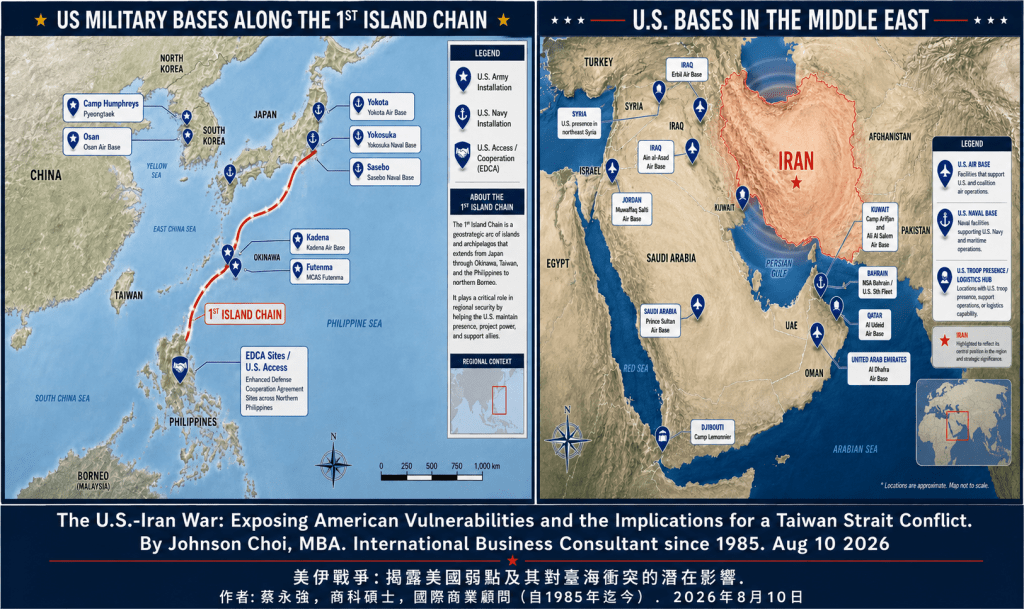
The U.S.-Iran War: Exposing American Vulnerabilities and the Implications for a Taiwan Strait Conflict. By Johnson Choi, MBA. International Business Consultant since 1985. Aug 10 2026
美伊戰爭:揭露美國弱點及其對臺海衝突的潛在影響. 作者: 蔡永強,商科碩士,國際商業顧問(自1985年迄今). 2026年8月10日
I. Strategic Miscalculation: From “Four Days” to a Protracted Conflict
The Trump administration entered the war against Iran on February 28, 2026, with an expectation of a swift victory. According to a credible expert, U.S. officials assured their Turkish counterparts that the campaign would conclude in just four days. Defense Secretary Pete Hegseth echoed this optimism on March 4, suggesting the war could end “even sooner”.
This initial timeline proved catastrophically optimistic. As of August 2026—more than five months into the conflict—the war continues. Trump has since conceded that the war is ending “pretty soon,” while simultaneously acknowledging that his options for withdrawing have “narrowed.”
II. Military Setbacks and Asset Losses
- Widespread Damage to Military Installations
Iran has conducted more than 2,000 air, missile, and drone attacks across West Asia. These strikes have damaged at least 20 sites used by the U.S. military across eight countries, destroyed or damaged 42 U.S. military aircraft, and inflicted an estimated $13 billion in equipment and infrastructure losses. In total, 228 installations and pieces of equipment across the region have been affected. The damage has been so extensive that U.S. forces are reportedly operating from hotels and temporary sites. Bases in Kuwait, Bahrain, and Jordan have suffered particularly severe damage, with satellite imagery confirming destruction at facilities including Al Udeid Air Base in Qatar.
- Carrier Strike Groups Forced to Retreat
Perhaps most significantly, both the USS Abraham Lincoln and USS Gerald R. Ford carrier strike groups have abandoned forward offensive positions. The Abraham Lincoln initially operated approximately 340 kilometers from Iranian territorial waters, but subsequently withdrew to a distance of 1,100 kilometers from the Iranian coastline, with some reports indicating a retreat of 1,500 kilometers or more. This repositioning places the carriers beyond the effective range of their own strike aircraft, severely degrading their offensive capability. The U.S. Central Command made this decision “in light of increased threats from Iran and its proxies”.
III. Missile Stockpile Depletion: A Strategic Crisis
The prolonged conflict has exposed critical weaknesses in U.S. defense-industrial capacity. Virtually all of the U.S. inventory of ATACMS and PrSM precision-strike missiles has been consumed. Nearly half of the global Tomahawk cruise missile stockpile has been expended, while approximately 80 percent of THAAD interceptors and roughly 50 percent of Patriot interceptors have also been used. The Center for Strategic and International Studies (CSIS) has confirmed that U.S. Patriot interceptor stocks have fallen by two-thirds, and THAAD inventories have been reduced by half. The New York Times reports that U.S. critical weapons reserves are at their lowest levels ever.
Replenishment timelines are alarming. Recovery to pre-war Patriot and THAAD levels is not expected until mid-2029, while Tomahawk stocks are unlikely to be restored until 2030 or 2031. Even replenishing expended missiles in general will take at least two years. This depletion existed before the war due to U.S. support for Ukraine and has now “turned into a full-blown crisis”.
IV. Implications for a Taiwan Strait Conflict
- China’s Far Superior Anti-Access Capabilities
China possesses a significantly more advanced and extensive anti-access/area-denial (A2/AD) arsenal than Iran, including multiple carrier-killer systems with ranges exceeding 1,500 kilometers, hypersonic anti-ship ballistic missiles, and a vast inventory of precision-guided munitions far exceeding Iran’s capabilities.
- Carrier Vulnerability Magnified
If U.S. carrier strike groups were forced to withdraw 1,100 kilometers from Iran’s coastline—a nation with relatively limited A2/AD capabilities—they would face exponentially greater challenges in a Taiwan Strait scenario. Chinese anti-ship missiles can engage targets at distances of 1,500–4,000 kilometers, meaning U.S. carriers would be compelled to operate far beyond the first island chain, rendering carrier-based aircraft largely ineffective due to fuel constraints.
- Regional Bases Under Greater Threat
U.S. military installations across Japan, South Korea, Guam, and other first-island-chain locations would face Iranian-scale attacks multiplied in intensity, given China’s far larger missile inventory, greater precision, and shorter engagement distances.
- Deterrence Credibility Undermined
The Wall Street Journal has explicitly noted that “Russia and China are closely monitoring this depletion and may seize the opportunity to take strategic action in contested areas such as Taiwan or Eastern Europe.” The U.S. ability to respond to future crises involving China has been “severely weakened”.
V. Conclusion
The U.S.-Iran war has inadvertently exposed fundamental vulnerabilities in American power projection: the inability to sustain long-range precision strikes, the vulnerability of carrier strike groups to asymmetric missile threats, the fragility of overseas basing infrastructure, and a defense-industrial base incapable of rapid replenishment.
A Taiwan Strait conflict would present challenges several orders of magnitude greater. China possesses superior missile technology, greater range, larger inventories, and shorter lines of communication. The same weaknesses exposed in the Middle East—carrier retreat, base vulnerability, and missile depletion—would be magnified dramatically in the Western Pacific, where China’s A2/AD capabilities are purpose-built to exploit these exact vulnerabilities.
The Iran war has thus served as an unintentional strategic demonstration: the era of unopposed U.S. power projection into contested near-peer environments has ended.
一、戰略誤判:從「四天」到持久戰
特朗普政府於2026年2月28日對伊朗開戰,原預期迅速取勝。據可靠專家透露,美國官員曾向土耳其方面保證,戰事將在四天內結束。國防部長赫格塞斯於3月4日呼應此一樂觀預期,聲稱戰爭可能「更快」落幕。
然而,這項初始時間表被證明是災難性的樂觀。截至2026年8月,衝突已持續超過五個月,戰火仍未平息。特朗普其後承認戰爭「很快」會結束,但同時也表示撤軍選項已「收窄」。
二、軍事受挫與資產損失
- 軍事設施遭受廣泛破壞
伊朗已在西亞地區發動超過2,000次空中、飛彈及無人機攻擊。這些打擊已損及八個國家內至少20處美軍設施,摧毀或損壞42架美軍軍機,並造成估計130億美元的裝備與基礎設施損失。整體而言,該區域共有228處基地與裝備受影響。損害嚴重程度已迫使美軍據報從旅館與臨時地點執行任務。科威特、巴林及約旦境內基地受創尤為嚴重,衛星影像證實包括卡達烏代德空軍基地在內的多處設施遭到摧毀。
- 航母打擊群被迫後撤
最為關鍵的是,林肯號與福特號兩支航母打擊群均已放棄前沿進攻陣位。林肯號起初部署於距伊朗領海約340公里處,其後撤至距伊朗海岸線1,100公里,部分報導更指撤退距離達1,500公里以上。此一重新部署使航母處於自身艦載機有效打擊半徑之外,嚴重削弱其攻勢能力。美軍中央司令部表示,此決策係「因應伊朗及其代理人日益升高的威脅」。
三、飛彈庫存枯竭:戰略危機
長期衝突暴露了美國國防工業能力的關鍵弱點。美軍幾乎所有ATACMS與PrSM精確打擊飛彈庫存均已耗盡。全球戰斧巡弋飛彈庫存近半數已被消耗,而THAAD攔截彈約80%及愛國者攔截彈約50%亦已用罄。戰略與國際研究中心(CSIS)證實,美軍愛國者攔截彈庫存已減少三分之二,THAAD庫存則減半。《紐約時報》報導指出,美國關鍵武器儲備正處於歷史最低水準。
補給時間表令人擔憂。愛國者與THAAD系統恢復至戰前水準預計要到2029年中,戰斧飛彈庫存則不太可能在2030或2031年前恢復。即使是一般性補充已消耗飛彈,也至少需要兩年時間。此一短缺在戰前因美國對烏克蘭的援助即已存在,如今更「演變為全面危機」。
四、對臺海衝突的啟示
- 中國具備遠優於伊朗的反介入能力
中國擁有較伊朗更為先進且廣泛的反介入/區域拒止(A2/AD)武器庫,包括多種射程超過1,500公里的航母殺手系統、高超音速反艦彈道飛彈,以及遠超伊朗的大量精確導引彈藥。
- 航母脆弱性加劇
若美軍航母打擊群在面對伊朗——一個A2/AD能力相對有限的國家——時即被迫後撤1,100公里,則在臺海情境下將面臨呈指數級增長的挑戰。中國反艦飛彈可在1,500至4,000公里距離上接戰目標,這意味著美軍航母將被迫在第一島鏈以外極遠距離運作,艦載機將因航程限制而幾乎無法有效執行打擊任務。
- 區域基地面臨更大威脅
美軍在日本、南韓、關島及其他第一島鏈據點的軍事設施,將面臨比伊朗攻擊規模更為劇烈的打擊,因為中國擁有遠為龐大的飛彈庫存、更高的精確度及更短的接戰距離。
- 嚇阻信譽受損
《華爾街日報》明確指出,「俄羅斯與中國正密切關注此一庫存耗竭,並可能伺機在臺灣或東歐等爭議區域採取戰略行動。」美國應對涉及中國的未來危機之能力已「嚴重削弱」。
五、結論
美伊戰爭無意間暴露了美國力量投射的根本性弱點:無法維持長程精確打擊、航母打擊群對不對稱飛彈威脅的脆弱性、海外基地基礎設施的易損性,以及國防工業基礎無法快速補充的困境。
臺海衝突將帶來數個數量級以上的更大挑戰。 中國擁有更優越的飛彈技術、更遠的射程、更龐大的庫存及更短的補給線。美國在中東暴露的相同弱點——航母後撤、基地易受攻擊、飛彈短缺——在西太平洋地區將被急劇放大,而中國的A2/AD能力正是為針對這些弱點而量身打造。
因此,伊朗戰爭已成為一場無意的戰略示範:美國在競爭性近等對手環境中暢行無阻的力量投射時代,已然終結。