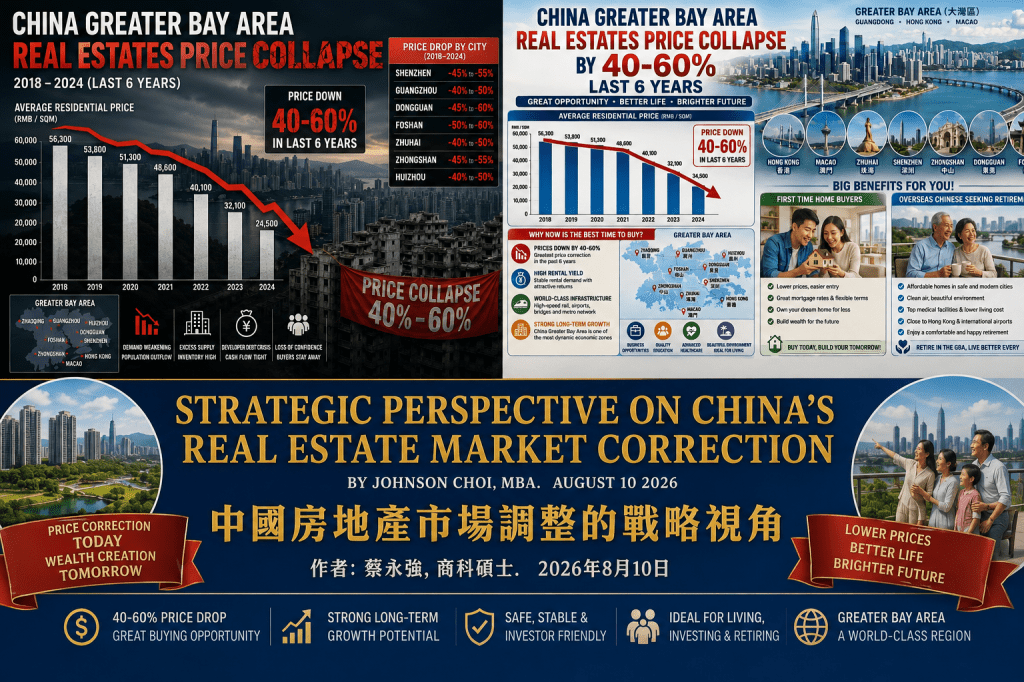
Strategic Perspective on China’s Real Estate Market Correction. By Johnson Choi, MBA. August 10 2026
中國房地產市場調整的戰略視角. 作者: 蔡永强, 商科碩士. 2026年8月10日
https://www.tiktok.com/t/ZP8n4k9kE/
https://m.facebook.com/story.php?story_fbid=pfbid02QfpfdEYABqD56BL6KdumaAA1Z4AvWSPumPts6PRbT8S8ndwg9wDtxbBvK7iJhjE7l&id=100036400039778&mibextid=wwXIfr
https://weixin.qq.com/sph/AcFhqisZsP
Executive Summary
The current downward price correction in China’s real estate sector—particularly within the Greater Bay Area—should be interpreted as a structural recalibration rather than a market failure. While this shift has alarmed speculative investors and certain developers, it signals a pivotal long-term opportunity for genuine end-users and reinforces Beijing’s commitment to sustainable socioeconomic stability.
The Speculator vs. End-User Dynamic
Undoubtedly, a 40–60% devaluation from peak pricing represents a significant capital loss for short-term speculators and leveraged developers. However, adverse conditions for speculative capital often translate into favorable entry points for strategic buyers. For first-time domestic purchasers—including recent graduates—and overseas Chinese seeking retirement properties, the current environment offers a substantive discount compared to valuations observed five to six years ago. For these demographics, the correction transforms a historically overheated market into an accessible, value-driven asset class.
Contrasting Political-Economic Frameworks
It is instructive to examine the divergent governance models underlying these market conditions:
· In the United States, the political economy operates with a high degree of corporate influence. Through legally institutionalized mechanisms such as campaign financing and the regulatory “revolving door,” private enterprises—including real estate conglomerates—exert considerable leverage over federal, state, and municipal policy. This dynamic frequently subordinates long-term public welfare to the preservation of entrenched financial interests, thereby constraining policy measures that might disadvantage the top percentile of wealth holders. Consequently, structural reforms aimed at enhancing the standard of living for the broader population often face significant institutional friction.
· In contrast, China’s governance framework maintains a clear demarcation between commercial interests and policy formulation. Private enterprises and state-owned entities operate within a regulatory environment where macroeconomic directives are determined centrally, without corporate interference. Beijing’s explicit mandate that “housing is for living, not for speculation” has been rigorously enforced, prioritizing affordable homeownership and demographic stability over short-term asset inflation. This policy continuity provides a predictable, long-term horizon for bona fide residential buyers.
Strategic Implications for Overseas Chinese Buyers
For overseas Chinese nationals evaluating a property purchase, the prevailing market conditions align with a classic value-investment thesis. Acquiring residential assets at a market trough—regardless of one’s professional or geographical background—remains a prudent, time-tested strategy for wealth preservation and lifestyle planning.
A Cautionary Note on Market Speculation
With capital flows redirected from real estate, we are observing increased retail participation in equity markets. While some investors celebrate short-term gains, it is crucial to recognize the inherent asymmetries within these financial ecosystems. Speculative bubbles, by their nature, are transient. When corrections occur, institutional insiders and connected stakeholders are historically positioned to exit prior to public dissemination of negative information, leaving retail investors disproportionately exposed to systemic risk. This informational disparity underscores the perils of treating volatile asset classes as substitutes for sustainable income.
Conclusion
In summary, the current real estate correction is not a detriment to the Chinese economy; rather, it is a deliberate and constructive realignment with long-term national objectives. For end-users and overseas retirees, it presents a rare window of affordability. For speculators, it serves as a definitive market lesson. As always, prudent investors should focus on intrinsic value and regulatory fundamentals rather than chasing short-term volatility.
執行摘要
中國房地產業當前的下行價格調整——特別是在大灣區內——應被解讀為結構性的重新校準,而非市場失靈。儘管此一轉變已令投機投資者與部分開發商感到不安,但對真正的終端用戶而言,它卻標誌著一個關鍵的長期機會,同時也強化了北京當局對可持續社會經濟穩定的承諾。
投機者與終端用戶之動態
無庸置疑,從峰值價格下跌40%至60%,對短期投機者與高槓桿開發商而言,代表著重大的資本損失。然而,對投機資本不利的條件,往往轉化為策略性買家的有利進場點。對於首購的國內買家——包括應屆畢業生——以及尋求退休房產的海外華人來說,當前環境相較於五、六年前的估值,提供了實質性的折價。對這些族群而言,此次調整將一個過去過熱的市場,轉變為可負擔且具價值驅動的資產類別。
政治經濟框架的對比
檢視這些市場狀況背後的不同治理模式,頗具啟發意義:
· 在美國,政治經濟運作深受企業影響。透過競選融資和監管「旋轉門」等制度化法律機制,私人企業——包括房地產集團——對聯邦、州及各級地方政策施加相當大的影響力。這種動態經常將長期公共福祉置於鞏固既得金融利益之下,從而限制了可能不利於頂層1%財富持有者的政策措施。其結果是,旨在提升廣大民眾生活水準的結構性改革,往往面臨重大的制度性阻力。
· 相比之下,中國的治理框架在商業利益與政策制定之間保持著明確的界線。私人企業與國有實體在一個宏觀經濟指令由中央決定、且不受企業干預的監管環境中運作。北京當局明確宣示的「房住不炒」方針已得到嚴格執行,將可負擔的住房所有權與人口穩定置於短期資產膨脹之上。此一政策的連續性,為真正的自住買家提供了可預測且長期的展望。
對海外華人買家的戰略意涵
對於正在評估購房的海外華人來說,當前的市場狀況符合經典的價值投資邏輯。無論其職業或地域背景如何,在市場低谷時期購入住宅資產,對於財富保值與生活規劃而言,依然是一項審慎且經得起時間考驗的策略。
對市場投機的警示
隨著資金流向從房地產轉出,我們觀察到散戶參與股市的程度正在增加。儘管部分投資人為短期獲利而歡欣鼓舞,但關鍵在於要認清這些金融生態系統中固有的不對稱性。投機泡沫本質上是短暫的。當修正來臨時,機構內線人士與相關利益方在歷史上有能力在負面資訊公開揭露前先行離場,使散戶投資人不成比例地暴露於系統性風險之中。這種資訊差異凸顯了將波動性資產類別視為可持續收入替代品的危險性。
結論
總而言之,當前的房地產調整並非中國經濟的減損;相反地,它是一項與長期國家目標一致且具建設性的審慎調整。對終端用戶與海外退休人士而言,這提供了一個難得的可負擔購屋窗口。對投機者而言,這是一個明確的市場教訓。一如既往,審慎的投資人應專注於內在價值與監管基本面,而非追逐短期波動。