Prompted by constant betrayals of US, EU strives to enhance strategic autonomy by Jian Junbo Oct 29 2021
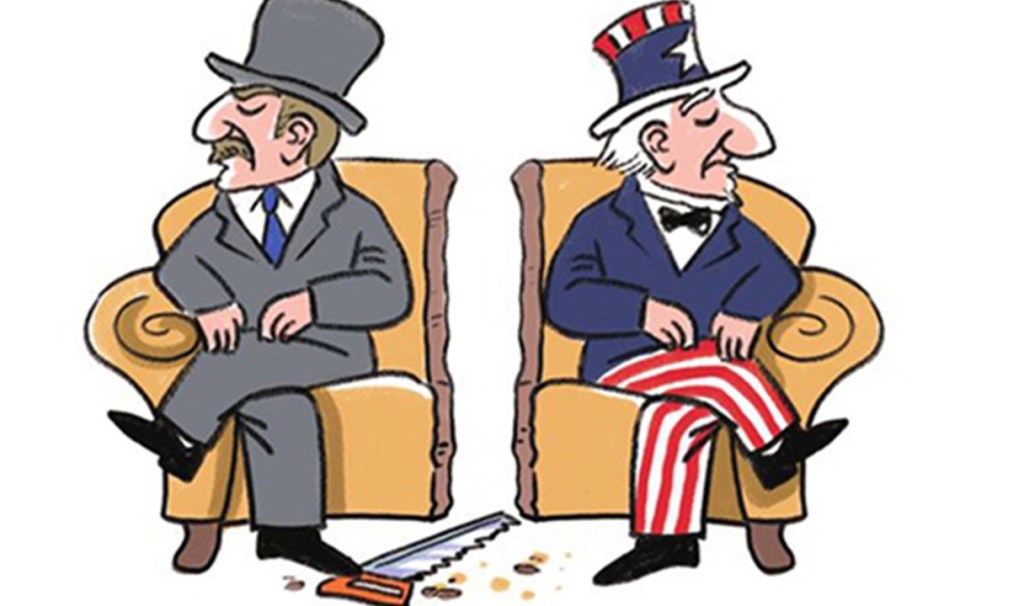
The troubled trans-Atlantic alliance was not formed in one day. Analysts keep asking, “Are the US and Europe breaking up?”, as European countries constantly find themselves betrayed by their US ally. What’s worse, “The US and Europe cannot stand shoulder to shoulder unless they agree on the threats that democracies now confront. But in too many areas, they don’t,” asserted a recent opinion piece in the Wall Street Journal.
The latest betrayal by the US fell on France in September. This came with the pushing of a US multibillion-dollar deal to supply nuclear submarine technology to Australia. Another recent example is the embarrassing mess the US dragged its NATO allies into as it hastily withdrew from Afghanistan. This, too, generated loud and persistent criticism within Europe.
There are numerous more cases that show how the US pursues its own interests at the cost of Europe. In May, the media reported how Denmark collaborated with US spy agency to collect information about European politicians from Germany, France, Sweden and Norway. Nord Stream 2, a project that would pipe natural gas from Russia under the Baltic Sea to Germany, has suffered major assaults from the US since its very beginning. Former US president Donald Trump escalated the trade fight with Europe by imposing tariffs on European steel and aluminum in 2018.
In the face of Washington’s constant betrayals, Brussels will certainly try to strengthen the EU’s strategic autonomy. The EU and its main members, such as France, have been emphasizing European strategic autonomy since around 2007 due to the US’ betrayals, unilateralist behaviors, and the Eastward shift of the strategic focus in its diplomacy. They aim to truly shape Europe’s independent foreign policy and operational capacity and become free from dependence on major international powers, including the US.
Currently, in terms of building strategic autonomy, the EU has launched the Permanent Structured Cooperation and the vision of the Strategic Compass. It has also established the European Defence Fund in its medium- and long-term budgets.
In the economic arena, the EU has proposed to promote the autonomy of industrial chains and established the European Raw Materials Alliance. Moreover, it attempted to introduce a carbon border tax and included human rights and environmental standards into foreign trade and economic relations.
Politically, the EU emphasizes the place of European values and ideology in foreign relations. It does so while expanding European standards and norms in global governance. Regarding geopolitics, it has started to emphasize competition and tried to make the European Commission a “geopolitical commission” that highlights the competition for power.
The EU’s willingness and practice to enhance European autonomy in all aspects and fields will change the traditional US-EU alliance, to a certain extent. However, as the EU strengthens its autonomy, it will also enhance its cooperation with the US in certain areas, even if constantly betrayed by the latter. This is because the EU will and cannot really get rid of the trap of the US-EU alliance.
For example, Europe’s defense autonomy, the most important part of its strategic self interest, faces several difficulties to make any substantial breakthroughs. This includes huge expenses, technical difficulties around weapons, internal contradictions, military buildup problems, and complicated relations with NATO.
In other areas, Europe cannot be truly independent from the US as well. In fact, the two sides are a community of interests in many areas. In the economic and trade fields, for instance, the US and the EU are willing to cooperate to strengthen the autonomy of their industrial chain. They also jointly maintain the “rules-based liberal international system” dominated by the West. In addition, in the face of China’s rise, the US and Europe have common interests to join forces to compete with China, and even to confront it in certain areas.
In general, the US not only shares the same ideology with the EU, but also provides the latter with defense security. Moreover, both sides enjoy huge common interests in maintaining the current West-led international economic order and multilateral mechanisms. All these factors have decided that there will not be a fundamental change in the US-EU alliance, despite the betrayal of Washington.
However, as the international pattern changes and the US moves the center of its strategy more toward the Indo-Pacific region, the betrayal of the US will stimulate the EU to enhance its strategic autonomy further. This will, to a certain extent, give new meanings to traditional transatlantic relations. It may very well have a greater impact on the international community too.
The author is a research fellow at the Center for China-EU Relations at Fudan University. opinion@globaltimes.com.cn
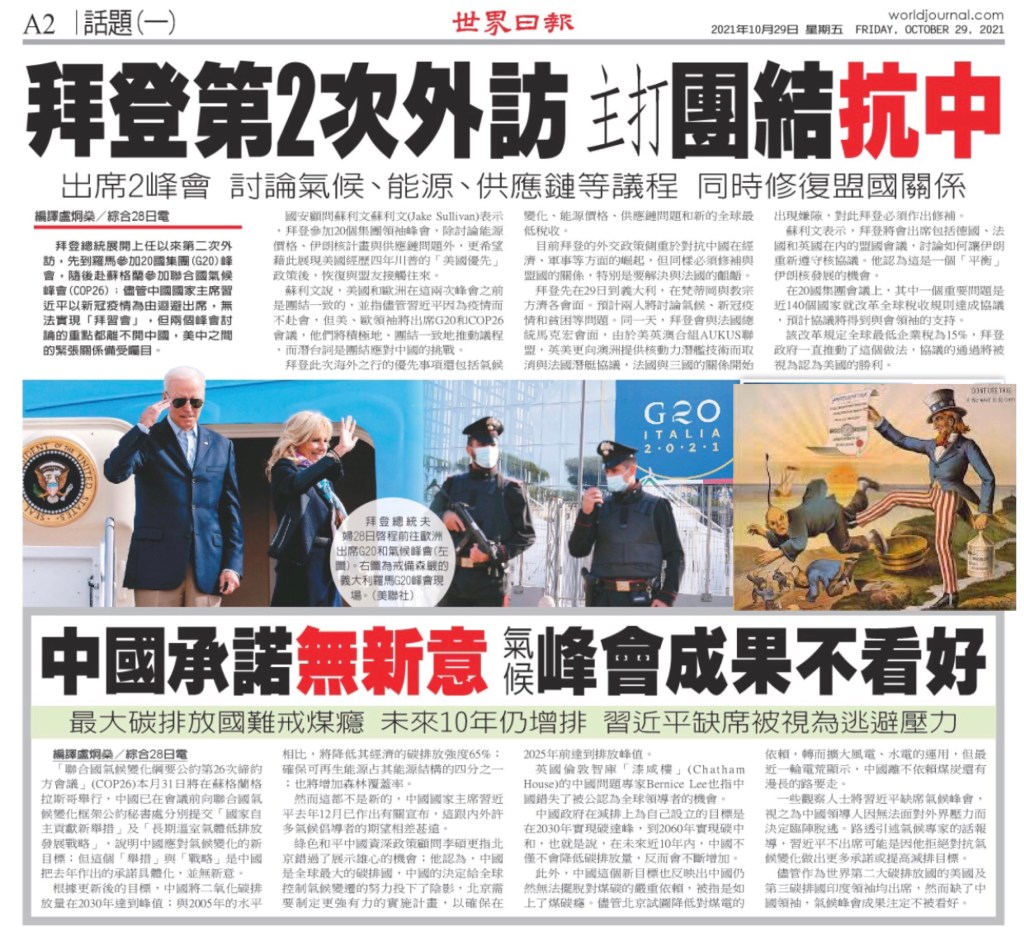
Biden 2nd out of country trip focus on uniting the AngloSaxon world forming anti-China Alliance stopping China rise at all cost by any means. 拜登第二次外訪的重點是團結盎格魯撒克遜(西人)世界,形成反華聯盟,不惜一切代價阻止中國崛起. World Journal Newspaper San Francisco 美國加州舊金山世界日報 10-29-2021
If you had any hopes that Biden is dialing down, see the Hybrid warfare emanating from the House Financial services Committee.
Mixture of rhetorical excess, performative theater, wonkish expertise, total delusion and massive threat inflation.
China is harming and destroying confidence in the US public capital markets, “the crown jewel” of the US economy.
This threatens to Nat’l security. Sanctions necessary.
Lack of transparency, non-disclosure, co-mingling of funds, fraudulent accounting, non-compliance, rule-breaking, free-riding, government interference, selective access, HR abuses, XJ slavery, Tibet, property rights not respected, boards not responsive to shareholders, VIES/shell companies and phony names,etc.
20: CRS; Selective openings, passive investments, 26: PCAOB: non compliance40: Dual class shares: Maxine Waters. undermining investor confidence. Should we question China when we do the same? 48: Seriousness: Financial Tiananmen53: Horsing around: how serious this issue is. 99:: Sanctions & reparations for Covid. Must counter malign Chinese acts. HFCA act. 106: Chinese collapse from fixed asset growth; systemic risks and global shock–Chinese gov’t responsible111: Surveillance state authoritarianism and predatory BRI144: Chinese leaving? XPCC sanctions. SCS148: Evergrande: gov’t is investor and regulator–systemic risk138: Hypocrisy? Threat is real. PCOB. Communist China is surrounding Japan.155: XJ–xpcc runs concentration camps.159: CPC is existential threat; MIC 2025; forced tech transfer
This US foster home no longer welcome Chinese, if you are members of the Chinese science community, China welcome you home. 這個美國寄養家庭不再歡迎中國人,如果你是中國科學界的成員,中國歡迎你回家.
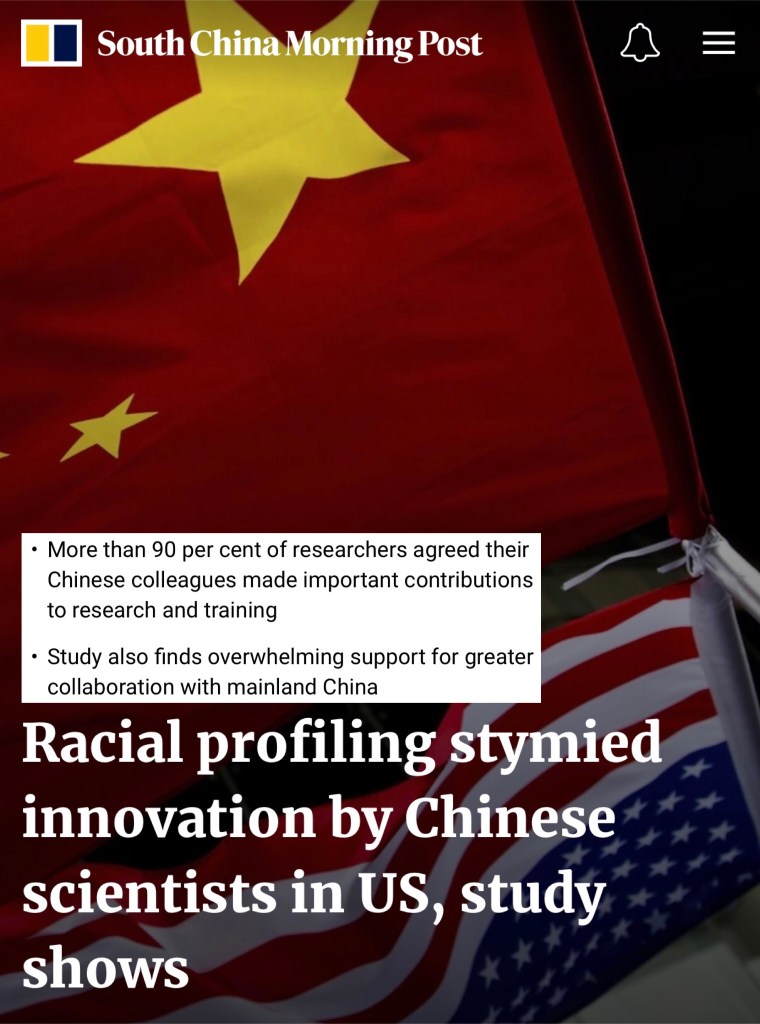
JUST ANNOUNCED: New Research Reveals Racial Profiling Among Scientists of Chinese Descent and the Consequences for the U.S. Scientific Community 剛剛宣布:新研究揭示了種族歧視華裔科學家的種族特徵以及對美國科學界的影響.
New York, NY and Tucson, AZ (October 28, 2021) — Committee of 100, a non-profit membership organization of prominent Chinese Americans, and the University of Arizona, one of the leading research universities in the country, unveiled findings today from a joint research project that focused on race and ethnicity in science and research.
The white paper “Racial Profiling Among Scientists of Chinese Descent and Consequences for the U.S. Scientific Community” showcases the survey results and data which demonstrate a consistent pattern of racial profiling in science and research. Scientists of Chinese descent and of Asian descent report far greater racial profiling from the U.S. government, difficulty in obtaining research funds, professional challenges and setbacks, and fear and anxiety that they are surveilled by the U.S. government, compared to non-Asian scientists.
Committee of 100 and the University of Arizona administered a nationwide blind survey to scientists both of Chinese and non-Chinese descent including faculty, postdocs, graduate students at top U.S. colleges and universities over the Summer of 2021. The final sample consisted of 1,949 scientists across the country.
The survey data also shows that the China Initiative is producing a wave of fear among scientists of non-Chinese descent as well, where scientists have described cutting ties with their collaborators in China, no longer hiring Chinese postdocs, and limiting communications with scholars in China, even at the expense of their own research projects.
Scientists of Chinese descent indicate in the survey that they have purposely not pursued federal funding for projects for fear of increased scrutiny, compared to scientists of non-Chinese descent. This can lead to smaller teams, downsizing of projects, and working with reduced resources. Scientists of Chinese descent have also started to consider working in less hostile climates outside the U.S., which could affect talent retention. The enrollment of new international graduate students from China has already been declining.
“What is clear from this research is that U.S. scientists and researchers of Chinese descent and non-Chinese descent experience the world and their work very differently because of racism, stereotypes, xenophobia, and government policies,” said Dr. Jenny J. Lee, Professor in the Center for the Study of Higher Education, College of Education, at the University of Arizona. “We thank the Committee of 100 for teaming with us at the University of Arizona to help shed light on a significant issue that directly impacts how research across the U.S. is conducted and advanced.”
“The U.S. is the global leader in scientific research, yet suspicions of scientists of Chinese descent in the U.S. have made progress and exchange more difficult,” said Zheng Yu Huang, President of Committee of 100. “Government policies have a direct correlation with and impact on advancements in life-saving innovation and technological breakthroughs. We need to move beyond the stereotypes of the perpetual foreigner and halt the xenophobia being directed at Chinese Americans and the entire AAPI community. We at Committee of 100 want to thank Dr. Jenny Lee and the University of Arizona for collaborating with us on important work that showcases the deleterious impact of racial profiling in science and research.”
Key data points pulled from the report: Overall, scientists of Chinese descent and non-Chinese descent both recognize the value of scientists of Chinese descent and support collaboration with China. 96.8% of scientists of Chinese descent and 93.6% of scientists of non-Chinese descent believe that scientists of Chinese descent make important contributions to research and teaching programs in the U.S.
42.2% of scientists of Chinese descent feel racially profiled by the U.S. government, while only 8.6% of scientists of non-Chinese descent feel so.
38.4% of scientists of Chinese descent experience more difficulty in obtaining funding for research projects in the U.S. as a result of their race/ethnicity/country of origin, compared to only 14.2% of scientists of non-Chinese descent.
50.7% of scientists of Chinese descent feel considerable fear and/or anxiety that they are being surveilled by the U.S. government, compared to only 11.7% of scientists of non-Chinese descent.
39.7% of scientists of Chinese descent believe the U.S. should be tougher on China to prevent the theft of intellectual property, while 74.8% of scientists of non-Chinese descent feel so.
Among those who had reported conducting research that involves China over the past 3 years, a higher percentage of the scientists of Chinese over non-Chinese descent reported limiting communication with collaborators in China (40.6% vs. 12.8%), deciding not to involve China in future projects (23.8% vs. 5.8%), and deciding not to work with collaborators in China in the future projects (23.2% vs. 9.7%).
Among those whose research with China was prematurely suspended over the past three years, 78.5% of scientists of Chinese descent wanted to distance themselves from collaborators in China due to the China Initiative, compared to 27.3% of scientists of non-Chinese descent.
Among non-U.S. citizen scientists in the sample, 42.1% of the scientists of Chinese descent indicate that the FBI investigations and/or the China Initiative affected their plans to stay in the U.S., while only 7.1% of the scientists of non-Chinese descent report so.
Dr. David Ho, Scientific Director, Aaron Diamond AIDS Research Center; Director, Wu Family China Center; Professor of Medicine and Microbiology & Immunology at Columbia University Vagelos College of Physicians and Surgeons; and Committee of 100 Member, stated about the research findings, “Scientific and educational exchanges are enormously beneficial to both U.S. and China. Full stop. Any unwarranted restriction or deterrent to open collaborations impedes scientific progress and technological development on both sides of the Pacific. Like so many other scientists, educators, and institutions of higher learning, I strongly urge our government to terminate the China Initiative. This initiative is deeply flawed not only because of its racist bent but also because it strangles the spirit of scientific research. For decades, American science and engineering have depended heavily on talent from abroad, including those from China. There is no doubt that the China Initiative is driving Chinese talent away from the U.S. and damaging our overall competitiveness.”
Quotes submitted by survey participants:
“Even though I do not work in a sensitive field nor do I deal with any privileged or proprietary information, I am increasingly hesitant to interact or collaborate with scientists from China for fear it may be misconstrued by overzealous authorities as a conflict of national interest.” (Chinese American Associate Professor, Biophysics)
“I am less willing to pursue and be involved in research funded by federal or state government agencies as such research may attract special and unjustified scrutiny by the government authorities.” (Chinese Associate Professor, Environmental Science)
“As a Chinese professor who is trained and has been working in the U.S. for nearly 20 years, these investigations and restrictions against Chinese scholars make me feel unwelcome and somewhat discriminated and I sometimes feel my Chinese identity may be the limiting factor for my career advancement in the U.S. In the past few years, I felt for the first time since I have been in the U.S. that Chinese scientists are not valued as much as before and politics is intervening academic freedom. This makes me seriously consider moving to China if the current trend continues or even worsens.” (Chinese Associate Professor, Chemistry)
“We don’t do anything wrong. Science has no borders. International collaborations should be encouraged. But under the DOJ China Initiative, who knows what will happen?” (Chinese American Professor, Mathematics)
About Committee of 100 Committee of 100 is a non-profit U.S. leadership organization of prominent Chinese Americans in business, government, academia, healthcare, and the arts focused on public policy engagement, civic engagement, and philanthropy. For over 30 years, Committee of 100 has served as a preeminent organization committed to the dual missions of promoting the full participation of Chinese Americans in all aspects of American life and constructive relations between the United States and Greater China. Visit https://www.committee100.org/ or follow Committee of 100 on LinkedIn, Twitter and Facebook for more information.
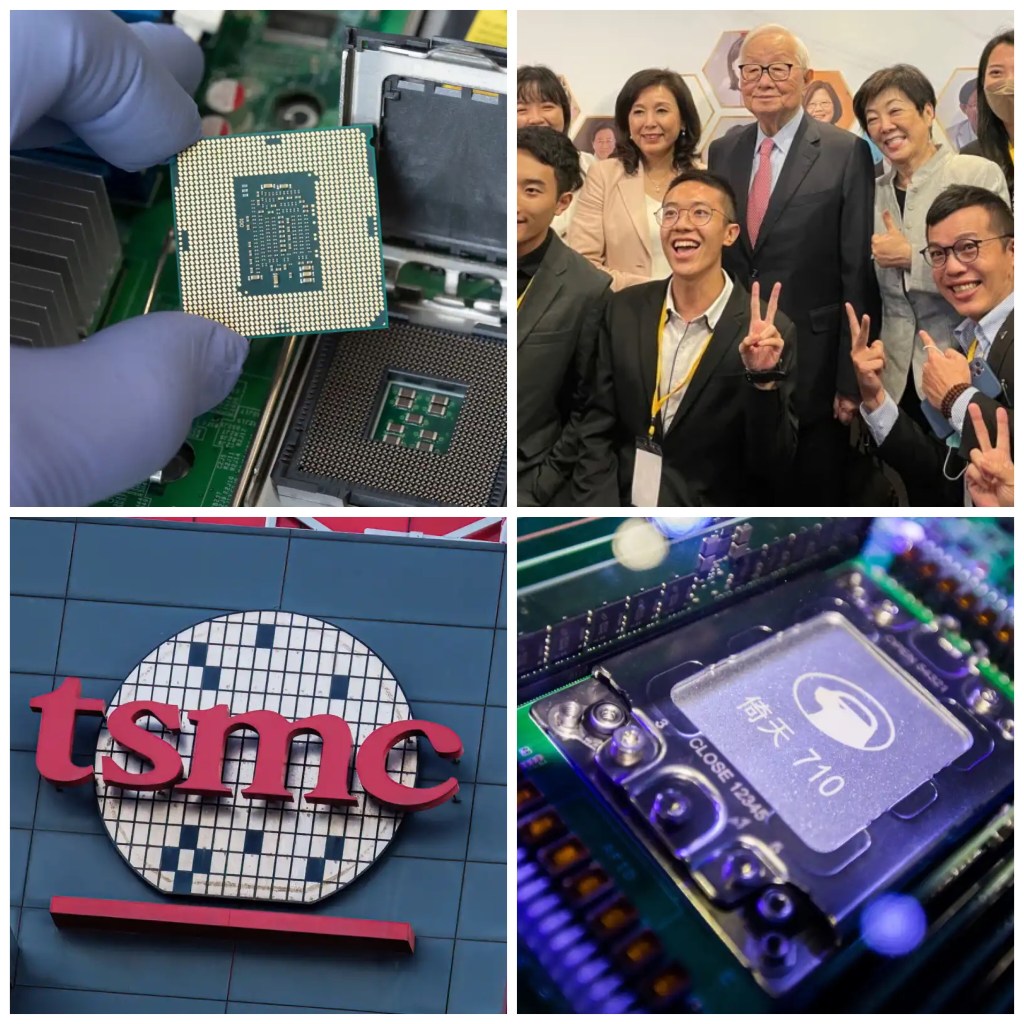
US to bring more chip production home by force. TSMC founder chides US plan for full chip supply chain onshore – TSMC founder calls domestic push unfeasible, $52bn in subsidies far too little 華盛頓將通過武力將更多芯片生產帶到美國。 台積電創始人指責美國在岸全芯片供應鏈計劃, 台積電創始人稱國內推動不可行,520億美元補貼太少by CHENG TING-FANG and LAULY LI, Nikkei, Oct 27, 2021
TAIPEI — As U.S. lawmakers look to invest $52 billion in the American chip industry, the founder of Taiwan Semiconductor Manufacturing Co. calls the plan far too small for rebuilding a complete supply chain in the country.
Morris Chang, an American citizen who founded the company that is now the world’s most valuable chipmaker, says it would be impossible for the U.S. to have a full chip supply chain onshore even if it spent far more — and that such a move may not be financially desirable in any case.
“If you want to reestablish a complete semiconductor supply chain in the U.S., you will not find it as a possible task,” Chang told a tech industry forum in Taipei on Tuesday night. “Even after you spend hundreds of billions of dollars, you will still find the supply chain to be incomplete, and you will find that it will be very high cost, much higher costs than what you currently have.”
The U.S. accounted for 37% of global semiconductor manufacturing in the 1990s, but has fallen to 12%, Semiconductor Industry Association data shows.
Washington is campaigning to bring more chip production onto American soil, amid concern about an overreliance on Taiwan. The U.S. Senate this year passed a $52 billion bill to support domestic semiconductor manufacturing and R&D, though the package has yet to become law.
Taiwan Semiconductor Manufacturing Co. founder Morris Chang, center, attends a tech industry forum on Oct. 26 in Taipei.
Chang, who retired from TSMC in 2018, claimed that some people arguing for bringing the chip supply chain onshore are driven by self-interest. Intel CEO Pat Gelsinger advocates for more manufacturing in the U.S. as “it is not safe in Taiwan and it is not safe in South Korea,” Chang said, while Intel hopes to secure funding from the $52 billion subsidy package.
Rethinking the supply chain will be a challenge for everyone, Chang said.
“In the past, companies in the U.S. or in Asia were growing and prospering thanks to globalization and free trade,” he said. Chang cited Thomas Friedman’s book, “The World Is Flat,” in which the commentator analyzes globalization and the opportunities it creates for nations.
“Well, Tom, the world is not flat anymore,” he said. “This is going to be a challenge for the Asian semiconductor industry, global semiconductor industry, including Intel.”
Chang’s comments Tuesday were the first time he directly and publicly questioned Washington’s efforts to rebuild semiconductor manufacturing. His criticism comes despite TSMC’s move to build an advanced chip facility in the U.S. state of Arizona in response to the government’s campaign.
Previously, Chang had said government efforts around the world to increase chip production could backfire, without specifying which countries. Sandra Oudkirk, director of the American Institute in Taiwan and the top U.S. diplomat in Taipei, was among the audience at the industry forum.
Europe, Japan and China also are gearing up to boost production at home, offering government aid to ensure that chips — which enable devices from smartphones to military techs — will remain within their countries.
TSMC recently announced that the company will build its first chip facility in Japan, where Prime Minister Fumio Kishida said his government will support large-scale private-sector investment.
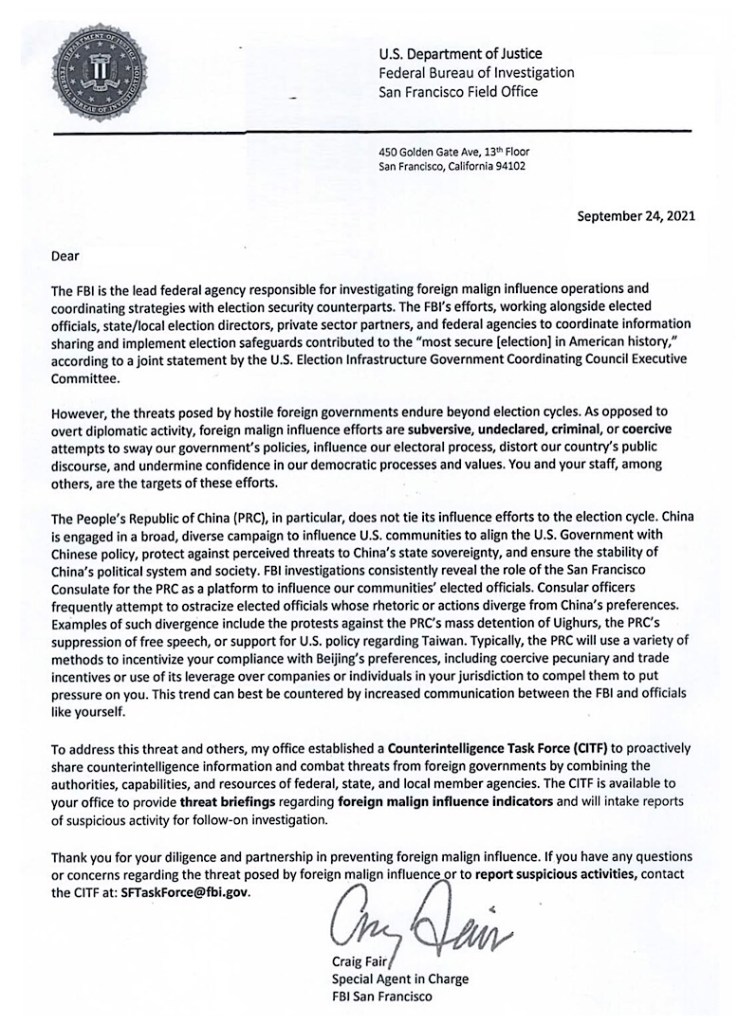
FBI is serving notice to the Chinese community in US: you are being targeted and watched. If you support US foreign agent English Tsai is fine. If you object her in US, you might have to pay a price! 美國聯邦調查局正在向華人社區發出通知:您正在成為目標並被監視。如果你支持漢奸蔡英文, 無問題. 如果你反對她, 後果自負!
The FBI letter not to our group, but to leaders in the Chinese Community in San Francisco. I am the President of China Hawaii Chamber of Commerce. I was visited by FBI for 2 consecutive years in Hawaii 10 years ago asking me similar things, except Taiwan because it was not an issue at that time. There are 400+ FBI agents in Hawaii watching all Chinese and military bases in Hawaii – I was told by the 4 FBI agents visited me 10 years ago. (Feel like Nazi watching the Jews during WWII)
That is what Chinese facing in US today. The rise of China makes Chinese enemies of the States, the United States.
We hope the 5 millions Chinese in US will not ends up in the gas chambers.
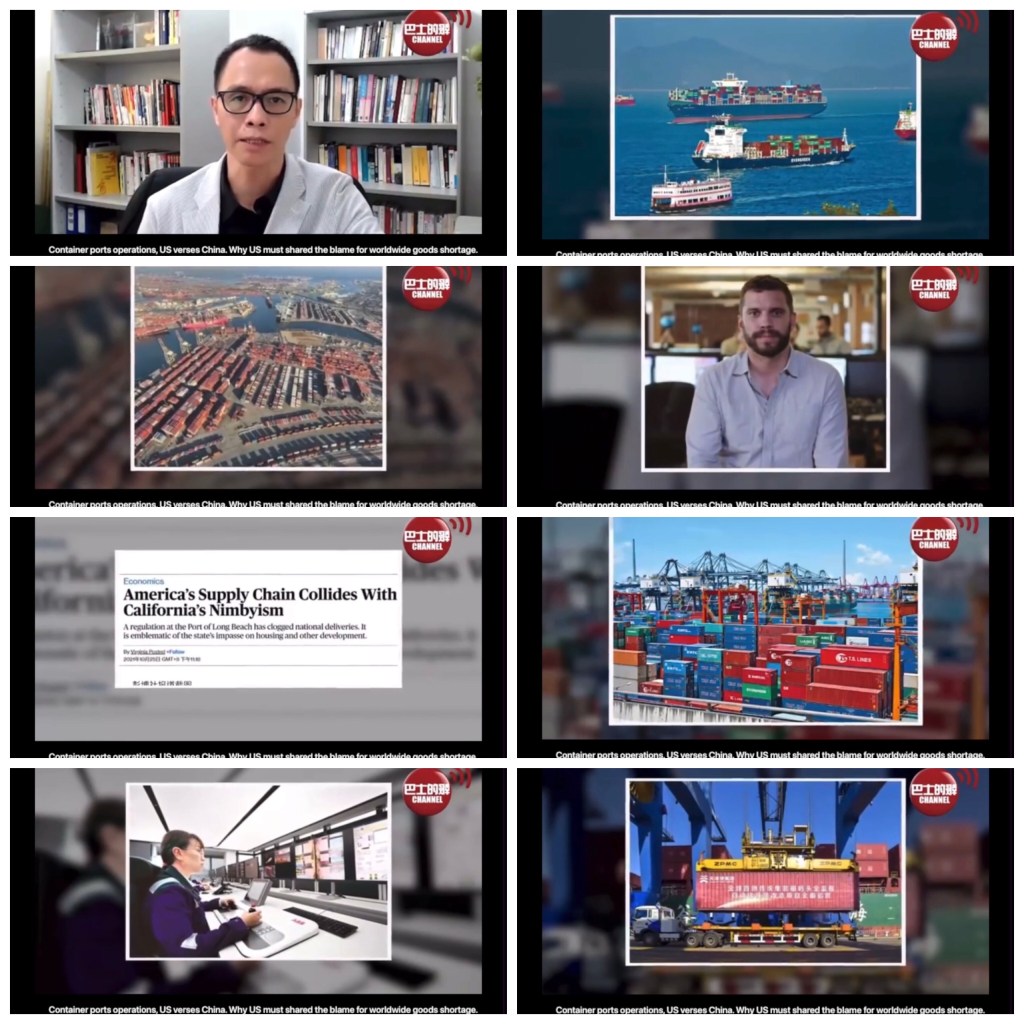
Two days ago in SF we had a zoom meeting. One of the topics were cost of shipping went up 10-20x and worldwide logistics problems. 兩天前,我們在三藩市舉行了一次視頻會議。 其中一個主題是運輸成本上漲了 10-20 倍,以及全球物流問題。
Long Beach and Los Angeles containers ports handles 40% of US import and export. Both ports are at least 20 years behinds time. No automation, AI and still run by people at exceptional high wages. As a result, hundreds of containers ships and hundreds of thousands of containers are parked outside the ports unable to load and unload containers. 長灘和洛杉磯集裝箱港口處理美國 40% 的進出口。 這兩個港口都至少落後了 20 年。 沒有自動化,人工智能,仍然由高薪的人經營。 結果,數百艘集裝箱船和數十萬個集裝箱停在港口外,無法裝卸集裝箱
In China, containers ports are completely automated, no need dock workers, runs by AI, 5G and Baidu Satallites and containers trucks are driverless. COVID19 has absolutely no effect on its operations 24/7. 在中國,集裝箱港口是完全自動化的,不需要碼頭工人,由人工智能、5G和百度衛星運行,集裝箱卡車是無人駕駛的。 COVID19 對其 24/7 的運營絕對沒有影響.
US military is mercenaries for US Fortune 500 companies funded by US taxpayers. Against Empire – Intervention: Whose gain? Whose pain? 美國軍隊是美國納稅人資助的美國財富500強公司的僱傭兵。 反對帝國 – 干預:誰的收益? 誰的痛?by Michael Parenti
US prides itself on its military. Although it only ranks third for the largest army in the world, it has the highest military spending worldwide, peaking at $778 billion in 2020 and dwarfing China’s mere $252 billion.
A Global Military Empire – The exercise of U.S. power is intended to preserve not only the international capitalist system but U.S. hegemony of that system. The Pentagon’s “Defense Planning Guidance” draft (1992) urges the United States to continue to dominate the international system by “discouraging the advanced industrialized nations from challenging our leadership or even aspiring to a larger global or regional role.” By maintaining this dominance, the Pentagon analysts assert, the United States can insure “a market-oriented zone of peace and prosperity that encompasses more than two- thirds of the world’s economy”.
In the name of fake democracy human rights and rules of laws
U.S. leaders profess a dedication to democracy. Yet over the past five decades, democratically elected reformist governments in Guatemala, Guyana, the Dominican Republic, Brazil, Chile, Uruguay, Syria, Indonesia (under Sukarno), Greece, Argentina, Bolivia, Haiti, and numerous other nations were overthrown by pro-capitalist militaries that were funded and aided by the U.S. national security state.
Since World War II, U.S. forces have directly invaded or launched aerial attacks against Vietnam, the Dominican Republic, North Korea, Laos, Cambodia, Lebanon, Grenada, Panama, Libya, Iraq, and Somalia, sowing varying degrees of death and destruction.
Before World War II, U.S. military forces waged a bloody and protracted war of conquest in the Philippines in 1899-1903. Along with fourteen other capitalist nations, the United States invaded socialist Russia in 1918-21. U.S. expeditionary forces fought in China along with other Western armies to suppress the Boxer Rebellion and keep the Chinese under the heel of European and North American colonizers. U.S. Marines invaded and occupied Nicaragua in 1912 and again in 1926 to 1933; Cuba, 1898 to 1902; Mexico, 1914 and 1916; Honduras, six invasions between 1911 to 1925; Panama, 1903-1914, and Haiti, 1915 to 1934.
Why Intervention? Why has a professedly peace-loving, democratic nation found it necessary to use so much violence and repression against so many peoples in so many places? An important goal of U.S. policy is to make the world safe for the Fortune 500 and its global system of capital accumulation. Governments that strive for any kind of economic independence or any sort of populist redistributive politics, who have sought to take some of their economic surplus and apply it to not-for-profit services that benefit the people–such governments are the ones most likely to feel the wrath of U.S. intervention or invasion.
The designated “enemy” can be a reformist, populist, military government as in Panama under Torrijo (and even under Noriega), Egypt under Nasser, Peru under Velasco, and Portugal under the MFA; a Christian socialist government as in Nicaragua under the Sandinistas; a social democracy as in Chile under Allende, Jamaica under Manley, Greece under Papandreou, and the Dominican Republic under Bosch; a Marxist-Leninist government as in Cuba, Vietnam, and North Korea; an Islamic revolutionary order as in Libya under Qaddafi; or even a conservative militarist regime as in Iraq under Saddam Hussein–if it should get out of line on oil prices and oil quotas.
The public record shows that the United States is the foremost interventionist power in the world. There are varied and overlapping reasons for this:
Protect Direct Investments. In 1907, Woodrow Wilson recognized the support role played by the capitalist state on behalf of private capital:
Since trade ignores national boundaries and the manufacturer insists on having the world as a market, the flag of his nation must follow him, and the doors of the nations which are closed against him must be battered down. Concessions obtained by financiers must be safeguarded by ministers of state, even if the sovereignty of unwilling nations be outraged in the process. Colonies must be obtained or planted, in order that no useful corner of the world may be overlooked or left unused.
Later, as president of the United States, Wilson noted that the United States was involved in a struggle to “command the economic fortunes of the world.”
During the late nineteenth and early twentieth centuries, large U.S. investments in Central America and the Caribbean brought frequent military intercession, protracted war, prolonged occupation, or even direct territorial acquisition, as with Hawaii, Puerto Rico, and the Panama Canal Zone. The investments were often in the natural resources of the country: sugar, tobacco, cotton, and precious metals. In large part, the interventions in the Gulf in 1991 (see chapter six) and in Somalia in 1993 (chapter seven) were respectively to protect oil profits and oil prospects.
In the post cold-war era, Admiral Charles Larson noted that, although U.S. military forces have been reduced in some parts of the world, they remain at impressive levels in the Asia-Pacific area because U.S. trade in that region is greater than with either Europe or Latin America. Naval expert Charles Meconis also pointed to “the economic importance of the region” as the reason for a major U.S. military presence in the Pacific (see Daniel Schirmer, Monthly Review, July/August 1994). In these instances, the sword follows the dollar.
Create Opportunities for New Investments. Sometimes the dollar follows the sword, as when military power creates opportunities for new investments. Thus, in 1915, U.S. leaders, citing “political instability,” invaded Haiti and crushed the popular militia. The troops stayed for nineteen years. During that period French, German, and British investors were pushed out and U.S. firms tripled their investments in Haiti.
More recently, Taiwanese companies gave preference to U.S. firms over Japanese ones because the U.S. military was protecting Taiwan. In 1993, Saudi Arabia signed a $6 billion contract for jet airliners exclusively with U.S. firms. Having been frozen out of the deal, a European consortium charged that Washington had pressured the Saudis, who had become reliant on Washington for their military security in the post-Gulf War era.
Preserving Politico-Economic Domination and the International Capital Accumulation System. Specific investments are not the only imperialist concern. There is the overall commitment to safeguarding the global class system, keeping the world’s land, labor, natural resources, and markets accessible to transnational investors. More important than particular holdings is the whole process of investment and profit. To defend that process the imperialist state thwarts and crushes those popular movements that attempt any kind of redistributive politics, sending a message to them and others that if they try to better themselves by infringing upon the prerogatives of corporate capital, they will pay a severe price.
In two of the most notable U.S. military interventions, Soviet Russia in 1918-20 and Vietnam in 1954-73, most of the investments were European, not American. In these and other such instances, the intent was to prevent the emergence of competing social orders and obliterate all workable alternatives to the capitalist client-state. That remains the goal to this day. The countries most recently targeted being South Yemen, North Korea, and Cuba.
Ronald Reagan was right when he avowed that his invasion of Grenada was not to protect the U.S. nutmeg supply. There was plenty of nutmeg to be got from Africa. He was acknowledging that Grenada’s natural resources were not crucial. Nor would the revolutionary collectivization of a poor nation of 102,000 souls represent much of a threat or investment loss to global capitalism. But if enough countries follow that course, it eventually would put the global capitalist system at risk.
Reagan’s invasion of Grenada served notice to all other Caribbean countries that this was the fate that awaited any nation that sought to get out from under its client-state status. So the invaders put an end to the New Jewel Movement’s revolutionary programs for land reform, health care, education, and cooperatives. Today, with its unemployment at new heights and its poverty at new depths, Grenada is once again firmly bound to the free market world. Everyone else in the region indeed has taken note.
The imperialist state’s first concern is not to protect the direct investments of any particular company, although it sometimes does that, but to protect the global system of private accumulation from competing systems. The case of Cuba illustrates this point. It has been pointed out that Washington’s embargo against Cuba is shutting out U.S. business from billions of dollars of attractive investment and trade opportunities. From this it is mistakenly concluded that U.S. policy is not propelled by economic interests. In fact, it demonstrates just the opposite, an unwillingness to tolerate those states that try to get out from under the global capitalist system.
The purpose of the capitalist state is to do things for the advancement of the entire capitalist system that individual corporate interests cannot do. Left to their own competitive devices, business firms are not willing to abide by certain rules nor tend to common systemic interests. This is true both for the domestic economy and foreign affairs. Like any good capitalist organization, a business firm may have a general long-range interest in seeing Cuban socialism crushed, but it might have a more tempting immediate interest in doing a profitable business with the class enemy. It remains for the capitalist state to force individual companies back in line.
What is at stake is not the investments within a particular Third World country but the long-range security of the entire system of transnational capitalism. No country that pursues an independent course of development shall be allowed to prevail as a dangerous example to other nations.
Common Confusions – Some critics have argued that economic factors have not exerted an important influence on U.S. interventionist policy because most interventions are in countries that have no great natural treasures and no large U.S. investments, such as, Grenada, El Salvador, Nicaragua, and Vietnam. This is like saying that police are not especially concerned about protecting wealth and property because most of their actions take place in poor neighborhoods. Interventionist forces do not go where capital exists as such; they go where capital is threatened. They have not intervened in affluent Switzerland, for instance, because capitalism in that country is relatively secure and unchallenged. But if leftist parties gained power in Bern and attempted to nationalize Swiss banks and major properties, it very likely would invite the strenuous attentions of the Western industrial powers.
Some observers maintain that intervention is bred by the national-security apparatus itself, the State Department, the National Security Council, and the CIA. These agencies conjure up new enemies and crises because they need to justify their own existence and augment their budget allocations. This view avoids the realities of class interest and power. It suggests that policymakers serve no purpose other than policymaking for their own bureaucratic aggrandizement. Such a notion reverses cause and effect. It is a little like saying the horse is the cause of the horse race. It treats the national security state as the originator of intervention when in fact it is but one of the major instruments. U.S. leaders were engaging in interventionist actions long before the CIA and NSC existed.
One of those who argues that the state is a self-generated aggrandizer is Richard Barnet, who dismisses the “more familiar and more sinister motives” of economic imperialism. Whatever their economic systems, all large industrial states, he maintains, seek to project power and influence in a search for security and domination. To be sure, the search for security is a real consideration for every state, especially in a world in which capitalist power is hegemonic and ever threatening. But the capital investments of multinational corporations expand in a far more dynamic way than the economic expansion manifested by socialist or precapitalist governments.
In fact, the case studies in Barnet’s book Intervention and Revolution point to business, rather than the national security bureaucracies, as the primary motive of U.S. intervention. Anti- communism and the Soviet threat seem less a source for policy than a propaganda ploy to frighten the American public and rally support for overseas commitments. The very motives Barnet dismisses seem to be operative in his case studies of Greece, Iran, Lebanon, and the Dominican Republic, specifically the desire to secure access to markets and raw materials and the need, explicitly stated by various policymakers, to protect free enterprise throughout the world.
Some might complain that the foregoing analysis is “simplistic” because it ascribes all international events to purely economic and class motives and ignores other variables like geopolitics, culture, ethnicity, nationalism, ideology, and morality. But I do not argue that the struggle to maintain capitalist global hegemony explains everything about world politics nor even everything about U.S. foreign policy. However, it explains quite a lot; so is it not time we become aware of it? If mainstream opinion makers really want to portray political life in all its manifold complexities, then why are they so studiously reticent about the immense realities of imperialism?
The existence of other variables such as nationalism, militarism, the search for national security, and the pursuit of power and hegemonic dominance, neither compels us to dismiss economic realities, nor to treat these other variables as insulated from class interests. Thus, the desire to extend U.S. strategic power into a particular region is impelled at least in part by a desire to stabilize the area along lines that are favorable to politico-economic elite interests–which is why the region becomes a focus of concern in the first place.
In other words, various considerations work with circular effect upon each other. The growth in overseas investments invite a need for military protection. This, in turn, creates a need to secure bases and establish alliances with other nations. The alliances now expand the “defense” perimeter that must be maintained. So a particular country becomes not only an “essential” asset for our defense but must itself be defended, like any other asset.
Inventing Enemies
As noted in the previous chapter, the U.S. empire is neoimperialist in its operational mode. With the exception of a few territorial possessions, U.S. overseas expansion has relied on indirect control rather than direct possession. This is not to say that U.S. leaders are strangers to annexation and conquest. Most of what is now the continental United States was forcibly wrested from Native American nations. California and all of the Southwest USA were taken from Mexico by war. Florida and Puerto Rico were seized from Spain.
U.S. leaders must convince the American people that the immense costs of empire are necessary for their security and survival. For years we were told that the great danger we faced was “the World Communist Menace with its headquarters in Moscow.” U.S. citizens accepted a crushing tax burden to pay for “defense,” to win the superpower arms race and “contain Soviet aggression wherever it might arise.” Since the demise of the USSR, our political leaders have been warning us that the world is full of other dangerous adversaries, who apparently had been previously overlooked.
Who are these evil adversaries who wait to spring upon the USA the moment we drop our guard or the moment we make real cuts in our gargantuan military budget? Why do they stalk us instead of, say, Denmark or Brazil? This scenario of a world of enemies was used by the rulers of the Roman empire and by nineteenth- century British imperialists. Enemies always had to be confronted, requiring more interventions and more expansion. And if enemies were not to be found, they would be invented.
Americans have little cause to take pride in being part of “our” mighty empire, for what that empire does to peoples abroad is nothing to be proud of. And at home, the policies of empire benefit the dominant interests rather than the interests of the common citizenry. When Washington says “our” interests must be protected abroad, we might question whether all of us are represented by the goals pursued. Far-off countries, previously unknown to most Americans, suddenly become vital to “our” interests. To protect “our” oil in the Middle East and “our” resources and “our” markets elsewhere, our sons and daughters have to participate in overseas military ventures, and our taxes are needed to finance these ventures.
The next time “our” oil in the Middle East is in jeopardy, we might remember that relatively few of us own oil stock. Yet even portfolio-deprived Americans are presumed to have a common interest with Exxon and Mobil because they live in an economy dependent on oil. It is assumed that if the people of other lands wrested control of their oil away from the big U.S. companies, they would refuse to sell it to us. Supposedly they would prefer to drive us into the arms of competing producers and themselves into ruination, denying themselves the billions of dollars they might earn on the North American market.
In fact, nations that acquire control of their own resources do not act so strangely. Cuba, Vietnam, North Korea, Libya, and others would be happy to have access to markets in this country, selling at prices equal to or more reasonable than those offered by the giant multinationals. So when Third World peoples, through nationalization, revolution, or both, take over the oil in their own land, or the copper, tin, sugar, or other industries, it does not hurt the interests of the U.S. working populace. But it certainly hurts the multinational conglomerates that once profited so handsomely from these enterprises.
Who Pays? Who Profits? We are made to believe that the people of the United States have a common interest with the giant multinationals, the very companies that desert our communities in pursuit of cheaper labor abroad. In truth, on almost every issue the people are not in the same boat with the big companies. Policy costs are not equally shared; benefits are not equally enjoyed. The “national” policies of an imperialist country reflect the interests of that country’s dominant socio-economic class. Class rather than nation-state more often is the crucial unit of analysis in the study of imperialism.
The tendency to deny the existence of conflicting class interests when dealing with imperialism leads to some serious misunderstandings. For example, liberal writers like Kenneth Boulding and Richard Barnet have pointed out that empires cost more than they bring in, especially when wars are fought to maintain them. Thus, from 1950 to 1970, the U.S. government spent several billions of dollars to shore up a corrupt dictatorship in the Philippines, hoping to protect about $1 billion in U.S. investments in that country. At first glance it does not make sense to spend $3 billion to protect $1 billion. Saul Landau has made this same point in regard to the costs of U.S. interventions in Central America: they exceed actual U.S. investments. Barnet notes that “the costs of maintaining imperial privilege always exceed the gains.” From this it has been concluded that empires simply are not worth all the expense and trouble. Long before Barnet, the Round Table imperialist policymakers in Great Britain wanted us to believe that the empire was not maintained because of profit; indeed “from a purely material point of view the Empire is a burden rather than a source of gain” (Round Table, vol 1, 232-39, 411).
To be sure, empires do not come cheap. Burdensome expenditures are needed for military repression and prolonged occupation, for colonial administration, for bribes and arms to native collaborators, and for the development of a commercial infrastructure to facilitate extractive industries and capital penetration. But empires are not losing propositions for everyone. The governments of imperial nations may spend more than they take in, but the people who reap the benefits are not the same ones who foot the bill. As Thorstein Veblen pointed out in The Theory of the Business Enterprise (1904), the gains of empire flow into the hands of the privileged business class while the costs are extracted from “the industry of the rest of the people.” The transnationals monopolize the private returns of empire while carrying little, if any, of the public cost. The expenditures needed in the way of armaments and aid to make the world safe for General Motors, General Dynamics, General Electric, and all the other generals are paid by the U.S. government, that is, by the taxpayers.
So it was with the British empire in India, the costs of which, Marx noted a half-century before Veblen, were “paid out of the pockets of the people of England,” and far exceeded what came back into the British treasury. He concluded that the advantage to Great Britain from her Indian Empire was limited to the “very considerable” profits which accrued to select individuals, mostly a coterie of stockholders and officers in the East India Company and the Bank of England.
Likewise, beginning in the late nineteenth century and carrying over into the twentieth, the German conquest of Southwest Africa “remained a loss-making enterprise for the German taxpayer,” according to historian Horst Drechsler, yet “a number of monopolists still managed to squeeze huge profits out of the colony in the closing years of German colonial domination.” And imperialism is in the service of the few monopolists not the many taxpayers.
In sum, there is nothing irrational about spending three dollars of public money to protect one dollar of private investment–at least not from the perspective of the investors. To protect one dollar of their money they will spend three, four, and five dollars of our money. In fact, when it comes to protecting their money, our money is no object.
Furthermore, the cost of a particular U.S. intervention must be measured not against the value of U.S. investments in the country involved but against the value of the world investment system. It has been noted that the cost of apprehending a bank robber may occasionally exceed the sum that is stolen. But if robbers were allowed to go their way, this would encourage others to follow suit and would put the entire banking system in jeopardy.
At stake in these various wars of suppression, as already noted, is not just the investments in any one country but the security of the whole international system of finance capital. No country is allowed to pursue an independent course of self- development. None is permitted to go unpunished and undeterred. None should serve as an inspiration or source of material support to other nations that might want to pursue a politico-economic path other than the maldevelopment offered by global capitalism.
The Myth of Popular Imperialism Those who think of empire solely as an expression of national interests rather than class interests are bound to misinterpret the nature of imperialism. In his American Diplomacy 1900-1950, George Kennan describes U.S. imperialist expansion at the end of the nineteenth century as a product of popular aspiration: the American people “simply liked the smell of empire”; they wanted “to bask in the sunshine of recognition as one of the great imperial powers of the world.”
In The Progressive (October 1984), the liberal writers John Buell and Matthew Rothschild comment that “the American psyche is pegged to being biggest, best, richest, and strongest. Just listen to the rhetoric of our politicians.” But does the politician’s rhetoric really reflect the sentiments of most Americans, who in fact come up as decidedly noninterventionist in most opinion polls? Buell and Rothschild assert that “when a Third World nation–whether it be Cuba, Vietnam, Iran, or Nicaragua–spurns our way of doing things, our egos ache. . .” Actually, such countries spurn the ways of global corporate capitalism–and this is what U.S. politico-economic leaders will not tolerate. Psychologizing about aching collective egos allows us to blame imperialism on ordinary U.S. citizens who are neither the creators nor beneficiaries of empire.
In like fashion, the historian William Appleman Williams, in his Empire As a Way of Life, scolds the American people for having become addicted to the conditions of empire. It seems “we” like empire. “We” live beyond our means and need empire as part of our way of life. “We” exploit the rest of the world and don’t know how to get back to a simpler life. The implication is that “we” are profiting from the runaway firms that are exporting our jobs and exploiting Third World peoples. “We” decided to send troops into Central America, Vietnam, and the Middle East and thought to overthrow democratic governments in a dozen or more countries around the world. And “we” urged the building of a global network of counterinsurgency, police torturers, and death squads in numerous countries.
For Williams, imperialist policy is a product of mass thinking. In truth, ordinary Americans usually have opposed intervention or given only lukewarm support. Opinion polls during the Vietnam War showed that the public wanted a negotiated settlement and withdrawal of U.S. troops. They supported the idea of a coalition government in Vietnam that included the communists, and they supported elections even if the communists won them.
Pollster Louis Harris reported that, during 1982-84 Americans rejected increased military aid for El Salvador and its autocratic military machine by more than 3 to 1. Network surveys found that 80 percent opposed sending troops to that country; 67 percent were against the U.S. mining of Nicaragua’s harbors; and 2 to 1 majorities opposed aid to the Nicaraguan contras (the rightwing CIA-supported mercenary army that was waging a brutal war of attrition against Nicaraguan civilians). A 1983 Washington Post/ABC News poll found that, by a 6 to 1 ratio, our citizens opposed any attempt by the United States to overthrow the Nicaraguan government. By more than 2 to 1 the public said the greatest cause of unrest in Central America was not subversion from Cuba, Nicaragua, or the Soviet Union but “poverty and the lack of human rights in the area.”
Even the public’s superpatriotic yellow-ribbon binge during the more recent Gulf War of 1991 was not the cause of the war itself. It was only one of the disgusting and disheartening by- products. Up to the eve of that conflict, opinion polls showed Americans favoring a negotiated withdrawal of Iraqi troops rather than direct U.S. military engagement. But once U.S. forces were committed to action, then the “support-our-troops” and “go for victory” mentality took hold of the public, pumped up as always by a jingoistic media propaganda machine.
Once war comes, especially with the promise of a quick and easy victory, some individuals suspend all critical judgment and respond on cue like mindless superpatriots. One can point to the small businessman in Massachusetts, who announced that he was a “strong supporter” of the U.S. military involvement in the Gulf, yet admitted he was not sure what the war was about. “That’s something I would like know,” he stated. “What are we fighting about?” (New York Times, November 15, 1990)
In the afterglow of the Gulf triumph, George Bush had a 93 percent approval rating and was deemed unbeatable for reelection in 1992. Yet within a year, Americans had come down from their yellow ribbon binge and experienced a postbellum depression, filled with worries about jobs, money, taxes and other such realities. Bush’s popularity all but evaporated and he was defeated by a scandal-plagued, relatively unknown governor from Arkansas.
Whether they support or oppose a particular intervention, the American people cannot be considered the motivating force of the war policy. They do not sweep their leaders into war on a tide of popular hysteria. It is the other way around. Their leaders take them for a ride and bring out the worst in them. Even then, there are hundreds of thousands who remain actively opposed and millions who correctly suspect that such ventures are not in their interest.
Cultural Imperialism Imperialism exercises control over the communication universe. American movies, television shows, music, fashions, and consumer products inundate Latin America, Asia, and Africa, as well as Western and Eastern Europe. U.S. rock stars and other performers play before wildly enthusiastic audiences from Madrid to Moscow, from Rio to Bangkok. U.S. advertising agencies dominate the publicity and advertising industries of the world.
Millions of news reports, photographs, commentaries, editorials, syndicated columns, feature stories from U.S. media, saturate most other countries each year. The average Third World nation is usually more exposed to U.S. media viewpoints than to those of neighboring countries or its own backlands. Millions of comic books and magazines, condemning communism and boosting the wonders of the free market, are translated into dozens of languages and distributed by U.S. (dis)information agencies. The CIA alone owns outright over 200 newspapers, magazines, wire services and publishing houses in countries throughout the world.
U.S. government-funded agencies like the National Endowment for Democracy and the Agency for International Development, along with the Ford Foundation and other such organizations, help maintain Third World universities, providing money for academic programs, social science institutes, research, student scholarships, and textbooks supportive of a free market ideological perspective. Right-wing Christian missionary agencies preach political quiescence and anticommunism to native populations. The AFL-CIO’s American Institute for Free Labor Development (AIFLD), with ample State Department funding, has actively infiltrated Third World labor organizations or built compliant unions that are more anticommunist than pro-worker. AIFLD graduates have been linked to coups and counterinsurgency work in various countries. Similar AFL-CIO undertakings operate in Africa and Asia.
The CIA has infiltrated important political organizations in numerous countries and maintains agents at the highest levels of various governments, including heads of state, military leaders, and opposition political parties. Washington has financed conservative political parties in Latin America, Asia, Africa, and Western and Eastern Europe. Their major qualification is that they be friendly to Western capital penetration. While federal law prohibits foreigners from making campaign contributions to U.S. candidates, Washington policymakers reserve the right to interfere in the elections of other countries, such as Italy, the Dominican Republic, Panama, Nicaragua, and El Salvador, to name only a few. U.S. leaders feel free to intrude massively upon the economic, military, political, and cultural practices and institutions of any country they so choose. That’s what it means to have an empire.
Video: Daily Mail, The Times Both Repeat China “Dune” Poster Lies DAYS After Others Retracted False Claims 《每日郵報》、《時代》周刊都在重複中國“沙丘”海報的虛假仇中訊息 https://vimeo.com/639998517 https://youtu.be/vZGkigsKG9A https://www.facebook.com/100036400039778/posts/593778198512176/?d=n “YouTubers” and the US-based China Africa Project spread lies recently claiming that China omitted black actress Sharon Ducan-Brewster from Dune (2021) movie posters, suggesting it is China’s policy to exclude black actors and actresses from movie posters.
Despite being exposed as an absolute lie through photos FROM China of movie posters featuring the actress all across the country – and those telling the lie having already retracted it – “real journalists” at the Daily Mail and The Times in the UK as well as CAIR have decided to repeat these lies again anyway, maximizing the damage of these before any correction is made – if any is made.
It is part of a well-developed strategy that understands the importance of “first impressions” and the power of misleading people who will continue believing a lie even after official retractions.
Twin-seat J-20 stealth fighter jet spotted, extra pilot ‘to give advantage’ by GT staff reporters Oct 28 2021
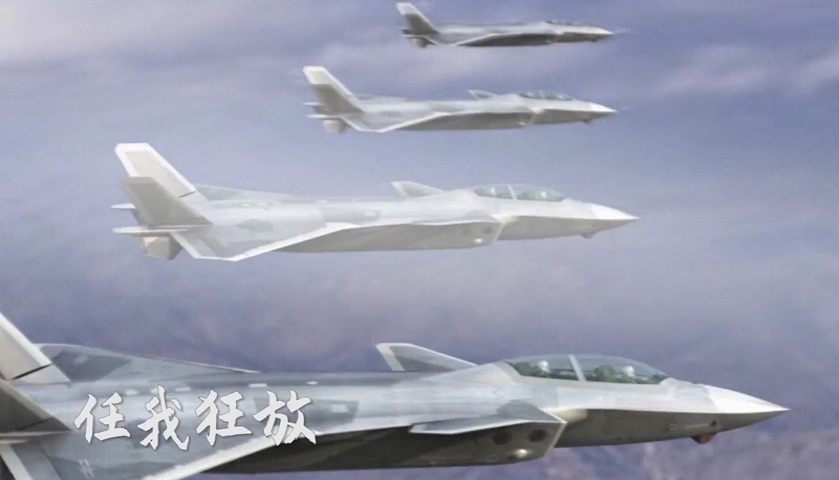
The twin-seat variation of the J-20 fighter jet, depicted by computer-generated imagery, is seen in a video released by AVIC celebrating the 10th anniversary of the aircraft’s maiden flight in 2021.
Photos and videos that give the world the first glimpse of the long-rumored twin-seat variant of China’s J-20 stealth fighter jet circulated on social media this week, leading foreign media outlets to say that the aircraft is the world’s first stealth fighter jet with two seats.
An extra seat could allow the second pilot to deal with complex tasks that can’t be done by one person alone, like electronic warfare and the control of accompanying drones, and this will give China an advantage in the air, analysts said.
The unverified and undated photos appear to show a J-20 in yellow primer paint with a two-seat tandem cockpit and an elongated canopy to enclose it, at the flight test airfield of the Chengdu Aerospace Corp under the state-owned Aviation Industry Corp of China (AVIC), US-based news website thedrive.com said in a report on Tuesday.
The report was updated on Wednesday with an additional photo and a short video that shows the aircraft taxiing near a runway.
It seems that the aircraft has yet to make its maiden flight, US media outlet the Military Watch Magazine said on Tuesday.
Both reports pointed out that the twin-seat variant of the J-20, the designation of which has not yet been confirmed, will be the first twin-seat stealth fighter jet in the world, and not even the US has an equivalent.
The existence of the twin-seater J-20 has been rumored for a long time.
In a promotional video in celebration of the 10th anniversary of the original J-20’s maiden flight released by AVIC in January, four twin-seat J-20 variations were seen flying in formation, as depicted by computer-generated imagery.
“Assuming we do have a twin-seat version of the J-20, it would not be a trainer aircraft, because it would be developed for the enhancement of the aircraft,” said Yang Wei, chief designer of the J-20, at a press conference at Airshow China 2021 in late September hen being asked about the possible twin-seat jet.
Military experts and analysts reached by the Global Times said that the J-20 excels at information gathering, processing and distributing, and many of its potential functions could only be taken advantage of when a second pilot is on board.
A second pilot could make more use of vast amounts of data than only one pilot, and make the twin-seat J-20 an aerial command center, and control a swarm of loyal wingman-style drones, analysts said.
Another possibility is that the second pilot could run electronic warfare or tactical bombing tasks, which could also be overwhelming for just one pilot, experts added.
When added to the J-20’s stealth capability, this will give China significant advantages in the air, they said.



 Johnson Choi Biz