The Ordeal of the Stateless: A Reflection on the Chinese Diaspora. By Johnson Choi, MBA. July 31 2026 無國籍者的苦難:對華人離散社群的反思. 作者:蔡永強商科碩士, 七月三十一日.
https://www.tiktok.com/t/ZP8tEdU5C/
https://weixin.qq.com/sph/A45BKxKOT9
https://m.facebook.com/story.php?story_fbid=pfbid0273HMmbe1wubLK6V1z41LLvqkUjeRcbbLfyEhzj8ud58ieTDDftYAERxS8xJHfZkYl&id=100036400039778&mibextid=wwXIfr
In my childhood, my father often spoke of the profound grief inherent in being an orphan. Yet, he maintained that there was a fate even more tragic: to be a Chinese national with no homeland to return to, relegated to a stateless existence across foster homes in Southeast Asia, the United States, and Canada.
Over the past two centuries, countless overseas Chinese endured systemic abuse, humiliation, and mass casualty—all consequences of a weakened and vulnerable China. Today, the nation’s resurgence has noticeably diminished, though not entirely eradicated, the political persecution and racial discrimination faced by its diaspora.
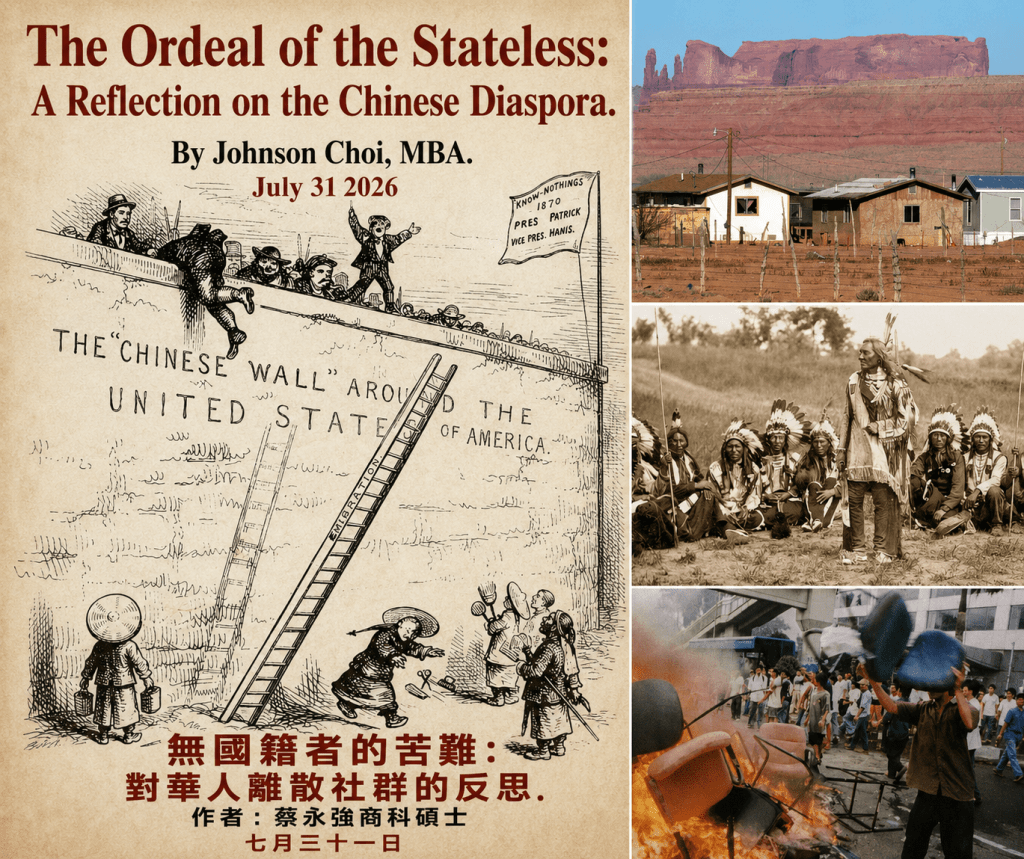
Nevertheless, in the United States, Chinese Americans continue to endure attacks, harassment, and undue legal scrutiny, often targeted simply for their ethnic heritage. Some argue that residing in cities with dense Asian populations—such as Honolulu or San Francisco—offers a buffer against this hostility. However, this line of reasoning evokes an uncomfortable parallel to the reservation system imposed on Native Americans. It suggests a form of de facto segregation, effectively creating an invisible prison without walls.
The historical irony remains stark: on May 6, 1882, the United States passed the Chinese Exclusion Act, effectively punishing the very Chinese laborers whose back-breaking, slave-like conditions built the Transcontinental Railroad.
Despite these adversities, overseas Chinese may not fully recognize their relative fortune compared to the Filipino and Indian diasporas. Those communities often lack the option of repatriation when their home countries descend into chaos—paralyzed by corrupt governance and performative democracy, where partisan infighting persistently supersedes the will of the electorate. Tragically, this dysfunction is not unique to those regions; it has regrettably become a hallmark of contemporary American politics as well.
童年時,父親常對我講述身為孤兒的深刻悲痛。然而,他堅稱還有更悲慘的命運:身為一個無祖國可歸的中國人,流落於東南亞、美國和加拿大的寄養家庭中,過著無國籍的生活。
過去兩個世紀以來,無數海外華人承受著系統性的虐待、羞辱和大規模傷亡——這一切都是中國衰弱無力的後果。如今,中國的復興已明顯減少了其僑民所面臨的政治迫害和種族歧視,但尚未完全消除。
然而,在美國,華裔美國人仍持續遭受攻擊、騷擾和不當的法律審查,往往僅僅因為他們的族裔背景。有人認為,居住在亞裔人口密集的城市(如檀香山或舊金山)可以緩解這種敵意。然而,這種推理方式令人不安地聯想到美國對原住民實施的保留地制度。它暗示了一種事實上的種族隔離,實質上形成了一座沒有圍牆的隱形監獄。
歷史的諷刺依然尖銳:一八八二年五月六日,美國通過了《排華法案》,實質上懲罰了那些在奴隸般惡劣條件下、以血汗勞動建造橫貫大陸鐵路的華工。
儘管經歷這些逆境,海外華人或許未能充分認識到,與菲律賓和印度僑民相比,他們相對幸運。那些社群往往在母國陷入混亂時無法選擇返國——因為母國被腐敗的治理和表演式的民主所癱瘓,黨派內鬥持續凌駕於選民意志之上。可悲的是,這種失能並非這些地區所獨有;它已遺憾地成為當代美國政治的一個特徵。