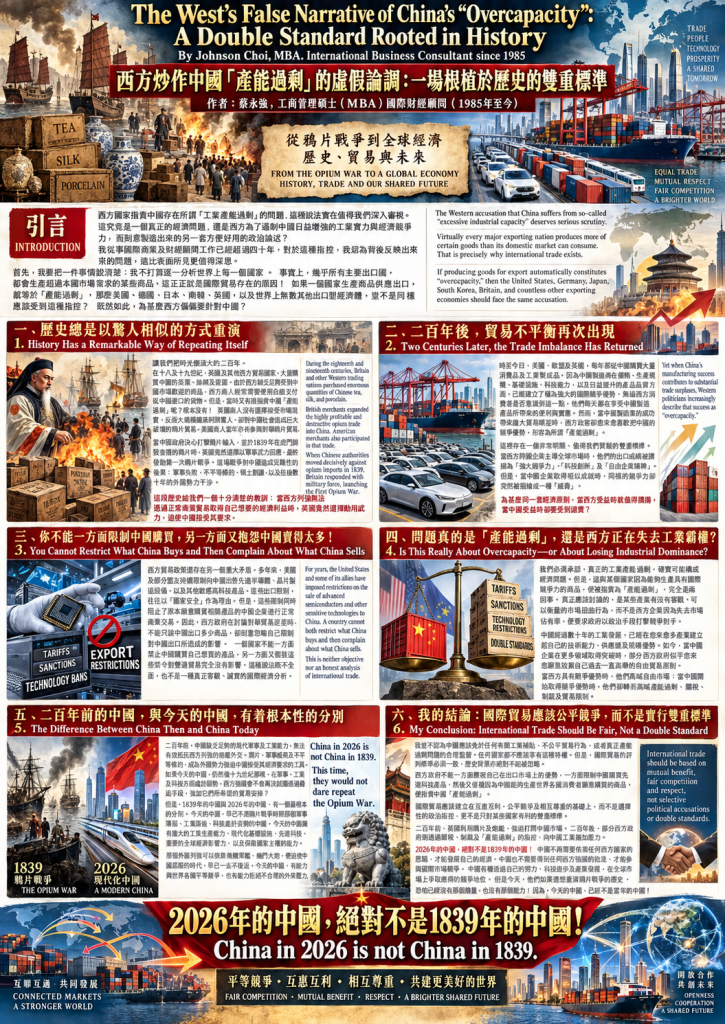
The West’s False Narrative of China’s “Overcapacity”: A Double Standard Rooted in History. By Johnson Choi, MBA. International Business Consultant since 1985
西方炒作中國「產能過剩」的虛假論調:一場根植於歷史的雙重標準. 作者:蔡永強,工商管理碩士(MBA)
國際財經顧問(1985年至今)
西方國家指責中國存在所謂「工業產能過剩」的問題,這種說法實在值得我們深入審視。
這究竟是一個真正的經濟問題,還是西方為了遏制中國日益增強的工業實力與經濟競爭力,而刻意製造出來的另一套方便好用的政治論述?
我從事國際商業及財經顧問工作已經超過四十年,對於這種指控,我認為背後反映出來的問題,遠比表面所見更值得深思。
首先,我要把一件事情說清楚:我不打算逐一分析世界上每一個國家。
事實上,幾乎所有主要出口國,都會生產超過本國市場需求的某些商品。這正正就是國際貿易存在的原因!
如果一個國家生產商品供應出口,就等於「產能過剩」,那麼美國、德國、日本、南韓、英國,以及世界上無數其他出口型經濟體,豈不是同樣應該受到這種指控?
既然如此,為甚麼西方偏偏要針對中國?
一、歷史總是以驚人相似的方式重演
讓我們把時光倒流大約二百年。
在十八及十九世紀,英國及其他西方貿易國家,大量購買中國的茶葉、絲綢及瓷器。
當時,中國製造的商品深受西方消費者歡迎,需求極為龐大。由於西方缺乏足夠受到中國市場歡迎的商品,西方商人經常需要使用白銀支付從中國進口的貨物。
但是,當時又有誰指責中國「產能過剩」呢?
根本沒有!
中國只不過是生產了外國消費者願意花錢購買的優質商品。
然而,這種貿易不平衡,卻令英國深感不滿。
英國商人沒有選擇接受市場現實,也沒有積極開發更多中國消費者願意購買、具有競爭力的產品,反而大規模擴張利潤驚人、卻對中國社會造成巨大破壞的鴉片貿易。
美國商人當年亦有參與對華鴉片貿易。
當中國政府決心打擊鴉片輸入,並於1839年在虎門銷毀查獲的鴉片時,英國竟然選擇以軍事武力回應,最終發動第一次鴉片戰爭。
這場戰爭對中國造成災難性的後果:軍事失敗、不平等條約、領土割讓,以及往後數十年的外國勢力干涉。
這段歷史給我們一個十分清楚的教訓:當西方列強無法透過正常商業貿易取得自己想要的經濟利益時,英國竟然選擇動用武力,迫使中國接受其要求。
二、二百年後,貿易不平衡再次出現
時至今日,美國、歐盟及英國,每年都從中國購買大量消費品及工業製成品。
為甚麼?
因為中國製造商在價格、生產規模、基礎設施、科技能力,以及日益提升的產品品質方面,已經建立了極為強大的國際競爭優勢。
無論西方消費者是否意識到這一點,他們每天都在享受中國製造產品所帶來的便利與實惠。
然而,當中國製造業的成功帶來龐大貿易順差時,西方政客卻愈來愈喜歡把中國的競爭優勢,形容為所謂「產能過剩」。
這裡存在一個非常明顯、值得我們質疑的雙重標準。
當西方跨國企業主導全球市場時,他們的出口成績被讚揚為「強大競爭力」、「科技創新」及「自由企業精神」。
但是,當中國企業取得相似成就時,同樣的競爭力卻突然被描繪成一種「威脅」。
為甚麼同一套經濟原則,當西方受益時就值得讚揚,當中國受益時卻要受到譴責?
這究竟是自由貿易,還是只容許西方勝出的選擇性自由貿易?
三、你不能一方面限制中國購買,另一方面又抱怨中國賣得太多!
西方貿易政策還存在另一個重大矛盾。
多年來,美國及部分盟友持續限制向中國出售先進半導體、晶片製造設備,以及其他敏感高科技產品。
這些出口限制,往往以「國家安全」作為理由。
但是,不論其政治理由如何,這些限制同時阻止了原本願意購買相關產品的中國企業進行正常商業交易。
因此,西方政府在討論對華貿易逆差時,不能只談中國出口多少商品,卻刻意忽略自己限制對中國出口所造成的影響。
如果中國企業原本願意花費巨額資金購買西方先進科技產品,卻因為政府禁令而無法成交,那麼這些失去的出口機會,自然會影響雙邊貿易關係。
我並不是說,只要取消所有高科技出口限制,中國的貿易順差便會完全消失。
國際貿易收支涉及許多因素,包括國民儲蓄、投資、消費需求、匯率,以及各國的產業政策。
但是,一個國家不能一方面禁止中國購買自己想買的產品,另一方面又假裝這些禁令對雙邊貿易完全沒有影響。
這種說法既不全面,也不是一種真正客觀、誠實的國際經濟分析。
四、問題真的是「產能過剩」,還是西方正在失去工業霸權?
我們必須承認,真正的工業產能過剩,確實可能構成經濟問題。
例如,當生產規模超過市場可以長期承受的需求,而政府補貼又鼓勵低效率投資,甚至導致企業長期以低於成本的價格銷售產品時,便有可能造成市場扭曲。
這類問題無論發生在中國、歐洲,還是美國,都應該接受合理而客觀的審視。
但是,這與某個國家因為能夠生產具有國際競爭力的商品,便被指責為「產能過剩」,完全是兩回事。
真正應該討論的,是某些產業有沒有客觀、可以衡量的市場扭曲行為,而不是西方企業因為失去市場佔有率,便要求政府以政治手段打擊競爭對手。
過去相當長的一段時間,西方國家在全球製造業、金融及科技產業中,佔據了最有利、利潤最高的位置。
但是,中國經過數十年的工業發展,已經在愈來愈多產業建立起自己的技術能力、供應鏈及規模優勢。
這種轉變,正在挑戰長期由西方主導的全球經濟秩序。
如今,當中國企業在更多領域取得突破時,部分西方政府似乎愈來愈願意放棄自己過去一直高舉的自由貿易原則。
當西方具有競爭優勢時,他們高喊自由市場;當中國開始取得競爭優勢時,他們卻轉而高喊產能過剩、關稅、制裁及貿易限制。
這不正正值得全世界深思嗎?
五、二百年前的中國,與今天的中國,有着根本性的分別
二百年前,中國缺乏足夠的現代軍事及工業能力,無法有效抵抗西方列強的炮艦外交。
鴉片、軍事威脅及不平等條約,成為外國勢力強迫中國接受其經濟要求的工具。
現在,讓我們作出一個假設。
如果今天的中國,仍然像十九世紀那樣,在軍事、工業及科技方面處於弱勢,西方強國會不會再次試圖透過脅迫手段,強加它們所希望的貿易安排?
它們又會不會再次以「平衡貿易」為藉口,合理化一些對中國經濟及社會造成破壞的行為?
歷史已經給予我們充分理由,去提出這些問題。
但是,1839年的中國與2026年的中國,有一個最根本的分別。
今天的中國,早已不是鴉片戰爭時期那個軍事薄弱、工業落後、科技處於劣勢的中國。
今天的中國擁有龐大的工業生產能力、現代化基礎設施、先進科技、重要的全球經濟影響力,以及保衛國家主權的能力。
中國已經不再是一個可以任由外國列強欺凌、任意施加不平等條件的國家。
那個外國列強可以依靠幾艘軍艦、幾門大炮,便迫使中國屈服的時代,早已一去不復返。
今天的中國,有能力與世界各國平等競爭,也有能力拒絕不合理的外來壓力。
六、我的結論:國際貿易應該公平競爭,而不是實行雙重標準
我並不認為中國應該免於任何有關工業補貼、不公平貿易行為,或者真正產能過剩問題的合理監督。
任何國家都不應該享有這種特權。
但是,國際貿易的評判標準必須一致,歷史背景亦絕對不能被忽略。
西方政府不能一方面慶祝自己在出口市場上的優勢,一方面限制中國購買先進科技產品,然後又僅僅因為中國能夠生產世界各國消費者願意購買的商品,便指責中國「產能過剩」。
國際貿易應該建立在互惠互利、公平競爭及相互尊重的基礎上,而不是選擇性的政治指控,更不是只對某些國家有利的雙重標準。
二百年前,英國利用鴉片及炮艦,強迫打開中國市場。
二百年後,部分西方政府則透過關稅、制裁及「產能過剩」的指控,向中國工業施加壓力。
雖然這些手段在性質、程度及歷史背景上存在重大差異,但其中的歷史對照,仍然值得世人認真思考。
因為世界必須明白一個最基本的事實:
2026年的中國,絕對不是1839年的中國!
中國不再需要依靠任何西方國家的恩賜,才能發展自己的經濟。
中國也不需要得到任何西方強國的批准,才能參與國際市場競爭。
中國有權透過自己的努力、科技進步及產業發展,在全球市場上爭取應得的競爭地位。
二百年前,西方列強可以用鴉片和炮艦,迫使中國接受不平等的貿易安排。
但是今天,他們如果還想重演鴉片戰爭的歷史,恐怕已經沒有那個膽量,也沒有那個能力!
因為,今天的中國,已經不是當年的中國!
The Western accusation that China suffers from so-called “excessive industrial capacity” deserves serious scrutiny. Is this genuinely an economic concern, or is it another convenient narrative designed to contain China’s growing industrial and economic competitiveness?
I have spent more than four decades working in international business, and I find this accusation particularly revealing.
Let me make one thing clear: I am not going to examine every country individually. Virtually every major exporting nation produces more of certain goods than its domestic market can consume. That is precisely why international trade exists.
If producing goods for export automatically constitutes “overcapacity,” then the United States, Germany, Japan, South Korea, Britain, and countless other exporting economies should face the same accusation.
Why, then, is China singled out?
History Has a Remarkable Way of Repeating Itself
Turn back the clock approximately 200 years.
During the eighteenth and nineteenth centuries, Britain and other Western trading nations purchased enormous quantities of Chinese tea, silk, and porcelain. China’s products were highly desirable, and Western merchants frequently paid for them with silver.
At that time, nobody was accusing China of possessing “excessive capacity.” China simply produced goods that foreign consumers wanted to buy.
But the resulting trade imbalance created frustration in Britain.
Rather than accepting the imbalance or developing enough competitive products that Chinese consumers wanted, British merchants expanded the highly profitable and destructive opium trade into China. American merchants also participated in that trade.
When Chinese authorities moved decisively against opium imports, including the destruction of confiscated opium at Humen in 1839, Britain responded with military force, launching the First Opium War.
The consequences for China were devastating: military defeat, unequal treaties, territorial concessions, and decades of foreign interference.
The historical lesson is unmistakable: When Western powers could not obtain the trade relationship they wanted through ordinary commerce, Britain resorted to force.
Two Centuries Later, the Trade Imbalance Has Returned
Today, the United States, the European Union, and Britain purchase enormous quantities of Chinese-made consumer and industrial products.
Why?
Because Chinese manufacturers have become extraordinarily competitive in price, production scale, infrastructure, technological capability, and increasingly, product quality.
Western consumers benefit from these products every day, whether they realize it or not.
Yet when China’s manufacturing success contributes to substantial trade surpluses, Western politicians increasingly describe that success as “overcapacity.”
There is an obvious double standard worth questioning.
When Western corporations dominate global markets, their export success is celebrated as competitiveness, innovation, and free enterprise.
When Chinese corporations achieve similar success, their competitiveness is frequently portrayed as a threat.
Why should the same economic principle be praised when it benefits the West but condemned when it benefits China?
You Cannot Restrict What China Buys and Then Complain About What China Sells
There is another major contradiction in Western trade policy.
For years, the United States and some of its allies have imposed restrictions on the sale of advanced semiconductors, semiconductor manufacturing equipment, and other sensitive technologies to China.
These restrictions are often justified on national security grounds, but they also prevent transactions that Chinese companies would otherwise be willing to make.
Consequently, Western governments cannot reasonably discuss trade imbalances without acknowledging the effects of their own export restrictions.
If China is prevented from purchasing certain advanced products, those lost export opportunities necessarily affect the trading relationship.
I am not suggesting that removing every technology restriction would eliminate China’s trade surplus. Trade balances involve many factors, including savings, investment, consumer demand, exchange rates, and industrial policy.
But a country cannot simultaneously restrict access to products that China wants to purchase and then pretend those restrictions have no bearing on bilateral trade.
That is not a complete or intellectually honest discussion of international commerce.
Is This Really About Overcapacity—or About Losing Industrial Dominance?
Excess industrial capacity can be a genuine economic problem when production exceeds sustainable demand, particularly where subsidies encourage inefficient investment or below-cost sales.
Such concerns deserve examination wherever they occur, including in China, Europe, and the United States.
But that is very different from declaring that a country has excessive capacity simply because it can manufacture competitive products for international markets.
The real question should be whether particular industries demonstrate measurable market distortions—not whether Western competitors dislike losing market share.
China’s industrial development has challenged a global economic order in which Western countries traditionally occupied the most profitable positions in manufacturing, finance, and technology.
Now that China has developed capabilities across a growing range of industries, some Western governments appear increasingly willing to abandon the free-trade principles they once championed.
The Difference Between China Then and China Today
Two centuries ago, China lacked the military and industrial capabilities necessary to resist Western gunboat diplomacy.
Opium, military coercion, and unequal treaties became instruments through which foreign powers imposed their economic demands.
Imagine if China were still as vulnerable today as it was during the nineteenth century.
Would powerful Western countries once again attempt to impose their preferred trade arrangements through coercion? Would they justify economically destructive practices in the name of correcting trade imbalances?
History gives us good reason to ask those questions.
But there is one fundamental difference between the China of 1839 and the China of 2026.
Today’s China is no longer the weak and technologically disadvantaged country that Western powers confronted during the Opium Wars.
It possesses enormous industrial capacity, modern infrastructure, advanced technologies, substantial economic influence, and the means to defend its national sovereignty.
The age when foreign powers could force China to accept their terms through gunboat diplomacy is over.
My Conclusion
I do not believe China should be exempt from legitimate scrutiny of industrial subsidies, unfair trade practices, or genuine overcapacity. No country should be.
But the standards must be consistent, and the historical context cannot be ignored.
Western governments cannot celebrate their own export dominance, restrict China’s access to advanced technologies, and then condemn China merely for manufacturing goods that the rest of the world wants to purchase.
International trade should be based on mutual benefit, fair competition, and respect—not selective accusations and political double standards.
Two hundred years ago, Britain used opium and gunboats to force open China’s markets. Today, Western governments use tariffs, sanctions, and accusations of “overcapacity” to pressure China’s industries. These are different instruments in very different circumstances, but the historical comparison deserves attention.
And there is one more difference that the world must recognize:
China in 2026 is not China in 1839.
This time, they would not dare repeat the Opium War.