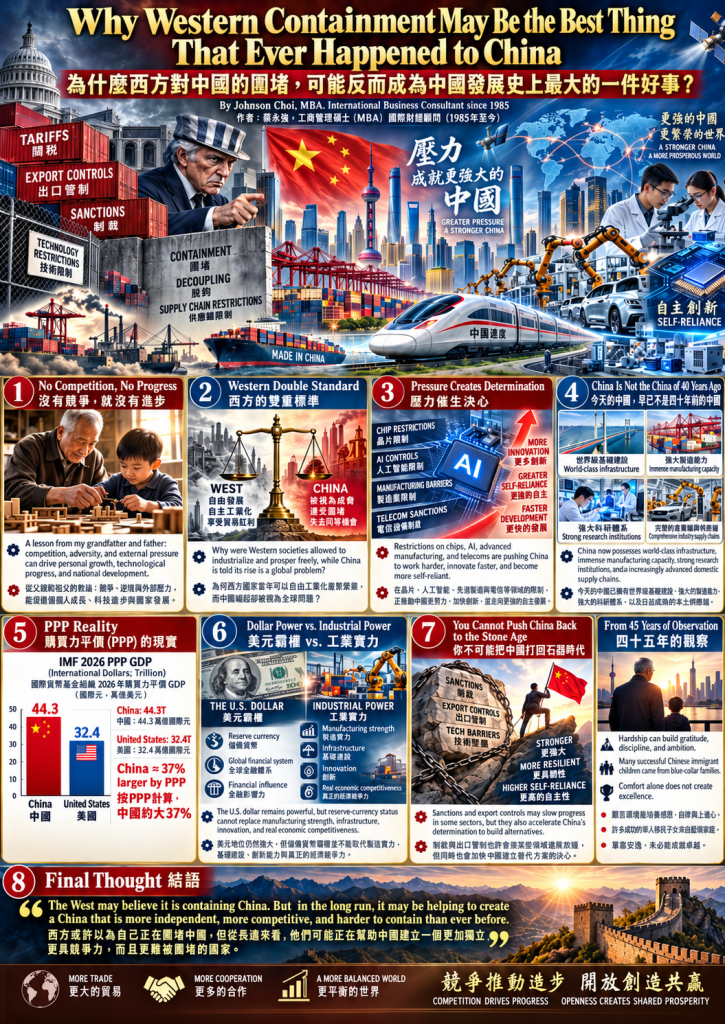
Why Western Containment May Be the Best Thing That Ever Happened to China. By Johnson Choi, MBA. International Business Consultant since 1985
為什麼西方對中國的圍堵,可能反而成為中國發展史上最大的一件好事?作者:蔡永強,工商管理碩士(MBA)
國際財經顧問(1985年至今)
一、沒有競爭,就沒有進步- 祖父和父親教導我的人生道理
在我成長的歲月裡,祖父和父親經常教導我們一個簡單卻非常有力量的道理:
「沒有競爭,就沒有進步。」
這句話伴隨着我走過大半生,尤其是在我從事國際商業及顧問工作超過四十年的歲月裡,更讓我深刻體會到其中的智慧。
隨着年齡增長,見識過世界各地不同的社會、文化、經濟體系和商業環境,我越來越相信,競爭、逆境,甚至來自外部的壓力,都可以成為推動個人成長、科技進步,以及國家發展的強大力量。
正因如此,我認為西方國家試圖圍堵中國崛起的種種措施,最終可能反而成為西方在無意之間送給中國的一份最珍貴的禮物。
西方原本希望透過圍堵迫使中國屈服,但結果可能恰恰相反——圍堵反而正在迫使中國變得更加強大、更具創新能力、更能自力更生,而且比以往任何時候都更加堅定。
二、西方的雙重標準:究竟誰才有權享受富裕的生活?
讓我們回顧美國前總統奧巴馬在2010年4月發表的一番備受爭議的言論。
當時,奧巴馬接受澳洲電視台訪問時警告,如果超過十億中國人民都採用與美國人和澳洲人相同的消費模式,將會對全球環境造成難以持續的後果。
他的言論主要圍繞資源消耗、環境保護,以及建立更可持續發展的經濟模式。
然而,在我看來,這番話背後其實引出了一個更加深層次的問題:
為什麼西方國家在過去工業化和經濟發展的過程中,沒有對自己施加同樣的限制,但當中國人民追求同等生活水平時,卻突然被要求接受種種限制?
過去幾代人,西方國家享盡工業化、大量消費、廉價能源、汽車普及、現代化住宅,以及生活水平持續提高所帶來的好處。
他們的人民享受着經濟發展的成果。
然而,當中國開始讓數以億計的人民擺脫貧困,並追求同樣的發展機會時,國際社會卻突然開始討論:地球究竟能否承受中國人民也過上富裕生活?
這種說法令我深感不安。
在我看來,這類論調可能進一步鞏固一種不平等的國際經濟秩序:西方人民已經享有的高生活水平,被視為理所當然的既得權利;但中國人民追求同樣的生活,卻被描繪成一個全球性問題。
我堅決反對這種雙重標準。
中國人民與美國人、歐洲人,以及世界上任何其他國家的人民一樣,都有權享有繁榮、尊嚴、現代化基礎建設、科技進步,以及更美好的生活。
環境可持續發展當然是全球共同關注的重要議題。
但相關原則必須公平適用於所有國家,而不能變成限制後發工業國家經濟發展的方便藉口。
三、為什麼過度安逸,反而可能扼殺孩子的上進心?
這又讓我想起祖父和父親從小教導我的道理。
競爭能夠激發動力。
挑戰能夠磨練品格。
艱苦的環境,有時更能培養出非凡的意志與決心。
然而,我也觀察到,在一些原本充滿愛心、經濟條件相當不錯的家庭裡,卻出現了完全相反的情況。
有些父母,尤其是部分中產階級家庭的家長,因為太希望保護自己的孩子,不想讓他們吃苦,結果反而在無意之間,剝奪了孩子培養獨立能力、抗逆精神、上進心,以及自律能力的機會。
父母為孩子提供一切。
替他們解決所有問題。
替他們清除每一個障礙。
甚至不願意讓孩子承受任何失望或挫折。
結果,在某些情況下,這些父母彷彿把孩子當作需要終身呵護的寵物般寵愛,而不是把他們培養成將來必須獨立面對社會、參與競爭、解決問題,以及自力更生的成年人。
當然,家庭經濟富裕並不代表孩子必然失去上進心;同樣,貧窮也不保證一個人將來必定成功。
但如果孩子從來不需要面對挑戰,不需要為自己的決定承擔後果,也沒有機會學習克服困難,他們可能永遠無法發掘自己真正的潛能。
父母的愛,應該是幫助孩子準備好面對真實世界,而不是永遠把他們保護在溫室之中。
四、四十五年來觀察美國華人移民家庭,讓我明白了什麼?
過去四十五年,我親眼見證了不少美國華人移民家庭的成長歷程,也觀察到一個十分值得深思的現象。
在我認識的華人家庭之中,一些最有上進心、最勤奮、最有成就的下一代,往往來自父母從事藍領工作的家庭。
他們的父母可能是餐館員工、工廠工人、建築工人、清潔工、小生意經營者,以及其他辛勤工作的移民。
不少父母每天長時間工作,有些甚至同時兼做兩份工作,目的只有一個:
讓子女有飯吃、有地方住、有書讀,並且獲得自己年輕時沒有機會享有的發展條件。
這些孩子從小親眼看着父母為家庭犧牲自己的舒適生活、休閒時間,甚至個人理想,只為讓下一代有更好的未來。
然後,一件令人感動的事情發生了。
這些孩子的眼睛裡,開始燃起一團火。
那是一團渴望改變命運、追求更好生活的火。
他們希望接受更好的教育。
希望找到更有前途的工作。
希望早日實現經濟獨立。
更希望爭取那些父母雖然努力工作,卻無法直接提供給他們的機會。
他們未必擁有最新款的玩具、最昂貴的名牌衣服,也未必享有凡事都有人安排妥當的舒適生活。
然而,很多人卻擁有比金錢和物質更加寶貴的東西:
對成功的渴望、堅定的意志、自律精神,以及對父母犧牲的感恩之心。
我也親眼看着不少這樣的孩子長大成人,成為成功的專業人士、企業家、工程師、醫生,以及各行各業的傑出人才。
然而,最令我感動的,並不單單是他們取得了多少財富或事業成就。
而是很多人始終沒有忘記自己的根。
他們記得父母當年為家庭所作出的犧牲。
當自己有能力之後,也願意主動在經濟上支持父母,並在父母年老時照顧他們。
對我來說,這正好說明,逆境有時不但能夠培養成功的人,更能培養懂得感恩、有責任感,以及具有良好品格的人。
我並不是說所有工人階級家庭的孩子都一定成功,也不是說富裕家庭的孩子必然缺乏上進心。
我想強調的是:
當艱苦環境與父母的愛、教育機會,以及正確的價值觀結合起來時,往往能夠激發出人類非凡的潛能。
而我在中國近幾十年的發展歷程中,也看到了十分相似的道理。
五、西方的圍堵,正在造就一個更加堅定的中國
多年來,美國及部分西方盟友陸續推出各種限制措施,試圖限制中國獲取某些先進科技、敏感設備,以及進入重要戰略市場的機會。
半導體、人工智能、先進製造業、電訊科技,以及其他關鍵產業,已經成為地緣政治競爭最激烈的領域。
西方政府提出的理由,包括國家安全、科技依賴,以及經濟競爭等問題。
然而,從中國的角度來看,這些限制措施同時傳遞了一個再清楚不過的訊息:
如果中國希望掌握自己的未來,就不能永遠依賴外國提供那些關係到國家發展與安全的關鍵技術。
試想一下,當你告訴一個擁有超過十四億人口的國家,某些重要科技和發展機會可能永遠不會向他們開放,結果會發生什麼事?
你等於給了這個國家一個強而有力的理由,去尋找另一條出路。
你促使工程師更加努力工作。
你激勵科學家尋求新的科技突破。
你推動大學培養更多本土科研人才。
你促使製造企業不斷提升自身技術水平。
你鼓勵企業家研發可以取代外國技術的產品。
而更重要的是:
你把科技自主,從單純的經濟發展問題,提升成關乎國家尊嚴、民族自豪感,以及長遠生存能力的重要使命。
西方的圍堵政策,或許能夠在短期內達到某些戰略目標。
但從長遠來看,這些限制同時也為中國創造了更強烈的動機,推動中國減少對西方科技的依賴。
當然,這並不代表任何一項制裁或限制,都必然自動帶來科技突破。
科研成果需要長期投資、專業知識、制度支持,以及無數次失敗之後仍然堅持不懈的努力。
但歷史一次又一次證明:
需求與競爭,往往正是推動創新的強大動力。
六、今天的中國,早已不是四十年前的中國
西方決策者可能犯下的最大錯誤之一,就是仍然以幾十年前的舊觀念來衡量今天的中國。
中國早已不再只是一個依靠廉價勞動力、外國投資和進口技術的製造業基地。
今天的中國,已經成為全球主要工業強國之一,擁有龐大的基礎建設、巨大的製造能力、先進的科研機構,以及日益成熟的本土供應鏈。
中國在高速鐵路、電動汽車、電池、再生能源、電訊科技、工業生產,以及其他多個領域所取得的成就,已經深刻改變全球經濟競爭格局。
當然,在尖端半導體及部分高端技術方面,中國仍然面對重要的技術限制和挑戰。
但正因為存在這些挑戰,中國才會持續投入大量資源,推動科學研究、本土製造能力,以及科技自主發展。
我認為最值得關注的一點是:
西方政府越是強硬地限制中國獲取先進科技,中國就可能越有決心自行研發替代技術。
你或許可以限制對手購買某一種產品。
但你無法永遠消滅對手自行發明競爭產品的意志。
這正是我認為圍堵政策作為長期戰略,所存在的一個根本弱點。
七、以購買力平價計算,中國早已是全球第一大經濟體
還有一個重要的經濟現實,值得大家認真思考。
如果按照購買力平價(Purchasing Power Parity,簡稱PPP)計算,中國已經是全球第一大經濟體。
根據國際貨幣基金組織(IMF)2026年4月的預測:
- 中國:按購買力平價計算,國內生產總值約為44.3萬億國際元。
- 美國:按購買力平價計算,國內生產總值約為32.4萬億國際元。
換句話說,按照這種計算方式,中國經濟規模比美國大約高出37%。
購買力平價會考慮不同國家國內物價水平的差異,因此有助比較各個經濟體實際生產的商品與服務總量。
當然,如果按照市場匯率計算的名義GDP,美國仍然是全球最大的經濟體。
美國在金融市場、國際資本流動,以及全球貨幣影響力方面,也繼續保持明顯優勢。
然而,中國在購買力平價方面所反映出來的經濟規模,正好說明中國已經具備極為龐大的國內實際生產能力。
與此同時,美國亦正面對嚴重的長期財政挑戰,包括龐大的聯邦政府債務、持續的財政赤字,以及不斷增加的國債利息負擔。
我們不應低估美國的經濟實力。
美國仍然擁有世界頂尖大學、先進科技企業、成熟而龐大的資本市場,以及強大的創新能力。
但同樣地,如果有人低估中國的實力,或者認為美國可以在缺乏競爭的情況下,永遠維持其金融與科技優勢,那也是十分不明智的想法。
八、美元的強大地位,並不能保證美國永遠稱霸世界
美國其中一項最重要的戰略優勢,至今仍然是美元在國際金融體系中的特殊地位。
美元在國際貿易、外匯交易、金融市場,以及各國中央銀行外匯儲備中的主導地位,賦予美國極大的經濟與地緣政治影響力。
這種優勢同時增強了華盛頓實施金融制裁,以及影響國際金融網絡的能力。
但金融影響力,並不等於無窮無盡的工業實力。
一個國家的長遠競爭力,還取決於它是否有能力製造產品、推動創新、培養人才、興建基礎建設、發展科技,以及生產世界各地消費者真正願意購買的商品。
中國龐大的製造業基礎,令它在上述多個領域具有相當強的競爭優勢。
當然,美國除了美元之外,仍然擁有許多重要優勢。
而中國本身亦面對不少挑戰,包括人口結構變化、房地產市場問題、地方政府債務,以及進入海外市場時遇到的障礙。
然而,我認為華盛頓如果一方面試圖限制中國的經濟發展,另一方面卻認為單靠美元的金融主導地位,就能夠永遠維持美國的全球優勢,這將是一種十分危險的戰略判斷。
擁有全球主要儲備貨幣的地位,確實是一項非凡優勢;但它絕對不能取代持續的工業創新,以及真正的經濟競爭力。
九、你不可能一面迫使一個國家更加努力,一面幻想把它打回石器時代
那些相信透過經濟制裁、出口管制、關稅,以及科技封鎖,就能迫使中國重新陷入經濟落後的人,可能從根本上誤判了形勢。
中國已經建立起龐大的工業生產能力、技術熟練的勞動人口、現代化基礎建設,以及巨大的國內市場。
外部限制當然會帶來成本、延緩某些科技進展,甚至造成實際的經濟困難。
但同時,這些限制也可能鼓勵中國發展本土替代產品、進行更多科技實驗、推動產業多元化,以及建立不再過度依賴外國的供應鏈。
外國限制越是威脅中國取得關鍵技術的能力,中國就越有動機研發那些不容易再被外國切斷供應的核心技術。
我們必須明白一個重要分別:
拖慢一個競爭對手的發展,與永久擊敗這個競爭對手,完全是兩回事。
圍堵政策或許能夠減慢中國在某些產業的發展速度,但同時也可能進一步激發中國擺脫西方科技依賴的決心。
這正是為什麼我相信,西方圍堵中國的長遠結果,最終可能與當初制定這些政策的人所預期的完全不同。
十、祖父和父親說得對:沒有競爭,就沒有進步
經過四十多年從事國際商業及財經顧問工作的經驗,我深深體會到:
真正的競爭,並不是我們應該害怕的東西。
相反,競爭是一種值得尊重的力量。
競爭迫使企業改善產品、降低成本、提高效率,以及投資更先進的技術。
競爭促使個人更加努力、學習新技能,並培養更強的應變及解決問題能力。
競爭也可以迫使國家重新審視自身弱點,改善制度,並鞏固長遠發展的基礎。
就像當年那些勤奮工作的華人移民家庭,他們的子女因為渴望更美好的未來,而培養出非凡的上進心和奮鬥精神。
中國在面對西方圍堵之後,也可能逐步建立起更強大的科技自主能力,以及更具韌性的工業體系。
當然,這種結果並不是必然發生的。
中國能否真正取得成功,仍然取決於是否制定合理的政策、鼓勵企業家精神、保持科學研究的開放性、持續投資,以及有效克服各種真實存在的經濟挑戰。
但有一點,我認為非常清楚:
中國追求進步、突破限制,以及掌握自身未來的動力,是不容忽視的。
我的祖父和父親,在今天這場大國地緣政治競爭出現之前很久,就已經明白這個道理。
沒有競爭,就沒有進步。
沒有挑戰,就難以培養堅定的決心。
沒有逆境,就難以磨練強大的韌性。
而有時候,當你面對一個本來就充滿決心的競爭對手時,你所能犯下的最大錯誤,就是再給他一個更強烈、非成功不可的理由。
十一、結語:西方以為自己正在圍堵中國,卻可能反而幫助中國變得更強大
如果西方圍堵中國的目的是要阻止中國繼續壯大,那麼從長遠來看,這套戰略最終可能適得其反。
這些政策不但未必能夠永久削弱中國,反而可能激勵新一代中國科學家、工程師、企業家,以及工業領袖,努力實現一些過去被認為不可能達成的目標。
我認為,最具建設性的國際關係,應該建立在公平競爭、互相尊重,以及在共同利益領域互相合作的基礎上。
而不是認為,一個文明的繁榮,必須以另一個文明的衰落作為代價。
世界足夠廣闊,完全容得下美國人民和中國人民同時追求更美好的生活。
中國追求繁榮發展,並不需要得到西方的批准。
西方也不能一方面剝奪其他國家的公平競爭機會,另一方面卻幻想自己的優勢可以永遠維持下去。
我的祖父和父親從小就教導我:
「沒有競爭,就沒有進步。」
今天,當我回顧中國的發展歷程,再看看當前的國際形勢,我更加相信這句話所蘊含的智慧,至今仍然具有極其重要的現實意義。
西方或許以為自己正在成功圍堵中國。
但從長遠來看,他們可能正在無意之間,幫助中國建立一個更加獨立、更具競爭力,而且將來更難被任何外部力量圍堵的國家。
作者:蔡永強,工商管理碩士(MBA)
國際財經顧問(1985年至今)
No Competition, No Progress — A Lesson From My Grandfather and Father
When I was growing up, my grandfather and father repeatedly taught us a simple but powerful lesson:
“No competition, no progress.”
Those five words have stayed with me throughout my life, particularly during my more than four decades working in international business and consulting.
The older I become, and the more I observe the world, the more convinced I am that competition, adversity, and even external pressure can become powerful forces for personal growth, technological advancement, and national development.
That is precisely why I believe Western attempts to contain China’s rise may ultimately turn out to be one of the greatest unintended gifts the West has ever given China.
Instead of bringing China to its knees, containment may be forcing China to become stronger, more innovative, more self-reliant, and more determined than ever.
The Western Double Standard: Who Has the Right to Prosper?
Let us revisit a controversial statement made by former U.S. President Barack Obama in April 2010.
During an interview with Australian television, Obama warned that if more than a billion Chinese people adopted the same consumption patterns as Americans and Australians, the environmental consequences would be unsustainable.
His remarks were framed around resource consumption, environmental protection, and the need for a more sustainable economic model.
But I believe those remarks raised a much deeper question:
Why should Chinese people be expected to accept limitations that Western societies historically did not impose on themselves during their own industrialization and economic development?
For generations, Western countries enjoyed the benefits of industrialization, mass consumption, inexpensive energy, automobiles, modern housing, and rising living standards.
Their citizens enjoyed the fruits of economic progress.
Yet when China began lifting hundreds of millions of people out of poverty and pursuing those same opportunities, suddenly the discussion turned toward whether the planet could afford China’s prosperity.
I find this deeply troubling.
My interpretation is that such arguments can reinforce an unequal international economic order in which Western living standards are treated as established entitlements, while China’s aspirations are viewed as a global problem.
I firmly reject that double standard.
The Chinese people have just as much right to prosperity, dignity, modern infrastructure, technological progress, and a better quality of life as Americans, Europeans, or anyone else.
Environmental sustainability is a legitimate global concern. But it must apply equally to every nation, not become a convenient justification for restricting the development of countries that arrived later at the industrial table.
Why Too Much Comfort Can Destroy Ambition
This brings me back to the lessons my grandfather and father taught me.
Competition creates motivation. Challenges build character. Hardship can produce extraordinary determination.
But sometimes, I have observed the opposite happening inside otherwise loving and financially comfortable families.
Some parents, particularly in middle-class households, become so determined to protect their children from hardship that they unintentionally deprive them of the opportunities needed to develop independence, resilience, ambition, and self-discipline.
They provide everything, solve every problem, remove every obstacle, and shield their children from disappointment.
In effect, they sometimes treat their children like pampered pets rather than future adults who must learn to compete, solve problems, and survive independently.
Of course, financial comfort does not automatically destroy ambition, just as poverty does not guarantee success.
But when children never experience challenges, never face meaningful consequences, and never learn to overcome difficulties, they may never discover their true potential.
Love should prepare children for the real world, not permanently shelter them from it.
What 45 Years of Observing Chinese Immigrant Families Have Taught Me
Over the past 45 years, I have personally witnessed an interesting pattern among Chinese immigrant families in the United States.
Some of the most ambitious, hardworking, and successful children I have encountered came from families whose parents worked in blue-collar occupations.
Their parents were restaurant workers, factory employees, construction workers, cleaners, small-business operators, and other hardworking immigrants.
Many worked long hours, sometimes holding two jobs, simply to provide their children with food, shelter, education, and opportunities they themselves never enjoyed.
These children often grew up watching their parents sacrifice comfort, leisure, and personal ambitions for the next generation.
And something remarkable happened.
They developed a fire in their eyes.
They wanted more from life.
They wanted better education, better careers, financial independence, and opportunities their parents could not afford to give them.
They did not always have the newest toys, the most expensive clothes, or the luxury of having everything handed to them.
But many possessed something far more valuable: hunger, determination, discipline, and an appreciation for sacrifice.
I have also witnessed many of these children grow into successful professionals, business owners, engineers, doctors, and other accomplished individuals.
What impressed me most was not simply their financial success.
It was that many never forgot where they came from.
They remembered their parents’ sacrifices and, when circumstances allowed, willingly supported and cared for them as they grew older.
To me, that is a beautiful example of how adversity can help create not only success, but gratitude and character.
This is not to suggest that every working-class child succeeds or that children from comfortable families lack motivation. My point is that hardship, when accompanied by love, opportunity, and strong values, can sometimes produce extraordinary human potential.
And I see a powerful parallel with China’s development.
Western Containment Is Creating a More Determined China
For years, the United States and some of its Western allies have introduced restrictions intended to limit China’s access to certain advanced technologies, sensitive equipment, and strategic markets.
Semiconductors, artificial intelligence, advanced manufacturing, telecommunications, and other critical industries have become arenas of intense geopolitical competition.
The stated Western concerns include national security, technological dependence, and economic competition.
But from China’s perspective, these restrictions also send an unmistakable message:
If China wants to secure its future, it cannot depend indefinitely on foreign countries for technologies essential to its development and national security.
And what happens when you tell a nation of more than 1.4 billion people that certain opportunities and technologies may be permanently denied to them?
You give that nation a powerful reason to find another way.
You encourage its engineers to work harder.
You encourage its scientists to pursue breakthroughs.
You encourage its universities to develop domestic talent.
You encourage its manufacturers to improve their capabilities.
You encourage its entrepreneurs to develop alternatives to foreign technology.
And, perhaps most importantly, you turn technological independence into a matter of national pride.
Western containment may achieve some short-term strategic objectives, but it also creates a powerful long-term incentive for China to reduce its dependence on the West.
This does not mean every restriction will automatically produce success. Technological breakthroughs require years of investment, scientific knowledge, institutional support, and sometimes failure after failure.
But history repeatedly demonstrates that necessity and competition can become extraordinary engines of innovation.
China Is Not the China of 40 Years Ago
One of the greatest mistakes Western policymakers can make is to evaluate today’s China through the assumptions of the past.
China is no longer simply a low-cost manufacturing destination dependent on foreign investment and imported technology.
It has become a major industrial power with extensive infrastructure, enormous manufacturing capacity, advanced research institutions, and increasingly sophisticated domestic supply chains.
Its achievements in high-speed rail, electric vehicles, batteries, renewable energy, telecommunications, industrial production, and several other sectors have substantially changed the global competitive landscape.
There are still important areas, particularly leading-edge semiconductors and certain advanced technologies, where China faces significant constraints.
But those challenges are precisely why China continues investing so heavily in scientific research, domestic manufacturing capabilities, and technological self-reliance.
What I find particularly interesting is the possibility that the more aggressively Western governments attempt to restrict China’s access to technology, the more determined China may become to develop its own alternatives.
You may be able to restrict access to a product, but you cannot permanently eliminate the motivation to invent a competing product.
That is the fundamental weakness of containment as a long-term strategy.
China Is Already the World’s Largest Economy by Purchasing Power Parity
There is another economic reality that deserves serious attention.
Measured by purchasing power parity, or PPP, China is already the world’s largest economy.
According to the International Monetary Fund’s April 2026 projections, China’s PPP-adjusted GDP is approximately 44.3 trillion international dollars, compared with approximately 32.4 trillion for the United States.
In other words, China’s economy is roughly 37% larger than America’s when measured using this method.
PPP adjusts for differences in domestic price levels and therefore provides a useful comparison of the real volume of goods and services produced across economies.
Of course, the United States remains larger when measured by nominal GDP at market exchange rates. It also continues to hold major advantages in financial markets, international capital flows, and global currency influence.
Nevertheless, China’s PPP position reflects its tremendous domestic productive capacity.
Meanwhile, the United States faces serious long-term fiscal challenges, including an enormous federal debt burden, persistent budget deficits, and rising debt-servicing costs.
American economic strength should not be underestimated. The United States remains a formidable global power with leading universities, advanced technology companies, deep capital markets, and considerable innovative capabilities.
But it would be equally foolish to underestimate China or assume that American financial and technological advantages can be maintained indefinitely without competition.
The U.S. Dollar Is Powerful — But It Cannot Guarantee Permanent Dominance
One of America’s greatest strategic advantages remains the international role of the U.S. dollar.
The dollar’s dominance in international trade, foreign-exchange transactions, financial markets, and central-bank reserves provides the United States with substantial economic and geopolitical influence.
It also strengthens Washington’s ability to impose financial sanctions and influence international financial networks.
But financial influence is not the same thing as unlimited industrial strength.
A nation’s long-term competitiveness also depends on the ability to manufacture, innovate, educate, build infrastructure, develop technology, and produce goods that people around the world want to buy.
China’s manufacturing base gives it considerable strengths in many of these areas.
The United States still possesses significant advantages beyond the dollar, and China faces its own challenges, including demographic pressures, property-sector difficulties, local-government debt, and international market access.
Nonetheless, I believe it is dangerous for Washington to assume that financial dominance alone can preserve America’s global position while attempting to restrict China’s economic progress.
A reserve currency is an extraordinary advantage, but it is not a substitute for continuous industrial innovation and economic competitiveness.
You Cannot Send a Nation Back to the Stone Age by Making It Work Harder
Those who believe that sanctions, export controls, tariffs, and technological restrictions can somehow force China back into economic backwardness may be misreading the situation.
China has already developed vast industrial capabilities, a highly skilled technical workforce, sophisticated infrastructure, and a large domestic market.
Restrictions can impose costs, delay progress, and create real economic difficulties.
But they can also encourage domestic substitution, technological experimentation, industrial diversification, and the development of alternative supply chains.
The more foreign restrictions threaten China’s access to critical technology, the greater China’s incentive becomes to develop capabilities that cannot easily be taken away.
There is an important distinction between slowing a competitor and permanently defeating one.
Containment may slow China’s progress in certain sectors, but it may also accelerate China’s determination to build a future beyond Western technological dependence.
That is why I believe the long-term consequences of containment may be very different from what its architects intended.
My Grandfather and Father Were Right: No Competition, No Progress
After more than four decades in international business, I have learned that genuine competition is not something to fear.
It is something to respect.
Competition forces businesses to improve their products, lower costs, increase efficiency, and invest in better technologies.
It forces individuals to work harder, learn new skills, and become more resourceful.
And it can force nations to reconsider their weaknesses and strengthen their foundations.
Just as the children of hardworking immigrant families often developed tremendous ambition because they wanted a better future, China may emerge from Western containment with greater technological independence and industrial resilience.
That outcome is not guaranteed. Success will depend on sound policies, entrepreneurship, scientific openness, investment, and the ability to overcome genuine economic challenges.
But the motivation is unmistakable.
My grandfather and father understood this principle long before the present geopolitical rivalry began.
No competition, no progress.
No challenge, no determination.
No adversity, no resilience.
And sometimes, the greatest mistake you can make with a determined competitor is to give that competitor an even stronger reason to succeed.
Final Thought
If the objective of Western containment is to prevent China from becoming stronger, the strategy may ultimately prove self-defeating.
Instead of permanently weakening China, it may encourage a new generation of Chinese scientists, engineers, entrepreneurs, and industrial leaders to achieve what once appeared impossible.
The most constructive path would be fair competition, mutual respect, and cooperation where interests overlap — not the assumption that one civilization’s prosperity must come at the expense of another.
The world is large enough for both Americans and Chinese to pursue better lives.
China does not need the West’s permission to pursue prosperity. And the West cannot expect to preserve its advantages forever by denying others the opportunity to compete.
My grandfather and father taught me that competition creates progress.
Looking at China today, I believe their wisdom is as relevant as ever.
The West may believe it is containing China. But in the long run, it may be helping to create a China that is more independent, more competitive, and harder to contain than ever before.
By Johnson Choi, MBA
International Business Consultant since 1985