Retired Swiss Military-Intelligence Officer: ‘Is it Possible to Actually Know What Has Been And is Going on in Ukraine?’

Retired Swiss Military-Intelligence Officer: ‘Is it Possible to Actually Know What Has Been And is Going on in Ukraine?’

[…] Just recently I came across perhaps the clearest and most reasonable account of what has been going on in Ukraine. Its importance comes due to the fact that its author, Jacques Baud, a retired colonel in the Swiss intelligence service, was variously a highly placed, major participant in NATO training operations in Ukraine. Over the years, he also had extensive dealings with his Russian counterparts. His long essay first appeared (in French) at the respected Centre Français de Recherche sur le Renseignement. A literal translation appeared at The Postil (April 1, 2022). I have gone back to the original French and edited the article down some and rendered it, I hope, in more idiomatic English. I do not think in editing it I have damaged Baud’s fascinating account. For in a real sense, what he has done is “to let the cat out of the bag.” — Boyd D. Cathay

The Military Situation In The Ukraine

by Jacques Baud

March 2022

Part One: The Road To War

For years, from Mali to Afghanistan, I have worked for peace and risked my life for it. It is therefore not a question of justifying war, but of understanding what led us to it.

Let’s try to examine the roots of the Ukrainian conflict. It starts with those who for the last eight years have been talking about “separatists” or “independentists” from Donbass. This is a misnomer. The referendums conducted by the two self-proclaimed Republics of Donetsk and Lugansk in May 2014, were not referendums of “independence” (независимость), as some unscrupulous journalists have claimed, but referendums of “self-determination” or “autonomy” (самостоятельность). The qualifier “pro-Russian” suggests that Russia was a party to the conflict, which was not the case, and the term “Russian speakers” would have been more honest. Moreover, these referendums were conducted against the advice of Vladimir Putin.

In fact, these Republics were not seeking to separate from Ukraine, but to have a status of autonomy, guaranteeing them the use of the Russian language as an official language — because the first legislative act of the new government resulting from the American-sponsored overthrow of [the democratically-elected] President Yanukovych, was the abolition, on February 23, 2014, of the Kivalov-Kolesnichenko law of 2012 that made Russian an official language in Ukraine. A bit like if German putschists decided that French and Italian would no longer be official languages in Switzerland.

This decision caused a storm in the Russian-speaking population. The result was fierce repression against the Russian-speaking regions (Odessa, Dnepropetrovsk, Kharkov, Lugansk and Donetsk) which was carried out beginning in February 2014 and led to a militarization of the situation and some horrific massacres of the Russian population (in Odessa and Mariupol, the most notable).

At this stage, too rigid and engrossed in a doctrinaire approach to operations, the Ukrainian general staff subdued the enemy but without managing to actually prevail. The war waged by the autonomists consisted in highly mobile operations conducted with light means. With a more flexible and less doctrinaire approach, the rebels were able to exploit the inertia of Ukrainian forces to repeatedly “trap” them.

In 2014, when I was at NATO, I was responsible for the fight against the proliferation of small arms, and we were trying to detect Russian arms deliveries to the rebels, to see if Moscow was involved. The information we received then came almost entirely from Polish intelligence services and did not “fit” with the information coming from the OSCE [Organization for Security and Co-operation in Europe] — and despite rather crude allegations, there were no deliveries of weapons and military equipment from Russia.

The rebels were armed thanks to the defection of Russian-speaking Ukrainian units that went over to the rebel side. As Ukrainian failures continued, tank, artillery and anti-aircraft battalions swelled the ranks of the autonomists. This is what pushed the Ukrainians to commit to the Minsk Agreements.

But just after signing the Minsk 1 Agreements, the Ukrainian President Petro Poroshenko launched a massive “anti-terrorist operation” (ATO/Антитерористична операція) against the Donbass. Poorly advised by NATO officers, the Ukrainians suffered a crushing defeat in Debaltsevo, which forced them to engage in the Minsk 2 Agreements.

It is essential to recall here that Minsk 1 (September 2014) and Minsk 2 (February 2015) Agreements did not provide for the separation or independence of the Republics, but their autonomy within the framework of Ukraine. Those who have read the Agreements (there are very few who actually have) will note that it is written that the status of the Republics was to be negotiated between Kiev and the representatives of the Republics, for an internal solution within Ukraine.

That is why, since 2014, Russia has systematically demanded the implementation of the Minsk Agreements while refusing to be a party to the negotiations, because it was an internal matter of Ukraine. On the other side, the West — led by France — systematically tried to replace Minsk Agreements with the “Normandy format,” which put Russians and Ukrainians face-to-face. However, let us remember that there were never any Russian troops in the Donbass before 23-24 February 2022. Moreover, OSCE observers have never observed the slightest trace of Russian units operating in the Donbass before then. For example, the U.S. intelligence map published by the Washington Post on December 3, 2021 does not show Russian troops in the Donbass.

In October 2015, Vasyl Hrytsak, director of the Ukrainian Security Service (SBU), confessed that only 56 Russian fighters had been observed in the Donbass. This was exactly comparable to the Swiss who went to fight in Bosnia on weekends, in the 1990s, or the French who go to fight in Ukraine today.

The Ukrainian army was then in a deplorable state. In October 2018, after four years of war, the chief Ukrainian military prosecutor, Anatoly Matios, stated that Ukraine had lost 2,700 men in the Donbass: 891 from illnesses, 318 from road accidents, 177 from other accidents, 175 from poisonings (alcohol, drugs), 172 from careless handling of weapons, 101 from breaches of security regulations, 228 from murders and 615 from suicides.

In fact, the Ukrainian army was undermined by the corruption of its cadres and no longer enjoyed the support of the population. According to a British Home Office report, in the March/April 2014 recall of reservists, 70 percent did not show up for the first session, 80 percent for the second, 90 percent for the third, and 95 percent for the fourth. In October/November 2017, 70% of conscripts did not show up for the “Fall 2017” recall campaign. This is not counting suicides and desertions (often over to the autonomists), which reached up to 30 percent of the workforce in the ATO area. Young Ukrainians refused to go and fight in the Donbass and preferred emigration, which also explains, at least partially, the demographic deficit of the country.

The Ukrainian Ministry of Defense then turned to NATO to help make its armed forces more “attractive.” Having already worked on similar projects within the framework of the United Nations, I was asked by NATO to participate in a program to restore the image of the Ukrainian armed forces. But this is a long-term process and the Ukrainians wanted to move quickly.

So, to compensate for the lack of soldiers, the Ukrainian government resorted to paramilitary militias. In 2020, they constituted about 40 percent of the Ukrainian forces and numbered about 102,000 men, according to Reuters. They were armed, financed and trained by the United States, Great Britain, Canada and France. There were more than 19 nationalities.

These militias had been operating in the Donbass since 2014, with Western support. Even if one can argue about the term “Nazi,” the fact remains that these militias are violent, convey a nauseating ideology and are virulently anti-Semitic…[and] are composed of fanatical and brutal individuals. The best known of these is the Azov Regiment, whose emblem is reminiscent of the 2nd SS Das Reich Panzer Division, which is revered in the Ukraine for liberating Kharkov from the Soviets in 1943, before carrying out the 1944 Oradour-sur-Glane massacre in France.

The characterization of the Ukrainian paramilitaries as “Nazis” or “neo-Nazis” is considered Russian propaganda. But that’s not the view of the Times of Israel, or the West Point Academy’s Center for Counterterrorism. In 2014, Newsweek magazine seemed to associate them more with… the Islamic State. Take your pick!

So, the West supported and continued to arm militias that have been guilty of numerous crimes against civilian populations since 2014: rape, torture and massacres…

The integration of these paramilitary forces into the Ukrainian National Guard was not at all accompanied by a “denazification,” as some claim.

Among the many examples, that of the Azov Regiment’s insignia is instructive:

In 2022, very schematically, the Ukrainian armed forces fighting the Russian offensive were organized as:
The Army, subordinated to the Ministry of Defense. It is organized into 3 army corps and composed of maneuver formations (tanks, heavy artillery, missiles, etc.).

The National Guard, which depends on the Ministry of the Interior and is organized into 5 territorial commands.
The National Guard is therefore a territorial defense force that is not part of the Ukrainian army. It includes paramilitary militias, called “volunteer battalions” (добровольчі батальйоні), also known by the evocative name of “reprisal battalions,” and composed of infantry. Primarily trained for urban combat, they now defend cities such as Kharkov, Mariupol, Odessa, Kiev, etc.

Part Two: The War

As a former head of analysis of Warsaw Pact forces in the Swiss strategic intelligence service, I observe with sadness — but not astonishment — that our services are no longer able to understand the military situation in Ukraine. The self-proclaimed “experts” who parade on our TV screens tirelessly relay the same information modulated by the claim that Russia — and Vladimir Putin — is irrational. Let’s take a step back.

  1. The Outbreak Of War

Since November 2021, the Americans have been constantly threatening a Russian invasion of Ukraine. However, the Ukrainians at first did not seem to agree. Why not?

We have to go back to March 24, 2021. On that day, Volodymyr Zelensky issued a decree for the recapture of the Crimea, and began to deploy his forces to the south of the country. At the same time, several NATO exercises were conducted between the Black Sea and the Baltic Sea, accompanied by a significant increase in reconnaissance flights along the Russian border. Russia then conducted several exercises to test the operational readiness of its troops and to show that it was following the evolution of the situation.

Things calmed down until October-November with the end of the ZAPAD 21 exercises, whose troop movements were interpreted as a reinforcement for an offensive against Ukraine. However, even the Ukrainian authorities refuted the idea of Russian preparations for a war, and Oleksiy Reznikov, Ukrainian Minister of Defense, states that there had been no change on its border since the spring.

In violation of the Minsk Agreements, Ukraine was conducting air operations in Donbass using drones, including at least one strike against a fuel depot in Donetsk in October 2021. The American press noted this, but not the Europeans; and no one condemned these violations.

In February 2022, events came to a head. On February 7, during his visit to Moscow, Emmanuel Macron reaffirmed to Vladimir Putin his commitment to the Minsk Agreements, a commitment he would repeat after his meeting with Volodymyr Zelensky the next day. But on February 11, in Berlin, after nine hours of work, the meeting of political advisors to the leaders of the “Normandy format” ended without any concrete result: the Ukrainians still refused to apply the Minsk Agreements, apparently under pressure from the United States. Vladimir Putin noted that Macron had made empty promises and that the West was not ready to enforce the agreements, the same opposition to a settlement it had exhibited for eight years.

Ukrainian preparations in the contact zone continued. The Russian Parliament became alarmed; and on February 15 it asked Vladimir Putin to recognize the independence of the Republics, which he initially refused to do.

On 17 February, President Joe Biden announced that Russia would attack Ukraine in the next few days. How did he know this? It is a mystery. But since the 16th, the artillery shelling of the population of Donbass had increased dramatically, as the daily reports of the OSCE observers show. Naturally, neither the media, nor the European Union, nor NATO, nor any Western government reacted or intervened. It would be said later that this was Russian disinformation. In fact, it seems that the European Union and some countries have deliberately kept silent about the massacre of the Donbass population, knowing that this would provoke a Russian intervention.

At the same time, there were reports of sabotage in the Donbass. On 18 January, Donbass fighters intercepted saboteurs, who spoke Polish and were equipped with Western equipment and who were seeking to create chemical incidents in Gorlivka. They could have been CIA mercenaries, led or “advised” by Americans and composed of Ukrainian or European fighters, to carry out sabotage actions in the Donbass Republics.

In fact, as early as February 16, Joe Biden knew that the Ukrainians had begun intense shelling the civilian population of Donbass, forcing Vladimir Putin to make a difficult choice: to help Donbass militarily and create an international problem, or to stand by and watch the Russian-speaking people of Donbass being crushed.

If he decided to intervene, Putin could invoke the international obligation of “Responsibility To Protect” (R2P). But he knew that whatever its nature or scale, the intervention would trigger a storm of sanctions. Therefore, whether Russian intervention were limited to the Donbass or went further to put pressure on the West over the status of the Ukraine, the price to pay would be the same. This is what he explained in his speech on February 21. On that day, he agreed to the request of the Duma and recognized the independence of the two Donbass Republics and, at the same time, he signed friendship and assistance treaties with them.

The Ukrainian artillery bombardment of the Donbass population continued, and, on 23 February, the two Republics asked for military assistance from Russia. On 24 February, Vladimir Putin invoked Article 51 of the United Nations Charter, which provides for mutual military assistance in the framework of a defensive alliance.

In order to make the Russian intervention seem totally illegal in the eyes of the public, Western powers deliberately hid the fact that the war actually started on February 16. The Ukrainian army was preparing to attack the Donbass as early as 2021, as some Russian and European intelligence services were well aware.

In his speech of February 24, Vladimir Putin stated the two objectives of his operation: “demilitarize” and “denazify” the Ukraine. So, it was not a question of taking over Ukraine, nor even, presumably, of occupying it; and certainly not of destroying it.

From then on, our knowledge of the course of the operation is limited: the Russians have excellent security for their operations (OPSEC) and the details of their planning are not known. But fairly quickly, the course of the operation allows us to understand how the strategic objectives were translated on the operational level.
Demilitarization:
ground destruction of Ukrainian aviation, air defense systems and reconnaissance assets;
neutralization of command and intelligence structures (C3I), as well as the main logistical routes in the depth of the territory;
encirclement of the bulk of the Ukrainian army massed in the southeast of the country.
Denazification:
destruction or neutralization of volunteer battalions operating in the cities of Odessa, Kharkov, and Mariupol, as well as in various facilities in the territory.

  1. Demilitarization

The Russian offensive was carried out in a very “classic” manner. Initially — as the Israelis had done in 1967 — with the destruction on the ground of the air force in the very first hours. Then, we witnessed a simultaneous progression along several axes according to the principle of “flowing water”: advance everywhere where resistance was weak and leave the cities (very demanding in terms of troops) for later. In the north, the Chernobyl power plant was occupied immediately to prevent acts of sabotage. The images of Ukrainian and Russian soldiers guarding the plant together are of course not shown.

The idea that Russia is trying to take over Kiev, the capital, to eliminate Zelensky, comes typically from the West. But Vladimir Putin never intended to shoot or topple Zelensky. Instead, Russia seeks to keep him in power by pushing him to negotiate, by surrounding Kiev. The Russians want to obtain the neutrality of Ukraine.

Many Western commentators were surprised that the Russians continued to seek a negotiated solution while conducting military operations. The explanation lies in the Russian strategic outlook since the Soviet era. For the West, war begins when politics ends. However, the Russian approach follows a Clausewitzian inspiration: war is the continuity of politics and one can move fluidly from one to the other, even during combat. This allows one to create pressure on the adversary and push him to negotiate.

From an operational point of view, the Russian offensive was an example of previous military action and planning: in six days, the Russians seized a territory as large as the United Kingdom, with a speed of advance greater than what the Wehrmacht had achieved in 1940.

The bulk of the Ukrainian army was deployed in the south of the country in preparation for a major operation against the Donbass. This is why Russian forces were able to encircle it from the beginning of March in the “cauldron” between Slavyansk, Kramatorsk and Severodonetsk, with a thrust from the East through Kharkov and another from the South from Crimea. Troops from the Donetsk (DPR) and Lugansk (LPR) Republics are complementing the Russian forces with a push from the East.

At this stage, Russian forces are slowly tightening the noose, but are no longer under any time pressure or schedule. Their demilitarization goal is all but achieved and the remaining Ukrainian forces no longer have an operational and strategic command structure.

The “slowdown” that our “experts” attribute to poor logistics is only the consequence of having achieved their objectives. Russia does not want to engage in an occupation of the entire Ukrainian territory. In fact, it appears that Russia is trying to limit its advance to the linguistic border of the country.

Our media speak of indiscriminate bombardments against the civilian population, especially in Kharkov, and horrific images are widely broadcast. However, Gonzalo Lira, a Latin American correspondent who lives there, presents us with a calm city on March 10 and March 11. It is true that it is a large city and we do not see everything — but this seems to indicate that we are not in the total war that we are served continuously on our TV screens. As for the Donbass Republics, they have “liberated” their own territories and are fighting in the city of Mariupol.

  1. Denazification

In cities like Kharkov, Mariupol and Odessa, the Ukrainian defense is provided by the paramilitary militias. They know that the objective of “denazification” is aimed primarily at them. For an attacker in an urbanized area, civilians are a problem. This is why Russia is seeking to create humanitarian corridors to empty cities of civilians and leave only the militias, to fight them more easily.

Conversely, these militias seek to keep civilians in the cities from evacuating in order to dissuade the Russian army from fighting there. This is why they are reluctant to implement these corridors and do everything to ensure that Russian efforts are unsuccessful — they use the civilian population as “human shields.” Videos showing civilians trying to leave Mariupol and beaten up by fighters of the Azov regiment are of course carefully censored by the Western media.

On Facebook, the Azov group was considered in the same category as the Islamic State [ISIS] and subject to the platform’s “policy on dangerous individuals and organizations.” It was therefore forbidden to glorify its activities, and “posts” that were favorable to it were systematically banned. But on February 24, Facebook changed its policy and allowed posts favorable to the militia. In the same spirit, in March, the platform authorized, in the former Eastern countries, calls for the murder of Russian soldiers and leaders. So much for the values that inspire our leaders.

Our media propagate a romantic image of popular resistance by the Ukrainian people. It is this image that led the European Union to finance the distribution of arms to the civilian population. In my capacity as head of peacekeeping at the UN, I worked on the issue of civilian protection. We found that violence against civilians occurred in very specific contexts. In particular, when weapons are abundant and there are no command structures.

These command structures are the essence of armies: their function is to channel the use of force towards an objective. By arming citizens in a haphazard manner, as is currently the case, the EU is turning them into combatants, with the consequential effect of making them potential targets. Moreover, without command, without operational goals, the distribution of arms leads inevitably to settling of scores, banditry and actions that are more deadly than effective. War becomes a matter of emotions. Force becomes violence. This is what happened in Tawarga (Libya) from 11 to 13 August 2011, where 30,000 black Africans were massacred with weapons parachuted (illegally) by France. By the way, the British Royal Institute for Strategic Studies (RUSI) does not see any added value in these arms deliveries.

Moreover, by delivering arms to a country at war, one exposes oneself to being considered a belligerent. The Russian strikes of March 13, 2022, against the Mykolayev air base follow Russian warnings that arms shipments would be treated as hostile targets.

The EU is repeating the disastrous experience of the Third Reich in the final hours of the Battle of Berlin. War must be left to the military and when one side has lost, it must be admitted. And if there is to be resistance, it must be led and structured. But we are doing exactly the opposite — we are pushing citizens to go and fight, and at the same time, Facebook authorizes calls for the murder of Russian soldiers and leaders. So much for the values that inspire us.

Some intelligence services see this irresponsible decision as a way to use the Ukrainian population as cannon fodder to fight Vladimir Putin’s Russia. It would have been better to engage in negotiations and thus obtain guarantees for the civilian population than to add fuel to the fire. It is easy to be combative with the blood of others.

  1. The Maternity Hospital At Mariupol

It is important to understand beforehand that it is not the Ukrainian army that is defending Mariupol, but the Azov militia, composed of foreign mercenaries.

In its March 7, 2022 summary of the situation, the Russian UN mission in New York stated that “Residents report that Ukrainian armed forces expelled staff from the Mariupol city birth hospital No. 1 and set up a firing post inside the facility.” On March 8, the independent Russian media Lenta.ru, published the testimony of civilians from Mariupol who told that the maternity hospital was taken over by the militia of the Azov regiment, and who drove out the civilian occupants by threatening them with their weapons. They confirmed the statements of the Russian ambassador a few hours earlier.

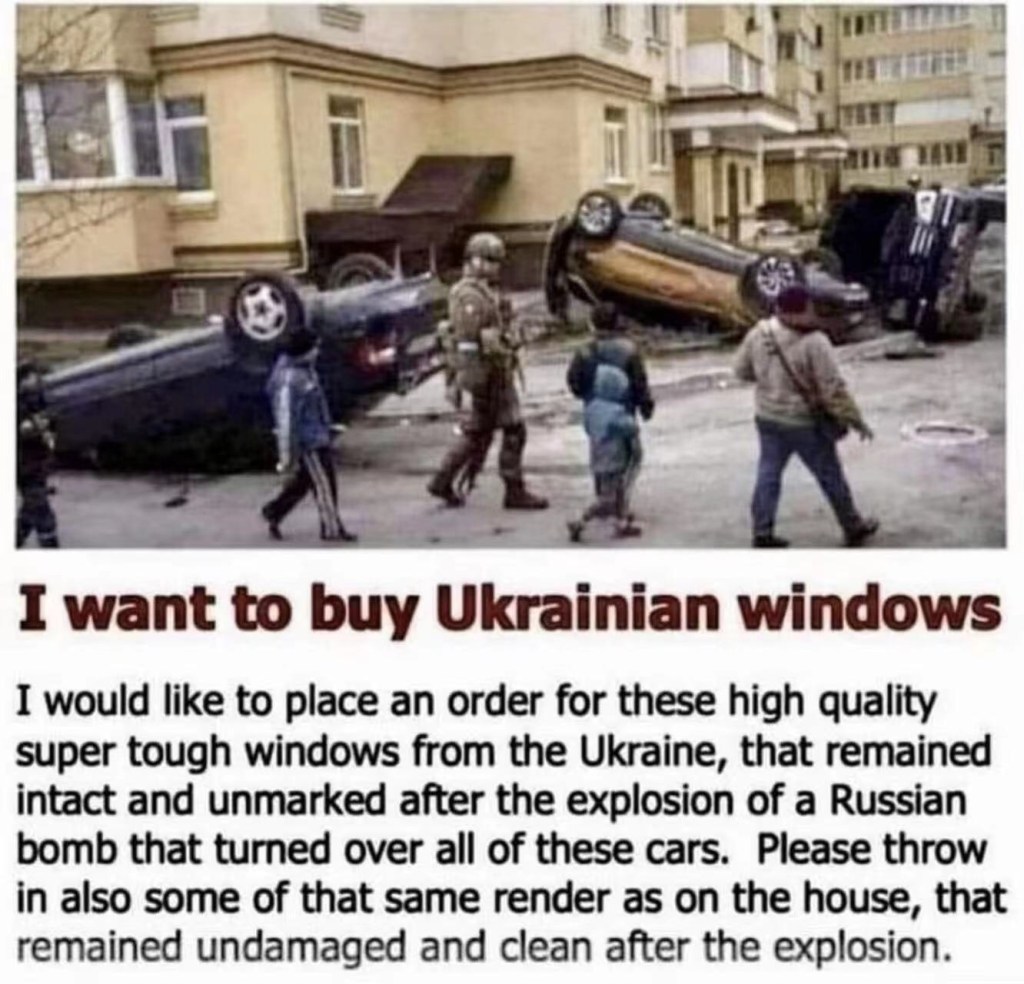
The hospital in Mariupol occupies a dominant position, perfectly suited for the installation of anti-tank weapons and for observation. On 9 March, Russian forces struck the building. According to CNN, 17 people were wounded, but the images do not show any casualties in the building and there is no evidence that the victims mentioned are related to this strike. There is talk of children, but in reality, there is nothing. This does not prevent the leaders of the EU from seeing this as a war crime. And this allows Zelensky to call for a no-fly zone over Ukraine.

In reality, we do not know exactly what happened. But the sequence of events tends to confirm that Russian forces struck a position of the Azov regiment and that the maternity ward was then free of civilians.

The problem is that the paramilitary militias that defend the cities are encouraged by the international community not to respect the rules of war. It seems that the Ukrainians have replayed the scenario of the Kuwait City maternity hospital in 1990, which was totally staged by the firm Hill & Knowlton for $10.7 million in order to convince the United Nations Security Council to intervene in Iraq for Operation Desert Shield/Storm.

Western politicians have accepted civilian strikes in the Donbass for eight years without adopting any sanctions against the Ukrainian government. We have long since entered a dynamic where Western politicians have agreed to sacrifice international law towards their goal of weakening Russia.

Part Three: Conclusions

As an ex-intelligence professional, the first thing that strikes me is the total absence of Western intelligence services in accurately representing the situation over the past year. In fact, it seems that throughout the Western world intelligence services have been overwhelmed by the politicians. The problem is that it is the politicians who decide — the best intelligence service in the world is useless if the decision-maker does not listen. This is what has happened during this crisis.

That said, while a few intelligence services had a very accurate and rational picture of the situation, others clearly had the same picture as that propagated by our media. The problem is that, from experience, I have found them to be extremely bad at the analytical level — doctrinaire, they lack the intellectual and political independence necessary to assess a situation with military “quality.”

Second, it seems that in some European countries, politicians have deliberately responded ideologically to the situation. That is why this crisis has been irrational from the beginning. It should be noted that all the documents that were presented to the public during this crisis were presented by politicians based on commercial sources.

Some Western politicians obviously wanted there to be a conflict. In the United States, the attack scenarios presented by Anthony Blinken to the UN Security Council were only the product of the imagination of a Tiger Team working for him — he did exactly as Donald Rumsfeld did in 2002, who “bypassed” the CIA and other intelligence services that were much less assertive about Iraqi chemical weapons.

The dramatic developments we are witnessing today have causes that we knew about but refused to see:
on the strategic level, the expansion of NATO (which we have not dealt with here);
on the political level, the Western refusal to implement the Minsk Agreements;
and operationally, the continuous and repeated attacks on the civilian population of the Donbass over the past years and the dramatic increase in late February 2022.
In other words, we can naturally deplore and condemn the Russian attack. But WE (that is: the United States, France and the European Union in the lead) have created the conditions for a conflict to break out. We show compassion for the Ukrainian people and the two million refugees. That is fine. But if we had had a modicum of compassion for the same number of refugees from the Ukrainian populations of Donbass massacred by their own government and who sought refuge in Russia for eight years, none of this would probably have happened.

Whether the term “genocide” applies to the abuses suffered by the people of Donbass is an open question. The term is generally reserved for cases of greater magnitude (Holocaust, etc.). But the definition given by the Genocide Convention is probably broad enough to apply to this case.

Clearly, this conflict has led us into hysteria. Sanctions seem to have become the preferred tool of our foreign policies. If we had insisted that Ukraine abide by the Minsk Agreements, which we had negotiated and endorsed, none of this would have happened. Vladimir Putin’s condemnation is also ours. There is no point in whining afterwards — we should have acted earlier. However, neither Emmanuel Macron (as guarantor and member of the UN Security Council), nor Olaf Scholz, nor Volodymyr Zelensky have respected their commitments. In the end, the real defeat is that of those who have no voice.

The European Union was unable to promote the implementation of the Minsk agreements — on the contrary, it did not react when Ukraine was bombing its own population in the Donbass. Had it done so, Vladimir Putin would not have needed to react. Absent from the diplomatic phase, the EU distinguished itself by fueling the conflict. On February 27, the Ukrainian government agreed to enter into negotiations with Russia. But a few hours later, the European Union voted a budget of 450 million euros to supply arms to the Ukraine, adding fuel to the fire. From then on, the Ukrainians felt that they did not need to reach an agreement. The resistance of the Azov militia in Mariupol even led to a boost of 500 million euros for weapons.

In Ukraine, with the blessing of the Western countries, those who are in favor of a negotiation have been eliminated. This is the case of Denis Kireyev, one of the Ukrainian negotiators, assassinated on March 5 by the Ukrainian secret service (SBU) because he was too favorable to Russia and was considered a traitor. The same fate befell Dmitry Demyanenko, former deputy head of the SBU’s main directorate for Kiev and its region, who was assassinated on March 10 because he was too favorable to an agreement with Russia — he was shot by the Mirotvorets (“Peacemaker”) militia. This militia is associated with the Mirotvorets website, which lists the “enemies of Ukraine,” with their personal data, addresses and telephone numbers, so that they can be harassed or even eliminated; a practice that is punishable in many countries, but not in the Ukraine. The UN and some European countries have demanded the closure of this site — but that demand was refused by the Rada [Ukrainian parliament].

In the end, the price will be high, but Vladimir Putin will likely achieve the goals he set for himself. We have pushed him into the arms of China. His ties with Beijing have solidified. China is emerging as a mediator in the conflict. The Americans have to ask Venezuela and Iran for oil to get out of the energy impasse they have put themselves in — and the United States has to piteously backtrack on the sanctions imposed on its enemies.

Western ministers who seek to collapse the Russian economy and make the Russian people suffer, or even call for the assassination of Putin, show (even if they have partially reversed the form of their words, but not the substance!) that our leaders are no better than those we hate — sanctioning Russian athletes in the Para-Olympic Games or Russian artists has nothing to do with fighting Putin.

What makes the conflict in Ukraine more blameworthy than our wars in Iraq, Afghanistan or Libya? What sanctions have we adopted against those who deliberately lied to the international community in order to wage unjust, unjustified and murderous wars? Have we adopted a single sanction against the countries, companies or politicians who are supplying weapons to the conflict in Yemen, considered to be the “worst humanitarian disaster in the world?”

To ask the question is to answer it… and the answer is not pretty.

About the author

Jacques Baud is a former colonel of the General Staff, ex-member of the Swiss strategic intelligence, specialist on Eastern countries. He was trained in the American and British intelligence services. He has served as Policy Chief for United Nations Peace Operations. As a UN expert on rule of law and security institutions, he designed and led the first multidimensional UN intelligence unit in the Sudan. He has worked for the African Union and was for 5 years responsible for the fight, at NATO, against the proliferation of small arms. He was involved in discussions with the highest Russian military and intelligence officials just after the fall of the USSR. Within NATO, he followed the 2014 Ukrainian crisis and later participated in programs to assist the Ukraine. He is the author of several books on intelligence, war and terrorism, in particular Le Détournement published by SIGEST, Gouverner par les fake news, L’affaire Navalny. His latest book is Poutine, maître du jeu? published by Max Milo.

This article appears through the gracious courtesy of Centre Français de Recherche sur le Renseignement, Paris.

Video: The balance of terror effect of Putin’s financial nuclear bomb

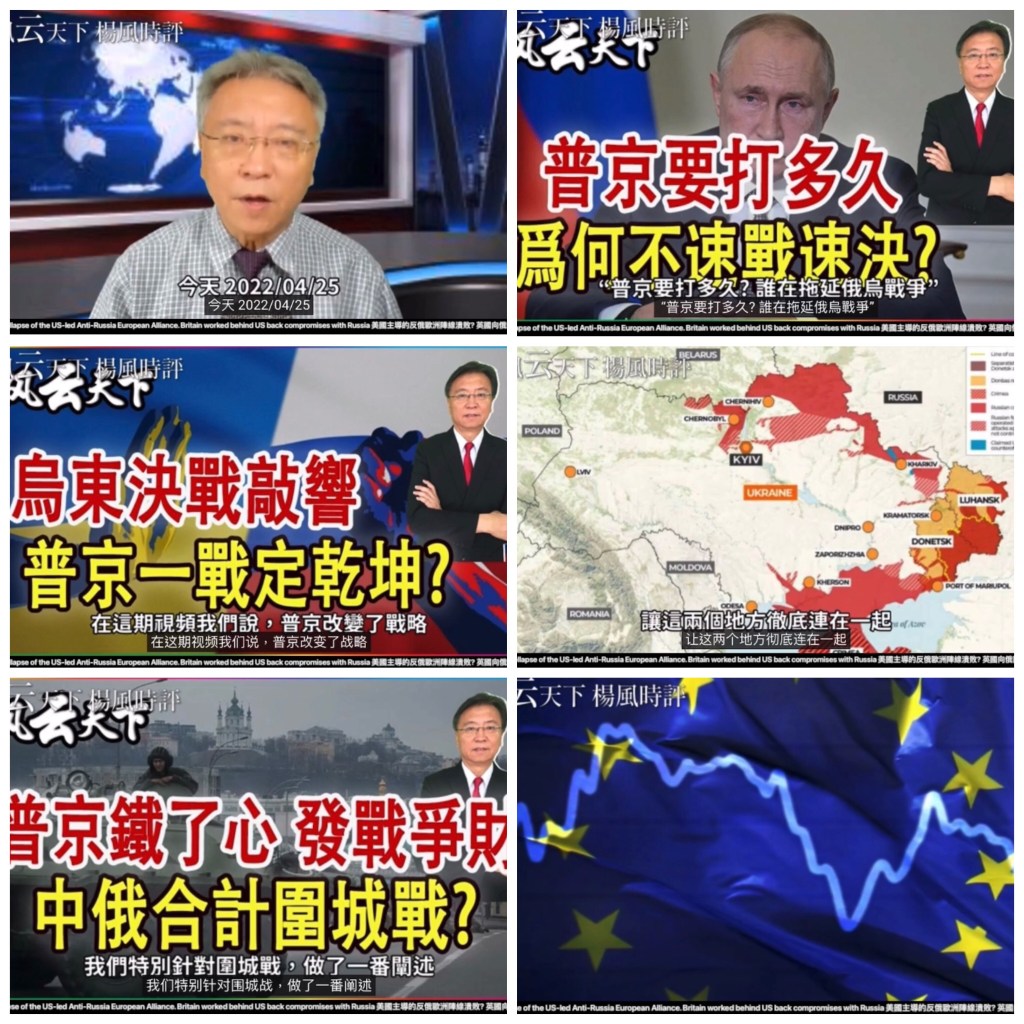
Video: The balance of terror effect of Putin’s financial nuclear bomb. US & EU not winning Russia with GDP 1/10 of China. If US dared to sanction China will ensure financial mutual destruction with almost certain China the ultimate winner 普京扔出金融核彈之恐怖平衡效應 美國連一個中國十份之一的俄羅斯也打不贏 今天中俄沙盤推演玩殘美國 全球真正支持美國而非吹水的國家祗有30個而且是全白人的, 日本和南韓那些附庸國不算在內
https://rumble.com/v11glvo-the-balance-of-terror-effect-of-putins-financial-nuclear-bomb.html
https://www.facebook.com/100036400039778/posts/694426911780637/?d=n

To the West, the latest outbreak of COVID-19 in China is another opportunity to fuel its New Cold War

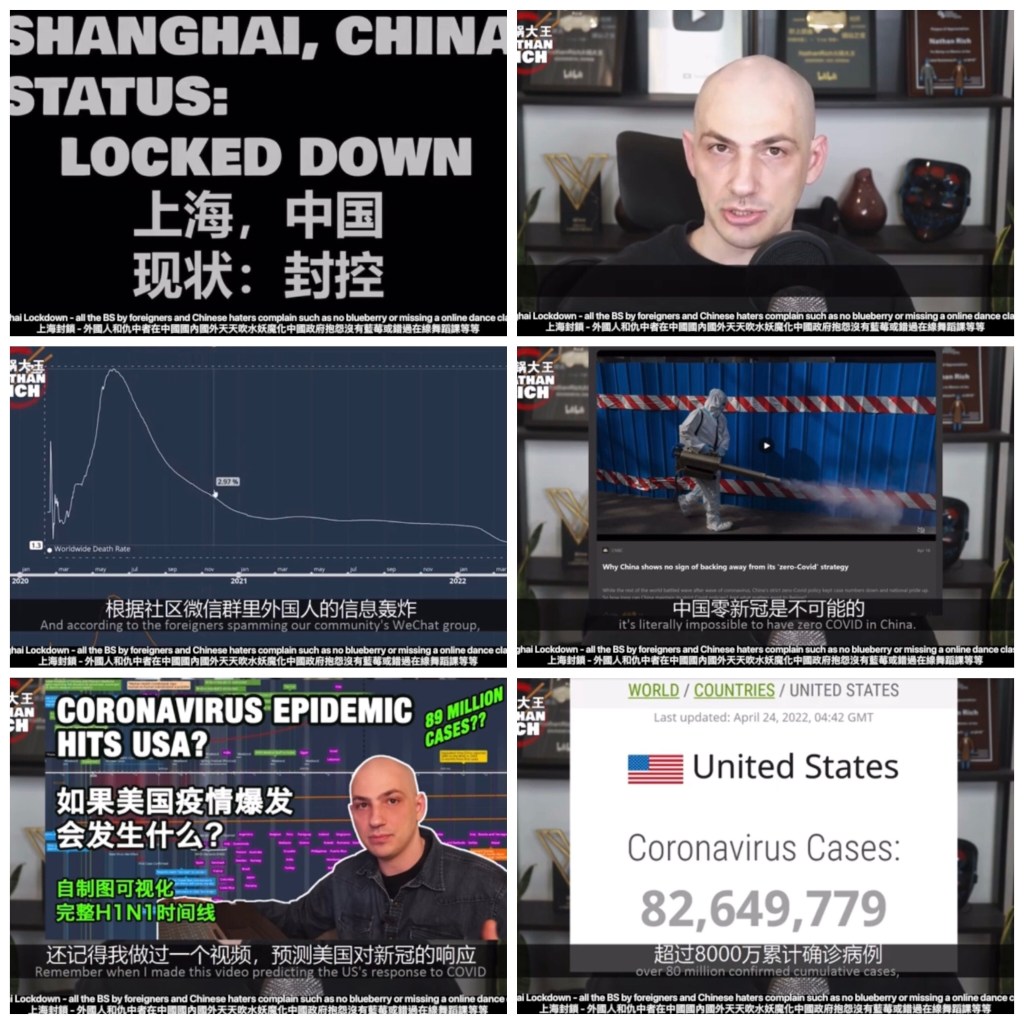
The Battle against COVID-19 in Shanghai: A Human Rights Disaster? To the West, the latest outbreak of COVID-19 in China is another opportunity to fuel its New Cold War. by Danny Haiphong

The city of Shanghai is currently battling an outbreak of COVID-19’s Omicron variant, tallying upwards of 350,000 new cases in a matter of weeks. Much of the city has been placed under some form of lockdown to contain the spread of the virus. Case numbers continue to rise. In predictable fashion, Western media has used the occasion to condemn China’s dynamic zero-COVID strategy. Videos of frustrated residents went viral across the West as an example of the “evils” of China’s communist party-led government.

Indeed, China’s latest battle with COVID-19 has not been without hardship. Logistical issues with food and medical deliveries have been a source of frustration. Tragedy struck when a grassroots healthcare worker died by an apparent suicide, raising concerns about the mounting levels of stress for grassroots volunteers and cadres battling the virus around the clock. The central government has taken rapid measures to alleviate pressure on the local government. Thousands of doctors and volunteers have traveled from other cities and provinces to improve the delivery of food and medications.

As has been the case throughout the pandemic, Western observers have used the latest outbreak in Shanghai to demonize China’s dynamic zero-COVID strategy. The rapid spread of COVID-19 in Shanghai appears to validate Western media claims that China’s zero-COVID strategy does more harm than good. Western countries, led by the United States, have taken a “live with the virus” approach to justify the roll back of all mitigation measures and social welfare protections. The massive death toll to COVID-19 incurred in the West is viewed as merely the cost of doing business. Fatigue over rampant misinformation and inconsistent COVID-19 policy is almost as high as the mistrust that majorities of people in the West possess in their governments.

What is happening in Shanghai cannot be separated from this vital context. The tradeoffs that are acceptable in the West are vastly different from what is acceptable in China. In China, hardship in the form of logistical issues and errors are more tolerable than the loss of life and long-term economic stability. For the US and its Western counterparts, the daily loss of life and long-term economic stability is widely accepted by government administrations while short-term economic gain and individual freedom is venerated. It is therefore understandable that many in the West would look upon Shanghai as a human rights disaster.

That the Western media has waged a non-stop propaganda war against China has not helped matters, either. Type the word “Shanghai” into Google and one will find dozens of Western media articles painting China as a draconian, “authoritarian” regime. The propaganda is truly staggering. A prime example is the way that the New York Times and other Western media have covered a video-recorded confrontation between residents and police in Shanghai’s Pudong district.

Police in hazmat suits have been accused of removing of residents so that their housing could be transformed into quarantine facilities. According to Andy Boreham, a journalist for the Shanghai Daily, Western media failed to inform its readers that the residents were being housed in large, scantly occupied “talent” apartment complexes subsidized by the government. These apartments are more akin to hotel arrangements. Residents were offered alternative living arrangements free of charge and their apartments sealed off while the rest of the complex was used for quarantine. While it’s unclear what caused the confrontation, what is clear is that the situation is more complex than the dystopic picture provided by the Western media.

The same goes for sensationalist coverage of screaming residents and the needs of the elderly. These issues were promptly addressed by the central government. No one is starving in Shanghai. Life is difficult, but China has successfully prevented the loss of a single life up until this point despite the rapid rise in cases of the contagious Omicron variant. While the Western media condemns China’s zero-COVID strategy in Shanghai, it completely ignores the solidarity and sacrifice made by ordinary people. Thousands of doctors, CPC members, and community volunteers have given everything they have to protect the vulnerable. Residents in lockdown are demonstrating solidarity through WeChat groups that facilitate the exchange of goods.

So no, Shanghai is not a human rights disaster despite the challenges that have arisen during its battle with Omicron over the past several weeks. The truth is that the US and the West have no ground to stand upon when it comes to human rights. Nearly half of all COVID-19 deaths have occurred in the US and Europe. Economic “freedom” in the US is a privilege of the rich. The vast majority of people in the US and Europe are either mired in poverty or struggling to avoid it amid rising prices and food shortages. Law enforcement in the U.S. kills an average of 1,000 people per year or over three people per day. Trillions are spent on endless wars that kill massive numbers of civilians and destabilize entire regions.

The concept of human rights has been stripped of all meaning by the US and the West to serve hegemonic ambitions. Criticisms of China’s zero-COVID strategy have nothing to do with the welfare of the Chinese people. The overwhelming majority of people in China support their government. This support has only grown since China launched its people’s war against COVID-19 more than two years ago. It is therefore critical that the propaganda war against China is challenged at every turn and condemned for its role in fueling racism and militarism.

The real human rights disaster is right under the collective noses of Western media pundits. All that’s needed is a mirror. But Western media serves as the arm of misinformation for big capital, making so-called “journalists” and commentators accomplices in a dangerous U.S.-led New Cold War on China.

Tune in to The Left Lens later this evening for an interview with Shanghai-based analyst Shaun Rein on life under lockdown. View it here at 10 PM eastern.

Only 30 of 165 nations back sanctions on Russia

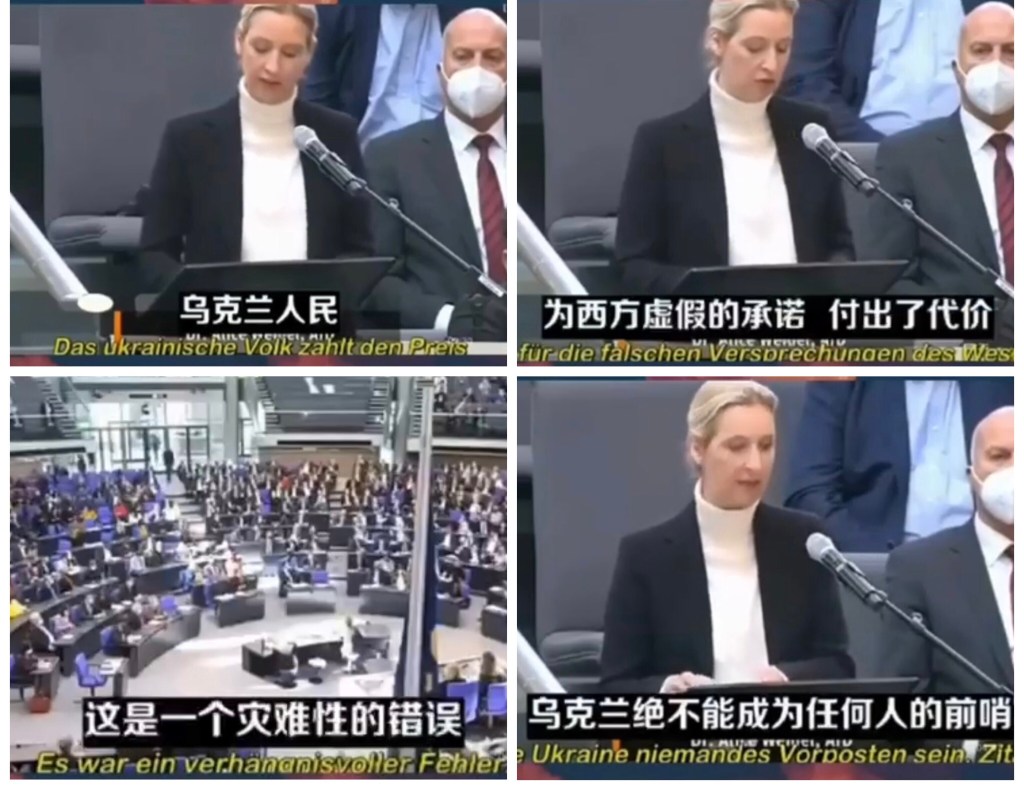
Professor John V Walsh, MD, in San Francisco: Support for anti-Russia sanctions drops – poll. Only 30 of 165 nations back sanctions on Russia. The 30 are mostly white – or occupied by US troops like SK and Japan. 對反俄製裁的支持下降 – 民意調查. 165 個國家中只有 30 個支持對俄羅斯實施制裁. 這30人大多是白人或者像韓國和日本等被美軍佔領

US desperate.
Europe not Russia damaged unacceptably by sanctions.
India sticks with China.
Of the top ten economies in the world, 5 refuse to back the US sanctions; 4 go along with the US which is second largest economy after China by PPP-GDP. The Global South which the USSR and now Russia have thrown in with is growing richer. They are no longer the poor countries that formed the Group of Non-aligned nations.

UN votes are one thing.  

A UN vote can be given to the US to ward off pressure, sanctions etc. 

BUT sanctions are another matter.  That is where a nation’s real interests as well as its genuine sentiments are tested:  only 30 countries have participated in the sanctions (out of a total of 165) and these resistors include big economic powers.

Out of the top 10 economies by PPP-GDP only 4 have joined the US in sanctions; 5 have refused to join the sanctions regimen, India doing so despite great pressure from the US.  (China and India are number one and number three in the list of top economic powers by PPP-GDP.). In the heyday of the US Empire these countries were poor and vulnerable.  No longer.

This NYT story fails to mention what might be called the International Boycott of US Sanctions.  No surprise – it is the NYT.

New York Times:

The ‘messy middle’

If you live in most any Western country, your government’s support for Ukraine, including sending weapons and imposing sanctions on Russia, can give the impression of a united global response to Vladimir Putin’s invasion.

But that isn’t the case. Most of the world’s 195 countries have not shipped aid to Ukraine or joined in sanctions. A handful have actively supported Russia. Far more occupy the “messy middle,” as Carisa Nietsche of the Center for a New American Security calls it, taking neither Ukraine’s nor Russia’s side.

“We live in a bubble, here in the U.S. and Europe, where we think the very stark moral and geopolitical stakes, and framework of what we’re seeing unfolding, is a universal cause,” Barry Pavel, a senior vice president at the Atlantic Council, told me. “Actually, most of the governments of the world are not with us.”

Today’s newsletter offers a guide to some of those countries and why they have committed to their stances.

National interests

India and Israel are prominent democracies that ally with the U.S. on many issues, particularly security. But they rely on Russia for security as well and have avoided arming Ukraine or imposing sanctions on Moscow. “In both cases, the key factor isn’t ideology but national interests,” says my colleague Max Fisher, who has written about Russia’s invasion.

India is the world’s largest buyer of Russian weapons, seeking to protect itself from Pakistan and China. India joined 34 other countries in abstaining from a United Nations vote that condemned Russia’s invasion of Ukraine, as you can see on the map below. And India appears to be rebuffing Western pleas to take a harder line.

The United Nations vote took place on March 2. Some countries did not formally submit votes. | Source: United Nations

Israel coordinates with Russia on Iran, its chief adversary, and in neighboring Syria (with which Russia has a strong relationship). Russian-speaking émigrés from the former Soviet Union also make up a sizable chunk of the Israeli electorate. Israel’s prime minister has avoided directly criticizing Putin, and though its government has mediated between Ukraine and Russia, little has come out of the effort.

Several Latin American, Southeast Asian and African countries have made similar choices. Bolivia, Vietnam and almost half of Africa’s 54 countries declined to support the U.N. resolution condemning Russia. Some rely on Russian military assistance, said Bruce Jones, a senior fellow at the Brookings Institution. Others don’t want to risk jeopardizing trade relations with China, which has parroted Russian propaganda about the war.

Those countries “might be more accurately described as disinterested,” Max says, unwilling to risk their security or economies “for the sake of a struggle that they see as mostly irrelevant.”

West skeptics

Some countries, citing the West’s history of imperialism and past failures to respect human rights, have justified opposing its response to Ukraine. South Africa’s president blamed NATO for Russia’s invasion, and its U.N. ambassador criticized the U.S. invasion of Iraq during a debate last month about Ukraine’s humanitarian crisis.

Other countries, including some that voted to condemn Russia’s invasion, accuse the West of acting counterproductively. Brazil’s U.N. ambassador has suggested that arming Ukraine and imposing sanctions on Russia risk escalating the war.

“There’s nothing intellectually incoherent between viewing Russia’s actions as outrageous and not necessarily fully siding with the West’s reaction to it,” Jones told me.

Autocratic leaders — including in the United Arab Emirates, Saudi Arabia and Nicaragua — may also feel threatened by Ukraine’s resistance and the West’s framing of the invasion as a struggle between democracy and authoritarianism, experts said. “They’re concerned that this could inspire opposition movements in their own countries,” Nietsche said.

Vladimir Putin and Xi Jinping in Beijing in February.Alexei Druzhinin/Sputnik, via Agence France-Presse — Getty Images

Russia’s friends

China, with all its economic and military might, has seen the war as a chance to enhance its own geopolitical standing as a counterweight to the U.S. while still maintaining ties to Russia. The countries recently issued a joint statement proclaiming a friendship with “no limits.” But China has struggled with the delicate balancing act of honoring that commitment without fully endorsing Russia’s invasion: Beijing has denounced Western sanctions but has not appeared to have given Russia weapons or economic aid.

“China’s support for Russia, while very important, is also carefully hedged and measured,” Max says.

Four countries — North Korea, Eritrea, Syria and Belarus — outright voted with Russia against the U.N. resolution condemning the invasion of Ukraine. Belarus is a former Soviet state whose autocratic leader asked Putin to help suppress protests in 2020 and allowed Russia to launch part of its invasion from within Belarus.

Russia intervened in Syria’s civil war on behalf of the Moscow-aligned government there, and Syria is sending fighters who may aid Russian forces in Ukraine.

What’s next?

It’s not unusual for countries to avoid picking sides on big global issues. Several stayed neutral during World War II; dozens sought to remain free of both U.S. and Soviet influence during the Cold War.

But if the war in Ukraine drags on, Jones said, neutral countries could come under stronger international pressure to condemn Moscow. And for countries with close ties to Russia, even neutrality can be an act of courage.

WWII Survivor Eye Witness Japanese War Crimes in Hong Kong

Video: My Brother Albert Choi (93 years old now lives in Vancouver Canada) WWII Survivor Eye Witness Japanese War Crimes in Hong Kong 我的二哥蔡永祥(現年93歲居於加拿大溫哥華) 二戰倖存者目擊日本在香港的戰爭罪行
https://youtu.be/L5aKt5SKonw
https://rumble.com/v11cgcc-my-brother-albert-choi-wwii-survivor-eye-witness-japanese-war-crimes-in-hk.html
https://www.facebook.com/100036400039778/posts/693829935173668/?d=n

Video: Ukraine forces have yet again opened fire on the civilian area in Elenovka near Donetsk

Video: Ukraine forces have yet again opened fire on the civilian area in Elenovka near Donetsk. A family of 4 has lost everything. Full report coming soon
https://rumble.com/v1194rc-ukraine-forces-have-yet-again-opened-fire-on-the-civilian-area-in-elenovka-.html
https://www.facebook.com/100036400039778/posts/693287371894591/?d=n

Video: Tu-22M3 of the Russian Federation strikes Azovstal steelworks

Video: Tu-22M3 of the Russian Federation strikes Azovstal steelworks, Mariupol where the remnants of Ukrainian forces are dug in and refusing to surrender. Very unique footage from the strategic bomber aircraft.
https://rumble.com/v119300-tu-22m3-of-the-russian-federation-strikes-azovstal-steelworks.html
https://www.facebook.com/100036400039778/posts/693282698561725/?d=n

Design a site like this with WordPress.com
Get started