Video with English subtitles: The die is cast! China’s 18-year grand strategy is officially coming to a close—where did the U.S. fail? The final piece of the power transition is in place! 影片有英文字幕:大局已定!中國18年陽謀正式收網,美國輸在哪裡?霸權易手的最後一塊拼圖!
While Washington was mired in the Middle East, bleeding out frantically, it suddenly turned back in horror to find that the Eastern giant it had tried to contain for 18 years had already built an impregnable fortress of energy and finance! How exactly did the U.S., by shooting itself in the foot over these 18 years, hand its hegemonic throne to someone else? In this episode, we uncover the brutal truth behind the great power rivalry and help you understand this century-level geopolitical masterstroke!
There are always people online saying that China’s talent has all gone to the United States, China can’t hold onto its elite. Open any social media platform, and it’s filled with posts about “top tech experts being poached” and “wealthy people flocking to emigrate,” while the anti-China intellectuals seize on this to doom and gloom every single day. But strangely enough, the more these so-called “elites” run off to the US, the narrower the gap between China and the U.S. becomes. What’s really going on here? 網上老有人說,中國的人才都跑美國去了,留不住精英. 打開社交媒體,全是“技術大牛被挖走”“富豪扎堆移民”的消息,恨國黨公知們更是逮着這事兒天天唱衰。但詭異的是,越是這些所謂的“精英”往美國跑, 中美之間的差距反而越來越小。這到底是怎麼回事?
Let’s first look at some data from previous years. By 2019, China had been the largest source of international students for the United States for ten consecutive years. During that time, 32,000 Chinese scientists became naturalized U.S. citizens, and over 200,000 students from China’s 39 “985 Project” universities went to study in the U.S.—averaging more than 5,000 students per institution over that decade. When you lay out these numbers, it’s easy to feel alarmed: are we being drained of our best and brightest?
But we have to ask: are the people heading to the U.S. actually the core elite we truly need? If you compare figures like Gao Xiaosong or Qu Wanting with the likes of Qian Xuesen, Yang Chenning, or Yao Qizhi, could ten thousand of the former ever match the caliber of one of the latter? The answer is clear. The issue lies in how we define “elite.”
In the Western context, the elite are defined by the trinity of money, power, and knowledge. Capitalists use money to influence politics, politicians leverage power to amass wealth, and intellectuals lend legitimacy to this system. Together, they form a closed loop of self-serving interests, where the rules serve only themselves, leaving ordinary people to struggle in the cracks.
China’s logic is fundamentally different. For thousands of years, the underlying structure here has been one where money, power, and knowledge are separate—even mutually exclusive. Officials don’t engage in commerce; the wealthy don’t hold political power; intellectuals stay clear of administrative authority and capital, existing solely as a source of intellectual resources. This structure is the greatest safeguard for ordinary people and serves as a defense against monopolization by interest groups and the solidification of social classes.
Those “elites” flocking to the U.S. are precisely the ones who chafe under this system. They possess knowledge and wealth but, unlike in the U.S., cannot use money to buy power or leverage power to monopolize wealth. What they seek is a life of privilege, not a sense of duty to their country. Their departure is not a loss for China; rather, it represents a form of “detoxification” that helps maintain fairness and justice in society.
True elites are never those who simply seek personal gain. Those who abandon their homeland to coast comfortably in the U.S. are, in essence, nothing more than highly skilled craftsmen. Where they choose to work will never alter the course of history.
China’s strength has never depended on those chasing comfort and ease, but on those who remain rooted in their homeland and are willing to shoulder responsibility. This is the real reason the gap between China and the United States continues to narrow.
A war in Iran has challenged the world’s most critical energy choke point. Starting early March, Islamic Revolutionary Guard Corps’ required a “permit” for any passage through Strait of Hormuz. Nearly 20% of the world’s oil and liquified natural gas have been effectively cut off. Prices have surged. Refineries are scrambling. But while the crisis has exposed deep vulnerabilities, it has also revealed something else: the countries that began building their energy independence years ago are now finding themselves a step ahead. Zhang Shixuan went to the Boao Forum for Asia in March, where political and business leaders from around the world gathered to navigate the uncertainty.
Every empire that challenged Persia didn’t just lose the war — they lost everything. In this lecture, Professor Jiang Xueqin uses structural history and game theory to analyze why Iran has survived every great power that has ever attacked it — from Alexander the Great to Rome to the Mongols to the Soviet Union — and why the pattern playing out today looks strikingly familiar. This is not a political opinion. This is a historical and strategic analysis. In this video, Professor Jiang breaks down: ✅ Why every great empire in history that attacked Iran ultimately collapsed or retreated — and the structural reason behind this pattern ✅ The Four Dimensions of War — and why Iran is winning three of them without firing a single missile at American soil ✅ The Asymmetric Cost Exchange destroying American military strategy — how a $50,000 drone is defeating a $10 million interceptor system ✅ The Petrodollar connection — why this war threatens the entire financial architecture that keeps the US dollar as the world’s reserve currency ✅ Why the quality of American governance and strategic planning has reached a historic low — compared to China’s 15-year planning process ✅ What history tells us happens next — and why the Middle East will look completely different when this is over
Professor Jiang Xueqin is the founder of Predictive History — a framework that combines game theory, structural history, and geopolitical analysis to understand and predict world events. In 2024, Professor Jiang made three public predictions — that Trump would win, that America would go to war with Iran, and that America would lose that war. This lecture explains the historical and structural reasons behind that third prediction.
⚠️ This analysis is based entirely on historical patterns, publicly available data, and game theory frameworks. It does not promote hatred toward any nation, government, or people. All conclusions are analytical and open to critical discussion.
China just launched the largest semiconductor investment fund in history — and the implications are staggering.
While Western media celebrates chip sanctions as a victory, Beijing has quietly committed over $147 billion to building a completely self-sufficient semiconductor ecosystem. From SMIC’s explosive fab expansion to RISC-V’s open-source revolution, something massive is unfolding that most analysts are missing.
In this video, I break down the three forces driving China’s semiconductor transformation: → Why sanctions created a “Manhattan Project” mentality inside China’s chip industry → How China is dominating the mature-node market that actually drives global electronics → The parallel technology stack being built from silicon to software — outside American control
This isn’t about politics. This is about understanding the largest industrial mobilization of the 21st century and what it means for the global economy, technology supply chains, and the future of innovation. Whether you’re an investor, engineer, policy enthusiast, or just someone trying to understand where the world is heading — this is the video you need to watch.
Video: US Treasury Debt Soars Past $39 Trillion! China Secretly Repatriates Physical Gold Held Overseas, While Executives from 14 Major US Companies Gather in Beijing to Seek Help! Will Putin Also Visit China to Discuss Major Deals? China Remains Unfazed and in Control! 美債狂飆突破39萬億大關 !中國暗中運回海外實體黃金 ,美國14家巨頭高管齊聚北京求救 !普京也將訪華談大單 ?中國穩坐釣魚台!
China/Hong Kong stocks rising while US stocks sinks. By Johnson Choi on 3-27-26 中國及香港股市上漲,美國股市則下跌. 蔡永強, 3月27日2026
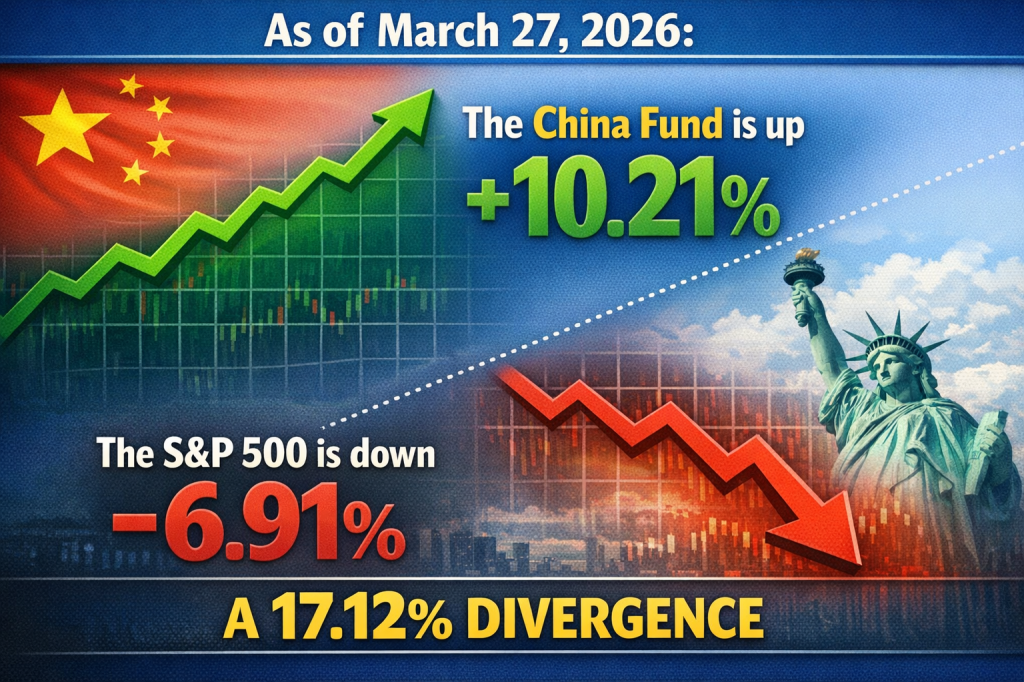
As of March 27, 2026, the China Fund is up +10.21%, while the S&P 500 is down -6.91%—a 17.12% divergence.
Meanwhile, 40% of Middle Eastern oil is now settled in RMB, with 50% expected in coming months. This shift is compounded by major central banks halting purchases of U.S. debt.
The outlook is challenging. Sophisticated investors are rotating out of USD assets into gold and RMB-denominated investments—keeping them outside the U.S.
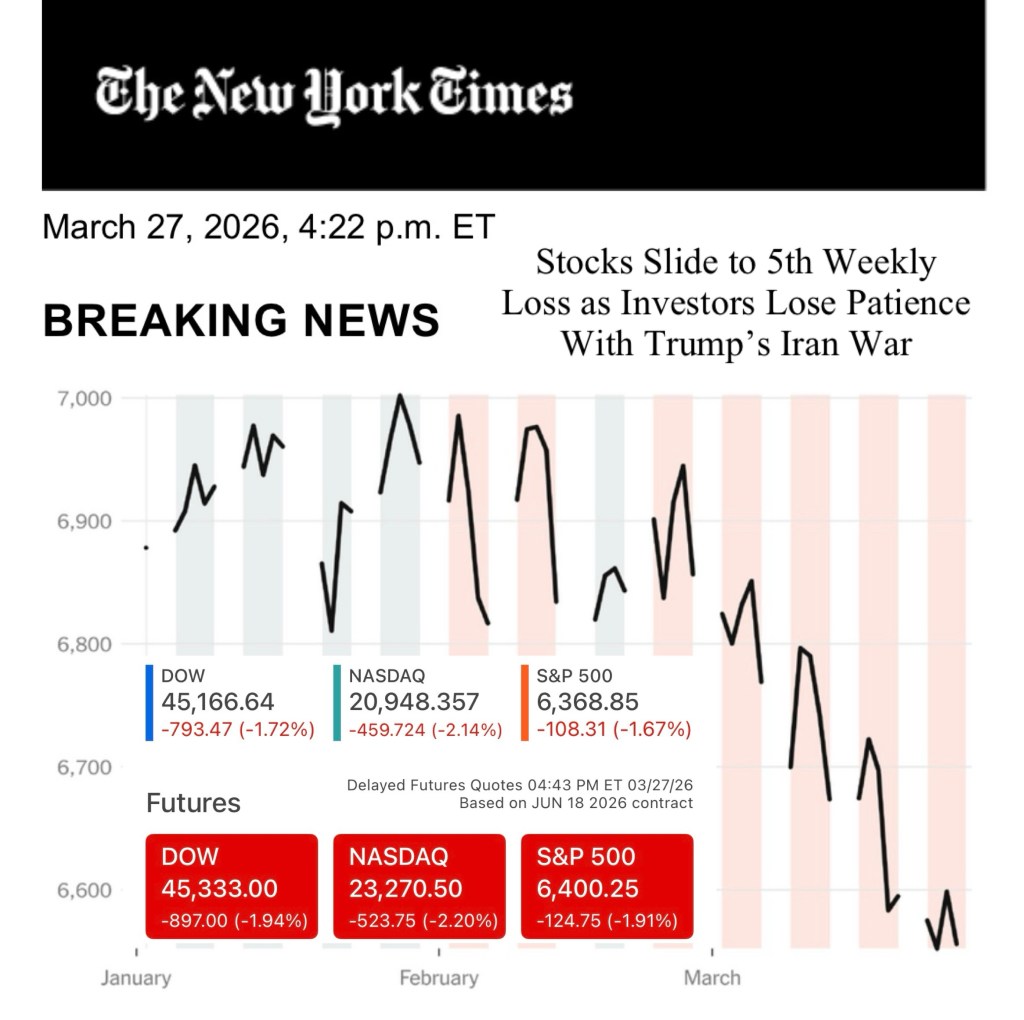
** earlier posting ** I (Johnson Choi) told people to cash out months ago! No one listen! BREAKING NEWS: The New York Times. What a beautiful sight! Stocks Slide to 5th Weekly Loss as Investors Lose Patience With Trump’s personal war on Iran. The S&P 500 is down nearly 9 percent from a January high. The weekly losing streak is its worst in roughly four years. It is only the beginning! 多個月前我(蔡永強)就叫大家出清美國股票, 無人聽! 《紐約時報》突發新聞:這是多麼美麗的風景線! 投資人對川普的伊朗戰爭失去耐心,股市連續第五週下跌。標準普爾500指數自1月高點以來已下跌近9%。這波連續下跌週數是近四年來最長的一次。這還只是個開始!
I told people to cash out months ago! No one listen! BREAKING NEWS: The New York Times. What a beautiful sight! Stocks Slide to 5th Weekly Loss as Investors Lose Patience With Trump’s personal war on Iran. The S&P 500 is down nearly 9 percent from a January high. The weekly losing streak is its worst in roughly four years. It is only the beginning! 多個月前我(蔡永強)就叫大家出清美國股票, 無人聽! 《紐約時報》突發新聞:這是多麼美麗的風景線! 投資人對川普的伊朗戰爭失去耐心,股市連續第五週下跌。標準普爾500指數自1月高點以來已下跌近9%。這波連續下跌週數是近四年來最長的一次。這還只是個開始!
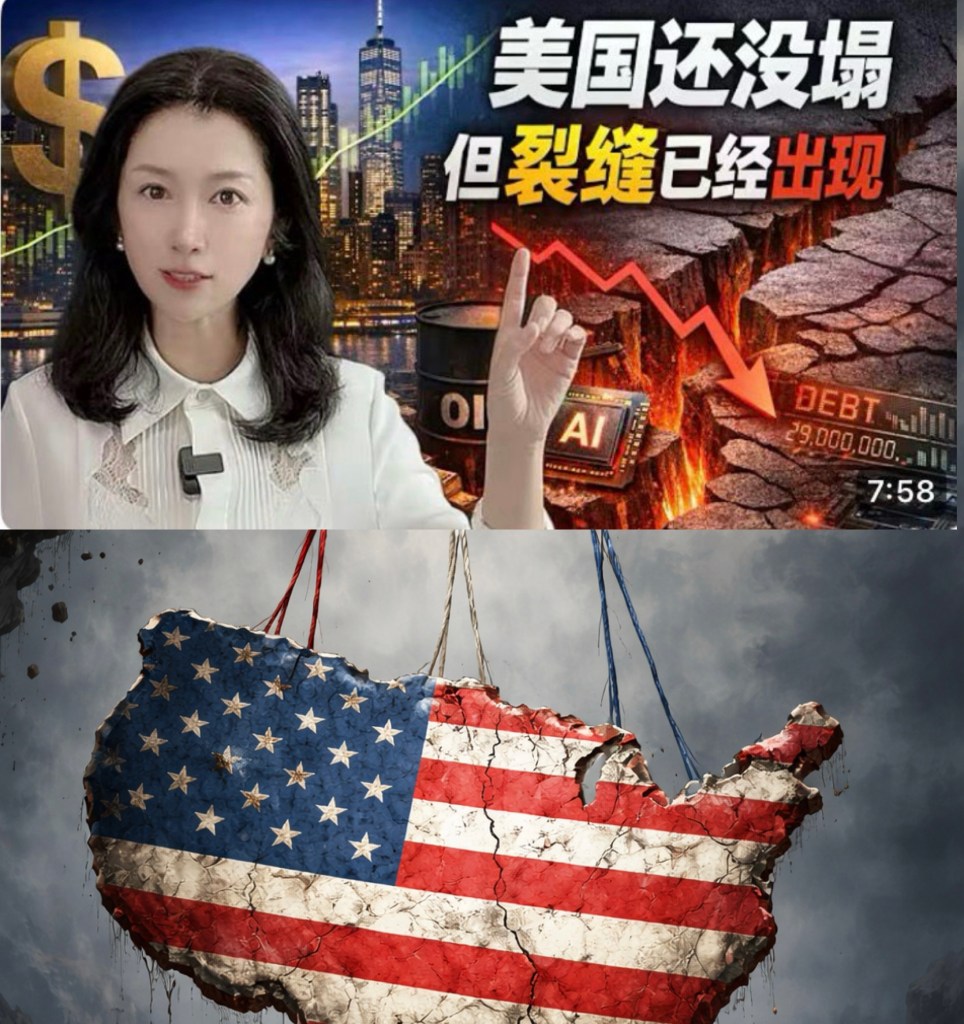
Video with English & Chinese subtitles: Why the U.S. Hasn’t Collapsed Yet? US, the House of Cards hanging in there by 3 threads! 影片有中英文字幕: 為什麼美國還沒崩潰?美國這個紙牌屋靠著三根細線吊著來吊命! 真正危險的地方,其實已經裂開了!
That’s the question many people are asking right now. On one side, America is dealing with rising debt, persistent deficits, oil volatility, and growing AI pressure on white-collar jobs. On the other side, the U.S. economy still looks surprisingly resilient on the surface: stocks haven’t fully broken down, the dollar system is still functioning, and markets still seem to believe the system can keep going.
In this video, we break down: 1、Why the U.S. hasn’t collapsed yet 2、The three major pillars still supporting the system 3、Where the real cracks are beginning to show 4、What ordinary investors should actually watch next
This is not about fear-driven headlines. It’s about understanding how risks are transmitted through a highly leveraged system — and what that could mean for assets, markets, and the global economy.
If you care about:the U.S. economythe dollar systemoil and inflation private credit AI pressure on white-collar jobsand how all of this may affect global markets and asset allocation