Video: In the past, when the U.S. sanctioned China, China could only tough it out; but today, if the U.S. wants to strike again, why doesn’t it dare? 影片有中英文字幕: 以前美國制裁中國,中國只能硬扛;今天再想下手,美國為什麼不敢了!
What is the most awkward part for the U.S.? It’s not that it doesn’t want to sanction—it’s that it has discovered that the sanction machine that used to “make others hurt at the push of a button” has started to backfire severely when turned on China.
In the past, when the U.S. wielded the knife, others bled; today, when the U.S. wields the knife, it has to first check whether the handle is still attached to its own hand. From the Huawei incident to the full-scale rise of new energy, the U.S. tried to bring China to its knees by cutting off supplies, but instead forced China to turn “self-reliance and controllability” into a national consensus. This is a recalculation of costs, and also a signal that the world’s rules are undergoing a fundamental shift.
Video: The West still wants to rewrite the world’s rules? After the G7 summit, they realized they simply cannot do without China! 影片有中英文字幕:西方還想重寫世界規則?G7開完才發現,根本離不開中國!
China didn’t even attend, so why did every topic at the G7 summit revolve around China? Trade, supply chains, new energy, the Global South, AI technology… The more the West tries to close its doors and isolate China, the more it proves that China is irreplaceable as the world’s “efficiency system.” This isn’t just rhetoric—it’s a real slap in the face delivered by the very structure of power! In this video, Peach takes you on a deep dive into the three layers of “awkward reality” reflected in the G7 summit that the West finds most embarrassing. The era when a handful of people dictated the world’s rules is long over.
EXCLUSIVE: IN A BREATHTAKING feat of hypocrisy, the UK is taking drastic steps to stop “foreign interference” cash while slamming Hong Kong for doing a basic, minimal version of the same thing.
Britain has long prohibited foreign payments to its political groups and recently escalated the law with a £100,000 annual cap on political donations from ITS OWN CITIZENS living abroad.
Keir Starmer’s government announced the new law on 25 March 2026, saying it was coming into force instantly and would have “retrospective effect”.
This had to be done to protect political “processes from foreign financial influence and interference”, a government statement claimed.
THE REAL STORY
The real story is totally different, according to the buzz in the Westminster coffee bars.
Cash-based foreign political interference (“foreign collusion” in legal terms) has been banned everywhere as an obvious evil for decades—except in Hong Kong, when the UK hypocritically long supported western-financed political opposition groups which continually campaigned to delay its introduction.
Beijing wised up to the trickery in 2020 and introduced a western-style law against foreign collusion in Hong Kong, bringing the city into line with the west.
REFORM FUNDING In the UK, that law already existed—but was dramatically extended in March to include a cap on donations by British citizens abroad, rushed through to stop the explosive growth of rival party Reform.
That’s because Reform is financed by a pair of British crypto bros, one from Thailand and one from… Hong Kong (O the irony!).
As the UK prepares for a crucial by-election set to cause problems for the Prime Minister, “the Electoral Commission publishes the latest party funding figures and reveals who is backing the Reform UK operation”, reports the latest issue of Private Eye magazine.
‘MALIGN INTERFERENCE’ In the first 3 months of 2026, Christopher Harborne of Thailand gave £3 million (latest of a long line of donations) and Ben Delo of Hong Kong gave £4 million. (Delo says he is moving back to UK as his main home.)
It is right to come down hard on foreign payments to politicians because they were cases of “malign interference”, a Labour party spokesperson said. “Labour is introducing these landmark changes to protect UK democracy from [the] scourge of foreign actors and financial influence.”
This is a staggering level of hypocrisy.
In British Hong Kong, from at least 1990, the UK governors allowed foreign agents, largely from the US, to finance a group called “the pan-democrats” with tens of millions of dollars. Many of the transactions were recorded in the accounts of the National Endowment for Democracy, a CIA regime-change spin-off.
When Hong Kong introduced a law in June 2020 which prevented financial influence and political collusion from overseas, it was presented by the UK politicians and media as if it banned dissent.
No dissent was allowed, and the punishment was death “by firing squad”, reported Jimmy Lai, the UK’s favorite Hong Kong newsman.
NONE OF IT WAS TRUE None of this was true. The 2020 National Security Law did not mention dissent, nor death penalties, nor firing squads in any form.
The law was largely a move to stop illicit cash payments to politicians in Hong Kong—bringing the city in line with the UK, US and other modern urban centers.
British passport holder Jimmy Lai and his sidekick, former US intelligence agent Mark Simon, had been earlier exposed by a disgruntled Apple Daily shareholder of delivering millions of dollars of unexplained cash to pan-democratic politicians.
NEWS BLACKOUT Western mainstream media ran (and is still running) a news blackout on negative news about Jimmy Lai and the pan-democrats, who are continually presented as Hong Kong heroes, when they have been repeatedly exposed as being the opposite.
The vast majority of Hong Kong people want a positive relationship with Mainland China and oppose independence.
To take just one example, Reuters likes to paint China-hostile churchman Joseph Zen as a hero—without mentioning that he received multiple unexplained payments of about $3 million Hong Kong dollars, which is about US$380,000, delivered by Lai and Simon.
Had Zen been taking the cash in the west, the media would have torn him to shreds. But he works to demonize China, so the international media chooses not to report it.
🔴 Western think tanks have labeled China a “perfect superpower.” Do you think this is a deliberate attempt to overpraise and set China up, or is it a cry of utter despair after they have exhausted all their means? 🔴 With a complete industrial system, a mega-market, and deep geographic strategic depth… among these “hexagonal” absolute advantages, which one do you think is our strongest trump card against external encirclement? 🔴 This “perfect system” that external sanctions cannot break must nevertheless face the internal challenges of demographic structure and financial risks. In the next decade, where do you think our biggest challenge lies? Feel free to leave your real thoughts in the comments! Like and subscribe, and we’ll help you understand the strategic and economic logic behind the great-power rivalry.
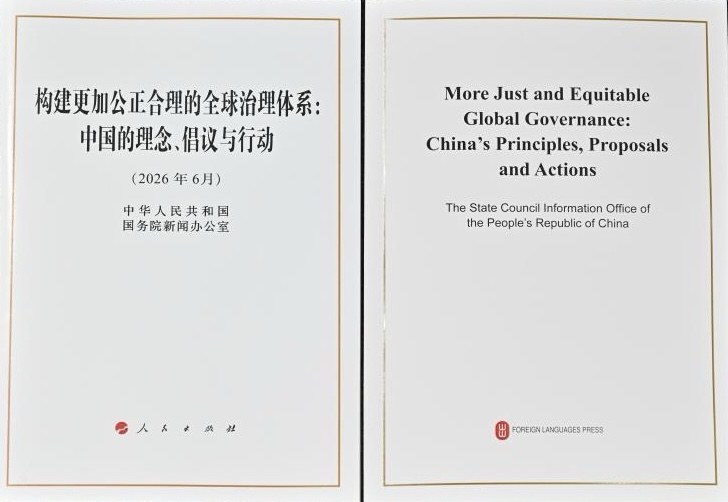
China Calls for Greater Justice and Equity in Global Governance – presents its latest vision for improving—and even transforming—global governance. June 17, 2026 中国政府发布关于全球治理的白皮书: 丛林法则严重冲击国际法治;全球南方声音需要更多倾听! 中國呼籲全球治理更公平正義——提出改善乃至變革全球治理的最新願景。2026年6月17日
China’s State Council Information Office on Wednesday released a white paper titled “More Just and Equitable Global Governance: China’s Principles, Proposals and Actions.”
The white paper was published to introduce China’s principles, proposals and actions on global governance, foster broader consensus within the international community, ensure more effective responses to global challenges, and build a more just and equitable global governance system.
Global governance is a common endeavor that bears on the well-being of all humanity, and building a just and equitable global governance system is a shared vision long pursued by people from across the world, the white paper said, adding that China has always been an active participant in, contributor to, and builder of global governance.
In the new era, President Xi Jinping put forward the vision of building a community with a shared future for humanity. In promoting a global governance system characterized by extensive consultation and joint contribution for shared benefit, he has called for true multilateralism to foster an equal and orderly multipolar world and a universally beneficial and inclusive economic globalization, according to the white paper.
In 2025, Xi proposed the Global Governance Initiative (GGI), which is designed to offer a Chinese solution to the two pressing questions of the era: what kind of global governance system should be established, and how global governance can be reformed and improved.
Upon its introduction, the GGI swiftly gained support from nearly 160 countries and international organizations, with over 60 countries joining the Group of Friends of Global Governance. The international community believes that the GGI sends a clear signal: uphold multilateralism, unite forces, and pursue a fair future, the white paper said.
The GGI aligns with the growing trend towards greater democracy in international relations and bolsters international confidence in practicing multilateralism. It offers a clear and feasible roadmap for improving global governance, bringing valuable stability and positive energy to a turbulent world, according to the white paper.
China has proposed the GGI to expedite the building of a more just and equitable global governance system. Resolutely upholding the UN’s authority and status is fundamental to the effective implementation of this initiative, the white paper said.
Success will also hinge on major countries bearing a sense of responsibility, and on all nations uniting and cooperating to address deficits in peace and development. All countries should firmly uphold the international system with the UN at its core, safeguard the international order based on international law, and uphold the basic norms governing international relations underpinned by the purposes and principles of the UN Charter, instead of reinventing the wheel, according to the white paper.
Apart from the preface and conclusion, the white paper has five parts: “The World Today Faces Severe and Complex Challenges,” “The Global Governance Initiative Responds to Challenges of Our Times,” “China’s Contribution to Promoting Global Governance,” “Guiding the Direction of Change Towards a Bright Future,” and “Moving Forward Hand in Hand at a Critical Juncture in History.”
Video: The 2026 World Cup (co-hosted by the U.S., Canada, and Mexico) has extensively adopted Chinese technology, covering everything from the match ball to security systems and transportation. Chinese involvement has evolved from simple “manufacturing” to deep participation in “smart technology” across multiple key areas. By Johnson Choi. June 17 2026 影片有中英文字幕: 2026年美加墨世界杯确实大量采用了中国技术,覆盖了从比赛核心用球到安保系统、交通保障等多个关键领域。中国元素已从“制造”升级为深度参与的“智造”. 作者; 蔡永強. 2026年6月17日
· Official Match Ball “Triple Wave” : Features a Chinese-made smart chip that records 500 touch data points per second, combined with limb-tracking tech to assist referees with precise decisions. · AI & Display Technology : Lenovo provides AI super-agents for tactical analysis and 3D digital human visualization for VAR (Video Assistant Referee); Hisense supplies professional display systems for the referee center.
🚇 Transportation & Security
· Light Rail & Shuttles : CRRC operates 115 new light rail trains across three Mexican host cities, carrying over 1.25 million passengers daily and serving the stadium that hosts the opening match. Yutong Bus provides nearly 1,000 buses and has dispatched 35 engineers for service support. · Security Equipment : X-ray scanners and other security screening devices at the venues also come from China.
🏟️ Venues & Merchandise
· Stadium Renovation : China Railway Construction Corporation (CRCC) and other firms led the renovation of the opening match venue—Mexico City’s iconic Azteca Stadium. · Official Merchandise : About 70% of global World Cup fan products (jerseys, souvenir balls, etc.) are produced in Yiwu, China.
Chinese companies have shifted from being mere “suppliers” to becoming “key participants” in the tournament’s core systems and infrastructure.
China just passed a law that punishes any company — including American ones — for following US sanctions against Chinese firms. 中國近日通過一項法律,將懲罰任何遵守美國對華制裁措施的公司——即使美國企業也不例外。
Starting July 1, China’s new Counter-Extraterritoriality Regulation takes effect. It gives Beijing the legal power to fine, sue, or sanction any business anywhere in the world that follows US rules targeting Chinese companies. In simple terms: if an American company stops doing business with a Chinese tech firm because Washington said to — China can now legally punish that American company.
This puts thousands of US businesses in an impossible position. Follow the US government’s orders and face punishment from Beijing. Follow Beijing and break American law. There is no winning move.
Nearly half of all American companies operating in China already say they have lost sales due to US export controls. Now they face legal retaliation on top of that. Jobs, revenues, and supply chains are all at risk.
China is playing a long, calculated game. It is building laws specifically designed to neutralize America’s economic weapons — sanctions, export controls, and trade restrictions. And it is moving fast.
July 1 is two weeks away. American businesses are running out of time.
Do you think US companies should pull out of China completely to avoid this legal trap? Tell us below.
US Secretary of War Pete Hegseth tweeted on X an hour ago that “US Indo-Pacific Command” will revert to its old name, “US Pacific Command”.
This is the latest of multiple moves from the western allies against India.
The US attacked three Indian ships last week, killing three sailors. The US left the ships to sink, and the surviving sailors were rescued by Oman.
Earlier this week, the UK armed forces grabbed an Indian-run ship, the Smyrtos, as it passed through the Straits of Dover on its way to India.
Both acts appear to contravene international law, specialists say.
EXPLOITING INDIA AS A PARTNER The “Indo-Pacific” name was introduced in May 2018 by the US armed forces to emphasize the US’s favoring of India and the Indian Ocean area.
In mid-2025, the US military instructed the international mainstream media to use “Indo-Pacific” in place of “Asia-Pacific”. The media obeyed, as Google searches confirm, with a huge spike in the use of that name.
At the time, the US believed it could exploit India as a partner to maintain western domination over Asia–as specified in US foreign policy.
But the US and its vassal (“ally”) the UK appear to have changed attitude to India these days, and so the “Indo” is disappearing from the name with immediate effect. US Indo-Pacific Command is now US Pacific Command.
Hegseth’s announcement of the name reversion today echoes his earlier move – to change Department of Defense to the (admittedly more accurate) Department of War.
ILLEGAL UNDER INTERNATIONAL LAW The UK seizure is an astonishing story.
On Sunday this week, the UK armed forces grabbed the Smyrtos, as it passed through the English channel on its way to Sikka in India.
The Smyrtos is owned by a Hong Kong-registered company, Zhao Yao Shipping Ltd, and is managed by a company in Tamil Nadu, India.
The UK claimed it was a stateless ship carrying Russian oil – but the seizure would still be illegal under international law, said Craig Murray, former Head of Maritime Section of the UK Foreign and Commonwealth Office.
Just because the US or an ally creates a sanction, that has no force of law in a transnational context.
DIRTY TRICK Murray shared an untold story. When the Smyrtos began its journey, it was flying the Cameroonian flag and was listed on the Cameroonian register.
But after it had set sail, the EU and UK threatened to halt development aid to Cameroon unless they removed Russia-friendly vessels from their shipping register.
“So the UK blackmailed Cameroon into deregistering the ship. Then, before the ship could reach a friendly port, the UK boarded it because it had been deregistered,” said Murray.
It may surprise some people that western nations should do such a dirty trick. “The UK actions are patently – and deliberately – unreasonable,” Murray added.
But the UK public is not hearing the real facts – it is “an astonishing story which the media will not tell you”, he said.
MODI IN A SPOT
These actions put Indian leader Narenda Modi in a spot. He has been energetically cozying up to the United States and Israel, despite their unpopularity among the people of India.
Now his people are asking: when will he give India a more independent, assertive stance?
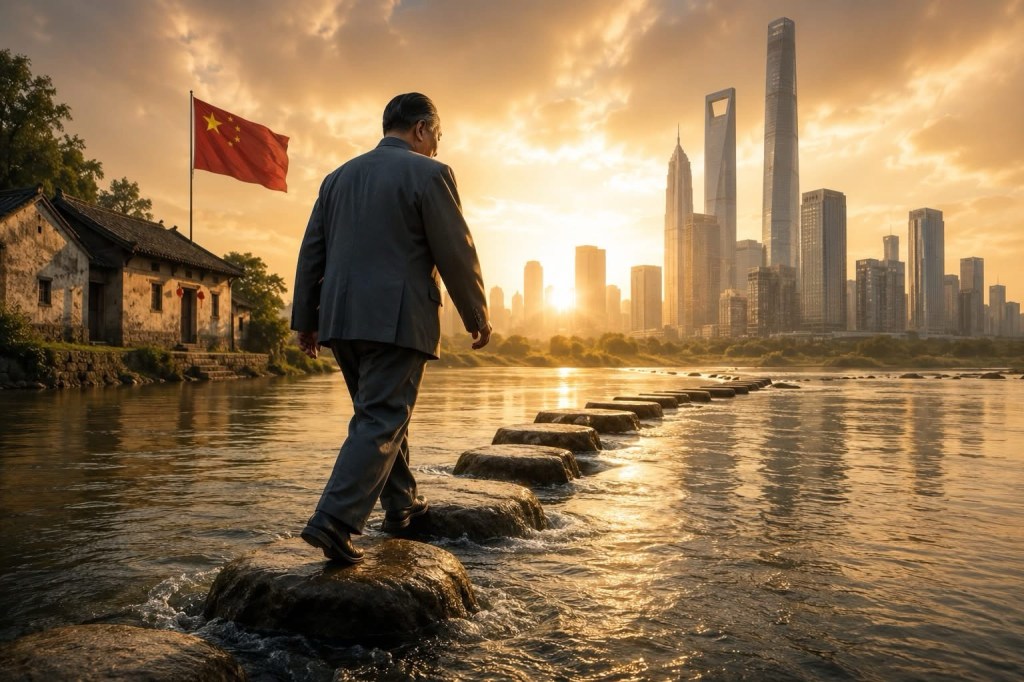
When Deng Xiaoping took the reins of a broken, backward China in 1978, he didn’t present a flawless ideological manifesto. Instead, he dropped a piece of ancient folk wisdom that became the absolute mantra of the Chinese miracle: “Cross the river by touching the stones.” (摸着石头过河). 當鄧小平於1978年接手一個破敗、落後的中國時,他並沒有提出一套完美無缺的意識形態宣言。相反地,他引用了一句古老的民間智慧,並將其變成中國奇蹟的核心信條:
The philosophy was simple: We know where the other side of the river is (wealth, stability, modernization). But the water is deep, current-heavy, and murky. We don’t have a bridge. So, how do we cross? You take a step. You feel with your foot under the water until you find a solid stone. If it holds your weight, you step onto it. If it wobbles, you pull your foot back and feel for another one.
You don’t commit to a leap of faith; you commit to relentless, small-scale experimentation.
Deng wanted to modernize agriculture, but the Communist Party dogma insisted on collective farming—even though it was starving the population. Instead of rewriting the national constitution overnight (which would have caused a political war), Deng looked at a tiny, desperate village called Xiaogang. The farmers there had secretly, illegally divided their land into family plots, promising to give the state its quota but keep the surplus to sell.
The result? Their harvest multiplied by ten in a single year. Deng didn’t punish them. He used their village as a “stone.” He watched the feedback, saw the stone was solid, and then quietly legalized the “Household Responsibility System” across the entire country. He let a local, illegal hustle rewrite national economic policy.
When China wanted to test capitalism and attract foreign investment, the hardliners panicked that it would corrupt the socialist soul of the country. Deng’s solution? He didn’t open up Beijing or Shanghai. He picked Shenzhen—a sleepy fishing village of 30,000 people right on the border of British Hong Kong.
He designated it a “Special Economic Zone.” It was a laboratory. If capitalism failed or caused a political disaster, the damage was contained to a tiny patch of sand on the coast. But the stone held. Shenzhen exploded, building skyscrapers at the rate of one floor every three days. Once the feedback proved the experiment worked, Deng stepped onto the next stones, opening up 14 more coastal cities to the global market.
If a policy works—even if it breaks your ideological rules—you step on it. If it fails, you drop it immediately and adjust.