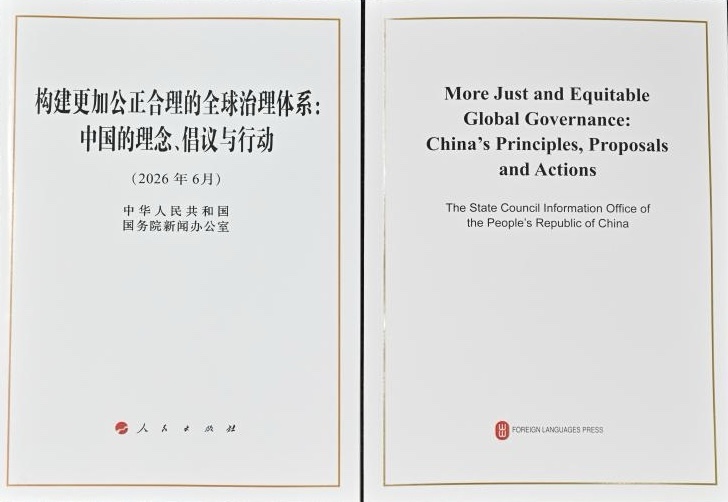
China Calls for Greater Justice and Equity in Global Governance – presents its latest vision for improving—and even transforming—global governance. June 17, 2026 中国政府发布关于全球治理的白皮书: 丛林法则严重冲击国际法治;全球南方声音需要更多倾听! 中國呼籲全球治理更公平正義——提出改善乃至變革全球治理的最新願景。2026年6月17日
https://johnsonwkchoi.business.blog/2026/06/17/china-calls-for-greater-justice-and-equity-in-global-governance-presents-its-latest-vision-for-improving-and-even-transforming-global-governance/
https://www.tiktok.com/t/ZP8sbqYxn/
https://www.tiktok.com/t/ZP8sbDqc1/
https://m.facebook.com/story.php?story_fbid=1684882262735092&id=100036400039778&mibextid=wwXIfr
中國國務院新聞辦公室週三發表題為《更加公正合理的全球治理:中國的理念、主張與行動》的白皮書。
白皮書發布旨在介紹中國關於全球治理的理念、主張和行動,凝聚國際社會更廣泛共識,更有效應對全球性挑戰,推動建設更加公正合理的全球治理體系。
白皮書指出,全球治理是關乎全人類福祉的共同事業,建設公正合理的全球治理體系是世界各國人民長期追求的共同願景。中國始終是全球治理的積極參與者、重要貢獻者和堅定建設者。
進入新時代後,習近平主席提出構建人類命運共同體理念。在推動共商共建共享的全球治理體系過程中,他倡導真正的多邊主義,推動建設平等有序的多極化世界,以及普惠包容的經濟全球化。白皮書指出,這些理念為全球治理改革與發展提供了重要指引。
2025年,習近平提出全球治理倡議(Global Governance Initiative,GGI),旨在為當今時代兩個重大課題提供中國方案:應建立什麼樣的全球治理體系,以及如何改革和完善全球治理。
白皮書表示,全球治理倡議一經提出,便迅速獲得近160個國家和國際組織支持,超過60個國家加入「全球治理之友小組」。國際社會普遍認為,該倡議發出了明確信號:堅持多邊主義、凝聚各方力量、共同追求公平未來。
白皮書指出,全球治理倡議順應國際關係民主化的大趨勢,增強了國際社會踐行多邊主義的信心,並為完善全球治理提供了清晰且可行的路線圖,為動盪不安的世界注入寶貴的穩定性和正能量。
中國提出全球治理倡議,是為了加快建設更加公正合理的全球治理體系。白皮書強調,堅決維護聯合國的權威和地位,是有效落實這項倡議的根本保障。
白皮書還指出,倡議的成功實施有賴於大國承擔責任,也有賴於各國團結合作,共同應對和平與發展赤字。各國應堅定維護以聯合國為核心的國際體系,維護以國際法為基礎的國際秩序,維護以《聯合國憲章》宗旨和原則為基礎的國際關係基本準則,而不是另起爐灶、重建體系。
除前言和結語外,白皮書共分五個部分:
- 《當今世界面臨嚴峻複雜挑戰》
- 《全球治理倡議回應時代挑戰》
- 《中國推動全球治理的貢獻》
- 《引領變革方向,共創光明未來》
- 《站在歷史關鍵節點攜手前行》
China’s State Council Information Office on Wednesday released a white paper titled “More Just and Equitable Global Governance: China’s Principles, Proposals and Actions.”
The white paper was published to introduce China’s principles, proposals and actions on global governance, foster broader consensus within the international community, ensure more effective responses to global challenges, and build a more just and equitable global governance system.
Global governance is a common endeavor that bears on the well-being of all humanity, and building a just and equitable global governance system is a shared vision long pursued by people from across the world, the white paper said, adding that China has always been an active participant in, contributor to, and builder of global governance.
In the new era, President Xi Jinping put forward the vision of building a community with a shared future for humanity. In promoting a global governance system characterized by extensive consultation and joint contribution for shared benefit, he has called for true multilateralism to foster an equal and orderly multipolar world and a universally beneficial and inclusive economic globalization, according to the white paper.
In 2025, Xi proposed the Global Governance Initiative (GGI), which is designed to offer a Chinese solution to the two pressing questions of the era: what kind of global governance system should be established, and how global governance can be reformed and improved.
Upon its introduction, the GGI swiftly gained support from nearly 160 countries and international organizations, with over 60 countries joining the Group of Friends of Global Governance. The international community believes that the GGI sends a clear signal: uphold multilateralism, unite forces, and pursue a fair future, the white paper said.
The GGI aligns with the growing trend towards greater democracy in international relations and bolsters international confidence in practicing multilateralism. It offers a clear and feasible roadmap for improving global governance, bringing valuable stability and positive energy to a turbulent world, according to the white paper.
China has proposed the GGI to expedite the building of a more just and equitable global governance system. Resolutely upholding the UN’s authority and status is fundamental to the effective implementation of this initiative, the white paper said.
Success will also hinge on major countries bearing a sense of responsibility, and on all nations uniting and cooperating to address deficits in peace and development. All countries should firmly uphold the international system with the UN at its core, safeguard the international order based on international law, and uphold the basic norms governing international relations underpinned by the purposes and principles of the UN Charter, instead of reinventing the wheel, according to the white paper.
Apart from the preface and conclusion, the white paper has five parts: “The World Today Faces Severe and Complex Challenges,” “The Global Governance Initiative Responds to Challenges of Our Times,” “China’s Contribution to Promoting Global Governance,” “Guiding the Direction of Change Towards a Bright Future,” and “Moving Forward Hand in Hand at a Critical Juncture in History.”