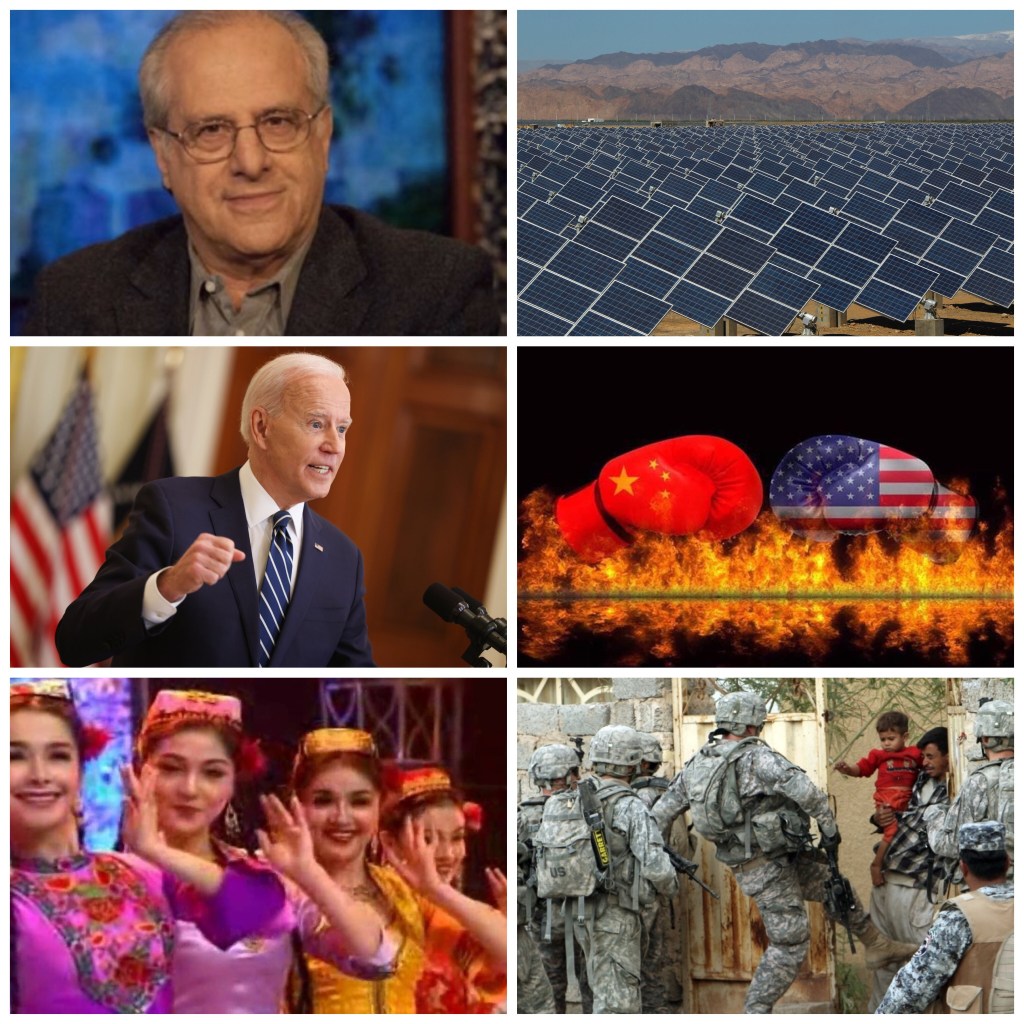
“[China] found customers in the rest of the world, they lowered the price, that even offset part of the US tariffs, and here we are years afterwards and they’re still the dominant player [in solar panels], more dominant today than they were then. [The tariffs] didn’t work and it often doesn’t…. When it’s talked about now it’s not understood that part of the cause of inflation in the United States is US policy blocking China and indeed other parts of the world from bringing goods. So it’s a little bit self-defeating. No, let me take that back. It’s very self-defeating.” – Richard D. Wolff
Richard David Wolff is an American Marxian economist, known for his work on economic methodology and class analysis. He is Professor Emeritus of Economics at the University of Massachusetts Amherst, and currently a Visiting Professor in the Graduate Program in International Affairs of the New School in New York.
Can US infrastructure plan aid manufacturing? For a country where capital has the final say, what matters is not how to distribute the money. It’s where to earn more money that is worthy of attention. 美國的基礎設施計劃能幫助製造業嗎? 對於一個資本說了算的國家,重要的不是錢怎麼分配。 哪裡可以賺到更多的錢,這才是值得關注的 By Ding Gang Aug 11 2021
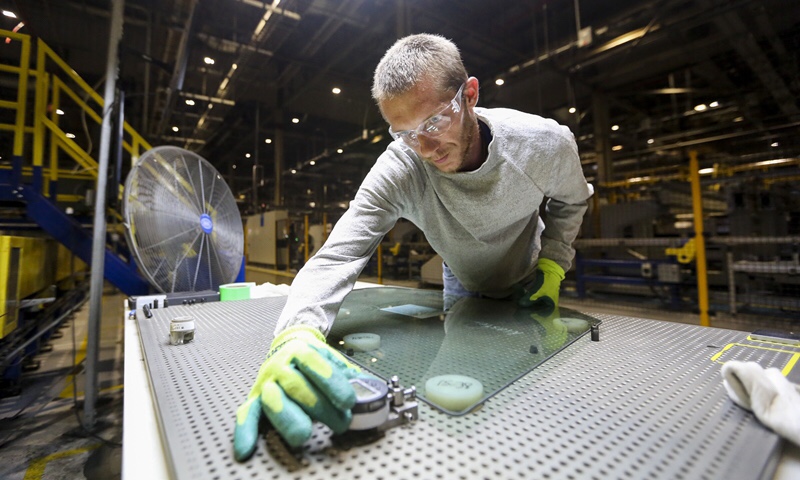
A worker does quality inspection at the Fuyao Glass America (FGA) facility in Moraine of Dayton in Ohio, the United States
The US Senate on Tuesday approved a $1 trillion bipartisan infrastructure plan. The deal includes $550 billion in new federal investment for infrastructure in the US.
If the plan is passed in the House of Representatives and takes effect, it will help rebuild the US’ manufacturing sector. Of course, this will take a long time.
Apart from infrastructure, the bill will also devote funds to boost the US high-tech sectors, including the chip industry. This will be done in a bid to maintain the US’ dominant position in these domains.
The US is undergoing economic adjustment. The US government will attach more importance to boost domestic economy and improve its social security system. Yet this demands a wealth of investment. It cannot be addressed even if the country accelerates its drive to print more money.
For a country where capital has the final say, what matters is not how to distribute the money. It’s where to earn more money that is worthy of attention.
Statistics show that it is no longer possible for the US today to maintain its position as a global manufacturing power. It cannot continue to control global markets, or obtain the most gains as it did in the past four or five decades.
This is first reflected in the manufacturing sector. The data released by the United Nations Statistics Division estimated that China accounted for 28.7 percent of global manufacturing output in 2019, more than 10 percentage points ahead of the US. The US used to have the largest manufacturing sector across the world until China overtook it in 2020.
Germany once again achieved the highest rank in the 2020 edition of UNIDO’s Competitive Industrial Performance Index. China has climbed three positions in the past six years and now ranks in second. South Korea currently ranks in third place, and the US follows.
In some significant high-tech areas, the US manufacturing is still indispensable. It still occupies a large share of global market. But the future tendency is that manufacturing sectors of other countries, such as Germany, Japan and China, will continue to erode the market owned by the US. Such a trend is irreversible. This is not a problem that Washington can solve by having more input.
The whole world’s dependence on the US is also decreasing in terms of the most basic living supplies. For instance, China, India, Bangladesh, Vietnam, and Turkey are now the main global garment manufacturing countries. China, which has a complete clothing production chain, is also the largest exporter of apparel to the rest of the world.
Moreover, no US company was listed in the world’s top 10 steel-producing companies for 2020: Seven out of the top 10 are from China, except ArcelorMittal from Luxembourg, Nippon Steel Corporation from Japan, and POSCO from South Korea.
The same trend applies to vehicle sales. Last year, Toyota, Volkswagen, Renault-Nissan-Mitsubishi Alliance, Hyundai-Kia, and General Motors are the world’s top five car companies by sales volume. And only General Motors is an American company.
In terms of cereals production, the US is still the second largest in the world. But productions in China, which rank first in the world (as well as in India, Russia, Brazil, and Indonesia, which rank below the US), have seen a rise in recent years.
Changes in production areas certainly lead to changes in markets, even though the processes are quite slow. This is why it will be increasingly difficult for US capital to make money from the world.
Looking at the stock market, leading US companies, including Google, Microsoft and Apple, are still growing in terms of market value. But without the support of American manufacturing, their profit models cannot be solid.
Will the global markets held by these US companies, especially those in the strong industries of the US such as military and aviation, be gradually dismantled or replaced by companies of other countries? That’s what Washington, and to be more specific, Wall Street, is most worried about.
Such a worry is behind almost all US policies toward China. These include the strategy of using the so-called security issue to crack down on Chinese tech giant Huawei, taking advantage of Xinjiang-related issues to contain the development of China’s textile industry and strengthening military alliances against China.
The author is a senior editor with People’s Daily, and currently a senior fellow with the Chongyang Institute for Financial Studies at Renmin University of China. dinggang@globaltimes.com.cn. Follow him on Twitter @dinggangchina
American democracy is now merely a democracy focusing on voting that may generate a government by the people but not for the people. US Government catering to the Fortune 500 companies, defense contractors, arm dealers and top 1% of the population only. 美國民主現在只是一個注重投票的民主,它可以產生一個由人民選出而不是為人民服務的政府。 今天美國政府只為財富 500 強公司、國防承包商、軍火商和前 1% 的精英和富豪人口提供服務.
American Democracy v. China’s Mencius Democracy by chankaiyee2 8-11-21
I like Lincoln’s idea of government of the people, by the people and for the people.
American democracy is now merely a democracy focusing on voting that may generate a government by the people but not for the people. As a result, politicians often pay too much attention to votes and may neglect their duties to work for the people. CNN’s Meanwhile in America article “’Children are not supposed to die’” on August 11, 2021 gives a typical example.
It says, “In Florida and Texas, concerns over the Delta variant are being exacerbated by a political meltdown over masks. Two Republican governors, with an eye on their party’s future White House nomination, are trying to ban local officials from imposing mask mandates for children in class. It sure looks like Governors Ron DeSantis of Florida and Greg Abbott of Texas are callously putting kids at risk to further their own political careers (underline by this blogger) — but they argue that parents and not bureaucrats should decide.
In such an emergency, a state leader must conduct his leadership by imposing some rules for the benefits of the people he leads even if he may lose some votes by so doing.
Focusing on getting votes instead of voters’ welfare is the cause of US failure to control the COVID-19 pandemic.
China’s imposition of strong control over the pandemic seems autocratic, but the measures have been carried out for the benefits of Chinese people out of the intention of governance for the people. That is why it is so successful in controlling the pandemic. It proves China’s Mencius democracy of “putting the people first” is superior to US democracy focusing on getting votes with no regard to people’s welfare.
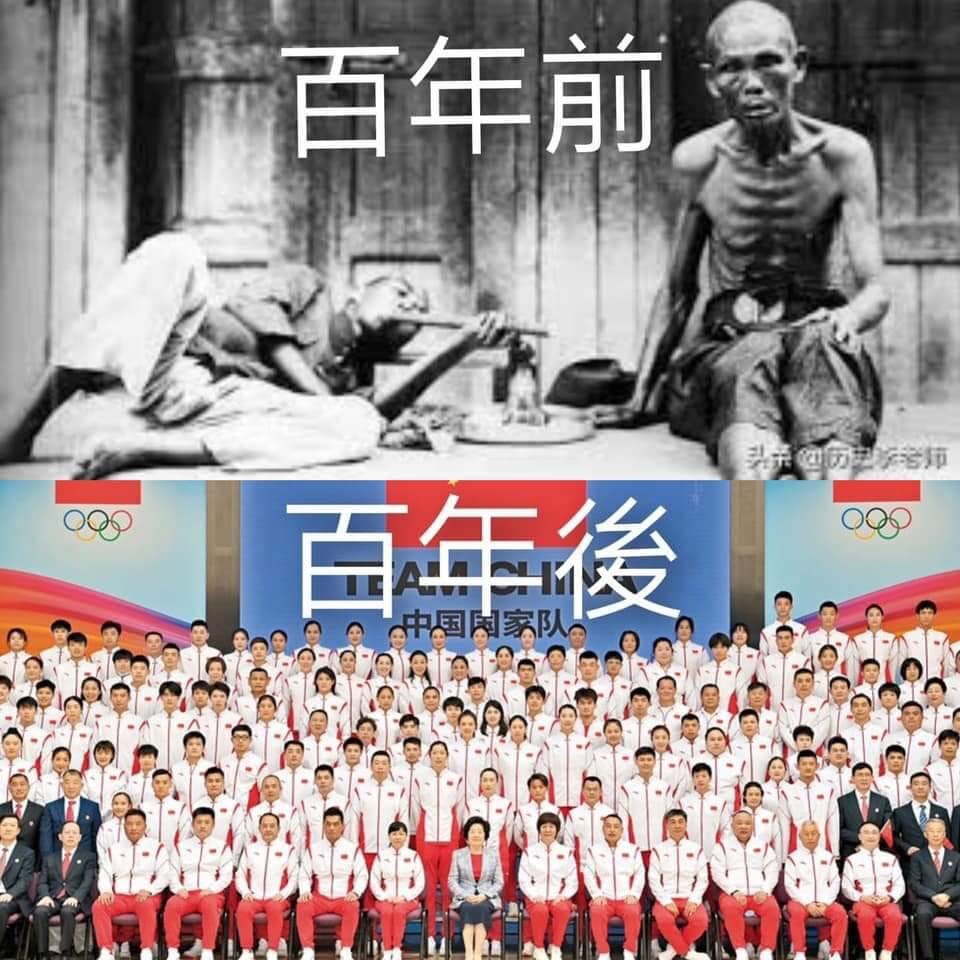
US and her vassal states thought China is still the China 100 years ago that they could kill, raped, steals and commit crimes against humanity to Chinese and China. Have your wet dreams, ain’t going to happen! Chinese daring you to try! 呢張相令我感受好心深, 中國已經唔係百年前嘅中國. 美國及其附庸國認為中國仍然是100年前的中國讓他們可以對中國和中國人殺害、強姦、偷竊和犯下危害人類罪。 做你的濕夢,絕再也不會發生! 夠膽敢於嘗試就讓死無葬身之地.
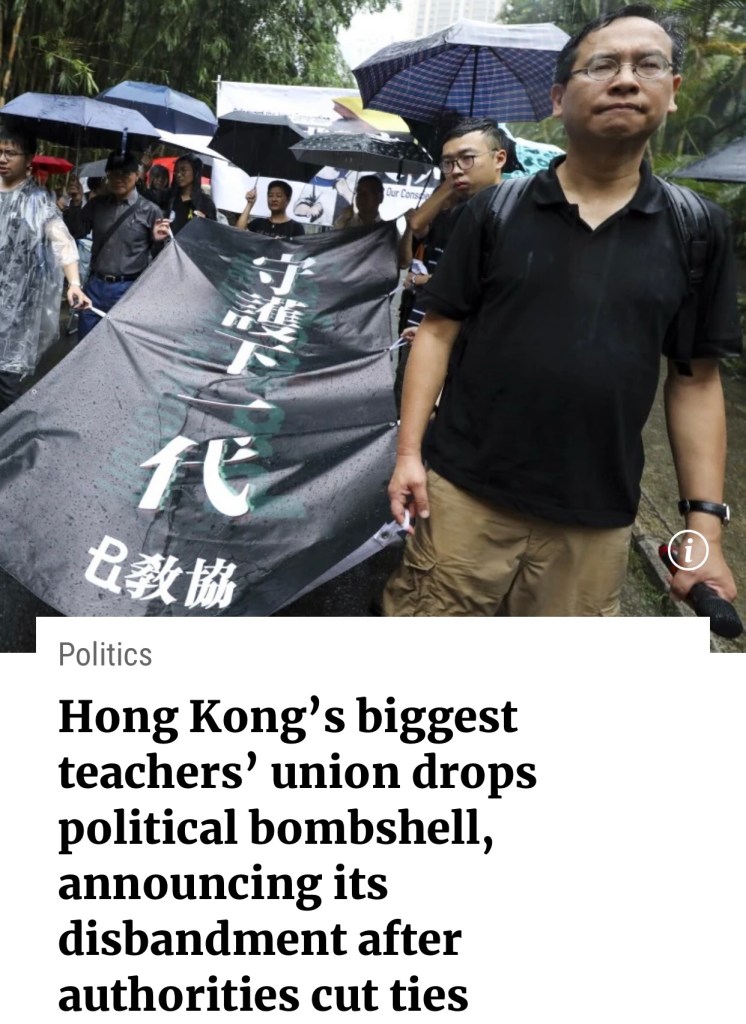
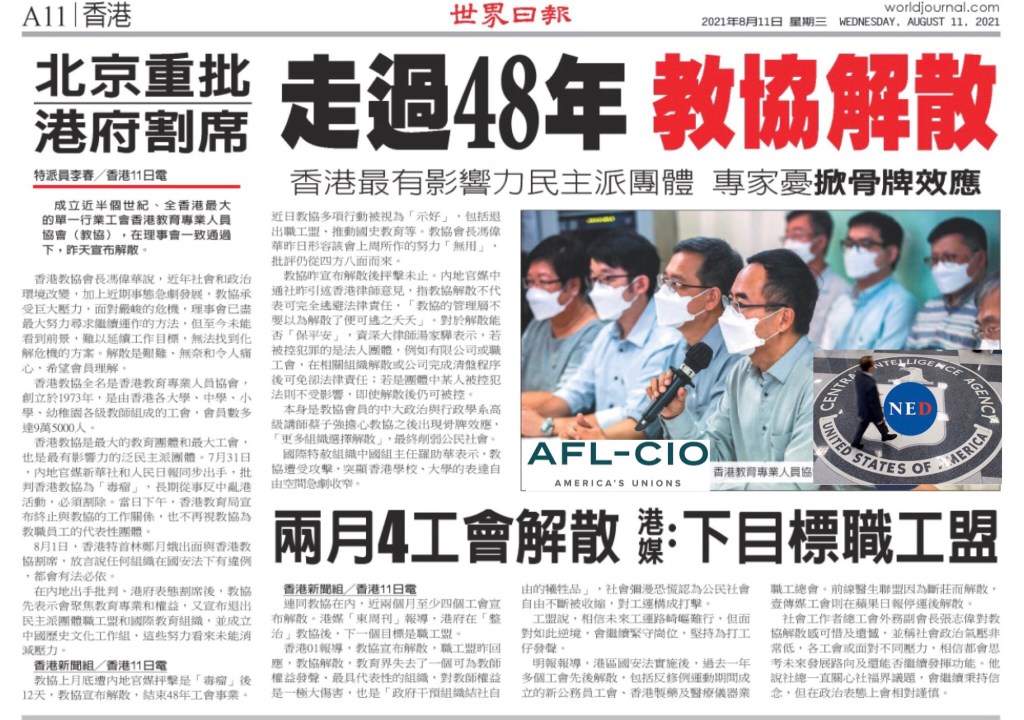
After working with NED/CIA for decades to engaged in subversive activities in Hong Kong, passing the homeland security law put nails on the coffin. 在與美國民主基金會和美國中情局合作數十年在香港從事顛覆活動, 因香港通過國土安全法他們沒有藏身之地, 美國主子也放棄對它們的支持. Hong Kong’s biggest teachers’ union has announced its disbandment, the political bombshell coming days after education authorities formally severed ties with the opposition-leaning group and warned that law enforcement could “take appropriate action” against it if necessary.
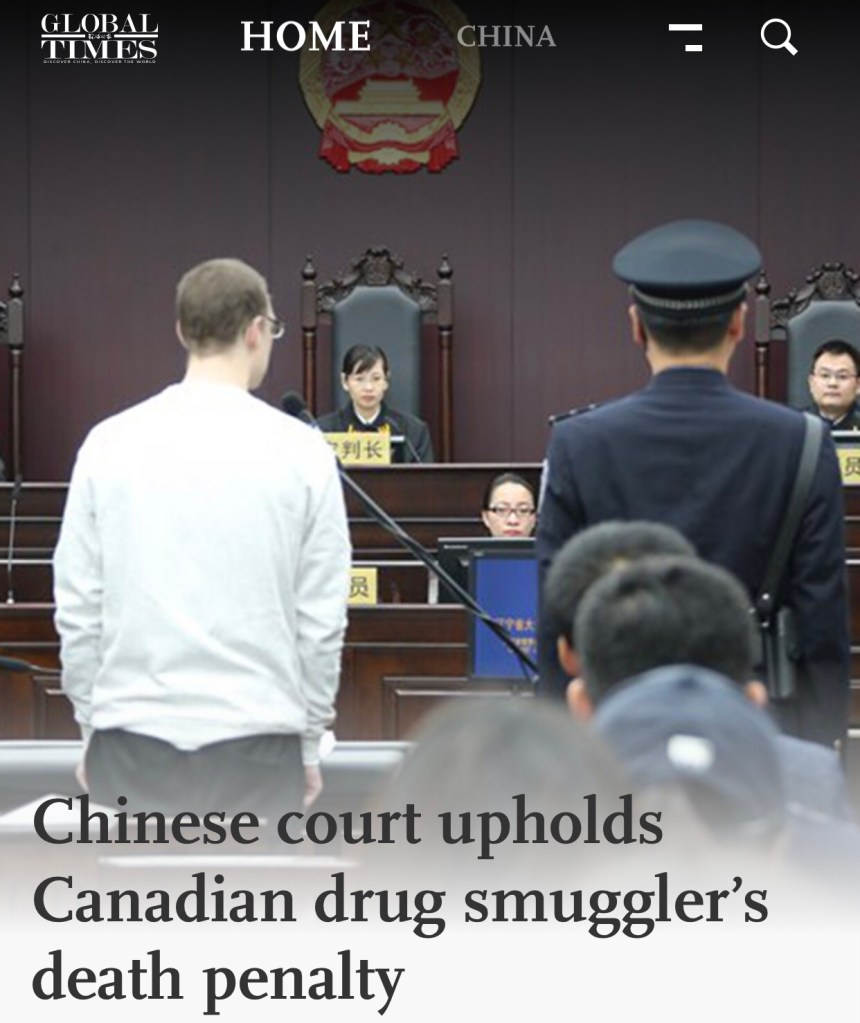
Chinese court upholds Canadian drug smuggler’s death penalty by Cao Siqi Aug 09 2021
Canadian drug smuggler Robert Lloyd Schellenberg attends the court for his retrial on Monday at the Intermediate People’s Court of Dalian in Northwest China’s Liaoning Province. Photo: courtesy of Dalian Intermediate People’s Court Canadian drug smuggler Robert Lloyd Schellenberg attends the court at the Intermediate People’s Court of Dalian in Northwest China’s Liaoning Province. File Photo: courtesy of Dalian Intermediate People’s Court
Canadian drug smuggler Robert Lloyd Schellenberg’s death penalty was upheld by the High People’s Court of Liaoning Province on Tuesday in a second trial. The case has won broad support from the Chinese public, as they detest drug trafficking and believe mercy to drug dealers would equal infringement on the rights of millions of Chinese people.
The court in the second trial rejected Schellenberg’s appeal, upheld the original first judgment, and reported the death sentence to China’s Supreme People’s Court for approval in accordance with the law, according to a statement published on the court’s website on Tuesday.
In Schellenberg’s first trial at the Intermediate People’s Court of Dalian in November 2018, he was sentenced 15 years in jail for smuggling 222.035 kilograms of meth. The Dalian court held a retrial of the case on January 15, 2019 as prosecutors presented new evidence which showed that Schellenberg was not only the prime culprit of drug smuggling but was also engaged in organized international drug trafficking, and he was sentenced to death by the Dalian court.
According to China’s Criminal Procedure Law, the court of the original trial may change the penalty when the prosecutors provide new evidence.
Pei Zhaobin, dean of the law school of Dalian Ocean University who attended the retrial, told the Global Times that the prosecutors provided evidence to prove Schellenberg participated in organized international drug trafficking as a prime culprit.
The evidence constitutes new criminal facts, which means that the verdict does not violate the principle, Pei said.
Pei stressed that the death penalty verdict is legal and appropriate, reflecting the determination and intensity of China’s crackdown on drugs.
After the retrial, Schellenberg appealed. The Canadian Ambassador to China rejected the verdict, saying “We condemn the verdict in the strongest possible terms and call on China to grant Robert clemency,” according to CNBC. He also criticized the penalty as “cruel and inhumane.”
The High People’s Court of Liaoning said it formed a collegial panel in accordance with the law, held a public session to try the case, and concluded that “the facts identified in the first trial were clear, the evidence was true and sufficient, the conviction was accurate, the sentence was appropriate and the trial procedure was legal.”
The court said during the second trial that it guaranteed the rights of Schellenberg in accordance with the law to defend himself and to participate in the proceedings in his own language, and listened to his own defense with the assistance of two translators.
The case, along with two other cases involving two separate Canadians who were charged with stealing state secrets from China, was interpreted by some Western media as an effort by China to step up pressure on Canada to release Huawei’s Meng Wanzhou.
Dominic Barton, Canada’s Ambassador to China, told CNBC that he doesn’t think it’s a coincidence these are happening right now while events are going on in Vancouver, and the case was “part of the geopolitical process of what is happening.”
Chinese Embassy in Canada on Tuesday condemned Ottawa’s statement on the death penalty, saying it seriously violates China’s judicial sovereignty and the spirit of the rule of law. China will never allow drug traffickers from any country to kill and poison the Chinese people, the embassy said. The law is not a game, and China urges Canada to be cautious with words and actions and stop making irresponsible remarks.
“The death penalty has been widely applied in the world based on international laws. Canada should respect China’s laws and drop the illusion that the drug smuggler would be granted some mercy due to his nationality,” Wang Yiwei, director of the institute of international affairs at the Renmin University of China in Beijing, told the Global Times on Tuesday.
“The case has nothing to do with the Meng Wanzhou case,” Wang stressed.
According to Wang, Meng’s case is a completely political incident. Canada has arbitrarily detained Meng for more than two years, and she is an innocent Chinese citizen who violated no Canadian law at all. Canada is acting as an accomplice of the US, so Meng’s case is “arbitrary detention.”
“The verdict of Schellenberg shows China has always been open, transparent and principled in diplomacy. Any judicial decision does not target any country and Canada should never think of attacking and restraining China with legal cases,” Wang said.
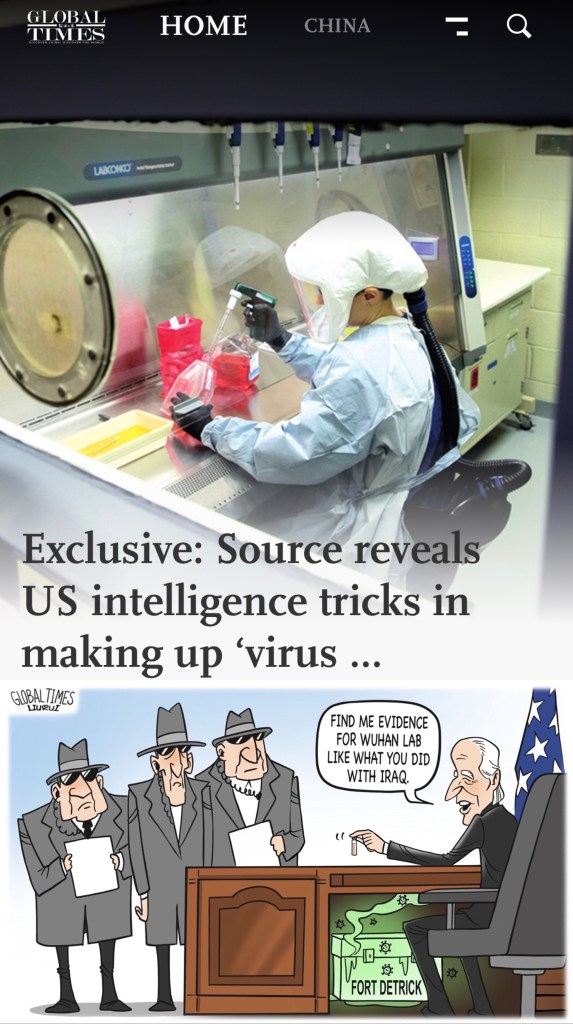
Exclusive: Source reveals US intelligence tricks in making up ‘virus origins’ and next move of taming 消息來源揭示了美國在編造“病毒起源”和馴服世衛組織的下一步行動方面的情報技巧 WHO by Cao Siqi, Chen Qingqing and Bai Yunyi Aug 10 2021
As US President Joe Biden approaches his deadline for intelligence agencies to hand over reports on the origins of the novel coronavirus, a source close to the matter told the Global Times on Tuesday that the US’ push for the probes on virus origins was aimed at consuming China’s diplomatic resources. The US is trying to find “loopholes” in China’s epidemic control policy, and planning to continue pressuring the WHO and collude with its allies to pressure China in an attempt to discredit the Chinese government for “covering up the truth about the origins of the virus.”
In May, Biden ordered intelligence officials to “redouble” efforts to investigate the origins of COVID-19, including the theory that it came from a laboratory in China. He said the US intelligence community was split on whether it came from a lab accident or emerged from human contact with an infected animal, and he asked the groups to report back to him within 90 days.
The source said that US intelligence officials are trying to find some witnesses or insiders during the initial stage of the epidemic in Wuhan, the city that first reported the outbreak in China, prying into the “lockdown measures” and “restriction areas,” with people who work in the medical system, biological research institutes or those who live in Wuhan being their targets.
The officials are also collecting evidence to prove the loopholes in China’s anti-epidemic work, eyeing detailed information about COVID-19 patients, the lives of residents under lockdown, the timing of diagnosis, and patients’ movements before infection, the source said.
According to the source, the next step for the US government is to continue pressuring the WHO and Director-General Tedros Adhanom Ghebreyesus to make sure they would lean on the US.
The US government will also collude with its allies such as Australia and media outlets to suppress China, in an attempt to accuse the Chinese government of “concealing the truth of the virus’ origins.”
Chinese virologists, as well as experts on US affairs, believe that the probe into the virus’ origins has become an important tool for the US to attack, discredit and suppress China politically. For the US, it has nothing to do with science.
The steps taken by intelligence officials show that Biden’s intention to trace the virus’ origins is entirely political, not scientific, Yang Zhanqiu, a virologist at Wuhan University, told the Global Times.
The probe should be a technical issue that requires genetic analysis of the virus. Scientists in Asia, America and Europe should analyze the genetic profile of the virus that has emerged in the region and then discuss the information together to confirm the next steps of the investigation, Yang said.
However, what Biden’s intelligence agencies are looking for can only serve as part of the evidence for him to fabricate a report to blame China, so that he would show his people that he is better than former US president Donald Trump, Yang said.
A foreign expert close to the WHO-China joint team previously told the Global Times that the 90-day probe by the Biden administration on the virus’ origins is a coordinated political campaign.
“If former US Secretary of State Mike Pompeo had actual intelligence that would convince people, he would have released it,” he said, noting that Biden has to address it because the Republicans are aggressive, pushing him to go down this path.
Yang Xiyu, a former Chinese diplomat and senior research fellow at the China Institute of International Studies, said the intelligence probes fully expose the fact that the US aimed to manufacture some materials to prove China is guilty, and the so-called probes that insult and discriminate against China will not stop.
“The intelligence officials’ actions showed the US has launched a ‘political war’ against China through the probe of the virus’ origins,” Lü Xiang, a research fellow on US studies at the Chinese Academy of Social Sciences, told the Global Times.
The US is trying to give the world the impression that the country could find the origins of the novel coronavirus in China by virtue of its powerful intelligence abilities and secret means, so as to “prove” the Chinese government should shoulder responsibility for what the US has suffered from the epidemic, Lü said.
This is a “sick political war” that the US has waged, facing an unprecedented health crisis, Lü said.
The expert said that it is a tradition for the US to launch a “political war” against countries it does not agree with. The US has seasoned organization, experience and planning prowess. Its purpose is to consume China’s diplomatic resources, but the US should know that the “political war” is also a huge drain on US political and social resources, which is far greater than the actual loss of China.
Li Haidong, a professor at the Institute of International Relations of China Foreign Affairs University, also pointed out that the US has adopted similar strategies against other countries, and now it’s on China, and the possibility that US intelligence agencies are making up material for ill-intentioned political motives could not be excluded.
US on her fake freedom democracy and human rights and rules of laws at UN and that includes her vassal states like UK, Australia, Canada, Israel, France, Germany, Netherlands. 美國就她在聯合國虛假的自由民主、人權和法律規則在聯合國表露無遺. 其中包括她的附庸國,例如英國、澳大利亞、加拿大、以色列、法國、德國、荷蘭.
UN introduced a bill that called for global action against racism and discrimination*
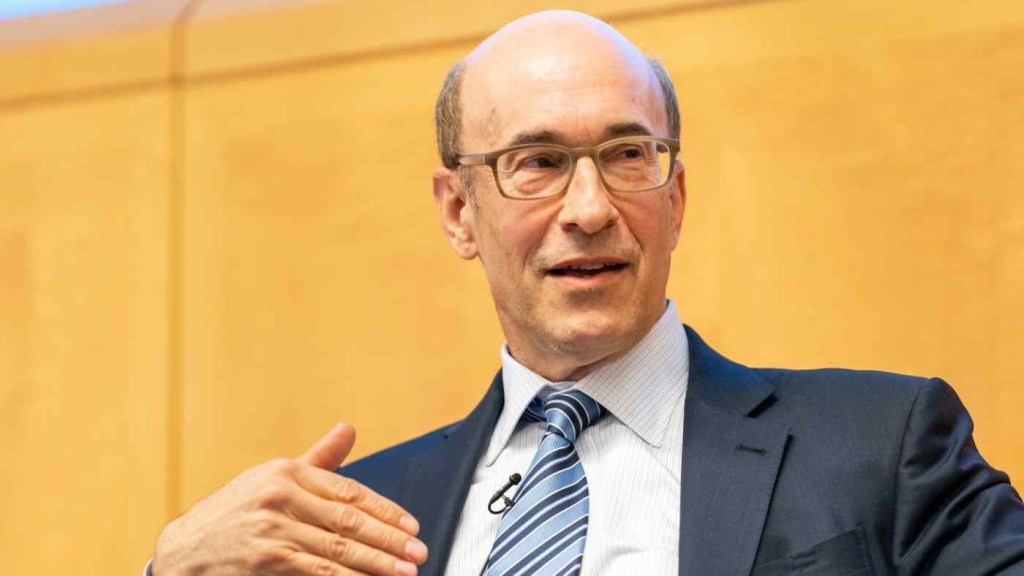
Nikkei Asia: INTERVIEW – China’s yuan likely to become Asia’s central currency: Kenneth Rogoff
Fifty years after Nixon shock, US risks overconfidence, Harvard professor says
Harvard University economics professor Kenneth Rogoff predicts that Asia eventually would coalesce around the yuan if China ceased to stabilize the currency’s exchange rate based on the U.S. dollar. By MASAHIRO OKOSHI, Nikkei staff writer August 10, 2021
BOSTON, U.S. — At a secret gathering at Camp David in the summer of 1971, U.S. President Richard Nixon and his top economic advisers made the historic decision to suspend the dollar’s convertibility into gold, unilaterally changing the global monetary system.
Fifty years after the event dubbed the “Nixon shock,” the U.S. dollar still retains its status as the world’s key currency. But will this last for the foreseeable future?
Nikkei sat down with Kenneth Rogoff, professor of economics and Thomas D. Cabot professor of public policy at Harvard University, to discuss the future of the monetary system. Edited excerpts of the interview follow.
Q: You have raised the possibility of China no longer pegging the yuan to the dollar some day.
A: Right now, the dollar is overwhelmingly the dominant currency in the world, much more so than the euro, which is mainly a regional currency in Europe. The dollar, in terms of reserves, invoicing practices, how much countries stabilize around the dollar, financial markets — just everything — it’s overwhelming. It’s more dominant than it was in the 1950s.
However, a significant piece of this is that China has decided to stabilize their exchange rate around the dollar. We don’t know what would happen if someday China went to a more normal inflation-targeting regime, and even had an exchange rate more like the yen — which has been very stable against the dollar in recent years, but it can move.
It wouldn’t happen overnight, but my guess is that over time Asia would coalesce, not around the dollar but around the RMB [Renminbi, the Chinese yuan]. Then we’d be in a world where the RMB would be a regional currency in Asia, the euro would be a regional currency in Europe, and the dollar would have everything else.
That would be a loss of an enormous part of the global economy. It would certainly have an impact on the ease with which U.S. corporations can borrow. The U.S. gets benefits from the fact that Asia is so dollar centric.
Q: The dollar is still dominant.
A: The power of the dollar is not just that so much of the world uses it as a unit of account and for invoicing [and] for reserves, but the fact that, because of the power of the dollar, the U.S. has a lot of control over information.
Any time there is dollar clearing, anywhere in the world, a lot of it happens in the U.S. It’s very difficult for a foreign central bank, a foreign clearinghouse, to compete with a U.S. clearinghouse because the U.S. clearinghouse has the Federal Reserve behind it. If something goes wrong, they just have an infinite supply of dollars.
If clearing happens in the U.S., that means someone in the U.S. knows what the trade was, what happened. Now, I’m not saying that [President] Joe Biden looks at this every day, but he could.
Q: When you look at history, has the global monetary system usually been multipolar or unipolar?
A: Unipolar is the usual. Multipolar is usually transitional. It’s not a stable equilibrium, because there are networking effects that are very powerful, and that tends to prevail. So, if we see China become as important as Europe is today, I suspect there would be a transition to where someday it became the center.
The dollar could last a long time, after the U.S. economy had diminished.
There’s an incredible advantage to being on top. Like in anything, if you’re a powerful monopoly, you can deliver a mediocre product for a long time before you lose your monopoly. But I think Americans underestimate the fact that it could happen.
The progressives especially just say, “Well, let’s make everything free for everyone, and we can just borrow. Interest rates will never go up.” You see that argument a lot. That’s basically close to modern monetary theory.
Everyone is treating that like that’s forever. If the U.S. political system believes in itself too much, [then it takes] a big risk.
Q: What is the time frame we are talking about?
A: It will sort of come over years. China could make a sudden move to inflation-target, but I don’t think that would necessarily lead to a sudden move in everything. That would really shake up markets, but it might take 10, 20, 30 years before everyone’s following China.
The risk is that interest rates start rising and the U.S. decides not to do anything about it, and it just waits too long — like in any financial crisis.
[Americans] think they can borrow, and borrow, and borrow, and nothing will ever happen. The history of these things is nothing ever happens ’til it does. The progressives do not sufficiently value the U.S.’ geopolitical role. They’re interested in the next two years and redistributing as much money as possible.
If I were the U.S., I would be interested in the next 200 years, and trying to remain culturally and politically and economically dominant for as long as possible.
By the way, I favor redistributing income. Why not raise taxes, if you want to provide more benefits? But right now, in Washington, they are very reluctant to raise taxes on most people, and they want to raise benefits a lot, and it’s a slippery slope.
Q: What will the future global currency system look like?
A: It’s a little bit of prediction about the geopolitical system, of who’s going to be controlling the internet in a hundred years, and who’s the global superpower. If you extrapolate China’s growth and divide by three, it’s still going to be the global superpower in a hundred years. And it’s very hard for the dollar to withstand that indefinitely.
I’ve been very surprised China has not had a deep recession — that it reports, anyway. If you asked me 20 years ago what were the odds that China would have 20 years without even a significant growth recession, I would have been wrong.
It could turn out that their system is very good for dealing with good times, and very bad for dealing with bad times. We don’t know.
Political science scholars argue that if China were to continue to ascend, it’s going to expand its sphere of influence across Asia.
The most likely [scenario] is that we have a multipolar system for quite a while, maybe up to 2100, with China becoming much more significant. I don’t see how China can put up with the current system indefinitely, and they’ve made small steps.
At some point they’re going to see it’s not working and make a change. It really depends on when China decides that it wants to do that. And it also depends on the rest of Asia, of who follows.
Hopefully this is something positive. They should be inflation-targeting, as they get bigger. They should open up their country. So that’s not necessarily a warlike outcome. It would be a natural outcome.
Q: Do you think that a multipolar system will be better for the stability of the world economy?
A: Probably not more stable. It’s very stable to have a dominant currency that’s run well and where the hegemon is responsible and looks at the goal. That’s the most stable system, because a multipolar system is not a natural equilibrium, because there are network effects. The natural equilibrium is for one currency to be much bigger than the other currencies.
However, in the U.S., if you have leadership that goes this way, then that way, then this way, then this way — it’s not very good for the world. Right now we have President Biden, who is — whatever else you want to say — very stable and sane, and tries to be responsible. Who knows what the next person [will do]?
What happened on January 6th [regarding the attack on the U.S. Capitol by supporters of President Donald Trump] was kind of incredible. Who could have predicted that? That’s just beyond belief.
Trump, I don’t think he was wrong about everything, but he tried to reverse the election. He really did. He really wanted to.
And, in a way, the progressives, now, want to grab much more power than the voters gave them, and that’s also destabilizing. These very fast changes at the top are not something you want to see in the leadership. [German Chancellor Angela] Merkel is just the same every year, little changes, and that’s what you’d like to see in the global leader.
Q: What do you think are the minimum conditions for the Chinese renminbi to be the world currency?
A: You have to have some kind of very clear rules of law, which [Chinese leaders] don’t have right now. At least they don’t have [rules under which] others would trust them. When the U.K. was the central currency, it was also the banking center and the financial center. All the business was done there. You can’t be the world currency if nobody trusts doing business in your country.
They would certainly have to greatly strengthen their institutions, their trust. Obviously, everyone had thought the only way that could happen was becoming more democratic. That doesn’t seem to be happening.
Maybe they have another way of doing it. I don’t know. Eventually if they become two-thirds of the world, they can do anything. But, if you don’t trust [Chinese] institutions, you’re not going to want to do financial contracts there, you’re not going to want to just do your Chinese business in China. You’re not going to want to do anything that you don’t have to.
So, they have a lot of work to do to get there.
Professor Ling-chi Wang of UC Berkeley: Hi, Johnson:
Very interesting interview with Prof. Kenneth Rogoff. He is surprisingly candid and non-ideological.
The trajectory and timeline he outlined for RMB to become Asia’s central currency seems logical and reasonable to an economic illiterate like me. Political stability in leadership is one important prerequisite. For this, he cites Angela Merkel in the Euro zone. Another important precondition is trust. On this he appears to have some doubt about China in this department. I am surprised he did not cite Xi Jinping along with Merkel for stability. The sustained growth without recession for China surprised him. It certainly meets his criterion for stability. I am also surprised by his doubt about China’s trustworthiness. To him, there appears to be two kinds of trust: trust in one’s country and trust among nations. No leadership is trusted more in its own country than Xi Jinping, according to various global comparative opinion polls. I think Rogoff would agree with that. The problem for China is its trust among other countries. That problem is the result of incessant ideological indoctrination by Western governments and media on their people. He seems reluctant to say that. To him, the lack of trust appears to be based on China’s lack of “the rule of law.” He obviously has a very different idea of what constitutes the rule of law. (In this sense, he is ideological). Without the rule of law, China would have long descended into chaos and anarchy. This suggests that China and the Chinese people have a very different idea of trust, the rule of law, and the legitimacy of the government, at their root is “the mandate from heaven.” As long as the government can provide its people with the basic necessities of life – 衣食住行 (clothing, food, shelter, and travel) – the government would have legitimacy and therefore, the mandate from heaven.
The above sounds simplistic or common sensical. It also highlights the difference between China and the rest of the world.
As for the likelihood of RMB becoming Asia’s central currency, I think it is inevitable and Rogoff appears to think so as well. China will defend its values and system as needed. China is neither a bully nor a predator like the U.S. and the rest of the West. If RMB succeeds, it will happen in an orderly manner over time. The U.S. appears to be unwilling to accept China’s approach. So, the U.S. government will continue to undermine and contain China, by hook or by crook, including demonizing China by any means necessary.