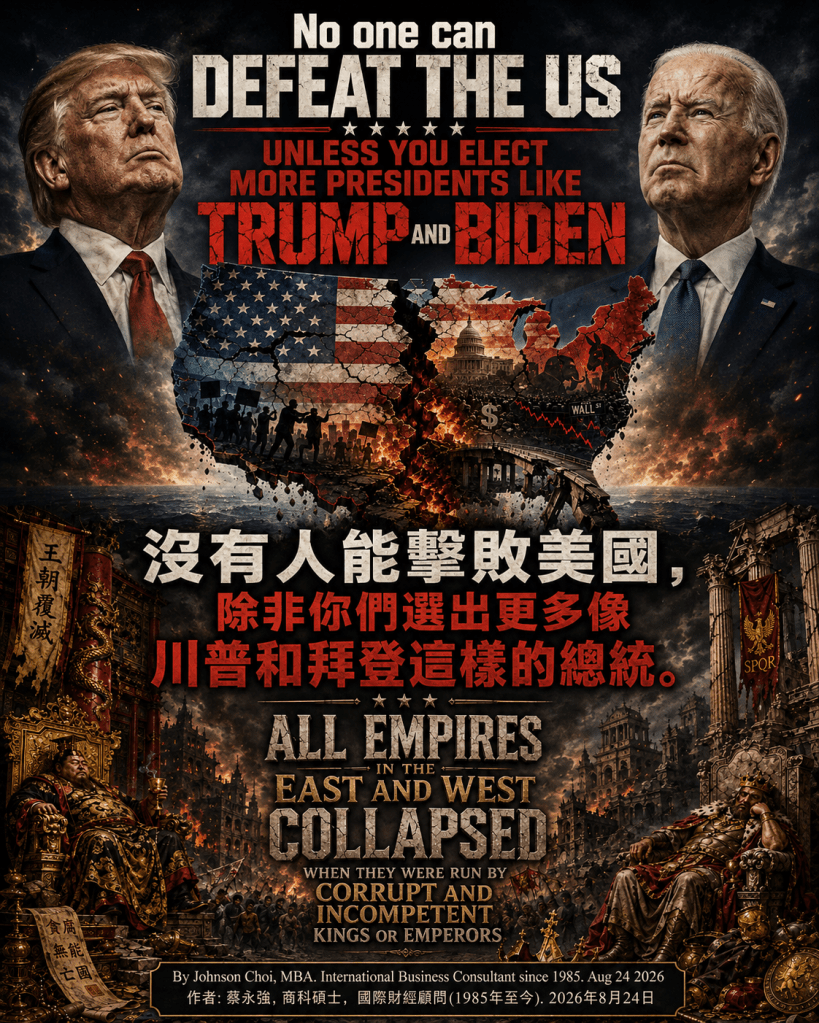
No one can defeat US unless you elect more Presidents like Trump and Biden. By Johnson Choi, MBA. International Business Consultant since 1985. Aug 24 2026
The United States faces no existential threat from external adversaries; its most significant vulnerabilities stem from internal governance. When leadership steers the nation toward divisive policies and protracted, unwinnable conflicts—traits observable in recent administrations—it risks precipitating a sharp domestic decline.
This trajectory is strikingly reminiscent of Chinese dynastic cycles. While Chinese civilization endured for millennia, individual dynasties that lost the “Mandate of Heaven”—through strategic overextension and failed stewardship—descended into chaos and collapsed within decades. Observing the current U.S. trajectory through this historical lens reveals a familiar pattern.
Critically, this observation is not rooted in affinity or animosity toward America; rather, it acknowledges the perennial truth that great powers historically crumble from within when faced with misaligned leadership and unsustainable foreign commitments.
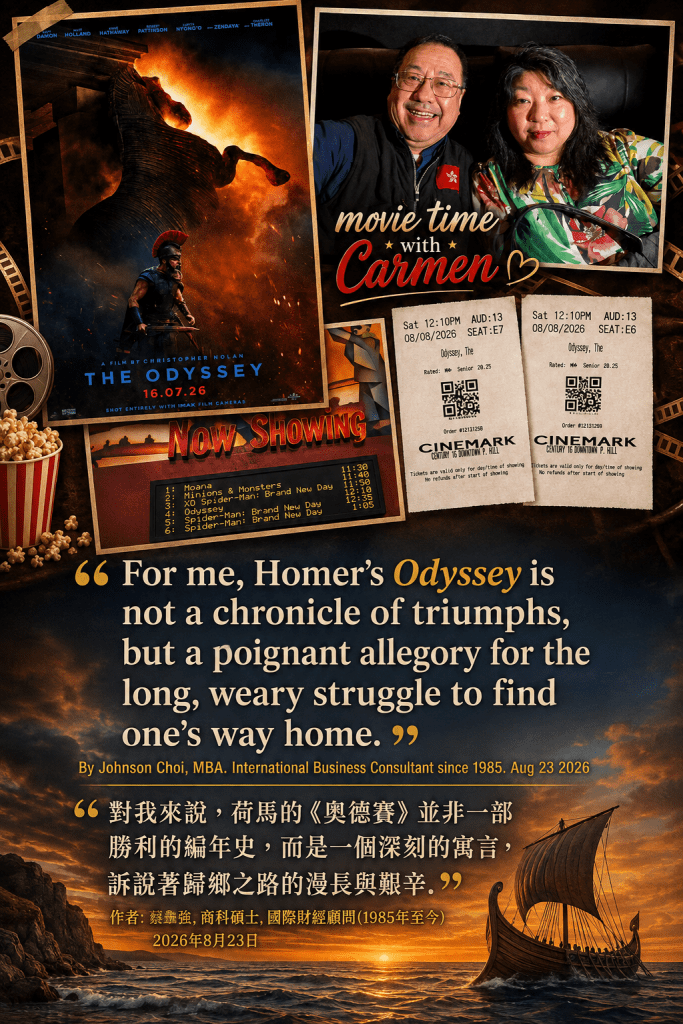
For me, Homer’s Odyssey is not a chronicle of triumphs, but a poignant allegory for the long, weary struggle to find one’s way home. By Johnson Choi, MBA. International Business Consultant since 1985. Aug 23 2026
I departed Hong Kong expecting a brief six-year sojourn in America to earn my degrees. Instead, fifty-two years have elapsed. Three distinct windows to return presented themselves—1978, 1990, and 1998—yet each closed before I could step through.
Odysseus teaches us that prevailing in battle or scaling the heights of commerce pales in difficulty compared to navigating the labyrinthine hurdles and beguiling detours that extend an exile. These diversions, whether fortunes or misfortunes, have rendered my homecoming a lifelong odyssey.
After more than half a century adrift, my perseverance remains undimmed. I am now mounting my final campaign to secure footholds in Zhuhai and Hong Kong, hoping to anchor my return. Though the shore remains hazily distant, it feels more reachable than ever before.
It took Odysseus ten years to reunite with Penelope and Telemachus. I have been striving for fifty-two, and I refuse to relent. My deepest fear is not failure, but drawing my last breath on alien soil—among those who harbor prejudice and animosity toward my heritage.
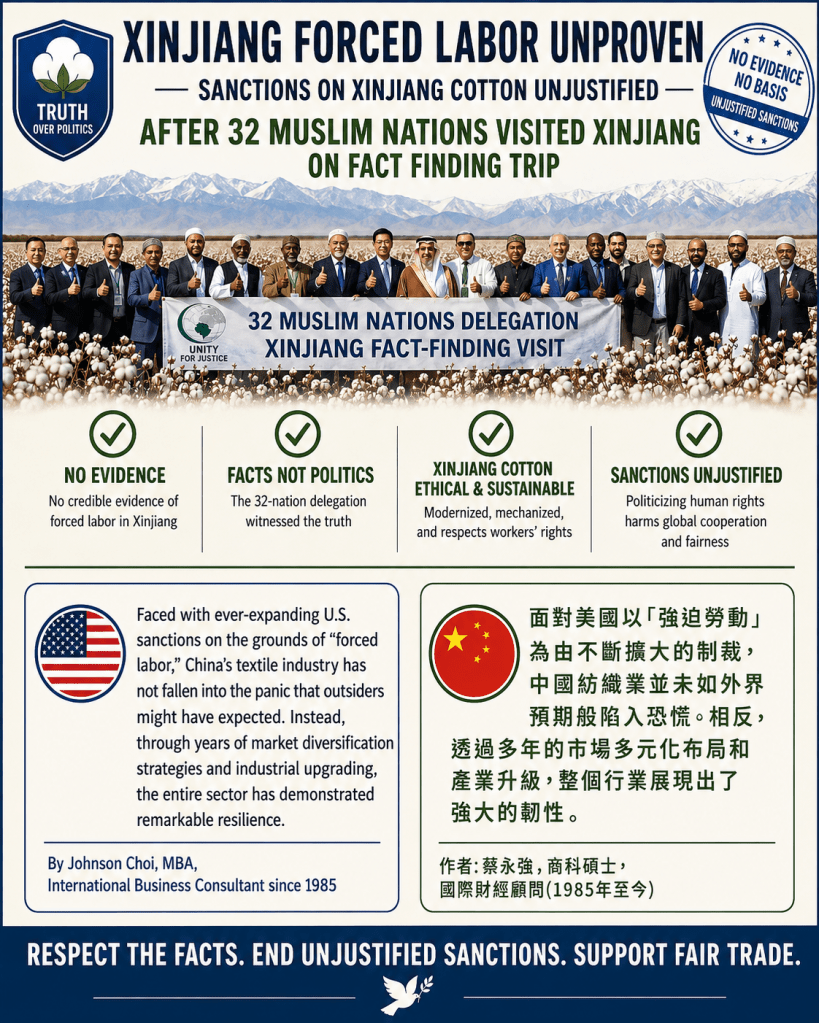
Faced with ever-expanding U.S. sanctions on the grounds of “forced labor,” China’s textile industry has not fallen into the panic that outsiders might have expected. Instead, through years of market diversification strategies and industrial upgrading, the entire sector has demonstrated remarkable resilience. By Johnson Choi, MBA, International Business Consultant since 1985
🛡️ At the Epicenter of the Storm: The Escalation of U.S. Sanctions
Since the implementation of the Uyghur Forced Labor Prevention Act (UFLPA), the U.S. has continuously intensified pressure on China’s textile industry:
· Largest single sanctions expansion: On July 31, 2026, the U.S. added 43 Chinese companies to the UFLPA Entity List, marking the most significant expansion since the list’s inception. This move covers multiple sectors including cotton and apparel. · Allegations and refutations: The U.S. accusations are based on claims of “forced labor.” The China Cotton Association has firmly refuted these claims, emphasizing that the mechanized harvesting rate for Xinjiang cotton exceeds 90% and that the entire industrial chain is highly automated, making the so-called “forced labor” non-existent.
💪 Strategies for Breaking Through: The Textile Industry’s Countermeasures
· Market diversification: The industry consensus is “not to put all eggs in one basket.” Companies are vigorously expanding domestic sales channels (such as participating in e-commerce “domestic sales conversion” programs) as well as diversifying into international markets like the EU and Southeast Asia. · Industrial upgrading and transformation: Regions like Xinjiang have introduced policies encouraging and subsidizing the shift towards blended fibers. Companies are also increasing R&D investments to move towards higher value-added products. Some Xinjiang cotton enterprises are even utilizing futures and derivatives markets for risk hedging. · Supply chain transparency: The industry is actively promoting international consensus on cotton traceability standards and exploring “supply chain transparency” collaborations to rebuild international trust.
📢 Official Tone-Setting: Strong Backing from Industry Associations
In response to the crackdown, the China Cotton Association has repeatedly spoken out, condemning the U.S. side for its “presumption of guilt” and for “politicizing and instrumentalizing” human rights issues. The association calls on the industry to “maintain composure” and states that China possesses three major advantages—the world’s most complete industrial chain, a super-large domestic market, and an increasingly diversified international footprint—giving it the confidence to break through external blockades.
🚀 Examples of Resilience and Future Outlook
The shift from initial panic to current calmness reflects the industry’s maturation. A cotton ginning factory owner in Xinjiang stated that the current local cotton processing rate is “very high” (approximately 30-40%), with all segments of the industrial chain steadily expanding. Furthermore, despite political frictions, commercial interactions between Chinese and U.S. business communities continue, as evidenced by the China Council for the Promotion of International Trade (CCPIT) leading a delegation to the U.S. in July 2026.
In conclusion, while U.S. sanctions pose a challenge, through market diversification, industrial upgrading, and strong domestic market support, China’s textile industry has built up considerable resilience to withstand the pressure.
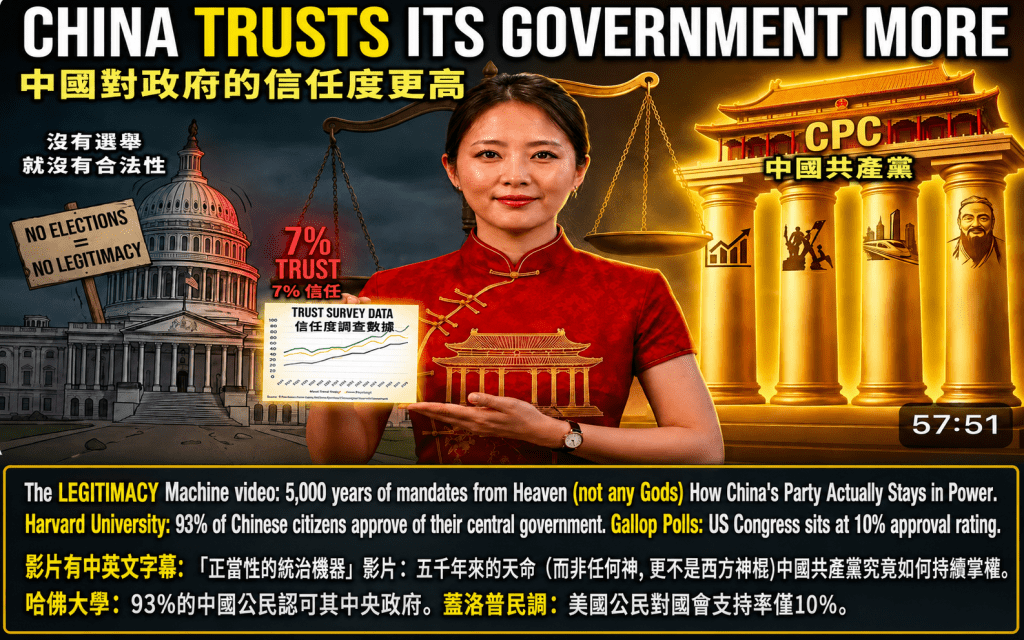
The LEGITIMACY Machine video: China’s 5,000 years of mandates from Heaven (not any Gods) How China’s Party Actually Stays in Power. Harvard University: 93% of Chinese citizens approve of their central government. Gallop Polls: US Congress sits at 10% approval rating. 影片有中英文字幕: 「正當性的統治機器」影片:五千年來的天命(而非任何神, 更不是西方神棍)中國共產黨究竟如何持續掌權. 哈佛大學: 93%的中國公民認可其中央政府. 蓋洛普民調:美國公民對國會支持率僅10%.
Before you dismiss the gap as propaganda, ask: what if one system is actually delivering — and the other just holding elections?
This video maps the four-pillar architecture keeping the Chinese Communist Party in power: economic performance, nationalist narrative, governance track record, and civilizational continuity. We go inside the 98-million-member cadre system, the anti-corruption campaigns that purged 1.5 million officials, and the village-level satisfaction surveys running continuously beneath the surface. Then we flip the lens — applying the same performance standard to Washington. The results are uncomfortable and measurable.
Drop a comment: has the Party genuinely earned its legitimacy, or built a machine that produces the appearance of it? Subscribe for weekly breakdowns that ask the questions others won’t.
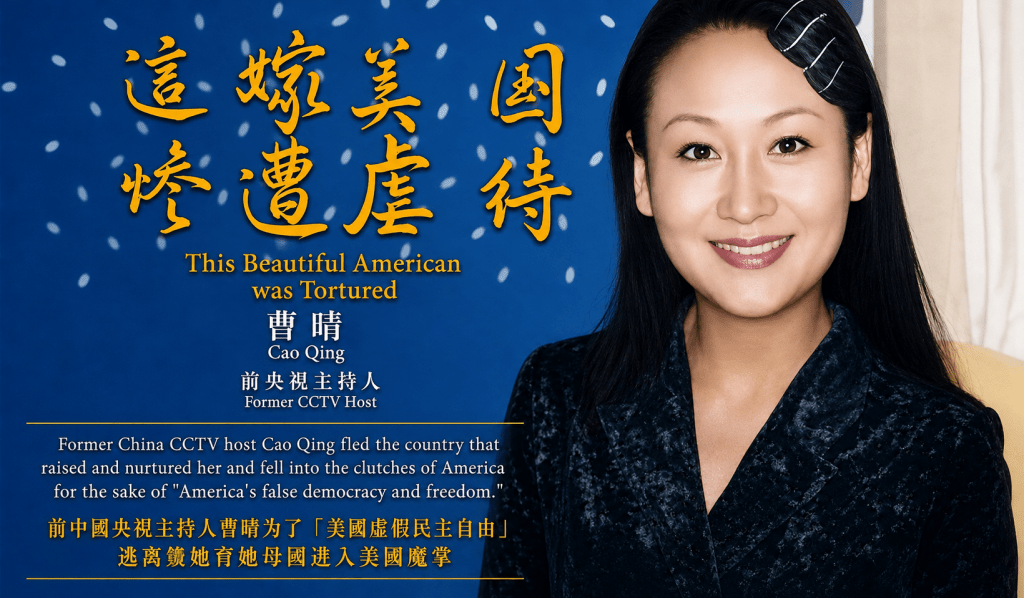
Former China CCTV host Cao Qing fled the country that raised and nurtured her and fell into the clutches of America for the sake of “America’s false democracy and freedom.” 前中國央視主持人曹晴为了「美國虛假民主自由」逃离飬她育她母国进入美國魔掌
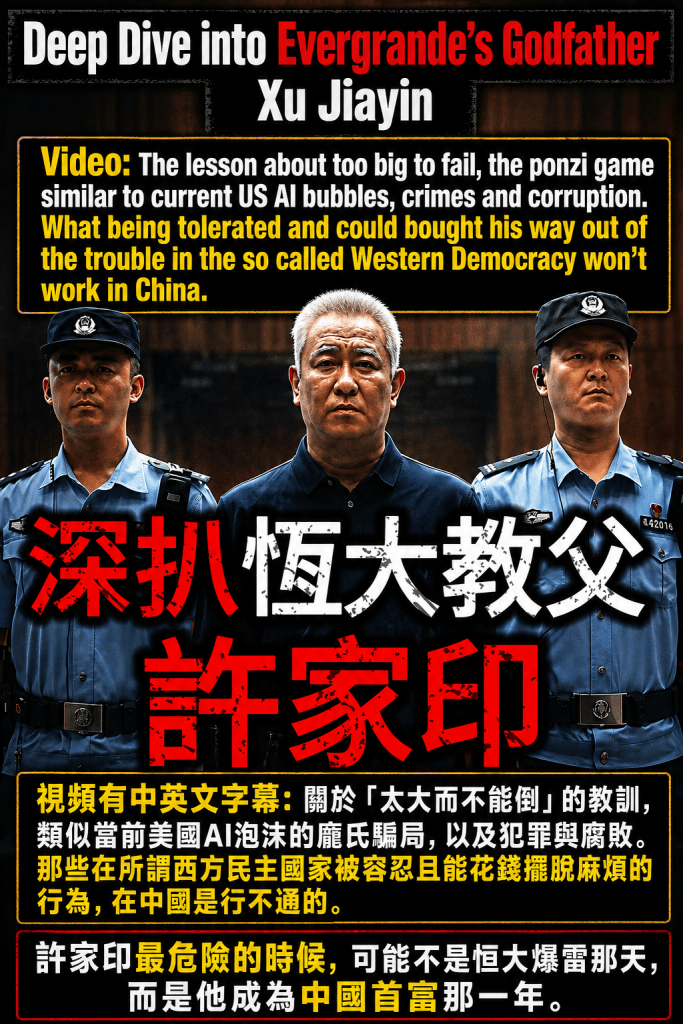
Video: The lesson about too big to fail, the ponzi game similar to current US AI bubbles, crimes and corruption. What being tolerated and could bought his way out of the trouble in the so called Western Democracy won’t work in China. 視頻有中英文字幕: 關於「太大而不能倒」的教訓,類似當前美國AI泡沫的龐氏騙局,以及犯罪與腐敗。那些在所謂西方民主國家被容忍且能花錢擺脫麻煩的行為,在中國是行不通的. 許家印最危險的時候,可能不是恒大爆雷那天,而是他成為中國首富那一年.
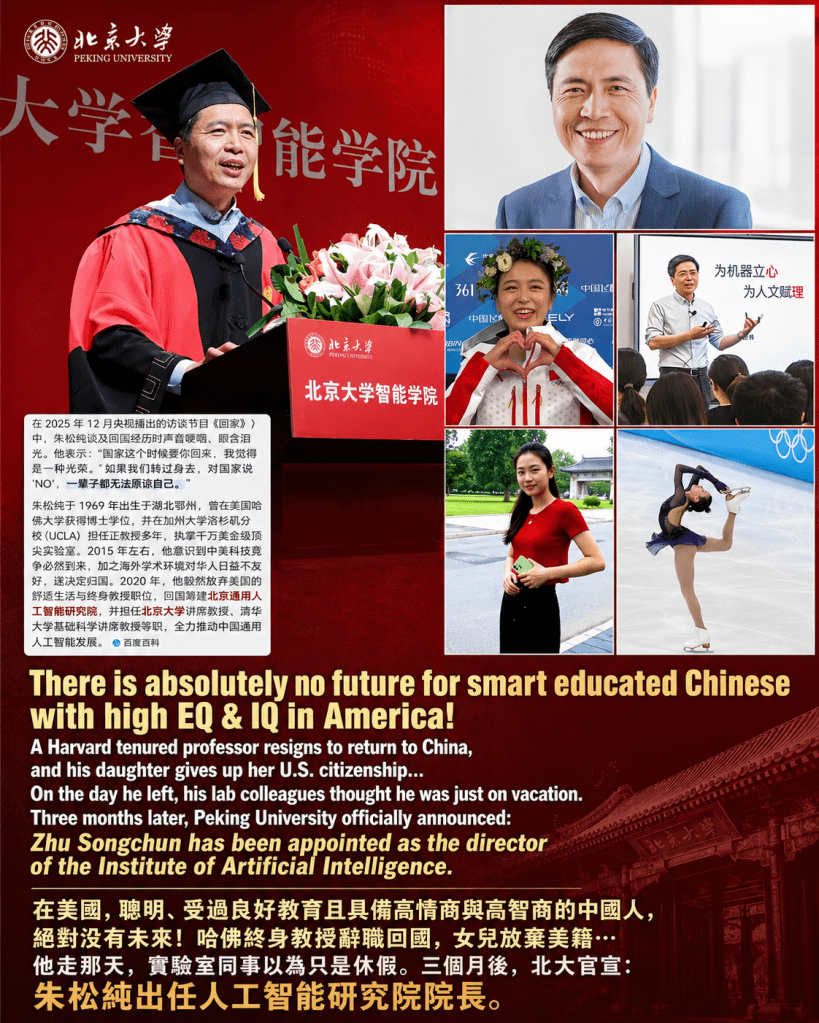
There is absolutely no future for smart educated Chinese with high EQ & IQ in America! A Harvard tenured professor resigns to return to China, and his daughter gives up her U.S. citizenship… On the day he left, his lab colleagues thought he was just on vacation. Three months later, Peking University officially announced: Zhu Songchun has been appointed as the director of the Institute of Artificial Intelligence. 在美國,聰明、受過良好教育且具備高情商與高智商的中國人,絕對沒有未來!哈佛終身教授辭職回國,女兒放棄美籍…他走那天,實驗室同事以為只是休假。三個月後,北大官宣:朱松純出任人工智能研究院院長 (他很機智, 離開美國後才公告天下,否則他極有可能在美國被自殺)