Video: Xi Jinping addresses General Debate of UN General Assembly

Video: Xi Jinping addresses General Debate of UN General Assembly 習近平在聯大一般性辯論中的講話 9-21-21
https://vimeo.com/611151004
https://youtu.be/_aO19tPB2nk
https://www.facebook.com/100036400039778/posts/570955050794491/?d=n

🇨🇳🇺🇳Chinese President #XiJinping addresses United Nations General Assembly, calls for bolstering confidence, jointly addressing global challenges

Below is the full speech.
Mr. President,

The year 2021 is a truly remarkable one for the Chinese people. This year marks the centenary of the Communist Party of China. It is also the 50th anniversary of the restoration of the lawful seat of the People’s Republic of China in the United Nations, a historic event which will be solemnly commemorated by China.

We will continue our active efforts to take China’s cooperation with the United Nations to a new level and make new and greater contributions to advancing the noble cause of the UN.

Mr. President, A year ago, global leaders attended the high-level meetings marking the 75th anniversary of the UN and issued a declaration pledging to fight COVID-19 in solidarity, tackle challenges together, uphold multilateralism, strengthen the role of the UN, and work for the common future of present and coming generations.

One year on, our world is facing the combined impacts of changes unseen in a century and the COVID-19 pandemic. In all countries, people long for peace and development more than ever before, their call for equity and justice is growing stronger, and they are more determined in pursuing win-win cooperation.

Right now, COVID-19 is still raging in the world, and profound changes are taking place in human society. The world has entered a period of new turbulence and transformation. It falls on each and every responsible statesman to answer the questions of our times and make a historical choice with confidence, courage and a sense of mission.

First, we must beat COVID-19 and win this decisive fight crucial to the future of humanity. The history of world civilization is also one of fighting pandemics. Rising to challenges, humanity has always emerged in triumph and achieved greater development and advancement. The current pandemic may appear overwhelming, but we humanity will surely overcome it and prevail.

We should always put people and their lives first, and care about the life, value and dignity of every individual. We need to respect science, take a science-based approach, and follow the laws of science. We need to both follow routine, targeted COVID-19 protocols and take emergency response measures, and both carry out epidemic control and promote economic and social development.

We need to enhance coordinated global COVID-19 response and minimize the risk of cross-border virus transmission.

Vaccination is our powerful weapon against COVID-19. I have stressed on many occasions the need to make vaccines a global public good and ensure vaccine accessibility and affordability in developing countries. Of pressing priority is to ensure the fair and equitable distribution of vaccines globally. China will strive to provide a total of two billion doses of vaccines to the world by the end of this year.

In addition to donating 100 million US dollars to COVAX, China will donate 100 million doses of vaccines to other developing countries in the course of this year. China will continue to support and engage in global science-based origins tracing, and stands firmly opposed to political maneuvering in whatever form.

Second, we must revitalize the economy and pursue more robust, greener and more balanced global development. Development holds the key to people’s well-being. Facing the severe shocks of COVID-19, we need to work together to steer global development toward a new stage of balanced, coordinated and inclusive growth. To this end, I would like to propose a Global Development Initiative:

— Staying committed to development as a priority. We need to put development high on the global macro policy agenda, strengthen policy coordination among major economies, and ensure policy continuity, consistency and sustainability. We need to foster global development partnerships that are more equal and balanced, forge greater synergy among multilateral development cooperation processes, and speed up the implementation of the UN 2030 Agenda for Sustainable Development.

— Staying committed to a people-centered approach. We should safeguard and improve people’s livelihoods and protect and promote human rights through development, and make sure that development is for the people and by the people, and that its fruits are shared among the people. We should continue our work so that the people will have a greater sense of happiness, benefit and security, and achieve well-rounded development.

— Staying committed to benefits for all. We should care about the special needs of developing countries. We may employ such means as debt suspension and development aid to help developing countries, particularly vulnerable ones facing exceptional difficulties, with emphasis on addressing unbalanced and inadequate development among and within countries.

— Staying committed to innovation-driven development. We need to seize the historic opportunities created by the latest round of technological revolution and industrial transformation, redouble efforts to harness technological achievements to boost productivity, and foster an open, fair, equitable and non-discriminatory environment for the development of science and technology. We should foster new growth drivers in the post-COVID era and jointly achieve leapfrog development.

— Staying committed to harmony between man and nature. We need to improve global environmental governance, actively respond to climate change and create a community of life for man and nature. We need to accelerate transition to a green and low-carbon economy and achieve green recovery and development.

China will strive to peak carbon dioxide emissions before 2030 and achieve carbon neutrality before 2060. This requires tremendous hard work, and we will make every effort to meet these goals. China will step up support for other developing countries in developing green and low-carbon energy, and will not build new coal-fired power projects abroad.

—Staying committed to results-oriented actions. We need to increase input in development, advance on a priority basis cooperation on poverty alleviation, food security, COVID-19 response and vaccines, development financing, climate change and green development, industrialization, digital economy and connectivity, among other areas, and accelerate implementation of the UN 2030 Agenda for Sustainable Development, so as to build a global community of development with a shared future.

China has pledged an additional three billion US dollars of international assistance in the next three years to support developing countries in responding to COVID-19 and promoting economic and social recovery.

Third, we must strengthen solidarity and promote mutual respect and win-win cooperation in conducting international relations. A world of peace and development should embrace civilizations of various forms, and must accommodate diverse paths to modernization. Democracy is not a special right reserved to an individual country, but a right for the people of all countries to enjoy.

Recent developments in the global situation show once again that military intervention from the outside and so-called democratic transformation entail nothing but harm. We need to advocate peace, development, equity, justice, democracy and freedom, which are the common values of humanity, and reject the practice of forming small circles or zero-sum games.

Differences and problems among countries, hardly avoidable, need to be handled through dialogue and cooperation on the basis of equality and mutual respect. One country’s success does not have to mean another country’s failure, and the world is big enough to accommodate common development and progress of all countries. We need to pursue dialogue and inclusiveness over confrontation and exclusion.

We need to build a new type of international relations based on mutual respect, equity, justice and win-win cooperation, and do the best we can to expand the convergence of our interests and achieve the biggest synergy possible.

The Chinese people have always celebrated and striven to pursue the vision of peace, amity and harmony. China has never and will never invade or bully others, or seek hegemony. China is always a builder of world peace, contributor to global development, defender of the international order and provider of public goods. China will continue to bring the world new opportunities through its new development.

Fourth, we must improve global governance and practice true multilateralism. In the world, there is only one international system, i.e. the international system with the United Nations at its core. There is only one international order, i.e. the international order underpinned by international law. And there is only one set of rules, i.e. the basic norms governing international relations underpinned by the purposes and principles of the UN Charter.

The UN should hold high the banner of true multilateralism and serve as the central platform for countries to jointly safeguard universal security, share development achievements and chart the course for the future of the world. The UN should stay committed to ensuring a stable international order, increasing the representation and say of developing countries in international affairs, and taking the lead in advancing democracy and rule of law in international relations.

The UN should advance, in a balanced manner, work in all the three areas of security, development and human rights. It should set common agenda, highlight pressing issues and focus on real actions, and see to it that commitments made by all parties to multilateralism are truly delivered.

Mr. President,

The world is once again at a historical crossroads. I am convinced that the trend of peace, development and advancement for humanity is irresistible. Let us bolster confidence and jointly address global threats and challenges, and work together to build a community with a shared future for mankind and a better world for all.
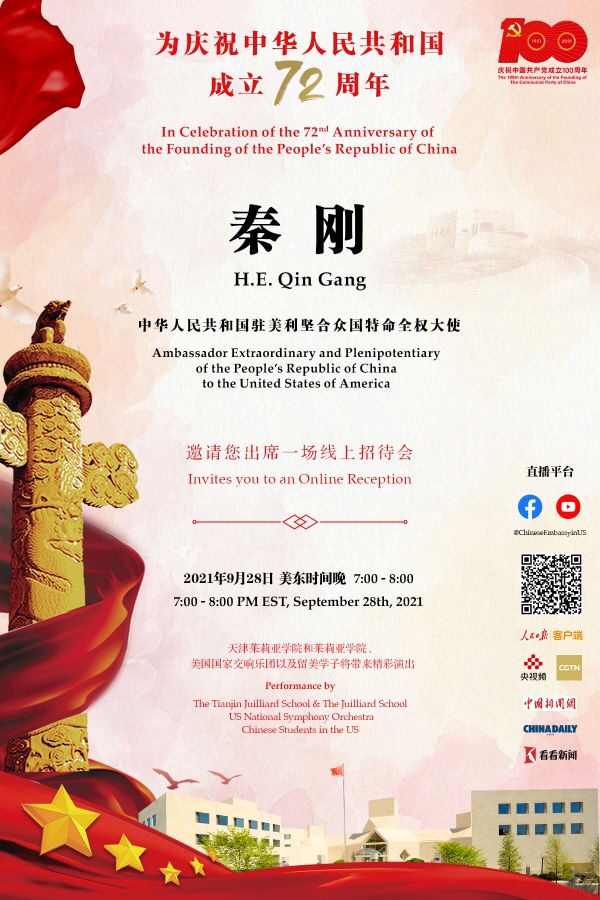

Invitation: Celebrate China’s 72nd National Day by Chinese Embassy and Consulates General in the United States of America

Invitation: Celebrate China’s 72nd National Day by Chinese Embassy and Consulates General in the United States of America

请柬:庆祝中华人民共和国成立72周年招待会 – 中华人民共和国驻美利坚合众国使领馆

Participate online: https://youtu.be/_WqFYc37KX8

An online reception for the 72nd anniversary of the founding of the People’s Republic of China will be held on September 28 at 7pm EST. The reception is organized by the Chinese Embassy in the US, together with Chinese Consulates General in New York, San Francisco, Los Angeles and Chicago.

At the reception, Chinese Ambassador Qin Gang and invited guests will deliver video remarks, which will be followed by performances by the students and faculty of The Tianjin Juilliard School and The Juilliard School, artists of US National Symphony Orchestra and Chinese students in the US. Your participation is welcome!

From September 22 to 27, documentaries will be shown on the Embassy’s social media channels at 7pm each day: The CPC Way, a 6-episode documentary on the 100th anniversary of the founding of the Communist Party of China; A Long Cherished Dream, a 4-episode documentary about ordinary Chinese’s pursuit of a better life; as well as videos about Asian elephants’ northbound migration in China and preparations for the 2022 Beijing Winter Olympic Games. Stay tuned!

“庆祝中华人民共和国成立72周年招待会”将于美东时间9月28日晚7时在线上举行。招待会由中国驻美国大使馆举办,中国驻纽约、旧金山、洛杉矶、芝加哥总领馆协办。

届时,中国驻美国大使秦刚和特邀嘉宾将发表视频致辞。天津茱莉亚学院和茱莉亚学院师生、美国国家交响乐团青年演奏家以及中国留美学子将为大家呈现精彩演出。诚邀各界朋友线上参与!  

9月22日至27日每晚7时,驻美国使馆社交媒体将播出庆祝中国共产党成立100周年六集纪录片《活力密码》讲述平凡中国人逐梦小康的四集纪录片《柴米油盐之上》、云南野生亚洲象北迁纪录片以及北京2022冬奥会筹备情况视频集锦。欢迎收看!

New York Times Advises China on Covid-19: Abandon Success, Try Failure – Shielding the Western elite from justified rage. by John V. Walsh in San Francisco / September 21st, 2021

New York Times Advises China on Covid-19: Abandon Success, Try Failure – Shielding the Western elite from justified rage. 紐約時報就新冠病毒向中國提供建議: 放棄成功, 嘗試失敗來保護西方精英免受正當憤怒by John V. Walsh in San Francisco / September 21st, 2021

The recent outbreak of the Delta variant in China “shows that its strategy no longer fits. It is time for China to change tack.”

So declared a lead essay atop the New York Times Opinion/Editorial section on September 7 by Yanzhong Huang, a senior fellow at the Council on Foreign Relations.

The Delta outbreak that “changed the game” in Huang’s words emerged after an outbreak at Nanjing international airport in July traced to a flight from Russia. Did this outbreak change anything, in fact?

Let’s do the numbers.

Let’s do something that Huang did not; let’s look at the numbers from July 1 until September 7, the date of the article, a period that brackets the Delta outbreak cited by Huang.

During that period China experienced 273 new cases, about 4 per day, and no new deaths. That hardly seems like a failure.

To get some perspective on these numbers, during that same July1-September 7 period, the US, a country one fourth China’s size, reported 6,560,588 new cases (96,479 per day) and 45,054 new deaths (662 per day).

The same contrast can be seen for the entire period of the pandemic. From the pandemic’s initial Wuhan outbreak in January, 2020, until September 7, 2021:

China had a sum total of 95,512 cases and 4,629 deaths;

The US had 40,196,953 cases and 648,146 deaths.

There have been two previous outbreaks of the Delta variant in China, one in Guangdong and another in Yunnan near the Myanmar border before the one arising in Nanjing. The Delta variant was contained in each case. None of the three has turned out to be a “game changer,” as Huang incorrectly maintains.

Perhaps it is the U.S. that needs “to change tack.”

To anticipate an objection that has largely faded but persists in some quarters, can we believe the case and mortality count China gives us? There are now many first-hand accounts of what life has been like in China these days that make the official tallies quite reasonable. And quantitative evidence supporting China’s data is available in a peer-reviewed study in the prestigious British Medical Journal; it is summarized and discussed here. Carried out by groups at Oxford University and China’s CDC, the study compares excess deaths in Wuhan and also in the rest of China during the period of the lockdown, and it finds that the official counts are remarkably accurate.

Do China’s life-saving measures imperil its economy?

China would need a very good reason to abandon its public health measures of massive, rapid testing, tracing and, where necessary, quarantining. Are there any such reasons? Mr. Huang states that the life-saving measures now “threaten overall economic growth in China”. Does this prognostication fit the facts?

China’s GDP grew more slowly in 2020, but still it grew by 2.27%, the only major economy in the world not to contract. In contrast the US economy contracted by 3.51%. (Even China’s slowed growth in 2020 matched the US economy in normal times, which grew at an average rate of 2.3% in the four pre-pandemic years, 2016-2019.)

What about the future? Economies are set to rebound in 2021 from their 2020 lows, with recent projections giving China an 8.4% bounce before settling in to an average growth of 6% over the following 5 years. For comparison the US jump in 2021 is estimated to be 6.4%, dropping to a 1.9% average over the following 5 years.

In terms of the economy present and future, China’s policies appear to be doing quite well, better, in fact, than any other major economy. Mr. Huang has advanced a thesis that is unencumbered by the facts.

Why is the media’s failure to report on China’s success a threat to our very lives?

At every step of the way, China’s successes with Covid-19 have been met in the U.S. media with silence, denigration or a prediction that the success cannot continue (FAIR provides a brief survey here). As a result, China’s measures are not widely known or understood.

China’s success with its public health measures is important for us now, because the pandemic is far from over. We don’t know what surprises viral evolution will have in store for us. If a new variant emerges that is resistant to existing vaccines, then we have only public health measures to protect us until we catch up. That is also true for future pandemics which will surely come our way. For us to be kept in ignorance of those measures or to have them dismissed, as Yanzhong Huang does, poses a threat to our very lives.

We might also wonder what would happen if the people of the West, including the U.S., understood clearly that measures were possible which could have protected us from the millions of deaths we have suffered. Governments have toppled from far less. Mr. Huang, the New York Times and the mass media, whatever else they are doing, are certainly protecting our Establishment from a rage that might have most unpleasant consequences.

John V. Walsh can be reached at john.endwar@gmail.com. He writes about issues of war, peace and empire, and about health care, for Antiwar.com, Consortium News, Dissident Voice.org and other outlets. Now living in the East Bay, he was until recently Professor of Physiology and Cellular Neuroscience at a Massachusetts Medical School.

New York Times Advises China on Covid-19: Abandon Success, Try Failure

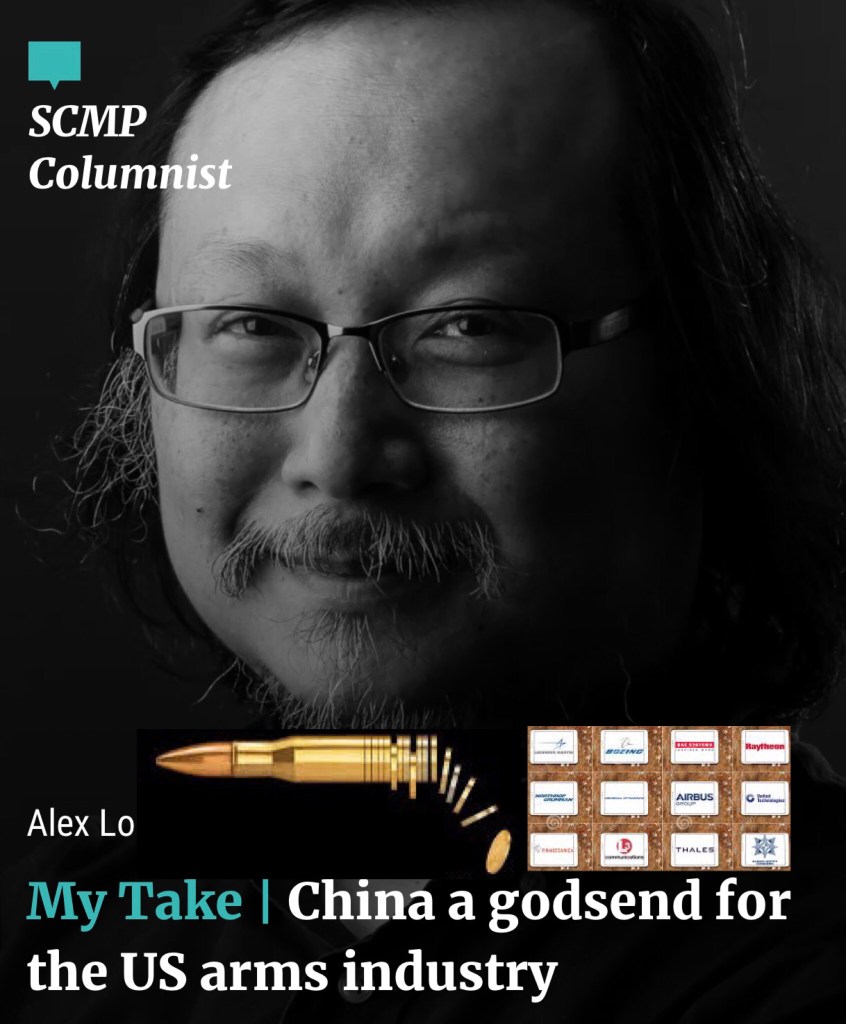
In short, China has been a godsend for the US arms industry.

In short, China has been a godsend for the US arms industry. 簡而言之,中國一直是美國軍火工業的天賜之物. 作為國會授權的國防戰略委員會,該委員會 12 名成員中有 9 名與軍火工業有直接或間接聯繫.

“The Congressionally mandated National Defence Strategy Commission … rang an even louder alarm bell about the purported threat from China and proposed 3 to 5 per cent annual growth in the Pentagon budget to address it … 9 of the 12 members of the commission had direct or indirect ties to the arms industry, a reality that no doubt had some influence over their deliberations and conclusions.”

Since the start of the US war in Afghanistan in 2001, the Pentagon has been handed a total of more than US$14 trillion, one-third to one-half of which went directly to defence contractors. That’s the total Pentagon expenditures for all purposes since 2001, which include the oft-quoted US$2 trillion spent on Afghanistan.

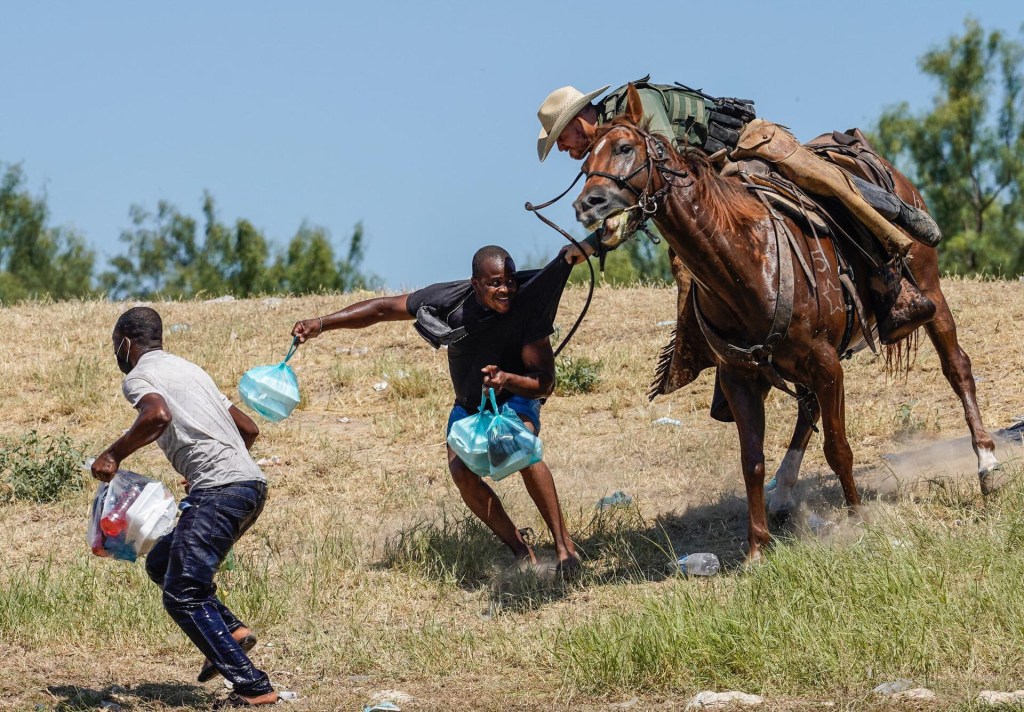
I Remembered the old John Wayne movie beating up the Native Americans on horseback – U.S. BORDER AGENTS ON HORSEBACK CHASE HAITIAN MIGRANTS, CRACKING WHIPS

US fake freedom democracy human rights and rules of laws – I Remembered the old John Wayne movie beating up the Native Americans on horseback – U.S. BORDER AGENTS ON HORSEBACK CHASE HAITIAN MIGRANTS, CRACKING WHIPS 我記得約翰·韋恩 (John Wayne) 的老電影在馬背上毆打美洲原住民 – 美國邊境特工騎馬追逐海地移民,敲碎鞭子

Photos that appear to show Border Patrol agents on horseback cracking whips and pushing Haitian migrants from the border town of Del Rio, Texas, are drawing outrage. White House spokesperson Jen Psaki called the images “horrific.” The U.S. is rounding up the migrants and sending them back to Haiti.

US never changed

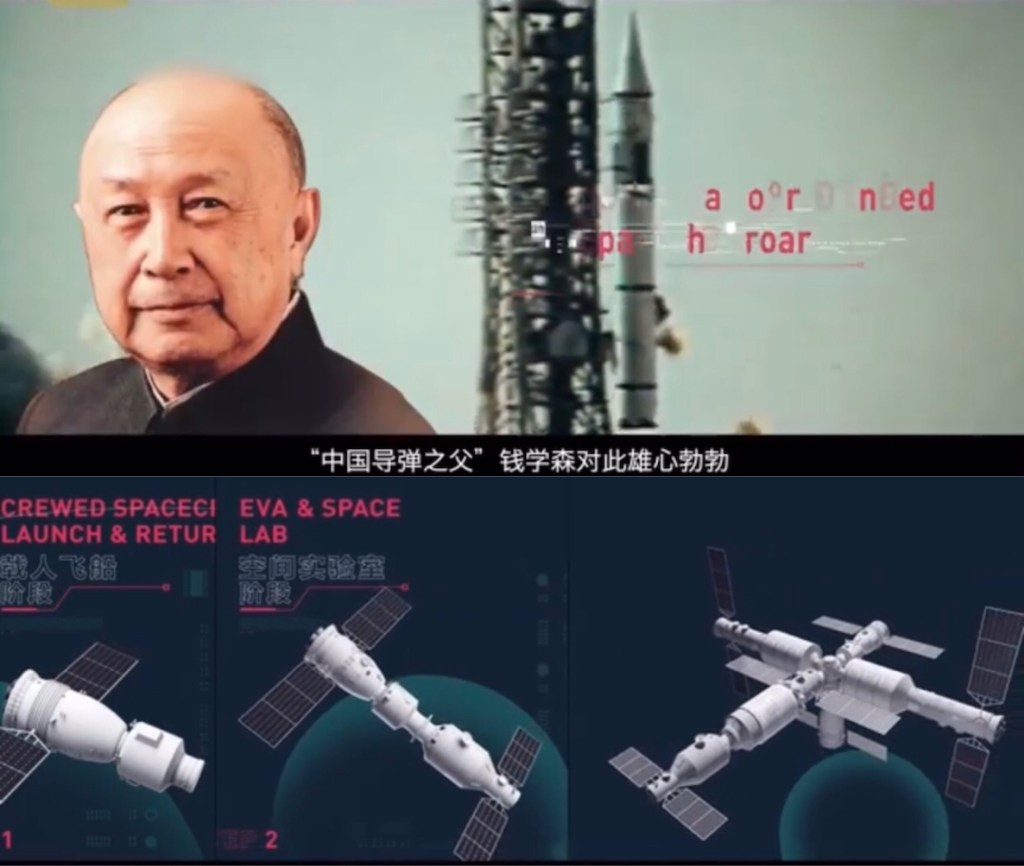
Video: How China starts its manned space exploration

Video: How China starts its manned space exploration 中國如何開始載人航天探索In 1969, Neil Armstrong delivered his famous words from the Moon, “That’s one small step for a man, one giant leap for mankind.” By this time, China had already been working on its first manned spacecraft research for two years. That spacecraft was called Shuguang – or first light of dawn. From Shuguang to Tiangong, what has China experienced in its space exploration program?
https://vimeo.com/610361616
https://youtu.be/uz96Bdlgsu4
https://www.facebook.com/100036400039778/posts/570442760845720/?d=n

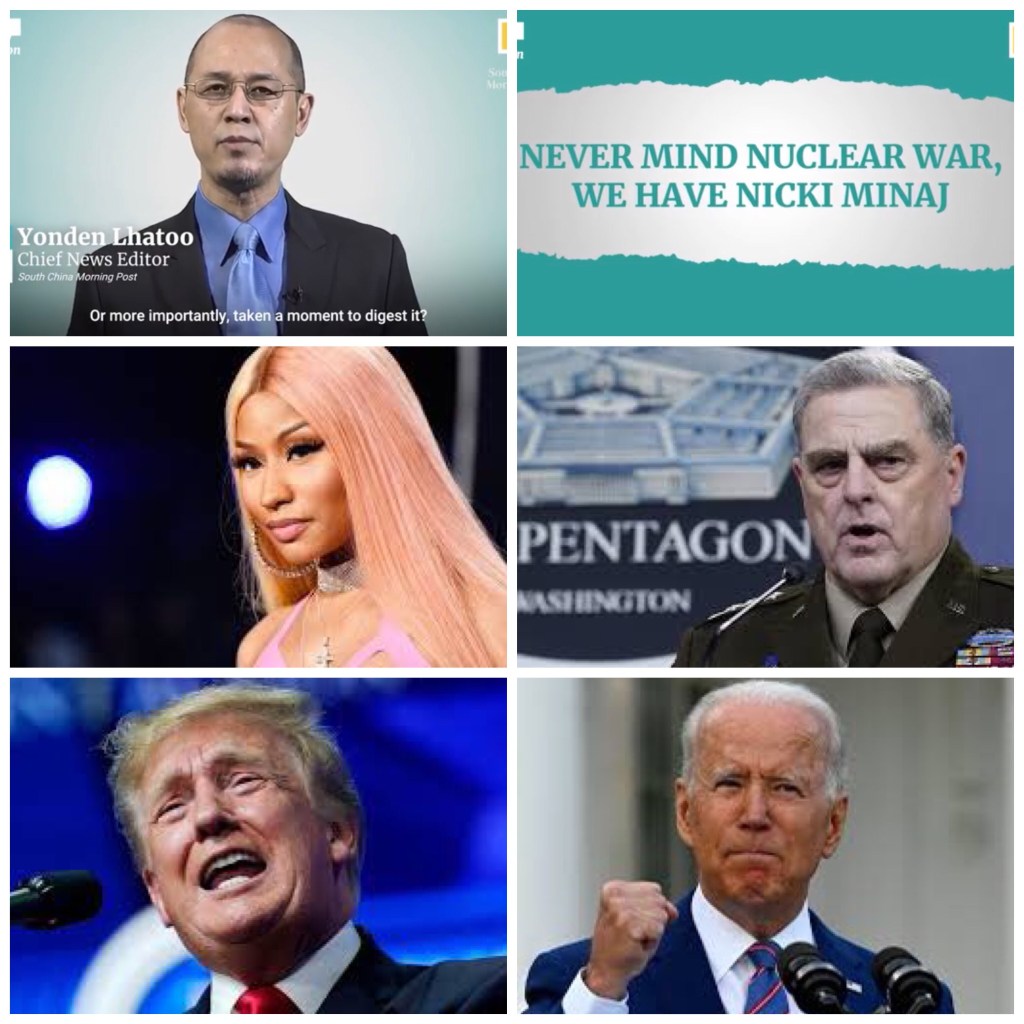
SCMP video: Why worry about a China-US nuclear war when we have Nicki Minaj

SCMP video: Why worry about a China-US nuclear war when we have Nicki Minaj 有了妮琪·米娜,為什麼還要擔心中美核戰爭SCMP chief news editor Yonden Lhatoo worries about how close China and the US may be coming to a nuclear conflict, but is distracted by the news cycle moving on to rapper Nicki Minaj’s Covid-19 vaccine hesitancy
https://vimeo.com/610306096
https://youtu.be/MZLuwZe-fMs
https://www.facebook.com/100036400039778/posts/570394470850549/?d=n

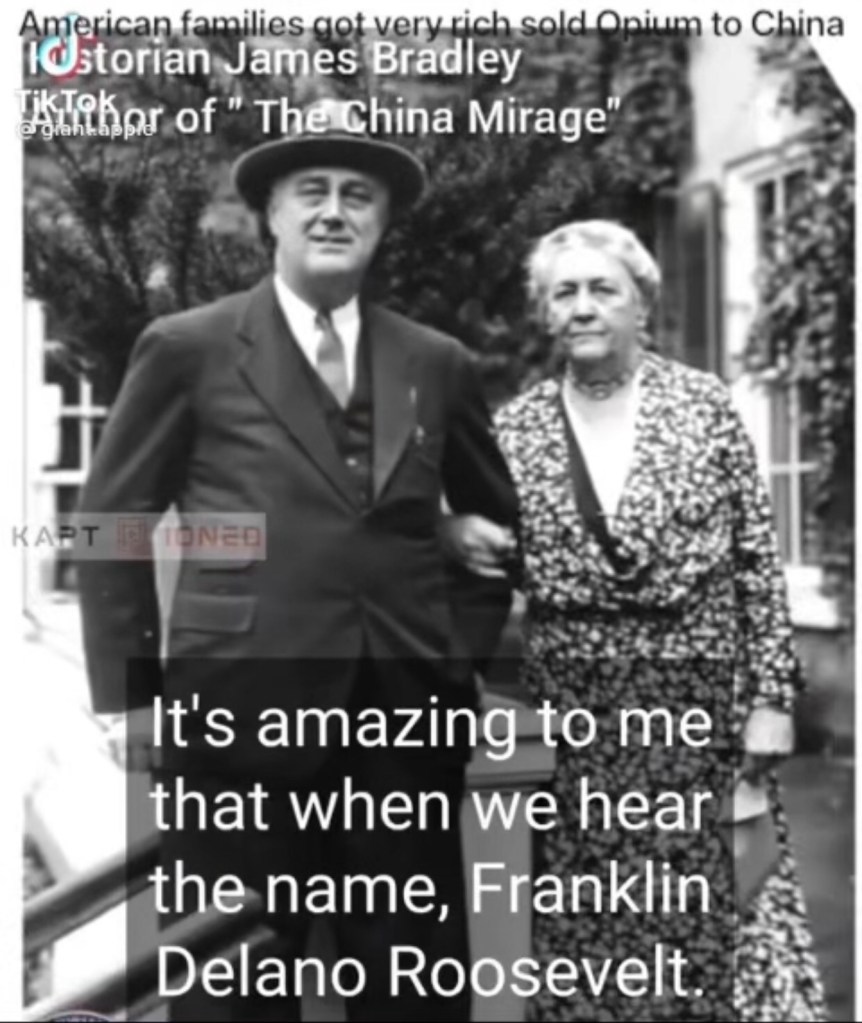
Video: American families got very rich by selling Opium to China

Video: American families got very rich by selling Opium to China 美國家族通過向中國出售鴉片而致富

Professor Kenneth Hammond: The Forbes family, as in John Forbes Kerry, were also great drug profiteers. New England Brahmins dominated the American branch of the opium trade. They sourced their drugs from the Ottoman Empire rather than India. The US Marines were organized to provide security for American drug dealers sailing through the Mediterranean at the end of the 18th & beginning of the 19th century. Local rulers on the North African coast sought to charge transit fees for passage through their waters, which the Americans portrayed as extortion (the Barbary Pirates), so the federal government created a military force to protect drug profits. “From the Halls of Montezuma to the shores of Tripoli.”
https://vimeo.com/610254445
https://youtu.be/lPEbIoq2qWg
https://www.facebook.com/100036400039778/posts/570333517523311/?d=n

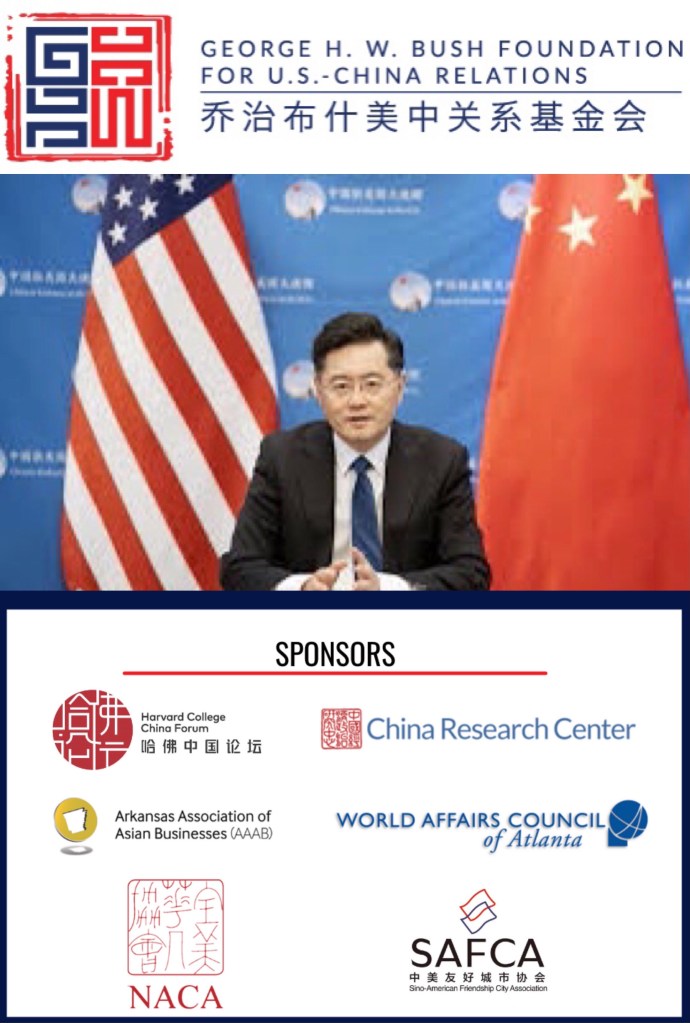
Charting a New Course in U.S.-China Relations: A Conversation with Ambassador Qin Gang – Sep 22, 2021 03:30 PM Eastern Time (US and Canada)

Charting a New Course in U.S.-China Relations: A Conversation with Ambassador Qin Gang – Sep 22, 2021 03:30 PM Eastern Time (US and Canada) Webinar ID 825 9753 6943 Register here https://us02web.zoom.us/webinar/register/WN_IbNR_tIHRjeG-1BO6GjmRA
This online dialogue with China’s new ambassador to the United States of America Qin Gang is jointly organized by the Carter Center and the George H. W. Bush Foundation for U.S.-China Relations. Ambassador Qin arrived in Washington D.C. in late July and this is his first public conversation with American organizations and people who would like to see the bilateral relationship stabilized and improved. It is sponsored by many other organizations including the World Affairs Council of Atlanta, the National Association of Chinese Americans and the China Research Center of Atlanta.