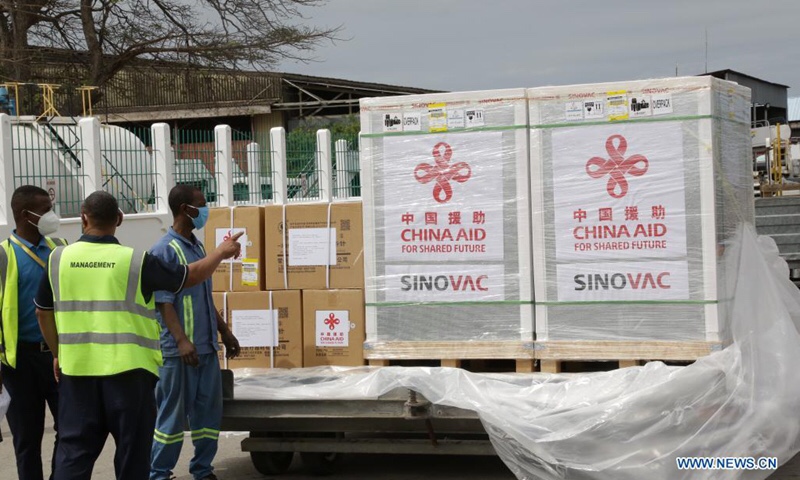
China to provide 2 billion doses of vaccine to world this year by Leng Shumei and Hu Yuwei Aug 05 2021
China on Thursday vowed to make efforts to provide the world with 2 billion doses of COVID-19 vaccines this year and donate $100 million to COVAX to promote global vaccine provision amid the rampaging Delta variant, which is bringing about more challenges for developing countries to access vaccines and combat the pandemic while the West continues to drag its heels in fulfilling its promises.
Chinese President Xi Jinping made the announcement Thursday night in a written address to the first meeting of a forum on international cooperation on COVID-19 vaccines.
Xi said he expects the forum to further boost fair vaccine accessibility worldwide, boost solidarity among developing countries and contribute to the success in the fight against the novel coronavirus.
Developing countries are facing three main challenges: the low accessibility to vaccines, the declining efficacy of existing vaccines against mutations, and the competition between different producers on the international market, making it more difficult for developing countries to choose vaccines, Zha Daojiong, a professor of international political economy in the School of International Studies and Institute of South-South Cooperation and Development at Peking University, told the Global Times on Thursday.
“Cooperation on vaccines is limited not only in providing finished products, but also jointly producing vaccines,” Zha noted. He said that the Thursday conference will promote more cooperation between Chinese and foreign producers, leading to overseas production of China-developed vaccines in order to increase production capacity, and save time and costs for international transportation.
Chinese experts noted that the conference served as an opportunity for developing countries to communicate with each other and come up with solutions to the challenges they are facing in accessing vaccines.
China is able to produce 5 billion doses of COVID-19 vaccines per year and only needs half of them to vaccinate its 1.4 billion people. This means China is able to provide the world with a large amount of vaccines, Tao Lina, a Shanghai-based vaccine expert, told the Global Times on Thursday.
The key work in the current stage is to unite the international community and put aside ideological divergences to combat the pandemic to provide the world with vaccines of the highest efficacy, Tao noted.
Key global support
The international community has been working together to ensure accessibility and equity of vaccine distribution in developing countries. However, inequity between rich and poor regions in access to vaccines continues to worsen due to unbalanced resource distribution and the West’s slowness in realizing its promise to assist poor regions.
To date, 82 percent of all COVID-19 vaccine doses that have gone into arms worldwide have been administered in high-income and upper-middle-income countries. By contrast, less than 1 percent have been administered in low-income countries. Meanwhile, COVAX, the multinational vaccine facility, is struggling to meet this challenge, having distributed only 153 million doses out of 4.1 billion administered worldwide, according to data tracked by the Duke University.
While more than half of all Americans have had at least one dose and dozens of rich countries aren’t far behind, less than 1 percent of people across the world’s low-income countries have been vaccinated.
Meanwhile, the African continent’s vaccination rates are still painfully low: Just 16 million, or less than 2 percent, of Africa’s 1.3 billion people are now fully vaccinated, according to AP.
While rich countries are hoping to vaccinate 70 percent of their populations, most developing countries are struggling with the vaccine demand-supply gap – they still lack about billions of shots needed to vaccinate 30 percent of their population by the end of this year, Feng Duojia, president of the China Vaccine Industry Association, told the Global Times on Thursday.
China will become the world’s most important vaccine provider with the largest number and the most selection of products, Feng noted.
In addition to expanding production, Chinese authorities and producers have also been accelerating research and development of vaccines to deal with the rapidly mutating virus as the world is dragged into a third wave of the COVID-19 pandemic due to the rampaging Delta variant, which has been found to be much more infectious than the original variant.
West slow to fulfill promise
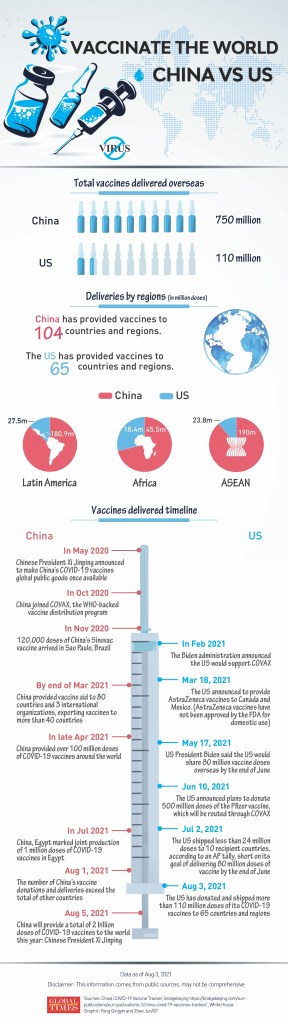
US President Joe Biden said Tuesday that the US, which has been accused of hoarding many more doses than it needs, has shipped more than 110 million COVID-19 vaccine doses to 65 countries and regions, following regulatory and logistical setbacks. The figures come about one month behind the White House’s June goal of delivering 80 million doses overseas, part of a greater vaccine-donation drive by the US in the coming months.
In addition to the slow move to make good on their promises, US producers are also increasing prices for their products while the shots are becoming more and more urgently needed amid the rampaging Delta variant, putting more pressure and worries on developing countries seeking access to vaccines.
Pfizer has raised the price of its COVID-19 vaccine by more than one-quarter and Moderna by more than one-tenth in the latest EU supply contracts, as Europe battled supply disruptions and concerns over side effects from rival products, Financial Times reported on August 1.
Even though the US said it would donate vaccines to developing countries, they will be donating products that can’t be sold in their domestic market or that have not been approved for domestic use such as the AstraZeneca vaccine, a Beijing-based immunologist told the Global Times on condition of anonymity.
Without Chinese vaccines, there would be fewer choices for developing countries and regions, and more inequity in global vaccine distribution, the expert said.
China has taken important steps to close the global vaccine gap, including the acceleration of large-scale production, boosting fair distribution and licensing local production in more countries.
Chinese State Councilor and Foreign Minister Wang Yi attended the ASEAN Plus Three Foreign Ministers’ Meeting on Tuesday via video link. At the meeting he revealed that China had provided more than 750 million doses of vaccines overseas and will provide another 110 million shots to COVAX in the following four months. China will also provide 3 billion dollars to the international community in the next three years.
So far, the shots and semi-finished shots China provided to the world account for one-sixth of the total administered worldwide. China has exported 227 percent of that of Europe and 84 times that of the US, according to a report on the Global Use of COVID-19 Vaccines (Report), release by the Chongyang Institute for Financial Studies at Renmin University of China on July 29.
China has mainly provided vaccines to four geographical regions – a total of 104 countries and regions around the world. Out of these four regions, the Asia-Pacific has received the largest number of Chinese vaccines, with 38 countries receiving vaccines from China. Latin America has received the second largest number, with only 19 countries receiving these vaccines. There are 37 countries in Africa that have received vaccines from China.
According to officially released data, China has donated 304.9 million doses to the Asia-Pacific regions, 180.9 million doses to Latin America and 45.5 million doses to Africa, while the US had donated only 23.8 million, 27.5 million and 18.3 million to these regions respectively.
At the 73rd World Health Assembly held in May, Chinese President Xi Jinping announced that China would make its vaccines global public goods, the earliest commitment made in the world to narrowing the vaccine gap. As early as November 2020, Sao Paulo in Brazil received the first batch of Chinese vaccines. By March 2021, China had provided or was providing vaccine aid to 53 countries.
Meanwhile, the US prioritized their domestic needs in the early stages of the pandemic and refused to provide help to India, a major source of vaccines at that time, to facilitate its vaccine production. The US did not start assisting other countries with shots until March 18 amid a flood of international accusations over its failure to assume its responsibility as a great power.
China has also been transferring technology to developing countries and has been helping them establish domestic production lines.
According to the website of the Chinese government, Chinese vaccine producers have built production lines in the United Arab Emirates, Egypt, Indonesia, Turkey and Brazil, with total production capacity at these lines exceeding 200 million doses per year.
For developing countries, the difficulty in accessing vaccines not only lies in finance but also storage and transportation. “Some developing countries have very complex topography and bad traffic, which will prevent vaccines from being smoothly delivered. Some countries also need help in training and hiring doctors and nurses,” Zha noted.
Unlike Western countries, China is not only giving developing countries fish but also teaching them how to fish. Zhan warned that there could possibly be another pandemic after COVID-19, so it is very important for developing countries to increase their ability in producing and using vaccines themselves.


 Johnson Choi Biz