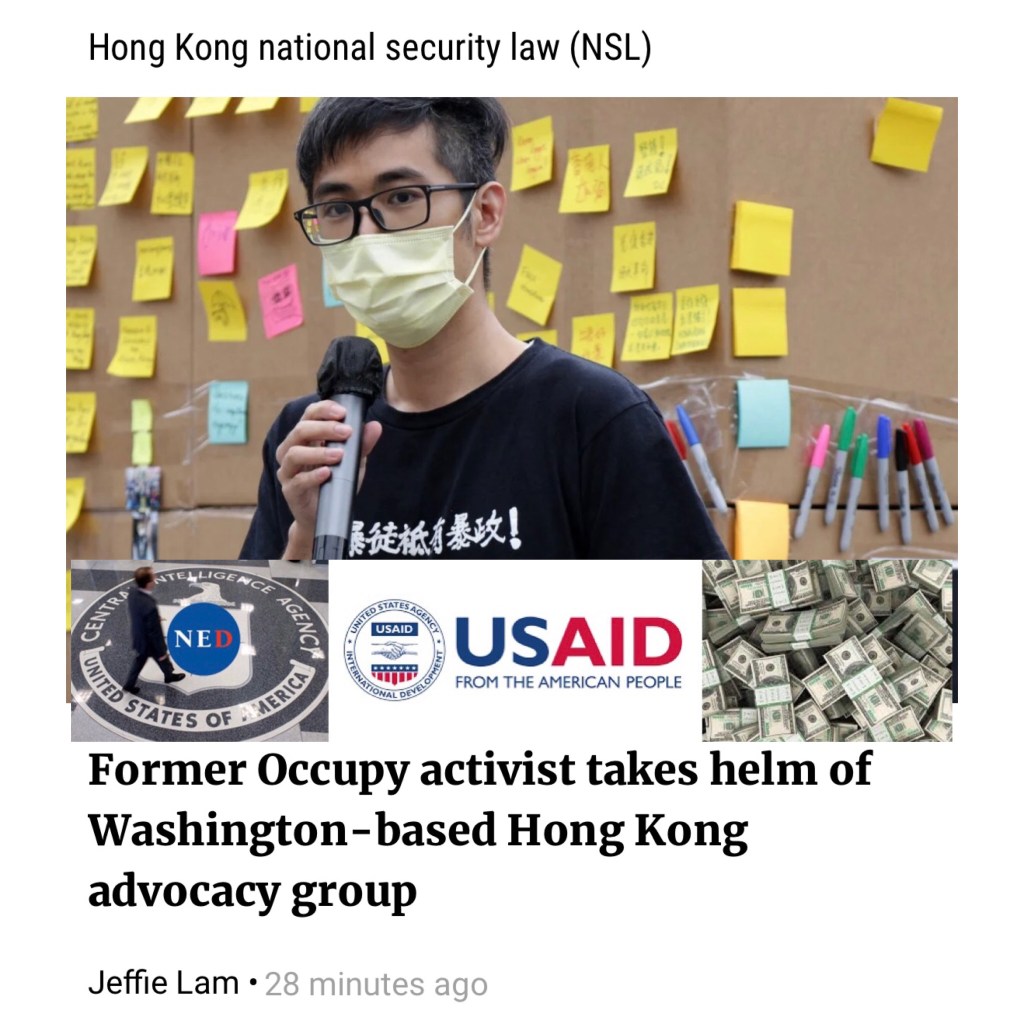
A former student leader who rose to prominence during the 2014 Occupy movement has taken the helm of a Washington-based advocacy group, arguing that foreign lobbying by US’s NED/CIA indispensable
End of an Empire – A spectre is haunting the United States — the spectre of decline. 帝國的終結 – 一個幽靈正在困擾著美國 – 衰落的幽靈 Written by Goutam Bhattacharya
Every kingdom is born to die. The 15th century belonged to the Portuguese, the 16th to Spain, 17th to the Dutch. France dominated the 18th and Britain the 19th. Bled white and left bankrupt by WWI, the British maintained a pretence of domination as late as 1935, when the empire reached its greatest geographical extent.
It wasn’t until the 1956 Suez debacle, when Britain was pressured by the U.S., the Soviet Union, and the United Nations to withdraw its forces from Egypt — which it had invaded along with Israel and France following Gamal Abdel Nasser’s seizure of the Suez Canal—that it became clear that its imperial days were over.
America’s debut on the world stage was epoch-making. By 1913, it was a major economic power, albeit one with little interest in global matters. This changed with its intervention in WWI on the side of the Allied Powers, ensuring their victory.
In 1940, America had a smaller army than Portugal or Bulgaria. Within 4 years, 18 million men and women would serve in uniform, with millions more working double shifts in mines and factories.
When the Japanese, within 6 weeks of Pearl Harbour, took control of 90% of the world’s rubber supply, the U.S. dropped the speed limit to 35 mph to protect tires, and, in 3 years, invented from scratch a synthetic-rubber industry that allowed Allied armies to roll over the Nazis. Shipyards spat out Liberty ships at a rate of two a day for four years; the record was a ship built in four-and-a-half days. A single American factory, Chrysler’s Detroit Arsenal, built more tanks than the whole of the Third Reich.
It was US industrial might and the blood of Russian soldiers that won the war.
After the end of WWII, the US gradually replaced the British Empire as a dominant power in much of the world. With but 6% of the world’s population, it accounted for half of the global economy, including the production of 93% of all automobiles. In under 50 years, America stood victorious, as USSR collapsed.
US domination was morally underpinned by its belief in “manifest destiny” and economically underpinned by the US dollar as the reserve currency, maintaining the massive gap between its economic might and its nearest rivals and its control of the airways and oil supply lines, and by its military might.
America boasted a vibrant middle class, a trade union movement that allowed a single breadwinner with limited education to own a home and a car, support a family, and send his kids to good schools. Affluence allowed for a truce between capital and labour, opportunity and declining income inequality, marked by high tax rates for the wealthy, who were by no means the only beneficiaries of a golden age of American capitalism.
But there was a dark side. America never stood down in the wake of victory in WWII. To this day, American troops are deployed in 150 countries. Since the 1970s, China has not once gone to war; the U.S. has not spent a day at peace. President Carter recently noted that in its 242-year history, America has enjoyed only 16 years of peace, making it “the most warlike nation in the history of the world”. Since 2001, the U.S. has spent over $6 trillion on military operations and war, money that might have been invested in the infrastructure of home. China, meanwhile, built its nation, pouring more cement every 3 years than America did in the entire 20th century.
The US military has become ever less able to win wars, even as its advantage in spending and in the amount and sophistication of its armaments has widened over its actual and potential rivals to an unprecedented level. America’s only unambiguous military victories since WWII came in the first Gulf War of 1991, a war with the strictly limited objective of expelling Iraq from Kuwait, and in various “police actions” against pathetically small and weak opponents in the Dominican Republic in 1965, Grenada in 1983 and Panama in 1989. America is unique among the world’s dominant powers of the past 500 years in its repeated failure to achieve military objectives over decades.
From the arrival at the airport to the high-speed train or subway trip into town, a visit to Europe and East Asia can seem to an American like a journey to a Tomorrowland, never to be realized in the United States outside of Disney World.
As America policed the world, the violence came home. On D-Day, June 6, 1944, the Allied death toll was 4,414; in 2019, domestic gun violence had killed that many Americans by the end of April. By June 2019, guns in the hands of ordinary Americans had caused more casualties than the Allies suffered in Normandy in the first month of a campaign that consumed the military strength of five nations.
Meanwhile, America lionised the individual at the expense of community and family. It was the sociological equivalent of splitting the atom. What was gained in terms of mobility and personal freedom came at the expense of common purpose. In wide swaths of America, the family as an institution lost its grounding. By the 1960s, 40% of marriages were ending in divorce. Only 6% of American homes had grandparents living beneath the same roof as grandchildren; elders were abandoned to retirement homes.
People exhausted themselves in jobs that only reinforced their isolation from their families. The nation consumes 69% of the world’s antidepressants. The collapse of the working-class family has been responsible for an opioid crisis that has displaced car accidents as the leading cause of death for Americans under 50.
Mountains of public and private debt is a ticking time bomb.
At the root of this dysfunctional dystopia is a widening chasm between the haves and the have-nots. When the promise of a good life for a working family is shattered as factories close and corporate leaders, growing richer by the day, ship jobs abroad, the social contract is irrevocably broken. For two generations, America has celebrated globalisation with iconic zeal, when, as a working person can see, it’s nothing more than capital on the prowl in search of cheap labour.
Black Americans, just 13% of the population, significantly outnumber whites in prisons.
In economic terms, USA of the 1950s resembled Denmark as much as the America of today. Marginal tax rates for the wealthy were 90%. The salaries of CEOs were, on average, just 20 times that of their mid-management employees.
Today, the pay of those at the top is 400 times that of their salaried staff, with many earning orders of magnitude more in stock options and perks. The elite 1% of Americans control $30 trillion of assets, while the bottom half have more debt than assets. The 3 richest Americans have more money than the poorest 160 million. 20% of American households have zero or negative net worth, a figure that rises to 37% for black families. The vast majority of Americans — white, black and brown — are two paychecks removed from bankruptcy. Though living in a nation that celebrates itself as the wealthiest in history, most Americans live on a high wire, with no safety net to brace a fall.
The unravelling of US domination has been mostly self-inflected. Its moral dimension started to come apart when the US invaded Iraq in 2003, disregarding the UN and propagating lies about Saddam Hussein’s WMD. The credibility of the economic order was damaged by financial meltdown of 2008, when major US financial institutions collapsed like a house of cards.
In the 2010s, the world witnessed the resurgence of Russia and the emergence of China as the global economic powerhouse, while signs of the internal socio-political crisis in America started to emerge, reflected in the rise of Trumpism, the growing racial injustice that triggered the Black Lives Matter movement and the collapse of the health system amid the COVID-19 pandemic.
With the COVID crisis, 40 million Americans lost their jobs, and 3.3 million businesses shut down. The pandemic simply revealed what had long been forsaken. A country that once turned out fighter planes by the hour could not manage to produce paper masks or cotton swabs. The nation that defeated smallpox and polio, and led the world for generations in medical innovation and discovery, was reduced to a laughing stock as an odious buffoon of a president advocated, like a carnival barker, the use of household disinfectants as a treatment for a disease that intellectually he could not begin to understand.
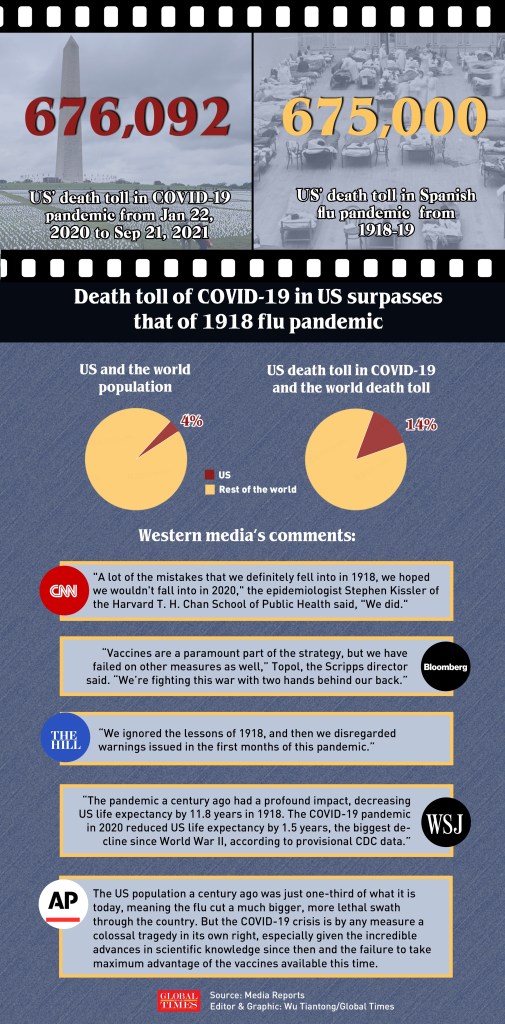
With less than 4% of the global population, the U.S. soon accounted for more than a fifth of COVID deaths.
For the first time, the international community felt compelled to send disaster relief to America. For more than two centuries, reported the Irish Times, “the United States has stirred a very wide range of feelings in the rest of the world: love and hatred, fear and hope, envy and contempt, awe and anger. But there is one emotion that has never been directed towards the U.S. until now: pity.” As American doctors and nurses eagerly awaited emergency airlifts of basic supplies from China, the hinge of history opened to the Asian century.
As America responded to the crisis like a corrupt tin pot dictatorship, tin pot dictators of the world seized the high ground, relishing a rare sense of moral superiority, especially in the wake of the killing of George Floyd. The autocratic leader of Chechnya, Ramzan Kadyrov, chastised America for “maliciously violating ordinary citizens’ rights”. North Korean newspapers objected to “police brutality” in America. Quoted in the Iranian press, Ayatollah Khamenei gloated, “America has begun the process of its own destruction.” When an American official raised the issue of human rights on Twitter, China’s Foreign Ministry spokesman, invoking the killing of George Floyd, replied, “I can’t breathe.”
The American political process made possible the ascendancy to the highest office in the land a national disgrace, a morally and ethically compromised demagogue. As a British writer quipped, “There have always been stupid people, and plenty of nasty people too. But rarely has stupidity been so nasty, or nastiness so stupid.”
Trump is less the cause of America’s decline than a product of its descent. In a complete abandonment of the collective good, U.S. laws define freedom as an individual’s inalienable right to own a personal arsenal of weaponry.
The American cult of the individual denies the very idea of society. What every prosperous democracy deems to be fundamental rights — universal health care, equal access to quality public education, a social safety net for the weak, elderly, and infirm — America dismisses as socialist indulgences. American politicians dismiss the Scandinavian model as creeping socialism, communism lite.
Asked what he thought of Western civilisation, Mahatma Gandhi famously replied, “I think that would be a good idea.” The remark accurately reflects the view of America as seen from the perspective of any modern social democracy. Oscar Wilde quipped that the United States was the only country to go from barbarism to decadence without passing through civilisation.
These are evidences of such terminal decadence.
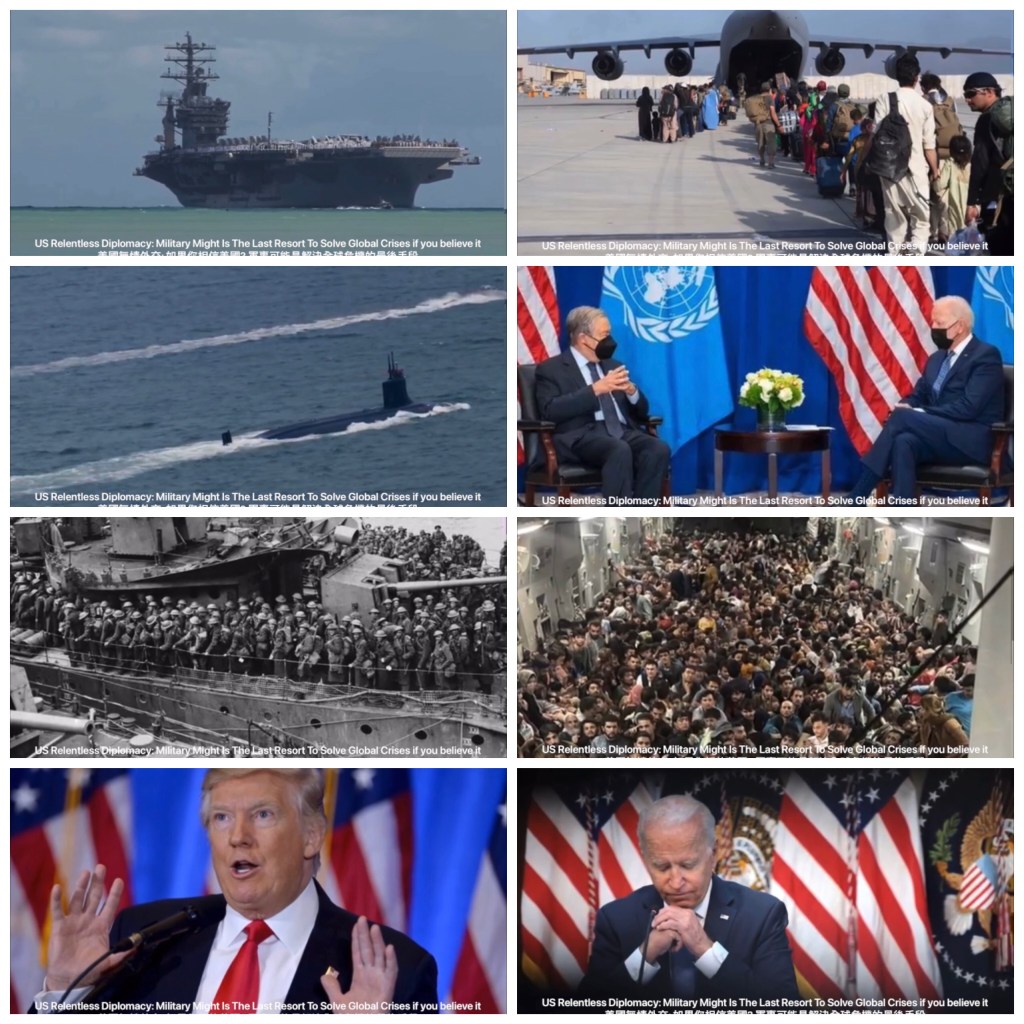
In this perspective, the humiliating withdrawal from Afghanistan, one can say that the century of American dominance may well be coming to an end.
The US remains the biggest military power. The size and sway of its economy remains formidable. What has changed, however, is its appetite for direct and indirect conflict to maintain its power. Its allies – in Afghanistan and elsewhere – are the first to feel this growing American aversion to global dominance.
As Henry Kissinger said, “It may be dangerous to be America’s enemy, but to be America’s friend is fatal.”
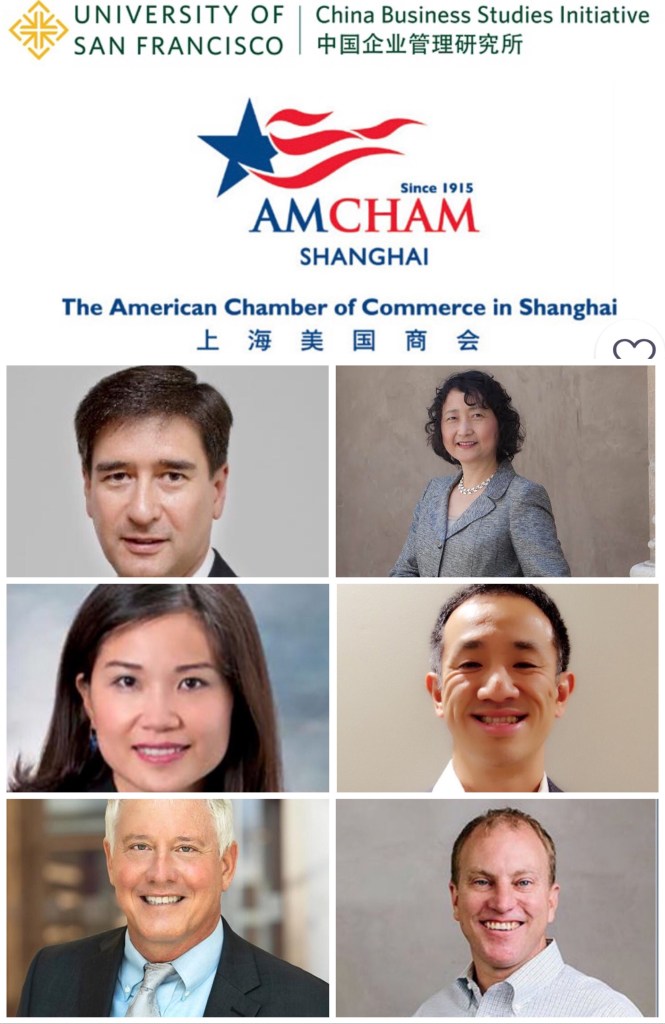
USF and AmCham Shanghai presentation on China Business Report “US Business View on China” by AmCham Shanghai President Ker Gibbs in SF.
Thursday, Sept 23, 3-5:30pm San Francisco California USA via zoom – please register online https://bit.ly/3EpGtRV (complimentary)
It will be followed by panel discussion: Hao Lin, Alibaba Cloud Vivien Wang, Deloitte Don Williams, Hogan Lovells Internatonal LLP Peter Lorentzen, USF Moderator: Xiaohua Yang, USF
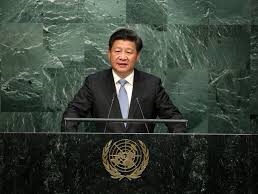
🇨🇳🇺🇳Chinese President #XiJinping addresses United Nations General Assembly, calls for bolstering confidence, jointly addressing global challenges
Below is the full speech. Mr. President,
The year 2021 is a truly remarkable one for the Chinese people. This year marks the centenary of the Communist Party of China. It is also the 50th anniversary of the restoration of the lawful seat of the People’s Republic of China in the United Nations, a historic event which will be solemnly commemorated by China.
We will continue our active efforts to take China’s cooperation with the United Nations to a new level and make new and greater contributions to advancing the noble cause of the UN.
Mr. President, A year ago, global leaders attended the high-level meetings marking the 75th anniversary of the UN and issued a declaration pledging to fight COVID-19 in solidarity, tackle challenges together, uphold multilateralism, strengthen the role of the UN, and work for the common future of present and coming generations.
One year on, our world is facing the combined impacts of changes unseen in a century and the COVID-19 pandemic. In all countries, people long for peace and development more than ever before, their call for equity and justice is growing stronger, and they are more determined in pursuing win-win cooperation.
Right now, COVID-19 is still raging in the world, and profound changes are taking place in human society. The world has entered a period of new turbulence and transformation. It falls on each and every responsible statesman to answer the questions of our times and make a historical choice with confidence, courage and a sense of mission.
First, we must beat COVID-19 and win this decisive fight crucial to the future of humanity. The history of world civilization is also one of fighting pandemics. Rising to challenges, humanity has always emerged in triumph and achieved greater development and advancement. The current pandemic may appear overwhelming, but we humanity will surely overcome it and prevail.
We should always put people and their lives first, and care about the life, value and dignity of every individual. We need to respect science, take a science-based approach, and follow the laws of science. We need to both follow routine, targeted COVID-19 protocols and take emergency response measures, and both carry out epidemic control and promote economic and social development.
We need to enhance coordinated global COVID-19 response and minimize the risk of cross-border virus transmission.
Vaccination is our powerful weapon against COVID-19. I have stressed on many occasions the need to make vaccines a global public good and ensure vaccine accessibility and affordability in developing countries. Of pressing priority is to ensure the fair and equitable distribution of vaccines globally. China will strive to provide a total of two billion doses of vaccines to the world by the end of this year.
In addition to donating 100 million US dollars to COVAX, China will donate 100 million doses of vaccines to other developing countries in the course of this year. China will continue to support and engage in global science-based origins tracing, and stands firmly opposed to political maneuvering in whatever form.
Second, we must revitalize the economy and pursue more robust, greener and more balanced global development. Development holds the key to people’s well-being. Facing the severe shocks of COVID-19, we need to work together to steer global development toward a new stage of balanced, coordinated and inclusive growth. To this end, I would like to propose a Global Development Initiative:
— Staying committed to development as a priority. We need to put development high on the global macro policy agenda, strengthen policy coordination among major economies, and ensure policy continuity, consistency and sustainability. We need to foster global development partnerships that are more equal and balanced, forge greater synergy among multilateral development cooperation processes, and speed up the implementation of the UN 2030 Agenda for Sustainable Development.
— Staying committed to a people-centered approach. We should safeguard and improve people’s livelihoods and protect and promote human rights through development, and make sure that development is for the people and by the people, and that its fruits are shared among the people. We should continue our work so that the people will have a greater sense of happiness, benefit and security, and achieve well-rounded development.
— Staying committed to benefits for all. We should care about the special needs of developing countries. We may employ such means as debt suspension and development aid to help developing countries, particularly vulnerable ones facing exceptional difficulties, with emphasis on addressing unbalanced and inadequate development among and within countries.
— Staying committed to innovation-driven development. We need to seize the historic opportunities created by the latest round of technological revolution and industrial transformation, redouble efforts to harness technological achievements to boost productivity, and foster an open, fair, equitable and non-discriminatory environment for the development of science and technology. We should foster new growth drivers in the post-COVID era and jointly achieve leapfrog development.
— Staying committed to harmony between man and nature. We need to improve global environmental governance, actively respond to climate change and create a community of life for man and nature. We need to accelerate transition to a green and low-carbon economy and achieve green recovery and development.
China will strive to peak carbon dioxide emissions before 2030 and achieve carbon neutrality before 2060. This requires tremendous hard work, and we will make every effort to meet these goals. China will step up support for other developing countries in developing green and low-carbon energy, and will not build new coal-fired power projects abroad.
—Staying committed to results-oriented actions. We need to increase input in development, advance on a priority basis cooperation on poverty alleviation, food security, COVID-19 response and vaccines, development financing, climate change and green development, industrialization, digital economy and connectivity, among other areas, and accelerate implementation of the UN 2030 Agenda for Sustainable Development, so as to build a global community of development with a shared future.
China has pledged an additional three billion US dollars of international assistance in the next three years to support developing countries in responding to COVID-19 and promoting economic and social recovery.
Third, we must strengthen solidarity and promote mutual respect and win-win cooperation in conducting international relations. A world of peace and development should embrace civilizations of various forms, and must accommodate diverse paths to modernization. Democracy is not a special right reserved to an individual country, but a right for the people of all countries to enjoy.
Recent developments in the global situation show once again that military intervention from the outside and so-called democratic transformation entail nothing but harm. We need to advocate peace, development, equity, justice, democracy and freedom, which are the common values of humanity, and reject the practice of forming small circles or zero-sum games.
Differences and problems among countries, hardly avoidable, need to be handled through dialogue and cooperation on the basis of equality and mutual respect. One country’s success does not have to mean another country’s failure, and the world is big enough to accommodate common development and progress of all countries. We need to pursue dialogue and inclusiveness over confrontation and exclusion.
We need to build a new type of international relations based on mutual respect, equity, justice and win-win cooperation, and do the best we can to expand the convergence of our interests and achieve the biggest synergy possible.
The Chinese people have always celebrated and striven to pursue the vision of peace, amity and harmony. China has never and will never invade or bully others, or seek hegemony. China is always a builder of world peace, contributor to global development, defender of the international order and provider of public goods. China will continue to bring the world new opportunities through its new development.
Fourth, we must improve global governance and practice true multilateralism. In the world, there is only one international system, i.e. the international system with the United Nations at its core. There is only one international order, i.e. the international order underpinned by international law. And there is only one set of rules, i.e. the basic norms governing international relations underpinned by the purposes and principles of the UN Charter.
The UN should hold high the banner of true multilateralism and serve as the central platform for countries to jointly safeguard universal security, share development achievements and chart the course for the future of the world. The UN should stay committed to ensuring a stable international order, increasing the representation and say of developing countries in international affairs, and taking the lead in advancing democracy and rule of law in international relations.
The UN should advance, in a balanced manner, work in all the three areas of security, development and human rights. It should set common agenda, highlight pressing issues and focus on real actions, and see to it that commitments made by all parties to multilateralism are truly delivered.
Mr. President,
The world is once again at a historical crossroads. I am convinced that the trend of peace, development and advancement for humanity is irresistible. Let us bolster confidence and jointly address global threats and challenges, and work together to build a community with a shared future for mankind and a better world for all.
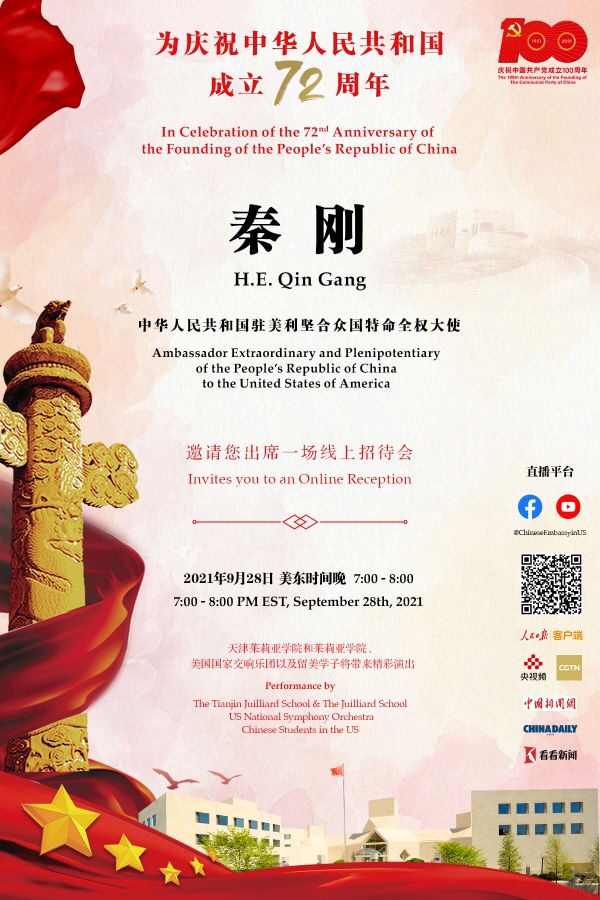
An online reception for the 72nd anniversary of the founding of the People’s Republic of China will be held on September 28 at 7pm EST. The reception is organized by the Chinese Embassy in the US, together with Chinese Consulates General in New York, San Francisco, Los Angeles and Chicago.
At the reception, Chinese Ambassador Qin Gang and invited guests will deliver video remarks, which will be followed by performances by the students and faculty of The Tianjin Juilliard School and The Juilliard School, artists of US National Symphony Orchestra and Chinese students in the US. Your participation is welcome!
From September 22 to 27, documentaries will be shown on the Embassy’s social media channels at 7pm each day: The CPC Way, a 6-episode documentary on the 100th anniversary of the founding of the Communist Party of China; A Long Cherished Dream, a 4-episode documentary about ordinary Chinese’s pursuit of a better life; as well as videos about Asian elephants’ northbound migration in China and preparations for the 2022 Beijing Winter Olympic Games. Stay tuned!
New York Times Advises China on Covid-19: Abandon Success, Try Failure – Shielding the Western elite from justified rage. 紐約時報就新冠病毒向中國提供建議: 放棄成功, 嘗試失敗來保護西方精英免受正當憤怒by John V. Walsh in San Francisco / September 21st, 2021
The recent outbreak of the Delta variant in China “shows that its strategy no longer fits. It is time for China to change tack.”
So declared a lead essay atop the New York Times Opinion/Editorial section on September 7 by Yanzhong Huang, a senior fellow at the Council on Foreign Relations.
The Delta outbreak that “changed the game” in Huang’s words emerged after an outbreak at Nanjing international airport in July traced to a flight from Russia. Did this outbreak change anything, in fact?
Let’s do the numbers.
Let’s do something that Huang did not; let’s look at the numbers from July 1 until September 7, the date of the article, a period that brackets the Delta outbreak cited by Huang.
During that period China experienced 273 new cases, about 4 per day, and no new deaths. That hardly seems like a failure.
To get some perspective on these numbers, during that same July1-September 7 period, the US, a country one fourth China’s size, reported 6,560,588 new cases (96,479 per day) and 45,054 new deaths (662 per day).
The same contrast can be seen for the entire period of the pandemic. From the pandemic’s initial Wuhan outbreak in January, 2020, until September 7, 2021:
China had a sum total of 95,512 cases and 4,629 deaths;
The US had 40,196,953 cases and 648,146 deaths.
There have been two previous outbreaks of the Delta variant in China, one in Guangdong and another in Yunnan near the Myanmar border before the one arising in Nanjing. The Delta variant was contained in each case. None of the three has turned out to be a “game changer,” as Huang incorrectly maintains.
Perhaps it is the U.S. that needs “to change tack.”
To anticipate an objection that has largely faded but persists in some quarters, can we believe the case and mortality count China gives us? There are now many first-hand accounts of what life has been like in China these days that make the official tallies quite reasonable. And quantitative evidence supporting China’s data is available in a peer-reviewed study in the prestigious British Medical Journal; it is summarized and discussed here. Carried out by groups at Oxford University and China’s CDC, the study compares excess deaths in Wuhan and also in the rest of China during the period of the lockdown, and it finds that the official counts are remarkably accurate.
Do China’s life-saving measures imperil its economy?
China would need a very good reason to abandon its public health measures of massive, rapid testing, tracing and, where necessary, quarantining. Are there any such reasons? Mr. Huang states that the life-saving measures now “threaten overall economic growth in China”. Does this prognostication fit the facts?
China’s GDP grew more slowly in 2020, but still it grew by 2.27%, the only major economy in the world not to contract. In contrast the US economy contracted by 3.51%. (Even China’s slowed growth in 2020 matched the US economy in normal times, which grew at an average rate of 2.3% in the four pre-pandemic years, 2016-2019.)
What about the future? Economies are set to rebound in 2021 from their 2020 lows, with recent projections giving China an 8.4% bounce before settling in to an average growth of 6% over the following 5 years. For comparison the US jump in 2021 is estimated to be 6.4%, dropping to a 1.9% average over the following 5 years.
In terms of the economy present and future, China’s policies appear to be doing quite well, better, in fact, than any other major economy. Mr. Huang has advanced a thesis that is unencumbered by the facts.
Why is the media’s failure to report on China’s success a threat to our very lives?
At every step of the way, China’s successes with Covid-19 have been met in the U.S. media with silence, denigration or a prediction that the success cannot continue (FAIR provides a brief survey here). As a result, China’s measures are not widely known or understood.
China’s success with its public health measures is important for us now, because the pandemic is far from over. We don’t know what surprises viral evolution will have in store for us. If a new variant emerges that is resistant to existing vaccines, then we have only public health measures to protect us until we catch up. That is also true for future pandemics which will surely come our way. For us to be kept in ignorance of those measures or to have them dismissed, as Yanzhong Huang does, poses a threat to our very lives.
We might also wonder what would happen if the people of the West, including the U.S., understood clearly that measures were possible which could have protected us from the millions of deaths we have suffered. Governments have toppled from far less. Mr. Huang, the New York Times and the mass media, whatever else they are doing, are certainly protecting our Establishment from a rage that might have most unpleasant consequences.
John V. Walsh can be reached at john.endwar@gmail.com. He writes about issues of war, peace and empire, and about health care, for Antiwar.com, Consortium News, Dissident Voice.org and other outlets. Now living in the East Bay, he was until recently Professor of Physiology and Cellular Neuroscience at a Massachusetts Medical School.



 Johnson Choi Biz