Video: Western Empires continue to push US aggressive China containment policy to stop China rise by all means at all cost in the name of fake freedom democracy human rights and rules of laws. 美國加州舊金山星島電視 – 霍詠強 :後孟晚舟事件的中美對峙:前後夾撃?美國陰招可謂層出不窮。
在分析兩件表面上不相關的美國行動之前,這星期還有兩宗關於中美關係的大事件,其一是美國貿易代表戴琪在拜登政府上任九個月首次發表的對華貿易政策,然而她在戰略與國際研究中心(Center for Strategic and International Studies) 的發言,除了一開始就定調了和中國的對抗色彩以外,並無新意。她指出「拜登認為需要負責任地管理競爭並確保它是公平的。長期以來,中國不遵守全球貿易規範,已經削弱了美國人和世界其他地方的繁榮,北京進一步強化以國家為中心的經濟體制,缺乏有意義的改革,也無法解決美國和許多國家共同的擔憂。」
9月29至30日,美國和歐盟在匹茲堡召開了為期兩天的首次美歐貿易和技術委員會 (TCC: Trade and Technology Council) 會議,這個委員會是今年5月拜登訪問歐盟時成立的,從這次會議發表的聯合聲明可以看出,美國和歐盟已經在針對中國建立一個貿易和技術聯盟方面邁出實質性步伐,匹茲堡會議將歐美綑綁成一個新的跨大西洋的發展聯盟,專注於半導體、供應鏈、疫苗和氣候變化,以及人工智能和高科技電訊發展,尤其是在6G網絡的研究和制定標準上。在會議中,美商務部長 Raimondo 稱「美歐要通力合作,才可減慢中國的科創發展 」(slow down China’s rate of innovation)。
於是,美國果斷打撃中國賣家,聯邦貿易委員會(FTC)與Amazon 進行了長達數月的溝通,Amazon 甚至直言不諱表示封禁相關品牌來自於FTC的授意,並要求運營部門不得受理相關品牌和店鋪的申訴 (we are advised to not entertain any appeals)。幾乎同一時間,兩黨參議員發起的《線上零售市場消費者保護法案》(INFORM Consumers Act),其中的核心內容,是要求電商平台第三方店鋪必須公示註冊地及聯繫信息,更直言不諱地表示法案瞄准的是中國賣家,要將「中國製造」和負面印象聯結,遏制中國賣家在Amazon的發展。
A true patriot fight against US’s NED/CIA regime change in HK, Prof. Xiang Zhang JP, former Ernest S. Kuh Endowed Chaired Prof. at UC Berkeley, President of the University of HK (HKU) got his contract extended for 5 years.
1800s Western Empires back by military sold Opium to China in exchange for Teas & Porcelains; 2021 China wants to buy Computer Chip, Advance Weaponry, AI to balance trade with US, but US won’t sell. Who’s faults? 1800 年代,西方帝國利用強大的軍隊將鴉片強迫賣給中國以換取茶葉和瓷器; 2021 中國想購買計算機芯片、先進武器、人工智能以平衡與美國的貿易,但美國不會出售。誰的錯?
Many dog fanciers like to trace their favorite breed to antiquity, but the researchers who study the modern and ancient DNA of dogs have a different perspective. By James Gorman Oct. 4, 2021
“The tiny Maltese,” the American Kennel Club tells us, “has been sitting in the lap of luxury since the Bible was a work in progress.”
This is also the opinion of my friend the Maltese owner (the dog is also my friend), who recently invoked the Greeks and the Romans as early admirers of the breed.
I have these conversations on occasion with people who are devoted to one breed or another and I usually nod and say, well, maybe, sort of. True, Aristotle did praise the proportions of a kind of lap dog described as a Melitaean dog. Scholars debate whether this meant the dog came from Malta, or another island called Melite or Miljet, or maybe a town in Sicily. It was a long time ago, after all. Aristotle also compared the dog to a marten, a member of the weasel family, perhaps because of its size. And yes, the Romans absolutely loved these dogs.
So there is little doubt that there were little white lap dogs 2,000 years ago. The question is whether the modern Maltese breed is directly descended from the pets Romans scratched behind the ears.
I have not mentioned this to the dog herself, who would prefer to remain anonymous because the internet can be vicious. And I doubt she would pay much attention to genealogical intrigue. Her interests, from what I can see, run more toward treats, arrogant and intolerable chipmunks and smelly places to roll around in.
It’s not just Maltese fanciers who are interested in their breed’s ancient roots. Basenjis, Pomeranians, Samoyeds, Salukis, terriers and others have supporters who want to trace the breeds back to ancient times. But the Maltese seemed a good dog to discuss because the historical record is so rich. Obviously the Maltese is an ancient breed. Right?
I brought this question to several of the scientists I turn to when I have dog DNA questions. Is the modern Maltese breed, in fact, ancient? The scientists, you will be shocked to learn, said no. But, as with anything involving dogs and science, it’s complicated.
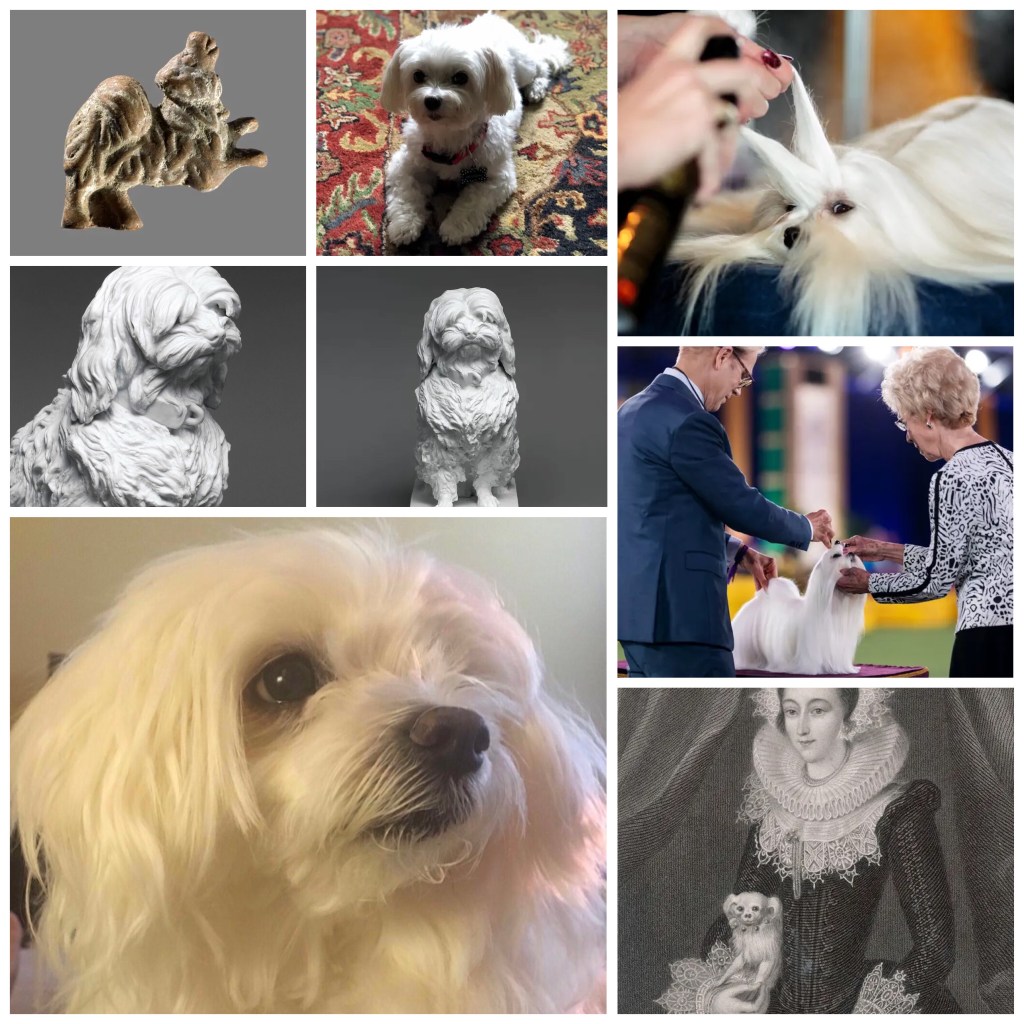
“Tobias and the Angel,” by Antonio del Pollaiolo, 1460, with a possible Maltese in the lower left corner.
A friend of the author, who wished to remain anonymous.
A couple of points to set the stage. All dogs are descended from the first dogs, just as all humans can trace their ancestry to the first Homo sapiens. None of us, or our dogs, have a more ancient ancestry than any other. What people seem to want to know is whether those ancestors were mutts or nobles, William the Conqueror or one of the conquered, a dog on a lap who got into a portrait, or a dog on the street who got into trouble.
I’m not looking at this from the outside, by the way. I’ve been there myself, digging as deep as I could into the long and honorable history of my cairn terriers and Pomeranians. I’ve also tried to trace my family’s O’Connors and O’Learys and Fallons and Goritzes. (I haven’t found any conquerors yet.) But the idea of valuing genetic purity feels creepy sometimes, even if it is in animals who like to roll in cow pies when they get the chance.
Elaine Ostrander, a dog genomics specialist at the National Institutes of Health, has gone as deep into breed differences and history as any scientist. She said the hunger for old breed ancestry is similar to the desire to reach back to the Mayflower for human antecedents. “We think that way about ourselves. So we think that way about our dogs.”
“The Pharaoh hound people were the first to approach me and ask that question,” she recalled.
“Do our dogs really date back to the time of the Pharaoh?” the breeders asked. Unfortunately not. That breed, Dr. Ostrander said, was “totally recreated by mixing and matching existing breeds” after World War II.
Other breeds were established by picking an existing group of dogs in the Victorian era and classifying them as a breed with a definition that meant only dogs whose names were in a registry or whose ancestors could be identified as being in that registry, fit the breed. And 2,000 years ago, she said, “the concept of a breed did not exist.”
A Maltese competing in the Westminster Kennel Club dog show in Tarrytown, N.Y., in June.
Nor does DNA show any direct line from ancient to modern Maltese. To understand what dog DNA research is all about, it’s worth taking a step back. The genetic markers that Dr. Ostrander and other researchers use in genome comparisons to identify breeds are mostly not the genes that contain the recipe for floppy ears or bent legs or a certain color coat.
They are not seeking a genetic recipe for a Bassett Hound or Beagle, but a way to see how closely related one is to the other. Most DNA in humans and dogs has no known function. Only a portion of a genome makes up actual genese. And repetitive stretches of DNA of unknown purpose, if any, have proven to be useful in comparing groups and individuals. They change more from generation to generation and so offer more variation for scientists to work with in comparing breeds. What researchers develop is a breed fingerprint, but not a blueprint.
Neither Dr. Ostrander nor Heidi Parker, a colleague and collaborator at N.I.H., gave a firm answer on how far back a breed could be traced, but they agreed that it basically depended on how long a breed club had been keeping records, not on what’s in a dog’s DNA. Before that time, breeding was not so regulated.
The genomes of the Maltese, the havanese, the bichon and the Bolognese (the dog not the sauce) are all related, Dr. Parker said. The breeds may have split from a common ancestor a few hundred years ago and that common ancestor may no longer exist, or it might have been closer to one of the breeds than the others. But there’s no DNA line to be traced to the time of Aristotle.
When I asked Greger Larson, of the University of Oxford, who studies ancient and modern DNA of dogs and other animals, whether any breeds date to antiquity, he looked, as best I could tell from his Zoom image, like I had asked him if the Earth might really be flat.
“Breeds have closed breeding lines,” he said. “That’s the idea. Once they get established, you’re not allowed to bring anything into it. And that concept of breeding toward an aesthetic and closing the breeding line — that whole thing is only mid-19th century U.K.”
“I don’t care whether you’re talking about a pug or a New Guinea singing dog or a basenji,” he said. Breeds, by definition, are recent.
Queen Elizabeth I with a suspected Maltese.
Mary Queen of Scots, with her own small white dog.
There have, however, been lineages of dogs bred to the chase, or the lap, or to herd the sheep, for a long, long time. One such lineage, call it Maltese-adjacent, might be defined as “really small dogs with short legs and they require a lot of attention and people are in love with them,” Dr. Larson said. That lineage was certainly around in ancient Rome.
My friend the Maltese partisan sent me images of old paintings. Mary Queen of Scots has some kind of little dog in a portrait from around 1580, but I have to say it looks more like the ghost of a Papillon than a living Maltese. Queen Elizabeth also has a small dog in a portrait from around the same time, which looks like a little white dog, more or less.
There are lots of others, but I doubt they would qualify for the Westminster Kennel Club Dog Show. And none of this means that the modern Maltese or any other modern breed is the same as the dogs of antiquity.
“We want to say that our dog is very old in its current form, that it hasn’t been changed,” Dr. Larson said. “Like the Maltese is the Maltese for the last 2,000 years. And that’s just clearly” not true. Although “not true” was not the expression he used.
“People have not been breeding dogs in the way that we do now for very long, at all,” he said. “What we lack in our vocabulary is a word for dogs that mostly look the same, doing the same kind of a job.”
But, setting words aside, I asked, what about the DNA. Does the DNA tell us how close a dog that looks like a Maltese now is to a Maltese then? He said that dog breeding in the past was never done to physical type, that dogs moved as people moved, from Rome to Britain, and back to Spain and Rome, and that nobody kept track of pedigrees. In addition, when breeds were established, they were based on a limited number of dogs admitted to the breed at that time. That is known in genetics as an extreme bottleneck. And all modern dogs are descended from just a few, unless there is interbreeding and mixing to change the look of the breed, which can happen.
Hank, a Maltese being groomed for competition in the Westminster dog show in 2014.
A Maltese Lion Dog was exhibited at the first Westminster dog show in New York in 1877. After that, Maltese dogs were sometimes crossed with poodles, and some are said to show poodle traits now. The stud book, or registry, was started with two females in 1901 and reached about 50 dogs in the 1950s.
You can now find out if your Maltese is really a Maltese by checking its pedigree or, if you want to dig into its genome, by sending some saliva (the dog’s) off to a company like Embark, with more than 100 employees chasing the secrets of dog DNA, or an academic venture like Darwin’s Dogs, part of the Darwin’s Ark project at the University of Massachusetts. (The ark, no judgment here, includes cats.) The scientists involved in this work also get pulled into the question of breed antiquity by curious dog owners and journalists.
Adam Boyko, the co-founder of Embark, and a geneticist at the Cornell University School of Veterinary Medicine, agreed that modern breeds, with their “closed populations” are about 200 years old.
He said there’s no question that little white lap dogs have a long history. “They were very popular in Roman times. They may or may not have come from Malta or some other Greek island.” But he said, it’s an open question what kind of genetic continuity there may be with modern little white lap dogs.
A terracotta relief of a Maltese dog from Smyrna, Turkey, dated to the first century B.C.E.
The British Museum
“The White Duchess,” by Francisco Goya, 1795.
Even in human genealogy, where one can trace the human equivalent of a pedigree back 1,000 years, the idea of genetic continuity is divorced from the reality of genes.
Over the ages, each time a man and woman produce offspring, they take half the DNA from each parent. The genetic deck is shuffled and half the cards discarded. This shuffling occurs over and over. In each generation, it is as if two decks of 52 cards are shuffled to come up with a new deck that still numbers 52.
“When you go back 10 generations,” Dr. Boyko said, most of those ancestors, 10 generations back actually didn’t contribute any DNA to you. It got shuffled out.” It’s the same with a Maltese. Even if there were a documented direct line, which there is not, the descendants wouldn’t have much of the ancestors’ specific genetic variation.
In the end, of course, explained Elinor Karlsson, a genomics researcher at the University of Massachusetts Medical School who runs Darwin’s Ark, we cannot reach complete clarity on dog breeds because “breed” is used to mean different things by different people.
Speaking of dogs in art, she said: “It could be either that the dog in the painting simply looks like a Maltese and is entirely unrelated to the Maltese around today. It could be that that dog actually has exactly the same genetic variant that causes a Maltese to be small or causes a Maltese to be white.” But, she added, “I don’t know whether that makes them the same
China pledged to buy more US products, China could buy US$200 billion of computer chips, advance weaponry, AI technology, but US won’t sell. The problem is on US sides, not China. 中國承諾購買更多美國產品,中國可以購買2000億美元的計算機芯片、先進武器、人工智能技術,但美國不會出售。問題出在美國方面,而不是中國.
In the trade deal, signed in January 2020, Beijing pledged to buy at least $200 billion more U.S. goods and services over 2020 and 2021, compared with 2017. The agreement paused a trade fight between the U.S. and China, which dragged on for about two years.









 Johnson Choi Biz