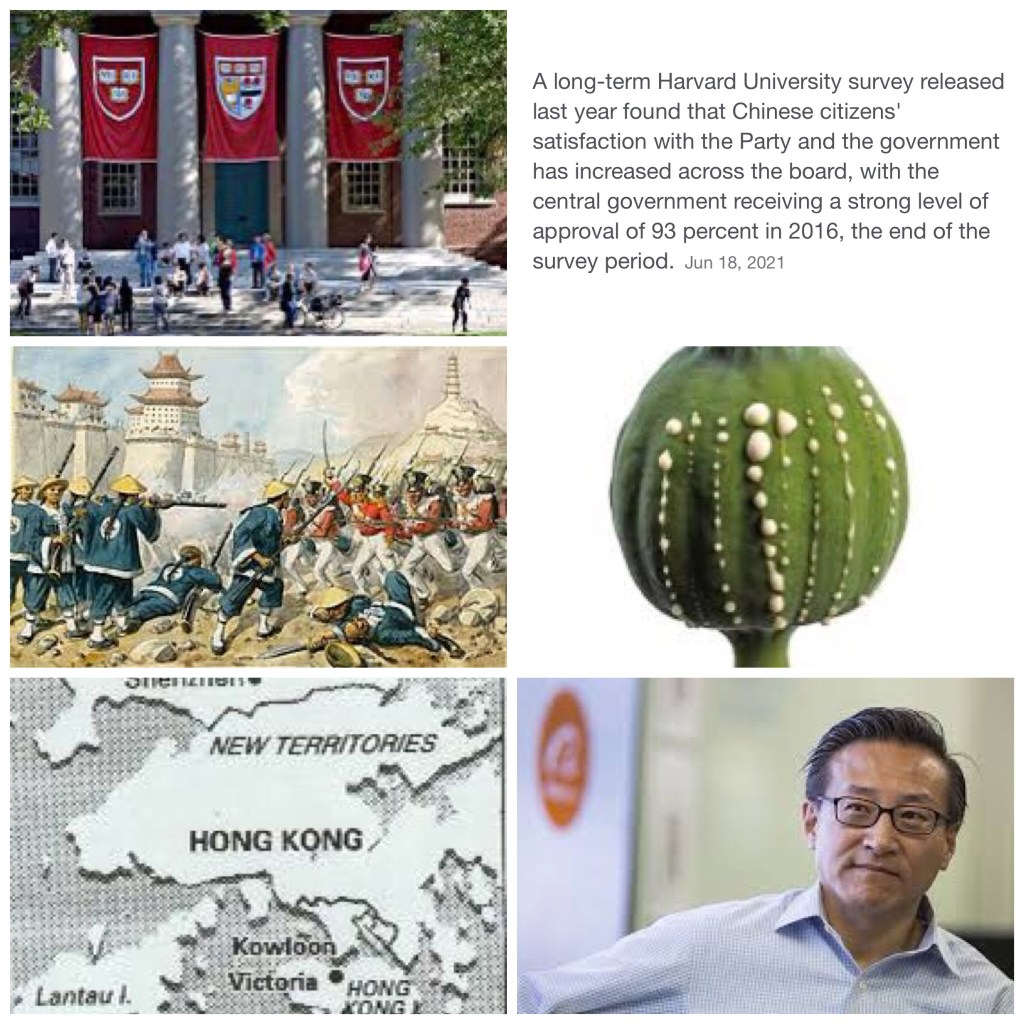
Video: Joe Tsai, VP of Alibaba lives in HK drops TRUTH BOMBS on cnbc live! immediately erased by racist Western media 住在香港的阿里巴巴副總裁在CNBC直播上説出真相, 立即被種族主義的西方媒體抹去
Watch a live news MOMENT that was immediately censored and deleted by CNBC’s YouTube service. In fact no mainstream media outlet included this very crucial moment of the interview in their online news clips of this interview (go ahead and check for yourself!). They just can’t let you folks hear the TRUTH on China. If you heard the truth then it would be harder to start a war or conflict with people on the other side of the world! 觀看被 CNBC 的 YouTube 服務立即審查和刪除的實時新聞。 事實上,沒有主流媒體在這次採訪的在線新聞剪輯中包含採訪的這個非常關鍵的時刻(去看看吧!)。 他們就是不能讓你們這些人聽到關於中國的真相。 如果你聽到了真相,那麼與世界另一端的人發生戰爭或衝突就更難了!
Wingo Wong: Co-founder of Alibaba and co-owner of South China Morning Post, Joseph Tsai’s inteview was deleted by the other Western media when his testimony that he is living in fear of the black shirt rioters and other violence caused by the protest in Hong Kong as he is not a Cantonese speaker living in Hong Kong. When the narrative does not match with the Western media’s agenda, even if you are media, you will be silenced yet the fake news that aligns with the MSM agenda will be repeated endless times like the fake “Xinjiang police testimony” by CNN and or allegations by Adrian Zenz. LOL
US demonize Asians, Chinese, Chinese Americans and China is working as planned. 美國妖魔化亞洲人、中國人、美籍華人,中國正在按計劃運作. Sunni Lee, got 3 Olympic gold medals in Tokyo, reveals she was target of racist attack, By Ryan Gaydos – Fox News
Sunni Lee returned from Tokyo an Olympic gold medalist and one of the best gymnasts in the world.
But at home she was still met with racist attacks, she revealed to Pop Sugar in a recent interview. The 18-year-old Minnesota native is a Hmong American. Her parents emigrated from Laos to Minnesota, which has the largest concentration of Hmong in the U.S.
She told the outlet she had been waiting for an Uber with some of her friends who are all of Asian descent when a group in a speeding car yelled “ching chong” at them and told them to “go back to where they came from.” Lee said one person sprayed her arm with pepper spray.
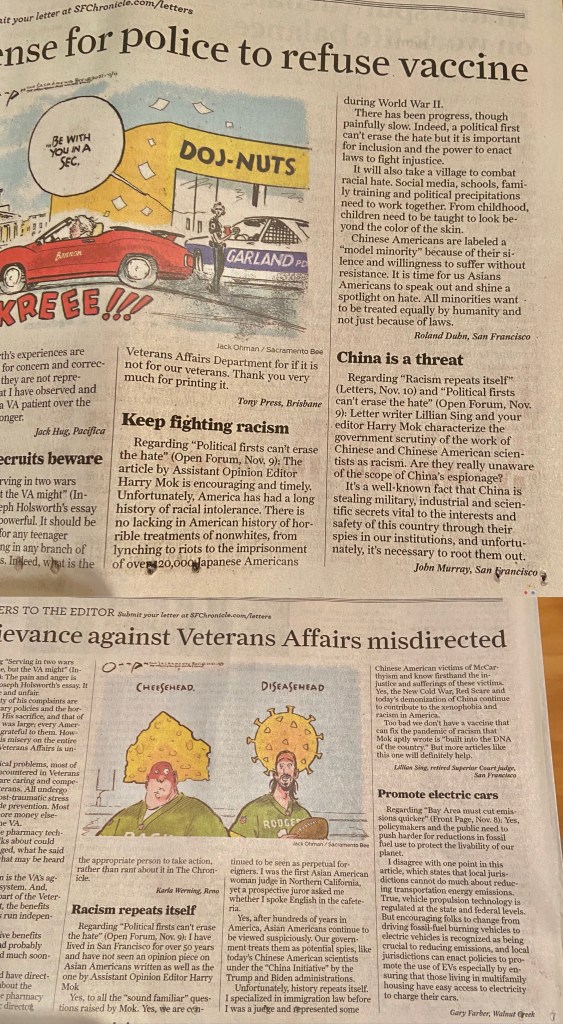
Notice how low the standards are to be published when you China-bash in the racist America. Judge Lillian Sing and Roland Duhn in San Francisco got their opinion pieces published. 請注意,當您在種族主義的美國進行中國抨擊時,發布的標準是多麼低。
Matt, the opinions editor of San Francisco Chronicle Newspaper said, we want personal narrative, combined with facts, with local relevance. Craft it carefully, clearly, and respectfully, make it sweet, comforting, and succinctly, like condensed milk, and maybe you will get published.
On the other hand, any unsubstantiated China-bashing claim–thoughtless, racist verbal graffiti–gets published immediately and indiscriminately. That’s the double standard.
If there is espionage, where are the convictions for espionage?
Of course there are none, because these racists claim “a thousand grains of sand” strategy–essentially tarring everyone. This is why Harry’s article was so lacking, and why Russell Jeung is out to lunch (because “selective targeting” is meaningless when you presume Asian students and researchers are guilty).
If it’s espionage, why is China’s technology is more advanced in many areas?
Why is China beating the US hands down in patents filed (whose specificity of documentation would be a windfall for any prosecutor)?
Why is the US spying on Chinese technology?
This is just more racist stereotyping, essentially claiming that the Chinese (actually all foreigners and indigenous) are thieves, cheaters, and of course, incapable of creativity.
Video: What really happened to the US$3 billions USS Connecticut submarine in Chinese territory ends up hitting an undersea mountain? 價值30億美元的康涅狄格號潛艇在中國領土上撞上海底山,究竟發生了什麼?
Severely Damaged U.S. nuclear submarine hit underwater mountain in South China Sea, Navy says. It was severely damaged in Chinese territory struck an uncharted underwater mountain, the Navy said Monday. Nov 2, 2021 美國海軍稱,嚴重受損的美國核潛艇撞上了中國南海的水下山峰。 海軍周一表示,它在中國領海撞上了一座未知的水下山峰。 2021 年 11 月 2 日
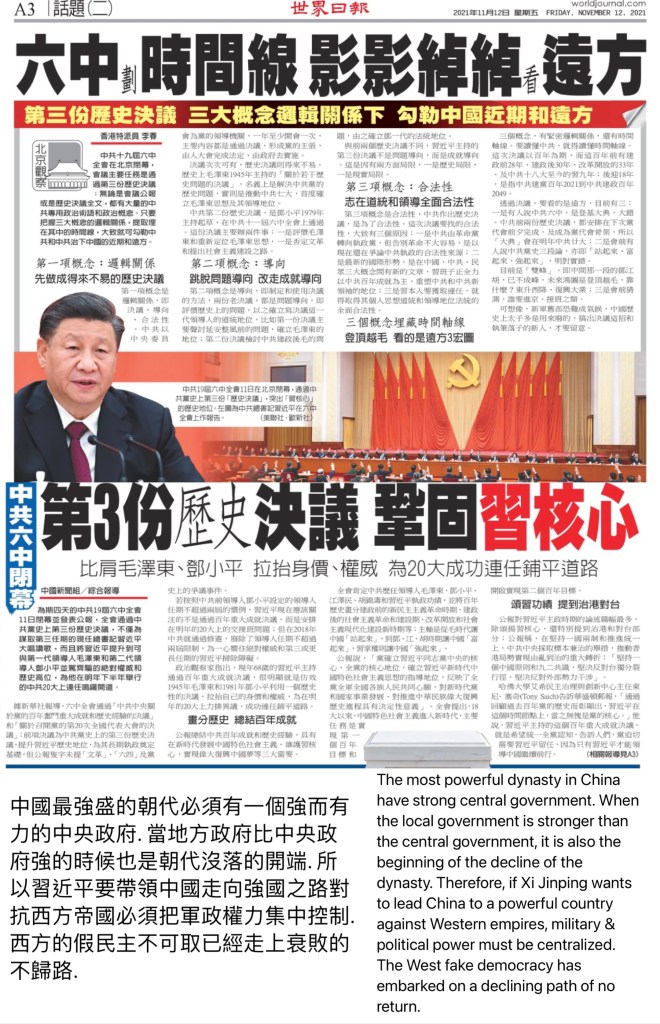
The most powerful dynasty in China have strong central government. When the local government is stronger than the central government, it is also the beginning of the decline of the dynasty.
Therefore, if Xi Jinping wants to lead China to a powerful country against Western empires, military & political power must be centralized. The West fake democracy has embarked on a declining path of no return.
Asia Times: China offers solutions to climate change – Rather than demonizing China, the West would do well to emulate some of the country’s environmental policies By K J NOH And MICHAEL WONG NOV 12, 2021
Beijing officials say the issue of climate change can not be separated from broader political disputes between China and the US. Image: iStock The Earth’s greenhouse-gas (GHG) concentrations are driving catastrophic climate change, and creating an existential threat to the planet. But there is a way out.
Last year, President Xi Jinping pledged that China’s carbon-dioxide emissions would peak before 2030, and that the country would become carbon-neutral before 2060.
China has a history of setting ambitious, nearly impossible goals and then achieving them –often before deadline – so this pledge is significant.
Under the Communist Party of China (CPC), Beijing has already created an “economic miracle” in transforming China into the largest economy in the world. It ended extreme poverty while creating the largest middle class in the world.
It has virtually eradicated Covid-19 through non-pharmaceutical methods, while vaccinating up to 20 million people daily, and pledging the largest number of vaccines (2.2 billion) and distributing more than a billion to the rest of the world.
It has also been applying similar focus and national resolve to tackle climate change.
China has the greatest program of adopting renewable energy of any country. It generates more renewable power than North, Central and South America – 42 countries – combined. It has more solar parks and wind farms than any other country. Last year it established more wind power than the rest of the world combined.
It has more electric vehicles than any other country: it operates 420,000 electric buses, 99% of the world’s total; Shenzhen alone has 16,000 e-buses and 22,000 e-taxis. It aims to have 325 million electric vehicles operating by 2050.
Its high-speed rail network spanning 38,000 kilometers is so extensive and effective that air travel is starting to become obsolete. No country has as dense, large, and efficient system of clean public transportation and high-speed rail as China.
In addition, China has the greatest carbon-sequestration afforestation program in the world, creating forests the size of Belgium every year. It has doubled its forest coverage to 23% over the past 40 years. Satellite analysis over the past 20 years by the US National Aeronautics and Space Administration’s Ames Research Lab proves that China has contributed more to greening the planet than any other country in the world.
In other words, by almost every sustainability index, China a world leader – far ahead of the US, for example – and is pioneering a way forward for the planet. It will likely hit its targets ahead of time.
These things are happening because the CPC has written sustainability and ecological development directly into its constitution. This is then implemented into regional and local policy, such as sustainable eco-city mandates, transportation policy, energy infrastructure, and advanced research, as well as dedicated funding for alternative energy development for companies to start up and build clean energy technology.
These commitments exist despite the fact that China’s historical and per capita GHG and CO2 emissions are a fraction of the world’s total. According to the World Bank, on an annual per capita basis, China’s share is less than half of the United States; its household energy consumption is one-eighth of America’s.
Even more important, here’s a chart showing the cumulative emissions by country.
Source: Carbon Brief / No Cold War Cumulative historical amounts matter because CO2 does not dissipate but accrues in the atmosphere: stocks, not flows, are what matter. In accounting, you look at one’s total accrued debt, not one’s daily credit expenditures, to determine what he or she owes to others. Likewise, you have to look at historically accrued GHG to understand harms, liabilities, and mitigation responsibilities accurately.
Note also, between 14% and 33% of China’s annual GHG emissions are actually the West’s that have been offshored through manufacturing. This way, the West gets to have its cake and eat it too: consume, pollute and destroy the planet, while virtue-signaling and blaming developing countries like China for the cost of Western consumption.
Coal: the real story
Much, too, has been made of China’s coal plants, but the fact is that they are advanced supercritical or ultra-supercritical plants, which means they are much more efficient and cleaner than many of the industrial-era legacy plants of the US.
China has a more sustainable approach along the entire chain of production and consumption. That said, China understands coal as a transitional source that it wants to phase out, except that the US has an explicit military plan to choke off China’s alternative fuel imports through the South China Sea.
China needs to maintain backup capacity in clean coal as it leapfrogs into renewables, which will constitute fully 80% of its energy portfolio by 2060. As for funding overseas coal plants, 87% of that finance comes from the West or Japan, and China has committed not to fund any more foreign coal plants.
With these commitments, China has demonstrated that it is dedicated and committed to both national and global sustainability and carbon neutrality.
Credit where it’s due
Last, most calculations of GHG emissions leave out the US military boot print, the single largest institutional emitter in the world, greater than the combined emissions of 140 nations. Add the cost of endless US wars, and subtract offshored GHG from the West from China’s total, you get a different picture of responsibility for global emissions.
Despite the hypocritical finger-pointing at China at COP26 by the worst polluters, the US and the West, the simple facts refute the lies.
China is a net GHG creditor nation, not a debtor. The Lancet showed that 92% of emissions above the safe level of 350 parts per million can be attributed to the Global North, of which 40% of these emissions are the United States’ alone. By contrast, China is a net creditor nation.
In other words, the atmosphere (atmospheric carrying capacity), a precious global commons, has been colonized and monopolized by the West to the detriment of the rest of the world. In this, the US bears the greatest individual responsibility for the global climate crisis.
Despite all this, China leads in solutions – in technology, policy, transition planning, and implementation. It is not only pulling its weight, it is showing the world a way forward.
This is in stark distinction to the US, where 25% of Congress members still refuse to believe in human-caused climate change and where the last president claimed that global warming was a “Chinese hoax.” The US was also responsible for disabling the original 1997 Kyoto Protocol by lowering standards, engineering carbon indulgences (“carbon trading”), exempting military emissions, and unjustly trying to offload responsibility to developing countries.
In the recent China-US Joint Glasgow Declaration on Enhancing Climate Action, the US momentarily dropped its China-bashing, and pledged to strengthen implementation of the Paris Agreement.
Is this about-face a sign of meaningful attempt to work together, or is it a temporary, opportunistic respite for domestic electoral reasons? Is the US capable of cooperating for the global good, or is this a momentary tactical reset within a general strategy of escalating hostility against China?
The constant demonization of China by the US leadership, not only on climate change, but on all fronts, reinforced through endless echo-chambering in the mainstream media, would suggest that this is not a good-faith change of heart.
For the sake of the planet, sanity must prevail to seek real win-win cooperation on all fronts to tackle the existential threat of our time. China is doing its part by demonstrating what an ecologically sustainable civilization based on common prosperity could look like.
Will the neoliberal West and the US follow suit, learn and cooperate, or will they play at politics and war, doubling down on the suicidal carbon-fueled endgame?
Clear-sighted citizens must challenge the lies, the mendacity, and the escalating demonization, and urge their governments to work for peace and cooperation.
The future of the world depends on it.
K J Noh is a journalist, political analyst, writer, and teacher specializing in the geopolitics of the Asia-Pacific region.
Michael Wong is vice-president of the San Francisco chapter of Veterans for Peace.
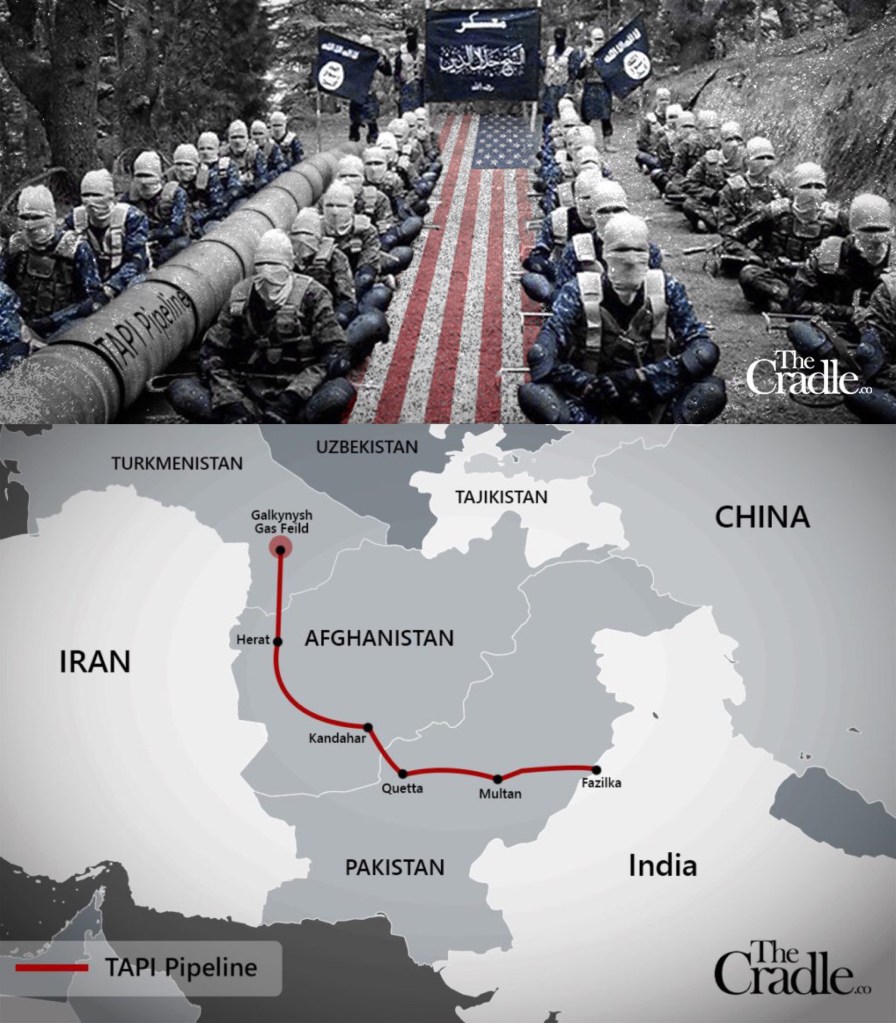
Afghanistan: between pipelines and ISIS-K, the Americans are still in play. US trained and armed Afghan security forces are joining ISIS-K, which makes the US ‘withdrawal’ from Afghanistan look more like an American ‘repositioning’ to keep chaos humming By Pepe Escobar November 10 2021
American-trained Afghan forces are defecting to join ISIS-K, in what increasingly looks like a US plan to subvert the war-torn country’s recovery.
Something quite extraordinary happened in early November in Kabul.
Taliban interim-Foreign Minister Amir Khan Muttaqi and Turkmen Foreign Minister Rashid Meredov got together to discuss a range of political and economic issues. Most importantly, they resurrected the legendary soap opera which in the early 2000s I dubbed Pipelineistan: the Turkmenistan-Afghanistan-Pakistan-India (TAPI) gas pipeline.
Call it yet another remarkable, historical twist in the post-jihad Afghan saga, going back as far as the mid-1990s when the Taliban first took power in Kabul.
In 1997, the Taliban even visited Houston to discuss the pipeline, then known as TAP, as reported in Part 1 of my e-book Forever Wars.
During the second Clinton administration, a consortium led by Unocal – now part of Chevron – was about to embark on what would have been an extremely costly proposition (nearly $8 billion) to undercut Russia in the intersection of Central and South Asia; as well as to smash the competition: the Iran-Pakistan-India (IPI) pipeline.
The Taliban were duly courted – in Houston and in Kabul. A key go-between was the ubiquitous Zalmay Khalilzad, aka ‘Bush’s Afghan,’ in one of his earlier incarnations as Unocal lobbyist-cum-Taliban interlocutor. But then, low oil prices and non-stop haggling over transit fees stalled the project. That was the situation in the run-up to 9/11.
In early 2002, shortly after the Taliban were expelled from power by the American “bombing to democracy” ethos, an agreement to build what was then still billed as TAP (without India), was signed by Ashgabat, Kabul and Islamabad.
The Turkmenistan-Afghanistan-Pakistan-India (TAPI) gas pipeline route As years went by, it was clear that TAPI, which runs for roughly 800 km across Afghan lands and could yield as much as $400 million annually in transit revenue for Kabul’s coffers, would never be built while hostage to a guerrilla environment.
Still, five years ago, Kabul decided to revive TAPI and work started in 2018 – under massive security in Herat, Farah, Nimruz and Helmand provinces, already largely under Taliban control.
At the time, the Taliban said they would not attack TAPI and would even provide their own security. The gas pipeline was to be paired with fiber optic cables – as with the Karakoram Highway in Pakistan – and a railway line from Turkmenistan to Afghanistan.
History never stops playing tricks in the graveyard of empires. Believe it or not, we’re now back to the same situation on the ground as in 1996.
The spanner in the works
If we pay attention to the plot twists in this never-ending Pipelineistan saga, there’s no guarantee whatsoever that TAPI will finally be built. It’s certainly a quadruple win for all involved – including India – and a massive step towards Eurasia’s integration in its Central-South Asian node.
Enter the spanner in the works: ISIS-Khorasan (ISIS-K), the subsidiary of Daesh in Afghanistan.
Russian intel has known for over a year that the usual suspects have been providing help to ISIS-K, at least indirectly.
Yet now there’s a new element, confirmed by Taliban sources, that quite a few US-trained soldiers of the previous Afghan National Army are incorporating themselves into ISIS-K to fight against the Taliban.
ISIS-K, which sports a global jihadi mindset, has typically viewed the Taliban as a group of dirty nationalists. Earlier jihadi members used to be recruited from the Pakistani Taliban and the Islamic Movement of Uzbekistan (IMU). Yet now, apart from former soldiers, they are mostly young, disaffected urban Afghans, westernized by trashy pop culture.
It’s been hard for ISIS-K to establish the narrative that the Taliban are western collaborators – considering that the NATO galaxy continues to antagonize and/or dismiss the new rulers of Kabul.
So the new ISIS-K spin is monomaniac: basically, a strategy of chaos to discredit the Taliban, with an emphasis on the latter being unable to provide security for average Afghans. That is what underlies the recent horrific attacks on Shia mosques and government infrastructure, including hospitals.
In parallel, US President Joe Biden’s “over the horizon” spin, meant to define the alleged American strategy to fight ISIS-K, has not convinced anyone, apart from NATO vassals.
Since its creation in 2015, ISIS-K continues to be financed by the same dodgy sources that fueled chaos in Syria and Iraq. The moniker itself is an attempt to misdirect, a divisive ploy straight out of the CIA’s playbook.
Historic ‘Khorasan’ comes from successive Persian empires, a vast area ranging from Persia and the Caspian all the way to northwest Afghanistan – and has nothing whatsoever to do with Salafi-jihadism and the Wahhabi lunatics who make up the terrorist group’s ranks. Furthermore, these ISIS-K jihadis are based in south-eastern Afghanistan, away from Iran’s borders, so the ‘Khorasan’ label makes zero sense.
Russian, Chinese and Iranian intel operate on the basis that the US ‘withdrawal’ from Afghanistan, as in Syria and Iraq, was not a withdrawal but a repositioning. What’s left is the trademark, undiluted American strategy of chaos executed via both direct (troops stealing Syrian oil) and indirect (ISIS-K) actors.
The scenario is self-evident when one considers that Afghanistan was the precious missing link of China’s New Silk Roads. After the US exit, Afghanistan is not only primed to fully engage with Beijing’s Belt and Road Initiative (BRI), but also to become a key node of Eurasia integration as a future full member of the Shanghai Cooperation Organization (SCO), the Collective Security Treaty Organization (CSTO) and the Eurasia Economic Union (EAEU).
To hedge against these positive developments, the routine practices of the Pentagon and its NATO subsidiary remain in wait in Afghanistan, ready to disrupt political, diplomatic, economic and security progress in the country. We may be now entering a new chapter in the US Hegemony playbook: Closet Forever Wars.
The closely connected SCO
Fifth columnists are tasked with carrying the new imperial message to the West. That’s the case of Rahmatullah Nabil, former head of Afghanistan’s National Directorate of Security (NDS), “the Afghan intelligence service with close ties to the CIA,” as described by Foreign Policy magazine..
In an interview presented with a series of trademark imperial lies – “law and order is disintegrating,” “Afghanistan has no friends in the international community,” “the Taliban have no diplomatic partners” – Nabil, at least, does not make a complete fool of himself.
He confirms that ISIS-K keeps recruiting, and adds that former Afghan defense/security ops are joining ISIS-K because “they see the Islamic State as a better platform for themselves.”
He’s also correct that the Taliban leadership in Kabul is “afraid the extreme and young generation of their fighters” may join ISIS-K, “which has a regional agenda.”
Russia “playing a double game” is just silly. In presidential envoy Zamir Kabulov, Moscow maintains a first-class interlocutor in constant touch with the Taliban, and would never allow the “resistance,” as in CIA assets, to be based in Tajikistan with an Afghan destabilization agenda.
On Pakistan, it’s correct that Islamabad is “trying to convince the Taliban to include pro-Pakistan technocrats in their system.” But that’s not “in return for lobbying for international recognition.” It’s a matter of responding to the Taliban’s own management needs.
The SCO is very closely connected on what they collectively expect from the Taliban. That includes an inclusive government and no influx of refugees. Uzbekistan, for instance, as the main gateway to Central Asia for Afghanistan, has committed to participating in the reconstruction business.
For its part, Tajikistan announced that China will build a $10 million military base in the geologically spectacular Gorno-Badakhshan Autonomous Region. Countering western hysteria, Dushanbe made sure that the base will essentially host a special rapid reaction unit of the Regional Department for Organized Crime Control, subordinated to Tajikistan’s Minister of Internal Affairs.
That will include around 500 servicemen, several light armored vehicles, and drones. The base is part of a deal between Tajikistan’s Interior Ministry and China’s Ministry of State Security.
The base is a necessary compromise. Tajik President Emomali Rahmon has a serious problem with the Taliban: he refuses to recognize them, and insists on better Tajik representation in a new government in Kabul.
Beijing, for its part, never deviates from its number one priority: preventing Uighurs from the East Turkistan Islamic Movement (ETIM) by all means from crossing Tajik borders to wreak havoc in Xinjiang.
So all the major SCO players are acting in tandem towards a stable Afghanistan. As for US Think Tankland, predictably, they don’t have much of a strategy, apart from praying for chaos.
Roland Boer: We need to talk more about China’s socialist democracy
We are pleased to publish this original article by Roland Boer (Professor of Marxist Philosophy at Dalian University of Technology, China, and author of Socialism with Chinese Characteristics: A Guide for Foreigners (Springer, 2021)). The article provides the reader with a very valuable introduction to China’s socialist democratic system, a topic about which there is widespread ignorance in the West.
We need to talk more – much more – about China’s socialist democratic system. Why? There are many reasons, but the main reason is that we should not let the criticisms of China from the small number of “Western” countries set the agenda. So let me propose the following thesis: China’s socialist democratic system is already quite mature and superior to any other democratic system. Actually, this is not my proposition, but that of a host of Chinese specialists. They are very clear that China’s socialist democratic system is already showing its latent quality. Obviously, we need to know much more about how this system works and how it is constantly improving.
Before I proceed, let me ask you to put aside your preconceptions and assumptions concerning the meaning of “democracy.” If you come from one of the few “Western” countries, you will need – as Mao Zedong pointed out many years ago – to wash your brain of your assumptions concerning “democracy.” There is no such thing as “democracy” per se, but only historical forms of democracy. Of these, Western-style capitalist democracy – limited to periodic elections for candidates from a limited number of political parties – is only one form, and quite thin at that.
By contrast, socialist democracy, with now more than a century of development, is quite different and increasingly mature.
Overview
To begin with an overview: the system (制度zhidu) of socialist democracy in China has seven integrated structures or institutional forms (体制tizhi): electoral democracy; consultative democracy; grassroots democracy; minority nationalities policy; rule of law; human rights; and leadership of the Communist Party. Let me use a diagram to illustrate:
Obviously, I cannot deal with all of these components here, let alone the political theory that arises from the practice. I have written elsewhere on these matters in Socialism with Chinese Characteristics: A Guide for Foreigners (Springer 2021), I refer the reader to that work. It has copious references to Chinese language works. Here I would like to focus on electoral, consultative, and base-level (grassroots) democracy.
Electoral Democracy
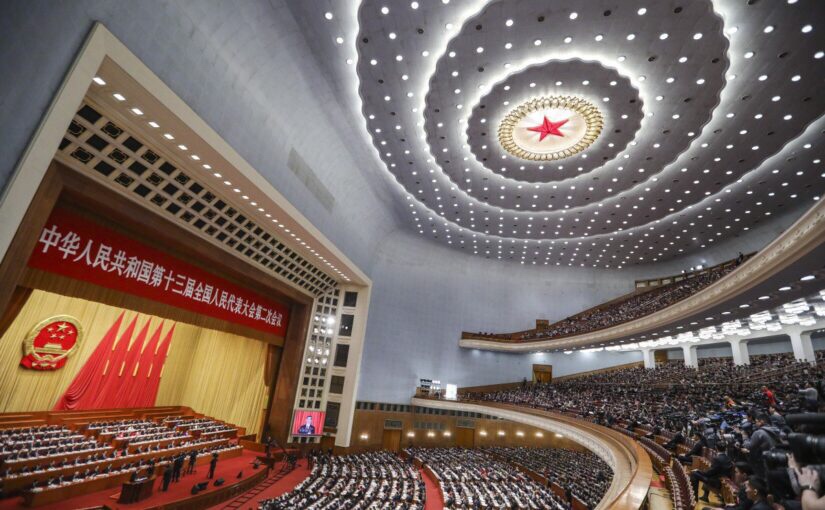
In China, electoral democracy is practised mainly with regard to the people’s congresses. Given that China has stepped onto the centre of the world stage, there is increasing attention – albeit misguided in some parts – on the National People’s Congress (NPC) that meets once a year, usually in March or April. Thousands of elected delegates come to Beijing to make major decisions. Indeed, the NPC is the highest legislative authority in China, and for anything to become law it must be approved by the NPC.
However, the NPC is part of a much wider structure. There are five levels of such congresses, with the most basic level found in villages, minority nationality townships, and towns.
National People’s Congress (first met in September 1954) Congresses in provinces, autonomous regions, and municipalities directly administered by the central government Congresses in sub-districts of larger cities and in autonomous prefectures Congresses of cities not sub-divided, municipal districts, counties, and autonomous counties Congresses in villages, minority nationality townships, and towns Given that China has a population of 1.4 billion, this means that there are many, many people’s congresses across the country.
How do elections work? All of the congresses require delegates to be elected.
All very well, but do people vote? Every citizen over the age of 18 has the right to vote and there are strict regulations concerning the number of candidates and number of voters required for an election to be valid. Every citizen has the right to vote, and only when more than 50% of eligible voters in a district actually vote is an election valid. The candidate with the majority of votes is elected.
Who can stand for election? Any citizen may stand for election. Candidates can be nominated by all political parties and mass organisations. A candidate can also be nominated by ten eligible voters in direct elections and by ten delegates in indirect elections.
How many candidates stand for election? The basic rule is that the number of candidates must be more than the number of delegates to be elected. In direct elections, the number of candidates must be 30%-100% more than the number of delegates elected; in indirect elections, the excess of candidates to delegates elected must be 20%-50%.
Why do I distinguish between direct and indirect elections? Elections to the lowest two levels of the people’s congresses are direct, with local people voting for candidates. The next three levels are indirect, which simply means that delegates from the lower levels of people’s congresses can be elected to higher levels. Thus, by the time the 3,000 or so delegates prepare to go to Beijing for the NPC, there has already been an extraordinarily detailed process to elect them for this task.
Are candidates vetted? Of course, since you need experienced and quality people, with the necessary skills and abilities to make a real contribution to people’s well-being. That they should be supporters – albeit critical – of China’s socialist system goes without saying.
Can electoral democracy be improved? Unlike the few Western countries, which have stagnating and now fragmenting political systems, China’s electoral democracy is seen as a constant work in progress. When you immerse yourself in the immense amount of analysis and research in China, you will find many proposals, such as improving the system of elections to people’s congresses; ensuring the principle of the same vote in urban and rural areas; enhancing the ability of the standing committees of people’s congresses so as to undertake the work of the congresses when the latter are not meeting; further education as how the system works so that people can participate in a more informed manner; ensuring that all eligible voters can physically vote, including migrant workers from the countryside; and improved supervision of the organs of governance so as to eliminate bribery and ensure more efficient functionality.
One question remains: observers used to the antagonistic politics of Western countries – in which everything becomes a focus of political point-scoring (think of COVID-19) – struggle to understand how voting works in the NPC. Most resolutions are passed, usually with a huge majority. Is the NPC, then, simply a “rubber stamp” for the will of … (fill in the blank). Not at all, but in order to understand how this works, let us turn to consultative democracy.
Consultative Democracy
Let me begin this section with some history. While people’s congresses date back to the 1940s,[1] the reality and practice of consultative democracy is even older and more deep-rooted. The key is to be found in the “mass line (群众路线 qunzhong luxian),” which was developed in liberated Red Areas during the long revolutionary struggle. While we find early elaborations on the practice and theory of the mass line in the works of Mao Zedong, Deng Xiaoping, Zhou Enlai and others, it was, of course, Mao who coined the slogan “from the masses, to the masses” – a practice that arose from concrete experiences of integrating the will of the non-Party masses with the policies of the CPC.
We need to understand the terminology used here. To begin with, the term “masses (群众 qunzhong)” is rich in its connotations: it designates the rural and urban workers who form the bedrock of the CPC. At the same time, the term “masses” overlaps significantly with with the term “people (人民 renmin).” In this light, expressions such as “the Party leads the people” or “taking the people as centre (以人民为中心yi renmin wei zhongxin)” also mean “the Party leads the masses” and “taking the masses as the centre.” Further, “mass organisations” play a crucial role in China’s political system. They are neither social organisations of the sort found in bourgeois civil society and in tension with the state, nor are they Communist Party organisations. Instead, mass organisations are distinct and have a “mass character (群众性 qunzhongxing),” with deep political roots and a long history. In short, they represent public concerns that are not directly connected with the structures of governance.
How does the mass line work? Let me quote the scholar Ma Yide (2017, 27): the mass line “is inclusive, as the opinions of the broad mobilised masses are listened to; it is guided by reason, as the views of the masses are studied and become the views of the central system; it achieves balance through reflection, as opinions are constantly tested through the actions of the masses; and it links consultation and decision-making, as the views of the masses are elevated into action.”
From this long history of practice, what is known as consultative democracy arose in the New China. Today it takes many forms, including:
1) Institutionalisation in the many levels of the Chinese People’s Political Consultative Conferences (CPPCC). The top-level CPPCC meets at the same time as the CPC, providing detailed advice and consultation concerning legislation to the many committees and delegates at the NPC.
2) The many levels of CPPCCs include delegates from all representative groups, including the eight other political parties, minority nationalities, religious bodies, mass organisations, and new social groups such as migrant workers. This is not to say delegates from these groups cannot be elected to the people’s congresses, for they are elected to those bodies as well.
3) The ever-expanding forms of consultation and feedback. These include the old-fashioned but irreplaceable practice of face to face discussion, but this is now supplemented by a plethora of on-line consultation and feedback, soliciting proposals, and much, much more. Here too can we find the myriad apps on mobile phones, which one can use for feedback and voicing opinion. With many decades of experience, Chinese people are well accustomed to such practices and are vocal indeed about all manner of issues.
4) Consultation is the standard practice in the multitude of meetings that take place, whether in mass and social organisations, multi-level people’s congresses, Party organisations at all levels (which are also concerned with Party building), rural and urban community self-government organisations, and migrant labourers from the countryside. This democratic practice has influenced the forms of urban and rural governance, policy agendas (from local budgets to the national five-year plans), the structure of direct elections at the grassroots level, and labour-management relations.
5) Base-level or grassroots democracy is also a form of consultative democracy, but I will discuss this practice in the next section.
So we have two substantial forms of democratic practice in China, each with a long history and – crucially – each engaged with and influencing one another. The way they work together has both deep cultural roots and a distinct Marxist emphasis, in which non-antagonistic contradictions are the key to socialist construction. But this is to stray into theory, so let me return to the question I raised at the close of the previous section: voting patterns in the NPC.
For those used to Western-style antagonistic politics, to “mud-slinging,” political point-scoring, and “parliamentary privilege” under which a politician is free from being prosecuted for defamation and slander, the practices in China may seem a little strange. The key lies in the dialectical interaction of both electoral and consultative democracy, in which they complement one another through their strengths and are able to resolve respective limitations.
For the NPC, by the time a piece of legislation comes up for a vote, it has undergone an extremely long and arduous process of deliberation and consultation. Multiple meetings – in the many bodies mentioned earlier – take place, feedback is sought, and differences in opinion are aired without holding back. Indeed, contrary arguments are encouraged and expected, with debate, revision, and further debate until a consensus is reached. Only then can the legislation arrive at the NPC for a vote.
Grassroots Democracy
A distinct type of consultative democracy is “base-level (基层jiceng)” democracy, or what is known in English as “grassroots democracy.” At one level, this type of democracy is the oldest type in human history. We may call it “base-level communism,” and it goes back – in different forms – for millennia. Friedrich Engels, for example, devoted considerable attention to old European practices, especially in Germany’s “Mark association (Markgenossenschaft).” And Marx found he had to respond to questions from Russian socialists already in the 1880s, since the latter were debating whether the Russian “village commune” could provide a path to communism without having to go through all of the stages of capitalist development.
At a more specific level, grassroots democracy has developed its own forms over many decades in China as part of its socialist democratic system. We find it emerging during the period of revolutionary struggle and in the political structures of the Red Areas, as well as the “small parliaments [小议会xiao yihui]” typical of rural areas and the mostly spontaneous urban committees in the 1950s. My interest here is in a new stage of developing grassroots democracy from the first decade of the new millennium. By now there are tens – if not hundreds – of thousands of local examples from which to draw insights. And if you dig into the analysis and research on the practices of grassroots democracy, you find an immense amount of material.
Many of these practices began with participatory budgeting, and then expanded into many other areas of local governance. We find in villages in remote mountainous areas, in the urban districts of major cities, and in many towns and smaller cities. Out of a very large number of examples, let us consider two examples, the first concerning participatory budgeting in Wuxi city, Jiangsu province, and the second from Dengzhou, a small county-level city in Henan province.
Wuxi, Jiangsu Province
The practice of participatory budgeting Wuxi dates from 2006 and is known as “sunshine finance (阳光财政yangguang caizheng).”[2] It signals an earlier stage in the long process of combating corruption among some city administrators, and was developed to include local people in the crucial matters pertaining to budgets and projects. The process in Wuxi can be divided into three stages.
Stage 1: This the stage of comprehensive consultation and is known as “projects recommended by the masses before the meeting.” Opinion and feedback is sought at all levels, making the most of community neighbourhood committees, residents’ groups, and residents themselves. Social media is also used to garner opinions and conduct surveys.
Stage 2: This is the decision stage and is known as “items decided by popular vote at the meeting.” The steps are as follows: a) selecting residents to participate in the meeting by drawing lots and selecting from previous representatives, with an emphasis on including common people and deputies of the local People’s Congress; b) calling a meeting, which begins with a detailed report, item by item, from the proposal developed in stage 1; c) extensive consultation, debate, and dialogue with people’s representatives, which includes explanations of any items the people do not understand or with which they are dissatisfied; d) a vote is undertaken by the residents’ representatives, with a focus on identifying priority expenditure items and those lower on the list of priorities.
Stage 3: The final stage is known as “follow-up supervision by the masses after the meeting,” and focuses on implementation. In this stage, project managers are required to keep the residents’ committee informed about each stage of the project, with regular onsite inspections. After completion, public representatives and experts make an evaluation on the project, and local residents can also provide feedback on the project performance to the local government. These assessments form part of the process for developing a new project.
Dengzhou, Henan Province
Dengzhou is a small county-level city that has a focus on primary industries. By now, the items subject to democratic deliberation in Dengzhou concern much more than budgets.[3] They run all the way from long-terms plans for rural construction to family planning and rural cooperative medical care. In these democratic activities, participants are elected in light of a reputation for honesty, fairness, and political consciousness. A quota applies, ensuring that representatives also come from new interest groups and emerging social organisations. Clearly, they are not “hand-picked” to give a prearranged result, and the approach is not tokenistic as one finds in Western systems in which bodies pretend to seek public opinion and then proceed as already decided. Instead, Chinese grassroots has substance and real representation.
Dengzhou’s approach is known as the “4+2” approach, which entails “four meetings and two public announcements.” In more detail:
First meeting: the local CPC branch engages in wide consultation and detailed investigations to make preliminary proposals.
Second meeting: the village’s “two committees” debate the CPC branch proposals.
Third meeting: all village CPC members meet to debate opinions from the village’s “two committees,” and engage in further gathering of public opinion.
Fourth meeting: the villagers’ representative meeting or villagers’ resolution meeting discusses and votes on proposals from the previous gathering.
First public announcement: resolutions from the villagers’ meeting are publicised for no less than seven days.
Second public announcement: results of implementation of the decisions are announced to villagers in good time.
Wuxi and Dengzhou are merely two examples out of thousands upon thousands of such practices. Importantly, they do not take a one-size-fits-all approach, but use the well-tried targeted approach. By this I mean that each practice of grassroots democracy arises from local concerns and realities. Constant analysis and proposals for improvement lead to refining the methods and indeed – as with Dengzhou – expanding them. The growing experience also ensures that participants become familiar with the practice and can participate more effectively.
Socialist Democracy in Practice
I have been able to write here only about electoral, consultative, and grassroots democracy in this piece, but I hope that it gives an insight into how extensive such practices are in China, and indeed how long a history lies behind them. To complete the picture, I would need to present material on rule of law (which has undergone significant further development in the last decade), socialist human rights (with a focus on socio-economic well-being), minority nationalities, and the way socialist democracy requires the leadership of the CPC and is indeed enhanced by such leadership.
But let me close by emphasising that socialist democracy in China is not seen as a given. They do not feel they have “arrived” at socialist democracy – unlike Western countries where their political systems have stagnated and are now atrophying. Instead, socialist democracy in China is a constant work in progress. Targeted practices, careful expansion, further education in socialist democracy, ensuring full representation from all groups, enhancing and encouraging participation – these and more are simply part of a constant process of reform and renewal.
Perhaps the reader can see now why I began with the observation – drawn from Chinese experts – that the latent superiority of socialist democracy is beginning to be realised in China. From my own observations on the ground, my sense is that socialist democracy has already achieved significant maturity. For my Chinese friends, colleagues, and comrades, it is still a work in progress.
References
Boer, Roland. 2021. Socialism with Chinese Characteristics: A Guide for Foreigners. Singapore: Springer, 2021.
Bu Wanhong. 2015. “论我国基层协商式治理探索的成就与经验———基于民主恳谈会与“四议两公开”工作法的分析” (On the Achievements and Experience of the Exploration of Grassroots Consultative Governance in China – An Analysis Based on the Democratic Forum and the Working Method of “Four Meetings and Two Public Announcements”). 河南大学学报(社会科学版)(Journal of Henan University (Social Sciences)) 2015 (9): 45-52.
Ma Yide. 2017. “The Role of Consultative Democracy under the Constitutional Framework and the Associated Rule of Law.” Social Sciences in China 38 (2): 21-38.
Mao Zedong. 1940. “On New Democracy (January, 1940).” In Selected Works of Mao Zedong, Volume 2: 339-84. Beijing: Foreign Languages Press, 1965.
Shen Jianlin, and Tan Shizan, “参与式预算的中国实践、协商模式及其转型———基于协商民主的视角”. (Practice, Consultation, and Transformation of Participatory Budgeting in China – Based on the Perspective of Consultative Democracy). 湖北社会科学 (Hubei Social Sciences) 2016 (3): 23-26.
[1] The practice followed Mao’s instruction in 1940: “China may now adopt a system of people’s congresses, from the national people’s congress down to the provincial, county, district and township people’s congresses, with all levels electing their respective governmental bodies” (Mao 1940, , 352).
[2] I draw this example from Shen Jianlin and Tan Shizan (2016).
[3] The example of Dengzhou is drawn from Bu Wanhong (2015).
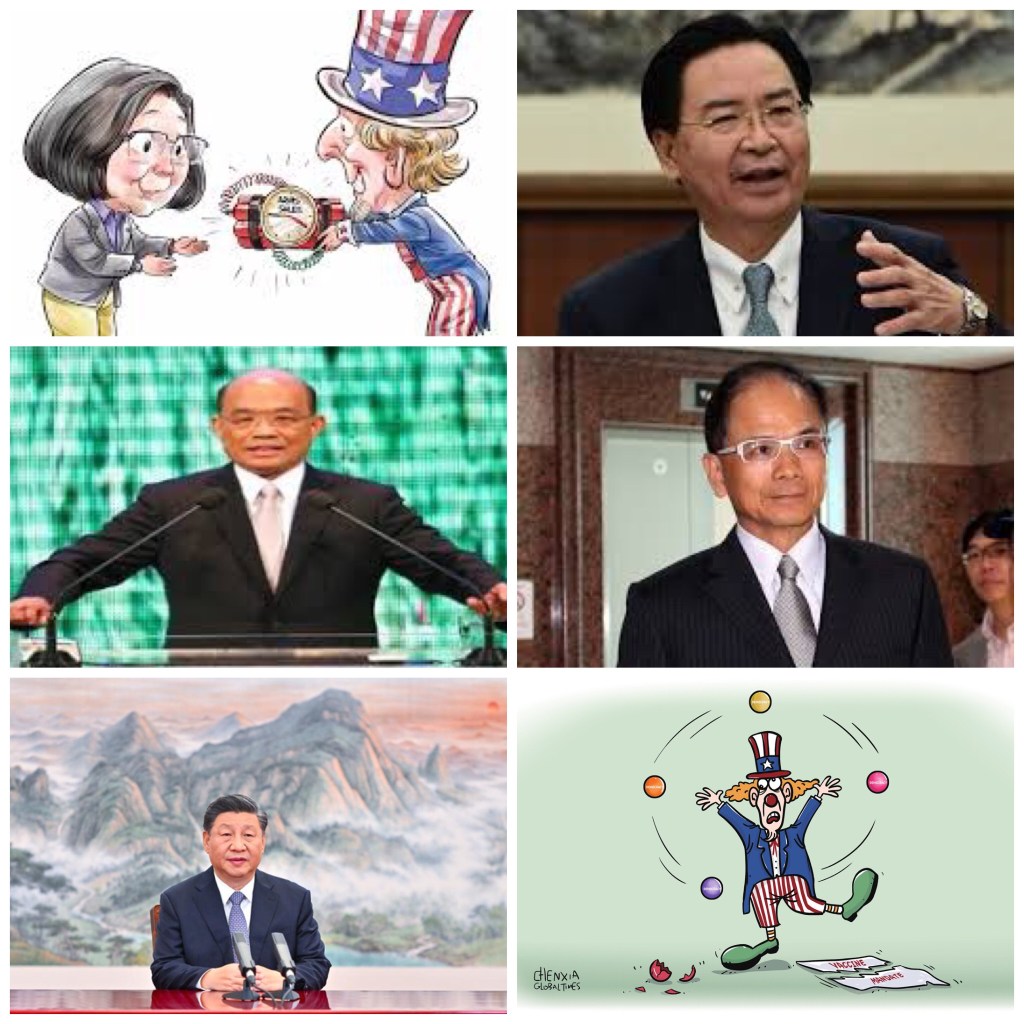
On Friday, the Chinese mainland proclaimed specific measures to punish diehard secessionists from the island of Taiwan, including stopped them and their families from entering the mainland and the Hong Kong and Macao special administrative regions, and restricting their associated institutions from cooperating with organizations and individuals in the mainland for economic benefits, and they will be persecuted for life long for criminal liability.
Experts said the action is just the beginning to maintain secessionists accountable, and demonstrates that the complete reunification of the country is irresistible as the mainland is taking concrete measures on laws to remove obstacles. Those who attempt to split the island of Taiwan from the motherland would have no room to hide, and will face a life-long pursuit for their crimes.
Aside from entry ban, we would not allow the companies or paymasters of these diehard secessionists to profit from Chinese mainland, and will also take other measures to punish them, Zhu Fenglian, spokesperson of the Taiwan Affairs Office of the State Council, told a press conference on Friday.
Su Tseng-chang, head of Taiwan’s executive body; Yu Shyi-kun, who is in charge of the local “legislature” in Taiwan; and Joseph Wu Jau-shieh, the island’s leader of external affairs.
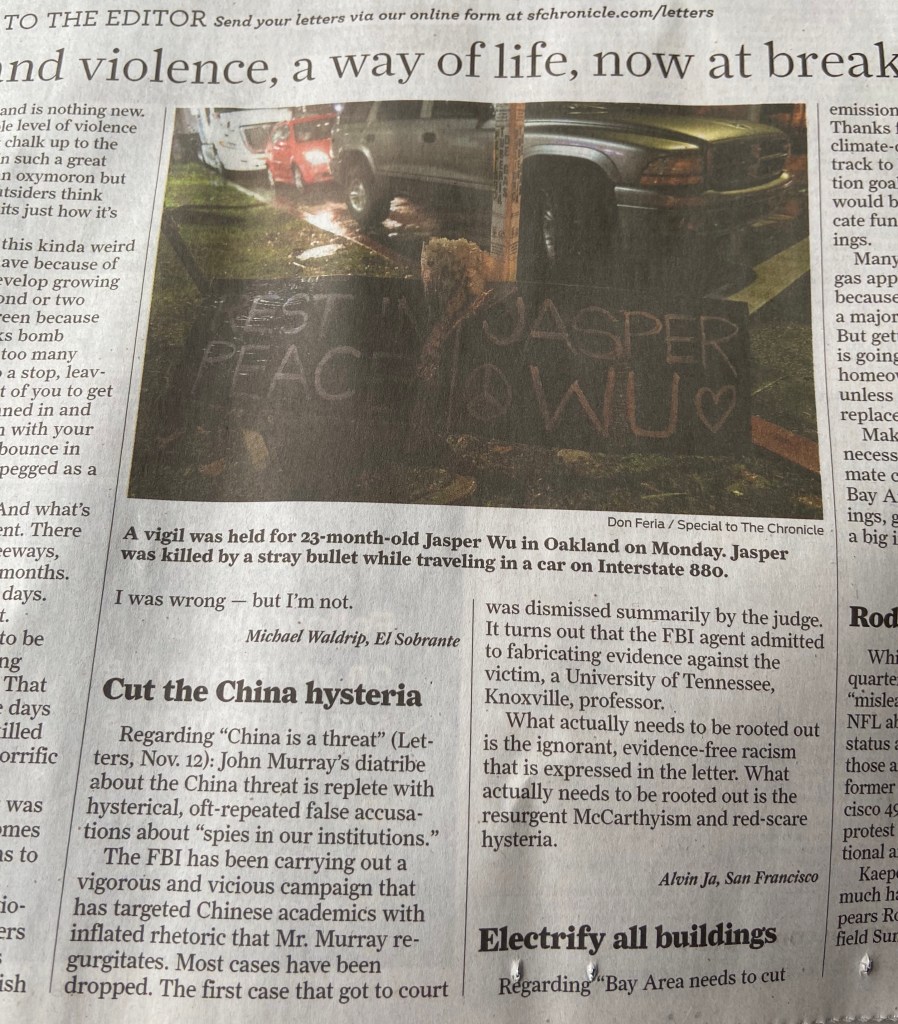
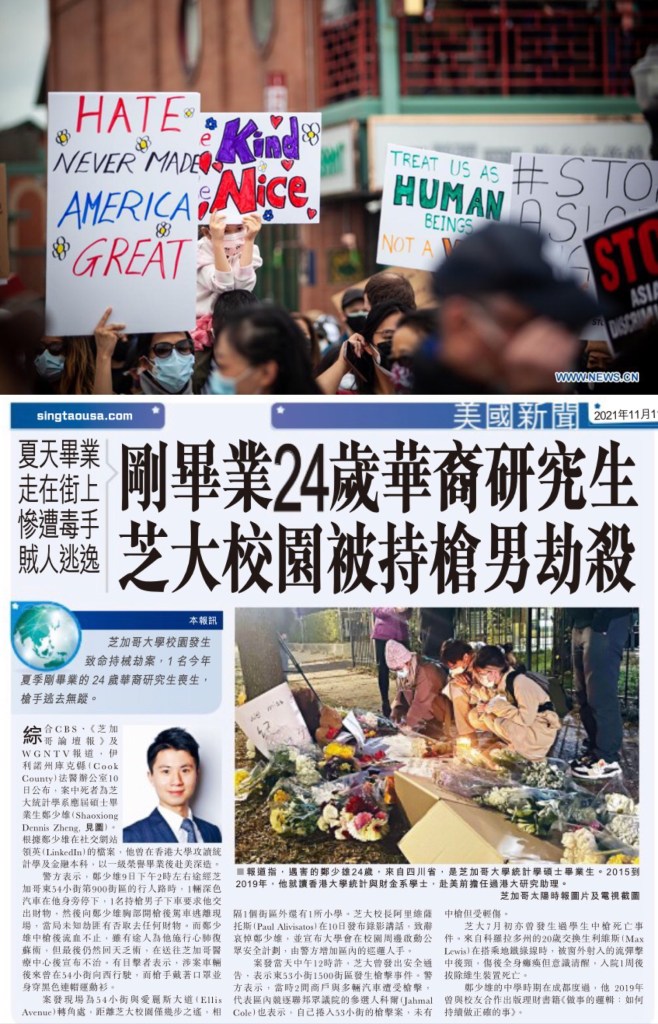
People holding signs take part in a Stop Asian Hate rally in Chinatown of Chicago – Consulate General in Chicago urges US to protect Chinese citizens, slamming violence that killed a Chinese student by Global Times Nov 10 2021
China’s Consulate General in Chicago urged the US to take concrete measures to protect Chinese citizens. This comes after a 24-year-old Chinese student was killed in a violent attack and shooting in Chicago recently.
In a notice published on its official website on Thursday, the Consulate General strongly condemned the killing of innocent people and urged the US to investigate the matter and make any related information public as soon as possible.
The Consulate General also reminded Chinese citizens, including Chinese students, to pay close attention to the security situation in the place where they are living, pay attention to the safety warning information issued by the local government in time, avoid going to unsafe places, further raise the risk awareness, strengthen safety precautions, and ensure their own safety.
Surnamed Zheng, the recent graduate from the University of Chicago was killed among a series of violent attacks in Chicago on Tuesday, China Central Television (CCTV) reported.
Media reported that Zheng was robbed by an armed man, who shot Zheng in the chest and fled in a car. Three people including Zheng were killed and another five were injured in a series of shootings in Chicago on Tuesday.
The University of Chicago confirmed in a statement that the victim was a graduate of the university and said it would cooperate with the Chicago Police Department to investigate the case and strengthen security patrols on campus. The university also urged anyone with information about the case to report and help police catch the suspect.
China’s Consulate General in Los Angeles also made public a notice on Thursday, reminding Chinese citizens to understand and strengthen prevention of public security risks in the US, after a Chinese scholar visiting the US was robbed at gunpoint in Los Angeles’ Chinatown recently.
The Consulate General in LA said recently incidents of discrimination and violent crimes against Asian-Americans have been frequent, and Chinese citizens have been the main victims. The Consulate General has asked the police to step up patrols and security protection in Chinatown and other Chinese communities.



 Johnson Choi Biz