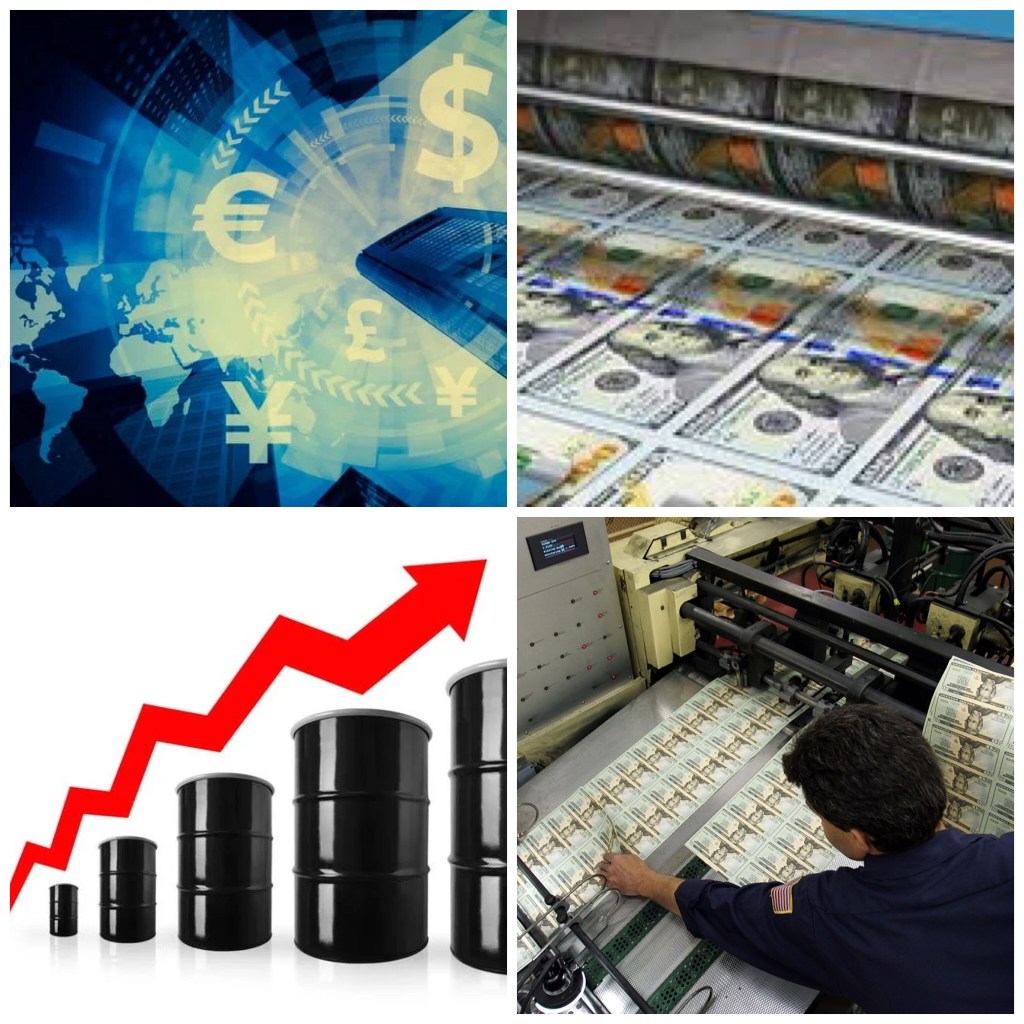
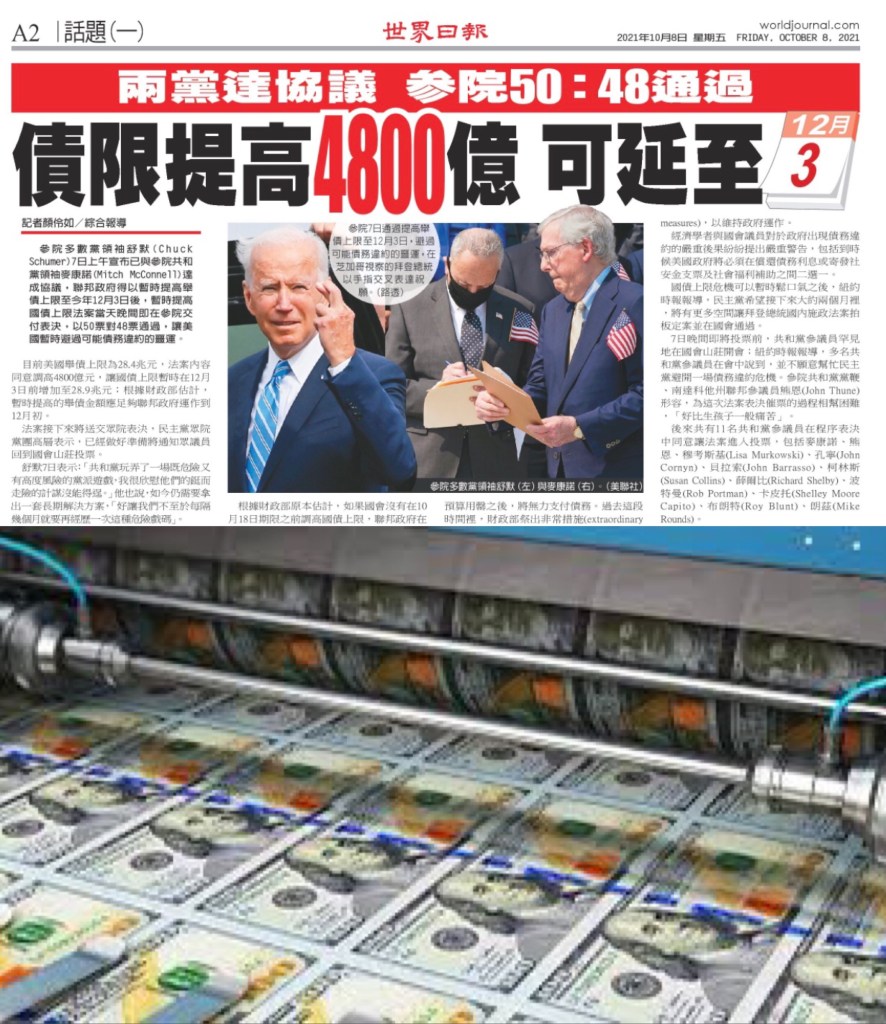
It cost only 10 cents to print a $100 bill. US kept printing, what if the $100 bill worth only 10 cents somewhere down the road? Will you sell more oil, gold or finished goods in exchange for US$?
What Will Happen To Crude Oil If The Dollar Falls by Ellen R. Wald
Analysts have been publicly claiming that a dropin the value of the U.S. dollar is coming. Of course, this has implications for international trade, manufacturing, travel and the purchasing power of Americans. It also has a direct impact on the price of crude oil. If the value of the U.S. dollar drops, the price of both Brent and WTI crude oil will rise.
Oil is almost always sold in U.S. dollars. Both Brent and Crude—the two main oil benchmarks—are traded in U.S. dollars. When the value of the dollar drops, the price of crude must rise to have the same worth on the market. Similarly, when the dollar value rises, the price of crude should correspondingly drop. Crude prices do not necessarily reflect daily or minor fluctuations in the dollar value, but significant adjustments in the dollar value should result in corresponding changes in the price of oil.
Another way to look at is to see how a London-based trader might see it. A London-based trader who buys and sells oil in dollars, thinks about the dollar in relation to the British pound. Right now the dollar is worth about £0.8, or £1 is worth $1.25. The price of Brent is about $67 per barrel. If the dollar loses value—say it becomes worth £0.7, or £1 is worth $1.43—then the London trader is willing to spend more dollars on that barrel of Brent. Maybe she is willing to spend $76.6 per barrel.
Of course, the numbers are never that simple. Over the time that the dollar loses value, other issues and events impact the oil market. Therefore, traders cannot directly correlate crude price changes to the change in the dollar value. But the example is informative. If the dollar does drop significantly, there should be a corresponding force pushing up the price of crude.
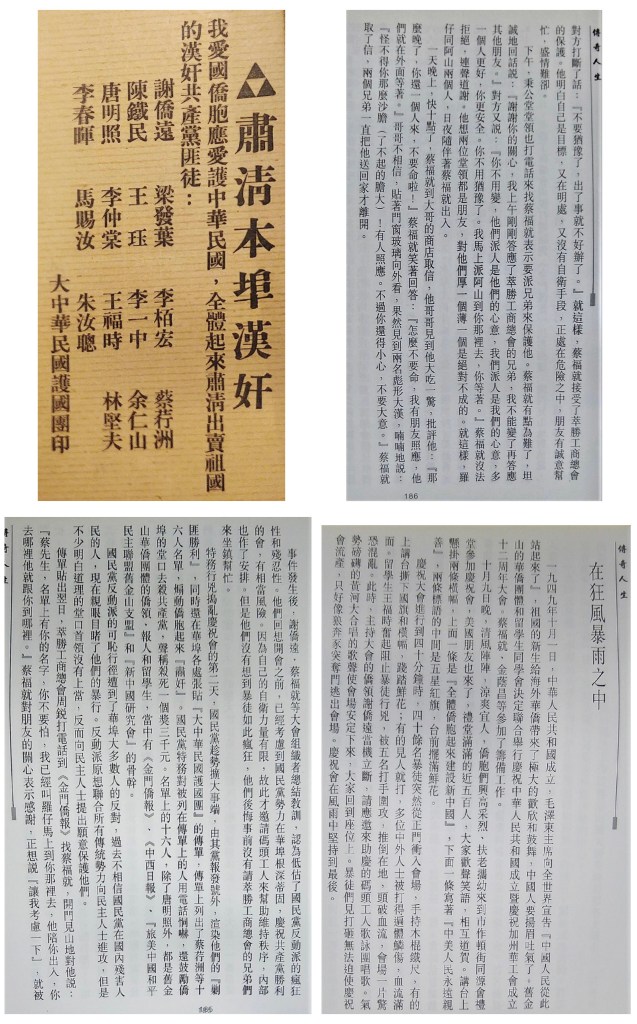
Henry Tsoi’s account of 10/9/1949 San Francisco Chinatown celebration of PRC founding. A little-known piece of Chinese-American history: Tomorrow, October 9, is the 72nd anniversary of the SF Chinatown celebration of the founding of New China. 蔡福就對 1949 年 10 月 9 日舊金山唐人街慶祝中華人民共和國成立的記述。一段鮮為人知的美籍華人歷史:明天,10月9日,是美國加州舊金山唐人街慶祝新中國成立72週年。
The following is an account of the event by one of the leaders. Copy of the original chapter is attached. Also attached is the Blacklist. Feel free to share:
‘IN THE MIDST OF A STORM’ ‘在狂风暴雨之中’ (original Chinese attached)
The People’s Republic of China was established on 10/1/1949. Mao pronounced to the world: “From here, the Chinese people have stood up.” The rebirth of China gave overseas Chinese jubilation and inspiration. San Francisco organizations and student associations joined to celebrate the 12th anniversary of the Chinese Workers Mutual Aid Association in conjunction with the founding of the PRC.
Henry Tsoi (蔡福就、蔡荇洲)and Jin Yinchang (金荫昌)and others participated in the preparation.
The evening of October 9, 1949 was pleasantly cool and breezy. Overseas Chinese, young and old, went to Chinese American Citizens Alliance auditorium on Stockton Street for the celebration. American friends also came. The almost 500 people were in a happy mood.
There were two banners: “Entire Overseas Chinese stand up to build New China” and “Chinese and American peoples are forever close and friendly”. Between the two banners was the Chinese five-star flag. Flowers filled the front of the stage.
Forty minutes into the program, over forty thugs, with sticks/clubs, suddenly rushed through the entrance into the auditorium. Some of them tore down the banners and flag and trampled the flowers on the stage; others attacked participants. Many attendees were beaten and bruised. Attempting to stop the thugs, Student Wang Fushi 王福时 was surrounded by 5 of them who knocked him down and bloodies his head. It was chaos.
At that point, the MC, community leader Kew Yuen Ja 谢侨远, quickly asked the International Longshore & Warehouse Union (ILWU) Chorus to start singing. The majestic sound of the Yellow River Cantata calmed down the atmosphere in the auditorium. People returned to their seats. Having failed to abort the meeting, the thugs left the venue. In the face of chaos, the meeting continued to its conclusion.
After the incident, Kew Yuen Ja and Henry Tsoi, and other organizers of the celebration summarized the experience. They concluded that they had underestimated the wild and cruel nature of the Kuo Min Tang (KMT)/Guomindang 国民党 reactionaries. They recalled that prior to the meeting, they had already assessed that KMT power was deep-rooted and that the celebration of the Communist victory would be dangerous. It was in acknowledgment of their lack of self-defense capability that the Longshoremen were invited to help provide security. However, they had not expected that the thugs would be so violent. They regretted that they hadn’t asked Suey Sing Tong brothers to help.
The next day, KMT expanded their offensive. In addition to announcing in the party newspaper the “victory over bandits’, they posted leaflets by “Republic of China Protection Group”. The leaflet listed Henry Tsoi in a list of 16 [actually, the list consisted of 15–aj] traitors to be eradicated. KMT made threatening phone calls to the listed people. Tongs were encouraged kill Communists, offering $3,000 per victim. Other than Thomas Tang/Tang Mingzhao 唐明照 【 of New York City–aj 】,the listed people were SF Chinatown community leaders, newspaper people, and students. Among the listed were core people in Golden Gate Weekly 金门侨报 【this paper started publication in May 1949 based on a 1945 recommendation by Dong Biwu 董必武 when he was in SF for United Nations conference–aj 】, Jungsai Daily 中西日报, SF chapter of Overseas Chinese Federation for Peace and Democracy 旅美中国和平民主联盟旧金山支盟 【This organization was initiated by General Feng Yuxiang 冯玉祥 】, New China Study Group 新中国研究会。
The reactionary KMT’s despicable behavior was met with opposition by the majority of people in Chinatown. Those who had previously disbelieved reports of KMT brutality in China had now seen their brutality locally. The reactionaries thought that they would unite with traditional organizations to attack the progressives. But more than a few Tong leaders weren’t fooled. To the contrary, they offered protection to the democratic forces.
The next day, Joe Yuey 周銳 of Suey Sing Tong called Henry Tsoi at Golden Gate Weekly. He said directly: “Mr. Tsoi, the blacklist has your name on it. Don’t worry. I have already told Law Jai 罗仔 to accompany you. Wherever you go, he will go with you.” Tsoi thanked him for the thoughtfulness of his friend and was going to say: “Let me think about it.” But he was cut off: “Don’t be hesitant. It will be hard to handle if something happens.” In this manner, Henry Tsoi accepted the protection of Suey Sing Tong. He knew he was a target with no ability to defend himself. In the face of danger, he accepted the sincerity of his friend.
In the evening, a Bing Kung Tong leader called Tsoi, offering to send someone to protect him. Tsoi felt uncomfortable and told him: “Thanks for your consideration, but just this morning, I accepted an offer from a Suey Sing brother. I can can’t turn around and accept another offer from a friend.” The person replied: “You don’t have to change. They are sending a person to express their sincerity; we will send a person to express ours. It’s even better with another person. You will be even safer. No need to be reluctant. I will send Ah San 阿山 to you immediately. Wait for him.” Henry Tsoi could not object and thanked him. Both leaders being friends, he could not treat them unequally. Consequently, both Law Jai and Ah San accompanied Henry Tsoi everywhere.
One evening, Tsoi went to his older brother’s store to pick up mail. The brother was shocked and criticized him: “Do you want to die coming out so late by yourself?!” Tsoi laughed: “What do you mean want to die? I have friends taking care of me. They are waiting for me outside.” The brother didn’t believe him. He went to look out the window and saw two tough looking men. He said: “No wonder you’re so brave. You have guards. But you still have to be careful and not take things for granted.” Tsoi got his mail. The two brothers accompanied him back home before leaving.
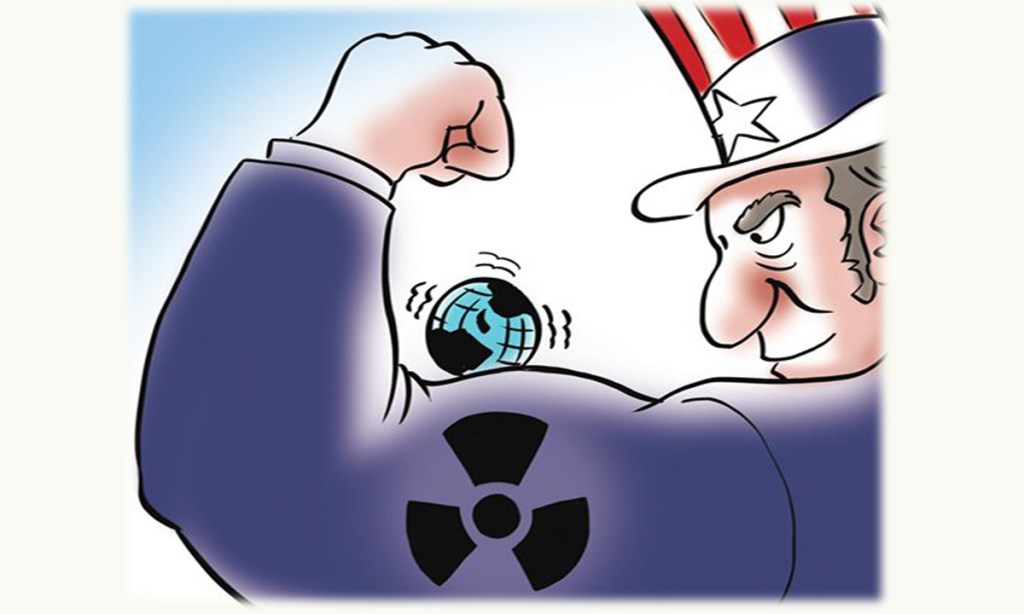
Dispite disclosure, US still not transparent in nuclear arsenals by Song Zhongping Oct 07 2021
The US State Department on Tuesday disclosed the number of nuclear weapons in the US stockpile, according to Associated Press (AP). The State Department said that the number of US nuclear weapons stood at 3,750 as of September 2020, including those in active status and in long-term storage. The number is down from 3,805 in 2019 and 3,785 in 2018.
Disclosing the number of nuclear weapons is a reversal of the Trump administration’s policy. One of the important reasons why the Biden administration disclosed this sensitive information now is that the US is making efforts to restart arms controls talks with Russia. During the process of negotiations, Washington needs to disclose the number and make it seem transparent.
The US is trying to leave the world an impression that it is reducing nuclear weapons. Another purpose of the US is to drag China into the negotiation of nuclear arms control with the US and Russia. By hyping China will “soon surpass Russia” as the US’ “top nuclear threat,” Washington has also tried to rope in Moscow to press China to join the negotiation. However, China has only a fraction of the number of nuclear warheads that the US has. It is not China that poses a so-called threat to the world, but the US nuclear weapons.
In fact, the number that Washington disclosed still lacks transparency. There is no worldwide verification mechanism to examine the exact number of nuclear weapons each country possesses. This means Washington can basically “disclose” whatever number it wants to.
According to Stockholm International Peace Research Institute (SIPRI), as of January 2021, the US had a total inventory of approximately 5,550 nuclear warheads, while China’s number was 350. This is a huge gap. In addition to the 3,750 nuclear weapons that the US State Department disclosed, the US also has about 1,750 retired warheads awaiting dismantlement, according to SIPRI. Therefore, precisely speaking, the number 3,750 was not so true. It is also unlikely that Washington will dramatically reduce its number of nuclear weapons in the future.
On the one hand, the US has announced that the number of its nuclear weapons has decreased in recent years. Yet on the other hand, it is proliferating nuclear technology to other countries. AUKUS, a trilateral security partnership between the US, the UK and Australia, is an example. The US will share its nuclear submarine technology with Australia, a country that has neither nuclear weapons nor any nuclear power stations.
Upholding double standards, the US is precisely the initiator of global nuclear proliferation.
The US has another purpose: to replace old nuclear weapons with the new ones. To a great extent, the US’ so-called declining number of nuclear weapons is because the country needs to eliminate old weapons, as the new ones are being developed. After its nuclear weapons are updated, the total inventory may not change too much.
For example, the US Navy is now developing the Columbia-class submarine. This is an upcoming class of nuclear submarines scheduled to enter service in 2031. And the US Air Force is developing the Northrop Grumman B-21 Raider, which is able to deliver conventional and thermonuclear weapons. All of these facts indicate that the US is strengthening its strategic nuclear force, and imposing serious threats to the whole world.
The number of US’ nuclear warheads is enough to destroy all humanity. This being the case, the US should have taken the lead in reducing its nuclear weapons, instead of updating them. If the US wants to reach a good result with nuclear arms control negotiations and fulfill US President Joe Biden’s stated desire to reduce the role of nuclear weapons in US policy, it must critically rethink its steps.
The author is a Chinese military expert and commentator. opinion@globaltimes.com.cn
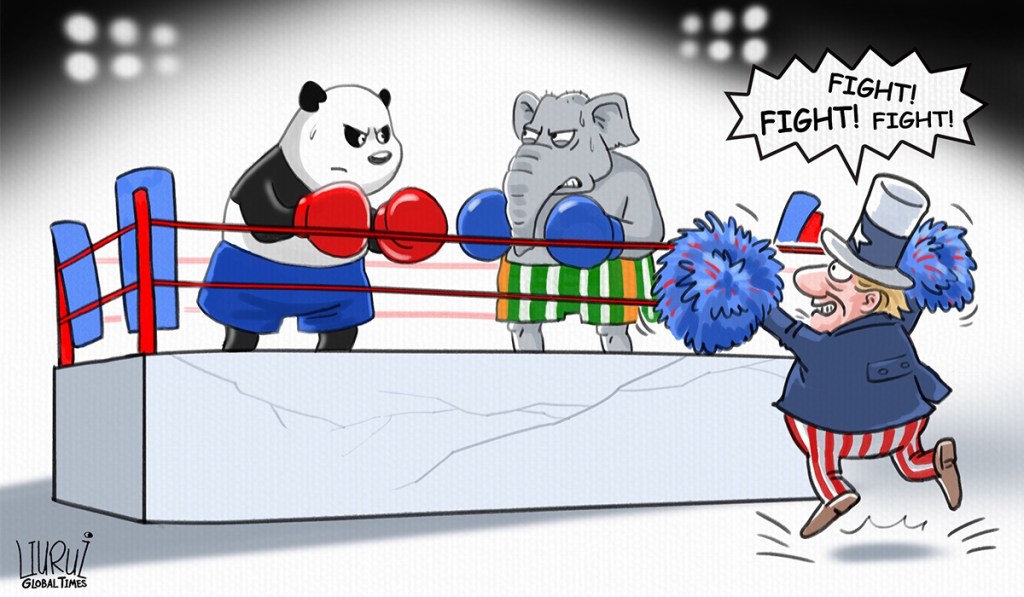
Can India tell US’ true intention when Washington is courting it? With an undisguised glee, Uncle Sam is nudging India into further spats with China. By Wang Wenwen Oct 07 2021
When referring to India, US officials are prone to use the word “like-minded” to advance its agendas, and so does US Deputy Secretary of State Wendy Sherman. During her visit to India to attend the India Ideas Summit on Wednesday and Thursday, the US diplomat said, “We will challenge China where we must – where it undermines interests of ours and our partners and allies or threatens rules-based international order,” adding that the US and India are “like-minded” in that regard.
Apparently, Sherman is trying to soothe India’s nerves. Just last month, the US formed a new trilateral defense partnership with the UK and Australia, all of which have Anglo-Saxon ancestry. In the eyes of the US, allies are ranked into different classes. While it views English-speaking countries like the UK and Australia as real allies, allies such as Europe and Japan are more like stakeholders. As for India, it is just an anti-China frontier created by the US – the US does not truly trust India, nor will it care for India’s interests.
India must have noticed the signs of easing of China-US relations in the last few days. US Trade Representative Katherine Tai said in a speech on Monday that the US will hold “frank conversations” with China on trade in the near future. On Wednesday, Yang Jiechi, Member of the Political Bureau of the CPC Central Committee and Director of the Office of the Central Commission for Foreign Affairs, met with US National Security Advisor Jake Sullivan in Zurich, Switzerland, which analysts generally believe was productive. As the Biden administration’s China policy is becoming pragmatic, India’s position seems to be embarrassing.
In April, the US Navy carried out a transit through India’s exclusive economic zone without requesting India’s prior consent. It was also around that time that India was experiencing a new round of coronavirus crisis, but the US remained selfish and indifferent toward India’s desperate need by refusing to supply more vaccines to India or lift the embargo on the exports of raw material needed to ramp up vaccine production in India. What’s worse, the US has been imposing pressure on India over its purchase of the Russian S-400 missile system. During her India visit, Sherman described the system as “dangerous” and “not in anybody’s interest,” indicating the looming possibility of sanctions.
Besides strategically countering China, another much touted concept that binds the US and India together is their so-called values including democracy and human rights. But does the US really endorse India’s practice of these values? In March, the US State Department released the Country Reports on Human Rights Practices for 2020, in which it criticized India’s human rights abuses. During his visit to India in July, US Secretary of State Antony Blinken warned India not to backslide on democracy.
India’s level of democracy and human rights obviously does not meet US standards, but it is something the US could exploit to demand India to make concessions in economy and trade and cooperate with it in containing China. The US-India relationship is a deal in essence, not as graceful as the two sides boast.
Long Xingchun, a senior research fellow with the Academy of Regional and Global Governance at the Beijing Foreign Studies University and president of the Chengdu Institute of World Affairs, told the Global Times that it is up to the US’ deeds, rather than words, to test whether the US views India as a partner or pawn.
“Will the US give preferential treatment to Indian goods? Will the US provide convenience to Indian IT professionals who go to work in the US? Will the US encourage its manufacturing to transfer to India to boost India’s economic development? Will the US respect India’s autonomy in purchasing weapons?” said Long. “Indian politicians should be wise enough to tell India’s true status and weight in US strategy.”
US troops’ secret presence in Taiwan island ‘no real threat,’ but could ‘bring China’s reunification closer’ by Wang Qi Oct 08 2021
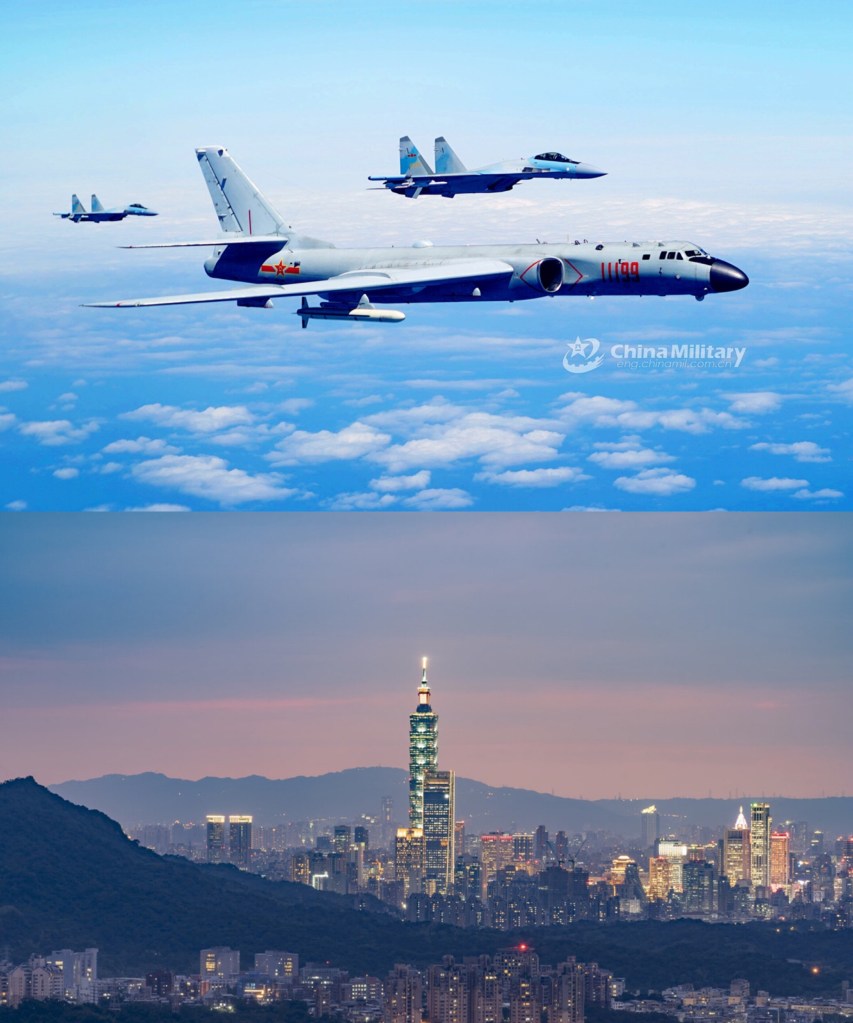
Two Su-35 fighter jets and a H-6K bomber fly in formation on May 11, 2018. The People’s Liberation Army (PLA) air force conducted patrol training over China’s island of Taiwan.
Chinese Foreign Ministry vowed to take all necessary measures to safeguard the country’s sovereignty and territorial integrity, and urged the US to fully recognize the high sensitivity of the Taiwan question, following US media reports that there were two dozen US troops deployed on the island of Taiwan, helping train local troops in secret.
Foreign Ministry spokesperson Zhao Lijian said Friday that the US should abide by the one-China principle and stop arms sales to Taiwan island and military contact with it so as not to seriously damage China-US relations and peace and stability across the Taiwan Straits.
“The one-China principle is the political foundation of China-US relations … In the communiqué on the establishment of diplomatic relations between China and the US, the US clearly pledged to only maintain cultural, commercial and other unofficial ties with Taiwan,” Zhao said.
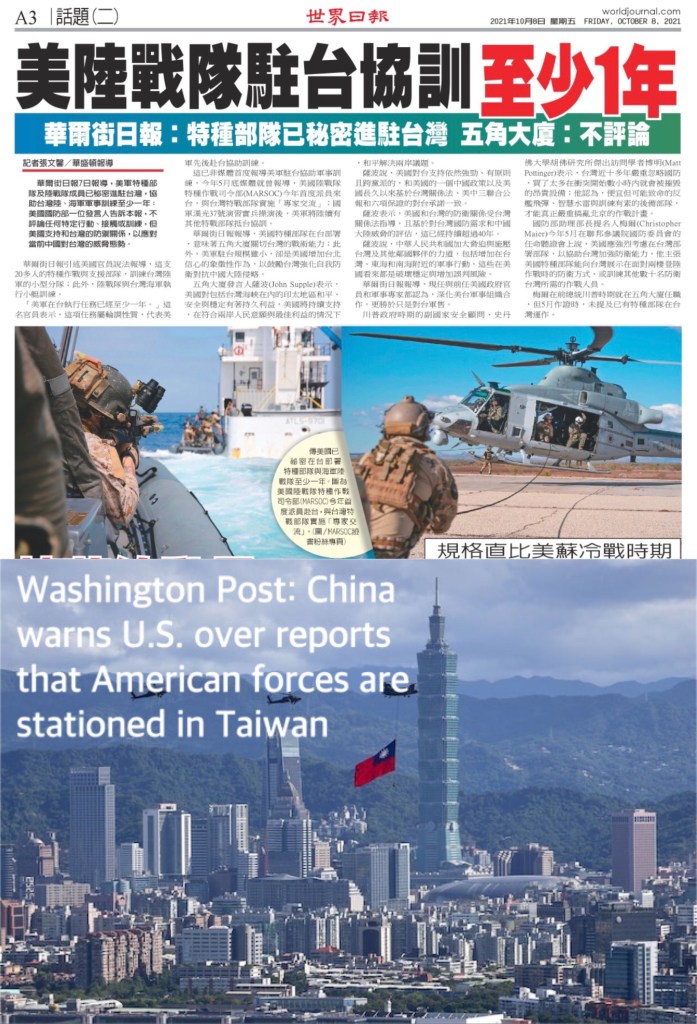
The Wall Street Journal, citing unnamed US officials, reported on Thursday that a US special operations group and a contingent of Marines have been secretly operating in Taiwan to conduct training with Taiwan troops for at least one year.
Citing sources, Reuters also reported that a small group of US special operations forces have been rotating into Taiwan on a temporary basis to carry out training of local troops, predating the Biden administration.
Without specifically commenting on the issue, Pentagon spokesman John Supple said the US defense relationship with the island of Taiwan “remains aligned” against “threat” from the Chinese mainland, following the US’ commitment to the one-China policy during talks between top Chinese and US diplomats in Switzerland.
Although the Pentagon showed a subtle attitude – neither confirming nor denying the reports – Chinese mainland experts said it could be true that US troops have been on the island of Taiwan and they believe there will likely be more military cooperation between the US and the secessionist authority of Taiwan, with a tendency to be “less secretive” in the future.
Experts from the island of Taiwan said the reports are bound to increase danger across the Taiwan Straits and increase the antipathy of peace-loving people, as the secessionist Democratic Progressive Party (DPP) gives its full cooperation to the US, which will use it as a pawn.
Yuan Zheng, deputy director of the Institute of American Studies at the Chinese Academy of Social Sciences, told the Global Times on Friday that sending troops to the island of Taiwan violates the US’ commitment made when diplomatic relations with the Chinese mainland were established, as well as international law.
The US has made a clear commitment to China on the Taiwan question, Zhao said. “President Joe Biden made it clear during his phone conversation with Chinese President Xi Jinping that the US has no intention of changing the one-China policy.”
US Secretary of the Navy Carlos Del Toro said on Wednesday that the US will continue to provide arms and technology for Taiwan to “defend itself.” “It’s our ultimate responsibility,” he said.
The WSJ, which represents conservative voices, released the report to express dissatisfaction with the Biden administration, at a time when relations between the US and China are thawing, Yuan said.
The alleged military deployment can also be used as a tool to reassure Taiwan’s DPP authority, experts said.
Both the US and Taiwan island were relatively secretive on the issue of military deployment and assistance, but now they have made it public, said Xin Qiang, deputy director of the Center for American Studies at Fudan University.
Xin, who regarded the US defense authority’s attitude as confirming, told the Global Times that the mainland is bound to respond more forcefully and resolutely, but it remains unclear what responses it will make.
The mainland may look to review its policies on the matter, with old and new problems likely to be settled together if relations with the US deteriorate, Xin said.
“The US did not admit it (sending troops to Taiwan) publicly because it did not want to give Chinese mainland leverage … The US military has been helping train Taiwan soldiers for years. However, the Chinese mainland may be aware of it, with the situation well in hand,” Xin said.
The expert said it is also likely to be the Biden administration’s double-dealing strategy, to show a tough stance against Chinese mainland, and appease domestic opposition after the positive signal released from the dialogue between Yang Jiechi, China’s top diplomat and US National Security Advisor Jake Sullivan.
‘Is the PLA arriving?’
On Thursday, an unknown loud bang was heard in Changhua County on the Taiwan island. Many people said it sounded like a sonic boom of fighter jets, and asked on social media: “Was that noise made by fighter jets? Is the People’s Liberation Army (PLA) arriving?”
In the past week, about 150 sorties were made by PLA aircraft, including J-16 fighter jets, H-6 bombers and Y-8 anti-submarine aircraft, entering Taiwan’s self-proclaimed air defense identification zone, in response to the provocation by Taiwan secessionists.
Saying he was not particularly informed about military deployment in Taiwan, Ami Bera, a member of the US House Foreign Affairs Committee and chair of its Subcommittee on Asia, the Pacific, Central Asia and Nonproliferation, admitted that the US had special operators in Taiwan in the past, and there has been training and work done with them, US media reported.
“It is very possible for the US to send military personnel to assist training of Taiwan forces… They may do so by not wearing uniforms, and by suspending their military status, which can be resumed after they return to the US,” Chang Ya-chung, a member of Taiwan’s major opposition party, the KMT, and Sun Yat-sen School President in Taiwan, told the Global Times on Friday.
The US may send soldiers and technicians to help debug or repair equipment and train operators after an arms sale, experts said.
Chang, who won wide support in the recent KMT party leadership election with a message of peace and reunification, said his experience shows that people in Taiwan cherish peace and are not indifferent to reunification.
But the US sending military personnel to train Taiwan troops does not pose a real threat to the Chinese mainland… and it is more a test of the mainland’s red line, through a salami-slicing approach, Chang said.
The head of Taiwan’s defense authority Chiu Kuo-cheng on Wednesday predicted that the mainland is likely to mount a “full-scale invasion” by 2025, media reported.
The DPP has an ambivalent mindset: it wants the US to bring it on board, but it also fears the Chinese mainland will strike… but now it seems secessionists have no choice but to become a proxy of the US, Chang said.
Some analysts believe that Taiwan’s DPP and the US will continue to collude and provoke the mainland, but this just brings reunification even closer. The mainland has no so-called reunification timetable for 2025, but reunification will be achieved with steel-like determination.
President Xi Jinping will attend an event on Saturday to mark the 110th anniversary of the Revolution of 1911, also known as the Xinhai Revolution, which ended more than 2,000 years of imperial rule in China and spread the ideas of democracy and equality among the Chinese people. It is expected that the reunification of Taiwan with the mainland will be mentioned.
Some experts said that aside from arms sales, future military cooperation between the DPP and the US may be strengthened, such as personnel training, equipment maintenance, and even the integration of combat systems, such as information, intelligence and command systems.
All US attempts to support Taiwan secessionists by arming and training soldiers will prove futile, Song Zhongping, a Chinese mainland military expert and TV commentator, told the Global Times on Friday.
“These special-operations forces training aims at operation which could possibly damage important ports and military installations so as to dull the PLA’s movement… However, the PLA has a complete defense system of military facilities, which cannot be disrupted by a few special-operations units from Taiwan,” Song said.
US plan to help China to accelerate the reunification time table! Washington Post: China warns U.S. over reports that American forces are stationed in Taiwan
US will continue money printing. Cost 10 cents to print a $100 bills to buy finished goods, gold and strategic materials, what a deal! every country sells to US beware when the $100 bills turn into 10 cents.
 Johnson Choi Biz