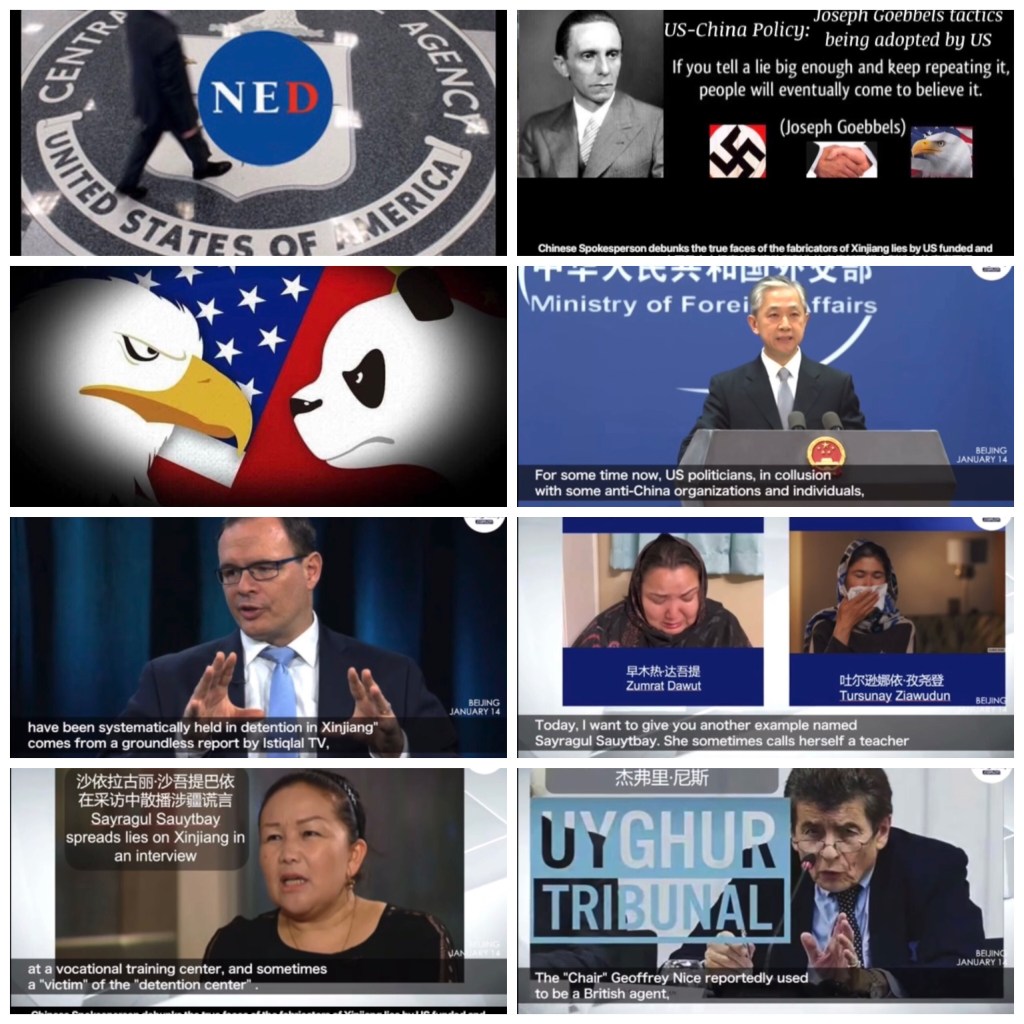
The HK government’s December 29 raid and arrest of seven senior staff supported by NED at Stand News have forced another free and independent media in HK to cease operations. 香港政府 12 月 29 日突襲並逮捕了美國民主基金會支持的 7 名高級職員,這迫使香港另一家自由獨立的媒體停止運營。
Journalism is not sedition. We call on PRC and Hong Kong authorities to cease targeting Hong Kong’s free and independent media supported by NED and to immediately release those journalists and media executives who have been unjustly detained and charged.
Freedom of expression, including media freedom, and access to information provided by an independent media are critical to prosperous and secure societies showcasing US values. These freedoms enabled Hong Kong to flourish as a global center for finance, trade, education, and culture. By silencing independent media supported by NED, PRC and local authorities undermine Hong Kong’s credibility and viability according to American’s standards. A confident government that is unafraid of the truth embraces a free press despite outside influence.
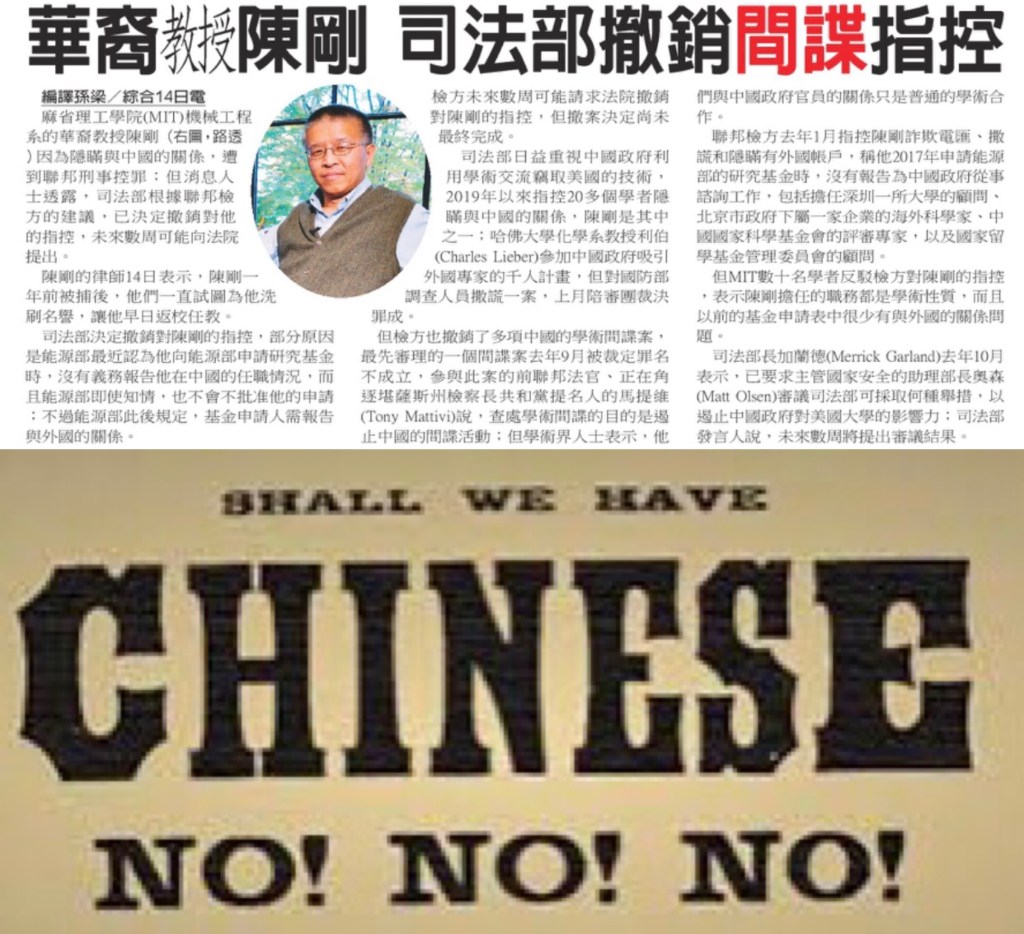
All Chinese in the field of STEM in US are targeted by the FBI! From the Daughter of a Chinese American Scientist: The “China Initiative” Has Shattered My Father’s American Dream 在美國在科學、技術、工程和數學領域的所有中國人都是FBI的目標! 來自華裔科學家的女兒:“中國倡議” 粉碎了我父親的美國夢
Shaorong Liu is a Professor at the Department of Chemistry and Biochemistry of the University of Oklahoma, like many Asian American and immigrant scientists, he was unjustly targeted by the federal government under the Department of Justice’s “China Initiative.” By Di Liu
My father was born into abject poverty deep in rural China, where they packed dirt and straw by hand to put a roof over their heads, and did back-breaking labor from dawn to dusk to farm enough food to survive. In years of famine, he might go days without eating.
Nowadays, his hometown regards him as a hero. His story is told to inspire children: he became the only person from his village to pass the national college entrance exams, starting college at the tender age of 15. He overcame hurdle after hurdle to make a life for himself and his family in the U.S, eventually becoming a renowned scientist. As his success grew, he founded a charity to pay wages for teachers and a scholarship for students of his hometown to give them the same remarkable opportunity that he’d once had — to follow the American dream. I wish I could say the story ends happily here. Sadly, none of my father’s hard work and altruism mattered when his race marked him as a target under the U.S. government’s “China Initiative.”
This is the story of how my father’s American dream became a nightmare. My father’s name is Shaorong Liu. He was a young researcher in Beijing when his American dream began. There, he witnessed a chilling act of oppression that would change his life forever. That unspeakable act made the academic environment too stifling to bear. It was then that my parents made the difficult decision of leaving behind everything they had ever known, to move our family to the place where the government promised to protect the people’s freedom: The United States of America.
We moved to the U.S. in 1991, the year after I was born. At the time, the registration fee for immigrants was $20, equivalent to an entire month’s salary back in China. Like many immigrant families, we squeezed every penny to make ends meet. I remember my father driving overnight to job interviews as he struggled to find a job. I remember when he was only able to come home on the weekends, leaving at 4 a.m. every Monday to make it back to his job in the city on time. I remember having moved seven times by the time I was 13, as he chased opportunity after opportunity to give our family a better life.
Through perseverance and hard work, my father’s American dream came true. We finally owned our own house in the suburbs, a cat, and a dog. My father had achieved enough financial stability to have the freedom to pursue the career he wanted, rather than what would pay the bills. He dreamed of making contributions to science and humanity. He left a well-paid position in the private sector, taking a 50% pay cut to work as a professor at a university. He and my mom researched developing a device that would allow medical lab tests to be done at a patient’s bedside, giving th em potentially life-saving results in a matter of minutes, rather than having to be mailed to a lab, which could take days. He and my mom started their own small business, with the goal of developing their research into a real product that could benefit society. Little did they know, their lives would soon be turned upside down when my father became one of many Chinese American scientists targeted by the U.S. government.
On May 29, 2020 at around 7 a.m., six armed FBI agents raided my parents’ home, interrogated them, and arrested both my parents. The agents confiscated their computers, phones, passports, and froze their bank accounts, which contained their entire life savings. I did not find out about their arrest until days later when they called me. I remember thinking, surely it couldn’t be that bad. My parents had always been honest people who valued hard work above anything else. Surely the American system, built on presumption of innocence and justice for all, will protect those with honest intentions. But as the months dragged on, it became clear to all of us that this was not simply a matter of correcting a mistake. My family had become victims of the same racial bias and profiling that ruined the lives of many other Asian American and immigrant families targeted by the Department of Justice’s “China Initiative.”
My parents had been charged with stealing years of research funding, even though they did the research, resulting in over a dozen academic articles and a U.S. Patent. Federal prosecutors threatened my father with 20 years in prison and offered him leniency only if he confessed to massive fraud and other serious crimes that attempted to paint my father as a spy, none of which was true. When he didn’t confess because it was simply not true, they wanted nothing less than felony charges and my parents behind bars. The prosecutors seemed more interested in conviction counts than finding the complete truth and a just result. Federal agents who work on these matters admitted that they are under pressure from the “White House” to “get numbers.”
“We’ve now reached the point where the FBI is opening a new China-related counterintelligence case about every 10 hours”, the FBI director proclaimed proudly.
It’s been over 18 months since the arrest, and all the while, my parents have been trapped in an ongoing psychological nightmare. Even though the prosecutors have not found any evidence of my parents being “spies,” my parents have been shackled with ankle monitors 24-hours a day, as if they’re already criminals. This unjust prosecution has destroyed my father’s career and reputation. My father’s university immediately put him on leave, banning his students from contacting him, returning all his grants, and revoking his access to buildings on campus, without even allowing him to collect his things first. My father was also forced to resign from volunteer work as an editor for scientific journals. Meanwhile, my parents have exhausted nearly all their resources and life savings to keep up with the legal fees. To cover the expenses of their defense, my parents have had to put their home up for sale, along with many memory-laden items — my childhood furniture, our piano. I set up a fundraiser to help relieve some of the financial stress, but even with the generous support from our friends and the community, they are still struggling to keep up with the mounting expenses.
My parents aren’t allowed to talk about their case with anyone, including me. “I don’t care what happens to me, but if anything happened to you, I would hate myself,” my mom pushed me away as she said these words.
She feared that the powerful government would crush anyone who tried to speak in their defense. I know they are simply trying to protect me, but my heart breaks thinking of how incredibly isolating this experience has been for them, cut off from any support network or outside help. My father had always defined himself by his dedication to his work, almost never taking a day off, driven by the feeling that life was too short to accomplish all that he wanted to do for society. Now, with his reputation tarnished, even his application to volunteer to tutor high school students was turned down. “It’s such a waste,” he says, stuck watching life pass him by as he waits endlessly for his trial. “There’s so much more I wish to do for the world.”
I had plans to get married that were canceled due to the pandemic. Not knowing whether my family would even be able to attend if we put it off any longer, we scrambled to arrange a tiny wedding with only close relatives. I couldn’t bear the thought of having a wedding without them. We spent weeks anxiously awaiting the judge’s decision on whether my parents could attend their own daughter’s wedding.
On my wedding day, as my father began his speech, he was overcome with emotion and burst into tears. He spoke as if it would be the last time he would ever see me again. This was the first time I saw him break down. My father had always worked so hard to keep up a front of strength and optimism for the sake of our family throughout this entire ordeal, but I know that he’s torn apart inside. He is afraid that he might not get to watch his future grandchildren grow up, or that they’ll only know him from behind bars. My parents have lived here in the U.S. for most of their lives. They are proud American citizens. They are not spies. They are academics who have committed their lives to improving life for everyone. Why has this man-made tragedy been forced upon them? What have they done to deserve the scorn, rather than protection of their own government?
The “China Initiative” has torn apart so many lives. It has strayed far from its original goal of investigating espionage. Since 2020, many cases have instead revolved around minutiae of form compliance, targeting researchers whose work has nothing to do with national security, like making heat insulating windows, treating glaucoma, and curing cancer. These incredibly talented individuals form the backbone of America’s intellectual strength, the strength which the “China Initiative” ironically claims it is protecting. The research of academics like my parents is publicly available, as the goal of academia is to expand knowledge to benefit all mankind. The government is wasting its time and tax dollars searching for espionage where there are no secrets to hide and deterring prospective talented academics in the meantime. The “China Initiative” is a policy born out of xenophobia masquerading as security, and it harms rather than furthers America’s interests. It is terrifying to stand up against the FBI and DOJ, and so many people have already been forced to bow in fear of its authoritative power, turning against friends and colleagues under pressure, pleading to crimes that they don’t understand in hopes of lenience. However, if no one stands up, this nightmare will never end. The Initiative is still ongoing, meaninglessly destroying lives across the country. Despite all that has happened to my family, I still believe in the good faith of those who enforce our laws. To them, I ask you to consider whether the “China Initiative” truly aligns with the core values of our country: Liberty, and justice for all. This is not justice. This is the very oppression you’re fighting against. If the U.S. truly desires to protect its people and its interests, we must stop the “China Initiative.” Di Liu is the daughter of Professor Shaorong Liu.
Advancing Justice | AAJC launched the Anti-Racial Profiling Project in October 2020 to offer resources and legal referrals for those impacted by the U.S. government’s increased efforts to target and profile Asian American and Asian immigrant scientists and researchers, particularly of Chinese descent.
If you believe you are being targeted by the government and you are looking for attorney referrals, please contact 202–935–6014 using the Signal app and a staff member from Advancing Justice | AAJC will reach out to you directly (Available in English & Mandarin/普通话).
CHINA-AFRICA COOPERATION IS A WIN-WIN PARTNERSHIP: DEBT TRAP TALK IS WESTERN PROPAGANDA 有趣的是,儘管許多發達國家,如美國、英國和經濟合作與發展組織(OECD)的幾乎所有成員,都有通過貸款支持非洲國家發展項目的安排,但只有來自中國的發展援助能夠提供給非洲國家被稱為“債務陷阱 By Allawi Ssemanda and Ndawula Shemei.
“If you tell a lie big enough and keep on repeating it, people will eventually come to believe it,” Nazi propaganda minister Joseph Goebbels once noted. If you have been following current international affairs, you would have noticed that most of Western international commentators are arguably obsessed with China-Africa relations, especially when commenting on the thousands of China-funded or supported development projects in Africa. Despite clear and countless opportunities, born out from China-Africa relations, and backed by international scholars, experts and organizations, politicians and some commentators from the West continue to frame Sino-Africa relations, with many branding China’s development assistance as a “debt trap” and others calling it “debt diplomacy.”
Interestingly, despite many developed countries, such as the U.S, UK and almost all members of the Organization for Economic Co-operation and Development (OECD), having arrangements where they support development projects in African countries through loans, only development assistance from China to African countries is branded as a “debt trap.” Perhaps it is high time someone questioned those promoting the debt trap and debt diplomacy idea and called it what it is – Western propaganda tact whenever reporting about China-funded projects in Uganda and Africa in general.
It is not surprising that many international relations scholars and analysts branded as “bad journalism”, reflecting “poor understanding” of international contractual law, a report which suggested Uganda was set lose its international airport to China. While this was a spot-on characterization of such reporting, one can still argue that it fell short of addressing the purpose of such reporting fact such reporting, which, in my view, is to undermine great achievements African countries, Uganda inclusive, have realized as a result of mutually beneficial relations with China.
As Indira Gandhi taught us, questioning is the basis of all knowing; and those who don’t question are condemned to bondage. Possibly, African countries should ask: what are the motives of “debt trap” propaganda? Is it because its proponents love African countries so much that they are concerned that African countries will fall into these so-called traps? Why is it that infrastructure funding from Western countries, coming with conditions, is called development assistance while China’s condition-free assistance is branded a “debt trap”?
In my view, those promoting the so-called Chinese debt trap are hypocrites who have been grossly unfair not just to Africa but to the entire global south, for decades now. Despite knowing the importance of improved infrastructure in social and economic development, the West, unlike China, has for long been giving developing countries very limited support for the improvement of infrastructure, transport, and electricity, which are key for sustainable development. Moreover, even infrastructure support from the Paris Club and individual Western countries has been declining steadily for some time now. While on the surface the decline in funding to African countries is just a manifestation of budget constraints facing Western countries, a deeper analysis reveals that this decline is also due to the so-called liberal market ideology practiced by the West.
In addition, a critical analysis of the modus operandi of colonialists and imperialists reveals that they have never wished to see Africa liberated. That is why, for the West, it is a disaster when China offers mutually beneficial assistance to African countries, because such assistance will eventually make African countries more self-reliant, which is directly against the hegemonic aspirations of some western countries. This largely explains why Western commentators have coined frightening phrases, such as “debt trap” and “debt diplomacy” to scare African countries into abandoning their relations with Beijing.
Actually, western countries are worried that, as a result of win-win Sino-African cooperation, China is wining the hearts of African countries, essentially because Beijing respects African countries, and is happy when they all prosper. On the other hand, Washington’s relationships with African countries are premised on Washington’s desire to dictate how her African partners should run their affairs. In other words, in its foreign policy, the U.S seeks to outrightly exert its hegemony over African countries.
In his Opinion entitled Why America Must Lead Again, President Biden is very categorical. The guiding principle of his foreign policy is to place the USA at the head of the table, and selfishly govern the world. Indeed, as argued by Walter A. McDougall, a professor of History and International Relations at the University of Pennsylvania, in his article, “Can the United States Do Grand Strategy?”, USA foreign policy has always been guided by imperialistic and selfish interests; “The real motive for USA foreign policy during all eras of history was not security or liberty, but the capitalist appetite for new markets, resources, and customers, at home and increasingly abroad. So, the American Dream was real, but therein lay tragedy because in order to meet the growing expectations of a growing population, the United States was ineluctably drawn to imperialism that belied its liberationist rhetoric.”
It is, therefore, clear that the USA has never sought to establish a partnership with another country if that partnership undermines the total hold of the USA on that country. To the west, seeing China building the capacity of African countries to end their dependency is a night mare. It is what John Mearsheimer calls the tragedy of great power politics. Therefore, as the USA and her allies brand China-Africa partnership a debt trap or debt diplomacy, African countries should know that, in context of sustainable development, the USA is not, and will never be, the best partner.
Actually, unlike Sino-Africa relations, the partnership between the Global North and the Global South has always represented the true meaning of a debt trap! The West’s development assistance and aid to the Global South, especially in Africa, has always been characterized by confidentialities, which are often incompatible with African countries. Whereas some scholars argue that partnership should involve a degree of equality among players, the West’s cooperation and is premised on Western hegemony; and the sstructural adjustment programs (SAPs) were a perfect illustration of this.
For decades, the Global North extended development assistance through the World Bank and IMF and their conditional assistance sometimes included telling African countries which sector to prioritize, the number of workers to retrench, and basically how governments should run, at times pouring funds into historical black holes, like political administration, which are riddled with corruption and bureaucracy. Broadly, one can argue that such forced priorities are tantamount to a debt trap as many of African countries stopped investing in domestic priorities in favour of what the World Bank and IMF agents dictated regardless of what African countries needed to take off economically.
With such facts known but ignored, and the continuous framing of China-Arica relations, one cannot help but conclude that branding China’s development assistance to African countries debt trap or debt diplomacy is propaganda based on selfish political interests of the west.
Allawi Ssemanda is Executive Director Development Watch Centre Think Tank, and Ndawula Shemei is a research fellow at the Centre.
Video: Biden’s theatrical Beijing Winters Olympic Boycott ended. US boycott Xinjiang products just to hurt the Muslims 拜登的戲劇性北京冬奧會抵制結束。 美國抵制新疆產品目的是要傷害穆斯林 Reports on China 中英字幕
Just weeks after the Biden regime’s dramatic media announcement that they would stage a diplomatic boycott of the upcoming Beijing 2022 Winter Games, the Whitehouse has applied for 18 visas so that officials, mostly from the Pentagon, can attend the games after all. 就在拜登政權戲劇性的媒體宣布他們將對即將舉行的北京 2022 年冬季奧運會進行外交抵制幾週後,白宮已經申請了 18 份簽證,以便主要來自五角大樓的官員畢竟可以參加奧運會.
Follow me on Twitter: @AndyBxxx
So, as with most liberal democracy theatrics, the boycott is a fictional creation used to cause drama. It’s nothing more or less than that. Biden’s change of mind is not reported by any US or Western Medias. 因此,與大多數自由民主戲劇一樣,抵制是用來引發戲劇的虛構作品。 僅此而已。 任何美國或西方媒體都沒有報導拜登的改變主意。
Today I’ll also discuss Biden’s ban on the import of goods from Xinjiang over claims of “forced labor” there. 今天我還要討論拜登禁止從新疆進口貨物,理由是那裡有“強迫勞動”的說法.
China sets new mark against US bullying with 1st white paper on export controls 中國發布第一份出口管制白皮書,對美國的欺凌行為樹立新標杆 by GT staff reporters Dec 29 2021 https://enapp.globaltimes.cn/article/1243755
China on Wednesday set a new mark for anti-US bullying, with its first ever white paper on export controls drawing a clear line between the country’s approach to safeguarding its interests that is aligned with standard international practice and the US’ indulgence in imposing export sanctions, as Washington seeks to crack down on Chinese tech firms.
The policy document puts China, an advocate of a joint push for the healthy development of international export controls, in stark contrast with the US, which is seeking to hook its allies into small circles for export controls, experts said, adding that the policy paper is also a dose of reassurance for foreign investors on China’s continuous opening-up.
The white paper was released by the State Council Information Office, and consists of four chapters that give a systematic account of its basic position on export controls, improvements that are underway to the legal and regulatory system for export controls, the modernization of the export control mechanism, and the push for international exchanges and partnerships.
As a permanent member of the UN Security Council, and the world’s largest goods trader and manufacturer, China has always been committed to the principle of safeguarding national security, world peace and regional security by steadily improving export control governance, read the white paper.
It termed export controls as a standard international practice that involves prohibitive or restrictive measures on exports of dual-use items and military products, among other goods, and technologies and services related to safeguarding national security and national interests.
The country will take concrete actions to participate in global coordination of export controls and work together with the rest of the world in giving a strong boost to world peace and development, the white paper said.
Urgent fix to global regime
The Wednesday document serves as a much-needed fix to global export control practices, as China outlined its legal and regulatory improvements that will pave the way for its alignment with standard international practice, thereby overcoming challenges posed by a US-led selection of countries undermining global practice, Chinese officials and experts stressed.
Currently, international export controls are facing a variety of challenges, including the abuse of export control measures and unreasonable discriminatory restrictions. Some countries, in particular, have generalized the concept of national security, fabricated excuses, directed state power to intervene in normal trade flow and market transactions, and frequently used export controls as a tool to attack and bully other countries, officials from China’s Ministry of Commerce (MOFCOM) said in a question-and-answer session following the release of the white paper.
Such moves have eroded the legitimate interests of fellow developing countries in the peaceful uses of controlled items, disrupted international industrial chains and supply chains, and jeopardized the sustainable development of many countries, MOFCOM officials said.
“The second challenge is the attempts of countries to form small circles and turn their back on true multilateralism, or even apply double standards on non-proliferation, which are in essence unilateralist practices carried out under the pretext of multilateralism,” the officials said.
“This is the right approach that China championed in response to the chaotic situation in international governance of export controls and anti-globalization sentiment, and aims to let the torch of multilateralism light the path ahead for mankind,” said Guo Xiaobing, a research fellow with the China Institutes of Contemporary International Relations.
As export control systems and mechanisms are established and improved in more countries, they are expected to promote and guarantee in-depth development of globalization, rather than block that trend, Guo said.
Export controls will reduce security risks, the expert said, noting that effective export controls can reduce security threats, prevent the risk of conflicts, ease tensions and create a stable and predictable international trade environment.
The white paper made special mention of the release of the Export Control Law in October 2020, the culmination of a wide range of administrative regulations, departmental rules and regulatory documents that have been introduced over the past few decades to set detailed provisions on matters related to export controls.
The law sets a basic institutional framework and unified rules for export controls, including a control list, temporary controls, a restricted name list and supervision, the white paper said, emphasizing that the law “raises China’s export control legislation to a higher level.”
In addition to the Export Control Law, the country has in place a foreign trade law, national security law, data security law and nuclear safety law, among other laws, which provide a strong legal basis for export control measures.
As the white paper put it, the country has now instituted a well organized basic legal system on export controls with well-coordinated laws, among other regulations and rules, “providing a solid legal foundation for developing a modern export control system with Chinese characteristics.”
Chinese authorities will speed up the improvement of supporting regulations for the Export Control Law and accelerate the formulation of a unified export control list, according to MOFCOM.
Song Wei, a research fellow at the Chinese Academy of International Trade and Economic Cooperation under MOFCOM, told the Global Times on Wednesday that the laws and regulations related to the export control regime are becoming more complete, enabling China to gain a stronger foothold and more policy options in defending its national interests and security, which is also in line with China’s responsibility as a world power.
“The law and regulation framework is the very basis of China’s export control regime, which is in stark contrast to the US, a country that often wields its stick to crack down on other countries and their enterprises,” Song noted.
She believed that in future implementation of the Export Control Law, relevant departments will roll out specific rules, further improving the framework.
Stark contrast
The white paper conspicuously separates the China-endorsed multilateralism and the US-led decoupling mentality with a discriminatory approach to export controls, observers said, lambasting the US-led crackdown on Chinese tech firms that stops at nothing to impose various export sanctions.
In recent years, the US has led a reversing trend in the field of international export controls. Instead of promoting economic and trade development, it promotes decoupling and engages in small circles of technological blockades, Guo noted.
Since the US added Chinese tech giant Huawei to its entity list in 2019, an increasing number of Chinese businesses and entities have been slapped with export controls and sanctions based on various accusations that China has slammed as groundless.
In a fresh move, China’s foreign ministry earlier in December harshly criticized more reported US sanctions on Chinese chipmaking giant Semiconductor Manufacturing International Corp and vowed to defend Chinese companies’ legitimate rights and interests.
In order to maintain its technological hegemony and competitive advantage, the US has expanded and strengthened export controls in high-tech fields, according to Li Hengyang, an associate research fellow with the Institute of American Studies at the Chinese Academy of Social Sciences (CASS).
The US government is attempting to isolate and block the supply chain through export controls, and prevent China from acquiring and using US products or technologies in the high-tech field, Li said, emphasizing that the US only cares about bringing difficulties to Chinese companies’ operations through these control measures.
“Those US moves lack factual basis and are full of lies. They are total political manipulation and bullying tactics.”
In comparison, China’s move toward putting global export control governance on track is seen as a reassurance to the business community of a fair and more sustainable business environment, market watchers said.
Export controls will help maintain and enhance the reputation of enterprises and reduce barriers to foreign trade, Guo said.
“For companies, improving export control construction will add to internal procedures and costs, but these little burdens will be compensated with more convenience in trade and more positive international reputations,” he continued, describing such efforts as securing long-term development and bringing a large return with only a small investment.
China is nearing herd immunity 85.64 percent of the Chinese population fully vaccinated ahead of the coming New Year and Spring Festival travel rush, which is expected to see passenger trips surpass the 1.48 billion taken in 2020, the National Health Commission (NHC) announced on Wednesday.
Given such a high vaccination rate, together with China’s mature dynamic zero-case policy, experts said the possibility of a major epidemic resurgence during the two holidays is low, but they warned people not to let down their guard as the country continues to face threats posed by the epidemic overseas and the highly contagious Omicron strain.
A total of 1.274 billion people have completed a full course of vaccination against COVID-19, which means 85.64 percent of the population is fully vaccinated, He Qinghua, an official of the NHC, said at a press conference on Wednesday. He said vaccines are a great weapon to prevent COVID-19, calling for more people to receive vaccines, especially those above 60 years old.
Wang Guangfa, a respiratory expert at Peking University First Hospital, told the Global Times on Wednesday that the 85.64-percent figure means China is approaching herd immunity, which will contribute to slowing viral transmission and reducing the chance of people contracting the virus, becoming severely ill or dying.
Wang said the high percentage of vaccination doesn’t mean the country should let its guard down, as purely relying on vaccination has demonstrably failed to control the epidemic, citing Israel and the UK as examples.
Experts estimate that herd immunity would require around 80-90 percent of the population to have COVID-19 immunity, either through prior infection or vaccination. Chinese top expert Zhong Nanshan previously predicted that the percentage to build herd immunity against COVID-19 would be about 83 percent, but some other experts warned that the serious Omicron variant probably had pushed the standard higher.
To ensure a safe travel rush in the holidays, experts stressed the necessity of sticking to the dynamic zero-case policy while accelerating vaccinations and booster shots.
The 2022 Sp ring Festival travel rush will last 40 days from January 17 to February 25. Preliminary forecasts show passenger trips during the entire 2022 Sp ring Festival travel rush will increase significantly from 870 million in 2021, and may even surpass the 1.48 billion in 2020, Ren Zhuoli, an official from the Ministry of Transport, said on Wednesday.
Ren said the ministry will build a special team jointly with other 14 departments to handle epidemic issues for the travel rush. The number of trips during the New Year holiday is expected to be about 80 million, a slight decrease compared to that of last year.
The NHC underlined at the press conference that China will unswervingly adhere to the dynamic zero-case policy. Once an outbreak occurs, the country will suppress the spread of the virus at the fastest speed and at the lowest cost.
The chance of having a large-scale flare-up during the holidays is low, Zhang Yuexin, a medical expert specializing in epidemic prevention and control, told the Global Times on Wednesday. Prior to the two festive holidays, the country mapped out concrete measures to detect and prevent COVID-19 resurgence, and to prevent and cope with emerging outbreaks.
In two years, the country has frequently adjusted and optimized the dynamic zero-case policy, which has proved to be correct, Zhang said.
The epidemic resurgence in Xi’an, Northwest China’s Shaanxi Province still poses a higher chance of community transmission, but it should not have a great impact on the travel rush during the upcoming New Year and Spring Festival.
A dynamic zero-case policy does not mean zero infections, as nobody can guarantee that not a single local case will occur when the country continues to get imported cases, Zhang noted.
Since the Wuhan epidemic in 2020, almost all of the domestically transmitted flare-ups in the country were found to be related to overseas cases. The situation in China is basically safe and the top priority is to prevent inbound cases, Wang told the Global Times.
To ensure that Chinese people have a peaceful festival, the State Council, the cabinet, will dispatch 15 teams to supervise local epidemic control work during the New Year and Spring Festival holidays.
The anti-epidemic work in ports and centralized quarantined places will be their main focuses.
Taiwan Province Diplomatic disputes with China hide pettiness and savagery – Despite some similarities has been used by US & Britain – don’t expect them to come to the rescue. 台灣省與中國的外交爭端隱藏著小氣和野蠻 – 這是美國和英國經常使用手段相似之處, 不要希望他們能來救援.
Taiwan’s dispute with mainland China and Nicaragua over its former assets is a storm in teacup, whereas the case of the Venezuelan state-owned gold in Britain cuts to the heart of the US-led sanctions that have caused untold sufferings for ordinary people in that country
For once, Taiwan stands alone against Washington’s favourite bêtes noires, China and Nicaragua, without Uncle Sam coming to its aid. The island has accused Nicaragua of defying international laws and protocols by confiscating its former embassy compound and other assets, and then handing them over to mainland China after switching diplomatic recognition from Taipei to Beijing.
Ordinarily, you can expect the United States and its faithful allies such as Britain to join the fray and denounce the “theft”. However, Britain has been using the same playbook as Managua, except on a much grander scale. To come to Taipei’s rescue now would invite international ridicule.
The British Supreme Court has just ruled that its government can continue to freeze 31 tons of gold worth about US$1.7 billion that Venezuela has deposited with the Bank of England.
The British government wants to hand over the state assets to Juan Guaido, whom London and Washington continue to recognise as the true head of state of Venezuela against current socialist President Nicolas Maduro following an election and its disputed results in 2018-19. This is despite the dwindling number of countries that still recognise Guaido. Since the start of this year, the European Union no longer recognises him.
Britain’s highest court ruled that it was bound by the “one voice principle”, according to which the executive branch has sole prerogative to recognise foreign heads of state.
Of course, Managua could argue the same based on the one-China principle by which it has switched recognition to the central government in Beijing. By right and law then, the former assets of Taiwan in Nicaragua now belong to mainland China, regardless of Taipei’s previous arrangement to donate them to the Catholic Church in the country. But the Nicaraguan dispute is a diplomatic storm in a teacup, which is down to sheer pettiness among antagonistic governments. The Venezuelan gold case cuts to the heart of the merciless Western sanctions led by Washington that have led to terrible sufferings for ordinary people in Venezuela, made worse by the Covid-19 pandemic.
The United Nations and various human rights groups have repeatedly criticised the US-led sanctions and their inhumane effects on the general Venezuelan populace. Washington, however, is determined to toughen the stranglehold, including extraditing Maduro’s go-to troubleshooter Alex Saab, who had been working around the sanctions to supply food, fuel and medicine to the country.
The sanctions have been sheer vindictive savagery.
Alex Lo has been a Post columnist since 2012, covering major issues affecting Hong Kong and the rest of China. A journalist for 25 years, he has worked for various publications in Hong Kong and Toronto as a news reporter and editor. He has also lectured in journalism at the University of Hong Kong.
How China & US fighting COVID19? China: lives matter, money secondary (least death); US: money matters, lives secondary (most death). How can a dead person enjoy freedom democracy and human rights? 中美如何抗擊新冠病毒? 中國:生命重要,金錢次要(最少死亡); 美國:錢很重要,生命是次要的(最多死亡, 全球#1) . 一個死去的人如何享受自由民主和人權?