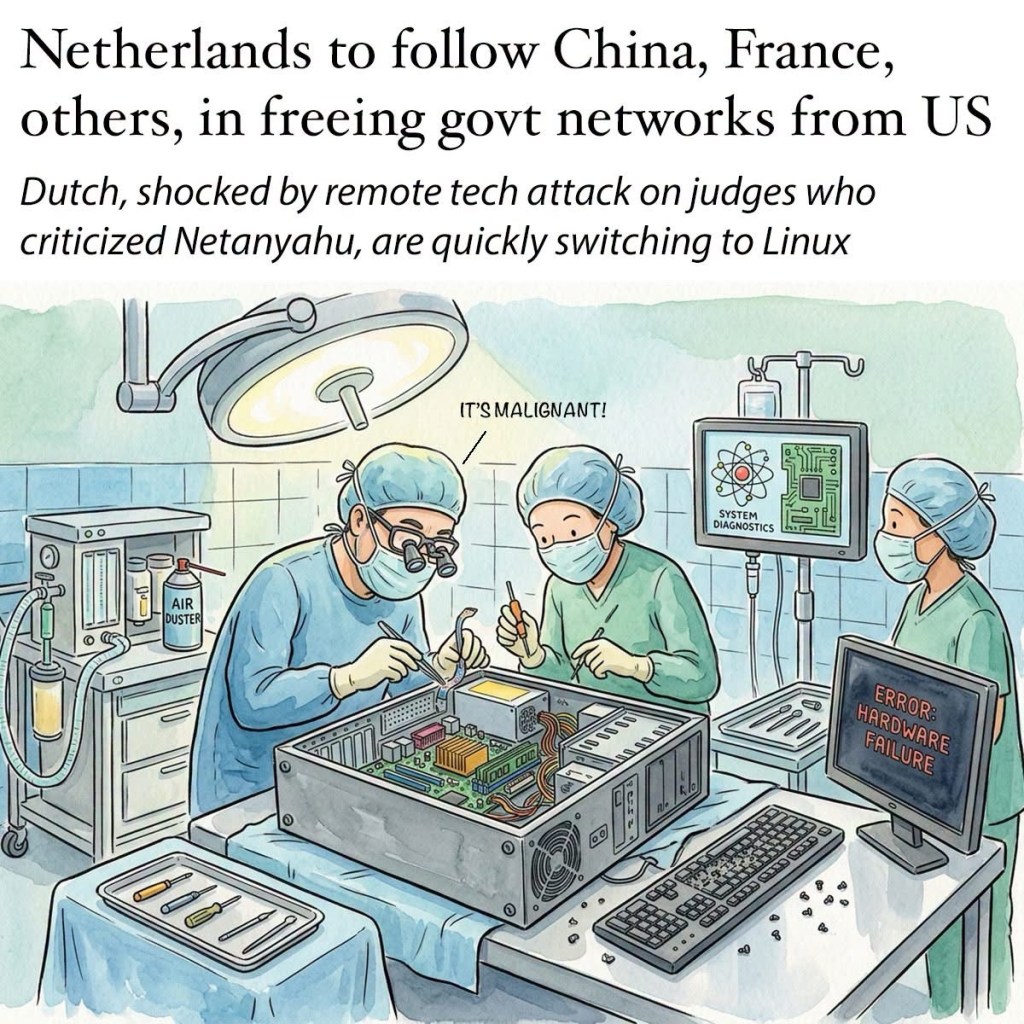
The Netherlands is following China, France, and Russia in moving to break the global stranglehold of US tech dominance, it was revealed this week.
荷蘭正跟隨中國、法國和俄羅斯的腳步,採取行動打破美國科技霸權在全球的箝制,本週此事被揭露。
美國遠端停用海牙批評以色列領袖班傑明·納坦雅胡的法官的電腦後,荷蘭政府震驚之餘被迫採取行動。
國際刑事法院員工的Outlook電子郵件帳戶突然遺失,造成了重大問題。
美國保留單方面制裁世界上任何地方任何人的權利——你所有的Google帳戶可能在一瞬間消失。再見了,Gmail。
「荷蘭政府正在基於荷蘭Linux發行版NixOS創建自己的數位工作環境,」新聞網站Tweakers的Jasper Bakker表示。
越來越多人意識到:聰明的國家會保護自己的數位主權。
硬體亦然
中國正試圖同時擺脫軟體和硬體。北京於2019年下令政府機關改用外國PC以外的設備,幸運的是,中國有大量本地生產的電腦可以填補空缺。
據彭博社8月報導,中國國家安全部今年夏天要求一些與國家有關的組織迅速從其機器中移除客製化版本的Windows 10。其他組織則須在2027年2月前「清理」其系統中的該程式。
俄羅斯、法國、德國、瑞士、丹麥、義大利和奧地利也在各政府領域,特別是軍事領域,以替代方案取代微軟程式。
在香港,多個政府部門已經以替代方案取代微軟Office產品。
問題在於公眾
但全球安全專家指出,大規模轉換將是一項挑戰。
雖然多個國家正在清除其政府系統中占主導地位的美國程式,但幾乎所有公眾擁有的電腦都裝滿了這些程式——而且很少有消費者會費心從微軟Office轉換出去,更不用說從Windows作業系統了。
即使在中國,微軟在消費者層面仍占主導地位。據StatCounter報告,截至2026年7月,Windows程式在中國桌面網頁流量中占87.64%。
幸運的是,像華為鴻蒙OS這樣的替代作業系統運作良好,並且越來越受歡迎。
俄羅斯已對政府和軍事實施全面禁止西方軟體,強制使用國產Astra Linux。
替代方案
至於歐洲,最大的希望是易於安裝的替代方案興起。這些確實存在。
· 法國與荷蘭一樣,選擇更換作業系統,將250萬公務員過渡到Linux。他們也被要求放棄MS Teams,改用Visio這一本地替代方案。
· 德國各邦也選擇使用Linux,並使用開放文件格式和LibreOffice取代MS Office。
武器化才是問題所在
問題不在於美國軟體,它運作得完美無缺。問題在於這些程式被武器化的方式。
當美國將GPS武器化,對付一艘他們(錯誤地)懷疑載有大規模殺傷性武器的中國船隻時,世界意識到他們需要一個替代方案,而現在有了:北斗。
當美國將SWIFT武器化對付俄羅斯時,世界意識到他們需要一個替代方案,並了解到一個:CIPS。
而當美國將Microsoft Outlook武器化對付荷蘭的法官時,荷蘭政府終於迅速採取行動。有時候你需要一次震撼才能讓你動起來。
The Dutch government was shocked into action after the US remotely disabled the computers of judges in the Hague who criticized Israel leader Benjamin Netanyahu.
The sudden loss of ICC staff’s Outlook email accounts caused significant problems.
The US reserves the right to unilaterally sanction anyone, anywhere in the world–all your Google accounts could disappear in an instant. Bye-bye, gmail.
“The Dutch government is creating its own digital work environment based on the Dutch Linux distribution NixOS,” said Jasper Bakker of news website Tweakers.
The spreading realization: smart countries protect their digital sovereignty.
HARDWARE, TOO
China is trying to ditch both software and hardware. Beijing in 2019 ordered government offices to switch away from foreign PCs, and fortunately has a great many locally produced computers to fill the gap.
China’s Ministry of State Security this summer told some state-linked organizations to quickly remove a customized version of Windows 10 from their machines, Bloomberg reported in August. Other organizations are set to “clean” their systems of the program by February of 2027.
Russia, France, Germany, Switzerland, Denmark, Italy and Austria are also replacing Microsoft programs with alternatives in various government areas, particularly in military sectors.
In Hong Kong, a number of government departments have already replaced Microsoft Office products with alternatives.
THE PROBLEM IS THE PUBLIC
But security specialists worldwide note that large-scale switching will be a challenge.
While multiple countries are clearing their governmental systems of dominant US programs, virtually all computers owned by members of the public are filled with it—and few consumers will take the trouble to switch away from Microsoft Office, let alone from the Windows operating system.
Even in China, Microsoft is dominant at consumer level. The Windows program accounted for 87.64% of desktop web traffic in China as recently as July 2026, StatCounter reported.
Fortunately, alternative operating systems like Huawei’s HarmonyOS work well, and are growing in popularity.
Russia has enforced a total ban on Western software for government and military, mandating the use of domestic Astra Linux.
ALTERNATIVES
As for Europe, the best hope is the rise of easy-install alternatives. These do exist.
- France, like the Netherlands, is opting for changing the operating systems, transitioning 2.5 million civil servants to Linux. They have also been told to ditch MS Teams and use Visio, a local alternative.
- Individual German states are also opting for Linux, and are using Open Document Format and LibreOffice in place of MS Office.
WEAPONIZATION IS THE ISSUE
The problem is not US software, which works perfectly well. The issue is the way the programs are weaponized.
When the US weaponized GPS against a Chinese ship they (wrongly) suspected of carrying weapons of mass destruction, the world realized they needed an alternative, and now has one: Beidou.
When the US weaponized SWIFT against Russia, the world realized they needed an alternative, and became aware of one: CIPS.
And when the US weaponized Microsoft Outlook against judges in the Netherlands, the Dutch government finally sprang into action. Sometimes you need a shock to get you moving.