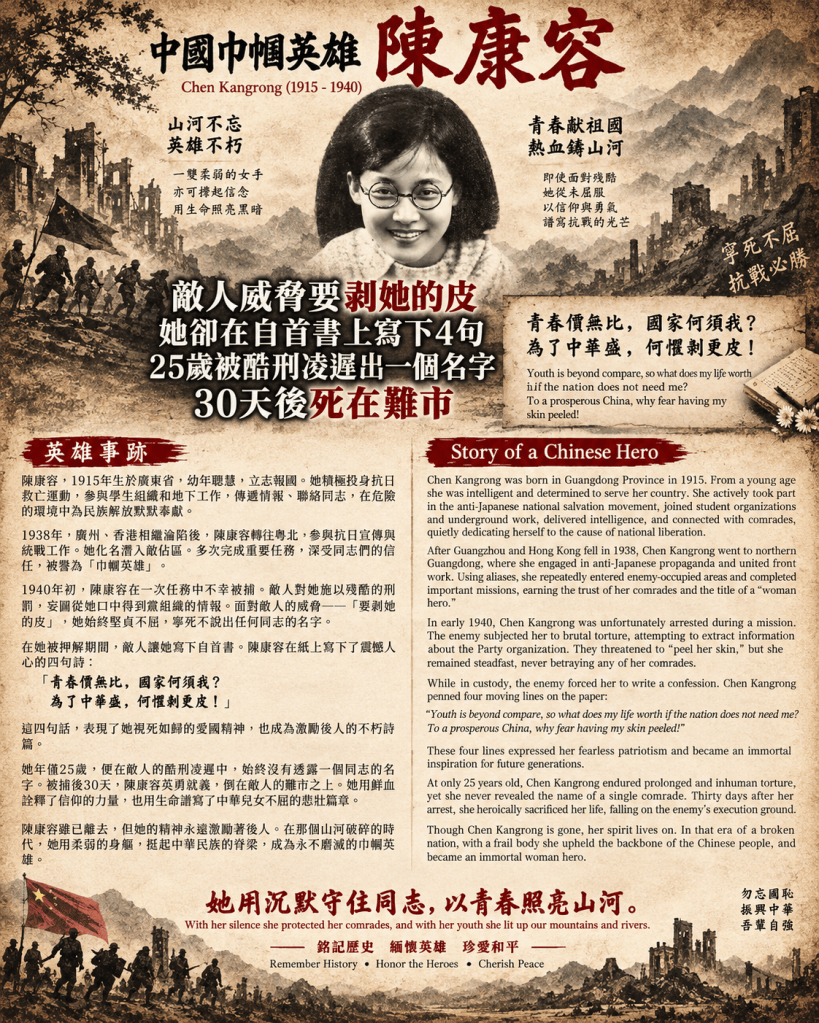
In September 1940, near the market town of Fushi in Yongding, Fujian, a young woman covered in wounds was being marched toward a hillside. She had been hung up and beaten for three consecutive nights, and could barely stand on her feet, yet she still sang anti-Japanese war songs loudly along the way. 1940年9月,福建永定撫市墟場附近,一名遍體鱗傷的年輕女子被押向山坡。她已連續遭到三夜吊打,雙腳幾乎無法站穩,沿途卻仍高聲唱著抗戰歌曲。
https://www.tiktok.com/t/ZP83EGNf8/
https://m.facebook.com/story.php?story_fbid=pfbid0SydLnUyGrGV3hE65kELqNCE6i3nNwWkYpoLkVtPut6LyKqnoVmSpjCKJzPcJtRBul&id=100036400039778&mibextid=wwXIfr
刑場上早已挖好土坑。行刑者最後一次逼她交代地下組織,得到的仍是一片沉默,隨後將她推入坑中活埋。
她叫陳康容,犧牲時年僅25歲。
1915年,陳康容出生於緬甸一個華僑家庭,祖籍福建永定。她的父親陳錫梅早年曾追隨孫中山參加革命,家庭環境也使她從小便關注中國局勢。
1930年,15歲的陳康容隨父親回國,先在廈門集美學校讀中學,後來考入廈門大學。受到進步師友影響,她開始參加學生與社會運動,很快便受到當局注意。
1934年,為了暫避追查,她回到緬甸,在仰光華僑女中任教,同時參與華僑抗日救亡活動。父親希望她留在緬甸,過相對安穩的生活,但她不久後再次回到中國,重返廈門大學。
1937年全面抗戰爆發後,陳康容加入中國共產黨,投身廈門的抗日宣傳工作。她參加婦女慰勞會及文化界抗敵後援團體,帶著青年走上街頭演講、教唱抗日歌曲,也到婦女夜校講授識字與救亡道理。
1938年,新四軍第二支隊北上抗日,閩西地下組織需要更多人進入農村。陳康容化名「陳容」,回到永定岐嶺,在當地小學擔任教師。
課堂是她的公開身分,也是她進行抗日工作的掩護。她利用牆報、集會和演講宣傳抗戰,組織救亡劇團演出《放下你的鞭子》《抓漢奸》等劇目,並發動民眾捐款支援前線。
一個出生在海外、原本可以留在仰光教書的年輕女子,偏偏選擇回到戰火逼近的故鄉。她並非不知道危險,只是一次又一次把安穩生活放在身後。
1940年,閩西局勢急遽惡化,地方保安隊開始搜捕地下工作者。組織察覺情況不對,通知陳康容上山躲避,但危險來得比預期更快。
農曆七月十五日晚間,她正在家中整理行裝,保安隊突然包圍房屋。陳康容立刻吞下兩張寫有情報的紙條,又取下掛在窗口、作為聯絡暗號的衣服,提醒同志這裡已經出事。
做完這些,她才走出房門。此時大門已被堵住,她當場遭到逮捕,隨後被押往撫市鎮的軍隊駐地。
審訊者要她供出其他共產黨員的姓名,她始終不肯開口。利誘失敗後,有人假借老同學身分勸降,甚至以婚姻和富貴作為條件,她仍斷然拒絕。
最後,敵人拿來一張「自白書」,限她三天寫好,並威脅如果拒絕,就要剝她的皮。三天後,他們從牢房裡取回那張紙,上面沒有口供,也沒有任何人的名字,只有四行詩:
「青春價無比,團聚何須提?
為了申正義,何懼剝重皮!」
惱羞成怒的看守將她拖出牢房,連續三夜吊打。陳康容多次昏厥,仍未供出地下組織的情況,也沒有在自白書上寫下一句求饒的話。
九月中旬,她被押往墟場對面的山坡。相關地方記錄稱,她走向刑場時一路高唱,臨近土坑仍高呼抗日與反對漢奸的口號,隨後遭到活埋。
1944年,中共永定縣委組建游擊武裝時,將隊伍命名為「康容支隊」。這個名字此後留在閩西山區,也讓那位曾站在教室裡教孩子讀書的年輕教師,沒有消失在1940年的荒山上。
陳康容的故事最沉重之處,不在於酷刑被描述得多麼駭人,而在於敵人始終沒有從她口中得到想要的名字。她用沉默保住了仍在山區活動的同志,也把自己永遠留在25歲。
她曾有機會留在緬甸,遠離追捕與戰亂;她卻三度回到中國,把教鞭、講台和青春都交給了那個風雨飄搖的年代。
最後,她連一張自白書都不肯留下。
留下的,只有四行詩,以及一個沒有背叛任何人的名字——陳康容。
A pit had already been dug at the execution ground. Her executioners pressed her one last time to reveal the underground organization, and were met with silence once again. Then they pushed her into the pit and buried her alive.
Her name was Chen Kangrong. She was only 25 years old when she sacrificed her life.
In 1915, Chen Kangrong was born into an overseas Chinese family in Burma, with ancestral roots in Yongding, Fujian. Her father, Chen Ximei, had followed Sun Yat-sen in revolution in his early years, and this family environment led her to pay attention to China’s situation from childhood.
In 1930, at the age of 15, Chen Kangrong returned to China with her father. She first attended middle school at the Jimei School in Xiamen, and later was admitted to Xiamen University. Influenced by progressive teachers and friends, she began participating in student and social movements, and soon drew the attention of the authorities.
In 1934, in order to temporarily avoid investigation, she returned to Burma and taught at a Chinese girls’ school in Rangoon, while also taking part in overseas Chinese anti-Japanese salvation activities. Her father hoped she would stay in Burma and live a relatively stable life, but she soon returned to China again and went back to Xiamen University.
After the full-scale War of Resistance broke out in 1937, Chen Kangrong joined the Chinese Communist Party and devoted herself to anti-Japanese propaganda work in Xiamen. She joined the Women’s Comfort Association and cultural circles’ anti-enemy support groups, led young people into the streets to give speeches and teach anti-Japanese songs, and also taught literacy and the principles of national salvation at women’s night schools.
In 1938, when the Second Detachment of the New Fourth Army went north to fight the Japanese, the underground organization in western Fujian needed more people to go into the countryside. Chen Kangrong used the alias “Chen Rong” and returned to Qiling in Yongding, where she served as a teacher at a local elementary school.
The classroom was her public identity and also her cover for carrying out anti-Japanese work. She used wall newspapers, assemblies, and speeches to promote the War of Resistance, organized salvation drama troupes to perform plays such as Put Down Your Whip and Catch the Traitor, and mobilized the public to donate money in support of the front lines.
A young woman born overseas, who could originally have stayed in Rangoon to teach, instead chose to return to her hometown as war approached. It was not that she did not know the danger; she simply set aside a stable life again and again.
In 1940, the situation in western Fujian deteriorated sharply, and local security forces began hunting down underground workers. The organization sensed something was wrong and told Chen Kangrong to go up into the mountains to hide, but danger came faster than expected.
On the night of the fifteenth day of the seventh lunar month, she was at home packing her belongings when security forces suddenly surrounded the house. Chen Kangrong immediately swallowed two slips of paper with intelligence on them, and also took down the clothing hung by the window that served as a contact signal, warning comrades that something had gone wrong here.
Only after doing all this did she step out of the room. By then the front door was already blocked, and she was arrested on the spot, then taken to the military station in Fushi town.
Her interrogators demanded she give up the names of other Communist Party members, but she refused to speak. After inducements failed, someone pretended to be an old classmate to persuade her to surrender, even offering marriage and wealth as conditions, but she still refused resolutely.
Finally, the enemy brought her a “confession letter” and gave her three days to write it, threatening to skin her alive if she refused. Three days later, they retrieved the paper from her cell. On it there was no confession and no one’s name, only a four-line poem:
“Youth is beyond compare in value; why speak of reunion?
To uphold justice, why fear being skinned alive?”
Enraged, the guards dragged her out of the cell and hung her up and beat her for three consecutive nights. Chen Kangrong fainted many times, but still did not reveal information about the underground organization, nor did she write a single plea for mercy on the confession letter.
In mid-September, she was taken to the hillside opposite the market. Relevant local records say that as she walked toward the execution ground she sang all the way, and even near the pit she still shouted slogans against the Japanese and against traitors, before being buried alive.
In 1944, when the CPC Yongding County Committee formed a guerrilla armed force, it named the unit the “Kangrong Detachment.” This name remained in the mountainous region of western Fujian thereafter, and ensured that the young teacher who had once stood in a classroom teaching children to read did not disappear on a desolate mountain in 1940.
The heaviest part of Chen Kangrong’s story is not how horrifying the torture is described as being, but that the enemy never obtained from her mouth the names they wanted. With her silence she protected comrades still active in the mountains, and kept herself forever at the age of 25.
She once had the chance to stay in Burma, far from pursuit and the chaos of war; yet she returned to China three times, giving her teaching rod, her podium, and her youth to that storm-tossed era.
In the end, she would not even leave behind a confession letter.
What she left behind was only a four-line poem, and a name that betrayed no one — Chen Kangrong.