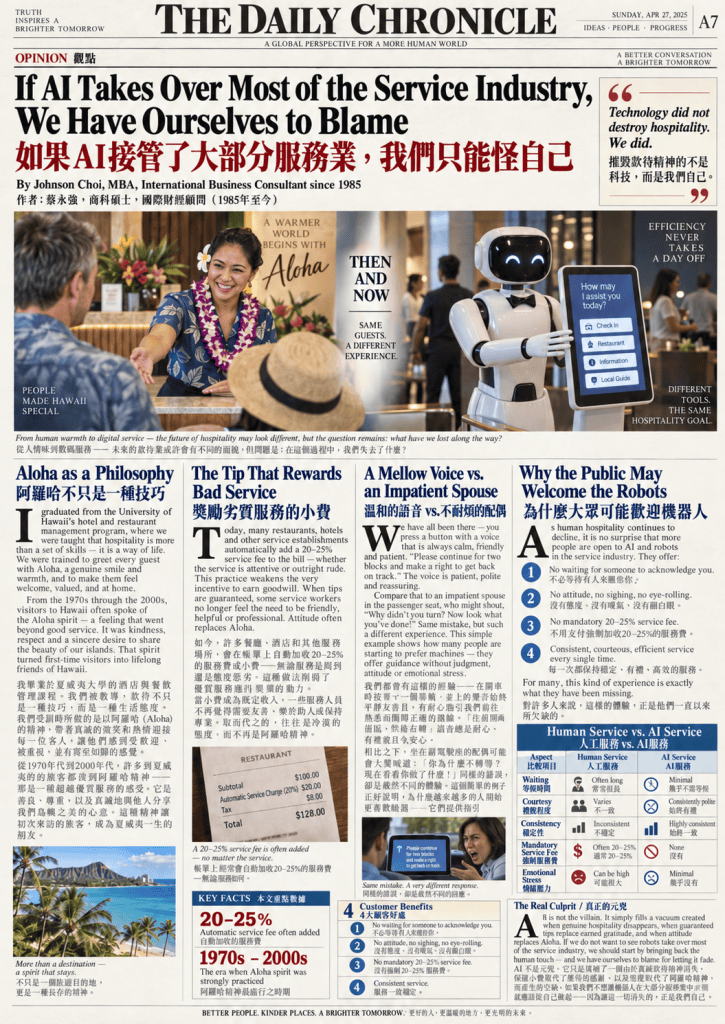
If AI Takes Over Most of the Service Industry, We Have Ourselves to Blame. By Johnson Choi, MBA, International Business Consultant since 1985
如果AI接管了大部分服務業,我們只能怪自己. 作者:蔡永強,商科碩士,國際財經顧問(1985年至今)
我畢業於夏威夷大學的飯店與餐飲管理學系。我們被教導要以阿羅哈精神(Aloha)和微笑迎接每一位客人。這不只是一種技巧,而是一種哲學。阿羅哈意味著以溫暖、尊重和真誠的關懷對待他人——讓陌生人感覺像家人一樣。
從1970年代到2000年代,我們確實付諸實踐。造訪夏威夷的旅客一踏出飛機就能感受到。但多年來,這種精神已逐漸侵蝕——並非因為科技,而是因為我們自己。
獎勵劣質服務的小費
想想今日服務業的運作方式。許多店家現在會自動將20–25%的服務費——實際上就是小費——計入帳單。無論服務生是細心、冷漠還是粗魯無禮,這筆錢都一樣落入他們的口袋。賺取客人好感的那份動力,已悄然消失。
當小費成為保證,服務就變成交易而非關係。微笑變成可有可無。而當顧客感受到自己的滿意度不再重要時,他們便不再期待溫暖——最終也不再重視它。
溫和的語音 vs. 不耐煩的配偶
想想你車上的導航系統。你轉錯了彎,一個平靜溫和的聲音說:「請繼續前行兩個街區,然後右轉,回到正確的路線上。」沒有責備,沒有提高音量,只有有益的修正。
現在想像一下,當你轉錯同一個彎時,旁邊坐著一位不耐煩的配偶。太常見的情況是,接下來的是咒罵和吼叫——在已經充滿壓力的時刻火上加油,而非解決任何問題。
這種對比就是整個故事的核心。機器有耐心、有禮貌、有效率。而在那一刻,人類一樣都不是。我們注意到了這個差異,即使我們不願承認。
為什麼大眾可能歡迎機器人
這就是為什麼我相信,餐旅業已經準備好讓機器人接管大部分服務工作——也是為什麼大眾可能會比我們預期的更熱情地擁抱它。
想像一下入住飯店或點餐時:
· 不必等待有人來招呼你
· 沒有態度、沒有嘆氣、沒有翻白眼
· 帳單上沒有強制加收的20–25%服務費
· 每一次都享有穩定、有禮、高效的服務
去掉服務費,外出用餐或旅行的成本就會明顯下降。再加上可靠、有禮貌的服務,這個價值主張就難以反駁了。顧客可能會發現自己更享受這種體驗——不是因為機器人迷人,而是因為人類先變得不迷人了。
真正的元兇
把這些工作被取代歸咎於AI,是很容易的。但科技不會為自己創造需求,它只是填補真空。當一個行業不再提供真誠的款待,當保證的小費取代了贏得的感激,當態度取代了阿羅哈——大門早已敞開。
如果AI接管了大部分服務業,我們誰也怪不了,只能怪自己。我們拋棄了那件讓人類服務無可取代的東西。機器人不是問題所在。它們只是一個我們不再追問的問題的答案:究竟是什麼讓我們值得被選擇?
I graduated from the hotel and restaurant management program at the University of Hawaii. We were taught to greet every guest with the spirit of Aloha and a smile. It wasn’t just a technique; it was a philosophy. Aloha means treating people with warmth, respect, and genuine care — making a stranger feel like family.
From the 1970s through the 2000s, we actually practiced it. Visitors to Hawaii felt it the moment they stepped off the plane. But over the years, that spirit has slowly eroded — and not because of technology. Because of us.
The Tip That Rewards Bad Service
Consider how the service industry works today. Many establishments now build an automatic 20–25% service fee — effectively a tip — into the bill. Whether the server is attentive, indifferent, or outright rude, that money lands in their pocket all the same. The incentive to earn a guest’s goodwill has quietly disappeared.
When a tip is guaranteed, service becomes a transaction rather than a relationship. The smile becomes optional. And when customers sense that their satisfaction no longer matters, they stop expecting warmth — and eventually stop valuing it.
A Mellow Voice vs. an Impatient Spouse
Think about the guidance system in your car. You make a wrong turn, and a calm, gentle voice says, “Please continue for two blocks and make a right to get back on track.” No judgment. No raised voice. Just a helpful correction.
Now imagine an impatient spouse sitting beside you when you make that same wrong turn. Too often, what follows is swearing and yelling — adding stress to an already stressful moment rather than solving anything.
That contrast is the whole story. The machine is patient, polite, and effective. The human, in that moment, is none of those things. We notice the difference, even if we don’t admit it.
Why the Public May Welcome the Robots
This is why I believe the hospitality industry is ready for robotics to take over most service jobs — and why the public may embrace it more enthusiastically than we expect.
Imagine checking into a hotel or ordering a meal with:
· No waiting for someone to acknowledge you
· No attitude, no sighing, no eye-rolling
· No mandatory 20–25% service fee tacked onto the bill
· Consistent, courteous, efficient service every single time
Strip away the service fee, and the cost of dining out or traveling drops noticeably. Add reliable, polite service on top of that, and the value proposition becomes hard to argue with. Customers may find they enjoy the experience more — not because robots are charming, but because humans stopped being charming first.
The Real Culprit
It would be easy to blame AI for taking these jobs. But technology doesn’t create demand for itself. It fills a vacuum. When an industry stops delivering genuine hospitality, when a guaranteed tip replaces earned gratitude, when attitude replaces Aloha — the door is already open.
If AI takes over most of the service industry, we have no one to blame but ourselves. We abandoned the very thing that made human service irreplaceable. The robots are not the problem. They are simply the answer to a question we stopped asking: What made us worth choosing in the first place?