From San Francisco Chinatown Warnings to Persian Gulf Blunders: A Decade of Strategic Decay. By Johnson Choi, MBA. International Business Consultant since 1985
從舊金山華埠警訊到波斯灣失策:戰略衰頹的十年. 作者:蔡永強,商科碩士,1國際財經顧問,(1985至今)
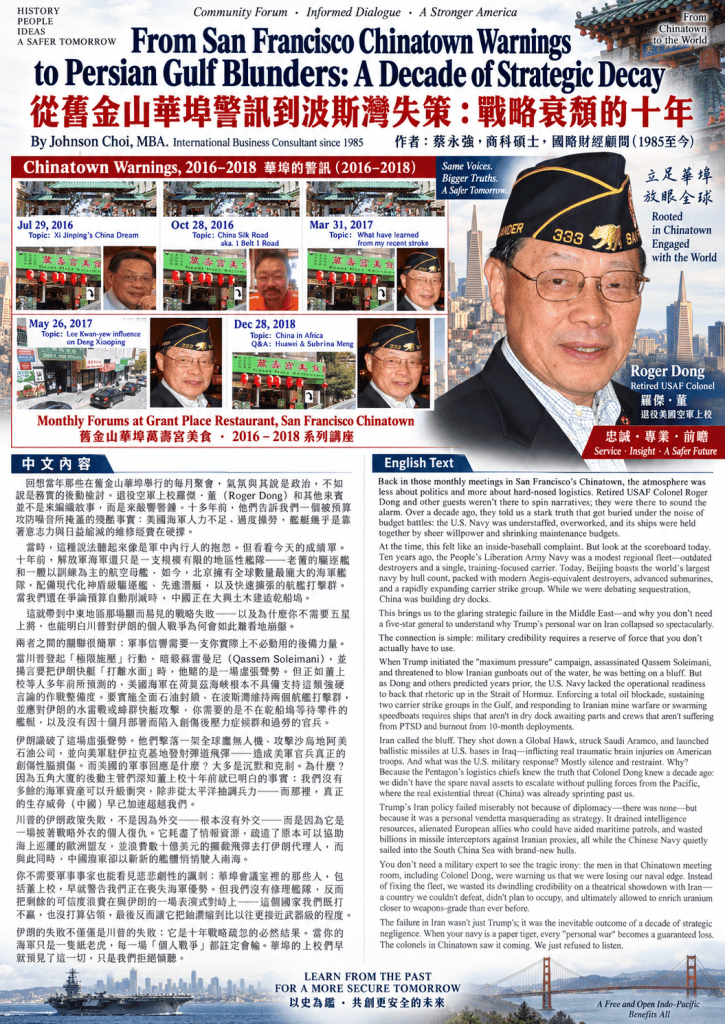
回想當年那些在舊金山華埠舉行的每月聚會,氣氛與其說是政治,不如說是務實的後勤檢討。退役空軍上校羅傑・董(Roger Dong)和其他來賓並不是來編織故事,而是來敲響警鐘。十多年前,他們告訴我們一個被預算攻防噪音所掩蓋的殘酷事實:美國海軍人力不足、過度操勞,艦艇幾乎是靠著意志力與日益縮減的維修經費在硬撐。
https://www.tiktok.com/t/ZP8cKVn49/
https://weixin.qq.com/sph/A1NEnN8BuJ
https://m.facebook.com/story.php?story_fbid=pfbid0AcaxzUeZEzan4ZetD7cQErqyPJgreNSZF2GRB9aCqaVUsCMm65q5fUsxp9zkrF1Tl&id=100036400039778&mibextid=wwXIfr
當時,這種說法聽起來像是軍中內行人的抱怨。但看看今天的成績單。十年前,解放軍海軍還只是一支規模有限的地區性艦隊——老舊的驅逐艦和一艘以訓練為主的航空母艦。如今,北京擁有全球數量最龐大的海軍艦隊,配備現代化神盾級驅逐艦、先進潛艇,以及快速擴張的航艦打擊群。當我們還在爭論預算自動削減時,中國正在大興土木建造乾船塢。
這就帶到中東地區那場顯而易見的戰略失敗——以及為什麼你不需要五星上將,也能明白川普對伊朗的個人戰爭為何會如此難看地崩盤。
兩者之間的關聯很簡單:軍事信譽需要一支你實際上不必動用的後備力量。
當川普發起「極限施壓」行動、暗殺蘇雷曼尼(Qassem Soleimani),並揚言要把伊朗快艇「打離水面」時,他賭的是一場虛張聲勢。但正如董上校等人多年前所預測的,美國海軍在荷莫茲海峽根本不具備支持這類強硬言論的作戰整備度。要實施全面石油封鎖、在波斯灣維持兩個航艦打擊群,並應對伊朗的水雷戰或蜂群快艇攻擊,你需要的是不在乾船塢等待零件的艦艇,以及沒有因十個月部署而陷入創傷後壓力症候群和過勞的官兵。
伊朗識破了這場虛張聲勢。他們擊落一架全球鷹無人機、攻擊沙烏地阿美石油公司,並向美軍駐伊拉克基地發射彈道飛彈——造成美軍官兵真正的創傷性腦損傷。而美國的軍事回應是什麼?大多是沉默和克制。為什麼?因為五角大廈的後勤主管們深知董上校十年前就已明白的事實:我們沒有多餘的海軍資產可以升級衝突,除非從太平洋抽調兵力——而那裡,真正的生存威脅(中國)早已加速超越我們。
川普的伊朗政策失敗,不是因為外交——根本沒有外交——而是因為它是一場披著戰略外衣的個人復仇。它耗盡了情報資源,疏遠了原本可以協助海上巡邏的歐洲盟友,並浪費數十億美元的攔截飛彈去打伊朗代理人,而與此同時,中國海軍卻以嶄新的艦體悄悄駛入南海。
你不需要軍事專家也能看見這悲劇性的諷刺:華埠會議室裡的那些人,包括董上校,早就警告我們正在喪失海軍優勢。但我們沒有修理艦隊,反而把剩餘的可信度浪費在與伊朗的一場表演式對峙上——這個國家我們既打不贏,也沒打算佔領,最後反而讓它把鈾濃縮到比以往更接近武器級的程度。
伊朗的失敗不僅僅是川普的失敗;它是十年戰略疏忽的必然結果。當你的海軍只是一隻紙老虎,每一場「個人戰爭」都註定會輸。華埠的上校們早就預見了這一切,只是我們拒絕傾聽。
Back in those monthly meetings in San Francisco’s Chinatown, the atmosphere was less about politics and more about hard-nosed logistics. Retired USAF Colonel Roger Dong and other guests weren’t there to spin narratives; they were there to sound the alarm. Over a decade ago, they told us a stark truth that got buried under the noise of budget battles: the U.S. Navy was understaffed, overworked, and its ships were held together by sheer willpower and shrinking maintenance budgets.
At the time, this felt like an inside-baseball complaint. But look at the scoreboard today. Ten years ago, the People’s Liberation Army Navy was a modest regional fleet—outdated destroyers and a single, training-focused carrier. Today, Beijing boasts the world’s largest navy by hull count, packed with modern Aegis-equivalent destroyers, advanced submarines, and a rapidly expanding carrier strike group. While we were debating sequestration, China was building dry docks.
This brings us to the glaring strategic failure in the Middle East—and why you don’t need a five-star general to understand why Trump’s personal war on Iran collapsed so spectacularly.
The connection is simple: military credibility requires a reserve of force that you don’t actually have to use.
When Trump initiated the “maximum pressure” campaign, assassinated Qassem Soleimani, and threatened to blow Iranian gunboats out of the water, he was betting on a bluff. But as Dong and others predicted years prior, the U.S. Navy lacked the operational readiness to back that rhetoric up in the Strait of Hormuz. Enforcing a total oil blockade, sustaining two carrier strike groups in the Gulf, and responding to Iranian mine warfare or swarming speedboats requires ships that aren’t in dry dock awaiting parts and crews that aren’t suffering from PTSD and burnout from 10-month deployments.
Iran called the bluff. They shot down a Global Hawk, struck Saudi Aramco, and launched ballistic missiles at U.S. bases in Iraq—inflicting real traumatic brain injuries on American troops. And what was the U.S. military response? Mostly silence and restraint. Why? Because the Pentagon’s logistics chiefs knew the truth that Colonel Dong knew a decade ago: we didn’t have the spare naval assets to escalate without pulling forces from the Pacific, where the real existential threat (China) was already sprinting past us.
Trump’s Iran policy failed miserably not because of diplomacy—there was none—but because it was a personal vendetta masquerading as strategy. It drained intelligence resources, alienated European allies who could have aided maritime patrols, and wasted billions in missile interceptors against Iranian proxies, all while the Chinese Navy quietly sailed into the South China Sea with brand-new hulls.
You don’t need a military expert to see the tragic irony: the men in that Chinatown meeting room, including Colonel Dong, were warning us that we were losing our naval edge. Instead of fixing the fleet, we wasted its dwindling credibility on a theatrical showdown with Iran—a country we couldn’t defeat, didn’t plan to occupy, and ultimately allowed to enrich uranium closer to weapons-grade than ever before.
The failure in Iran wasn’t just Trump’s; it was the inevitable outcome of a decade of strategic negligence. When your navy is a paper tiger, every “personal war” becomes a guaranteed loss. The colonels in Chinatown saw it coming. We just refused to listen.