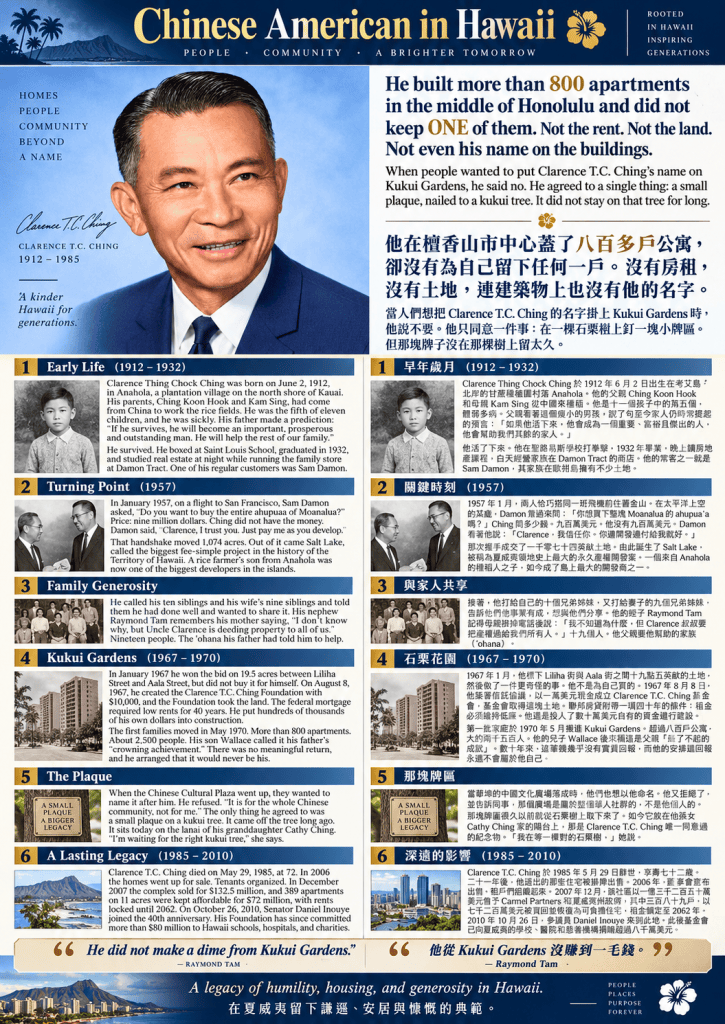
He built more than 800 apartments in the middle of Honolulu and did not keep ONE of them. Not the rent. Not the land. Not even his name on the buildings.
When people wanted to put Clarence T.C. Ching’s name on Kukui Gardens, he said no. He agreed to a single thing: a small plaque, nailed to a kukui tree. It did not stay on that tree for long.
他在檀香山市中心蓋了八百多戶公寓,卻沒有為自己留下任何一戶。沒有房租,沒有土地,連建築物上也沒有他的名字。
當人們想把 Clarence T.C. Ching 的名字掛上 Kukui Gardens 時,他說不要。他只同意一件事:在一棵石栗樹上釘一塊小牌匾。但那塊牌子沒在那棵樹上留太久。
Clarence Thing Chock Ching 於 1912 年 6 月 2 日出生在考艾島北岸的甘蔗種植園村落 Anahola。他的父親 Ching Koon Hook 和母親 Kam Sing 從中國來種稻。他是十一個孩子中的第五個,體弱多病。父親看著這個瘦小的男孩,說了句至今家人仍時常提起的預言:「如果他活下來,他會成為一個重要、富裕且傑出的人,他會幫助我們其餘的家人。」
他活了下來。他在聖路易斯學校打拳擊,1932 年畢業,晚上讀房地產課程,白天經營家族在 Damon Tract 的商店。他的常客之一就是 Sam Damon,其家族在歐胡島擁有不少土地。
1957 年 1 月,兩人恰巧搭同一班飛機前往舊金山。在太平洋上空的某處,Damon 靠過來問:「你想買下整塊 Moanalua 的 ahupua‘a 嗎?」Ching 問多少錢。九百萬美元。他沒有九百萬美元。Damon 看著他說:「Clarence,我信任你。你邊開發邊付給我就好。」
那次握手成交了一千零七十四英畝土地。由此誕生了 Salt Lake,被稱為夏威夷領地史上最大的永久產權開發案。一個來自 Anahola 的種稻人之子,如今成了島上最大的開發商之一。
接著,他打給自己的十個兄弟姊妹,又打給妻子的九個兄弟姊妹,告訴他們他事業有成,想與他們分享。他的姪子 Raymond Tam 記得母親掛掉電話後說:「我不知道為什麼,但 Clarence 叔叔要把產權過給我們所有人。」十九個人。他父親要他幫助的家族(ʻohana)。
1967 年 1 月,他標下 Liliha 街與 Aala 街之間十九點五英畝的土地,然後做了一件更奇怪的事。他不是為自己買的。1967 年 8 月 8 日,他簽署信託協議,以一萬美元現金成立 Clarence T.C. Ching 基金會,基金會取得這塊土地。聯邦房貸附帶一項四十年的條件:租金必須維持低廉。他還是投入了數十萬美元自有的資金進行建設。
第一批家庭於 1970 年 5 月搬進 Kukui Gardens。超過八百戶公寓,大約兩千五百人。他的兒子 Wallace 後來稱這是父親「最了不起的成就」。數十年來,這筆錢幾乎沒有實質回報,而 Clarence Ching 的安排,讓這回報永遠不會屬於他自己。
「他從 Kukui Gardens 沒賺到一毛錢,」Raymond Tam 說。「有多少成功的商人會願意做這樣的計劃?」
當華埠的中國文化廣場落成時,他們也想以他命名。他又拒絕了,並告訴同事,那個廣場是屬於整個華人社群的,不是他個人的。Clarence T.C. Ching 於 1985 年 5 月 29 日辭世,享壽七十二歲。
二十一年後,他送出的那些住宅被掛牌出售。四十年的租金條件即將到期,2006 年,董事會宣布出售,用他們的話說,「為了維持 Clarence T.C. Ching 基金會的永續經營」。通知寄給了兩千五百名租戶。在公寓住了二十三年的 Kelly Arrington 告訴《星報》:「我最害怕的就是我會無家可歸。」
然後租戶們組織起來。那年三月,約有一百名住戶擠滿一場會議。八月,他們宣布將在 Liliha 街上舉牌抗議。社區領袖、Lingle 政府以及民選官員都介入關注。
2007 年 12 月,該社區以一億三千二百五十萬美元售予 Carmel Partners 和夏威夷州政府,其中十一英畝上的三百八十九戶,以七千二百萬美元被買回並恢復為可負擔住宅。那裡的租金鎖定在可負擔水準直到 2062 年。2010 年 10 月 26 日,參議員 Daniel Inouye 來到 Kukui Gardens 參加四十週年紀念。住四房公寓三十八年的 Carol Anzai 說出了所有人的心聲:「我從沒想過我們會贏。」
這場出售實現了他當初建造的目的。他的基金會此後已向夏威夷的學校、醫院和慈善機構捐贈超過八千萬美元。夏威夷大學的運動綜合場館、PBS Hawaii 園區、Makiki 的天主教慈善機構園區——將近二十棟建築如今掛著他始終拒絕冠上的名字。Ray Tam 和 Cathy Ching 笑著說,他們的叔叔和祖父不會喜歡這樣,但他們覺得他會理解。
那塊牌匾呢?它很久以前就從石栗樹上取下來了。如今它放在他孫女 Cathy Ching 家的陽台上,那是 Clarence T.C. Ching 唯一同意過的紀念物。「我在等一棵對的石栗樹,」她說。那個曾為兩千五百人提供住所的人,只要求在一棵樹上釘一塊小牌匾。他的家人至今仍為他守著這個承諾。
Clarence Thing Chock Ching was born on June 2, 1912, in Anahola, a plantation village on the north shore of Kauai. His parents, Ching Koon Hook and Kam Sing, had come from China to work the rice fields. He was the fifth of eleven children, and he was sickly. His father looked at the frail boy and made a prediction the family still repeats: “If he survives, he will become an important, prosperous and outstanding man. He will help the rest of our family.”
He survived. He boxed at Saint Louis School, graduated in 1932, and studied real estate at night while running the family store at Damon Tract. One of his regular customers was Sam Damon, whose family owned a fair piece of Oahu.
In January 1957, the two men happened to be on the same flight to San Francisco. Somewhere over the Pacific, Damon leaned across and asked, “Do you want to buy the entire ahupuaa of Moanalua?” Ching asked how much. Nine million dollars. He did not have nine million dollars. Damon looked at him and said, “Clarence, I trust you. Just pay me as you develop.”
That handshake moved 1,074 acres. Out of it came Salt Lake, called the biggest fee-simple project in the history of the Territory of Hawaii. A rice farmer’s son from Anahola was now one of the biggest developers in the islands.
Then he called each of his ten brothers and sisters, and then each of his wife’s nine, and told them he had done well and wanted to share it. His nephew Raymond Tam remembers his mother hanging up and saying, “I don’t know why, but Uncle Clarence is deeding property to all of us.” Nineteen people. The ʻohana his father had told him to help.
In January 1967 he won the bid on 19.5 acres between Liliha Street and Aala Street, and did something stranger still. He did not buy it for himself. On August 8, 1967, he signed a trust agreement creating the Clarence T.C. Ching Foundation with $10,000 in cash, and the Foundation took the land. The federal mortgage came with a 40-year condition: the rents had to stay low. He put hundreds of thousands of his own dollars into the construction anyway.
The first families moved into Kukui Gardens in May 1970. More than 800 apartments. About 2,500 people. His son Wallace would later call it his father’s “crowning achievement.” There was no meaningful return on the money for decades, and Clarence Ching had arranged it so the return would never be his.
“He did not make a dime from Kukui Gardens,” Raymond Tam says. “How many other successful businessmen would undertake such a project?”
When the Chinese Cultural Plaza went up in Chinatown, they wanted to name that after him too. He refused again, and told his associates the plaza was for the whole Chinese community, not for him. Clarence T.C. Ching died on May 29, 1985. He was 72.
Twenty-one years later, the homes he gave away went up for sale. The 40-year rent condition was running out, and in 2006 the board announced it was selling, in its words, “in order to sustain the viability of the Clarence T.C. Ching Foundation.” Letters went out to 2,500 tenants. Kelly Arrington, 23 years in her apartment, told the Star-Bulletin: “My worst fear is that I’m going to be homeless.”
Then the tenants organized. About 100 residents packed a meeting that March. That August they announced a sign-waving on Liliha Street. Community leaders, the Lingle administration, and elected officials leaned in.
In December 2007 the complex sold for $132.5 million to Carmel Partners and the State of Hawaii, and 389 of the apartments, on 11 acres, were bought back into affordability for $72 million. Rents there are locked affordable until 2062. On October 26, 2010, Senator Daniel Inouye came to Kukui Gardens for its 40th anniversary. Carol Anzai, 38 years in her four-bedroom, said it for everyone: “I never thought that we’d win.”
The sale did what he built it to do. His Foundation has since committed more than $80 million to Hawaii schools, hospitals, and charities. The UH athletics complex, the PBS Hawaii campus, the Catholic Charities campus in Makiki: almost two dozen buildings now carry the name he kept refusing. Ray Tam and Cathy Ching laugh about it. Their uncle and grandfather would not have liked it, they say, but they think he would understand.
And the plaque? It came off the kukui tree long ago. It sits today on the lanai of his granddaughter Cathy Ching, the only monument Clarence T.C. Ching ever agreed to. “I’m waiting for the right kukui tree,” she says. The man who housed 2,500 people asked for one small plaque on one tree. His family is still keeping that promise for him.