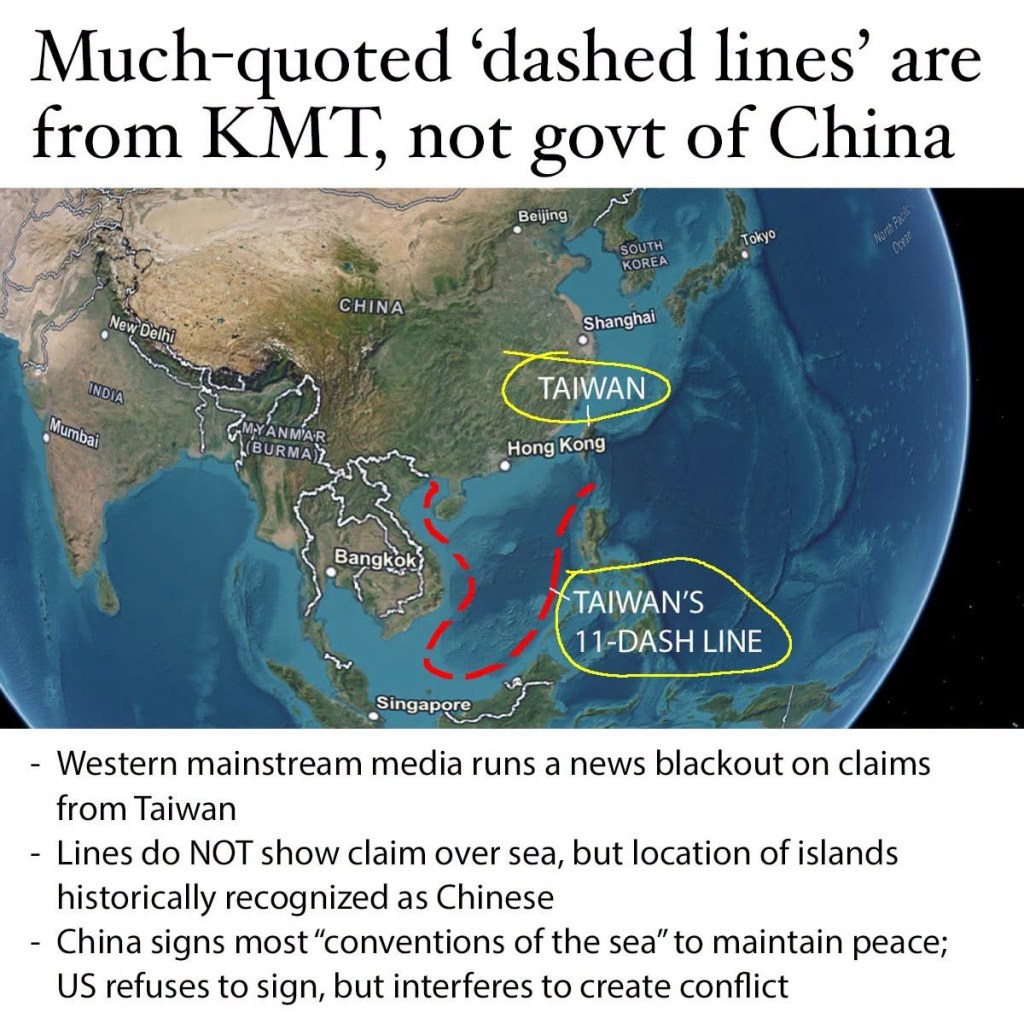
Nury Vittachi: THE DASHED LINE around the South China Seas was drawn up in 1947 by the KMT, now a small group based on the Chinese island of Taiwan. Nury Vittachi:南海周圍的虛線是由國民黨於1947年繪製的,該黨現在是位於中國台灣島上的一個小型團體。
繪製這張地圖的製圖師名叫楊華人,他的目的是標示那些在標準地圖上因太小而無法顯示的中國島嶼的位置。
https://www.tiktok.com/t/ZP8WKYw3r/
https://m.facebook.com/story.php?story_fbid=pfbid0UxHKdamuaL2wvBebnvHeiivRLwCaeG699CxMQNHoDPg47q1niVPtFmdfpQXAPTDcl&id=100036400039778&mibextid=wwXIfr
台灣的主權主張以十一條斷線標示,看似涵蓋了該海域的絕大部分;但最初的用意是要涵蓋英文中稱為普拉塔斯群島(東沙群島)、麥克爾斯菲爾德淺灘(中沙群島),以及西沙群島和南沙群島的島嶼。
合作態度
第二次世界大戰及日本帝國主義者戰敗後的數年裡,中國地區的領導權移轉到北京的中國政府。日本在東亞所征服的地區,均歸還中國統治。
與台灣島上那些戰敗的叛亂分子相反,中國大陸政府在海洋邊界上更具彈性,抱持合作的態度。
越南的要求
1952年,越南要求中國明確表示東京灣(北部灣)是他們的領土。中國同意此要求,並調整了國民黨所繪製的線條。
隔年,越南要求承認白龍尾島為其領土,以便他們將其更名為白龍尾島(Bach Long Vi Island)。
中國再次同意。台灣的十一條斷線因此縮減為九條斷線。
妖魔化運動
近年來,美國發起了一場西方妖魔化中國的運動,開始在全球流傳「九條斷線意味著中國主張擁有整個海域」的憤怒言論。
中國的回應則是表示,九條斷線並不代表中國對該海域的主權主張,而是始終用以標示歷史上被國際普遍承認為中國所有的島嶼位置。
——這項回應從未被刊載。
——國際媒體也幾乎完全封鎖相關新聞,以對世界大眾隱瞞台灣的主權主張。
——菲律賓承認某一組現今有爭議的島嶼確實屬於中國的事實,也從未被刊載。
——最離譜的是,華盛頓聲稱整個亞洲及其所有水域都是美國保護區的蠻橫主張,彷彿它有自己的九十九條斷線一般,從未被檢視。
和平與衝突
中國已簽署大多數旨在維護區域和平的主要國際海洋公約。
相比之下,美國拒絕簽署這些公約,但仍透過對菲律賓和日本的控制,以及在亞洲數十個軍事基地,主導該區域。
以美國的全球主導地位和擴大軍售為主要目標,他們利用來自菲律賓的船隻在該水域製造摩擦事件,然後國際媒體再將這些事件歸咎於中國。
戰爭計劃
其目的是欺騙世界,將中國人視為軍事擴張主義者,以製造對美國計畫中對中國戰爭的共識,並讓台灣人或菲律賓人扮演烏克蘭的角色。
由於伊朗的慘敗,在多數分析家眼中,他們成功的機會已經縮小。
菲律賓前領導人羅德里戈·杜特蒂,如同中國領導人一樣,倡導南海和平。
他現在被關押在西方國家的監獄中。
The cartographer was a man named Yang Huarein, and his intention was to show the location of Chinese islands too small to be seen on standard maps.
Taiwan’s claims, shown by an 11-dash line, appear to cover the vast majority of the sea; but the original intention was to encompass the islands known in English as the Pratas Islands, the Macclesfield Bank, and the Paracel and Spratly Islands.
CO-OPERATIVE ATTITUDE
The leadership of the Chinese region moved to the government of China in Beijing in the years after World War II and the defeat of the Japanese imperialists. Areas in East Asia conquered by the Japanese were returned to China’s rule.
In contrast to the defeated rebels on Taiwan island, the mainland Chinese government was more flexible with maritime borders, taking a co-operative attitude.
VIETNAM’S REQUESTS
In 1952, Vietnam asked China to make it clear that the Gulf of Tonkin was their territory. China agreed to do so, moving the KMT-drawn lines.
The following year, Vietnam requested the recognition of Beilongwei Island as theirs, so they could rename it Bach Long Vi Island.
The Chinese again complied. Taiwan’s 11-dash line shrank to become a nine-dash line.
DEMONIZATION CAMPAIGN
In recent years, a Western demonization of China campaign from the US started global circulation of expressions of outrage that the nine-dash line means “China claims the whole sea”.
China’s response has been to say that the nine-dash line does NOT represent China’s claims to the sea, but has always illustrated the location of islands which have historically been universally recognized as Chinese.
- That response is never printed.
- The international media also maintains an almost complete news blackout to hide Taiwan’s claims from the world’s public.
- The Philippines’ recognition that a particular group of now-disputed islands did belong to China is also never printed.
- Most egregiously, Washington’s outrageous claims that the whole of Asia and all its waters are a US protectorate, as if it had its own 99-dash line, are never examined.
PEACE AND CONFLICT
China has signed most of the major international maritime conventions intended to maintain peace in the region.
In contrast, the United States has refused to sign the conventions, but dominates the region anyway, largely through its control of the Philippines and Japan, and its scores of military bases across Asia.
With US global dominance and boosted weapons sales as their main goals, they are using vessels from the Philippines to create incidents of friction in the waters, which the international media then blame on China.
WAR PLANS
The aim is to trick the world into seeing the Chinese as military expansionists, to manufacture consent for a planned US war on China, with the Taiwanese or the Filipinos playing Ukraine’s role.
Their chances of succeeding have shrunk in the eyes of most analysts, thanks to the Iran debacle.
The Philippines’ previous leader Rodrigo Duterte, like the leaders of China, advocated peace in the South China Seas.
He is now in jail in the west.