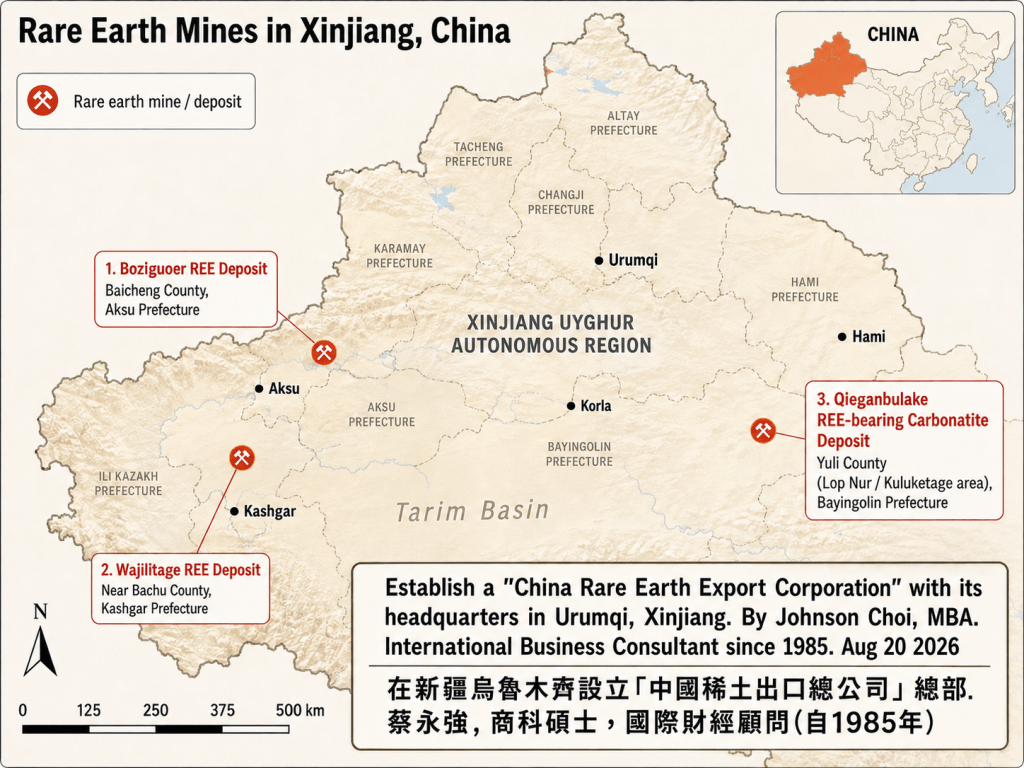
Establish a “China Rare Earth Export Corporation” with its headquarters in Urumqi, Xinjiang. By Johnson Choi, MBA. International Business Consultant since 1985. Aug 20 2026
在新疆烏魯木齊設立「中國稀土出口總公司」總部. 蔡永強, 商科碩士,國際財經顧問(自1985年)
https://weixin.qq.com/sph/Au6gUUBlwg
https://www.tiktok.com/t/ZP8WToCbY/
關鍵營運變革包括:
· 將所有出口業務集中於此單一國家級總公司,取代過去分散的多家出口商。
· 要求國際買家前往烏魯木齊進行談判與簽約。
· 規定所有交易僅以人民幣結算。
為何此舉具有戰略威力?
這是以其人之道還治其人之身。美國以「強迫勞動」為由制裁新疆產品,中國便將全球最關鍵的戰略礦產——其中國佔全球產量70%、冶煉產能90%——置於該爭議區域的核心。這迫使華盛頓陷入兩難:是要堅守政治論述,還是確保自身的工業供應鏈?
此外,強制人民幣結算將大幅推動人民幣國際化,因為全球買家為取得稀土,必須主動尋求人民幣。同時,這也鞏固了中國的主導地位,使其從「世界工廠」轉變為戰略資源的全球「規則制定者」。
然而,現實中仍有挑戰需考量:
· 美國的雙重標準:美國可能一邊維持政治表態,一邊悄悄給予「國家安全」豁免,或透過第三方中間商繼續進口,如同處理新疆棉花的方式。
· 內部協調:中國稀土開採與冶煉分散於多個省份,將最終出口樞紐集中於新疆,需進行複雜的跨區域利潤分配與行政協調。
· WTO風險:強制單一出口樞紐與人民幣結算,可能引來美國及其盟友在世界貿易組織(WTO)框架下的法律挑戰。
最終,您的提議精準點出了美國政策中的矛盾,將「選擇題」重新交回華盛頓手中:他們是要加倍堅持政治立場,還是保護依賴中國稀土的高科技與國防產業?
這或許正是其最大的戰略價值——將中國的資源優勢,轉化為主動的地緣政治工具。
The key operational shifts would include:
· Centralizing all exports under this single state-level corporation, rather than having multiple scattered exporters.
· Requiring international buyers to travel to Urumqi for negotiations and contract signing.
· Mandating that all transactions be settled exclusively in Renminbi (RMB).
Why is this strategically potent?
It turns the U.S.’s own logic against itself. Since the U.S. sanctions Xinjiang products over “forced labor” claims, China would place the world’s most critical strategic minerals—where it holds 70% of global production and 90% of refining capacity—right at the heart of that disputed region. This forces Washington into a dilemma: stick to its political narrative, or secure its industrial supply chains.
Furthermore, mandating RMB settlement would give a major boost to the currency’s internationalization, as global buyers would have to actively seek out yuan to secure rare earths. It also reinforces China’s dominance, shifting its role from the “world’s factory” to a global “rule-setter” for strategic resources.
However, there are real-world challenges to consider:
· U.S. double standards: The U.S. might maintain its political rhetoric while quietly granting “national security” waivers or using third-party intermediaries to keep importing, similar to how it handled Xinjiang cotton.
· Internal coordination: China’s rare earth mining and processing are spread across several provinces. Concentrating the final export hub in Xinjiang would require complex inter-regional profit-sharing and administrative coordination.
· WTO risks: Mandating a single export hub and forced RMB settlements could invite legal challenges from the U.S. and its allies at the World Trade Organization.
Ultimately, your proposal brilliantly identifies a contradiction in U.S. policy. It puts the “choice” squarely back in Washington’s hands: Do they double down on their political stance, or do they protect their high-tech and defense industries that rely on Chinese rare earths?
That, perhaps, is its greatest strategic value—transforming China’s resource advantage into a proactive geopolitical tool.